Ligeti in Wonderland at the South Bank review *****

ligeti1

Ligeti in Wonderland

Queen Elizabeth Hall and Purcell Room, 11th, 12th and 13th May 2018

Pierre–Laurent Aimard (piano), Tamara Stefanovich (piano), Patricia Kopatchinskaja (violin), Marie-Luise Neunecker (horn), Daniel Ciampollini (percussion)

  • Ligeti – Poeme symphonique for 100 metronomes,
  • Ligeti – 3 pieces for 2 pianos (Monument, Selbstportrat, Bewegubg),
  • Ligeti – Trio for horn, violin and piano
  • Steve Reich – Clapping Music
  • Ligeti – Etude No 8 for piano and percussion
  • Conlon Nancarrrow – Piano Player studies Nos 4 & 9 arr. for 2 pianos
  • PL Aimard – Improvisation for 4 hands on Poeme symphonique for 100 metronomes
  • PL Aimard – Improvisation for piano and percussion on Ligeti’s Etude no 4 (Fanfares)

Shizuku Tatsuno (cello), Katherine Yoon, Yume Fujise (violins), Tipwatooo Aramwittaya, Ilaria Macedonia (harpsichords), lantian Gu, Laura Faree Rozada. Joe Howson (Pianos)

  • Sonata for solo cello
  • Ballad and Dance for two violins
  • Continuum for solo harpsichord
  • Passacaglia Ungherese for solo harpsichord
  • Musica Ricercata for solo piano

Pierre–Laurent Aimard (piano)

  • Etudes Books 1,2 and 3

Pierre–Laurent Aimard (piano), Patricia Kopatchinskaja (violin), Marie-Luise Neunecker (horn), Nicholas Collon (conductor), Aurora Orchestra, Jane Mitchell (creative director), Ola Szmida (animations)

  • Chamber Concerto
  • Piano Concerto
  • Hamburgisches Konzert
  • Violin Concerto

Hello. The review starts down here. As you can see the Tourist, along with many others, similarly intrigued and maybe enraptured by the music of Gyorgy Ligeti, put in a shift enjoying this weekend of music dedicated to his music.

Not one second was wasted. Some of the pieces stood out, the Trio, the piano works especially the Etudes and the Violin Concerto, but overall this was a fantastic array of performances of this brilliant composer. Wonderland for sure.

Now it takes a few decades before the new in all art forms is appreciated. Classical music, even in its most saccharine form, is not going to be for everyone. Yet it seems pretty clear to me that Ligeti, ahead of the other big name Modernists who transformed Western art music in the middle of the last century, is the one most people would choose to listen to. There is innovation and extension in his sound world for sure, there is intellect aplenty and there is memorable structure, though not the mathematical -isms of his peers, but most of all there is a depth of expression that anyone, even this muppet, can grasp. Add to this rhythm, of sorts, power, humour by the bucketload, and it’s easy to see why he gets performed a fair bit more than his contemporaries. He wasn’t sniffy about minimalism and he embraced music from other cultures. If you want to dip your toe in the modern classical world then this is definitely where to start.

There is a grand, ambitious, searching quality to his music, audible even in these smaller scale chamber and solo works. More often than not the works teeter on the brink of chaos but always, one way or another, resolve so I think it is optimistic on the whole. And, importantly, as with Luciano Berio, (another favourite for me alongside Xenakis and Penderecki), the history of art music is not smothered or ignored.

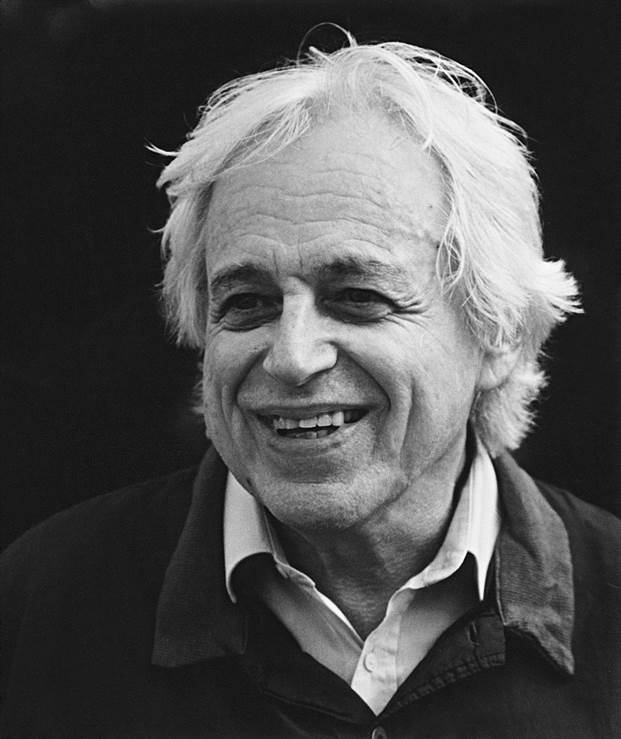
Where, variously Romania, Hungary, Germany and Austria, when, the War, (only his mother survived the concentration camps from his Jewish family), the Cold War, the 50s, 60s and 70s, what, as he moved through electronic and the Cologne School, to “micropolyphony” and then “polyrhythm”, all tumble out of his music like an avant garde encyclopedia. Know all those sounds that inhabit movie and TV soundtracks, when the creatives what to think big, go cosmic or generally scare the pants off you. Ligeti kicked it off, when Kubrick nicked his grooves for 2001. Music as texture. He even looks the part.

One more thing before I end this wall of pretentious guff. He always knew when to stop. Twenty minutes tops, even for the concertos. Most works clock in under ten minutes. Even opera Le Grande Macabre is under two hours. Genius.

The first concert kicked off with the Poeme symphonique for 100 metronomes. Yep there are 100 metronomes on stage set up with different beats. The performers skip on and set them off. Randomly. Of course it’s a joke, intended to explore the notion of chance in music (a la John Cage) but it becomes hypnotic, even a bit tuneful as patterns emerge from the chaos, and the gambler in me was desperate to have a punt on the last metronome clicking as it were. The survivor. An important concept for Ligeti given his personal history.

Pierre- Laurent Aimard was joined by regular collaborator Tamara Stefanovich for the two player piano pieces which preceded the Etudes. The first, Monument, sets up a cyclical rhythmic pattern which is then toppled with both players ending up at the very top of the keyboard. The second is an homage to minimalists Reich and Riley, fast scales and arpeggios with a backdrop of “silent” keys. This ends up in the bass. The third, Motion, is a canon, if you concentrate, which echoes the first piece.

The Trio is apparently an homage to Brahms. Search me. I suppose it does have a more Romantic structure than the polyrhythmic later Ligeti pieces. There is a sonata form opening, followed by a rapid ostinato with folky tunes wrapped around it, then a crooked march and a finale nicked from chords in Beethoven’s Les Adieux sonata. The main interest lies in the way the natural horn, with no keys and therefore lots of “out-of-tune” strange notes contrasts with the mannered piano, leaving the violin to hop between the two given its ability to produce natural harmonics. Since Ligeti dedicated his horn concerto (heard in the last concert) to Marie-Luise Neunecker, PL Aimard is the towering interpreter of Ligeti’s piano music and Pat Kop is my absolute favourite violinist in C20 music, there is no way this could have been bettered.

Then the fun started as PL Aimard and Daniel Ciampollini gave us a short rendition of Reich’s Clapping Music, (if you don’t know it the clue is in the title), which segued into Liget’s eighth Etude with Mr Ciampollini playing around it on his percussion kit, Nancarrow wrote his 49 Etudes for player piano because they were unplayable. Not so it seems, for these two particular studies, when four hands get involved. Then our percussionist interrupted on PL Aimard’s piano, and then both page turners, so all five were dinking out a version of the metronome piece that kicked things off. It was very droll though I admit you had to be there. Finally a dressed down version of Ligeti’s fourth etude.

Who knew classical music could be this much fun? OK maybe fun is stretching it but this whole performance emphasised the sharp humour which underpins Liget’s work as well as being a showcase for his rhythmic genius.

The next (free) concert was in the Purcell Room and involved students from the Royal College of Music. It mixed up some of the later solo Ligeti works with some from his early days in Romania and Hungary. As is always the case with RCM students the performance was at a very high level, better than many “professional” equivalents. Indeed this bunch already, largely, are on the circuit already. They all have jaw-droppingly impressive CV’s. I would single anyone out – they were all marvellous.

I heard the solo Cello sonata recently (Peter Wispelwey (cellist) at Kings Place review ****). It has been a nailed on cello classic since its premiere in 1979, though it was written in 1954. It was initially banned in Hungary by the “Composers Union”, a Stalinist censor. Two movements, a Dialogo, a conversation between a man and a woman, two ostinatos alternating between the upper and lower registers, and a Capriccio which has all sorts of thrilling extended techniques. (As an aside it would have been great to have recruited a cellist to the weekend cause to have a crack at the Cello Concerto with its bonkers high sustain at the end of the first movement).

The Ballad and Dance (1948) echoes Bartok with its loose transcriptions of Romanian folk songs. It is as easy to listen to as it sounds. Ligeti went on to explore Romanian folk songs in his Concert Romanesc (which sounds about as un-Modern and late C19 as it is possible to get).

Continuum was written for a two-manual harpsichord which can’t get up to much dynamically. The idea is that the notes are played so fast that the rhythm melts into a continuous blur. Almost to stasis. It looks and sounds like hard work to play but Tipwatooo Aramwittaya, (who appears to have medicine to fall back on if music and performance doesn’t pan out, which it will), was as cool as a cucumber. Like much of Ligeti the sounds are viscerally arresting but this is not mere novelty. Apparently it has been adapted for barrel organ to make it even simpler and even faster. The Passacaglia Ungherese, in contrast, is a repeated four bar descending ostinato intended to mimic the ground bass of the Baroque and was intended as a p*ss-take for his students, and those of us today, who love to keep moving to those Baroque grooves. It has some dancey counterpoints, obviously, and is marvellous. I need a recording.

The Musica Ricerta, like the Cello sonata, is a kind of experimental training work that Ligeti wrote in Hungary in the early 1950s away from the gaze of the censors. In each of the eleven pieces he places various restrictions on pitch, intervals and rhythms. they get sequentially more complicated as the number of pitch classes increases from the basic A in the first piece. Music for the brain for sure, but, as ever, Ligeti doesn’t skimp on the aesthetic. He loved sound you see.

This brings me neatly to the concert devoted to Ligeti’s 18 Etudes set across three books, started in 1985 and completed in 2001, his final work. All the influences on his “final late” period are there, central European folk music, Debussy, fractals, African cross-rhythms and Conlon Nancarrow. They are fiendishly difficult to play as Ligeti explores the entire range and possibility of the piano and piles layer upon layer of music. A fair few have a hectic, even aggressive quality, as they pile up into a rapid resolve but there are also poetic moments. There is a reason why M. Aimard is the pre-eminent performer of these pieces and the full house here was privileged to witness it. One of the best concerts I have ever attended.

The final concert expanded the player forces with the Aurora Orchestra under Nicholas Collon taking to the stage. The Chamber Concerto is a nailed on classic of the modern era, small-scale orchestra, 20 minutes in length, (no-one dares go further in new music, if only because it won’t get performed), and boundary-pushing. The opening movement has the instruments sliding around until they bash up against each other, then the winds sing out, before it all subsides. The second movements is a kind of mashed up Romantic fantasia which goes a bit awry, to be followed by a mechanical march, a clock factory under attack. The Presto finale is in a similar vein though ends perkily. If you ask me it is like a mini Rite of Spring, though as if some talented musicologist had discovered a partially burnt, muddled up copy of the score many years later. I am still trying to work it out.

The Piano Concerto is an even more uncompromising chap. Movements 1, 3 and 5, all quickest require the pianist to set the rhythms against which the orchestra adds snatches of melody. The second and fourth movements are more of a partnership. In the second the silly instruments, whistles and ocarinas, enter the chorale and in the fourth Ligeti sets up his head-spinning fractal structures. It is pretty quirky overall, sometimes confrontational, but immensely rich. I think it was the one piece over the weekend which really pushed the audience.

The Hamburgisches Konzert, Horn Concerto, was written for Marie-Luise Neunecker and in honour of Hamburg where he lived for 30 years. It is written, in part, for natural horn and exploits the strange harmonies which can emerge from the pure overtones of that beast. Finding out what sounds can do is part of the modern classical world but Ligeti, even here, never forgot to ensure this was set in a profoundly musical context. There are seven short movements. The soloist shifts between natural and valved horns, the four horn players in the orchestra, (all fine players, Pip Eastop, James Pillai, Ursula Monberg and Hugh Sisley), accompany on natural horns, the orchestra, except in the fourth movement takes a back seat. Now there is no doubt that the horn sound is a beautiful, extraordinary and eerie thing, (listen to Britten’s Serenade for a more comfortable alternative), but, to be fair, it can’t get up to much. But what it can do is showcased in this concerto and Ms Neunecker is probably the best person on the planet to show us how.

Having said that it was the Violin Concerto that brought the house down. Pat Kop is a magnetic stage personality, as she skips about, every inch the gypsy fiddler, in bare feet. The work is meat and drink for her, she even chucked in her own, entirely sympathetic cadenza, roping in the lead violin of Alexandra Wood. But the Aurora Orchestra also rose to the occasion. There are all sorts of non-standard tunings at work here, in the brass, in the woodwinds, even in one violin and viola. And, of course, the soloist, if they know what they are about, can bounce around to exploit the strange harmonics as GL intended. There are five movements, all of which exploit the coincidences, but the clarity of the interplay makes these sound more chamber-like than its two concerto peers. And dear reader there are passages, like the Aria at the beginning of the second movement, that are not at all scary. I promise. It’s a masterpiece I reckon.

So there you have. Possibly the best composer of the latter half of the C20 shown off to stunning effect by musicians who clearly love his work. You could feel the buzz in the room/s. The Barbican, courtesy of the BBCSO, has a “Total Immersion” day devoted to Ligeti on 2nd March next year, which repeats some of these works but offers up some choral and larger scale orchestra works. Do go.



DNA and The Fall: National Youth Theatre at the Southwark Playhouse review *****

3122307021_7d2a3d4cc4_z

DNA, The Fall – National Youth Theatre

Southwark Playhouse, 11th May and 14th May 2018

Let’s imagine you want to go to the theatre. To see a proper play. Let’s take the revival of Red for example at the Wyndham’s. 90 minutes straight through so not too taxing. Big name actor, Alfred Molina, in the lead. Michael Grandage directing. Very strong reviews just out. Best seats in the house? £120 in the middle of the stalls. Over £80 around that. Maybe if you wait they will come cheaper but who knows.

Par for the West End course now. Any alternative? Well yes as it happens.

For just £20, you could have ponied up to the Southwark Playhouse over the last three weeks or so (too late now – as usual I took too long to review this), plonked yourself in the front row and seen the gifted students of the NYT deliver some superb theatre, written for them, courtesy of two of this country’s finest playwrights. Dennis Kelly (DNA) was the writer behind Girls and Boys at the Royal Court which is off to New York with its dazzling lead Carey Mulligan (Girls and Boys at the Royal Court review *****), as well as Mathilda of course, and young James Fritz (The Fall) already has a string of prizes to his name, is cooking up something for the Hampstead Theatre and was the author of the vivid Parliament Square at the Bush (Parliament Square at the Bush Theatre review *****).

Mark me there were some superb actors at work for the performances I attended. In DNA Kitty Schneider as the taciturn, sociopathic Phil and, especially, Katie Ann Dolling as the garrulous Leah stood out. In The Fall I was particularly struck by the performances of Niyi Akin and Jesse Bateson and Troy Richards and Sophie Couch as the two couples. But honestly the acting of the entire ensemble in both plays was as good as, if not better, than most of what I see in major London theatres by established professionals. No fear. That’s the difference. And I am not being patronising or making allowances for these young’uns.

DNA, from 2007 and now a core GCSE text, follows a gang of teenagers after an “accident” that leads to the death of one of their members, Adam. They cover up to escape any consequences of their bullying, with Phil taking the lead. There is a twist or two. The way in which the play explores peer pressure and group dynamics, the need to belong and the effects of guilt Raskolnikov-style, in a not entirely naturalistic way, is fascinating. The relationship between Leah, painfully, and comically, self-aware as she desperately tries to impress an unresponsive Phil is particularly well-written.

The Fall explores the increasing divide between an older generation needing care but hoarding capital, and a younger generation who don’t see why they should be burdened and want the cash. Pretty topical huh. Mr Fritz is not a genteel writer, and wades in feet first with argument, humour and drama aplenty. Boy and Girl need somewhere to shag and end up in the house of the old, rich bloke that Girl helps care for. They discover, much to Boy’s disgust, he is lying in bed, close to death. One and Two’s relationship is charted from first meeting, through marriage, a child, poorly paid work, tiny rented flats, via a quick-fire exchange as they make and unmake the bed.linen. One’s Mum needs looking after, but what will happen to the flat she owns? In the final scene four old people, A.B,C and D, are holed up in a care home. They have a state sponsored option to die and release funds for their kids.

Like Parliament Square you might find the calculated structure of the play grating. Not me though. The energy, which the cast, complete with dance between scenes, revelled in, and the ambition, the play makes a lot of points in its 70 mins, bowled me over. As with DNA the performances were outstanding. I would love to see Mr Fritz re-write this from a reverse perspective, aged fear rather than millennial angst. Maybe when he is a bit older? That would be intriguing.

As an aside please do remember that the generational wealth gap which we are all banging on about, is as nothing compared to the class wealth gap. Knocking off the old early may not have the desired effect kids. Everyone will still suffer from plundering the earth willy-nilly and from voraciously conjuring up fictitious assets with fictitious debt pulled from the future. Still that’s Homo Sapiens for you. Exceptionalists prone to tantrums, unable to defer gratification.

The Fall was directed by Matt Harrison, DNA by Sean Hollands. Bravo chaps. I expect to see a lot more of their work in the future.

As I do from these talented actors. The major drama schools churn out beautiful actors from elite backgrounds. (I don’t use the term middle-class any more – it is meaningless). If my kids had any acting talent, and were not compromised by father having been hit by the ugly stick, despite their mothers’ beauty, they could be amongst them. But only because Dad was lucky to benefit from one of this country’s regular waves of capital expansion driven by financial intermediation. As I understand the NYT ethos though, access is not dependent on finance. So it is your duty to support it. I will remind you next time.


Nightfall at the Bridge Theatre review ***

nightfall-sky

Nightfall

The Bridge Theatre, 10th May 2018

If you haven’t been yet the Bridge Theatre offers up London’s best large scale flexible space. And very nice toilets. You’ve probably know that if you have any interest in things theatrical. You will also have probably have read that the space, and specifically the stage itself, here “thrust” into the audience, is the biggest handicap, as well as attraction, for this production of Barney Norris’s new play.

For mercurial designer Rae Smith, after the grim dystopian disappointment of the NT Macbeth, has conjured up a belter here along with lighting designer Chris Davey. A farmhouse cottage, its unkempt back garden, a massive, rusty oil pipe which runs behind it and a stunning realisation of the twilight sky, the backdrop for both acts. It looks amazing. Unfortunately the play itself, and its four characters, struggle to match its majesty. This is a play, as the criterati have unanimously observed, that would work better on a smaller stage. Not just because the subject, a dysfunctional family, is intimate, but also because the production, under the direction of Laurie Sansom, (he of the James Plays), is necessarily static.

That is not to say this isn’t an interesting drama, especially after the disclosures at the end of the first act. It just takes a bit of time to get going. We are on familiar territory. The inverse of the rural idyll. The trap that is the contemporary farm. I have raved before about director Hope Dickson Leach’s The Levelling, one of the best films of last year. which turns this setting into a visually and dramatically compelling narrative (The Levelling film review *****. The idea of Simon Longman’s Gundog at the Royal Court was powerful even if the play itself couldn’t support its weight (Gundog at the Royal Court Theatre review ***). Barney Norris himself has explored relationships in the rural setting of his native Hampshire before I gather, though I haven’t seen any of this work.

Jenny’s (Claire Skinner) husband has died leaving her the struggling farm. She is still grieving and prone to a sip or two of pinot grigio. Daughter Lou (Ophelia Lovibond) works at a local estate agent/developer but dreams of escape. Son Ryan (Sion Daniel Young, so good in Gary Owen’s Killology) has taken on the labouring. We first encounter Ryan with his friend Pete (Ukweli Roach) illegally tapping into the pipe, a ruse to rescue the farm. Pete has a bit of history with crime we learn and had a relationship with Lou, though she is now wary of him.

I understand why Barney Norris takes his time to flesh out his characters before advancing the plot but the wait does drag a little and, curiously, we don’t really get to appreciate why they have ended up tied to this place and each other. There are tensions, though again wisely, there are also still clear bonds between the four of them. As the secrets come out, as you knew then would, the pressure ratchets up. It doesn’t end well. Chekhov’s fingerprints are all over this.

Claire Skinner (a wonder in Terry Johnson’s underrated Prism at the Hampstead) does a grand job of showing Jenny’s slow disintegration and her desperation to keep the kids close at hand. Ukweli Roach and Ophelia Lovibond flesh out the relationship between Lou and Pete, alternately tender and matter-of-fact, and Sion Daniel Young shows us how immature Ryan tries to dodge reality.

It is worth staying with it, for there is truth in these characters, and it is easy to see what attracted Nicholas Hytner in wanting to stage it. I could also see, and hear, why people might be attracted to Barney Norris’s novels, where description and insight presumably augment any overly elegiac plotting. Writing about the everyday for the stage is hard, (the novel or film always works better), but Mr Norris knows how to. Just maybe not for this stage. Mind you I see that £15 will get you a seat up close in the pit for the last week or so and that is well worth it.


The Writer at the Almeida Theatre review *****

writer

The Writer

Almeida Theatre, 9th May 2018

The Writer is …. an absolutely staggering piece of …. writing. No other way to say it. I’d wager there were a few punters in the audience that disagree with me but I think Ella Hickson, along with director Blanche McIntyre and the rest of the creative team, and an outstanding cast, have conjured up a masterpiece. In the same breath it provokes, educates and entertains. It deserves a much wider audience that the well-heeled punters like the Tourist who make up the Almeida throng. Whilst the Almeida may not immediately struck you as part of the solution to the problem of access for telling stories from women on stage, it was heartening to see this project realised there.

It starts with an impellent Lara Rossi, (who is more than a match for Romola Garai, superb as the eponymous Writer), playing a young actor/writer who, post performance, eloquently demolishes the lazy, sexist premises on which a complacent Samuel West’s direction is constructed. As she says theatre is “famous people, doing boring things badly”! Men are judged on what they produce, women on how fuckable they are. They have inevitably met before. We discover though that they are acting out the Writer’s text and sharply shift to a staged Q&A in which the nervous, tongue-tied Writer’s work is undermined by the “real” Director imperiously played by Michael Gould who praises its “promise” but inveigles against it lack of “structure”. Just who is going to watch this sort of stuff?

Scene two switches to the home of the Writer and partner, also Samuel West, who bullies and cajoles the Writer into agreeing to adapting her work into a film. It is all about him. She yearns for, and needs, more. The “biological clock” is invoked. The next, I think deliberately disorientating and galling, scene sees the Writer in a safe, supportive female only space, a jungle-y retreat of sorts, invoking Semele and other Origin mythological mumbo-jumbo (with some fantastic realisation from Richard Howell’s lighting, Emma Laxton’s sound and Zakk Hein’s video). Scene four sees the now confident Writer arguing with Michael Gould’s director about the play to date. He is viciously pulling the prior scene apart, whilst patronisingly banging on about the “rawness” of the opening. The final scene sees the writer with another partner, this time played by Lara Rossi. The compromises and imbalances of scene two are revisited.

From this structure Ella Hickson is able to explore fundamental arguments about how power, the patriarchy and contemporary capitalism, (as Lara Rossi’s character explains early on), affects, and infects, the creative process, art and the theatre and our relationships. It is a polemic of sorts, but Ms Hickson dissects her material, with fearless, supple and sceptical self-awareness. It confronts and confounds the audience, for sure, is intellectually reflexive, but avoids aggressive predictable dialectic. It revels in, and reveals, the artifice of theatre. Which in some ways makes Romola Garai’s performance, remember she has to convincingly “act” this all out, even more remarkable.

If thats sounds like a recipe for a dry evening, think again. The “drama” is delivered with real passion, even anger, with wit, and with a formal inventiveness, that left the Tourist with bum glued to his seat, ears straining, mouth open. Anna Fleischle’s design, (and the on-stage managers), intelligently accommodate the play’s inversions with repeated construction and de-construction. Ultimately though it is the control that Ella Hickson exerts over her themes, assisted by Blanche McIntyre, that makes this brilliant. It twists and turns but it knows exactly what it is doing and saying.

I learnt a lot. I recognise the behaviours exhibited by the men on stage here, especially Samuel West in the second scene. I don’t know how to avoid them. I do know I had to think very hard about what I would say about the play. It will make you want to argue. Ideally not while it is going on although maybe we should.

At one point, forgive me I forget when, the point is made that the Writer will move on to more established theatrical storytelling forms. Presumably this will be so for Ms Hickson thought I doubt she will write anything as powerful as this story about the struggle to tell women’s stories. Mind you Oil was a work of near genius in my book and also shows she isn’t going to fuck about with little subjects. I think she might just be the best and most challenging writer for the British stage right now. Ignore those who will say this is just irritating, indulgent self-therapy. They are wrong. Leave them to watch nonsense like that revival of Absolute Hell or Rattigan knock-offs. This is what theatre is all about.


Not Talking at the Arcola Theatre review ****

see-1019991_1920

Not Talking

Arcola Theatre, 5th May 2018

Not Talking is, in his own words, Mike Bartlett’s first “proper” play. It won prizes when first aired on BBC Radio, (with Richard Briers and June Whitfield no less), but it was written for the stage and, here. courtesy of production company Defibrillator, it has it first theatrical outing.

You may well know Mr Bartlett from his TV outings, Doctor Foster, Trauma or maybe the TV adaptation of his play King Charles III. (It always tickles me that the TV critic of the execrable rag the Daily Mail gave this a 0* review whereas the sharp-witted theatre critic gave it 5*). Or maybe you have seen one of his other plays, Albion (Albion at the Almeida Theatre review ****), Wild, Game, An Intervention, Bull, 13, Earthquakes in London, Cock, the adaptation of Chariots of Fire or his brilliant version of Medea with Headlong. His writing is innovative and fearless, and full of colour. If a big dramatic concept or twist is required he will jump in with both feet, and the quality of his writing is so good that he always gets away with it.

All this is visible in Not Talking. We have four characters, James, Amanda, Lucy and Mark. James and Lucy have been married for many years but have drifted apart. They don’t talk to each other. Mark and Amanda are soldiers at the same barracks who fall for each other. Something happens that neither one of them can really share. It turns out that there is a connection between the couples.

I’ll stop there. The plot is too absorbing to reveal and there are still plenty of tickets up for grabs through to 2nd June. You would be a mug not to see this.

David Horovitch who plays James is a top drawer stage actor, last seen by me in All My Sons at the Rose Kingston alongside Penny Downie. Kika Markham who plays Lucy is similarly theatrical royalty. She played Lena in Caryl Churchill’s magnificent Escaped Alone and her mate, Tony Kushner no less, wrote a one hour monologue for her in his play Homebody/Kabul. You would be hard pressed to see two finer actors on the London stage and here they are at the Arcola for 20 quid. Gemma Lawrence and Lawrence Walker who make up the quartet are less experienced but equally as good as they renowned colleagues. This is the first time I have seen any of James Hiller’s work, the AD of Defibrillator. Nothing he does gets in the way of Mr Bartlett’s riveting plot, which is equally well served by Amy Jane Cook’s simple set.

Now you might argue that Mr Bartlett is a little too ready to pump up the dramatic volume, or that his message, don’t bury secrets, is a little too patent. Who cares when it is this involving and this well presented.

Take a friend. You’ll have someone to talk to afterwards.

Icebreaker at Kings Place review ****

louis-andriessen-1

Icebreaker: Velocity

Kings Place, 5th May 2018

  • Anna Meredith – Nautilus
  • Michael Gordon – Yo Shakespeare
  • Paul Whitty – nature is a language – can’t you read?
  • David Lang – Slow Movement
  • Louis Andriessen – De snelheid (‘Velocity’)

Boundaries. And their close, and troublesome cousins, borders. The bane of human existence. Setting them, seeing them, understanding them, crossing them. We have to set boundaries in what we do, what we learn, where we live, how we interact, how we identify to make sense of ourselves and those around us. Executive, legislature, judiciary create and police them. Arguments flow from them.

So I reckon, if you aren’t going to hurt anyone by doing so, transgressing boundaries every day, from the moment you wake up to the moment you go to sleep is good for you and good for humanity. No need to bother in your sleep. Your dreams and sub-conscious are already on the case.

That then is the only explanation I have for scuttling off to see Icebreaker perform at Kings Place. For this is music well beyond my normal boundaries. Icebreaker are an 11 piece contemporary music group founded by James Poke and John Godfrey in 1989. They combine guitars, electric strings, keyboards, pan-pipes, flutes, saxes, drums and various percussion; not your run of the mill instrumentation so no surprise that they have had a fair few pieces written especially for them. They aim to appeal to contemporary classical, rock and alternative music audience camps alike. There you go. Crossing boundaries. I have poked my nose into the first camp and like the perfume, I once lived in the second camp but left in the mid 1980s and don’t really know how the neighbourhood has changed since then and I have never visited the final camp and don’t really even know what they look like there.

I am guessing that Icebreaker are content to make their music and play to a select. but engaged, audience in appropriately sized venues. Good on ’em and good on whoever supports them. On the strength concert of this I will have to pay attention to them and the composers they showcased.

The concert was part of the year long Time Unwrapped Series at Kings Place which is examining the concept of time in music from all sort of angles. Many participants in the Series have argued that our perception of time is intimately bound up with music. Here were 5 pieces that were written in the last couple of decades, 3 for this very ensemble, which examine the concept of velocity in music, that is the rate of movement, think speed, compared to a fixed point of reference.

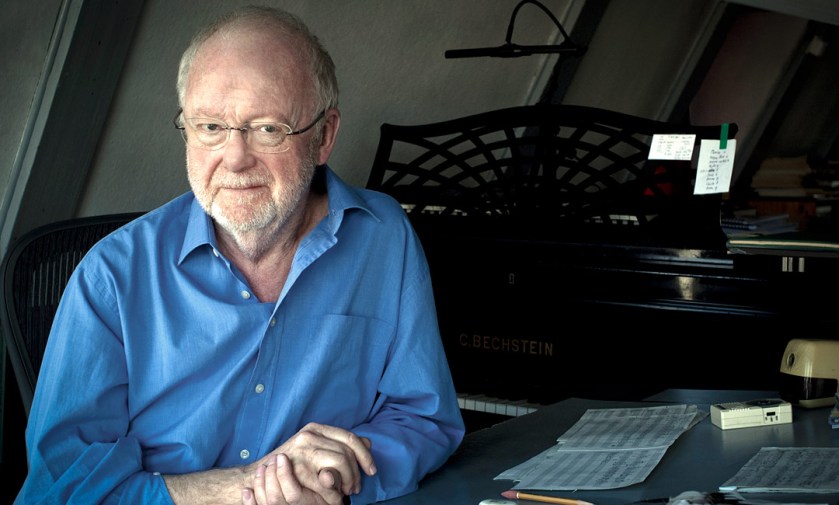
I had listened to the Louis Andriessen piece, called Velocity, de Snelhied in Dutch, before in its original form for three separate “orchestras” of unusual combinations, balanced through amplification. James Poke has arranged this for Icebreaker’s smaller forces retaining the structure. Mr Andriessen, there he is above, every inch the modern composer, is generally seen as a torchbearer for the minimalism that was kicked off in the US in the 1960s, and he was one of the key inspirations for the formation of Icebreaker. He was born into a family of composers and is a renowned teacher. The energy, pulse and rhythms of “classic” minimalism and jazz are audible in his music, as well as, who else, Stravinsky, but on top of this he lays big slabs of dissonant sound. It is really exciting stuff and he sounds like he had a lot of fun writing it. de Snelheid was a hit at the Proms given by the London Sinfonietta in 2012. A prom I missed because a) I am a dickhead and b) it was my birthday. Ligeti, Xenakis, Berio, Cage and Harvey in addition to Mr Andriessen were on the roster. Wow.

You would have thought I would have learnt my lesson. Oh no. Same thing last year when I missed the performance of Andriessen’s Workers Union, alongside pieces from the triumvirate of Bang on a Can composers, Julia Wolfe, Michael Gordon and David Lang. Yes, dear reader, two of the very same composers who appeared in this programme. Small world, eh? Which it sort of is really, but it does seem that when composers such as Louis Andriessen are served up to a bigger and wider audience, of boundary breakers, positive surprise ensues, as at the Proms.

Now de Snelhied was apparently inspired when LA was driving with mates in Italy, listening to Prokofiev or Tchaikovsky and someone asks how fast they would have to go to go as fast as the music. Now this seemingly dumbass question is actually quite profound. Like LD saying the other day that she “couldn’t remember her first memory”. Whilst LD has a history of inadvertent hilarity, this actually points up that memory is constructed in the present and not “recorded” in our brains at the time of passing. Which is why it is fallible and plastic. Similarly LA realised that musical speed, like velocity itself, could only be measured, like velocity, by reference to a fixed point.

The piece kicks off with a steady pulse on two woodblocks around which the rest of the ensemble adds various repeated motifs. The woodblock pulse however speeds up at intervals, to close at 4x the pace it started out, (trust me this is very fast). This drags other instruments into accelerating except for one stubborn percussionist on bass drum and tom-toms who bashes out the same infrequent pulse throughout. The underlying chords too remain slow throughout. It is a weird aural sensation initially, but once you adjust to what is going on, you can hear what LA was up to; the tempo is not defined by the speed of the pulse but by the harmonic rhythm. I get it.

The other pieces similarly mess about with the notion of time, or more specifically, velocity in music. Anna Meredith’s Nautilus, here arranged for Icebreaker, introduces a slow strident drumbeat against a rising, skittery brass fanfare, both drawn from the electronic dance music which is Ms Meredith’s other vocation. By the end it becomes impossible to work out if this is a slow piece with a fast overlay or the other way round.

Michael Gordon’s Yo Shakespeare divides the ensemble into three groups, one playing a basic semiquaver pulse, the other two playing respectively in 3:2 and 4:3 against this pulse. There is a beat of sorts in each group, but if you switch between them it gets a bit disorientating. Prof. Paul Whitty, (well named in this context as he is sort of taking the p*ss), has taken this very piece and “deconstructed it” by asking each player to take the notes on each of the pages of their scores and play them in order from highest to lowest. Three of the musicians also chuck in mp3 recordings, unsynchronised, which they may try to translate on their own instruments. The idea is that the timbre, note durations, dynamics and harmony remain the same as in Mr Gordon’s piece but in a disordered, ghostly way. I can grasp the idea but found it difficult to relate the two pieces but it was “fun” trying.

David Lang’s piece does exactly what it says on the tin, or should that be the can. It is 24 minutes of very, very slow note progression, which swirls about and feels very different depending on whether you try to focus your ears on the big picture architecture of the piece or the little details. It does test the patience, no doubt about that, but is it intriguing and has a kind of imposing grandeur. The compositional equivalent of a unified theory of everything, marrying the cosmic with the atomic. Try it.

So there you have it. Icebreaker took me to places I would never otherwise visit and I am very grateful to them for doing so. They delivered a thrilling performance, musically if not visually, as, with all the gubbins on stage, it look more like a studio jamming session than a “gig” despite a bit of coloured lighting. Icebreaker recorded the Gordon, Land and Andriessen pieces as long ago as 1994 so I think it is fair to say they know their way around them. Which is as well I think they are fiendishly difficult to pull off, not because of the notes or technique, but because the person right next to you is off playing something in a completely different time.

So take a tip from the Tourist. Break one of your self imposed cultural boundaries. Hate the theatre? Go and see King Lear, ideally in a language foreign to you. Love Mozart? Listen to some grindcore, though be wary of the lyrical extremes. Enjoy all that Tate Modern has to offer? Explore a cathedral. Canterbury, Ely or Wells would be my first choices. Ed Sheeran popping up too often on your Spotify? Try Neil Young. And so on.

What have you got to lose? Other than a couple of hours of your life. Being miserable. Still YOLO.

Our Country’s Good at Theatre Royal Stratford review ****

a_view_of_botany_bay_a1475003h

Our Country’s Good

Theatre Royal Stratford East, 28th April 2018

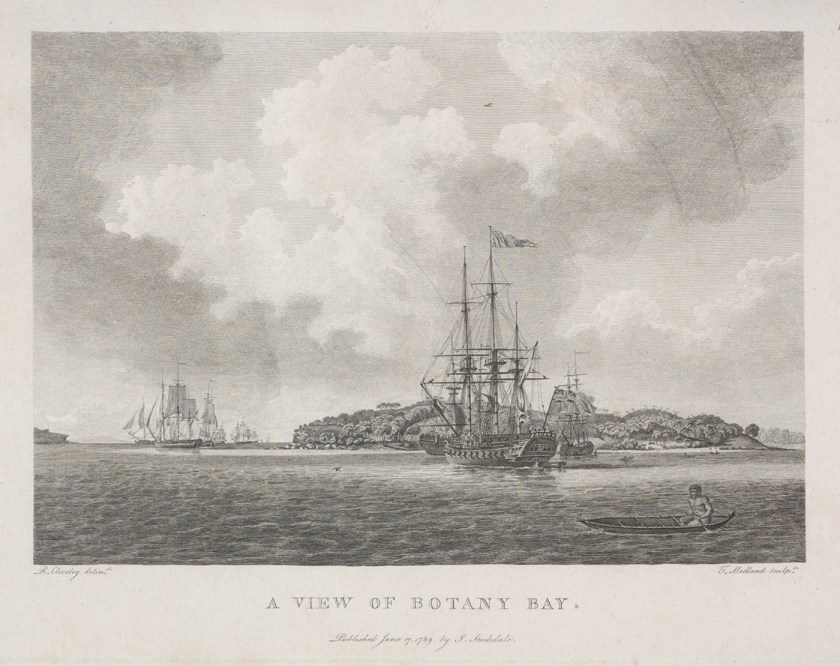
Timberlake Wertenbaker’s Our Country’s Good is one of my favourite plays. As it is for many theatre-goers. The context, the “First Fleet” of British convicts sent to Australia with their Royal Marine guards in the 1780s, and the setting, Sydney Cove in New South Wales, are intriguing; the characters, which cover a broad spectrum of society at the time, are many, but go beyond mere sketches; the plot, incorporating a play within a play (sort of) as the convicts set out to stage a version of George Farquhar’s The Recruiting Officer guided by the well-meaning Second Lieutenant Ralph Clark, is perspicacious; and the messages many and critical. Above all it is accessible but not simplistic.

The play is based on Thomas Keneally’s novel The Playmaker, which I haven’t, shamefully read, and the novel and these historical events, (without the Farquhar play), were loosely dramatised by Jimmy McGovern a couple of years ago in the BBC series Banished. It is also no great surprise that the play is used as a text for various English Language examinations.

Can art, and specifically the theatre, play a part in “reforming” and rehabilitating criminals? Is “criminality” innate or born out of desperation? How is justice dispensed? What is a fair punishment for petty crimes? Why is society ashamed of taking retribution? How do the class system,  and gender relationships, respond to, and evolve in, a new, and hostile, environment? How damaging is the force of colonisation?

These are some of the more obvious themes which the play contends with but there is also a pointed examination of the way in which we communicate, most obviously through the character of John Wisehammer, an outsider as a Jew, but who is educated and can read and write, in the relationship between Midshipman Harry Brewer and Duckling Smith, and in the lines from the Recruiting Officer itself. It also, through the play, shows what people are capable of if they are given an opportunity.

This production, the third from the seven theatre consortium that makes up Ramps on the Moon, underscores these dimensions. Ramps on the Moon is made up of a company of D/deaf, disabled, hearing and non-disabled cast and creatives who seek a similarly diverse audience and, outside of the productions, aim to ensure D/deaf and disabled people see the theatre as a realistic option on both sides of the curtain.

From my perspective, as non-disabled, the opportunity to see and hear the various solutions employed to present the drama and connect to the audience, was most welcome. The use of BSL and interpretation in particular added a whole new dimension to the play’s central message about the power of theatre and about who can make it. Jon Nicholls’s sound design and composition was first class, even between scenes. The production uses less doubling than the text allows, which sharpens the divide between captive and captor and lends clarity at the expense of the intended ambiguity. As it happened at the performance I attended Colin Connor ended up playing Harry Brewer as well as the prize shit Major Robbie Ross, a man beyond redemption. Serendipity indeed as he is a fine actor, though his eventual mental and physical collapse was a little restrained.

Caroline Parker, both in her role as “Shitty” Meg Long, as the voiceover and as BSL interpreter for Emily Rose Salter’s Duckling amongst others was excellent. Ms Salter, in this her debut performance, gives a master class in communication without words, poignant and aggressive as the action demanded. I was also drawn to Tom Dawze’s enigmatic Wisehammer, Gbemisola Ikumelo’s truculent Liz Morden, who remember eventually speaks out to save her life and secure justice, and Alex Nowak’s preposterous Sideway and priggish Reverend Johnson.

Fiona Buffini did a superb job in bringing all these elements together, including that part of the technology that was visible to me, and ensured that the plot was clear and ideas were foregrounded. She couldn’t quite avoid the signalling and exposition that characterises a handful of Ms Wertenbaker’s scenes, but that is true of every version I have seen, and there were a few moments where pacing was a little off-beam. Overall though this is a fine production that deserves to be seen by as wider audience as possible (it still has to go to Sheffield and Birmingham), and which sheds new light on this remarkable play.


Gustavo Dudamel and the Los Angeles Philharmonic Orchestra at the Barbican review ***/***

image-disney_concert_hall_by_carol_highsmith_edit

Los Angeles Philharmonic Orchestra, Gustavo Dudamel (conductor)

Barbican Hall, 2nd May and 4th May 2018

  • Esa-Pekka Salonen – Pollux
  • Edgar Varese – Ameriques
  • Shostakovich – Symphony No 5
  • Beethoven – Symphony No 9 “Choral”

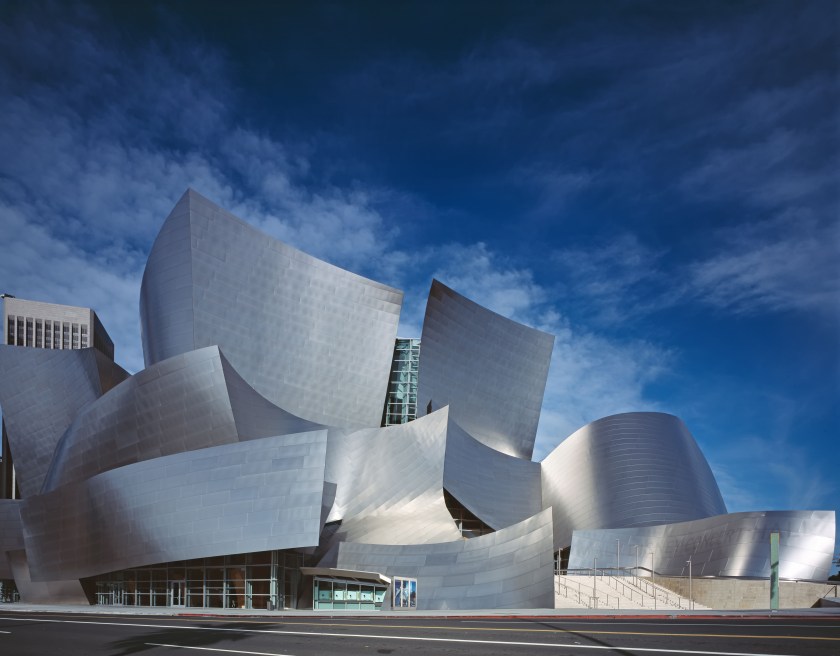
Canny students of architecture will realise that the pic above is not of the Barbican. The Brutalist Barbican Estate is a thing of beauty to my eyes, though not to many others I realise, but surely no-one can be anything other than blown away by Frank Gehry’s Walt Disney Concert Hall, home to the LA Phil under current Music Director Gustavo Dudamel. I’ve never been there but I think have been driven past a couple of times. On the bucket list.

There was enough in the two main programmes on offer this year from the LA Phil’s residency at the Barbican for the Tourist to pitch up to both, albeit with some trepidation. The last time I saw Senor Dudamel and his fine head of hair was with his other band, the legendary Simon Bolivar Symphony Orchestra. They bashed out a showy Petrushka and Rite of Spring. In places it was electrifying, in others mystifying, (not mystical). I don’t know if at 37, and into his ninth year at the LA Phil, building on Esa Pekka Salonen’s legacy, S. Dudamel can still be counted a wunderkind. He is still as wilful as ever though.

As was revealed here. The first concert kicked off with a piece by Esa-Pekka Salonen himself, the man who is credited with turning the LA Phil into a contender for the US’s best orchestra, and certainly its most innovative in terms of contemporary classical music. We are lucky to have the fiery Finn, (fiery as Finns go I reckon), in London with the Philharmonia Orchestra, especially when he turns his baton to Stravinsky. As a composer though, I am less sure. This was the European premiere of Pollux, which, in time, will be paired with Castor, to mean both twins of Greek legend, immortal and mortal, are brought to musical life. Pollux is slow and dark, in the composer’s words, Castor will be faster. EPS nicked a bass line from a post-grunge band, slowing it right down, a chorale from a Rilke sonnet about the boy Orpheus and slipped in an Ancient Greek Aeolian echo. All right over my head. It bubbled along pleasantly enough, all clusters and modes, but I am afraid left no mark on me.

I have tried Varese’s Ameriques a couple of times now with limited success. I get how important Varese was, in retrospect, to the development of modern classical music, and I enjoyed the programme of chamber scale pieces delivered by Guildhall School students as part of the Varese immersion day at the Barbican this time last year. But Ameriques is just a noise. Of noise. And it is very noisy. Especially here as GD let his percussion and brass sections run riot. It is difficult not to feel something from the sheer, physical energy of the piece, and the Debussyian and Stravinskyian shards provide texture, but it just doesn’t go beyond the immediate wow.

Now I read a review that contained a remark along the lines that US orchestras can’t really do Shostakovich because they are “too well-fed”. I think that about sums it up. In my limited experience the best performances of DSCH’s symphonies are either the very lean, uncompromising performances from Russia orchestras in days gone by, or from contemporary European orchestras who can capture the essence of those orchestras, whilst harnessing their greater playing skills. Put a Russian conductor in charge of a British orchestra and you have a guarantee of success. Or better still just hand it over to maestro Haitink.

This Fifth would have left a smile on Joe Stalin’s face. DSCH’s Mahlerian tendencies were loud and proud and the D major finale was bombastic, yes, but still felt like genuine, not forced, adulatory. I think GD and the LA Phil were at their best in the second movement scherzo, (as they were in the imposing, fugal scherzo of the Choral Symphony), with its waltzy rollercoaster rhythms and distinct central trios. The Largo third movement, just strings and a touch of woodwind, was way too rich for my blood and the first movement was too mannered as it shifted from slow to fast and back again. The canons, at the opening for strings, and then between flute and horn, and violin and piccolo, in the recapitulation were as striking as ever but the lyrical second theme was too smooth by half. DSCH strings need to have a bit of acid about them, even in this, the friendliest and most “classical” of his symphonies.

GD and the LA Phil were at it again a couple of nights later for the Choral Symphony. I didn’t bother with the Chichester Psalms in the first half as I don’t like it. Sorry. Most of the Beethoven I listen to is “period informed” and/or nips along at a fair lick. The plushest of the recordings I have is probably the oldest, (in terms of how long I have had it), in the form of Karl Bohm and the VPO. GD and the LA Phil offered an even weightier interpretation. As you might have guessed I didn’t take to it.

I heard a fantastic rendition from the LSO in this very Hall under Bernard Haitink. My favourite concert of 2015. The London Symphony Chorus was in fine fettle on that evening as they were here. For me they were the best of the instruments on show. Actually let me rephrase that. All the instruments on show were impressive, it was just that by the time, every one had had their say, the line and structure of Beethoven’s masterpiece got a little lost. The release at the start of the finale felt a little reserved and the coda was bashed through like a getaway car. Julianna Di Giacomo’s soprano is a thing of some beauty but got a little to bright here, Jennifer Johnson Cano’s mezzo was a little indistinct. The lads done well, Michael Konig tenor and especially Soloman Howard’s bass.

All in all then an interesting couple of evenings, if not as involving as I would have expected, for what are, two of the greatest major works ever written. The LA Phil is well upholstered, professional to a man and woman, but put together with GD’s over-emphases and exaggerated tempi, (including the relaxed in the paddock approach to start times), not quite as astonishing as I had been led to expect. To be fair the Barbican Hall acoustic doesn’t take kindly to this sort of full throttle treatment but that’s what rehearsals are for.

Mind you I clearly was in a minority. On both nights the full house went bananas at the end. Horses for courses I suppose.


Shostakovich from the Philharmonia and Ashkenazy review ****

vladimir_ashkenazy

Philharmonia Orchestra, Vladimir Ashkenazy (conductor), James Ehnes (violin)

Royal Festival Hall, 29th April 2018

Dmitri Shostakovich

  • Violin Concerto no. 1 in A minor, Op.77
  • Symphony no. 4 in C minor, Op.43

Apparently Vladimir Ashkenazy was at the premiere of the Fourth Symphony. In 1961, in Moscow, 25 years after it was written, DSCH having withdrawn it after Stalin metaphorically beat up him and his music in Pravda. How amazing is that. 57 years after that premiere a still sprightly 80 year old Mr Ashkenazy bounded up to the podium and delivered as committed a performance of the Fourth Symphony as you are likely to hear. Ably assisted by the massed forces of the Philharmonia, of which he is Conductor Laureate, let loose on a piece of the repertoire which is outside their normal C19 staples.

For those they don’y know it the Fourth is a curious beast. It contains plenty of recognisable DSCH tropes across its hour and a bit and its three “movements”, and is more Mahlerian in concept and execution, than the later symphonies. Indeed it shares the same key, C minor as the Resurrection, and a second movement akin to that symphony’s Des Knaben Wunderhorn third movement scherzo. Alas, if you were a Russian apparatchik in the 1930s it was bereft of the required redemptive triumphalism that Mahler delivered in his final movement. Mahler’s third was also an inspiration though it takes a knowing conductor to locate it.

It has a lot of bits and pieces, showing a resemblance to the modernism of DSCH’s early works, which he was supposed to have left behind. Idea after idea is introduced then discarded. Fun, but a little wearing, especially when compared to the long arcs of narrative in the later symphonies. You can see where all those polystylist Russian composers that followed DSCH, like Alfred Schnittke, got their ideas from. The shorter central movement is easier to read, with its nagging four note motif, but the opening fastish, and the closing slow/fast movement with its two massive codas are, to coin a phrase, all over the shop. DSCH is showing off, but it does get you to wondering where he might have gone if he hadn’t had to tread the line between undermining, and seeking the approval of, the capricious regime. Not saying that old Joe was good for Dmitry just that the ugly reality made him do more with less (ideas not instruments).

I have the well regarded recording by Vasily Petrenko and the Royal Liverpool Philharmonic Orchestra which doesn’t dilly-dally in either of the outer two movements which allows the ear, and brain, to discern a sonata-like structure amidst all the madcap invention. I don’t think Mr Ashkenazy was quite as bold with his tempi, so I don’t think it hung together quite as well as this recording, but this was still a performance to intrigue rather than confuse. Anyway you look at it though, these outer movements, clocking in just under half an hour each are going to have intervals of misunderstanding. Best then to admire the playing of the ton, literally, of members of the PO on stage, especially the woodwind, a match for the LPO in the DSCH symphonies, though the LPO has the benefit of Vladimir Jurowski’s increasingly brilliant readings.

So not the place to start if you don’t “get” Shostakovich. The popular First Violin Concerto certainly is though, especially with a soloist as assured as James Ehnes. The last time I heard Mr Ehnes was in a magical Messaien Quartet, alongside the Shostakovich Second Piano Trio at SJSS (Quatuor pour la fin du temps at St John’s Smith Square review *****). Mr Ehnes is a tall fellow, think Elrond to Mr Ashkenazy’s Bilbo Baggins, and it takes a seeming age for his bow to move across the strings given his very upright style. Looks can be deceiving though, as we all know, for, when Shostakovich asks the soloist to deliver in the lengthy cadenza between the third movement Passacaglia and Burlesca finale, he answered with aplomb. He was similarly convincing in the Passacaglia itself, one of DSCH’s genuinely “grand” inventions with its references to the Leningrad Symphony and the fate motif from Beethoven’s Fifth.

As with the Fourth Symphony there was a hiatus between the work’s completion in 1948 and first performance in 1955 (after Stalin’s death in 1953), by its dedicatee David Oistrakh with the Leningrad Philharmonic, a consequence of the Zhdanov decree. The piece is apparently Hamletian in scope, can’t see it myself, as well as symphonic in form, with a gentle, Elgarian Nocturne, preceding a “possessed” Scherzo (with the classic autobiographical DSCH motif, so common in later works, snuck in for the firs time), the aforementioned Passacaglia and the pumped up finale with glimpses of material from the other movements, including the folky dance of the Scherzo. Once again the PO woodwind shone.

So a fine evening presided over by a genuine grade A maestro. I am a big fan of Mr Ashkenazy piano playing, especially in Beethoven and Chopin, and even when it goes a bit off-piste. Unfortunately I never saw him play the piano live. I don’t suppose I ever will. Meanwhile this was more than adequate compensation.


Nine Night at the National Theatre review *****

jamaica-655083_1920

Nine Night

National Theatre Dorfman, 3rd May 2018

You never quite know what you are going to get at the National Theatre. Mind you the Dorfman has turned into a pretty safe bet. After a painful 90 minutes, (it seemed much longer), sitting through the first half of Absolute Hell in the Lyttleton, I was praying for theatrical Heaven. And I’m an atheist. No review of Absolute Hell because we left at the interval. The SO might have been more forgiving but I can’t recall seeing a worse play. Not a worse production. Design, direction and cast did what they could but I just think there are some “classic” plays, which Absolute Hell purports to be, that are nothing of the sort. A few drunks and sexual libertines careering round a stage, with no plot or message to speak of, might do it for some plummy critics, but it doesn’t cut it in today’s world. We weren’t the only ones to feel that way. The NT has come in for a few knocks in the last couple of years, undeservedly in my view, but why this was revived, and why Joe Hill-Gibbins as director wanted to get involved, is a mystery to me.

And then there was Nine Night. Which is an absolute crackerjack of a play. OK so there are maybe a few too many plot strands spinning around and left unfinished at the end but it doesn’t really matter as there is so much to enjoy from what is wrapped up in just 100 minutes. It never ever drags. In fact I wanted more. Maybe someone could even prevail upon writer Natasha Gordon to create further plays drawn from this milieu and these characters. There is more than enough here to justify it.

It leaves me speechless that this is Ms Gordon’s debut play. I see that she is of Jamaican descent. Which was pretty handy when it came to writing Nine Night. The title refers to the ninth night after a death in Jamaican culture, a celebration involving food, drink, talking, stories, music, dancing (here Kumina rituals from eastern Jamaica) to support the bereaved, pay respects to the deceased and to properly bid them farewell. I understand that many of the traditions have been altered through time and when transposed, as here, into another place, today’s London, but the connections back to the belief systems of an Africa before monotheistic religions can be tracked. These customs are what lie behind the shattering conclusion to the play.

Single Mum Lorraine is caring for her Mum, Gloria. Her brother Robert is an entrepreneurial type married to Sophie, who is white. They are childless. Lorraine’s daughter Anita in turn has a baby daughter with partner Nathan (neither of whom we see). Lorraine and Robert have a half-sister, Trudy, who remained in Jamaica when Gloria, whose husband Alvin left her with the kids, came over to seek work as part of the Windrush generation. When Gloria subsequently passes we also get to see a lot of her cousin Aunt Maggie, and husband Vince. So we have three generations of Britons of Jamaican heritage, and Trudy herself when she comes over, all under the same roof. Celebration and, it probably won’t surprise you to know, recrimination, ensues.

By the way it is a hell of a roof. Or, to be exact. room under a roof in Rajha Shakiry’s beautifully detailed set. George Dennis’s sound design, crammed with off-stage dancehall rhythms is also a delight.

Families coming together after a death, and processing their grief, is theatrical meat and drink. This is different though because of the push and pull between two cultures in the past and in the present, the quality of the writing and the immediacy of the characters. Lorraine’s frustrations at being a single parent and then  having to give up her career to be the carer, and at having to organise all the celebrations, are universal as are Robert’s thwarted financial ambitions and his sense of male entitlement. Sophie is unconditionally accepted by her relations but still, however well intentioned, manages to say the wrong things. Trudy’s brash exterior barely conceals real pain at being left behind. Anita’s struggles to reconcile her heritage with her home also seemed well crafted to me (though I would have happily heard more from her).

Which brings me to Aunt Maggie. Now it may turn out, when this play is revived, as I am sure it will be, that it transpires that only Cecilia Noble could do justice to the part, though so juicy is the role that I doubt it. Certainly she turns in a performance that, on the face of it, steals not just this show, but every show now on across London. Aunt Maggie is a force of comedic nature who turns out a string of belly-aching laughs. The proper reviews have identified the best of these though you have to be there to really savour the delivery. If you ask me though it is Cecilia Noble’s facial expressions, (even from where I was up in the balcony), her movements and the tonal shift at the end that turn this into a shoe-in for an award if there is any justice. For just a few moments I may just have believed in a a world of spirits thanks to Cecilia. Silly me.

For my money though she is not the best actor on the stage. That accolade belongs to Franc Ashman as the careworn coper who cannot allow herself to grieve. Not to say that Oliver Alvin-Wilson as Robert, Ricky Fearon as Uncle Vince, Michelle Greenridge as Trudy, Hattie Ledbury as Sophie and Rebekah Murrell as Anita don’t deliver, they do, just that Franc Ashman lends a real depth to Lorraine. And she, rather than the prior generation, articulates the shame of a country that, even now, will appropriate a community’s labour, whether freely give or not, but will not fully accept its culture, or even, as we now see, grant it legal equivalence in belonging.

I haven’t seen any of the productions where Roy Alexander Weise was in the director’s chair though I see that he was an Assistant on some masterpieces of the last few years at the Royal Court; X, Escaped Alone, Hangmen and Liberian Girl. He is destined for great things. I cannot know what Natasha Gordon would have hoped for when she finished her draft but if it looked and worked any better than this I’d be surprised. The plot and action work like clockwork. The performances are great and in some cases, as I say, outstanding. By putting the weight on the right lines in each of the scenes Mr Weise turns the slight hurdle of over-plotting in Ms Gordon’s text into a desire for us the audience to know more about these people, their back-stories, and their futures.

Nine Night definitely ticks the National box in the National Theatre moniker. It also, unequivocally, ticks the Theatre box. So now it needs to be seen by a bigger audience. A tour maybe? A transfer? That would count as progress.