Lessons in Love and Violence at the Royal Opera House review ****

Royal 20 A.II, f.10

Lessons in Love and Violence

Royal Opera House, 26th May 2018

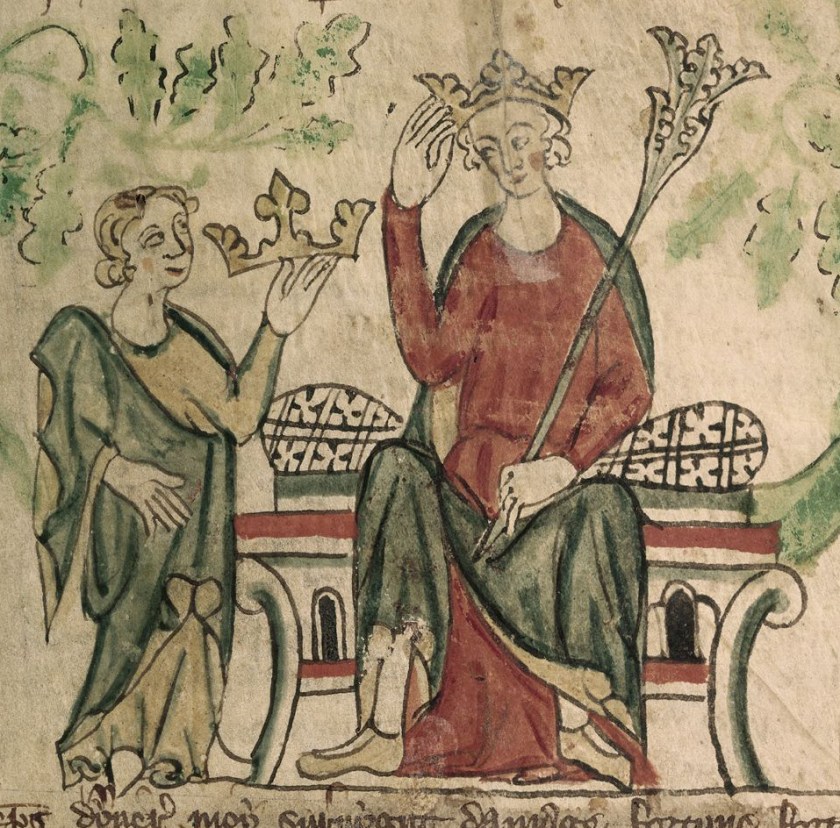
Here is an extract from an illuminated manuscript showing Eddy II getting a crown. Or more precisely a second crown. Not sure what that is all about but given he was by reputation a high maintenance sort of fella maybe two crowns makes sense.

George Benjamin and librettist Martin Crimp had a massive hit, (by contemporary opera standards), with their previous collaboration Written on Skin, which in terms of repeat performances has gone down better than BB’s Peter Grimes. Having finally seen it at the ROH in January last year I can report that it is pretty much as good as it is cracked up to be. GB is a superb dramatic composer for drama and, specifically, for the very particular prose that MC creates. I was not entirely persuaded by the only play of MC’s that I have see, The Treatment (The Treatment at the Almeida Theatre review ***), but I think he is growing on me.

This time round they have taken seven “events” in the life of the infamous Edward II, wisely leaving out his messy end, to tell the story of his relationships with lover Gaveston, wife Isabel and rival Mortimer. The two royal kids are thrown into the somewhat unusual household and we also see associated flunkeys and down trodden hoi polloi who were suffering under Eddy’s spendthrift ways. We begin with the banishment of Mortimer, then Isabel joining the plot to murder Gaveston after seeing the desitution of the people, Gaveston predicting the King’s future and then being seized, the King disowning Isabel after Gaveston’s death, Mortimer and Isabel setting up a rival court and grooming young Eddy (to be the III), the King’s abdication at Mortimer’s behest and finally the young Edward III seizing control from his Mummy.

As you might surmise the focus of MC’s story here is more on the “domestic” struggle between the “couples” and less on the conflict between King and nobles. The relationship between Mortimer and Isabel and Isabel and Edward II is given as much weight as that between Gaveston and the King. This, together with the truncated plot, makes it very different from its most obvious precursor, Marlowe’s Edward II, or, more precisely, The Troublesome Reign and Lamentable Death of Edward the Second, King of England, with the Tragical Fall of Proud Mortimer. Now I happen to believe Marlowe’s play is one of the finest ever written, comparable with Shakespeare’s History Plays. But it does go on a bit. If MC and GB had attempted to set the whole story as an opera I would still be sitting there two weeks later. So Kent, Warwick, the Spensers and all the other nobles. Canterbury and the bishops, Hainault, the Welsh, the sadists and various other hangers-on are absent. As are France, fighting, Kenilworth, scythes and pokers. The key themes in Marlowe’s play, his two fingers to his own contemporary society, namely homo-eroticism, religion and social status are downplayed, Isabella’s role and the passion between the four main protagonists are foregrounded.

Extracting these key episodes and, in some cases, manipulating them to allow GB to weave his marvellous score around them, was a classy move by MC. His libretto, as in pretty much all he writes, swings from the prosaically direct to the cryptically poetic. I mean this as a compliment but his writing is not florid but quite angular with intriguing turns of phrase and clear delineations between characters. I gather that once they have agreed the shape of the work, MC goes off and writes the whole thing, with minimal consultation, before handing it over to GB, who then slowly and patiently builds up the music from the “bottom up”. At least that is what is sounded like from the interview in the programme. But given how distinctive, dark and clever MC’s approach is I can see why it works. GB knows the “voice’ he will write around and, as in their prior collaborations, he knows his musical style, which has itself been through iteration, will fit the libretto.

The music is superb. The orchestration is immensely colourful but GB only uses large scale forces occasionally. Most of the time small clusters of instruments are used to create different moods in each of the seven scenes, notably from bass clarinet, bassoons and brass. The percussion section gets to play with all sorts of new toys. A cimbalom gets an frequent airing. There are probably motifs, patterns and structures within this but you will need to find that out from someone who knows what they are talking about. All I know is that music and drama were perfectly matched across the compact 90 minutes. I think the emotional extremes were more pronounced that in Written on Skin which had a more mythic feel. GB ratcheted up key points in the action by plunging us into dramatic silences. In Scene 3 when Edward and Gaveston private tryst is interrupted by Isabel, the kids and the courtiers and in Scene 2 when the people impinge on the Court a rich musical chaos is invoked. Harmony and counterpoint are wound up into a ball before collapsing.

The production, courtesy of the genius director Katie Mitchell, regular design collaborator Vicki Mortimer, lighting from James Farncombe and movement from Joseph Alford, reflected the enclosed and intimate nature of the drama. Each scene was set in a royal bedroom, which revolved to offer a different perspective. This included the “private” entertainment in Scene 3 with Eddy II and Gaveston and the mirroring “public” entertainment in Scene 7. The “people” were given an audience before Isabel in the bedroom in Scene 2 to air their grievances. Mortimer’s household and the King’s imprisonment at Berkeley are also presented in the confined, intimate setting of the bedroom. A massive fish-tank, which drains of water and therefore life through the scenes, is both visual treat and prominent symbol. There is a Francis Bacon style painting on the wall: that probably tells you all you need to know about the uncomfortable, existential aesthetic the production seeks to traverse. There are one or two predictable Katie Mitchell cliches, slow motion soft-shoe shuffles anyone, but the tableau are undeniably effective, When you are stuck up in the Gods, (you would be hard pressed to be further away from the stage than I was, me being such a tightwad), this matters. At this distance the Court becomes a dolls house, an interesting perspective in itself, so the “choreography” that the director brings to proceedings, matters more than the close up expressiveness of the singers.

The ROH orchestra was on top form. Mind you if you have the composer himself conducting then there is little room for error. This is not a chamber opera, GB’s sound world is too rich, but some of the textures require various players to push their technique which they certainly did. I can’t really tell you much about the skil of the cast, they all amaze me, but Barbara Hannigan, as she always does, was off the scale as Isabel, vocally and as an actor. Stephane Degout bought a petulant, entitled air to Edward II, Peter Hoare’s Mortimer was a mixture of ambition and pragmaticism. Gyula Orendt stood out as Gaveston in his scenes with the King, a mystic of sorts. Samuel Boden’s sweet high-tenor stepped up very effectively towards the end as the Boy King and Ocean Barrington-Cook, (well done Mum and Dad for the name), artfully portrayed the damage done to her and her brother by having to witness the turmoil, despite not having a voiced part (another clever idea from the creators). The children were, I suppose, the ultimate recipients of the “lessons in love and violence” that we the audience were also privy to. Though the production was smartly modern-dress there was no crass attempt to draw any lessons for our own times but the plot, MC’s libretto and GB’s music combined to underscore the tension between the private and the political for those that wield power across history.

My guess is that if I saw and heard this again, perhaps from a more advantaged position, it would merit 5*. A few punters trotted out at various junctures which intrigued me. This surely is as digestible as contemporary. “modernist” opera gets. The historical subject is not obscure, the plot direct, music is beautiful, the libretto intriguing, the staging is excellent and it is hard to imagine the performances being topped. (the vocal parts were largely written for exactly this cast). Not much in the way of tunes and no arias, but surely the most cursory of examination would have revealed this in advance. The dissonance is never uncomfortable and is rooted in chordal progression. And it is short so why not see it through.

I would assume that GB and MC will, in the fullness of time, have another crack at this opera lark given how good they are it but I wonder if they have exhausted for now the “Medieval”. Like Written on Skin there is something of the illuminated manuscript here, (see what I have done there), a jewel like morality tale, (without all the God stuff). Suits me but with this amount of goodwill, (this is a seven way co-production), surely they could get away with something genuinely of the moment next time.
 

A Midsummer Night’s Dream at the Greenwich Theatre review ****

a_midsummer_night27s_dream

A Midsummer Night’s Dream

Greenwich Theatre, 24th May 2018

This was the third and final leg of Lazarus Theatre’s hitherto excellent season at the Greenwich Theatre. The previous productions, Edward II (Edward II at Greenwich Theatre review ****) and The Lord of Flies (Lord of the Flies at Greenwich Theatre review ****), both showed off Artistic Director Ricky Dukes’s inventive and combative ideas, and the young, fearless casts, to best effect. This version of A Midsummer Night’s Dream was similarly imbued with image, movement and ambition, but fell down a little on the delivery of verse and on pacing.

Getting Shakespeare’s lines out right isn’t easy. There are plenty of experienced actors who steer clear of the challenge. Practice may not make perfect but plainly it helps. Our cast here was, by and large, just out of drama school. Mr Dukes aim is to present theatre to as young and diverse an audience as he can. This will only work if his cast is similarly diverse. In Lord of the Flies he explored the tension from opening up gender in the casting. The young actors largely became the characters from William Golding’s novel filtered through Nigel Williams’s excellent adaptation. In Edward II the slightly more experienced cast, to a man and woman, nailed Marlowe’s muscular prose helped by Mr Dukes’s dramatic reshaping of the text.

Here though the verse was uneven and the spell was, at times, broken. This is not a criticism, just a reality. Max Kinder’s Lysander and Saskia Vaigncourt-Strallen’s Helena were the most accomplished speakers but the rest of the cast shone in other ways. Tessa Carmody played Puck as an enthusiastic, elfin ingenue not really up to the tasks allotted to her by Oberon. She was very funny. Eli Caldwell stepped into the limelight as a camp Flute in a tutu and Zoe Campbell captured the downtrodden air of a mechanical in her Snout. Jonathon George captured Demetrius’s slightly sour air, John Slade’s Quince was an exasperated but ineffective director and David Clayton was a bumptious Bottom, though might have been better served without the full donkey mask. Elham Mahyoub is an extraordinarily expressive actor in terms of face and movement, and, I mean no offence, was perfectly Hermia-sized. Lanre Danmola was a peeved Oberon with an air of making up his mischief as he went along, Ingvild Lakou’s Titania being suitably unimpressed.

The production really came alive when the director’s eye for movement, design (Jamie Simmons once again using the most mundane of materials), lighting (Stuart Glover) and sound (Sam Glossip) came together. Like all three of the Lazarus productions there is idea after idea which is simple but oh so effective. The highlight was Pyramis and Thisbe, here delivered in an hilarious song and dance routine, which the posh quartet get pulled in to. Like most recent productions Lazarus sort to uncover the darker elements in Shakespeare’s pastoral, though it is humour and joy which dominates. With more money, (which this company richly deserves), and more time, I reckon Lazarus, without too much fiddling with the stripped-back aesthetic, could create a memorable Dream. A Festival setting perhaps?

I don’t know what Lazarus will get up to next but I wholeheartedly recommend you check it out. This is not the most polished theatre you will ever see, and there are occasional missteps, it but it will restore your faith in what theatrical classics can deliver if you are already a luvvie, and should persuade you what you have been missing if you are a reluctant newbie. It’s better than Love Island. Mind you most things are.


Describe the Night at the Hampstead Theatre review ****

nonperson

Describe The Night

Hampstead Theatre, 23rd May 2018

In our country the lie has become not just a moral category but a pillar of the State. Aleksandr Solzhenitsyn.

Describe the Night hasn’t gone down too well with the London critics. The SO and I think they might have missed a trick. It is ambitious, ranging across several periods of Soviet and post Soviet Russian history, with a fairly cavalier approach to naturalism, and mixes fact and fiction, real and imagined events. Its workshop-py creative methodology shows through, but it was for us highly effective and enlightening. We’ve seen a fair few other plays that have fallen far shorter, despite their more limited intent. So hats off to Rajiv Joseph the writer for giving this a go. I see he won an OBIE, off Broadway award, for best new play with this. That’s probably a bit generous, (or New York is lamentably short of new work which I refuse to believe), but it’s proof that this isn’t the disappointment some have claimed it to be.

Polly Sullivan’s design sees a cliff wall of grey metal filing cabinets punctuated with a raised corridor and spiral staircase down to a dark open space with a couple of spindly birches. This, with some nifty work from Johanna Town’s lighting and Richard Hammarton’s sound, serves as backdrop for an underground KGB/NKVD filing room, an interrogation room, a minicab office, a plush Moscow apartment, a sparsely furnished flat and a forest exterior. The action kicks off in Poland in 1920 during the Russo-Polish war, (a conflict itself near forgotten), where we meet Isaac Emmauilovich Babel played by Ben Caplin and Nikolai Ivanovich Yezhov played by David Birrell. Both actors are superb by the way.

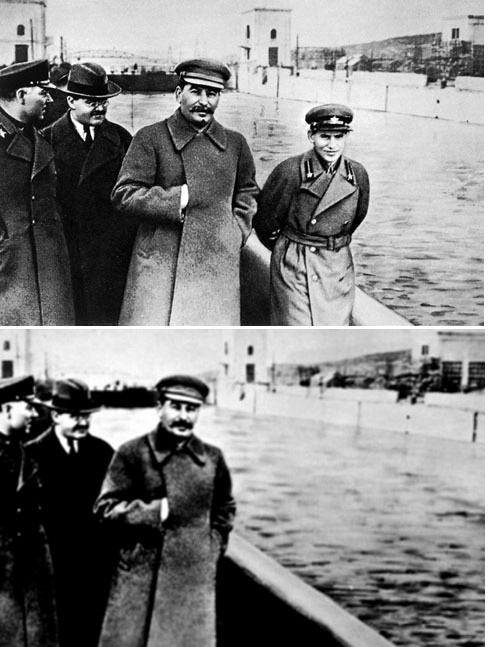
Now Babel was a writer whose stories about his childhood and this war were initially feted by the Soviet authorities but who was eventually arrested, his work confiscated, and he was executed in 1940. Yezhov was a small man, a party functionary, who drank to excess, but rose to become a favourite of Stalin and head of the NKVD through the Great Purge. Eventually though he fell foul of Stalin, his wife Yevgenia Solomonovna Feigenburg (Rebecca O’Mara) was arrested, and he too was executed in 1940, despite trying to save his skin by ratting on his friends including Babel. The photos above show how he was famously “non-person-ned” out of history.

The two meet in a forest near Smolensk as Babel is trying to “describe the night” around him. The literal Yezhov has very little of the poet about him, Babel relishes metaphor,  and the two debate the nature of facts and truth. They strike up a firm, if unlikely, friendship. We move forward to 1930s Moscow where we see Babel, whose estranged wife is in Paris, begin his affair with Yevgenia, (which, in reality, had started earlier before she married Yezhov). In the next scene we have whizzed forward to 2010 and Smolensk, where the plane taking the Polish president, his wife and various political and military elite to the commemoration of the Katyn massacre of 1940, has just crashed. Journalist Mariya (Wendy Kweh) is looking to evade the police and enlists the help of Feliks (Joel MacCormack) to made good her escape so she can tell the story.

For those that don’t know the crash is still the subject of conspiracy theories, despite the Polish and Russian authorities concluding it was down to human error, and the Katyn massacre saw the murder of some 22000 Polish military and intelligentsia by the NKVD, although Soviet authorities only finally admitted this in 2010 having previously blamed the Nazis.

We also seen Wendy Kweh as cantankerous Mrs Petrovna and her “daughter” Urzula, played by newcomer Siena Kelly, living in Dresden in 1989. Urzula wants to escape to the West. They have come to the attention of Vova, extravagantly played by Steve John Shepherd, who you might know as one Vladimir Vladimirovich Putin. We see our putative Putin rewriting his own history in a confrontation with Yezkov, who has “lived on” to control the files of the NKVD/KGB. The real Putin’s early history is somewhat uncertain. Urzula may be the grand-daughter of the illegitimate child of Babel and Yevgenia, who ended up in an asylum thanks to Yezkov, unable to distinguish Babel’s stories from her own memory. Vova also interrogates, unpleasantly, Mariya, mirroring Yezkov’s interrogation of Babel.

And so the stories weave together and what is true and what is fiction becomes ever more uncertain. Babel’s diary, started in 1920, becomes the physical link between the “scenes”. Some have seen parallels in th eplay with other contemporary regimes alongside Russia where the truth is routinely manipulated. Rajiv Joseph is after all an American playwright. There is certainly much to ponder on from Mr Joseph’s particular narratives. and from his mix of fact and fiction, with even some magic realism thrown in, (never be tempted to drink leech soup). History has always been uncertain, from the moment it is “made”. Leaders and states have always sought to confound “truth”. limited only by their shame and intelligence, or lack thereof. The multiplicity of viewpoint that curses our contemporary digital world might seem like it has “never been as bad as this” but it has, as this century of Russian “history”, shows us. People lie. History is rewritten. Truth is fiction and fiction truth where only art might be trusted. The scale of Russia’s current strategy of disinformation may be exaggerated by technology but it certainly isn’t novel.

We thought that Rajiv Joseph’s text and Lisa Spirling’s (AD of Theatre 503) unhurried direction turned into an invigorating display of these “realities”. The cast all seem to have adopted a slightly forced quality in their delivery, which is though entirely consistent with the structure of the play and the world it inhabits. The “workshopped” construction, this version is different from its NYC cousin, does sometimes mean the pace eases ever so slightly, and the play is, perforce, disjointed, but the rewards more than justify this. (I am much happier saying this about Describe the Night than Maly Theatre’s Life and Fate, a similar dramatic exploration of Russian history). There is dark humour throughout. I can imagine a more fleet-footed production, (Stoppard and Kushner, also writers who relish the interplay of ideas and theatre, similarly need momentum), but the play is already asking a fair bit from its audience, (there is definitely a case for reading the excellent HT programme in advance), so a less stagey approach might risk confusion.

For the moment though this is well worth the effort. There are a few performances left at the HT but I have a feeling this will come back in some form or other and will be a “grower” whose reputation will grow with time. Not everything is what it initially seems maybe.

PS. The foyer of the HT contains some of the material from David King’s splendid collection of Soviet graphic art and photographs which formed the backbone of the recent excellent Tate Modern exhibition. There are a few links below to reviews of other cultural events that plough a similar furrow. Treat yourself.

Red Star Over Russia at Tate Modern review ****

Life and Fate at the Theatre Royal Haymarket review ***

Ilya and Emilia Kabakov at Tate Modern review ****

The War Has Not Yet Started at the Southwark Playhouse review ***

The Death of Stalin film review ****

Russian Art at the Royal Academy review ****


Mayfly at the Orange Tree Theatre review *****

mayfly_2

Mayfly

Orange Tree Theatre, 21st May 2018

A play set in a rural location about a family processing grief. Not a million miles away from the not entirely successful Nightfall at the Bridge Theatre I hear you clamour. (Nightfall at the Bridge Theatre review ***). Well yes after a fashion. Joe White’s debut play though benefits, unlike Nightfall, from its location, in the round in the intimate OT space, and because its writing is tighter, funnier and more affecting. This may not be the most innovative play in terms of form and subject that you will ever see but it is a mightily polished effort which marks Joe White out as another talent to add to the list of young British playwrights.

Harry, (a disarmingly genuine performance from Irfan Shamji), works in a rural pub that is closing down. He encounters the plainly damaged pig farmer Ben (Simon Scardifield) trying to take his own life in the river. It is a Sunday in early May in Shropshire. (There are allusions to Housman, Auden and even Breughel through the play. Mr White clearly knows his elegiac English, and Flemish, onions). Loops, played superbly by Evelyn Hoskins, “hard as fuck me”, remembers Harry from some school cadet trip and means to make him her boyfriend. Cat, played by Niky Wardley, completing the quartet of marvellous actors, is lonely and makes an embarrassing pass at Harry in the pub. We soon see that Ben and Cats marriage is stressed to breaking point and immature daughter Loops is trapped. Their pain stems from the death of their young lad, Adam, son and brother. Harry gets sucked in when he comes to eat with them. He too is grieving. Some, limited, catharsis follows. The End.

All in one day. Like the life of the mayfly. The play works because Mr White is neither afraid of, nor forces through, the emotional core at the heart of his story and because it is very funny, more so than many comedies you might see. The naturalistic lilt of the character’s speech is expertly captured but there is still room for telling metaphor. The crumbling of the social and economic fabric in rural areas lurks in the background mirroring the household’s breakdown. When the pub goes all that will remain will be a Spar and a betting shop.

Mayfly is sympathetically directed here by Guy Jones, one of Paul Miller’s proteges at the OT, and the set from Cecile Tremolieres is inventive, (as it was for Suzy Storck at the Gate last year). I’d be surprised if this play doesn’t pop up again elsewhere and I certainly recommend tracking Mr White’s career. The plot here is just occasionally derivative. With a bigger and more complex idea I reckon he might surprise, big time.

Life and Fate at the Theatre Royal Haymarket review ***

vasilij_grossman2c_1945

Life and Fate

Maly Drama Theatre of St Petersburg, Theatre Royal Haymarket, 20th May 2018

The Maly Drama Theatre of St Petersburg was founded in 1944 and is one of just three European theatre companies to have been awarded the title Theatre of Europe from the EU. (No I didn’t grasp the geography of that either). The company has been led by Lev Dodin since 1983 and is renowned for its Russian adaptations of theatrical classics and for its examination of the paradoxes and realities of culture, society, life and politics in the Soviet Union. The relationship between culture and government in Russia continues to fascinate me and I wasn’t going to miss an opportunity to see Theatre with a capital T come to London.

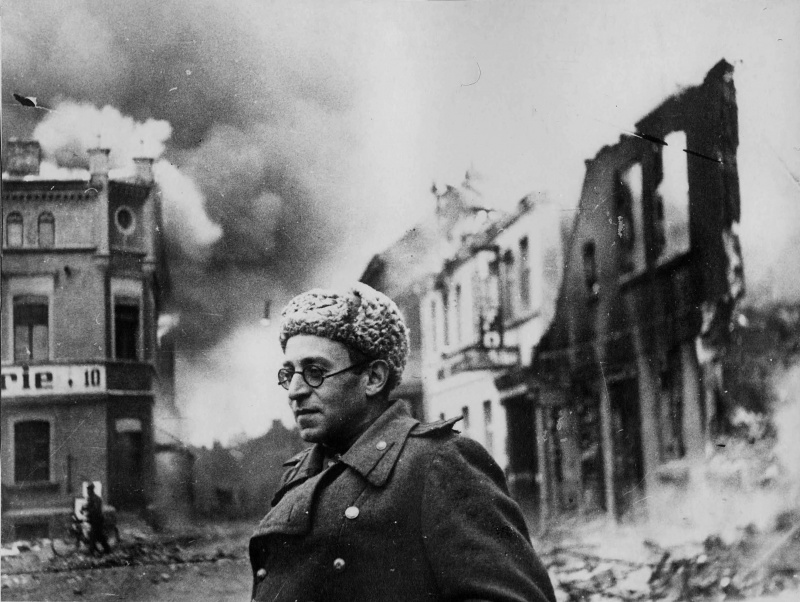
Life and Fate was premiered in Paris in 2007 and is based on the epic novel by Vasily Grossman, pictured above, which documents the life of the Shtrum family through the 1930s and WWII in Soviet Russia. Vasily Grossman was born in 1905, a Jew in Ukraine, and initially trained and worked as a chemical engineer. He took up writing full time after his one of his short stories In the Town of Berdichev attracted attention. In the 1930s he just about managed to stay the right side of the authorities, in contrast to many of his peers, but in 1938 his wife was taken into custody following the arrest of her ex-husband. He became a renowned war correspondent and was one of the first to enter Ukraine following its liberation, only to find his mother, and indeed the whole Jewish population of his hometown Berdichev, had been murdered by the Nazis. Ukrainian complicity in the genocide was covered up.

This personal history provided the material for Life and Fate which VG sought to get published in the thaw that followed Stalin’s death. However the manuscript was seized by the KGB and pronounced unpublishable for at least 200 years. After VG’s death in 1964 a secret copy was smuggled out and eventually published in Switzerland in 1980 and, finally, following Glasnost, in Russia though still with some passages removed.

It is then a Book with a capital B of immense significance. It is also a whopper extending to near 800 pages, echoing War and Peace. In another of the now not uncommon marital coincidences chez Tourist the SO has it near the top of her to-read list having been recently drawn into the world of investigative journalist Svetlana Alexievich, who also shines a light on Soviet and post Soviet life, albeit more recent decades. Unusually it was me that recommended her books. The cultural division of labour, with the SO doing the hard work of reading and writing, and me the easy jobs of seeing and hearing, art, theatre and music, is thus alive and kicking in the Tourist household.

Condensing down this work into three and a half hours of theatre must have been some undertaking, taking time (3 years in fact), effort, research and immersion. The play starts in 1943 after a prominent physicist, Viktor Shtrum, returns to Moscow and the Institute he works in. He lives in a flat with wife Lyuda, and schoolgirl daughter Nadya. Lyuda’s son from her first marriage, Tolya, has been killed in the war. Her first husband Abarchuk is a political prisoner in the gulag along with Krymov, the ex-husband of Lyuda’s sister Zhenya who comes to stay with the Shtrums.

The Soviet labour camp also houses another political prisoner Monidze and criminals Barkhatov and Ugarov. Their plight is contrasted with the prisoners in a Nazi concentration camp, Mostovskoy, Ikonnikov, Ershov and Osipov, overseen by SS officer Liss. There are scenes set in the Battle of Stalingrad with tank Colonel Norikov who is Zheya’s lover, his number two Getmanov and a runner Vershikov, and in the Moscow Institute with colleagues of varying political committment, Sevastnov, Sokolov, Shishakov and Kovchenko.

Fortunately there is no doubling up and the programme notes are excellent in providing context. For the scenes do deliberately mesh into each other, with some very well choreographed rearrangement of the set, and actors from one location often remain on stage when others take the lead. The chronology is also fluid and the presence of Victor’s dead mother Anna is made flesh in the most moving laments in between key scenes.

All this is intended to point up the equivalence between the totalitarian regimes of Nazi Germany and Soviet Russia and in this the play overwhelmingly succeeds. Viktor is Jewish and this leads to his ostracism and expulsion from the Institute as the policies of nationalism and anti-semitism infect Stalin’s regime in ways that mirror the more overt ideology of its enemy. If Viktor repents and confesses he might be able to save himself and his family, and continue with his work, but only if he abandons the truth and his identity.

And then along comes the fickle finger of fate as Stalin himself rings up and “wishes him success in his work”. It seems Viktor is the key to unlocking a nuclear bomb for the Soviets. He is safe. Life goes on. Except that the horror around him doesn’t stop. And Viktor is eventually faced with signing a letter that he knows will condemn dissidents to death.

It is an immense journey which in many ways is cleverly captured on this smallish proscenium stage. BUT it is very Actorly and very Speechy. Declamation is the go to style of delivery and this, compounded by the subject, makes for a gruelling evening. I was fortunately promoted to a much better seat, sightlines being untenable in my normal cheapskate TRH perch This exaggerated the staginess and meant a fair bit of my attention was lavished on the sur-titles for Francine Yorke’s translation. Now, I hear you cry, what did you expect going to see an epic set in the darkest period of the C20 delivered in Russian. Elf the Musical? Well no, I get that this did, to all intents and purposes, do exactly what it said on the can but I do think the production, not the material of course, tended to the overly grandiose.

I would find it invidious to pick out any of the cast or creative team for particular praise though you cannot deny the sheer presence of Sergey Kuryshev as Viktor and Tatiana Shestakova as Anna. I was also struck by Daria Rumyanantseva as Nadia, Alexander Koshkarev as Shishakov and Oleg Dmitriev as Liss but like I say this is large-scale, and I mean large, ensemble acting which I rarely see.

I feel unworthy saying this but the point of this blog is to record what I see, hear and learn. I have no doubt though that the next time one of the major Russian theatre companies comes to London I will be there. As with the visit of the Vakhtangov State Academic Theatre of Russia last year (Smile Upon Us Lord review at the Barbican Theatre review ***) the style may not grab me, the stories obviously do. And I am grateful to those who financed this visit. Anything that promotes mutual understanding of our histories must surely be valuable.

An Oak Tree the Orange Tree Theatre review ****

an_oak_tree_28conceptual_art_installation29

An Oak Tree

Orange Tree Theatre, 13th May 2018

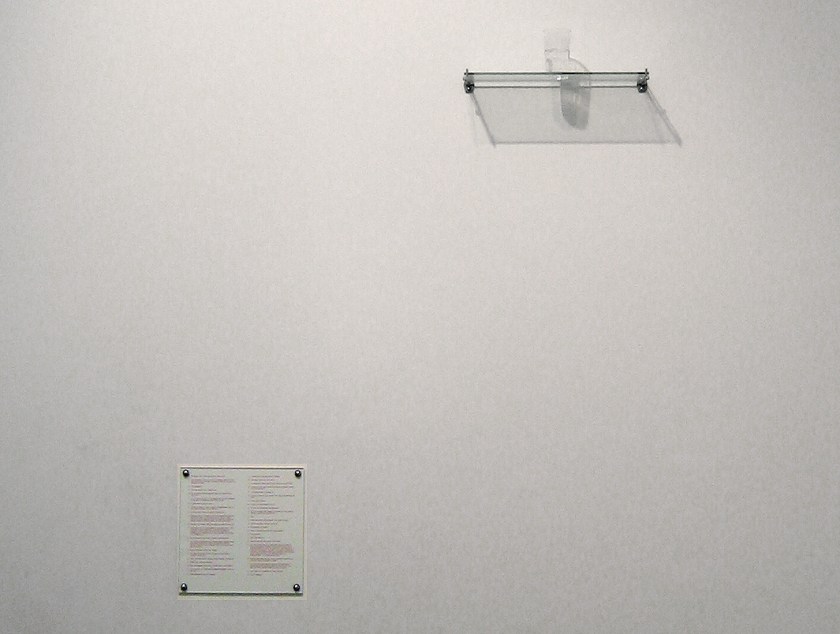
Tim Crouch’s An Oak Tree has been on my theatrical wish list for a little while now. First performed in 2005 at the Edinburgh Fringe it was, I understand, inspired by Michael Craig-Martin’s, (he of the day-glo technology), seminal work of conceptual art of the same name (see above) which “explains” why a glass of water balanced on a shelf is, in fact, an oak tree. Absolutely guaranteed to make the philistine’s blood boil. As so, to some extent, would Tim Crouch’s best known play.

Caryl Churchill no less described the play as “about theatre, a magic trick, a laugh and a vivid experience of grief, and it spoils you for a while for other plays”. Turns out that, for once, Ms Churchill maybe over-egging it a tad but it is still a fascinating work. Mr Crouch plays a stage hypnotist, complete with shiny waistcoat and cheap patter, whose act is crumbling, we discover, following a road accident which led to the death of a young girl (or maybe not). The other actor plays the father of the girl, Andy, who he encounters at one of his shows. The play then is ostensibly about guilt and grief, and how we process these emotions, a theatrical staple which has become something of a specialism at the OT.

But there’s a twist. The actor playing Andy, here Kate Hardie, hasn’t seen the play or the script before. Which leaves her being guided, like hypnosis, with a mixture of spoken and whispered instructions, headphones and script in hand, by Tim Crouch, in and out or character. It takes time for us, and her, to believe in Andy, though “he’ always remains slightly, and rightly, bewildered. Mr Crouch, on top of his “directing” duties also plays a character putting on an act, hypnotising an audience no less, and imagining an audience in parallel with us the real audience. We are asked to accept at various points that a chair is the dead child and that the grieving father in turns believes that an oak tree, (actually a tree which is part of the OT set for other current productions just in case this wasn’t all meta enough), is in fact his dead daughter, not just her spirit nor a symbol. It really is to him. This is analogous to the explanation of the Craig-Martin art work which informed the play. Indeed Mr Crouch exits the auditorium to fetch a glass of water at one point.

The wonder is that, as Mr Crouch piles on the deconstruction in his essay on performative language, counterpointing art and life, representation and reality, absence and presence, the artifice and magic of theatre, we actually end up caring about these two characters because of, and not in spite of, the form. No dry, academic exercise but a real play, albeit one with many conceptual layers through its 70 minutes.

You need to see it. And I need to see more of this magician’s work.


Oedipus at Amsterdam Stadsschouwburg review ****

OLYMPUS DIGITAL CAMERA

Oedipus

Tonneelgroep Amsterdam, Stadsschouwburg, 17th May 2018

The Tourist sets off to Amsterdam to see the new version of Oedipus from the mighty Toneelgroep Amsterdam. As well as his first visit to the Concertgebouw and a chance to reacquaint himself with one Rembrandt Harmenszoon van Rijn. The Tourist finally blogs as a Tourist.

What was the attraction. Oedipus first. Your man Sophocles could write a drama, no doubt about that, and for me, this, Oedipus the King (Rex or Tyrannus), tops his other oft-performed work, Antigone, (though that is still a cracker of a story). These two plays, in a trilogy, sandwiched Oedipus at Colonus where our unfortunate hero leaves Thebes with his daughters and proceeds to pop his clogs after a lot of philosophical chat.

I hope one day to see an adaption of Sophocles’s version of Electra, (all three Greek tragedians had a pop at this story), and Ajax, the miffed warrior who, surprise, surprise, tops himself. I hope, as has occasionally happened, some clever creative will also see the potential in Philoctetes, (wounded soldier on high horse – metaphorically of course – who doesn’t want to fight again). I gather the least interesting of Sophocles’s seven remaining plays is Women of Trachis.

Anyway, as you almost certainly know, the plot of Oedipus the King is an absolute belter. It’s been hard for any writer to top this, for sheer OTT intensity, ever since 429 BCE. That weirdo Freud even named a theory after it. Unwittingly kill your Dad and marry your Mum. It doesn’t end well.

How to adapt this though is the perennial creative conundrum. Which brings me to the second reason to hop on a train to see this. (Yes it is now possible to take the direct train from London to Amsterdam if not yet the return. Cheap as chips, door to door no longer than a flight. And so much more civilised. The bit from Brussels to Amsterdam was pretty much empty).

Namely director Robert Icke. For those that don’t know, Mr Icke, at just 32 years old, is the wunderkind of British theatre direction, though there are many others who match him in my opinion. He was responsible for the revelatory Almeida Hamlet with Andrew Scott, the recent Mary Stuart, 1984, Uncle Vanya and Mr Burns, all at the same venue, (where he is Associate Director), and The Red Barn at the National Theatre. Not all perfect but in many cases mightily close. Yet, of his work to date, probably the most breathtaking was his Oresteia, which even managed a West End transfer after its Almeida run.

Here he took Aeschylus’s mighty trilogy, dispensed with the chorus, pumped up the back story, gave the Gods a court-room at the end to weigh up Orestes’s guilt, (with a bit of audience participation), and carved out a family revenge drama of startling power, where black and white is mutated into every shade of grey, and where death is viscerally real. His adaptation translates the poetry into something more immediate which any audience can grasp. Greeks doesn’t get any better than this.

So no wonder he was invited into the Toneelgroep party to have a go at Oedipus. And there is a lot that Mr Icke has in common with the masters of TA, Ivo van Hove and Jan Versweyveld. The set of Oedipus is one of the modern, faceless, corporate offices which IvH and JV used so effectively in Kings of War and Roman Tragedies. Though given Mr Icke’s set up for Oedipus, a campaign headquarters on the night of an election result, Hildegard Bechtler’s design could hardly be more appropriate. As it happens Ms Bechtler designed the Hamlet set so she knows the Icke drill. The TA stage in the Stadsschouwburg is wide and deep like the Lyttleton. I reckon you could sit anywhere, (and seats are a bargain €30 or so), and see everything. As well as the set, the use of video (Tal Yarden) and screens, a bit of on-stage eating in a family dinner, the modern, relaxed dress, the sound of Tom Gibbons and the lighting from Natasha Chivers, all echo the TA aesthetic. Mr Icke also borrows freely from his own back catalogue, most noticeably with the giant digital clock counting down on stage, representing the time to the election result, but more importantly the revelation underpinning the prophecy. The domestic interplay, the interior setting, the on-stage suicide of Jocasta though thankfully not Oedipus’s gouging, (here with heels not dress pins, ouch), the bickering over the family dinner, the strategising, all will be familiar to those who have seen Oresteia.

The set-up is brilliant. We see a video of Oedipus talking to the press after the election has closed. He promises to clean up the plague which is debilitating Thebes. Here though the plague is shorthand for the political corruption and economic incompetence of the previous administration. “The country is sick”. He is offering a bright new future. “Yes we can” or “drain the swamp”. Take your pick. He also, on the hoof, commits to investigating, and getting to the truth of, Laius’s murder. Cut to the loyal speechwriter/adviser Creon, played here by Aus Greidanus Jr, having a go at Oedipus for making this risky promise. Tiresias (Hugo Koolschlin) is wheeled in to deliver the prophecy. Our first opportunity to see the nasty side of Hans Kesting’s Oedipus as he angrily dismisses the blind old boy’s “nonsense” and turns on Creon who he reckons wants the job of leader. Marieke Heebink’s Jocasta talks him out of sacking Creon, (no need for a chorus and executions in this scenario!), and we are on to the killing at the cross-roads.

But here Laius (Jocasta’s first hubby) is the victim of a road accident (limos not chariots obvs), and Oedipus starts to piece together his own accident story with the established version, questioning the Chauffeur, played by Bart Slegers. You know the rest …… and if you don’t you should. The way Robert Icke fits his version of the plot to the “original” is artful and ensures that the last third or so of the production is as powerful as it should be.

What Mr Icke also intelligently lays on top is the family dynamic as we see “Mum” Merope (Freida Pittoors), consumed by the agony of watching Oedipus’s unseen “Dad” Polybus dying whilst all Oedipus cares about is the prophecy and, here, his route to power, daughter Antigone (Helene Devos) and sons Polynices (Harm Duco Schut) and Eteocles (Joshua Stradowski). Their is some conflict between the two lads: remember they go on to bring Thebes to its knees by knocking seven bells out of each other. The entourage is rounded out by faithful retainer Corin (Fred Goessens) and assistant Lichas (Violet Braeckman).

The supporting actors are uniformly marvellous but it is Hans Kesting and Marieke Heebink who dominate the stage. Which brings me to the third reason to nip over to Amsterdam to see this. The Tourist considers Hans Kesting to be the best male actor in the world and Marieke Heebink to be the best female actor. They proved it once again here. No fear you see, massive emotional range and immense physicality. No point holding back as the revelations tumble out in Oedipus and, trust me, they don’t. The scene were Jocasta explains how she was abused by Laius, and conspires to smuggle her baby away, is unbearably moving. Love is about the trickiest emotion to capture on stage. These two show exactly how to do it.

So why just 4* and not the 5* that you might expect from this obviously gushing fan of the play, the ensemble and the director. Firstly there is maybe, as I allude to above, a bit of a sense that we have seen this all before. The setting works, how “fate” brings a “good, man” down, and, specifically whether it pays for a politician to be “honest”, but the look and feel is maybe just a bit too close to Mr Icke’s previous work. More importantly the text is maybe a little too direct. Remember I was following a sur-titled English translation of a Dutch adaption by Rob Klinkenberg of the original Greek filtered through numerous prior translations. This presumably makes its literalness even more literal. Helps plot and message but leaves poetry on the table. In TA’s other work I have seen, the Shakespeare for example, this has not been a constraint, the language still shines. In IvH/JW’s Antigone conversely, which came to the Barbican, the translation by Anne Carson was too challenging, though this disappointed more through Juliette Binoche’s miscasting it pains me to say.

Still overall this is a great piece of theatre. If it ever wends its way to London you must see it. Otherwise we have Marieke Heebink as the lead in Simon Stone’s Medea to look forward to next year at the Barbican and Simon McBurney makes his directorial debut at TA at the Staadsschouwburg with a Cherry Orchard. Yum. This creative collaboration, amongst so many other reasons, is why Europe is a good idea. Though I doubt any of the dumb-arses in England who think differently would care.


The Gronholm Method at the Menier Chocolate Factory review ****

menier_chocolate_factory

The Gronholm Method

Menier Chocolate Factory, 12th May 2018

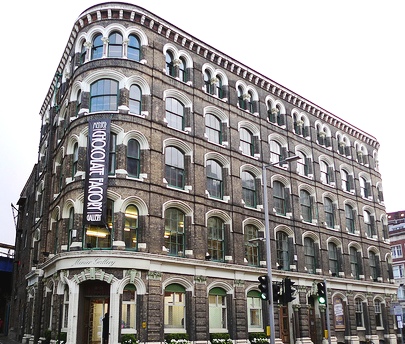
Curious place the Menier Chocolate Factory. Properly fringe in looks and feel. But programming which is more Bournemouth than Borough. Still it knows its audience and seems to pack ’em in, even with prices that seem a little more confident than some of its more fringe-y fringe theatre peers. And quite a variable output based on the critics and the opinions of one or two of the Tourist’s nearest and dearests. Still sometimes they nail it, especially with their musical revivals if that’s your bag, and their production of Stoppard’s Travesties, now on Broadway, was an absolute triumph.

So the Tourist pays attention to its offerings and saw something in The Gronholm Method which drew him in. Glad I did for it is a very pleasing, humorous, gentle satire on the world on modern employment practice, and specifically, the job interview. It is the most successful work from Spanish playwright Jordi Galceran, and has been performed in over 60 countries since its premieres in Barcelona and Madrid. The translators here are Anne Garcia-Romero and Mark St Germain and the director is BT McNicholl, the production having been imported from off-Broadway.

Frank (Jonathan Cake), Rick (John Gordon Sinclair), Carl (Greg McHugh) and Melanie (Laura Pitt-Pulford) pitch up in a smart office room in New York for an interview for some high-powered sales role. A draw opens with a set of instructions. One of them is an Human Relations ringer and they need to work out who. Further, increasingly bizarre and/or personal instructions, follow. One of them will get the job.

OK so it is a bit of a stilted set-up, which never quite relaxes, but it is the vehicle for some pretty amusing interchanges and some smart observations on the lengths people will go to in the modern, competitive workplace. The twists are not earth-shattering but they come at sufficiently regular intervals to intrigue. The performances are very fine, particularly Jonathan Cake as the viperous egoist Frank and John Gordon Sinclair as bumptious everyman Rick, and together the four players generate enough tension to convince. The direction is slick across the shortish 90 minutes, the set from Tim Hatley is spot on and the accents are convincing to my ear.

You will enjoy watching I am sure, but more for the games it plays, with us the audience, as well as between the actors, but any pretence it might have to offer psychological insight flounders on the rather cardboard cut-out nature of the characters served up. So, I would guess, you will largely forgot the entertainment not long after climbing the stairs out. No matter. Take it for what it is. As I did. Hence 4* not 3*.

If you want real workplace drama, look out for Mike Bartlett’s Bull. That’s so real it hurts.

DNA and The Fall: National Youth Theatre at the Southwark Playhouse review *****

3122307021_7d2a3d4cc4_z

DNA, The Fall – National Youth Theatre

Southwark Playhouse, 11th May and 14th May 2018

Let’s imagine you want to go to the theatre. To see a proper play. Let’s take the revival of Red for example at the Wyndham’s. 90 minutes straight through so not too taxing. Big name actor, Alfred Molina, in the lead. Michael Grandage directing. Very strong reviews just out. Best seats in the house? £120 in the middle of the stalls. Over £80 around that. Maybe if you wait they will come cheaper but who knows.

Par for the West End course now. Any alternative? Well yes as it happens.

For just £20, you could have ponied up to the Southwark Playhouse over the last three weeks or so (too late now – as usual I took too long to review this), plonked yourself in the front row and seen the gifted students of the NYT deliver some superb theatre, written for them, courtesy of two of this country’s finest playwrights. Dennis Kelly (DNA) was the writer behind Girls and Boys at the Royal Court which is off to New York with its dazzling lead Carey Mulligan (Girls and Boys at the Royal Court review *****), as well as Mathilda of course, and young James Fritz (The Fall) already has a string of prizes to his name, is cooking up something for the Hampstead Theatre and was the author of the vivid Parliament Square at the Bush (Parliament Square at the Bush Theatre review *****).

Mark me there were some superb actors at work for the performances I attended. In DNA Kitty Schneider as the taciturn, sociopathic Phil and, especially, Katie Ann Dolling as the garrulous Leah stood out. In The Fall I was particularly struck by the performances of Niyi Akin and Jesse Bateson and Troy Richards and Sophie Couch as the two couples. But honestly the acting of the entire ensemble in both plays was as good as, if not better, than most of what I see in major London theatres by established professionals. No fear. That’s the difference. And I am not being patronising or making allowances for these young’uns.

DNA, from 2007 and now a core GCSE text, follows a gang of teenagers after an “accident” that leads to the death of one of their members, Adam. They cover up to escape any consequences of their bullying, with Phil taking the lead. There is a twist or two. The way in which the play explores peer pressure and group dynamics, the need to belong and the effects of guilt Raskolnikov-style, in a not entirely naturalistic way, is fascinating. The relationship between Leah, painfully, and comically, self-aware as she desperately tries to impress an unresponsive Phil is particularly well-written.

The Fall explores the increasing divide between an older generation needing care but hoarding capital, and a younger generation who don’t see why they should be burdened and want the cash. Pretty topical huh. Mr Fritz is not a genteel writer, and wades in feet first with argument, humour and drama aplenty. Boy and Girl need somewhere to shag and end up in the house of the old, rich bloke that Girl helps care for. They discover, much to Boy’s disgust, he is lying in bed, close to death. One and Two’s relationship is charted from first meeting, through marriage, a child, poorly paid work, tiny rented flats, via a quick-fire exchange as they make and unmake the bed.linen. One’s Mum needs looking after, but what will happen to the flat she owns? In the final scene four old people, A.B,C and D, are holed up in a care home. They have a state sponsored option to die and release funds for their kids.

Like Parliament Square you might find the calculated structure of the play grating. Not me though. The energy, which the cast, complete with dance between scenes, revelled in, and the ambition, the play makes a lot of points in its 70 mins, bowled me over. As with DNA the performances were outstanding. I would love to see Mr Fritz re-write this from a reverse perspective, aged fear rather than millennial angst. Maybe when he is a bit older? That would be intriguing.

As an aside please do remember that the generational wealth gap which we are all banging on about, is as nothing compared to the class wealth gap. Knocking off the old early may not have the desired effect kids. Everyone will still suffer from plundering the earth willy-nilly and from voraciously conjuring up fictitious assets with fictitious debt pulled from the future. Still that’s Homo Sapiens for you. Exceptionalists prone to tantrums, unable to defer gratification.

The Fall was directed by Matt Harrison, DNA by Sean Hollands. Bravo chaps. I expect to see a lot more of their work in the future.

As I do from these talented actors. The major drama schools churn out beautiful actors from elite backgrounds. (I don’t use the term middle-class any more – it is meaningless). If my kids had any acting talent, and were not compromised by father having been hit by the ugly stick, despite their mothers’ beauty, they could be amongst them. But only because Dad was lucky to benefit from one of this country’s regular waves of capital expansion driven by financial intermediation. As I understand the NYT ethos though, access is not dependent on finance. So it is your duty to support it. I will remind you next time.


Nightfall at the Bridge Theatre review ***

nightfall-sky

Nightfall

The Bridge Theatre, 10th May 2018

If you haven’t been yet the Bridge Theatre offers up London’s best large scale flexible space. And very nice toilets. You’ve probably know that if you have any interest in things theatrical. You will also have probably have read that the space, and specifically the stage itself, here “thrust” into the audience, is the biggest handicap, as well as attraction, for this production of Barney Norris’s new play.

For mercurial designer Rae Smith, after the grim dystopian disappointment of the NT Macbeth, has conjured up a belter here along with lighting designer Chris Davey. A farmhouse cottage, its unkempt back garden, a massive, rusty oil pipe which runs behind it and a stunning realisation of the twilight sky, the backdrop for both acts. It looks amazing. Unfortunately the play itself, and its four characters, struggle to match its majesty. This is a play, as the criterati have unanimously observed, that would work better on a smaller stage. Not just because the subject, a dysfunctional family, is intimate, but also because the production, under the direction of Laurie Sansom, (he of the James Plays), is necessarily static.

That is not to say this isn’t an interesting drama, especially after the disclosures at the end of the first act. It just takes a bit of time to get going. We are on familiar territory. The inverse of the rural idyll. The trap that is the contemporary farm. I have raved before about director Hope Dickson Leach’s The Levelling, one of the best films of last year. which turns this setting into a visually and dramatically compelling narrative (The Levelling film review *****. The idea of Simon Longman’s Gundog at the Royal Court was powerful even if the play itself couldn’t support its weight (Gundog at the Royal Court Theatre review ***). Barney Norris himself has explored relationships in the rural setting of his native Hampshire before I gather, though I haven’t seen any of this work.

Jenny’s (Claire Skinner) husband has died leaving her the struggling farm. She is still grieving and prone to a sip or two of pinot grigio. Daughter Lou (Ophelia Lovibond) works at a local estate agent/developer but dreams of escape. Son Ryan (Sion Daniel Young, so good in Gary Owen’s Killology) has taken on the labouring. We first encounter Ryan with his friend Pete (Ukweli Roach) illegally tapping into the pipe, a ruse to rescue the farm. Pete has a bit of history with crime we learn and had a relationship with Lou, though she is now wary of him.

I understand why Barney Norris takes his time to flesh out his characters before advancing the plot but the wait does drag a little and, curiously, we don’t really get to appreciate why they have ended up tied to this place and each other. There are tensions, though again wisely, there are also still clear bonds between the four of them. As the secrets come out, as you knew then would, the pressure ratchets up. It doesn’t end well. Chekhov’s fingerprints are all over this.

Claire Skinner (a wonder in Terry Johnson’s underrated Prism at the Hampstead) does a grand job of showing Jenny’s slow disintegration and her desperation to keep the kids close at hand. Ukweli Roach and Ophelia Lovibond flesh out the relationship between Lou and Pete, alternately tender and matter-of-fact, and Sion Daniel Young shows us how immature Ryan tries to dodge reality.

It is worth staying with it, for there is truth in these characters, and it is easy to see what attracted Nicholas Hytner in wanting to stage it. I could also see, and hear, why people might be attracted to Barney Norris’s novels, where description and insight presumably augment any overly elegiac plotting. Writing about the everyday for the stage is hard, (the novel or film always works better), but Mr Norris knows how to. Just maybe not for this stage. Mind you I see that £15 will get you a seat up close in the pit for the last week or so and that is well worth it.