Minefield at the Royal Court Theatre *****

1063

Minefield

The Royal Court Theatre, 7th November 2017

Argentinian writer, Lola Arias, in her own words, explores the “overlap zones between reality and fiction”. Minefield though is all reality, in the rawest, most uncomfortable and, ultimately, moving way imaginable. She has devised a powerful piece of theatre, documenting the tragedy of war, from the testimony of six veterans of the Falklands/Malvinas war. It has toured the world since its original airing in Brighton in 2016 and, if you can’t make it to this run at the RC, I would thoroughly recommend you try to see it should it turn up near you.

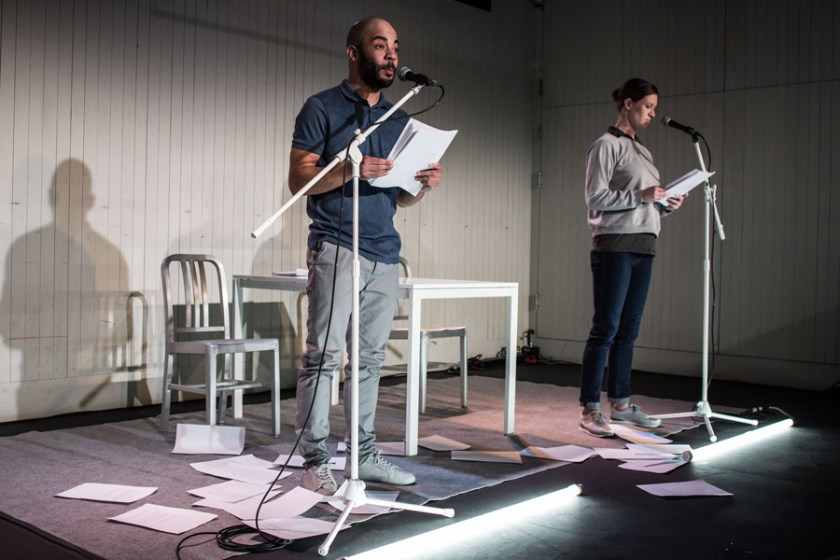
The six veterans, now all in their fifties, Lou Armour, David Jackson, Ruben Otero, Sukrim Rai, Gabriel Sagastume, and Marcello Vallejo, are obviously not professional actors, though they are men of immense talent, but boy can they tell a story. They chart, in English and Spanish, with appropriate sur-titles, the audition process (“the rehearsals for this play took a little longer” than the war), how they became soldiers, (by choice on the British side, by random conscription on the Argentinian), the media representation of the war, their arrival in the Islands, the endless waiting, some specific events (the sinking of the Belgrano, an Argentinian patrol blown up by their own mines, a jet attack), key battles, the last day of the conflict and coming to terms with what had happened to them on their return to civil society.

The production mixes projection (of newspapers, magazines, letters, photos), live video, re-enactment, masks, interviews, some very fine live music, props and mementoes, even some model soldiers, with a barrage of lighting and sound, all to mesmerising effect. We see the conflict from multiple perspectives. There was much that was new to me. The key though was the six honest men up there on stage. And their memories. The war has never left them. Most affecting is Lou Armour watching his younger self on video explaining how an Argentinian officer died in his arms. And Marcelo Vallejo describing to David Jackson, now a psychologist, his years of anger and addiction after the war.

No simple resolutions, still visible disagreement about the causes, let alone the outcome of the war, but it seemed to me that the experience provides some shared catharsis for these participants. A moving, intelligent and never inert remembrance.

Heather at the Bush Theatre review *****

heather-bush-theatre-2

Heather

Bush Theatre, 8th November 2017

For me the best plays take a very few ideas, or even better one idea, and then explore those ideas from multiple perspectives. If the writer loads up the text with too many ideas and messages, usually because he/she can and “it would be a shame not to” it can lead to confusion and drift in my simple mind. Less, as is so often the case, is usually more.

Thomas Eccleshare’s play Heather sticks fast to this rule and I loved it. It first popped up at the Tobacco Factory in 2014, again in Edinburgh I gather, and is now at the Bush for a couple more weeks. I implore you to see it.

I won’t detail the plot and central conceit as this would spoil the elegant twist. The play takes a children’s novel, in the vein of that wretched Potter (love JK Rowling, hate her work, sorry), as a springboard to explore the question of authorial identity and the relationship between art and the nature of the artist that creates it. We get to think about who we find acceptable in the creation of mainstream culture, how culture is represented, owned and marketed and whether rehabilitation is possible or desirable.

There is formal invention in the structure of the play, again I won’t delve too deeply to avoid spoiling, and some very clever and funny wordplay. The three parts of the play do not always entirely ring true but this is sort of the point in a play about how we should regard the representation of the written word. The two actors, Ashley Gerlach and Charlotte Mella, have the characters and the relationship between them absolutely nailed down, and the pace and rhythm of the production under Valentina Ceschi’s direction (she partners the writer in the Dancing Brick company) is spot on. As is the design of Lily Arnold.

That’s it. I won’t labour the point. Along with The End of Hope at the Soho Theatre this is the best way I can think of to spend an hour, (actually slightly less in the case of Heather), this weekend. Take a friend, discuss, eat.

My pick of London theatre – on now and booking ahead

national-theatre-pyrotechnics

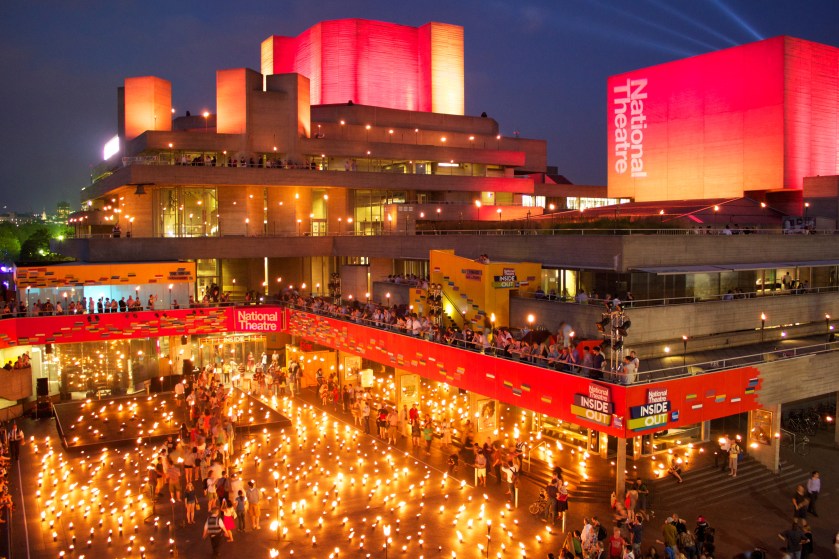
Right let me cut to the chase. Here is my latest attempt to distil the best of what is on now and what is coming up in the world of London theatre. There is a bunch of new stuff notably at the National Theatre, the Barbican, the Donmar Warehouse, the Hampstead Theatre and in the West End which has been announced since my last round-up which should be investigated. Happy theatre going.

Top 10 – all on now

1. The Ferryman at the Gielgud Theatre. I know most of you theatre lovers will have already seen it but if you haven’t you must. The Ferryman at the Royal Court Theatre review *****

2. Oslo at the Harold Pinter Theatre. This shouldn’t work – a straight narrative of the negotiations that led to the Oslo Accord between Israel and the PLO – but it does and is bloody magnificent. Oslo at the National Theatre review *****

3. Follies at the National. I hate musicals. This is different though. Made me want to cry and punch the air. Pretty much sold out but if it transfers snap it up or watch the cinema transmission next week. Follies at the National Theatre review *****

4. The End of Hope at the Soho Theatre. Go see this this weekend if you have nothing else to do. I saw this at the Orange Tree. A two hander which set in Northern Ireland by David Ireland and directed by a student amazingly. Just 60 mins and cheap as chips. It is hilarious and cutting. Highly recommended. Directors’ Festival at the Orange Tree Theatre review

5. Young Marx at the Bridge Theatre. The Bridge’s first offering. Not perfect but still v. funny and the new Bridge Theatre is wonderful. Young Marx at the Bridge Theatre review ****

6. Albion at the Almeida Theatre. Mike Bartlett’s (he who wrote the lines that have you shouting at the telly when Dr Foster is on) latest offering. A state of the nation thing. I loved it. Looks like it is sold out so you should have paid attention when I recommended it months ago. Albion at the Almeida Theatre review ****

7. Beginning at the National Theatre. Two hander on the excruciating pain of dating. Terrific. A few tickets left for the last week. Beginning at the National Theatre review ****

8. Minefield at the Royal Court. Only a couple of dates this weekend. Six veterans from the Falklands War act out their experiences. Really engrossing and moving.

9. Heather at the Bush Theatre. Tiny venue. Gold star from me if you see this. Amazingly clever play about a children’s author who is not what she seems. Only an hour.

10. The Comedy About a Bank Robbery at the Criterion Theatre. I went with LD to see this for the second time recently. Terrible West End venue and full of tourists (no offence intended) but it is still the funniest thing on the London stage so an Xmas treat if you haven’t been. The Comedy About a Bank Robbery at the Criterion Theatre review ****

Top 12 – booking ahead

1. A Very, Very, Very Dark Matter at the Bridge Theatre. I WILL WRITE THIS IN CAPITALS. YOU MUST BOOK THIS. This has just been announced. A new play from Martin McDonagh about Hans Christian Anderson (don’t laugh). McDongah’s last play was Hangmen which me and the SO think is the best play we have seen in the last 3 years. He wrote the classic film In Bruges. It will be caustically funny and gripping. I know it is next year but don’t blame me if you miss out as this won’t transfer since the Bridge is already a commercial theatre.

2. Julius Caesar at the Bridge Theatre. I know. Bloody Shakespeare. But the cast here is to die for. Plenty of tickets.

3. Macbeth at the National. Rory Kinnear and Anne_Marie Duff, our two finest stage actors of their generation, as the Lord and Lady. Will be unmissable. Booking opens next week.

4. John at the National. New Annie Baker play. This will likely sell out in hours as she has a cult following. Booking opens next week. Make sure to look at the “coming soon” part of the National as there is lots of good stuff.

5. Network at the National. High expectations but should be justified. Bryan Cranston as the TV anchor who has a meltdown. Looks like it is pretty much sold out so again should have listened a few months ago.

6. The Encounter at the Barbican. Bear with me on this. It is amazing. Simon McBurney (who is a genius) brings to life a book about a bloke getting lost in the Amazon. They give you fancy headphones and then he takes you on the journey. Booking opens tomorrow.

7. Pericles at the Barbican. From Cheek by Jowl a theatre company I love. A rare(ish) outing for a late(ish) Shakespeare. In French with surtitles so if you are a French speaker this is your time to shine. Booking opens tomorrow

8. The Twilight Zone at the Almeida. Don’t know if this is going to work but it’s the Almeida so I will give them the benefit of the doubt. Based on the 60s sci-fi TV series !! Plenty of tickets.

9. Belleville at the Donmar Warehouse. US transfer. Main draw is that James Norton in the lead who my ladies fancy something rotten. Looks like it may have sold out. Sorry. Elsewhere in the Donmar season is Congreve’s restoration comedy Way of the World which has Linda Bassett in the lead who is a genius actor (only a few tickets left cos us luvvies snap them up) and The York Realist a gay love story set in the 60s. Like the Almeida and the Royal Court the Donmar doesn’t generally do duds.

10. Glengarry Glen Ross at the Playhouse Theatre. Mamet’s shouty modern classic with a stellar cast and Sam Yates given the director’s chair.

11. The Birthday Party at the Harold Pinter Theatre. Pinter’s guest house to avoid with a fascinating cast and Ian Rickson directing.

12. Gundog at the Royal Court Theatre. I pretty much book anything that looks even vaguely interesting at the Royal Court, Orange Tree, Arcola and Young Vic. This is a guaranteed way to see stunning theatre at bargain prices. (though the RC prices have crept up) I can’t tell you why Gundog is on this list. I just have a feeling.


Follies at the National Theatre review *****

follies-poster-700x455

Follies

National Theatre, 2nd November 2017

I now think I might be mistaken in my general aversion to musical theatre. I think the problem may be that I just haven’t seen enough Sondheim. You can see from all the proper reviews and audience feedback just how well this production has gone down. Believe it. This is outstanding. Worth the thirty year wait And this from someone who is never happier than when he is locked up with 20 other punters above a pub seeing some obscure piece of European metaphysical miserabilism. So you can trust me on this.

There are a handful of tickets left. Or you can go with the Friday Rush or Day Tickets approach. If you can bear to do this, it will be worth it. This obviously cost a bomb to stage, so who knows if it will transfer, though patently it deserves too. If all else fails get to the cinema on 16th November when the performance will be screened live. Anyway, with a bit of luck, you are not a pompous, prejudiced berk like me and you will have already seen it.

Why so gushing? Design yes, courtesy of the gifted Vicki Mortimer, with her half=demolished theatre come to life on stage. The Olivier stage works best when the revolve is gainfully employed and when there is a hulking piece of stuff in the middle playing its part, as it does here. Direction yes. As others have remarked it is hard to believe this is Dominic Cooke’s first musical. Mind you, most everything he has done before, notably at the Royal Court, has turned to gold. This catapults him right to the top of the directorial league. The 21 piece orchestra, conducted by Nigel Lilley, the musical supervision of Nicholas Skilbeck, the orchestration of Jonathan Tunick and Josh Clayton and the outstanding choreography of Bill Deamer, especially in the tap routines; all combine seamlessly. Lighting and costumes are also to die for. Neon, washes, spotlights, feathers, sequins, heels, frocks, wigs, dickie bows, acres of face slap. Glam and glitz all present, correct and suitably superficial as the tale demands.

The 37 strong cast (bigger than a Premiership squad) is uniformly marvellous. The four leads garner most of the plaudits. Watching Imelda Staunton’s Sally, her girlish excitement as she is reunited with paramour Ben turning to bitter disappointment as reality bites, is about as good as acting gets. This is Imelda Staunton though so expect no less. Her rendition of “Losing My Mind” is spine tinglingly raw. Janie Dee as Phyllis, all disdainful bitterness, matches her. A trail of bile follows her round the stage. It all comes flooding out in the contemptuous “Could I Leave You”. Philip Quast is the big male beast of proper musical theatre and his Ben Stone is, to use another cliche, commanding. Watching him finally fall to pieces in the “Live, Laugh, Love” is as moving as theatre gets. Poor old Ben; money and status can’t buy you love or happiness. In my book, Buddy is the trickiest character to pull off, but not for Peter Forbes, who nails Buddy’s solipsistic refusal to take responsibility, preferring to play the fool, as he does in the “God Why Don’t You Love Me Blues”.

The younger ghostly doppelgangers (Fred Haig, Zizi Strallen, Alex Young and Adam Rhys-Charles) are perfectly matched, to each other and their mature selfs, and move effortlessly round the set. Who else? Tracie Bennett’s Carlotta, as she belts out “I’m Still Here”, even though no-one is listening, makes you want to punch the air. Operatic soprano Josephine Barstow’s duet with her younger Heidi self, play by Alison Langer, is another highlight. As, unsurprisingly, is Di Botcher as besuited Hattie in “Broadway Baby”. There are some other mind-blowing set pieces. The routine where the ladies intertwine with their sequinned and head-dressed younger selves is a highlight, as are the entrances early on down the fire escape stairs. The pastiche/parody routines are jaw dropping, camply serious, not seriously camp.

Here’s the thing though. All this stuff wouldn’t work for me if there weren’t real characters inside all the song and dance stuff and if the text and lyrics didn’t illuminate the characters. I can see that, at its heart, the story of a reunion of the showgirl cast and creator of an interwar Follies review is pretty flimsy. And that the idea of regret over lives lived and not lived, is hardly ground-breaking dramatic material. And bugger all happens. But I cared so much for these people.

And I think that even in the absence of a more upbeat ending as was apparently the case in the 1987 revival, this is still perversely an uplifting piece of theatre. And not just because of the tunes, though the way Sondheim’s music wraps its way around his lyrics, particularly into and out of the big songs, is a wonder to the ears. He just seems to perfectly capture not just the cadence of the words but also the emotions of the characters. No, the reason I came out all puffed up after this is because I think Sondheim, and writer James Goldman, tell us that all of this agonising over what might have been, which is basically what our four leads spend 2 hours bemoaning, is ultimately pointless. You only have one life. It will be full of disappointment and missed opportunities. But you might as well try and be happy with what you have. I appreciate this homily is f*ck all use if you don’t have the basics, or if your relationship threatens your physical or mental well being, but I can only describe what I think I saw and heard. There are plenty of other bright sparks, starting with that Buddha chap, who would agree that the best thing to do is ditch the constant yearning for something better. Dump the act: be yourself.

So there you have it. Redemption for Rufus Norris, AD at the NT, after the string of misses, (not as bad as some think in my book), on the Olivier stage this season. A triumphant revival of a marvellous piece of theatre where no-one, literally, puts a foot wrong. I am still smiling a week later. Loved it. No idea what the original audiences in 1971 Broadway were thinking when they failed to turn this into a monster hit.

Young Marx at the Bridge Theatre review ****

youngmarxw500h500

Young Marx

Bridge Theatre, 1st November 2017

Let me add to the chorus of theatre lovers telling you how wonderful the new Bridge Theatre is. Cracking location by the river (Thames obvs) with a view of Tower Bridge. Wide open foyer space with a long bar for those who fancy a tipple. Pretty comfy seats in the auditorium with, what seemed to me, great sight-lines from wherever you choose to perch. More urinals in the gents than you could shake a stick at. (I appreciate this disclosure is somewhat unsavoury but theatre loos matter). All in all a mighty fine addition to the London culturescape.

Nick Hytner and co-founder Nick Starr have kicked off with an ambitious season which, from the sound of the plays in the pipeline, is set to continue. There were high hopes for this production of Young Marx, and, by and large, they have been realised. The last time co-writers, Richard Bean and Clive Coleman came together with Mr Hytner as director was for Great Britain, which went down pretty well. (I failed to get through it though had a pretty good excuse for leaving). And, of course Mr Hytner and Mr Bean had a moderate success in the past at the NT with a little comedy entitled One Man, Two Guvnors.

Young Mark is no One Man, Two Guvnors, that would have been too much to hope for, but it is still a very entertaining romp through the life of the young Karl Marx and his compatriot Friedrich Engels. Messrs Bean and Coleman don’t stint on the comedy, visual and oral, and the whole does come across as a series of vignettes with no grand dramatic arc, but it is still well worth the entrance fee. There are plenty of tickets left at prices comparable to the old workhorses of the West End, but for a better play in far more comfortable surroundings.

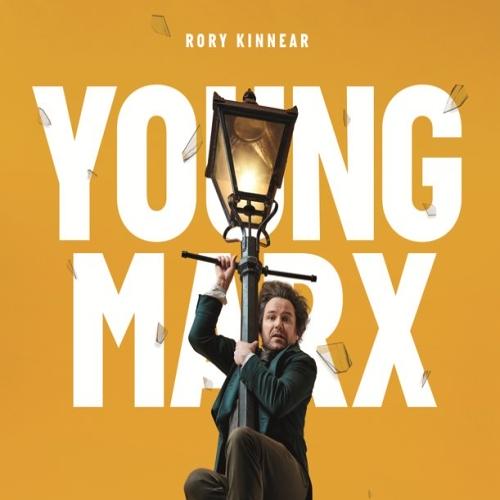
Rory Kinnear plays the eponymous genius. Now on his day, his Iago in Mr Hytner’s NT Othello in 2013 was about as good as stage acting gets, Mr Kinnear is peerless. Yet recent outings have been a little underpowered, the Trial at the Young Vic and his Macheath in the NT Threepenny Opera. He is back on fine form here. Marx, before bessie Engels went back to his Dad’s Manchester factory and provided the financial security of a stipend, was notoriously impecunious. This, together with his fondness for an ale, provides the backbone of the humour. We see him pawning family heirlooms, dodging creditors and German spies, evading the nascent Old Bill (there is a nice line in copper gags) and arguing with the other emigre revolutionaries that populated 1850s Soho. We also see the goading of his long suffering aristocratic wife Jenny and the overly close relationship with maid Nym. We see Marx as doting father and as inspiring rhetorician. Most of all though we see the close, and ultimately world-changing, friendship with Engels. Our Fred was no mean writer and thinker himself but he devoted his life to what he say as the superior intellect of big Karl. Marx must have wound him up something rotten in these early years but the mutual love and respect (“Marx and Engels, Engels and Marx” like some musical hall duet) is there on the stage.

Oliver Chris as the raffish Engels is the equal of Rory Kinnear’s more estuarine Marx. Nancy Carol’s desperate Jenny and Laura Elphinstone’s loyal Nym are the equal of the chaps both dramatically and intellectually which is a fine touch. The rest of the cast is bang on the money. Mr Hytner has wheeled out the A list for the set, Mark Thompson, lighting, Mark Henderson, sound, Paul Arditti, and music, Grant Olding. That’s why the production looks and sounds great. Beneath a silhouetted panorama of the London cityscape is a giant brick box, a brick building almost, which revolves to supply exterior and interior scenes, notably the cramped Marx household (just two rooms), upstairs in the the Red Lion and the reading room of the British Library. At one point we are transported to a frosty morning on Hampstead Heath as Marx duels with rival August von Willich (Nicholas Burns). The lighting is excellent.

So, all in all, this is a very superior production. As you might expect Mr Hytner’s direction is as energetic as the text of Messrs Bean and Colman. The gags come thick and fast, including some well wrought plays on Marxian concepts such as use/exchange value, alienation, capital accumulation, dialectical materialism and the like. Sometimes the humour is a little obvious, a bit Carry On if you like, but I think this can be forgiven. The farce elements are never overdone, the fight scenes stay the right side of slapstick. The whole thing is a little episodic, though to be fair these episodes from Marx’s life in London, which have been little embellished, are sufficiently entertaining to justify inclusion, and the lurch to tragedy near the end is a bit disconcerting, though again would have been hard to leave out. It might have been nice to have a couple more serious monologues from Marx and Engels, to create a little more message, though the scene where Engels lectures Marx on the plight of Manchester factory workers is arresting.

Minor quibbles though. This is a rollicking debut for the Bridge venture. I cannot wait for the forthcoming Julius Caesar. Nick Hytner directing again. Ben Whishaw, Michelle Fairley, David Morrissey and David Calder in the lead roles. And for 25 quid you can be one of the citizens in this promenade production. Sounds brilliant.

Beginning at the National Theatre review ****

beginning-1

Beginning

National Theatre, 30th October 2017

No need for some unseemly outpouring of emotional sharing from the Tourist but let’s just say that the very rare occasions when he has been compelled to confess his regard for another human being have been excruciatingly painful. A handshake is unsettling. Hugging and air kissing, in the absence of drink, promote intense anxiety (maybe this is genetic since MS and BD are exactly the same). Approaching a woman with a view to romance can literally leave the Tourist paralysed with fear. Fortunately the pity reflex seems to have taken hold of certain potential life partners in the past which has allowed the Tourist to deploy, and eke out, his pitiful amounts of charm, and then cling, limpet like, until finally, and rightly, he has been cast off. His strategy of keeping out of the SO’s way has miraculously worked for a couple of decades, but being this useless requires discipline.

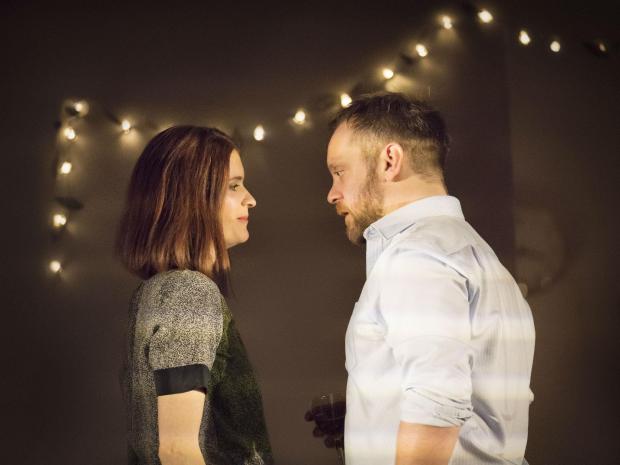
Anyway this history meant it was easy to feel sympathy for the characters of Laura and Danny in David Eldridge’s outstanding two hander Beginning. As, judging by the reaction, it was for most everyone in the audience. For the anguish of loneliness and the awkwardness of coming together are feelings that most people (assuming basic needs are satisfied) will experience. I guess there are plenty of other ways to negotiate life but, for most, finding someone to share the journey is a vital goal. Technology cannot change the reality of this negotiation nor negate the risks that come with emotional exposure.

We are in Laura’s flat in Crouch End in the aftermath of a party. Only Danny is left. Both are a little worse for wear drinkwise. Danny halfheartedly says it is time to get a cab. Laura confesses she had wanted him to stay. They talk, they drink a bit more, there’s a bit of music, some tidying at Danny’s behest. They lay open their pasts. And their desires. It is funny, touching and engrossing. The “will they, won’t they” is there but reticence is only a tiny part of what unfolds. This are good people trying to be happy and that is what makes you care.

Now this is not, I am guessing, particularly novel territory for a text to explore. But it is also a subject that is pretty easily turned into inconsequential mush. David Eldridge, who was the leading light in the so-called Monsterist manifesto, is one of our leading playwrights, who has proved he can write at any scale. I am not sure though if he has written at quite such a domestic and personal level before. Whatever. This is still an outstanding text whichever way you look at it. Wry but still affectionate, awkward but not uncomfortable, funny but not played for laughs,.

It can only work though with utterly committed performances to create real characters, and, with Justine Mitchell and Sam Troughton, this is exactly what you get. The ticking of late thirties Laura’s biological clock and the pain of early forties Danny’s separation from his son are universals which could easily lapse into cliches. Not here.

Polly Findlay’s direction doesn’t put a foot wrong, as usual, and Fly Davis’s set, in an end stage Dorfman, is spot on. The movement of the two characters around the set is as revealing as the things they say and the silences and interruptions are perfectly placed.

I see that a handful of tickets pop up on the day. With a bit of luck this will also find its way to another venue to extend the run. If so, go along, and wrap yourself up in their story for 100 minutes or so. You won’t regret it.


Albion at the Almeida Theatre review ****

albion_new_1470x690

Albion

Almeida Theatre, 21st October 2017

Now we all know Mike Bartlett is a great writer. If you don’t know his stage work then, if you love your telly in the UK, you will likely have come across his mini-series Doctor Foster. So you will know that he can write a totally gripping story and that he is not averse in taking liberties with plot construction in order to generate a few outrageous WTF moments. Now it helps that this series was blessed with some top-drawer acting talent in Suranne Jones, (up next in a revival of Frozen alongside Jason Watkins and Nina Sosanya at Theatre Royal Haymarket in what looks like casting made in heaven), the chameleonic Bertie Carvel (I would watch anything he does), Adam James (ditto and who is a Mike Bartlett veteran) and the gifted Victoria Hamilton.

And it is Ms Hamilton who takes the leading role of Audrey Walters in Albion. She is, quite simply, brilliant. I will get to the play shortly but just let me wax lyrical about Victoria Hamilton for a bit. Her Audrey is sharp, snappy, curt, brusque, tactless. A seemingly detached mother. A wife who takes her (second) husband for granted. A friend who has no interest in the life of her oldest chum. An alpha businesswoman. Yet she is also very funny, and, as we increasingly find out, vulnerable. At the heart of Mr Bartlett’s rich text it seems that Audrey, in all her contradiction, is all of us, or more specifically, is this country, whatever it might be. I guess the clue was always in the title but Albion is an allegory which takes a substantial domestic family drama as the mechanism to explore issues of national identity, place and heritage. The Brexit convulsions ooze out of the very earth, of which there is plenty on stage, though the accursed word is never mentioned.

It is a bloody marvellous role and an equally marvellous performance. You may have seen Ms Hamilton in other roles on the telly, maybe in costume dramas and the like, and I envy you if you have seen her on the stage, for she is an infrequent board-treader. Her stage reputation is immense though. I can now see why. I have no right to ask, as someone who sits around on his lardy arse most days, but PLEASE PLEASE PLEASE Victoria, come back to the stage soon when this one is over. Mind you if this doesn’t get a West End transfer, I’ll be gobsmacked (though I can see some logistical challenges).

Panegyric over. What about the play? Our Audrey has left her successful “home-stuff” business in the hands of the minions. She has bought a pile she knew from childhood in rural Oxfordshire. and left London behind. It is the garden that matters to her though. It had been created by a certain Mr Weatherbury and was of immense national importance. It has gone to rack and ruin. Audrey wants to sink some of cash into restoring it to its former glory (see where we are going ….), and create a memorial to the dead of the Great War, and, we quickly learn, her son James, who was pointlessly killed in one of the recent wars. With her come her browbeaten, though wryly optimistic, husband Paul (a spot on Nicholas Rowe) and self-absorbed, millenial daughter Zara (an anxious Charlotte Hope) who wants to write and would rather be in London. Audrey inherits a couple of retainers in husband/gardener and wife/housekeeper Matthew (Christopher Fairbank, hard to imagine anyone else better suited to the part) and Cheryl (Margot Leicester, who shows perfect comic timing) but they are getting on a bit so Audrey, somewhat tactlessly, recruits ambitious Polish cleaning entrepreneur Krystyna (Edyta Budnik), and the rather enigmatic local boy Gabriel (a compelling Luke Thallon) to help . Our cast is completed by Anna (Vinette Robinson, who convinces in what is a tricky role), who is James’s grieving girlfriend, Katherine Sanchez (Helen Schlesinger), very successful writer, best friend of Audrey since university and overt “remainer”, and conservative neighbour, Edward (Nigel Betts).

No commentary on what happens next. I insist you see for yourself. There are though some moments of very high drama as the tensions between the characters unfold. Some of these scenes push us to the edge of credulity but, as with Mr Bartlett’s other work, he gets away with it because it is so damnably thrilling. 

Rupert Goold’s direction doesn’t stand in the way of any of this, indeed positively encourages it, and it gives his lighting (Neil Austin), sound (Gregory Clarke) and movement (Rebecca Frecknall) colleagues room to have some real fun. All the action is set in the red garden “room” of Weatherbury’s original design. Miriam Buether’s “thrust” forward design is a cracker. A raised oval lawn with trusty oak tree and seat at the back and with a bed all around which is transformed halfway through. This England indeed. 

If the set up above sounds like a certain Mr Anton Chekhov you’d be right. It unashamedly has Cherry Orchard crawling all over it, and, greedy bugger that he is, he even takes a few feathers out of The Seagull. Why not though? Chekhov being the perfect template for showcasing the intersection of the personal and the political, the delineation of class, the weight of history and the vice of nostalgia. The garden itself is a quintessential metaphor for change. We English have always been good at gardens and don’t we just love ’em. Chekhov meshes comedy, tragedy and banality whilst hurling in a few bombshells. Mr Bartlett does the same.

Into this set-up then is layered a whole series of perspectives of what “we”, have been, are now, and, possibly, are going to be, now “we” have taken this unprecedented step. The short answer, if you were to ask me, is that “we” have been monumentally stupid. Mr Bartlett, as you might expect, is rather less dogmatic, and offers ambiguity (and indeed his greatest nod to Chekhov), at the end. He reminds us that even dear old Blighty is regularly convulsed by clashes between those who welcome the future, and those who cling to the past. Because, in some way or other, we all embrace this dichotomy.

The text swirls with meaning. Perhaps a little too much. This is what holds me back from a full-on JFG 5* review. Direction, staging, performances – all tip top. Garden as metaphor, check. Chekhov as inspiration, check. Formal structure, check. Narrative arc, check. Plot and characters, check. Ideas and meaning, a qualified check. Not the subject, no way, nothing right now more important could appear on a London stage. Just that maybe a few of the threads can could have been pulled a little more tightly together.

Minor criticism. This is still a hefty slab of theatre which captures the zeitgeist. Maybe not quite as immediately remarkable as the last combination of Mike Bartlett and Rupert Goold at this very venue, King Charles III. But it may well turn out to have even greater resonance as, brace yourselves, the impact of this Brexit caper has only just begun.


 

Les Miserables at the Queen’s Theatre review ***

show_lesmiserables

Les Miserables

Queen’s Theatre, 16th September

I first saw Les Mis at the Barbican some three decades ago (gulp). I seem to remember me and TFF were perched up in the gallery and the view was obscured a bit by lighting rigs. To use the vernacular it blew me away. Between now and then, as my cultural elitism ballooned along with my waist, I have become rather sniffy about it, as I am generally with West End musicals. However underneath my snobbish carapace I have always yearned to re-visit just to see what the older me would think. The SO, the D’s and MS had no interest so it was up to LS, with LGN in tow, to provide the excuse.

LS loves this sort of stuff. She dips in to the film at regular intervals and has the soundtrack constantly shuffling on her phone. So, happy faces on, we set off for LS’s belated birthday treat. Now before we get to the show a word about the Queen’s. I have yet to find a West End theatre I like. There are a few I can tolerate. The Queen’s is not one of them. Public spaces are tired, seats are uncomfortable, though legroom was just about OK, and the queue for the ladies was a joke. Indeed the ushers were basically issuing ultimatums to those poor women who didn’t cross the lavatorial threshold before the firm 20 interval, as it were. That’s just b*llocks. You can wait a few minutes and extend the interval. Tut, tut Mr Mackintosh.

Having said that we managed to secure some pretty decent seats near the front of the stalls with my aisle seat, (always an aisle – don’t ask, it’s a long story), losing only a fraction of the action. Prices here are just shy of gouging but I guess this part of the London market can bear it. This though is a show where paying up is worth it, given the set, and a little bit of research pays dividends.

Now the sound (Mick Potter) is very good. Obviously the cast are all miked up to the eyeballs. I see some sweet reviewers complaining about the miking. Trust me if the production team reigned this in, or even, as some suggest, dispensed with it, the poor punters in the gods would be watching a mime show. The lighting (David Hersey) is also dramatic, although all the action does emerge from some dark Stygian gloom, and they are very heavy on the dry ice. I guess we have to assume that France in the first few decades of the C19 had a very long run of bad weather.

I won’t bother with the story. You will know even if you don’t, by which I mean it shamelessly trots out some hoary dramatic staples, (unrequited love, mistaken identities, letting the baddie off the hook, belated realisation by baddie that he is a sh*t). But it does really work. Even if you try your level best to remain unmoved by the tale of Valjean’s redemption, (unless you are one of those blokes who is hard as nails and thinks theatre generally is suspect), you will get sucked in.

I had also forgotten just how simple the score is. That is not a criticism. When you break down Mozart’s operas, (or, if you can stomach them, Wagner’s), you see how the material is pushed and pulled into different shapes throughout. (OK maybe there is a bit more going on in The Marriage of Figaro than Les Mis, but the point still holds up). Ask a musicologist. I counted six or seven repeated melodies that crop up, with little variation, in two or three songs. That though is why the music is so powerfully direct. I had the privilege of LS bobbing about next to me and, just about still inaudibly, singing along in the second act, and she was not the only one. And there were tears aplenty as Eponine, the little cherub, the students and finally big JV himself, popped their clogs. It is nice to see an audience enjoying their theatre though my eyes stayed dry (and I am a perennial blubber).

So what holds the Tourist back. Not the singing. That all appeared up to snuff and what would I know anyway. If I had to highlight a couple of voices it would be Hayden Tee’s Javert and Charlotte Kennedy’s Cosette. No the problem lies in the acting. There are no inadvertent jazz hands but hands definitely get wrung, there are deaths from gunfire worthy of a 1950s cowboy movie, “woe is me” faces abound, legs are manfully thrust and skirts are assertively swished. The choreography and movement are impressive but all is still in service of the big numbers. To be fair this is why I dislike most opera that isn’t from the C20 or contemporary, and avoid most musical theatre. Here though none of the cast really connect with the characters IMHO, with the notable exception of Steven Meo’s Thenardier. Unlike the rest of the cast he seems up to now to have been working in “straight” theatre. It shows. Obviously the character is a preposterous villain straight our of Victorian melodrama, but at least I got a sense of a personality beyond the belters and balladers.

So there you have it. It’s pretty good. I drifted a bit but no more than many operas I have put my self through (for when opera works, as many observe, it is a sublime art form; it is just a shame it is so dull a lot of the time). If you like it you will really like it, but if you are wary of such entertainments, save your money. Hardly helpful advice but that’s the facts, folks.

You may be asking dear reader why such different reactions to the show from first to second viewing. My answer; the passage of time. I have learnt that the theatre can do so much more. Thirty odd years ago I confess to yawning through Othello, having barely any idea what was going on (like so many things you only get out what you put in with big Will) and desperate to get out before the pubs closed. I was, in so many ways, a twat then. The pity is, albeit in different ways, I still am.

Note this review is tardy even by my lax standards. I figured this show ain’t going anywhere.

Final note. I see that some of the supporting cast are termed Urchin/Whore and some Whore/Urchin in the programme. Not sure which is better.


Insignificance at the Arcola Theatre review ****

insignificance-arcola-700x455

Insignificance

Arcola Theatre, 21st October 2017

Regular readers of this blog (don’t be shy) will know that I adore the work of Terry Johnson. As do a lot of proper theatre critic types. I also have a very soft spot for the Arcola. With this revival of Insignificance the combination delivers.

However, I see from some other reviews that not all are persuaded. This is par for the course with Terry Johnson. I think the way he mixes high and low culture, and the multiplicity of meaning he inserts into his texts can leave some audience members a bit cold. He is, as my mum would have said, a “clever clogs”  and his humour is “knowing” with a capital K. In this play he is happy to trade ideas and words for the dramatic arc. The comedy, which often leavens Mr Johnson’s work, is less prominent in Insignificance and is downplayed by David Mercatali’s measured direction.

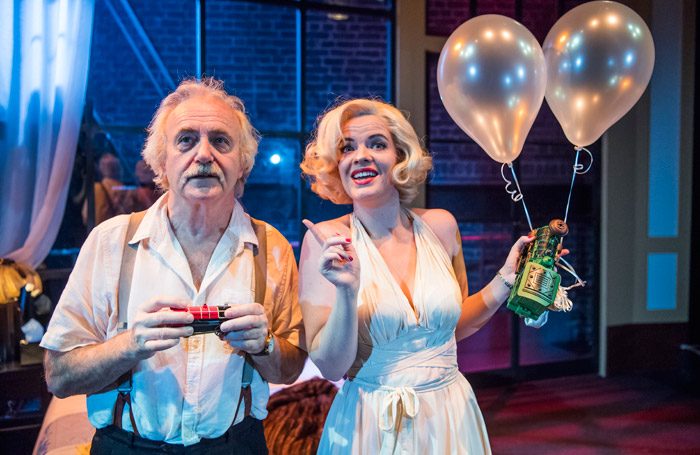
The Professor, played stoically by Simon Rouse, is in a hotel room, (Max Dorey’s utilitarian design copes with the Arcola space), working on the nature of space-time. He is interrupted by the Senator, played by Tom Mannion with increasing venom, who tries to bully him into testifying before the House Committee on Un-American Activities. The Professor refuses. The Senator leaves. The Actress (an excellent Alice Bailey Johnson who just happens to be the playwright’s daughter) appears in a recognisable white dress and, initially, trademark breathless voice. She and the Professor discuss the nature of fame and celebrity, she demonstrates, in ecstatic fashion, the theory of relativity using toy props in the room and then she attempts to seduce the Professor. They are interrupted by the Ball-Player played by Oliver Hembrough, who is not best pleased. The Professor leaves. The Ball-Player sleeps through the Actress’s announcement that she is pregnant. Next morning the Senator returns, mistakes the Actress for a prostitute and hits her. The Professor returns, chucks his work out of the window to thwart the Senator who leaves. the Ball-Player returns. The Actress miscarries and tells the Ball-Player their marriage is over. The Actress and Professor remain. The time approaches 8.15pm. The Professor visualises his recurring nightmare of nuclear destruction.

Now when you put it like I appreciate it doesn’t sound like a barrel of laughs. No so. Also it seems to me there is plenty going on in the play, it is just that it is confined to the one room. (Nic Roeg’s famous film version is obviously less claustrophobic). These characters are, of course, Albert Einstein, Joe McCarthy, Marilyn Monroe and Joe DiMaggio. None of this happened. But it might have done. That is the whole point. I never understand why people get worked up by drama which “strains credulity”. It is a play. It’s not real.

We see the world of science, politics, film and sport collide. These people were about as famous as it was possible to get in 1954 when the play is set. They still were in 1982 when the play was premiered at the Royal Court. And they still are today, notably in the case of Monroe and Einstein. The influence of fame and celebrity on the cultural superstructure is arguably even more profound. There was an actor in the White House when the play was written, there is a clown now. As Mr Johnson observes in a world which worships at the altar of celebrity society will fail to “question the power of the invisible”.

First and foremost the play is a meditation on the nature of fame, as many of Mr Johnson’s plays are. We think we know the public personae of these people and what they represent but we see very different identities in private. The Professor has sexual urges (Ms Monroe allegedly wanted to sleep with him). The Actress reveals a prodigious intellect in sharp contrast to Ms Monroe’s screen image. The Senator is an aggressive ideologue, as we liberal types would presuppose, but we shouldn’t forget that he mobilised an entire legislature to let him pursue his grotesque witch-hunt. The Ball-Player expresses his own renown in the most banal way through the greater number of bubble gum cards with his image when compared to peers. He too is more intelligent than the jock he presents but he sees little advantage in revealing this.

Mr Johnson also has some fun with other mind-bending scientific ideas with an off-stage cat belonging to a certain Mr Schrodinger and the Uncertainty Principle of Heisenberg. Science plays are ten a penny these days, not surprising as dramatists are creatures of wonder, but Terry Johnson was an early protagonist. He also squeezes in a Crucible gag. More moving are the Actress’s sorrow at her own objectification, the Ball-Player’s yearning for domestic normality and an heir and the literal cloud that hung over the Professor’s head in the latter years of his life as he reflected on the destructive power his science unleashed.

So there you have it. I would get it if this doesn’t float your boat but if any of this sounds remotely interesting please give it a go. You might be a convert.

What Shadows at the Park Theatre review ****

header_1264388_16-9-1024x575

What Shadows

Park Theatre, 19th October 2005

The Park Theatre has pulled off a bit of a coup in bringing the Birmingham Rep’s production of What Shadows to London. It has been a deserved sell out. I have some misgivings, there were times when the didactisism verged on the patronising, shared by the SO who I dragged up to North London, but these were more than compensated by the brisk plot and a very fine performance from Ian McDiarmid.

Pretty much everything Mr McDiarmid touches turns to dramatic gold whether as director, (The Almeida bloomed under his joint stewardship with Jonathan Kent), or as actor on stage, large or small screen. He inhabits every character he plays. Let’s be honest he is by some margin the best actor in Star Wars.

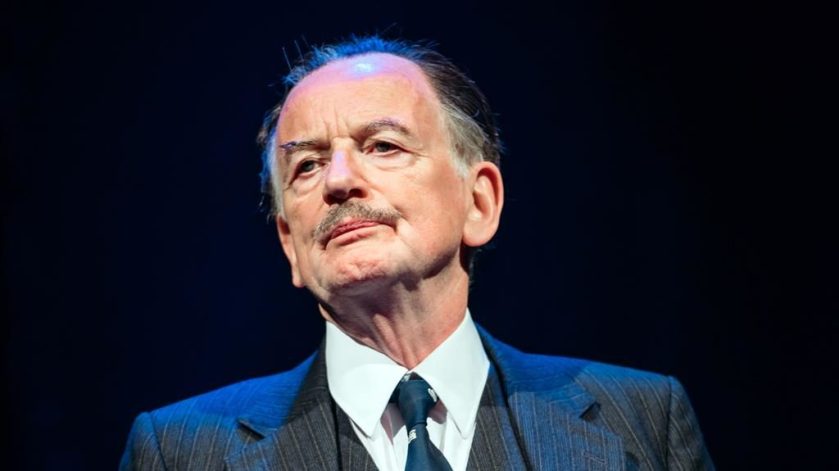
What Shadows was no exception. He is Enoch Powell. Worth seeing for the way he captures Powell’s voice and gait alone. In the performance we went to, in the scene where his erstwhile friend, journalist Clem Jones, throws the script of the infamous “Rivers of Blood” speech to the floor in disgust, most of the pages landed on Ian McDiarmid’s shoe. The way he slowly withdrew his foot, as if he relished the content but at the same time knew the sh*tstorm he would create, was masterly. I can’t believe this was deliberately staged. It just happened but he was able to take this serendipitous accident and turn it into a telling detail. Or maybe i just imagined. Either way he was very, very real.

Chris Hannan’s script takes Enoch Powell’s 1968 speech to the General Assembly of the West Midlands Area Conservative Political Centre, which led to his sacking by Ted Heath, as its subject. Powell’s scholarly brilliance, his skills as a rhetorician, his significant contribution in WWII, his trenchant views on the European Union and on free market economics, only appear in passing.  I pretty much disagree with everything he stands for politically but his influence on Conservative, and broader right wing politics, in this country has been undeniably profound (despite, or perhaps because of, the amount of time he spent criticising his own party).

But it is his views on race that turned him into a bogeyman and this is where Chris Hannan is focussed. He cleverly weaves the friendship that Powell and his briskly entitled wife Pamela (Joanne Pearce) had with Clem Jones (Nicholas Le Prevost, last seen by me in the excellent Winter Solstice at the Orange Tree which was a similarly uncomfortable watch) and Quaker wife Grace (Paula Wilcox) into the story. Similarly he takes the character of Marjorie Jones (Paula Wilcox again), the “only white woman” on a street in Birmingham, and the subject of another of Powell’s speeches, and charts her relationship with black woman, Joyce Cruikshank, and her daughter Rose Cruikshank, (both played by Amelia Donkor) as well as second husband Bobby (Waleed Akhtar). Rose herself has become an academic specialising in black history who is looking to probe the now retired Powell as part of her research. We see that she has both suffered and been the cause of past racism. She recruits Sofia (Joanne Pearce again), an older ex-colleague who career was cut short, in part by Rose’s actions, as a result of her own unpalatable opinions on race.

Whilst this set-up looks a bit awkward on paper it just about works in practice, thanks to the actors and to Roxana Silbert’s forthright direction. Having created this web of relationships to explore the politics of race and difference, Mr Hannan is then occasionally guilty of asking his characters to ram the points home which I think would naturally have emerged from the story, particularly in the case of Rose and Sofia.

Having said that though this is still a very fine play with a magnetic central performance. Powell’s own peculiar “otherness” which played a part in the thwarting of his own ambition, and his monumental self-belief, are brilliantly captured by script and actor. In my view this was no prophet but a dangerous demagogue. In his mind though prophet is exactly what he wanted to be. Our society has moved a long way since his heyday, though we seem no closer to bridging the divide between those he look out to the rest of the world and those who think we can close in, cut ourselves off and blame others for our plight.