Curtains at the Rose Theatre Kingston review ****

The_Rose_Theatre,_Kingston,_London

Curtains

Rose Theatre Kingston, 1st March 2018

Stage comedies don’t always stand the test of time too well. Comedy is elusive enough in the first place and may often be more rooted than tragedy to specific times, places or events. Comedic fashion chops and changes and what is acceptable shifts with the zeitgeist. Repetition does not always serve it well. This is as true of comedy from the last few decades as it is from hundreds of years ago. If a comedy play wins an award, especially an award for “best newcomer”, than alarm bells should sound for any subsequent revival.

Stephen Bill’s Curtains from 1987 won many just such awards, and repeated the trick when it was revived in New York a decade later. Added to that it’s a comedy about death. Set in the West Midlands. The second comedy about death set in the West Midlands I have seen in the last couple of weeks after the Guildhall’s Schools splendid production of Laura Wade’s Colder Than Here. (Colder Than Here at Guildhall School Milton Court Studio review *****). Maybe this very specific sub-genre holds a special fascination for me. Hm.

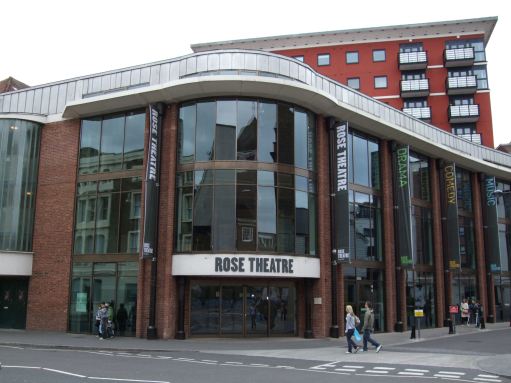
So I approached this with trepidation. I shouldn’t have. This is, by and large, a very smart play, directed by Lindsay Posner, who I assume was keen to revive it, which should be playing to packed houses at the Rose. I may be biased, because it is on the doorstep, but I really do think that, despite having no Artistic Director, the Rose is astutely delivering some high quality, uncluttered, proper theatre, sometimes in collaboration, sometimes, as here I think, off its own bat. Maybe not quite matching the Orange Tree in terms of innovation but streets ahead of the safety first pap that the Richmond Theatre largely relies on.

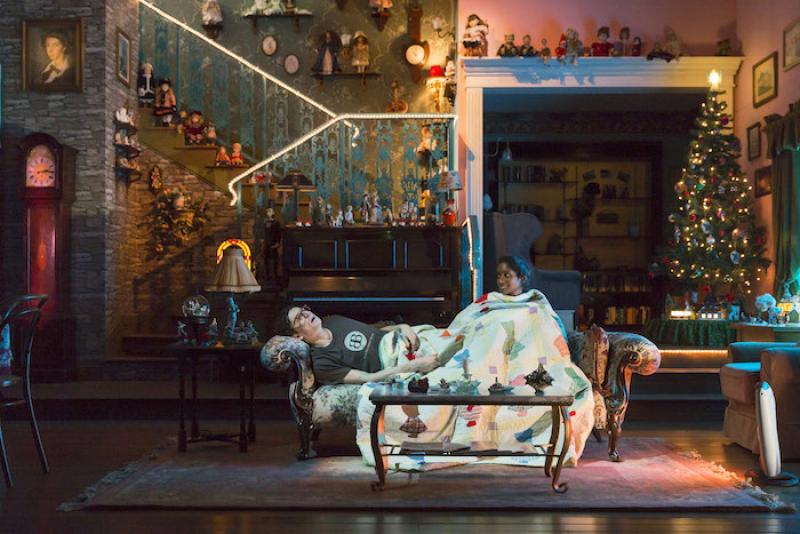
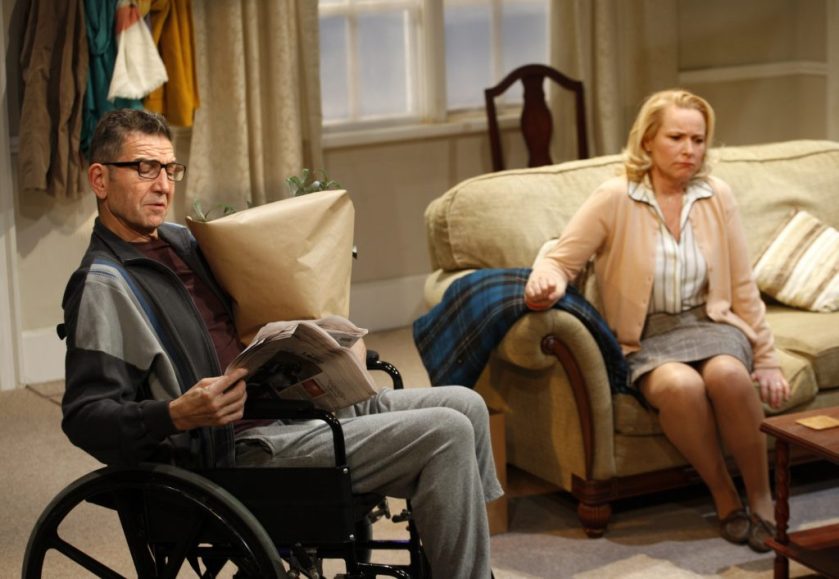
It’s that old Ayckbourn-ian staple, the family gathering, (which didn’t work as well in my last visit here for Sam Holcroft’s novel Rules for Living, another “best newcomer” – Rules For Living review at the Rose Theatre Kingston ***). It’s Ida’s (Sandra Voe) birthday. We are in her threadbare front room, courtesy of designer Peter McKintosh. She is stuck in her wheelchair with advanced dementia, her eyesight and hearing fading, surrounded by her two daughters, a splendidly po-faced Margaret (Wendy Mottingham) and a restless Katherine (Saskia Reeves and their respective husbands, the punctilious Geoffrey (Jonathan Coy) and the candid Douglas (Tim Dutton). Geoffrey and Margaret’s son Michael is also in attendance.

Now the somewhat gauche Michael is played by none other than Leo Bill, the son of the playwright. Do not be alarmed though, there is no nepotism at work here. Mr Bill junior is a fine comic actor as I know from his Bottom in Joe-Hill Gibbons’s characteristically bold Midsummer Night’s Dream (A Midsummer Night’s Dream at the Young Vic review ****). Now Bottom is funny. There is a clue in the name. And Shakespeare, who was good with gags, created him. Yet sometimes once you have done the donkey head and Titania fancying him, the belly-aches can ease up. Not so with Leo Bill who, with body, face and words, and a pair of tights, held the whole of the school-kid contingent in the palm of his hand, not to mention us old grumpers.

Dad Stephen Bill is probably much better known for his TV scripts than his plays, but it seems like he retired some time ago. So I think I can be confident that young Bill is here on merit; his performance certainly suggests so. The birthday party is completed by neighbour Mrs Jackson (Marjorie Yates), who, along with Michael who lives in the house, takes care of Ida, and, subsequently by a third sister, free spirit Susan (Caroline Catz) who is something of a black sheep, and winds Margaret up something rotten.

The fussing around Ida, drinks, sandwiches and cake are served in quick succession, and the importing of her reactions by the sisters, is spot on. It soon become clear though that there are tensions over how Ida should be cared for as she approaches the end, amidst the familiar, familial carping. This is the debate that lies at the heart of the play. How should families deal with with end of life, both practically and emotionally? As the population ages, and the cost of social care rises, this is, in turn, an increasing concern, as we have seen, for society as a whole. Mr Bill is a little guilty of shoe-horning various positions into the mouths of his characters, but the writing is still sufficiently airy to withstand this.

There is a fairly sharp tonal shift at the end of the first which sets up the argument in the second act, and which I shall refrain from describing. Suffice to say it works. There are a couple of incongruous moments which show the age of the play, notably some casual racism, a reminder of the mutability of comedy which I have remarked on above. Overall though this is a very well written play, keenly observed, darkly comic and with some trenchant argument. There is a hint of edgy, Orton-lite about proceedings, which is a very good thing, and Mr Bill has a handy knack of making his dialogue sound natural, often funny, but never “sit-com forced”.

Hats off to whoever thought to revive this.
Julius Caesar at the Bridge Theatre *****

0092_-_Wien_-_Kunsthistorisches_Museum_-_Gaius_Julius_Caesar

Julius Caesar

Bridge Theatre, 28th February 2018

I had really, really been looking forward to this. Julius Caesar is one of my favourite Shakespeare plays. Contemporary relevance of course, but Shakespeare always has relevance. My appetite whetted by the excellent RSC production I saw at the Barbican last month, (Julius Caesar at the Barbican Theatre review ****) and by Phyllida Lloyd’s heady all-female interpretation at the Donmar Kings Cross in 2016. Nicholas Hytner in the director’s chair and Ben Whishaw, David Morrissey, Michelle Fairley and David Calder in the four lead roles.

So a little bit of snow wasn’t going to stop me getting there, and dragging the SO along with me. It didn’t disappoint. Best play I have seen so far this year, along with John at the NT: admittedly we are only a couple of months in, with the NT Macbeth having just opened and, I haven’t yet seen Network at the NT. Still this is a cracker. There are plenty of tickets left in the run, though the cheaper seats have largely gone, (it is hard to believe there is a bad seat anywhere in the Bridge), but it is well worth 50 quid or, if you are a fit young’un snap up a promenade ticket and be part of the action.

The transformation into a promenade space from the straight on staging of Young Marx shows just how marvellous the Bridge space is. The promenaders are shepherded around the pit by stewards, a metaphor for the manipulation of the populus as effective as it is obvious. Bunny Christie’s production design is equally blunt but effective, with a series of plinths rising from the floor as and when scenes change. A massive shout out to production manager Kate West, company stage manager Hetti Curtis and the rest of the team at work for this performance and behind the scenes. To make this intricate production succeed, whilst actually enhancing its dynamism, takes real skill. Watch and see, especially, the floor transformed into a battlefield for the final scenes. The stage management team were rewarded with well deserved applause at the end. Bravo.

Even before Caesar (David Calder) appears in front of the crowd with Mark Anthony (David Morrissey) in tow, we have a treat in storm with a some pumped up rock’n’roll for Lupercal courtesy of a street band made up of Abraham Popoola, Fred Fergus, Zachary Hunt and Kit Young. I already have a high regard for Mr Popoola, having seen his vigorous Tobacco Factory Othello alongside Norah Lopez Holden’s Desdemona and Mark Lockyer’s Iago at Wilton’s Music Hall. (Othello at Wilton’s Music Hall review ****). Turns out he can sing a bit too and he puts in a stint as a plotter in the form of a taciturn Trebonius. Fred Fergus doubles up as a slow-witted Lucius and gets a right kicking as Cinna, in that simple but so effective mistaken identity scene. Kit Young is a crafty Octavius.

David Calder’s Caesar ticks all the right boxes: proud, conceited, vainglorious. Here is a man used to getting his own way. His eventual dismissal of Calpurnia’s (an under-utilised Wendy Kweh) qualms about his visit to the Senate is insouciant but still reveals a hint of underlying unease. Our conspirators are a thoughtful bunch. Michelle Fairley as Cassius is neither bluntly straightforward in her entreaties to Brutus not bitter in her abhorrence of Caesar and what he is turning into. Instead she is logical, using force of argument to persuade Brutus to lead the coup. Books, glasses, a desk and Ben Whishaw’s innate demeanour make him a contemplative, but still determined, Brutus. You can easily see why his belief in his own rectitude might come across as priggish arrogance to the crowd. He seems to be going through the motions in his justification speech. Mind you I can see why he might underestimate David Morrissey’s Mark Antony. He comes across as a duplicitous chancer, making up as he goes along. I don’t recall being as struck by his mendaciousness before in the scene with Octavius at the beginning of the battle when he brusquely withdraws the pay-out to the people in Caesar’s will.

I reckon a woman playing Cassius, (and indeed women playing other of the conspirators), will, and should, become the norm. It creates a shift in the dynamic between Cassius and Brutus which can be profitably mined, both in the early conspiracy scenes and in the bust-up and reconciliation ahead of the battle. I am not sure whether the distance I sensed between Brutus and Portia, (Leaphia Darko who I hope to see in a much bigger role), was intended but it created an interesting ingredient. Every Casca should be as pointedly sardonic as the scene-stealing Adjoa Andoh. I know Ms Andoh has had an illustrious stage career but I couldn’t help thinking, for example, how much better the recent RSC production of Antony and Cleopatra would have been with her in the driving seat. The rest of the cast, Mark Penfold as Lepidus, Ligarius and the Soothsayer, Nick Sampson as Cinna, Leila Farzad as the reluctant Decius Brutus, Hannah Stokely as Mellellus Cimber, Sid Sagar and Rose Ede were all on top form.

Nick Hytner directed the first Shakespeare productions that ever made any sense to me; his RSC productions of King Lear and The Tempest with the incomparable John Wood. This was when I first “got Shakespeare”.. He is the master of modern dress, “contemporary” Shakespeare. Early on at the NT he created a Henry V with Adrian Lester which was the antithesis of jingoistic. All the surveillance stuff in Hamlet that Robert Icke loaded up on at the Almeida. Look no further than Hytner’s 2010 version with a bookish Rory Kinnear as the Dane. His Othello at the NT with, surprise, surprise, Adrian Lester and Rory Kinnear, is possibly the best Shakespeare production I have ever seen. His Timon of Athens with Simon Russell Beale kicked into a cocked hat any notion that this is a difficult, unbalanced play.

His visual language is so complete that, even if you don’t catch every line. (let’s face it that is going to happen with Will S, one reason why you can never see too many productions), you still comprehend pretty much everything in front of you. He takes a view for sure, but always in the service of the universal themes that the plays wrestle with. Every single detail is thought through. For anyone who thinks Shakespeare is not for them, Mr Hytner will change your mind.. It helps that his key collaborators in this production, Bruno Poet (lighting), Christine Cunningham (costume), Nick Powell (music), Kate Waters (fight) and, especially here, Paul Arditti (sound) are so expert in bringing his vision to life.

The Trumpian allusions are not overplayed. No need to. We can see the attraction of Caesar to the crowd, but we also see why the conspirators are so alarmed by his lazy demagoguery. The vacuum that is created after the assassination, a visual twist here, is palpable, as the patronising elitist Brutus and the pragmatic Cassius haven’t thought through what happens next. Sounds familiar eh. Which leaves a yawning gap for the opportunist Mark Antony to unleash those war dogs. The failure of the “liberal’ response to populism hangs heavy in the air.

Finally here is my plea to Mr Hytner. Whilst I absolutely get that Messrs Shakespeare, Bean, Bennett, Hodge and McDonagh are, incontrovertibly, the best of writing collaborators, and I see he has the scoop on Nina Raine’s new play, please can you have another crack at Ben Jonson or Marlowe. Maybe you can make sense out of Bartholomew Fair and pull the punters in. There’s a challenge.

P.S. I note that another play that deals with the had-wringing liberal response to populism, albeit in a very, very different way, Roland Schimmelpfennig’s Winter Solstice, still has a few more legs of its tour left, Plymouth, Edinburgh and Scarborough. Highly recommended.

Picnic at Hanging Rock at the Barbican Theatre review ***

HangingRock0005

Picnic at Hanging Rock

Barbican Theatre, 24th February 2018

Picnic at Hanging Rock is an Australian cultural icon. Joan Lindsay’s novel, published in 1967 and Peter Weir’s 1975 film, (and all manner of subsequent examinations, interpretations and meditations), is a metaphor which gets to the very heart of the making of Australia. It is a fictionalised account, purporting to be true, of the disappearance of three students and a teacher, at Hanging Rock in Victoria, from a girls boarding school on St Valentine’s Day 1900. The “rational”, “European” Australia is contrasted with the timeless, “original”, natural Australia. As one character says, “we named things that had not been named”, but it turns out naming isn’t really enough. It doesn’t get any more meta or deconstructed than this.

So no simple attempt to act out the book/film on stage. Mind you that wouldn’t be that simple anyway. Renowned Aussie theatre companies Malthouse, (Shadow King, their take on Lear, was fascinating here last year), and Black Swan State, with writer Tom Wright, came together to create something far more ambitious. Our all-female cast of five appear on stage against a black backdrop, (thus sidestepping the problem of the cavernous Barbican stage for this small scale production), to narrate the story of Picnic at Hanging Rock, in a fragmentary, almost musical fashion. Their uniforms are contemporary – no flouncy Edwardian white frills here – but in that old, fashioned public school way. They inch forward menacingly on the stage. It is not long before they themselves collapse into the characters from the novel, acting out the key scenes. They are, it seems, consumed by the story they are telling.

The staging remains sparse, so text, lighting, soundscapes, and our imaginations, combine to conjure up the settings and, in particular, the mystical, primeval landscape. By having the cast take on the male “roles” and by concentrating on specific parts of the story and of the text, (which are sur-titled for emphasis in each scene), the mystery of the disappearances is downplayed and the colonisers fear of the natural world, the “anti-Eden”, is foregrounded. The sub-text of awakening sexuality is also lent a complexity that was, I seem to remember, more one-dimensional in the film, addressed in particular by the performances of, I think, Elizabeth Nabben, as increasingly beleaguered head Mrs Appleyard, Amber McMahon as the artless English visitor Michael Fitzhubert, who becomes obsessed with finding the girls, and Harriet Gordon-Anderson as the forthright detective set to uncover the “truth”.

There is still a dream-like feeling to events, but not the hot, sun-drenched, woozy “outback” of the film, (though remember this was, even in 1900, a tourist spot a short(ish) hop from Melbourne), but a darker, more nightmarish, fracturing of reality. This does make for a somewhat ardent production, which left me a little puzzled at times, but I guess that is an occupational hazard when trying to unpick a myth, especially in just 90 minutes. Still there was much to enjoy in this bold approach from Matthew Lutton (director), Zoe Atkinson (designer), Paul Jackson (lighting) and J David Franzke (sound). I couldn’t quite work out from the programme who exactly “played” whom but no matter. Harriet Gordon-Anderson, Arielle Gray, Amber McMahon, Elizabeth Nabben and Nikki Shiels made up a uniformly excellent ensemble.


Gundog at the Royal Court Theatre review ***

geograph-3297652-by-Lewis-Clarke

Gundog

Royal Court Jerwood Theatre Upstairs, 15th February 2018

Always a tricky business knowing what to pick out when booking in advance for productions at the Royal Court. Obviously if it is a big name playwright, or someone with previous form, probably best to get in there sharpish and buy blind. For newer writers it is a trickier proposition. Even I can’t justify/manage pitching up at everything they stage but waiting until productions open, or worse still, reviews trickle in, is a losing strategy given the generally high quality of the offer from the world’s greatest “writers’ theatre”.

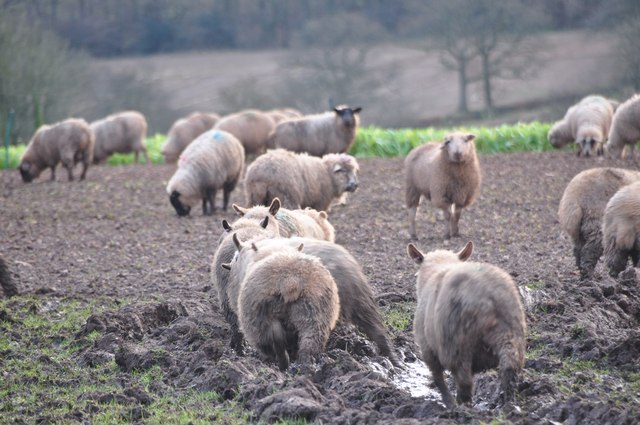
Now I really liked the sound of Simon Longman’s debut major play Gundog. The blurb suggested a meditation on the rigours of rural life, the passing of time and the impact of a stranger. With maybe the prospect of a twist. Which, broadly, is exactly what it was. Without the twist. We were presented with a stage of mud, lots of mud. (I have seen a few of these indoor fields now: Joe Hill-Gibbons’s Midsummer Nights Dream at the Young Vic and Pina Bausch’s Rite of Spring at Sadler Wells – la di dah. In this case I spent maybe a little too long contemplating how long it took, and who got roped into helping, to get the earth up and down the Royal Court stairs/lifts).

Loud bang, A flash of light and we are presented with a dead lamb, (not real so keep calm animal lovers). On stage are garrulous Anna, holding a shotgun, taciturn Becky, and Guy, who is plainly “not from round there”. Turns out Anna and Becky are sisters who run the failing family sheep farm and migrant Guy Tree, (“no-one can pronounce my real name”), has wandered into their world. He stays to help out. For a few years. Mum died way back. Dad, unseen, is mired in deep depression, mourning for his wife. Grandad is losing his marbles, though with flashes of lucid pathos. The less than prodigal son Ben returns after having conspicuously failed to secure his fortune. He’s even had his shoes nicked.

Time passes. In the first and third acts, forwards. In the second act, backwards. Each act ends with the death of an animal, the final and fourth act with a torrential storm. Disease ravages the flock, perhaps caused by Ben’s ineptitude, and the already precarious economics of the farm unravels. The sisters take to rustling. This is a miserable existence make no mistake. Dad takes his own life. Ben has tried and failed to escape, Becky has no choice, consumed, as she is, by the business of running the farm, Anna sees no point in any other life, she has given up on school, and Guy has nowhere else to go. Certainly not the idyllic arcadia we urban softies might dream about.

Lighting courtesy of Lee Curran, sound from Peter Rice, Chloe Lamford’s aforementioned set and Vicky Featherstone’s direction all work to emphasise this static, invariable world. Mr Longman’s dialogue, which is laced with dark humour, and the structure of the play feels very accurate. Perhaps too accurate for without any shift in tone or plot there are times when this became a little wearing. The idea is laudable, the execution powerful. Just a little too, er, still.

Ria Zmitrowicz as Anna once again caught the eye as she did in Alistair McDowall’s wonderful play X at the RC a couple of years ago. I look forward to seeing Rochenda Sandall again based on this understated portrayal of Becky. Alec Secareanu is a talented Romanian actor who, unsurprisingly, convinced as Guy. Alan Williams was as dependable as ever as grandad Mick and I know just how good Alex Austin, who played Ben, can be from his performance in Thebes Land at the Arcola, though in this he pushes a little at the histrionic.

Definitely worth seeing but maybe Simon Longman’s play is just a little bit too enclosed, as it were. The malleability of time and the power of nature are absorbing themes to explore, (look no further than the stage adaption of the mythic Picnic at Hanging Rock brought to the Barbican by Aussies Malthouse and Black Swan State Theatre). The precariousness and grind of rural existence is also a more than legitimate subject for artistic exploration. Mind you this was more satisfactorily captured by Hope Dickson Leach’s recent debut film The Levelling, which also had its own, mysterious plot (The Levelling film review *****). Still Simon Longman is clearly a writer with real credibility so I await his next move with considerable interest.


Colder Than Here at Guildhall School Milton Court Studio review *****

geograph-2563352-by-Eugene-Birchall

Colder Than Here

Milton Court Studio, 13th February 2018

Another visit to see the final year actors at the Guildhall School take on a fascinating contemporary play. Another excellent production laced with outstanding performances. Even better than the production of Edward Bond’s Saved, (Saved at Guildhall School Milton Court Studio review ****) which I had not expected.

Now playwright Laura Wade is best known to you culture vultures from her play Posh, later remade as the film The Riot Club directed by Lone Scherfig (who is an excellent director BTW). It is a not so thinly veiled parody of the infamous Bullingdon Club at Oxford University, the proving ground for rich, obnoxious toffs and, I fear people, many of your leaders. If you are only a casual theatre-goer put this on your list. I guarantee you will love it. That is why it has been so frequently revived since its Royal Court premiere in 2010.

I can’t vouch for any of Laura Wade’s other work with the exception of her adaptation of Sarah Water’s novel Tipping the Velvet, directed by the wonderful Lyndsey Turner at the Lyric Hammersmith. Now there is no easy way to say this but I did initially fell a little self-conscious when I rocked up to this as a solo, 50 year old fat bloke amongst such a glamorous audience. Once I had relaxed into it however I enjoyed the entertainment. The music-hall setting worked well, the musical arrangements were jolly, there was plenty of eye-catching capers, the cast attacked the text with gusto, especially Sally Messham, (seen recently in the Orange Tree/Paines Plough/Theatre Clywd triple bill), and Laura Davies, (the best actor in Rose Kingston’s recent revival of Rules for Living – Rules For Living review at the Rose Theatre Kingston ***). It was, as others observed, maybe a bit tame and less gritty in tone than Sarah Water’s book but a pleasure nonetheless.

So this then was an opportunity to see one of Ms Wade’s highly regarded earlier plays. And what a fine play it is. Down-to-earth, (no pun intended), Myra has terminal bone cancer. She determines to have a green burial and ropes husband Alec, and two daughters, headstrong Jenna and more measured Harriet, into her plan. As Myra says “you’s got to keep busy if you’re off work with dying”. That’s about it. Yet Laura Wade’s writing is so exact and light of touch that we learn a lot about, and laugh a lot with, this normal family having to deal with death. Frankie Bradshaw’s set is a commonplace front room flanked by copper piping which extends to the video design of K. Yolland. This serves as the backdrop for the six scenes where the family, in various combinations, visits potential natural burial sites.

Myra’s matter-of-fact approach to the end of her life, Alec’s refusal to talk directly about it and his frustrations with bureaucracy, Jenna’s drama-queen, boyfriend troubles and the eventual breakdown of Harriet’s composure, all reveal that their displacement and coping mechanisms are fragile. We can feel the sorrow beneath the comedy but the play never feels sentimental or mawkish.

So plenty for the four actors to get their teeth into. I was particularly impressed by the two sisters played by Phoebe Marshall and Mhairi Gayer. To be fair they probably have the best of the play in the scenes where they visit potential burial sites together. Phoebe Marshall cleverly shows us that Jenna’s truculent exterior is thin disguise for a sweeter interior. Mhairi Gayer, who was outstanding as Anya in the Guildhall’s Cherry Orchard last year (The Cherry Orchard at Milton Court Theatre review ***), was utterly convincing as Harriet. I expect an illustrious career lies ahead of her. Tallulah Bond and Jonny Lavelle had a bit more work to do playing characters twice their age but both delivered admirably. Director Lisa Blair precisely captured the tone of the play.

Now you can see plenty of contemporary and new plays in our great subsidised or, when the reputations justify it, commercial theatres where the whole turns out to be less than the sum of the parts. Ambition trumps execution. So it really was a pleasure to see this very fine, gentle play, which still has much to say, performed with such care and attention. Even down to, with the odd wobble, the West Midlands accents. And all for a tenner. Brilliant.


Saved at Guildhall School Milton Court Studio review ****

bondbw

Saved

Milton Court Studio, 10th February 2018

Now one of the manifold pleasures of being a layabout theatre addict is the ability to pitch up midweek to one of the invariably excellent performances served up by the students at London’s prestigious drama schools. Outstanding talent, likely to go on to glittering careers, matched by similarly gifted technicians and creatives and often guided by big name directors and designers. The auditoria at the Guildhall and RADA are some of the best in London, state of the art, comfortable, with perfect sight lines, and tickets are a bargain.

What’e not to like. Well as one, slightly confused, old boy at one performance I attended remarked afterwards, “they’re a bit young aren’t they”. Even if we accept the literal truth of this it rarely matters, with audaciousness often trumping inexperience. Best of all it often gives the curious theatre-goer a chance to see “classic” plays which maybe don’t often get an airing for one reason or another.

That certainly describes Saved. Edward Bond’s (in)famous 1965 play. The play premiered at the Royal Court Theatre to a private audience, as writer and director, William Gaskell, refused to make the cuts demanded by the Lord Chamberlain’s Office to secure a licence. The Lord Chamberlain decided to prosecute. The theatrical world was outraged, and, despite those involved in the production pleading guilty and getting fined, the absurdity of this censorship eventually helped to hasten the demise of this licensing system in 1968. The play was then immediately revived at the Royal Court, but was rarely performed thereafter, (in large part because Mr Bond rejects most professional requests to perform it), until Sean Holmes, (of course given his pedigree with provocative theatre), took it on in 2011 at the Lyric Hammersmith.

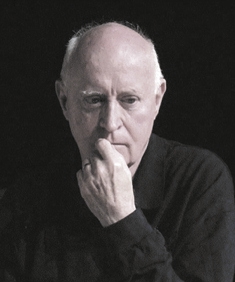
Autodidact Edward Bond, (there he is above), brought all the violence he had seen through the war years, and in his working-class upbringing, to bear on Saved, his second full length play. Indeed violence is the theme that runs through much of his work and his influence on later generations of British playwrights is patent. Saved is set in the South London of the 1960’s, socially, culturally and economically impoverished. This is no “kitchen-sink” period piece though. In some way it could have been written yesterday with a few tweaks to the language, (it being a fairly hackneyed, “gor-blimey”, argot with fairly pedestrian swearing).

Len and Pam hook up. They go boating, where Pam meets Fred, who she falls for even though he is a prize sh*t. Len has moved in with Pam and her parents, Mary and Harry. Theirs is not a happy marriage. Pam has a child by Fred, though neither turn out to be naturally suited to parenthood it’s fair to say. Fred goes fishing, watched by Len. Fred’s mates turn up ,as does Pam with the baby. She leaves the baby. Goading each other on, the gang taunts, and then stones, the baby in its pram. When Pam returns she doesn’t realise her child is dead. Fred is jailed for his part in the crime. When he gets out Pam begs him to come back to her. Len and Mary flirt. There is a huge row. Len fixes a broken chair: offering some hope of redemption at the end.

It may sound like bleak, visceral stuff. The central scene which so offended the critics at the public premiere is brutally shocking. As shocking as I have seen on stage. Violence may permeate contemporary culture, but theatre makes it more “real”. To the gang the baby is no more than a “thing”, such is their poverty of empathy. Despite this extreme, the play seems to me to present some real truths about an alienated society and the psychological damage it inflicts on people. No need to chuck drink, drugs, crime, consumerism, media into the mix. The essence of the relationships, fuelled by anger, resentment, bitterness, jealousy, boredom and frustration, rang true to me without foregrounding these addictions. The violence simmering under the surface of humanity colours each scene, each line, each interaction. The tone is not moralising, hectoring or judgemental. These are delicate, damaged, hopeless people. The final, wordless scene, is almost as affecting as the central, brutal scene.

Edward Bond’s plays were increasingly ignored from the 1980s, in part reflecting his own dissatisfaction with contemporary theatre practice. His most recent plays have been largely confined to the Big Brum company in Birmingham in this country, though his work is more widely performed in Europe, especially France. This is a shame, if that is the right word for drama suffused with violence. I would love to see, Early Morning, the surreal satire that followed Saved, or his other “classic”, Bingo, which puts a violent twist on Shakespeare’s later years. In fact, on the basis of Saved, I would try any of his work now that I have read about it.

He does though allow students to take on his work regularly. Which gave this accomplished cast an opportunity they all grasped with both hands. Toheeb Jimoh as Len had something of the observer about him, complicit in his manipulation by Pam, Fred and Mary. Shalifa Kaddu’s Pam was riveting, initially confident, crushed by Fred’s rejection, finally consumed by anger. I was also extremely impressed by Ellie Rawnsley as Mary, who effortlessly captured the brassy bearing and rancour of a character twice her age. Similarly Alex James-Cox, with very little dialogue until his heart to heart with Len near the end, shows Harry as a careworn, shuffling man clinging to routine to fill the void of his life and marriage. Joe Bolland, who played Fred, was perhaps the most assured. This is a powerful, brilliantly constructed play, make no mistake, and this cast, under experienced director John Haidar, did it real justice.


Out of Love at the Orange Tree Theatre review ****

review-out-of-love-paines-plough-orange-tree-theatre

Out of Love

Orange Tree Theatre, 6th February 2018

The second of the three co-productions with Paines Plough and Theatre Clywd and, for me, somewhat more persuasive than Black Mountain (Black Mountain at the Orange Tree Theatre review ***), though very different in subject and scope. Mind you, in both cases, out the door at 7, a quick dramatic fix, and back home by 9ish for a cup of tea, is surely the perfect evening. Out of Love is from the pen of Elinor Cook and garnered acclaim last year at Edinburgh with this same creative team and cast.

Now the SO and I were not entirely persuaded by the recent Donmar Warehouse production of Lady From the Sea, which was adapted by Elinor Cook, though, on my part, this is because I like my Ibsen icy. (The Lady from the Sea at the Donmar Warehouse review ***). There is no doubt though that she is a writer who persuasively captures the experience of women. At least I think so, as it is tricky to judge from my perspective as a fat, old, privileged white bloke. I did learn a lot about the two characters, Lorna and Grace, at the heart of this play.

Now telling the story of two friends, throughout their lives, is not revolutionary. Especially when one escapes their roots and one remains. This, after all, lies at the heart of Elena Ferrante’s quartet, (though I accept there is a great deal more here to feast on), which April de Angelis and Melly Still so ingeniously brought to the stage last year (My Brilliant Friend at the Rose Theatre Kingston review ****).

Elinor Cook though has shaken this up though by abandoning strict chronology. Instead we get a series of rapid, kaleidoscopic scenes which chart the women’s relationship with each other, with their parents, with their various partners and, poignantly, with Grace’s child, Martha. Grace is the feistier and more headstrong of the two, Lorna more measured and initially less confident. From the outset, a game of “weddings” in the park, we see that Lorna attracts more male attention, which fuels Grace’s jealously and protectiveness. Lorna has rejected her absent father but resents her stepfather’s attempts to cool the intensity of the friendship. Lorna’s academic success sees her go to university and build a career. Grace falls for local lad Mike and falls pregnant, and cannot follow Lorna’s path. This creates a gap between them that proves difficult to bridge.

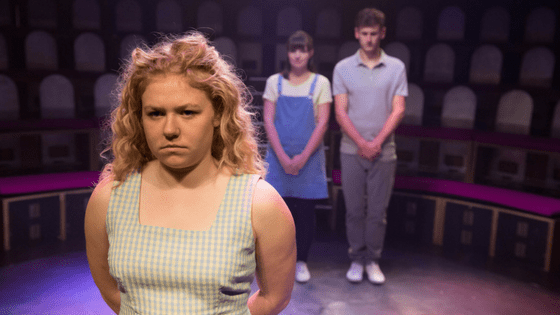
Like I say, nothing exceptional in the plot. Yet Elinor Cook’s writing is so exact and so true to life that, together with the dynamic structure, we are fully drawn into the friendship. Katie Elin-Salt is very impressive as Grace, her outward show of gobbiness failing to conceal her wounded vulnerability. Sally Messham matches her showing how Lorna grows in confidence, and independence, as she pushes back against family, partners and, yes, Grace. Hasan Dixon has his work cut out playing the eight, count ’em, incidental male roles, but any marginal audience confusion in the first few minutes soon evaporates. No costume changes, no lighting or sound pyrotechnics, (in contrast to Black Mountain), so we are reliant on text and actors. Oh and some very nifty work from Movement director Jennifer Jackson to demarcate both characters and place.

So a frank, smart, poignant, realistic, if not naturalistic, portrait of a friendship, which creates a deep impressions, actually impressions, over its compact 70 minutes. Definitely worth a visit, there are a couple of weeks left to run, and, if you are anywhere close by, it would be a crime to miss it.


Black Mountain at the Orange Tree Theatre review ***

hasan-dixon-and-katie-elinsalt-in-black-mountain_photo-credit-jonathan-keenan-4-600x350

Black Mountain

Orange Tree Theatre, 5th February 2018

The latest in a long string of ambitious, but not outrageously so, projects from the OT, this time commissioned in conjunction with trusty partners Theatre Clywd and Paines Plough. Three plays, in rep, from OT favourites, Brad Birch, Elinor Cook and Sarah McDonald-Hughes, with a cast of three, Hasan Dixon, Sally Messham and Katie Elin-Salt, directed by James Grieve.

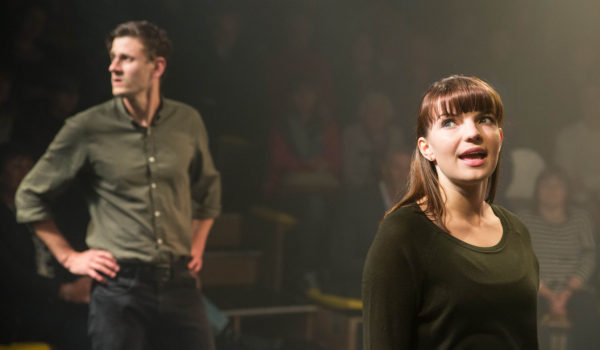
Black Mountain is the third play I have seen from Brad Birch at the OT. Like its predecessors, The Brink and Even Stillness Breathes Slowly Against A Wall (Directors’ Festival at the Orange Tree Theatre review), I was intrigued, engaged but not entirely convinced. Billed as a “tense, psychological thriller about betrayal and forgiveness” it certainly delivers on atmosphere. The intimate OT space was pumped full of dry ice and Peter Small’s lighting, and Dominic Kennedy’s sound, combined to convince me at least that we were holed up in some isolated cottage in the country. For this is where Rebecca (Katie Elin-Salt) and Paul (Hasan Dixon) have retired to to focus on repairing their relationship. Time to be honest and time to listen to each other, which they do, though with limited success. But, guess what, someone else is watching. Helen (Sally Messham) has turned up. Cue a twist or two, and strong strains of something in the woodshed.

Rebecca and Paul are sleeping separately. Any easy intimacy has disappeared. They are wary of each other and recrimination is their default mode of communication. Brad Birch’s dialogue is taut. He certainly captures Paul’s increasing paranoia and the anger that both women feel. Yet this also means that the relationships at the heart of the play don’t quite ring true. The plot, which to be fair, crackles, and the mood of the play, take precedence over the characters.

This is the impression I formed in the other two plays from Mr Birch that I have seen. The Brink presents a teacher who may, or may not, have discovered a bomb under his school. Even Stillness … sees a couple retreat from the world. All located in the world, but at the edge. I see he is currently working on a version of Ibsen’s Enemy of the People and Conrad’s Heart of Darkness. Both sound right up his street. I reckon he should have a crack at an all out Greek style bloodbath. That might be fun.


John at the National Theatre review *****

4-john-anneika-rose-as-jenny-and-tom-mothersdale-as-elias-c-stephen-cummiskey

John

National Theatre (Dorfman), 6th February 2018

I would be very wary of playwright Annie Baker if I were you. She will bewitch you. Magical powers. That is the only way to explain John. Nothing really dramatic happens, the setting doesn’t change and the words, initially at least, seem quite ordinary. Yet the longer it goes on, (it clocks in at near 3 hours even stripping out a couple of intervals), the more mesmerised the audience becomes. It is “pregnant with possibilities” you see and turns out to be anything but ordinary. Extraordinary in fact. John goes beyond the exaggerated naturalism of Annie Baker’s previous plays into, well, a theatrical place that I have never quite experienced before.

How she wrote it is beyond me. Conjuring up these voices, and then just letting them speak in the moment, reveals a writer of utter confidence who knows exactly what she is about. If she can see and hear the whole thing before putting pen to paper I am in awe. If she makes it up as she goes along, (I know, she almost certainly didn’t), then frankly I am gobsmacked.

Haunting is the word I have seen elsewhere to encapsulate John and it is a good word both to describe the meanings that Ms Baker seeks to explore, the effects she creates and the memories she delivers beyond initial viewing. The very best plays/productions leave you with a series of pictures in your head that can be recalled long afterwards, (doh – that’s how memory works you numbnut), and it is not always the ones that you might immediately expect. John vividly falls into this category.

It is the week after Thanksgiving. Jenny (Anneika Rose) and Elias (Tom Mothersdale) arrive at a bed and breakfast in Gettysburg, Pennsylvania run by Mertis (Marylouise Burke). All that follows takes place in the lounge/dining area of the B&B. Chloe Lamford’s set is a thing of wonder and a character in itself. A vintage radio cum juke box seems to be permanently set to Bach. A self-playing piano alarmingly springs to life. The furniture is exactly as you would imagine in a fading but homely B&B. Think dusty chintz. The staircase leads to a handful of unseen bedrooms, (to which Jenny and Elias retreat on occasion), which seem never to be heated. The dining area is, optimistically, named “Paris”. There are knick-knacks a plenty but what is most disturbing are the dolls lining a high shelf. Jenny even recognises one of them as the doll which unsettled her as a child. Peter Mumford’s superb lighting complements the set. The atmosphere which is created is ever so slightly off-kilter from the expected cosy, but still a long way from full-blown, Gothic supernatural.

It was Elias’s idea to come to Gettysburg for a couple of nights after seeing Jenny’s family: she was less sure. (Gettysburg remains the single biggest day, well three days, of slaughter in American history and was the turning point in the Civil War. One for students of semiotics there methinks). Elias is a musician, Jenny writes questions for a TV quiz show. They are three years into their relationship but cracks are appearing. Innocent comments, or texts, can prompt gentle bickering. Moody Elias is always looking to take offence: Jenny predictably counters with textbook passive-aggressiveness. There are silences – Ms Baker really, really understands the importance of silences. Then, just as naturally, they cuddle up on the sofa, (too cold upstairs), with Elias trying to make up “ghost” stories. So, a portrait of an entirely recognisable modern couple, played to perfection by Anneika Rose and Tom Mothersdale.

And so to Mertis, aka Kitty. Marylouise Burke is a veteran of the US stage and this is a remarkable performance. Mertis throughout is sweet, dithery, eccentric, but no cliche. She runs the B&B with second husband George, who is apparently ill and remains unseen. Her blind friend Genevieve, another perfectly pitched performance from June Watson, comes to visit, and, over a few glasses she and Mertis engage Jenny in meaningful conversation, Jenny having stayed behind suffering from menstrual cramps as martyr Elias went off alone to visit the battlefields. Genevieve is a more forthright character than Mertis but both believe they have been accompanied by “watchers” in their lives. This culminates in the idea of love as a haunting, literally in Genevieve case by her ex called, you guessed it, John. Jenny feels something of the same as does Elias when subsequently cornered by Mertis.

This then is what I took to be the central concern of the play. The idea that the uncertainty, loneliness and disappointment of life is what drives the urge to believe in, take comfort from, or be disturbed by, something beyond the immediate and rational. The uncanny stories, (in Act 3 Mertis reads some Lovecraft to Genevieve who then remains in the shadows through Elias and Jenny’s “final” argument), conversations, signs and symbols that abound in the play, as well as the precise naturalism of the lines, are, I think, what Annie Baker has alighted on to force us to think about how this “need” articulates with our interior monologues and our sense of external reality. Alternatively maybe I am just a pseud who thinks too much.

Theatre, at its best, is a shared experience in a way that other art forms cannot replicate. The connection between text and actor, character and actor, audience and actor for sure. But also the connection between members of the audience as text and performance unfold. That was definitely in the air for John. It is subtle but entirely engrossing. It is crammed with detail, and that is just what registered, there was probably loads more that I missed. Oh and did I say it is funny. Because, at times, it really is.

It is no surprise that James Macdonald is the director here. Is there a director working on the UK stage who is more sympathetic to playwrights? I don’t think so. I am pretty sure this will end up being in my top ten plays this year and I will do my level best to see more of Annie Baker’s plays. (I see Circle, Mirror, Transformation is being revived at Home, Manchester shortly).

If you are one of those bellends who feels the need to constantly check your phone then this probably isn’t for you. But if you are at all interested in the possibilities of theatre then you should snap up one of the tickets for the remaining performances, snuggle into a seat at the Dorfman, (not always that easy), and let this evocative play bleed into you.


The Open House at the Print Room Coronet review ***

greg-hicks-and-teresa-banham-in-the-open-house-at-the-ustinov-studio-theatre-royal-bath-credit-simon-annand-1024x706

The Open House

The Print Room Coronet, 27th January 2018

Arthur Miller, Tennessee Williams, Eugene O’Neill, August Wilson, Lorraine Hansberry, Sam Shepherd, Lillian Hellman. All succeeded at writing a Great American Play, or in some cases Plays, about dysfunctional families. In an entirely naturalistic way. It is the meat and drink of American drama.

I am no expert but I suspect there have also been multiple attempts to subvert this staple. That is what writer, Will Eno, is about here. Open House is another collaboration with Bath Theatre Royal’s Ustinov Studio, which has proved fruitful to date. I was reeled in by the Bath reviews, by the concept, but most of all by Greg Hicks, who is a marvellous actor IMHO. His Richard II at the Arcola was one of my favourite turns of last year. And, all things considered, I am glad I went along, though I have to confess this is a play that delights rather more in its central idea and its structure, than in its characters.

Father, (yes it is one of those trendy no-name jobs), played by the aforesaid Mr Hicks, is a cantankerous, misanthropic, sarcastic bully. Confined to a wheelchair post a stroke he pokes, probes, belittles and demeans the family that has gathered to celebrate a wedding anniversary. Long suffering wife and Mother Teresa Banham (last seen by me in the rash Dessert at the Southwark Playhouse) tries hard to blunt his barbs and smooth things over but her heart isn’t in it anymore. Son (Ralph Davies) and Daughter (Lindsey Campbell) make nervous family small talk but are constantly shot down by their irascible Dad. Finally Uncle (Crispin Letts) seems lost in his own world, still grieving from the loss of his wife. So far so miserable. It is on occasion very funny, in that cringey, lemon-sucking way, Mr Eno has an ear for the rhythms of this painful family gathering and the cast lap it up. Tom Piper’s set along with Madeleine Girling’s costumes, Oliver Fenwick’s lighting and Andrea J Cox’s sound all contrive to create an atmosphere of utter blandness. Colour is absent.

Food is needed and Daughter volunteers to head out to the deli. And one by one, for various reasons the family leaves. And one by one the family returns, but in a different guise. Daughter is now a realtor who is set to sell the house. Son is a handyman come to fix a couple of things, Uncle a prospective buyer, Wife his partner. Father is last to leave and is mystified by what is going on, (despite prompting the shift by revealing he wanted to sell up), until he returns as the buyer’s friend and lawyer. And, with all this coming and going, colour and light seep in. The conversations more from pained recrimination to upbeat geniality, focussed on the here and now and the future, not the past. In short from pessimism to optimism. It is a gratifying watch, replete with clever touches to support the inversion, but it doesn’t seem to say much beyond the central conceit and doesn’t really interrogate the characters.

Mr Eno is apparently a one for formal innovation and that is no bad thing. But he also seems to have the comic touch and in some ways the satire on family life here may ironically have been more acute if this had been structured in a more straightforward way. Still, it intrigued and made me laugh, and Michael Boyd’s direction, is, as you would expect, entirely sympathetic to the project.