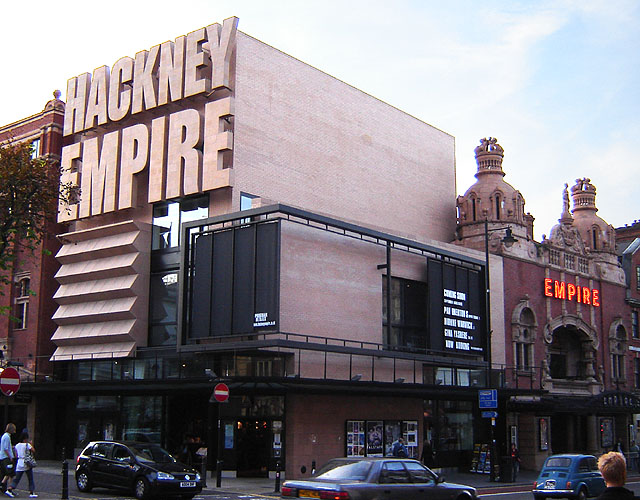
Hamlet at the Hackney Empire review ****

hackney_empire_2

Hamlet

Hackney Empire, 19th March 2018

Working on the premise that it surely is impossible to see Hamlet too often in a lifetime, and keen to make sure the RSC continues to bring as many productions as possible to London, I signed up some time ago for this gig. This despite having already seen the cinema broadcast from Stratford in 2016. A bit excessive I hear you cry. Nope, not when you have an actor as gifted as Paapa Essiedu. His Edmund in the RSC King Lear in 2016 was the best thing about the production, which was pretty good despite some misgivings about the play and Antony Sher’s Lear. Hopefully you had a chance to see him on the tour of this production before it came to the venerable Empire. If you are anywhere near the Kennedy Centre, Washington (DC not Tyne and Wear) in early May I commend you to get along for the last leg of this tour.

There is more to this production, directed by Simon Godwin, than Mr Essiedu however. Mr Godwin has demonstrated that he has a way of breathing new life into classic texts, combining innovation and fealty. (Twelfth Night at the National Theatre review ****). Denmark has been re-imagined as a West African state which yields some interesting insights and a design concept for Elsinore a long way from the usual Northern European Stygian gloom. The programme notes, (I don’t know why people don’t buy programmes, at the very least at the major subsidised theatres, there is so much to learn from them), refer to Hamlet coming “home” after his years studying in Wurttemberg and how he is torn between cultures. There is some mileage in this idea which the production gently explores. There are parallels with Tshembe Matoseh, the main protagonist in Lorraine Hansberry’s masterpiece Les Blancs. No doubt you clever people can think of other theatrical “culture-clash” conceits. Of course transporting the look and the backdrop of the play to West Africa, whilst still retaining a text and characters anchored in Shakespeare’s vague Denmark, throws up a few contradictions but I think that was largely the point. Your man Hamlet after all isn’t short of cognitive dissonance.

So our sweet Prince is already on edge and suspicious of how Claudius came to power. When he sees Dad’s ghost on the ramparts all togged out in tribal chief paraphernalia, in contrast to the modern dress of the present Court, he quickly resolves to action. There is a sense throughout that this Hamlet, whilst not knowing how and when, and running through the gamut of hesitant self examination, is powered by the powerful urge to right a wrong. His feigned madness, his toying with Polonius, the verbal sparring with Horatio, Rosencrantz and Guildenstern, the taunting of Claudius and Gertrude, the carousing with the players, are all in the service of avenging the old fella. The production breaks at the Claudius prayer scene with Hamlet circling in the shadows, gun in hand. I wasn’t sure but I reckon this was only ever going to be a reprieve for Claudius. (Of course I was sure, we all know what happens, but my point is this was a Hamlet who was just gearing up to the main event not a bottler with an uncertain grip on his own reality). “To be or not to be” is a pep talk to self here, not a page from Kierkegaard.

Paapa Essiedu fits this conflicted, mischievous Hamlet like a glove. There is not one single word, let along line, that doesn’t sound entirely right. He doesn’t hang around or over-elaborate, but there is still enough space around the words to take them in. Not the conversational musing of Andrew Scott at the Almeida or the irked ironic philosophising of Benedict Cumberbatch at the Barbican. Just a spontaneous intelligence which makes you wonder why other actors seem to agonise over the right tone to take for this admittedly complicated young fella. His movement and expression is flawless. He can project a single glance to the back of the balcony. He seems to find the shifts from comedy to tragedy, well, just easy. Look out for the laugh he conjures up when pulling Polonius’s body from behind the arras. And I know it shouldn’t matter but it really helps that he is the right age and he is beautiful. PE himself seeming to be a combination of child, student, lover, playboy, artist, he knows enough to question what it is all about, but not enough to buckle under the weight of his own existentialist uncertainties. And, despite all the moping about and hissy fits, you can see why people are really drawn to him and crave his approval.

Compare this to Clarence Smith’s Claudius which is far more old-skool declamatory, though this works pretty well in this context. A far cry from the last time I saw this fine actor as the broken Selwyn in Roy Williams’s brilliant latest play The Firm (The Firm at the Hampstead Theatre review *****). I wasn’t entirely convinced initially by the versatile Lorna Brown’s seemingly withdrawn and inert Gertrude, but this made more sense as the production unfolded and the final death scene was very poignant. He’s still her little boy you see.

In the scenes between Polonius (Joseph Mydell), Laertes (Buom Tihngang) and Ophelia (Mimi Ndiweni) there was a real sense of a loving family, something I had not really felt before. Matching Papa Essiedu’s dazzling performance was a tall order for the rest of the cast but Mmi Ndiweni, (taking on the role from Natalie Simpson in the first Stratford incarnation), came pretty close. The mad scene was both very moving and very scary. Mind you I am a sucker for a distraught Ophelia. And, thanks to both actors, Hamlet’s dismissal of Ophelia, here played out whilst writhing around in bed, actually made sense. Romayne Andrews and Eleanor Wyld as Rosencrantz and Guildernstern struck all the right notes, dislocated in this very different Denmark, and Ewart James Walters turned in some scene stealers doubling as a booming Old Hamlet and a Gravedigger who, judging by his accent, had taken a long way round to get to this particular Denmark.

The production really comes to vibrant life when the colours, sounds and dance of West Africa are brought to the stage thanks to Paul Anderson (lighting), Sola Akingbola (composer), Christopher Shutt (sound) and Mbulelo Ndabeni. The players are no afterthought here. Locating Hamlet’s antic disposition in the artistic milieu of Jean-Michel Basquiat works far better on stage than on paper. You are left wondering if Simon Godwin and the team might have found a few more visual or textual signifiers to flesh out Claudius’s rise to, (diplomatic duplicity alongside an arranged murder?), and fall from, power, and the effect of conflict with the “Norwegian” neighbours, though I get this might have made for an uneasy narrative. It may have helped ease the shift into the bloody carnage of Act V though.

Anyway not quite a perfect Hamlet (play) if such a thing where ever possible. But certainly a near perfect Hamlet (bloke) thanks to Paapa Essiedu. I think I have been guilty of saying too often that I can’t wait to see what xxxx does next on stage in this blog. In this case it is really true and I suspect most of those who have seen this production would agree. On this evidence anything is possible from this rare talent. There are some actors who convince but stay firmly rooted to the stage behind the invisible wall. There are some though that seem to magically come off and out to play to you alone. PE is one of these.




Lord of the Flies at Greenwich Theatre review ****

2422663323_5895cdda0c_o

Lord of the Flies

Greenwich Theatre, 17th March 2018

The second instalment in the Lazarus Theatre Company residency at the Greenwich Theatre and another cracker after their superb Edward II (Edward II at Greenwich Theatre review ****) On the basis of these two the final production of A Midsummer Night’s Dream should be mandatory viewing I reckon.

It is hard to imagine a more fluent adaption of William Golding’s seminal 1954 novel than that penned here by Nigel Williams, originally staged at the RSC and which was superbly revived at the Open Air Theatre a couple of years ago. Now Lazarus Artistic Director Ricky Dukes and his team have a little less budget, and atmosphere, to play with than Timothy Sheader at Regents Park, (with full size BA fuselage wreckage), but, as with Edward II, they make the most of what they have. The cast enter from the rear of the theatre, and sprint up and downstairs for dramatic effect at points thereafter, one side of the stalls, piled up with chairs, serves as the schoolboy’s makeshift shelter, chairs are put through their paces, we get fire, a stuck pig’s head, lashings of blood, and a couple of gasp-inducing coups de theatre. The plastic sheeting which did such sterling work in Edward II gets a workout. What brings it all together though is another superb lighting display from Ben Jacobs.

Mr Dukes opts to cast Ralph, Sam, Maurice, Rodger and little Percival as women but without changing the pronouns. Golding famously remarked that his story could not have happened with girls involved, sex would have predominated. I venture no opinion. The casting does bring an extra dimension as well as some fine performances notably from Amber Wadey as the vain Ralph and Georgina Barley as the cruel manipulator Roger. I was also impressed by the underlying vulnerability Nick Cope found in macho Jack and Benjamin Victor’s messianic Simon.

There are one or two moments where Mr Dukes’s Brechtian reading does come across as a little too “theatre-school” but this is more than compensated by the energy and intelligence he applies. This isn’t a subtle story and the odds are you will be well versed in why it was written and what it was trying to say. In a world where civil society feels as if it is increasingly under the cosh and the “threat of evil” is everywhere, (it isn’t and it doesn’t compared to history, but that is no reason not to be complacent), then Golding’s tale is well worth telling even if we all know how it goes.

And that is the biggest compliment I can pay to Mr Dukes and the young cast at Lazarus. I knew what was coming yet was pretty much enthralled from start to finish. As you will observe from this blog I see a lot of theatre, probably too much. But I don’t see much consistently more exciting than that I saw here. You really do need to seek this company out.


A (flawed) guide to London theatres

5082213817_08e9837e3f_z

When I was a young teenager I took to making up some very odd games. I wasn’t lonely, with a handful of very good friends as I remember, and my very earliest encounters with the ladies were amongst my most successful, since my true nature, an awkward mix of the needy and the misanthropic, had yet to be revealed. I was something of a swot, what you might call bookish and then, as now, was sometimes a little confused by what others did or said in social situations. But definitely not on any sort of spectrum I reckon, beyond that of the awkward 16 year old lad with lank, long hair, (despite the advent of punk), robust flares, bumfluff and the ability to make a pint of lager last a whole evening.

But enacting an entire Subbuteo World Cup, sixteen teams, (these were the days when FIFA could just about control its financial appetites – if you want to see what the future, actually present, of human “governance” looks like, like no further than the masters of the beautiful game), then quarters, semis and a final. All stats carefully recorded in a special notebook. All done on my own. That’s right. I played with myself, (no titters at the back please). Which meant that, whilst pretending to myself that this was an entirely objective exercise exercise, I got to see England play Holland in the final. England because that’s the fiction that is most deep-rooted in my psychology. But Holland won. Retribution for the injustice meted outed in the “real” World Cup final in 1974, (and, though I did not know it, but somehow feared it, again in 1978), and an early indication of my rabid pro-Europeanism.

Sounds a bit weird right. Except that PlayStations hadn’t been invented. So I like to think of myself as an early adopter, not a sad adolescent.

Anyway responsibility, albeit of a most shrunken kind, has meant I have had to let go of such childish things but I still like a good list, dictated by me, which purports to be based on “facts” but is in fact nothing of the kind. Though, as you know, (tautology alert), there are no such things as facts, only theories yet to be unproven, and “information” is mediated, and mutilated, by both provider and consumer. Do not believe anything, least of all if it comes out of your own head. Proud to be a sceptic.

So you can safely ignore what follows.

Since theatre is my current passion, I thought I would tot up the ratings that I had given the entertainments I had enjoyed over the past three years, derive some averages, adjust for frequencies and thereby show what London theatres reliably put on the best work. Thereby confirming my own biases, with my own biased ratings, mashed through a filter of spurious statistical analysis. Just the kind of woeful shite that organisations, opinion formers and your governors do everyday apparently on your behalf.

So here’s my top ten (well eleven actually). Turns out that it is a proven fact (!) that the Almeida under Rupert Goold is the best of the bunch, the Royal Court is a thing of wonder, especially when you reflect on the fact that the work is almost entirely new, and the National Theatre under Rufus Norris is not, repeat not, undergoing any sort of existential crisis, despite what some would say. The trouble with all those right-wing cultural commentators is that they are only happy when they have something to moan about; they can only argue the negative. I hope the Theatre Royal Haymarket continues its more enlightened programming under the new owners. The Young Vic remains the most exciting major theatre, even if that means a few misfires, and the one where I learn the most. The Barbican benefits from the RSC and the International companies that come through the door. The Donmar rarely drops a bollock but here you really have to be quick at the gate to get a seat. The Arcola and The Orange Tree get my vote for best of the fringe, and the Gate for those with more adventurous tastes. The Old Vic doesn’t always belt it out of the park but is pretty reliable.

In fact overall I doubt there is anything here that would surprise the seasoned theatre-goer. thus adding a nice line in utter pointlessness to the sins of commission I have already committed in compiling, and worst still, writing up this list.

There are a couple of lessons though for the more casual consumer of drama. Firstly, do not think for one moment that watching a film or series on a tiny screen can in any way match the thrill of live theatre, and secondly, if you want to avoid being the sap who comments that “I would liked to have seen that but it was all sold out before the reviews appeared … ” or end up paying three times the price for a painfully uncomfortable seat in some West End mausoleum, then sign yourself up to the Almeida, Royal Court and National lists and take the plunge as soon as you seen something half-interesting.

  1. Almeida Theatre 4.33
  2. Royal Court Theatre 3.87
  3. National Theatre 3.81
  4. Theatre Royal Haymarket 3.80
  5. Young Vic 3.79
  6. Barbican Theatre 3.78
  7. Donmar Warehouse 3.75
  8. Arcola Theatre 3.71
  9. Orange Tree Theatre 3.67
  10. Old Vic 3.60
  11. The Gate Theatre 3.60

Summer and Smoke at the Almeida Theatre review ****

1024px-tennessee_williams_by_juan_bastos

Summer and Smoke

Almeida Theatre, 14th March 2018

I don’t always find it easy to get into the “Tennessee Williams zone”. My head takes a little bit of time to adjust to all that dreamy lyricism and I find it easier to stomach if there is something to cling on to, a social structure lurking in the background, the interaction of a few characters such that the usual TW human foibles are spread around a bit, a production that is not overly “directorial”.

The Almeida production of Summer and Smoke didn’t offer too much of what I look for, so I can’t say I was quite as bowled over as some of the proper critics who reckon this production was enough to set S&S, written in 1948, alongside the classic TW’s such as A Streetcar Named Desire which premiered the year before. It is very, very good though and should be seen, if you are sharp enough to snaffle some of the Rush tickets that Almeida offers up for sold-out stuff like this, or if it finds its way into the West End as it might. It is also yet another reminder, if this were needed, for all you casual theatre-goers out there. that it is always worth taking a punt on Almeida productions for fear you end up shelving out twice as much when they transfer, as so many have done under Rupert Goold’s tenure. Romola Garai has already been announced in the lead role of Ella Hickson’s new play The Writer, and you can bet your bottom dollar that they will line up another outstanding female actor to take on the challenge in Sophie Treadwell’s Expressionist classic Machinal. Invest in both I say.

In S&S Patsy Ferran has, deservedly, attracted all the plaudits for her performance as the uneasy and multiloquent Alma Winemuller, alongside the equally impressive Matthew Needham as tall, dark, handsome, and troubled, boy-next-door John Buchanan. I wasn’t entirely persuaded by My Mum’s A Twat, Ms Ferran’s last outing, but there is no denying her comic credentials. This though is her first major opportunity to showcase her “serious” acting credentials and she grabs it wth both hands. Mesmerising. Yet, if you ask me, the real star to emerge here is director Rebecca Frecknall.

Ms Frecknall has directed this very play before at the Southwark Playhouse which went down well I gather, and has already rung up a string of awards recognising her precocious talent. She clearly has a deep understanding of the text and the battle between body and soul, which lies at the heart of the play. The way she has marshalled the contributions of designer Tom Scutt, the sparse set and simple costumes backed by a ring of 9 upright pianos, the lighting of Lee Curran, the sound of Carolyn Downing and, especially, composer Angus MacRae, is what turns this into a great production, despite my minor misgivings about the play itself.

Across two acts and thirteen scenes the play explores the ultimately unrequited relationship between the nervous, conventional pastor’s daughter Alma and the maverick John Jr, who comes home to become, like his father, the town’s doctor. It is set in the first decade or so of the C20 in the backwoods of Mississippi. A study of doomed desire, we see Alma shift from sexual repression to, eventually, abandonment, as John simultaneously grows out of his wild, drunken, early years into something approaching conformity, though his hasty marriage to Rosa, daughter of a Mexican immigrant who runs a casino, isn’t going to end well. There are a few other plot twists and turns, one decidedly dramatic if predictable, but the vast majority of the “action” centres on the will they, won’t they couple.

Of course out of this TW fashions something with limitless emotional depth and the apparent linear arc of the story dissolves into something more timeless and circular. Rebecca Frecknall seizes on this and, rightly. doesn’t let go. She has a keen eye for the best of contemporary theatre direction but offers her own, clear voice. Ms Ferran and Almeida regular Mr Needham are sympathetic to this interpretation, and importantly, to each other, and are aided by some heavyweight supporting performances from the likes of Forbes Masson (who plays both fathers – clever eh) and Nancy Crane and another remarkable turn from Anjana Vasan (who was so very good in the Young Vic’s Life of Galileo – Life of Galileo at the Young Vic review ****), as all the other young women in the story (clever again eh).

There were, I admit, a few moments where the intoxicating combination of TW’s poetry, the warm lighting and the minimalist piano score, felt a little too adagio, but, like I said in the open, this is probably more a reflection of my limited attention span that the artfulness of play and production. If you have ever fallen in love with the wrong, or indeed, the right person, and ultimately bollocksed it up, then you are going to recognise Alma and John, even if their world should seem a long way from ours. And, of course, whatever melodramatic nonsense was playing through the theatre of your mind during your great affair/s, it was going to look anaemic in comparison to the intensity of TW’s vision.

If this is what Patsy Ferran can root out of a character like Alma then heavens knows what we have to look forward to in years to come. Nora, Hedda, Martha, Queen Margaret, Lady Macbeth or a host of, I am sure, stunning parts to be written by the crop of outstanding female playwrights this country is fortunate to have right now. I really cannot wait to see what Rebecca Frecknall turns her hand and eye to next. Presumably she will have another crack at the Almeida. On this showing that nice Mr Icke has some competition.

Girls and Boys at the Royal Court review *****

30495363885_2658ef66a1_z

Girls and Boys

The Royal Court Theatre, 12th March 2018

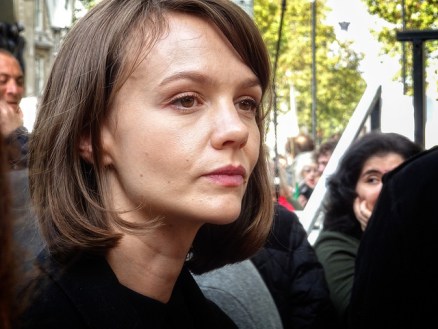
Flippin’eck. That Carey Mulligan can act. I had a fair idea from her turns on the telly and in films. She has an unerring knack of choosing roles in dramas that appeal to myself, the SO, and often both of us, in itself a rare skill. I have never seen her on stage though, having missed the 2015 revival of Skylight, (and been told I was a fool to do so), and her stint as Nina in the RC Seagull some years back, that being a dark period in my theatre-going career.

This is a revelation though. Dennis Kelly’s play, a 90 minute monologue which follows the relationship of an unnamed woman from first encounter to its brutal conclusion, provides plenty of material for her to get her teeth into, but even so, this is jaw-dropping stuff. You might reasonably arraign Mr Kelly’s story for being overly transparent and tendentious, but no matter, the points he makes about male psychology and its propensity to violence are valid even when spelled out this volubly. Ms Mulligan copes effortlessly with the shift from comedy to tragedy. We may guess the form of the tragedy fairly early on but it doesn’t make it any less gut-wrenching and Mr Kelly takes care to disclose ahead of the narrative curve to keep us involved.

The opening anecdote, when She first sees Him shame a couple of queue jumpers at an airport, is genuinely very funny. Carey Mulligan could successfully moonlight as a stand-up on the basis of this scene, impeccable timing and winning glances to the audience. The tone shifts through the recognisable description of the passionate early days of the relationship into marriage, domesticity and the birth and early years of children Leanne and Danny. She blags her way into a job as PA to a development executive’s assistant in documentary film-making, then sets up her own company, wins awards. His business meanwhile fails. He disintegrates.

The story is told through a mixture of “chats” which incorporate Her reflections on his male behaviour and identity, which betray more universal instruction, and “scenes” where She is looking after the two, imaginary kids. The play of the children declares there gender with Danny’s games always informed by violence. These scenes are played out in a contemporary interior lit entirely in pale blue in Es Devlin’s amazing set. We glimpse the true colours only very briefly in the switch from the chats, apart from one or two significantly highlighted objects. This device, together with the somewhat stilted, though still very convincing way that Carry Mulligan “interacts’ with the absent children, is ambitious and striking. It also offers an early clue as to where the drama is heading.

With an actor on this form I am tempted to suggest that the directing task for Lyndsey Turner was made easy. Not so. Mr Kelly’s text contains some remarkable language but the stark message and the “dualistic” structure required careful management to extract the full dramatic power, (and justify the tribute to Euripides), to avoid looking flat-footed.

I suspect that this may prove to be a play that finds it hard to outlive its first performer. We shall see. What I do know is that if Carey Mulligan steps on to the stage again, just go. Whatever she’s in and wherever it is.


Network at the National Theatre review *****

Bryan_Cranston_TIFF_2012

Network

National Theatre Lyttleton, 9th March 2018

Right then. Finally got to see Network. Booked early but this was the first date that BUD, KCK and the Blonde Bombshells could collectively make. A bit nervous because the last time we wheeled the Bombshells out to an Ivo van Hove entertainment it was Obsession at the Barbican which gets more disappointing as time elapses (Obsession at the Barbican Theatre review ***).

You can divide Mr van Hove’s work along three dimensions I reckon depending whether he adopts the “austere, psychologically insightful” or “busy, technological overload” aesthetic, whether or not he works with the Toneelgroep Amsterdam ensemble or other actors, and whether the play is drawn from a classic text or is adapted from a film. Most of the time he hits the jackpot but there is always a risk of disappointment, Obsession, the very dull Antigone a few years ago and the so-so After the Rehearsal/Persona Bergman adaption, being cases in point.

Obviously Network is brilliant. You know that from the reviews when it opened and all the social media buzz. Not just my opinion but the opinion of my guests who were well impressed. Paddy Chayefsky’s 1976 media satire, directed by Sidney Lumet, is a marvellous film. I watched it again ahead of this just to check. Fast-moving, acidic, contemptuous, intelligent, disturbingly prescient, strident, it isn’t subtle but it is hugely effective. I particularly love the performances of Faye Dunaway as Diana Christensen, Robert Duvall as Frank Hackett and Marlene Warfield as Laureen Hobbs.

Now if I am honest Lee Hall did not strike me as an obvious choice to adapt Paddy Chayefsky’s precious script. Then again Mr Hall, the brains behind Billy Elliot, War Horse and Victoria and Abdul on screen, The Pitmen Painters, Shakespeare in Love and Our Ladies of Perpetual Succour on stage, and an adept Brecht translator, is nothing if not versatile. Wisely he and Mr van Hove have elected to faithfully translate most of the vital dialogue from the film, with some minor shuffling between characters. The temptation to tamper with, for example, CCA Chairman Jensen’s excoriating speech about the power of capital, is resisted, as are Howard Beale’s own show sermons. It is unfortunate that the negotiation scenes involving the Ecumenical Liberation Army and the Communist Party of America are abandoned, they tickle me, but something had to give. The relationship between the obsessive TV programming executive Diana Christensen, whose only reference point is her own ambition, and news chief Max Schumacher, is fully preserved as is his wife’s, Louise Schumacher, pain at his betrayal. And all the corporate manoeuvring.

So plot, sub-plots and text vigorously reconstructed, what next? This is where the magic of Mr van Hove and his designer sidekick, Jan Versweyveld, really kicks in. The template they employ is well tested from the longstanding Toneelgroep Amsterdam Shakespeare adaptations, Roman Tragedies, and it more recent cousin, Kings of War. Extensive use of live, on-stage video and video fragments, mixed in real time, a stunning achievement from designer Tal Yarden and team. A thundering soundscape from Eric Sleichim with an on-stage quartet BLINDMAN. Costumes from An D’Huys which are exact re-creations of the mid 1970s setting. There is a “UBS” TV production suite on stage. There is, famously, a restaurant on one side. and costume and make-up desks lurk at the back of the stage. All the guts, the manipulation, of the production are on show and, because key scenes are set in a TV studio, this surely couldn’t be more effective. There is even a slightly time delayed video sequence where Max and Diana stroll along the South Bank with umbrella. (Mind you this couldn’t top the bemusement of some lost tourists caught on camera stumbling across the performance of Bart Siegers, I think, as Enobarbus, in Roman Tragedies, outside the Barbican).

In addition to the thrilling technical wizardry, Mr van Hove, breaks the wall, and ropes the audience in repeatedly as the story unfolds, in the warm-up at the top of the Howard Beale show, when Beale clambers into the audience and, obviously, when the assassin emerges at the end. The messages about the lengths broadcasters will go to to secure ratings, the ugly emptiness of much popular entertainment, the voracious appetite of the capitalist structure which sits behind this, the immorality and venality of those hardened by the system, the co-option of those who purport to stand against it, the alienation that they, and we, experience, ring out load. No updating of the plot required from an analogue to a digital world: the frantic, exhausting hyper-reality of the production does this for us. Remember the film was produced before the rise of neo-liberalism. Paddy Chayefsky died in 1981. If he was angry then, he’d be bloody livid now.

OK so there are one or two moments when being bashed over the head by this story and this production is a little tiring. But that I suppose is exactly the point, and you can chew more slowly on the content after the fact, as we have been doing.

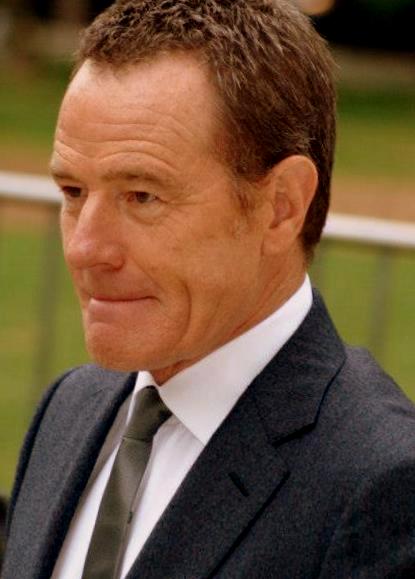
As if this wasn’t enough we have an astonishing performance from Bryan Cranston as Howard Beale. Casting him looks to have been the most inspired of a string of inspired decisions around this production. Now as I understand it, Mr Cranston spent many years as a moderately successful jobbing actor before his turn in Malcolm in the Middle (never seen it), and then, famously, Breaking Bad. I generally can’t be doing with these TV series, preferring to see my pleasures in more concentrated form, as should be clear from this blog. However BB was an exception though it did test my patience at times across the 60 odd episodes. Still it is rare to see such a complete portrayal in any dramatic medium.

For me BC betters Peter Finch’s screen Howard by appearing to retain a better grasp on the forces around him. That is not to say that BC doesn’t show Beale’s mental collapse, just that, once his albeit damaged mind is made up to preach his disgust, he summons up a strength that Mr Finch’s more prophetic Beale lacks. The shift in Beale’s rhetoric post the meeting with Jensen is actually more satisfying on stage. Mr Cranston is riveting in the video close-ups as Beale moves from resignation, to desperation, through wild anger, and on to zealotry and an almost gnomic mysticism.

Michelle Dockery’s Diana is not quite as emptily amoral as Faye Dunaway’s on-screen version, but the relationship with Douglas Henshall’s Max just about works. The collapse of his shallow idealism is matched by his pathetic attempts to secure her empty affection. She never cares, he knows this from the start, he stops caring, in the end neither one of them cares. Beverly Longhurst, as Louise Schumacher, standing in for Caroline Faber gets to deliver the only really compassionate lines in the production when she boots him out. You should be very afraid of Richard Cordery’s Arthur Jensen, that’s what the men consumed by power at the top are like. I was also much persuaded by Tunji Kasim’s Frank Hackett, but frankly barely anyone puts a foot wrong here. Just as well, it would have been chaos if they had.

At its heart I think Network is a plea for our shared humanity not to be broken by an economic complex which seems to be beyond our understanding and influence, and not to be bullied and sedated by technology. What better place to do that than in the elemental forum for shared experience which is the theatre.

Beware the Infotainment Scam people. Mind you I might just have been scammed by Mr van Hove and his collaborators. It felt good though.

Frozen at the Theatre Royal Haymarket review ****

frozen-water-drops

Frozen

Theatre Royal Haymarket, 8th March 2018

I see the Theatre Royal Haymarket is up for sale. Or rather a 70 year odd lease from the Crown Estate, a pernickety landlord, but one who has preserved the beautiful Nash terraces around Regents Park, and is slowing upgrading the built environment along Regent Street which looks a lot less sh*tty than it did 30 years ago.

I would love to buy it but I guess 20 quid won’t cut it. I assume that one of the big West End theatre companies, ATG, NIMAX or Delfont Mackintosh, will get its hands on it. I hope the new owners don’t tamper with the repertoire too much though I guess the family wouldn’t be selling up if they were minting it. A London home for that part of the RSC’s output which doesn’t get taken to the Barbican, and an opportunity for established directors and big name actors to tackle slightly more challenging work. Like Albee’s Goat last year (The Goat, or Who is Sylvia at the Theatre Royal Haymarket review *****), the less successful revival of Venus in Fur and now Bryony Lavery’s challenging Frozen. In years gone by we’ve had some Bond, Beckett, Shakespeare and Stoppard. Looking forward we have the Maly Drama Theatre of St Petersburg bowling up in all their splendour and a French/English Tartuffe.

TRH, along with the Harold Pinter Theatre just round the corner, (ATG, and hosting the transfer of the the NT production of Nina Raine’s Consent from 18th May with a new cast), the Wyndham’s (Delfont Mackintosh) and the Garrick (NIMAX) at the bottom of Charing Cross Road, as well as the Duke of York’s (ATG) and Noel Coward (Delfont Mackintosh) next door on St Martin’s Lane, are pretty much all you need in term of “proper” theatre in the West End, including most successful transfers from the subsidised sector. Maybe the Playhouse (ATG) and the Gielgud (Delfont Mackintosh) as well.

The Grade 1 listed Regency TRH though is my favourite. The stuccoed front elevation looks like the real deal with its beautiful portico with six elegant Corinthian columns. The theatre was designed by none other than John Nash and dates from 1821 having replaced the previous incumbent which was built in 1720. It acquired its royal patent in 1776 joining its namesake in Drury Lane and the Royal Opera House. We were lucky enough to see Ian Kelly’s Mr Foote’s Other Leg with Simon Russell Beale in 2015, at the Hampstead Theatre, not here, which tells the fascinating story of the TRH’s founding.

The bars in the TRH don’t look like an afterthought, loos are adequate and legroom is very good throughout. The Tourist has found plenty of lovely seats, from the 900 or so total, to suit his needs here, something he can’t necessarily say about the other theatres mentioned above. Outside of the balcony, the seats are comfy and in everything bar the very back of the stalls, and one or two by the wall in the dress circle, sight-lines are very good. The space is airy enough to accommodate the gold-leaf plastered on every surface of the beautifully maintained neo-classical interior, and the blue upholstery creates a much more balanced aesthetic when compared to bog-standard red.

So any theatre buyers reading this, by which I mean buyers of theatres, not tickets, I would snap up the TRH, however onerous the lease clauses.

What about Frozen I hear you ask. I will resist the urge to make the customary joke about kids getting a little bit confused by the absence of Queen Else belting out Let It Go. For Frozen, as I am sure you know, deals with a serial killer, Ralph played by Jason Watkins ,who sexually assaults and murders Rhona, the 10 year old daughter of Nancy, played here by Suranne Jones. Our speaking cast is completed by Nina Sosanya who plays Agnetha, the American psychiatrist who studies the case. The play essentially asks whether those who commit such crimes are born “evil” and whether they can, in any way, be forgiven.

So it is strong stuff and director Jonathan Munby and designer Paul Wills don’t pull any punches. Ms Lavery’s play was lauded when it first appeared in 1998 at the Birmingham Rep and garnered awards at the NT in 2002 and on Broadway in 2004. It hasn’t popped up again in London, perhaps not a surprise given the sIt is very well researched and emotionally powerful as you would expect though it does come over as a little calculated, with the Agnetha character slightly forced. When it is good though, it is very, very good. It is constructed initially from short monologues, later moving to dialogue between Agnetha and Ralph as she studies him, a meeting between Agnetha and Nancy and finally a meeting in prison between Nancy and Ralph himself where she offers forgiveness.

None of this would work if the audience were not totally convinced by Ralph. It probably isn’t any surprise that Jason Watkins delivered. I don’t mean to suggest that this will have been an easy role for him to inhabit, just that his TV performance as the teacher Christopher Jeffries who was wrongly accused of murder, suggested to me that his technique might prove suited. I was not however prepared for just how good he is in this. With his flattened West Midlands vowels, his false pride in his “logistical” skills, his pedantic explanation of events and his extreme temper he seemed to me to be the embodiment of the “banality of evil”. He is chilling, yes, undeniably odd, but also believably humdrum and, on the surface, quite affable. Detail after detail, his description of the van he uses to abduct his victims, the way he engages them in conversation, the appalling scene where he is displaying his paedophile videotapes, the explosions of anger in prison, leave the audience revulsed, of course, but compelled to watch more.

It is hard for Suranne Jones to match this. The play probably works better in a much smaller space. Director, and the design team, understandably want to fill the TRH stage, conjuring up projections of brain scans, assorted “frozen” images, ghostly images of Rhonda, and the like, wheeling props on and off with each scene change, as well as some unsubtle soundscapes. This all proves a little too bold I think, and Ms Jones has the most difficulty in projecting the incomprehension and grief that consumes Nancy for over twenty years, out into the audience. It is a bit easier for Nina Sosanya to highlight Agnetha’s contention that Ralph’s behaviour reflects his damaged neurological make-up, given much of this is delivered in the form of imagined scientific lectures. She also has some opportunity to show lighter moments, though we learn later on that she too is grieving over her own loss.

So no doubt this is a very good play, sympathetically delivered by a fine trio of actors. The direction might be a little heavy handed, and the space a little cavernous for what is an intense, episodic chamber piece, but it is well worth seeing. Particularly if you snap up some of the cheaper seats on the day. Just make sure everyone in your party is up to speed on the content.


Napoleon Disrobed at the Arcola Theatre review ****

Jacques-Louis_David_-_Napoleon_Crossing_the_Alps_-_Kunsthistorisches_Museum

Napoleon Disrobed

Arcola Theatre, 7th March 2018

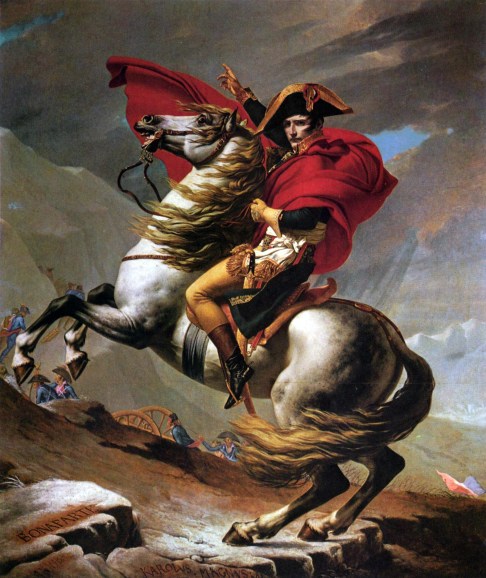
Here is JL David’s preposterously heroic painting of Napoleon Bonaparte Crossing the Alps. The Napoleon of Simon Ley’s alternative history The Death of Napoleon, is of a somewhat different hue. Ley’s novella, his real name was Pierre Ryckmans and he was a Belgian academic specialist based in Australia, imagines NB is smuggled out of St Helena, returns to Paris via Antwerp, and attempts to hook up with the faithful in order to mount a comeback. It all ends rather more prosaically.

This novella forms the basis for this play-ful diversion from Told By An Idiot. co-produced by Theatre Royal Plymouth. Told By An Idiot exists to put the fun into theatre so it is easy to see why this story, about an extraordinary man rendered ordinary and having to deal with the consequences, attracted them. When I say them I mean two gifted Hunters: Paul Hunter co-founder and driving force behind TBAI, and here our Napoleon, and director Kathryn Hunter, theatre’s acting chameleon, last seen in the Emperor at the Young Vic.

The final, and, for me, most valuable contribution however, came from Ayesha Antoine, who plays … everybody else, including Ostrich, the young woman who proves NB’s salvation. The play kicks off with some gentle, and very funny, Napoleon related banter with the audience from Paul Hunter. We cut to the escape from St Helena, NB masquerading as Eugene Lenormand, brought to life with a few well chosen props, the first of a dizzying number of costume changes from Ms Antoine, and the unpinioning of Michael Vale’s raised platform set to create the swelling sea. Sight gags, aural interruptions, wordplay and anachronisms a plenty, take us energetically through NB’s missed meeting with the Bonapartistes in Bordeaux, his train journey from Antwerp and his rendezvous with widow, single mum and melon shop owner Ostrich. The tone then shifts from the affectionately comic to the comically tender as NB abandons his ambitions and his destiny, his double on St Helena having pegged it early, to settle down with Ostrich, whoever she might be.

This is a piece that revels in the artifice and wonder of theatre which delivers more than you might expect or deserve. It might not quite deliver the contemplations on identity and freedom that the director might have imagined, is NB really who he says he is?, but you would have to be a serious miserabilist not to be won over by this. Plainly I am not as miserable as I think I am.

The Weir at Richmond Theatre review ****

Marsden_Weir,_Goulburn

The Weir

Richmond Theatre, 2nd March 2018

I am jealous of anyone who has never seen Conor McPherson’s 1997 play The Weir. They have something special to look forward to. I last saw it at the Royal Lyceum in Edinburgh at the beginning of 2016 in a fine production directed by Amanda Gaughan with a wonderful cast of Brian Gleeson, Frank McCusker, Lucianne McEvoy, Gary Lydon and Darragh Kelly. You might think that, given its structure, a series of memorable disclosures over one evening in a pub in Ireland, this was a play which might not warrant repeated viewing. You’d be wrong. I haven’t yet seen any of Conor McPherson’s other plays, bar one, which I hope to correct, but I can guess why this remains the favourite and most oft-performed.

Now Mr McPherson is currently packing them in, and getting award nominations, with Girl From the North Country at the Noel Coward Theatre having transferred from the Old Vic. (Girl From the North Country review ****). He is fortunate in his choice of musical collaborator, a certain Mr B Dylan, and his cast, notably Sheila Atim, Shirley Henderson, Ciaran Hinds and Arinze Kene, but these are his stories, his words and his direction.

For telling stories is what he is good at. Mind you he is in pretty good company. What is it that makes Ireland, per capita, the most talented country in the world when in comes to the dramatic word. This is a wild, unproven assertion, but you take my point. Farquhar, Goldsmith, Sheridan, Synge, Shaw, Wilde, Boucicault, Yeats (he founded the Abbey), Beckett, Behan, Friel, O’Casey, Walsh, Carr, McDonagh (alright he’s not really Irish). And that’s just the ones whose work I have seen. There are tons more.

Maybe it’s the education system, (which champions the word over other art forms), the civil structure, the pub culture, the craic. (I really do not mean to offend with gratuitous paddywhackery here). Maybe its the Catholic Church which tells a lot of lurid stories. Maybe its the long, and deeply held, oral tradition. Maybe it simply reflects past success. Irish writing outside the dramatic form also excels in the short story and the episodic. Maybe its the breadth of the diaspora. If you go round the world you have a lot of stories to tell. But none of this is particular or peculiar to Ireland and, anyway, such generalisations are surely slightly patronising.

Whatever the reason we should all be grateful and The Weir reminds us why. It’s a cold, windy night. Garage owner Jack, (veteran Sean Murray who I think has the juiciest part), comes in to the village pub, (perfectly realised in Madeleine Girling’s set), and pours himself a drink. From a bottle after tetchily discovering the Guinness tap is off. Eventually Brendan, (here charmingly played by Sam O’Mahony), comes from the house behind and officially opens his bar. They chat about their day. They are joined by mild odd-job man Jim (John O’Dowd) and they discuss the arrival of Valerie in the village. Finally local boy made good businessman Finbar (Louis Dempsey) arrives with Valerie herself (Natalie Radmall-Quirke, who is the only member of the cast I had seen before, in Cheek By Jowl Winter’s Tale). Valerie is renting a house and Finbar is showing her around, as she moves from Dublin. Jack and Finbar start verbally sparring with each other, Jack plainly jealous of Finbar’s success and Finbar overly cocky. This is in part a display to impress Valerie. We know these people even before the four mysterious supernatural stories emerge in succession. After the stories, we know them even better.

I’ll stop there in case you haven’t seen the play. Suffice to say all human, and beyond, life is there in the words of the five characters over 100 minutes or so. It is rooted in rural, Irish life, and there is no action to speak of, but at this performance, like I suspect all other performances, the audience is transfixed, so clearly Mr McPherson has tapped into universal truths. Myth is a powerful force in Ireland, and Mr McPherson is not the first of his countrymen to incorporate it into his plays, with Brian Friel an arch exponent for example. Others have also borrowed from the tradition: most recently Jez Butterworth in The Ferryman. Yet The Weir has a kind of special power because the stories are simultaneously extraordinary and day-to-day.

Moreover it isn’t just the monologues that suck you in. The dialogue is also compelling. These are lives lived, funny, sad, tender, sometimes desperate, filled with memory. Drink is an equivocal lubricant, opening the characters up and exaggerating emotions. I haven’t had a drink in years (don’t ask) but The Weir reminds me what I am missing. For despite the intimation of lives that have been blighted by sorrow or frustration these people seem to have had an enjoyable, fruitful evening in each other’s company. Think about it. One way or another your best memories will probably involve having a laugh or a heart to heart with friends. That’s life.

A superb play very well realised by the cast and director Adele Thomas. There were one or two moments where the transitions where a little ticklish, and the fading of the lights into the stories was a bit obvious, but it doesn’t really matter. When a play is this good, and the cast this attuned, then it can only be a success. This English Touring Theatre and Mercury Theatre Colchester co-production is nearly done I am afraid, just a couple more nights in Cambridge, but I see ETT’s next production is A Streetcar Named Desire. If it is coming anywhere near you I would seek it out based on the handful of ETT productions I have seen to date.


Smile Upon Us Lord review at the Barbican Theatre review ***

Здание_Государственного_академического_театра_им._Евг._Вахтангова_01

Smile Upon Us, Lord

Vakhtangov State Academic Theatre of Russia, Barbican Theatre, 1st March 2018

OK. Sometimes you just have to accept that an artistic endeavour is a bit beyond your reach. For whatever reason it just doesn’t click. That is what happened here with Smile Upon Us, Lord. There was much to enjoy visually, there was the bones of an interesting story and there was the rare opportunity to see some of Russia’s finest stage actors perform. But there just wasn’t enough there for me to really engage with so ultimately I was unmoved. Not indifferent. Just unable to fully grasp what I was being shown. No matter.

Turning up to productions at the Barbican performed by renowned theatre companies from around the world, the Netherlands (Toneelgroep Amsterdam), Australia (Malthouse), Germany (Schaubhne Berlin), Japan (Ninagawa), has proved a profitable strategy recently. The Vaktangov State Academic Theatre of Russia was hugely acclaimed last time they popped over to perform an adaption of Pushkin’s Eugene Onegin and, prior to that, an unconstrained Uncle Vanya. Well maybe not popped over given the huge ensemble and tons of kit that comes with them. Anyway I missed both of these because a) I am an idiot and b) it all sounded a bit intimidating. Armed with greater knowledge, more time and a new-found enthusiasm for all things theatrical I wasn’t about to make the same mistake twice/thrice. The house was packed with a welcome contingent of Russian speakers, Russophiles and students of Russian culture, and, maybe, expat Lithuanians as well.

For, as it happens SUUL is actually based on two novels, A Kid for Two Farthings and Smile to Us, O Lord by the pre-eminent Lithuanian writer Grigory Yaakov Kanovich. He was born into a traditional Jewish family in Lithuania. escaped with his parents in WWII seeking refuge in Kazakhstan then Russia, before returning to Vilnius. He has written more than ten novels which document the history of Jewry in Eastern Europe from the C19 through to the present day., as well as stage works and screenplays. He has been awarded numerous prizes, medals and prestigious awards in Lithuania and he now lives in Israel.

Now it transpires the Artistic Director of VSATR is also Lithuanian, Rimas Tuminas. The germination of SULL began in the 1990s with a plan to shoot a film. Presumably the theatrical potential was recognised as certain of the story lines were drawn out and as Mr Tuminas and his creative team worked with his Russian cast to create what we now see. The story starts in a shtetl, “small town” in Yiddish, a part urban, part rural Jewish community which was largely wiped out by the Holocaust. Efraim Dudak, an irascible stone-cutter played by Sergey Makovetskiy on the night I saw it, receives a letter informing his son is to be tried and potentially executed for an attempted political assassination in Vilnius. He resolves to go to see him leaving behind his beloved she-goat played by Yulia Rutberg (yep, that’s right, she played the goat like a slow-waltzing Miss Havisham). He is joined by water-carrier Smule-Sender Lazarek, (Evgeny Knyazev), and eccentric depressive Avner Rosenthal, played by Viktor Sukhorukov, (the pick of the seasoned cast), who has been reduced to penury after his shop burned down. The journey is hazardous, there are wolves, bandits and soldiers, and unpredictable and they meet a fair few rum characters along the way, including a “blind” con-man (Victor Dobronrarov) and an enigmatic “Palestinian” Grigory Antipenko

A kind of jaunty Beckettian road-trip if you will. Without maintained roads, and just a horse and cart, conjured up in a hugely imaginative way by designer Adomas Jacovskis. Now early C20 Jewish life in Lithuania is, it will come as no surprise, a world that is unfamiliar to me, and it was intriguing to see this conjured up on stage. This was overlain with a lyrical, poetic story with much philosophical musing from our heroes. There is humour tinged with despair, magic and banality. It is meandering, discursive and there is not much in the way of plot. Some of this connects, some of it, frankly, does not, there may well have been allusions that went right over my head, but there is just about enough impetus to keep the whole thing trundling on, much like the cart.

Am I glad I saw it? I think so. Would I see it again? I’m not sure. Did I really understand it? No. Is it worth getting wound up about it? Certainly not. Life is too short for low-level regret.