
OthelloMacbeth at the Lyric Hammersmith review ***

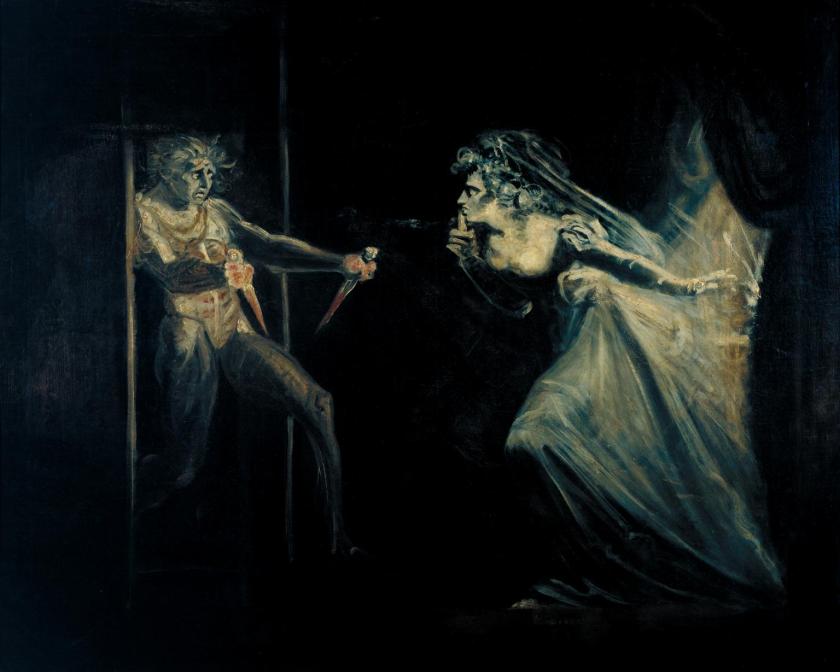
Lady Macbeth Seizing the Daggers ?exhibited 1812 by Henry Fuseli 1741-1825

OthelloMacbeth

Lyric Hammersmith, 8th October 2018

OK so this has its moments. By splicing together Othello and Macbeth, excising out extraneous context, sub-plot and characters, director Jude Christian has largely succeeded in achieving what she set out to do. That is to recast the two famous tragedies from the perspective of the female protagonists, Desdemona, Emilia and Bianca, the Ladies Macbeth and Macduff and, with a twist, the Three Witches. Without messing too much with the main plots. And with some occasionally breathtaking transfer of lines from one play to the other. However it is the Macbeth half that gets the best of the treatment, in large part because it benefits most from Basia Binkowska novel set design as it opens up. And this is definitely not for the purists who relish the verse. (I overhead some grumbling on the way out).

In part this reflected the cuts, in part the slightly uneven verse delivery on show and in part what happens when the psychological insight offered up by Shakespeare’s “roundest” characters is sold short. Samuel Collings as Iago/Macduff and, especially, Ery Nzaramba as Othello/Banquo had the most to lose. On the other hand there was much to learn from Kirsten Foster’s alert Desdemona and Caroline Faber’s measured Lady M, and the Witches, our two/three murdered/abused women from Othello. For this conceit, their revenge, as they unleash Lady M’s “unsex me now” monologue, and strumming on high pitched wires, is both clever and, in part, insightful.

Nagging away at me though is the belief that Shakespeare did offer up multiple vistas into what these women saw and felt whilst still getting on with the business of showing us that ambition, violence and jealousy are intrinsic, if ugly, facets of the human condition. I am not arguing that Shakespeare’s treatment of his female characters should be excused, the body count and violence meted out to them, tells its own story, just that, as in some much of his writing, there is insight and ambiguity when you look for it. And at least he has the excuse of history. The men today who continue to “fridge” women do not. After all Jude Christian in this mash-up, by using WS’s lines, is only highlighting what is already there in the text.

The cur-down version of Othello doesn’t need to tell us why “the Moor” is so hated, nor to have Iago poisoning his and our ears, but without it they come across a bit cartoonish. They are basically wankers from the off. The harsh brushed metal wall, there to mask the Macbeth reveal, only serves to highlight the static staging, and rushed delivery, with very rapid jump–cuts, of the first half of the first play. It does heat up post hanky mind you. Sandy Grierson squeezes a lot out of Cassio as do Kezrena James as Bianca and, especially, Melissa Johns as a blunt no-nonsense Northerner Emilia, who can sense what is coming. But this is maybe more to do with the “air-time” they have relative to standard interpretations rather than the actors really finding something new to say in the characters.

Sandy Grierson’s Macbeth does convince, because we know what to expect, because the call-back is more profound, because his is a fine performance and because the relationship with Caroline Faber’s Lady M stacks up. The early filleting of the text is less distracting, the motives of the power couple are still examined. Ms Faber makes chilling sense of the final Othello speech which falls to her. Even so at the end of the day it is Lady M who hatches the murderous plan, even if the narrative here is revenge for the wrongs of the first half. Once again I think there is more than enough complexity in Lady M as written by the Bard to make Jude Christian’s re-direction superfluous. Watch Judi Dench at work if you don’t believe me.

So a successful exercise on its own terms. I am just not sure that those terms were entirely necessary. New plays by women, telling women’s stories, with women creatives, would be more fruitful I think. (Lela & Co by Cordelia Lynn for example which Jude Christian directed). Or Jude Christian let loose on either one of this plays. Or a Caryl Churchill classic for example. This strand of wilful innovation has dogged the last few years of Sean Holmes’s stewardship of the Lyric. It hasn’t always worked as here. It will be interesting to see who, and what, comes next. It is a lovely theatre, thanks in large part to Mr Holmes’s industry, which deserves the best.


 

My Mum’s a Twat at the Royal Court Theatre review ***

methode2ftimes2fprod2fweb2fbin2fbc4692b8-f61d-11e7-a789-003e705b951e

My Mum’s A Twat

Royal Court Theatre, 16th January 2018

I am a fat bloke with a dodgy heart and a sore back in his 50s. So I should not be swanning around London without a care in the world hoovering up culture to make up for lost time. I should be grinding away engaged in pointless labour for 12 hours a day to ensure late Western capitalism can continue to eke out basis points of economic growth. “Growth” that is only secured by measuring the wrong things or by mortgaging the future. But, in some unseemly regress to my student and early post student years, that, (the swanning), is what I am doing.

Which in turn means I end up seeing theatre where I am plainly not the target audience, surrounded by youngers who could be my kids, on seating which has not been designed with me in mind. There is an excellent tendency amongst the most progressive theatres, the Gate, the Young Vic, the Royal Court, in London to incorporate the audience seating into the set design. I probably had a lucky escape from The Jungle at the Young Vic recently, (no allusion intended), as I was unable to make the booked date. From the sound of it that was a cultural loss, given the sparkling reviews, but a medical gain as the chances of me sitting for an hour or so on a cushion without the entire audience sensing my discomfort was miniscule.

And so to My Mum’s a Twat where a quick scan on the way in saw me quickly bypass the floor cushions and opt for the sturdiest wooden chair I could find, which just about did the trick. Now to be absolutely clear I am not moaning about any of these design concepts. Quite the reverse. Bringing the audience in, rather than shutting it out, can only be a good thing. And, at the end of the day, if I could just lay off the pies, the discomfort could be dialled down. No, this is simply an awkward, space-filling preamble to the bland realisation that My Mum’s a Twat may not have been for me.

Which is galling in so many ways. The Girl in this 75 minute monologue was played by my favourite stage pixie, Patsy Ferran. By my calculations you could secure maybe 4 Patsys for every 1 of me. And since Patsy Ferran delivers more joy in 30 seconds of stage performance that I could muster across several lifetimes, (even learning from my mistakes), then this would be a very valuable trade. She was the stand-out actor in Polly Findlay’s As You Like at the National in 2015 and in Ms Findlay’s most recent RSC Merchant of Venice. And her turn in Blithe Spirit in the West End a few years ago near upstaged some way more venerable colleagues. I note she is set to take the lead in the Almeida’s forthcoming TW’s Summer and Smoke – can’t wait.

Anyway she was made for this part. This debut play by Anoushka Warden, (whose day job is schmoozing the press for the RC – good on her), is a forthright memoir of the Girl’s childhood after her Mum and partner join a ropey (“batshit crazy”) cult. She tells tales of her siblings, her stepdad (“Moron”), Mum obviously, (the twat), the pious cult leader (sorry can’t remember her name), her Dad, who she eventually rejoins after Mum and stepdad move to Canada to set up a new outpost of the cult, her friends, drugs, sex, music. In fact all the things you would expect from a memory play about childhood and teenage years. It is not too gentle though it is pretty funny, and it captures many of the pleasures, the disappointments, the self-absorption, the bedroom rebellion, of those years. At its heart lays the bond between the Girl and her Mum, despite the nonsense that her Mum subscribes to in the cult.

I wished it had gone a little bit darker, especially into the workings of the cult. The story would allow that, the anger is rooted, but Ms Warden’s writing defaults back to comedy. And it might have benefitted from a little more surprise and revelation along the way, especially towards the end, where it becomes a little bit “teenage rebel” predictable. It does though have moments of real insight and acuity which expand beyond the specific’s of the Girl’s story and it serves as a perfect vehicle to showcase Ms Ferran’s undoubted talents. Some actors recede from the memory post performance, some actors intensify. Patsy Ferran is one of the latter.

Seating aside, Chloe Lamford’s teenage bedroom design is a winner, and Ms Warden has secured the services of, not one, but two, of our finest directors in boss Vicky Featherstone and Jude Christian. Ms Christian directed Parliament Square at the Bush and in Bath (Parliament Square at the Bush Theatre review *****), to thrilling effect, and Bodies (Bodies at the Royal Court Theatre review ****) in this very space. Next up she will be bringing Trust to the Gate Theatre. A post-theatre, dance based German-Dutch collaboration having a pop at global capitalism, in the tiny Gate space. It will either be genius or ludicrous. Probably a bit of both.

Parliament Square at the Bush Theatre review *****

parliament-square

Parliament Square

Bush Theatre, 6th December 2017

As a few slightly unkind people have pointed out most of the “reviews” I somewhat sadly post on this “blog” are worse than useless as, more often than not, they appear after the event. Fair criticism but I can’t be toddling off to everything in the first week and I judge that most plays at least are best seen about two thirds of the way through. If they have flaws by then, they can be corrected where possible, or parts excised if really necessary. Cast can get the full measure of character and interaction, timings, pauses and rhythm honed. So I reckon I will get more for my money. So yah boo to you.

In this case though I am doing you a favour. Parliament Square runs until 6th January having first appeared at the Royal Exchange, Manchester, there are plenty of tickets left and full price is just twenty quid. The main space at the Bush is airy, comfy and sightlines are terrific. Oh and it is a mightily good play, with an excellent cast, skilfully directed by emerging talent Jude Christian. It has an absorbing central concept, just how far will an individual go to protest against injustice, is formally inventive, each of the three sections has some sort of clever conceit, and it is very well written by James Fritz. It is probably fair to say that the ending is a little too calculated. On the other hand the first section, in large part thanks to exceptional performances from Esther Smith and Lois Chimimba, is as exhilarating a piece of theatre as I have seen this year.

The play won the Judges Award for Playwriting in the Bruntwood Prize in 2015 and, like other plays I have seen which have been recognised here, it has that spark of invigorating originality from the outset which characterises the best new writing. Kat (Esther Smith) gets up one morning, skips work, leaves her husband and young daughter behind, gets the train to London, and commits a premeditated, dramatic, act of self sacrifice. Through the first act, Fifteen Seconds, she is, literally, coached by her conscience in the form of Lois Chimimba, (last seen by me in the unfairly maligned Common, in Peter Pan and in the excellent Diary of A Madman at the Gate). Lois Chimimba also doubles up as Jo, Kat’s sullen teenage daughter in the final act, Fifteen Years. I expect she, and Esther Smith, will go on to bigger, (and maybe even better), things as they are both superb actors.

Kat “fails” in her protest thanks to an intervention by Catherine, another excellent performance from Seraphina Beh. In the second act, Fifteen Steps, we see Kat, vividly and painfully, reconstructing her life and explaining why she did what she did to husband (a perplexed Damola Adelaja), mother (a bluntly perceptive Joanne Howarth) and health professionals (a sympathetic doctor in Jamie Zubairi and demanding physiotherapist in Kelly Hotten) as well as, eventually, to Catherine herself. The rest you can see for yourself.

James Fritz’s writing is very spare but very accurate. We never get to know exactly what Kat is protesting against but it doesn’t matter. We do get to contemplate why someone might choose this idealistic course to try to make a difference, why some might be inspired and some revulsed and why some might see this as futile and selfish. Jude Christian’s direction, (along with Fly Davis’s design, lighting from Jack Knowles, sound from Ben and Max Ringham and movement from Jennifer Jackson), is perfectly matched to the text. There is nothing extraneous here but the required ambiguity about the wisdom of such action is brilliantly conveyed.

James Fritz’s previous plays (The Fall, Comment is Free, Ross and Rachel and Four Minutes and Twelve Seconds) have garnered significant acclaim. I can see why. This is great theatre, well executed. You will come out likely annoyed by some of the behaviour of the characters, but, that is kind of the point given the subject. I think you will admire both writing and acting though. So get along to the Bush. Now.