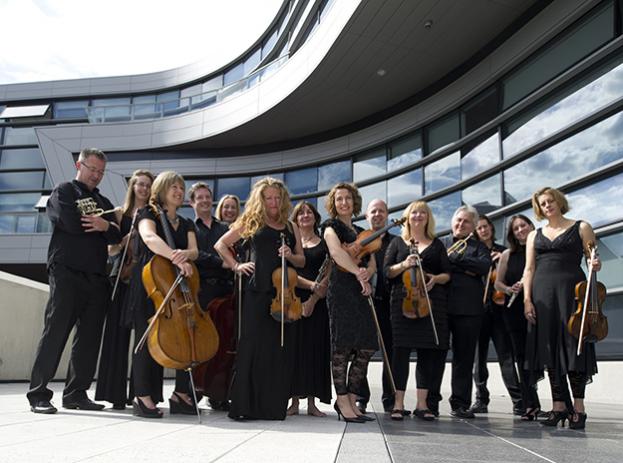
Britten Sinfonia and Thomas Ades at Milton Court review *****

brittensinfonia_625

Thomas Ades, Gerald Barry, Britten Sinfonia

Milton Court Concert Hall, 30th May 2017

  • Beethoven – Septet in E Flat Major Op 20
  • Gerald Barry – Five Chorales from the Intelligence Park
  • Beethoven – Piano Trio in E Flat Op 70/2

I’m guessing that composer heaven is a miserable place. All those blokes (the world of classical composition, at least until the mid C20 is, like pretty much every other sphere of human activity, a damning indictment of the patriarchy), sitting at their pianos with a rictus grin unable to conceal their seething of the one bloke who wears a permanently beatific smile. He is called Ludwig van Beethoven and he is smiling to himself (cast that famous scowling portrait of him out of your mind) because he knows he is better, way better, at his job that all the rest of them. And they too know it.

I suppose it is possible to spend a life without Beethoven. I might have done and I know plenty of people who do. And I realise how much of a pretentious pr*ck I sound for saying it. And that I am implicitly asserting the cultural supremacy of Western and “high” art by doing so. This is not my intention. The thing is, his music is just so very, very good. Pulse, beat, rhythm, melody, harmony all perfectly laid out. To quote the zeitgeist there is always an “emotional journey” in our Ludwig’s pieces, sometimes trivial, sometimes on a grand scale. But more importantly there is musical logic. I can’t read music and don’t really understand the language. But I know that this music is, at its best, perfect and can conjure up that sensation of “nothing else mattering but the music” like nothing else.

So I was looking forward to my week of concert going which was basically just one long Ludwig love-in, largely, though not exclusively, in the company of Thomas Ades, and his fellow contemporary composer, Gerald Barry. Mr Barry is a self-confessed Beethoven nut. Mr Ades, whose work betrays his chameleon-like snaffling of the history of Western art music culture, is also a champion, as revealed by this three year cycle of Beethoven symphonies with the Britten Sinfonia, which has just kicked off. I really like Mr Ades as a composer, witness my review of the Exterminating Angel below. But now I have been bowled over by his skill as a performer and conductor as well.

The Exterminating Angel at the Royal Opera House review *****

This chamber concert ahead of the symphonies, kicked off with Beethoven’s Septet. Old Ludwig gave this a right pasting in his life-time as he considered it a bit of a trifle compared to all his later “serious” stuff. Far be it from me to disagree but I think he was wrong on this. It certainly easy on the ear with six movements all based on dance forms, and it unmistakably still Classical, but it is still full to the brim with ideas. Direction is provided by the solo violin and here Thomas Gould was excellent, supple, yet still candid, in his playing.

Mr Ades and Mr Barry then took to the floor for a two piano version of Five Chorales from the Intelligence Park, Mr Barry’s first opera. I have seen performances of his last two operas, The Importance of Being Earnest and Alice’s Adventures Underground (semi-staged and conducted by …. one Thomas Ades), and I bloody loved ’em. Anyone who thinks contemporary opera isn’t for them should see Importance – it is a hoot.

Anyway this piano piece delivers excerpts (literally) from his earlier opera which showcase his rhythmic power and use of comfortable dissonances contrasted with quieter, simpler, almost lyrical passages. It is this bold rhythmic attack that I like as well as the bawdy humour that seems to break out. Mr Ades composes in a similar vein even if the influences are a little more diverse. Their music doesn’t require a PhD to grasp and there is far less of that long, drawn-out, slow movement, plinky-plonky, atonal musing that has turned me off other contemporary composers. I can’t call it easy listening, but it is easy to understand. So seeing them bash the bejesus out of the pianos was a joy.

In the final piano trio, Mr Ades was joined by Thomas Gould on violin and Caroline Deamley on the cello. Op 70 no 2 is a little less well-known that no 1 the “Ghost”, but I prefer it. By now Beethoven was well and truly in his brave new world as he starts shifting us all over the place in terms of mood and tempo but still basically serving up a robust structure amidst all the “how did he do that moments”. Now Mr Ades is a big fella and he packs a punch (as the previous piece had shown) and he did’t hold back here. This contrasted with the more measured reading of violin and cello to great effect (for me if maybe not the purist). But this power is what I think Ludwig heard. There is a perfectly formed skeleton, there is flesh on these bones, and there are pleasing, delicate features. But for me the one abiding characteristic of Beethoven is muscle. And this performance suggests Mr Ades agrees.

I think I am going to like the symphonies.



The Treatment at the Almeida Theatre review ***

cw-15033-medium1

The Treatment

Almeida Theatre, 24th May 2017

I didn’t really get on with this. The premise is interesting, the acting was accomplished (all the leads were new to me) and there were ideas to ponder upon, but I just didn’t find it that involving, either emotionally or intellectually.

I had wanted to see a work by writer Martin Crimp. I had previously only encountered his work through the libretto for George Benjamin’s haunting contemporary opera Written on Skin. So with an Almeida production directed by Lyndsey Turner (Chimerica, Faith Healer, Tipping the Velvet, Hamlet, Posh, Light Shining in Buckinghamshire – all fine productions that I have seen and that she has directed in recent years), and heartened by positive reviews, I had hoped to find a new favourite.

The plot focusses on how Anne’s (Aisling Loftus) story of her odd relationship with husband Simon (Matthew Needham) is appropriated by husband and wife “facilitators” Andrew (Julian Ovenden) and Jennifer (Indira Varma who for me stood out – a character that appears to speak first and then not really think too much afterwards). This is then turned into a film with the help of has-been writer Clifford (Ian Gelder), star actor John (Gary Beadle) and assistant turned starlet Nicky (Ellora Torchia). From this is spun a meditation on the fractured nature of modern urban (specifically New York) existence, the relationship between art and life, the restless superficiality of modern culture and the perversion of attraction.

Mr Crimp is a favourite of the Continental European stage and a go-to translator and the tone of this work shows why. It is mostly naturalistic (with a few curveballs to keep us on our toes – a blind cabbie for example, mirrored by a Gloucesterian eye gouging). For me it evoked that flat, clipped, precise almost vapid style beloved of novelists who worship at the altar of Brett Easton Ellis. Nothing wrong with that but I am not sure I go along with the idea that this play was somehow ahead of its time. For me it was very much of its time, despite I assume some deft updating (exhibit A – the smartphone – the gift that keeps on giving to the social commentator bereft of a commentary).

I normally find myself able to recognise what critics, programme writers and all the creatives say that they can see in terms of ideas, sub-texts and the like, but here I was a little off the pace I think.The satire of how the big bucks movie world takes a “real life” voyeuristic story and then twists it beyond recognition to make it more “real” unerringly hits the target and the delusions of the creatives in this tale are well observed. As a more profound enquiry into the alienation and neuroses which bedevil Western urban existence, I would be more circumspect. In its different way something like Scorsese’s Taxi Driver makes a better fist of nailing these themes I think, though again it is firmly locked in its time.

To be clear I didn’t mentally drift off (a happily rare but sure sign that the play is not for me) nor would I put anyone off who wants to take this in. It was just that it felt a little less than the sum of its parts. Not a no, not a yes, but a maybe.


The Goat, or Who is Sylvia at the Theatre Royal Haymarket review *****

edward-albees-the-goat-or-who-is-sylvia-sophie-okonedo-stevie-damian-lewis-martin-credit-johan-persson-01335

The Goat, or Who is Sylvia

Theatre Royal Haymarket, 25th May 2017

I love the theatre. It wasn’t always so. Until relatively recently I confess I didn’t have the time or, more importantly, the patience to really grasp what it was all about. Yes I would see a few plays, and sometimes, if the production delivered, and I wasn’t tired or distracted, I could get lost in the drama for a couple of hours. This was though, an infrequent distraction.

Things have changed. I count myself immensely fortunate that I now have the time, and the means, to indulge what is developing into a passion, nay addiction. Which brings me to Mr Edward Albee. Until the last couple of months I had never seen one of his plays. I was just about cognisant of his existence, and had seen the Burton/Taylor Virginia Woolf film version, but that was it. Now I have seen, in quick succession, the Who’s Afraid of Virginia Woolf production, directed by James MacDonald and with Imelda Staunton and Conleth Hill acting their socks off, and now this version of The Goat.

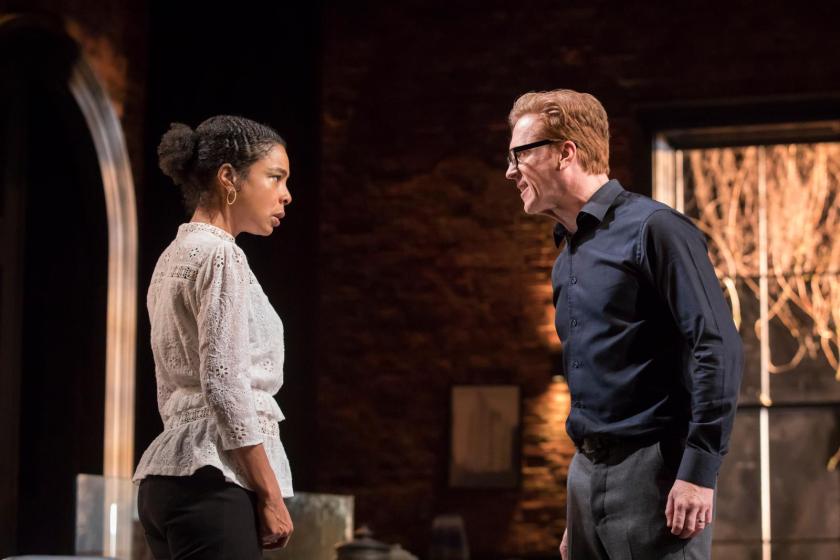
And I can’t wait to see more of his plays. This was really, really good. The set-up is as simple as it is provocative. Martin, our prize winning architect played by Damien Lewis, reveals to best friend Ross (Jason Hughes) that he has fallen in love, emotionally and physically, with a goat. Ross is compelled to tell Martin’s wife Stevie (Sophie Okonedo), who then tells son Billy (Archie Madekwe – what a play to debut in). So we have a man at the top of his game with a fatal flaw who through the action of another is brought crashing down. So this is the classic Greek tragedy updated (apparently the word tragedy comes from “goat ode” in ancient Greek). This forms the structure from which Albee explores the nature of love, its relationship to sex, what society admits is permissible and what is not, and, through an immensely rich text, why this is so,

The ultimate transgression of bestiality is a brilliant device to play with an audience. Obviously it puts us into a very uncomfortable place but also encourages us to laugh, both because some of the dialogue is genuinely funny (Martin and Stevie’s intelligence and liberalism make them very aware), and as a way to deal with the apparent absurdity of Martin’s behaviour. Yet as the other characters come to terms with what Martin is telling them the tragedy of the situation comes through. Hearing and feeling the audience’s reaction to the drama is what makes this an outstanding play.

Damien Lewis perfectly captures Martin’s pedantry and, as he moves from a curiously passive matter-of-factness, to a more impassioned exhortation of what he has done, we get pitched between disgust and sympathy. Jason Hughes as Ross represents a society that cannot, and will not, tolerate his actions. I confess that I think Sophie Okonedo is a brilliant actor – her performance of Margaret in the Hollow Crown is the best thing on the screen which, given the competition here, is saying something. Anyway the way she charts Stevie’s journey from disbelief and incomprehension through anger and vengeance, yet still being reflexive, was riveting.

A play ideally makes you laugh, cry, think and reflect. Inwardly, if not always outwardly. It should also stick with you. This fits the bill for me and, I gather, other theatrical smart-arses. I also gather there have been some highly regarded performances since it premiered in 2002. So maybe the play itself was what bowled me over but I am hard pressed though to see how this production could have been better. A more conflicted Martin from the off maybe – but then that removes his fatal justification on which the reactions hang.

In the hands of director Ian Rickson, nothing gets in the way of the tragi-comedy on the stage. That is as it should be. Next up he is directing Against at the Almeida. I can’t wait.

So if you are like me a couple of years back – a bit too busy to do more than a handful of plays a year – this is what you should do. Book this, there are a few weeks left, the transfer of the Almeida Hamlet at the Harold Pinter Theatre and the transfer of the Royal Court’s The Ferryman at the Gielgud Theatre. No risks, five star reviews for all of them across the board. Then just wait for the next blockbuster.


Occupational Hazards at Hampstead Theatre review ****

scaleheightwyizotaixq-occupationalhazards-prod-731

Occupational Hazards

Hampstead Theatre, 20th May 2017

You can learn a lot at the theatre.

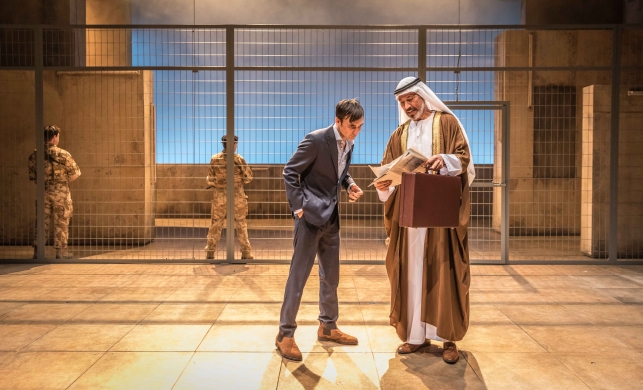
Rory Stewart is (actually was, given Parliament is dissolved) a junior minister at the Department of International Development. Apparently he has known the playwright here, Stephen Brown, since they were kids. Mr Stewart sounds like a bloke with a fair amount of derring-do and an admirable compulsion to get stuck in. In September 2003, at the age of 30, and having already walked across vast chunks of near Asia with just the clothes on his back, he blagged his way into the role of a governor of Maysan province in Southern Iraq post the “liberation”. I am guessing that being a scion of Scottish aristocracy, child of a diplomat, Eton, Oxford PPE, tutor to the royal princes and the Diplomatic Service may have helped get the job, but he might just have got lucky (or unlucky as it turns out).

This play dramatises the book he wrote about his experiences. I haven’t read it but I am guessing there is a healthy dose of self-aggrandisement at work. No matter. The question is does this make a good play. After some initial misgivings I have to say it does. It is, unsurprisingly, event driven. There isn’t a lot of exploration of Mr Stewart’s character and motivation (or indeed of the other protagonists), he is the referee between the various parties, and the device of his explaining events direct to the audience only serves to heighten this impression. The play doesn’t go in for dramatic expositions of opposing views or for exploration of historical and geographical context. It gets on with it. Much like Mr Stewart himself did I suspect.

What this approach does mean is that the shifting nature of the struggle for political control post the liberation, and through the attempts to rebuild the province, are very well described. It is confusing at first but gradually the characters and the issues shift into focus which I guess deliberately mirrors the confusion rife in those few months. It certainly points up the multi-faceted consequences that arose from the failure to plan for government in Iraq after the Baathists were booted out.

I knew nothing of any substance or detail about these events beyond a few headlines and pre-conceptions. Now I know more. And this was delivered by a fine cast, led by Henry Lloyd-Hughes as Rory Stewart, and director Simon Godwin in a dynamic, thoughtful and eloquent way. Given the subject and the subject matter it might be easy for others to criticise this. I will not. The run is nearly over but if the subject matter holds any interest, and it probably should, I would genuinely recommend this and think there is a place for more of the same.


The Levelling film review *****

levelling_03

The Levelling, 23rd May 2017

This is director Hope Dickson Leach’s full length film debut. In the screening I attended there was a short but illuminating interview with Ms Dickson Leach which discussed the difficulties female film-makers face in bringing their ideas to fruition. She gave up for a bit but came back. And she eventually managed to get financing for this film. Well all I can say it thank goodness she didn’t give up and thank goodness she got the money. This is a genuinely outstanding film. I can’t wait for her next outing – I’d be happy to give her a few quid if it helps

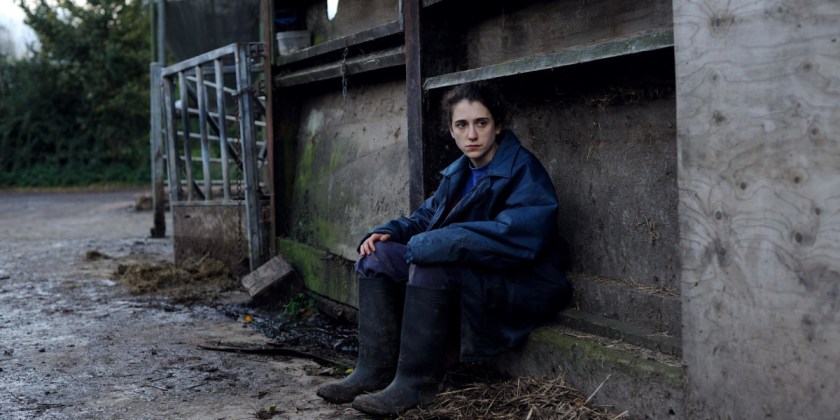
Clover, played by the astounding Ellie Kendrick who apparently is in that Game of Thrones frolic, is a veterinary science student, who returns to the family dairy farm on the Somerset Levels following the death of her brother Harry. Dad, Aubrey (David Troughton), it is fair to say, is somewhat emotionally stunted. The farm is a mess having never recovered from flooding and with no insurance bailout. Aubrey has abandoned the house to live in a caravan in the farmyard. He likes a drink. The two then fail to talk to each other in any meaningful way as the events that led up to Harry’s death are played out – not just the immediate past but over many years.

It is beautifully shot. This is not a conventionally attractive landscape. No attempt is made to leaven the atmosphere. The sun doesn’t shine at all. It rains quite a bit. There are however sone striking close ups of nature to remind us where we are. A farm is not a classic location for a British film I believe. We city types dominate the medium and the rural normally appears more arcadian that Hobbesian. The fragility of the existence and the temptation to take risks to secure economic viability is deftly portrayed. The sheer hard work of running the farm is not hidden.

Not much happens. Not that much is said. But the despair, disappointment, resentment and blame that the two central characters feel is remorselessly laid bare. You want to shake them to sort it out and swallow their pride. You know they can’t. The emotional intensity of the ending is shattering. All of this is accomplished with relatively sparse dialogue and there is loads of detail which remains ambiguous if not entirely elusive. What happened to Mum, why did Dad despise Harry, how exactly did Harry meet his end, what was the relationship between Harry and his best mate James (Jack Holden), who dreamt up the dubious plans to rescue the farm, will Clover stay and why? Don’t let me give the impression that this is in any way frustrating – it is what makes the story so utterly compelling.

The proper reviews have observed how this looks and feels like a horror film without the horror. It certainly begins in that vein. This is apt. Except, as those reviews have also generally observed, the unembellished horror of what has happened to this family is all too real.

If this all sounds more art house foreign auteurish that the Archers you’d be right. Ms Dickson Leach has herself cited the influence of the Dardenne brothers and Bruno Dumont (note to self: find out who these chaps are). Then again it is just so English – in the where certainly, but also in the who and the why.

I could go on and on. The mark of any great film, play, book, artwork is that it stays with in the days and years that follow its viewing. This slam-dunks that test. It will get under your skin. I doubt there will be a better female lead performance this year. Hope Dickson Leach is a mighty talent. And all this probably done for less than the bog paper bill for the cast of Pirates of the Caribbean: Just Serve Them Up Any Old Sh*t.

And this father – daughter relationship is throwing up some truly great films (Toni Erdmann, Graduation as well as this). Maybe there really is still some cinematic mileage in BD’s withering glances following my hilarious observations.

Woyzeck at the Old Vic review ***

wozyeck-11780

Woyzeck

The Old Vic, 27th May 2017

One day soon the Old Vic under the aegis of its ambitious Artistic Director, Mathew Warchus, is going to come up with an absolute stonker. The strategy of taking a classic play, or new work from a top flight current playwright, stuffing it with stars of stage and screen, wheeling in the brightest directors and other collaborators (if Mr Warchus doesn’t himself take the helm), and then bringing to a steady boil is surely going to pay off. We have come mighty close in the last couple of years; for me Tim Minchin’s musical Groundhog Day was a triumph but the straight plays have, for one reason or another, not quite smashed the ball out of the park.

The production of Rosencrantz and Guildenstern are Dead saw fine performances from Daniel Radcliffe and, especially, Joshua McGuire, and sure-footed direction from Stoppard veteran David Leveaux, but it is Stoppard, so there is no indulgence for any lapse of concentration by (me) the audience. Art contained three fine performances from Rufus Sewell, Paul Ritter and Tim Ke,y but not enough to persuade me that this play remains rather too pleased with itself. In retrospect there should have been no surprise at all that Glenda Jackson gave us a peremptory Lear, but Deborah Warner’s directing didn’t fully solve some of the play’s issues for me (I am all for massaging the text here to enhance proceedings), and there was some jarring casting. I can’t exactly say why, but the Caretaker directed by Mr Warchus himself didn’t quite deliver that electric thrill that Pinter can serve up when it all comes together, despite an outstandingly wheedling Davies from Tim Spall. And the Master Builder with Ralph Fiennes was frustrating, largely because of Sarah Snook’s Hilde I am afraid. I loved The Hairy Ape with Bertie Carvel (next up as young Robert Murdoch in Ink at the Almeida). In fact, for me, it has been the most successful of the productions since Mr Warchus’s tenure commenced, but I get that early Expressionist Eugene O’Neill is not for everyone. Finally the less said about Future Conditional the better, although the idea was sound.

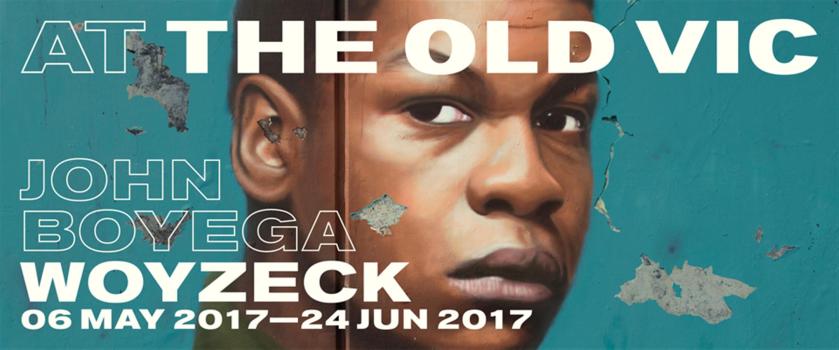
So I was hoping that Woyzeck might be the one. I fear it was not, though John Boyega’s tragic performance was riveting (let’s hope after this debut he doesn’t get lost to Hollywood). Now part of the problem may be that I only know the story here from Alban Berg’s opera Wozzeck. This is a musical masterpiece which I am slowly getting to grips with having seen a handful of productions now. Whilst Berg himself wrote the libretto he was keen, at least based on what he said, to retain the “essential character” of Georg Buchner’s 1837 play (the poor fella died aged 23) with “its many short scenes, its abrupt and sometimes brutal language, and its stark, if haunted, realism…”. If you have never seen the opera (and you should) then, trust me, he does.

So I can’t be sure just exactly how far Jack Thorne’s new adaptation deviates from Buchner’s fragmentary, unfinished text. But I know a man who does which is why the SO and the TFP’s were fairly willingly cajoled into joining me. And it is fair to say that Mr TFP, who is all over German literature, and I, were both a bit bamboozled by this.

I won’t spoil since the production has some weeks to go, but the shift to the divided Berlin of 1981, the insertion of an extensive back story for the lead and some fairly radical shifting around of events and character action/motivation (notably for Marie, Woyzeck’s wife, Andrews, his mate here, and Maggie, the Captain’s wife) didn’t entirely work for me. The social criticism in Buchner’s work was less evident (how grinding poverty and real hunger leaves the “lower classes” unable to sustain a “moral” life). The depiction (and causes) of Woyzeck’s psychosis were a little forced through some of the the extended dream sequences. The dehumanisng impact of military service seemed to get lost a little inside one man’s struggle with his own demons.

If I am honest I think the laudable attempt to update the play (this is not some plea for “authenticity”) and offer a more complete narrative, left the production poised uneasily between a sort of TV drama realism (Mr Thorne’s comfort zone  as he himself freely admits in the programme), and the more usual Expressionist tableau (most obviously visible in set and sound design), which didn’t quite do it for me. This tension between naturalistic and expressionistic is the conundrum at the heart of Buchner’s text I gather, but Jack Thorne and director Joe Murphy’s solutions seem to drag the structure down. Sometimes less can be more.

There are some memorable images though, especially if you are partial to a bit of simulated shagging, a gentleman’s full frontal, topless ladies and red marigolds (rubber not floral), and other borderline theatrical cliches. The supporting performances are all robust. So maybe, in the spirit of the less is more advice, you might find this more rewarding than me if you go in without too much expectation or preconception.

So next up at the Old Vic is Conor McPherson’s Girl from the North Country, which he is self-directing (with Joe Murphy assisting). Stardust will be sprinkled courtesy of Bob Dylan’s music and we have an interesting and expansive cast (including Ron Cook, Sheila Atim, Shirley Henderson, all firm favourites of mine). The setting in Minnesota intrigues (so no Steinbeckian dust bowl tragedy or Southern family saga I assume). Maybe this will be the one then.


.

Rosencrantz and Guildenstern are Dead at the Old Vic review ****

more time required

The cast for the revival of Art

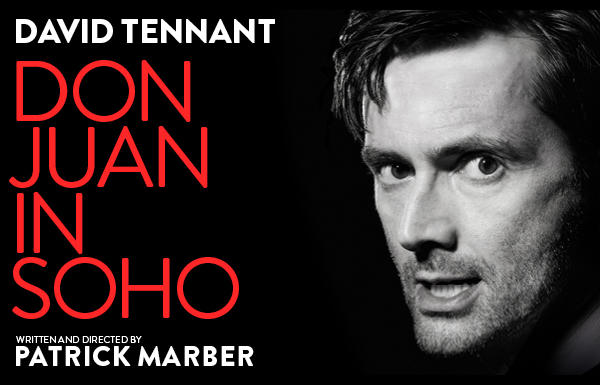
Don Juan in Soho at the Wyndham’s Theatre review ****

show_donjuaninsoho

Don Juan in Soho

Wyndham’s Theatre, 22nd May

Get this. The programme says that since a Spanish dramatist, Tirso di Molina, first brought Don Juan to the world in around 1620 he has appeared in at least 1,800 plays, operas, novels, films and poems. And I bet he appeared as a stock character in stories before the printing presses started rolling in earnest (though I am not away that this anti-hero was a feature of Greek or Roman theatre – but they were a cultured bunch right).

So what does this tell us. That people really like and admire him? Or that an overwhelmingly patriarchal artistic community keep shoving this obnoxious prick down our throats (literally), reflecting their own wish-fulfillment fantasies? Search me. I only really know the story from Mozart and Da Ponte’s opera, Don Giovanni (extracts from which unsurprisingly bookended this production). And every time I go into a performance of that, and usually for the first couple of scenes (the rape of Donna Anna for that is what it is, the murder of the Commendatore, and Leporello’s catalogue of conquests on behalf of his master), I think why I am watching this misogynistic clap-trap.

Then Mozart’s music takes over, Don Giovanni does eventually come unstuck and, finally, gets the comeuppance that maybe he deserves. This neatly then absolves us of any approbation we may have had for our anti-hero (and indeed any sneaking admiration some might harbour). All seems resolved except that within minutes of leaving I am once again questioning how I enjoying the tale of a dissolute libertine. I know, I know don’t judge a work of art written hundreds of years ago by today’s moral compass. But what I do often wrestle with is the audience reaction to this character.

Now the play, as interpreted by Moliere, also ups the ante by presenting Don Juan, in some ways, as worthy of our respect because he represents true freedom, the right to live your life as you please. Even more so he exposes the hypocrisy of all around him. This is where Patrick Marber, in this substantial adaptation originally produced in 2006, and which he also directs, pivots his attention with, I have to say, very considerable success. Our anti-hero, now just DJ, is alive and well in contemporary Soho, alongside his put-upon side-kick, Stan.

Now the first thing to say is that David Tennant and Adrian Scarborough end up with the audience in the palm of their hands so adept are their performances. There are times when I get annoyed by David Tennant who just seems to find it all too easy. I was not as bowled over as most by his last major stage work-out in the RSC’s Richard II and some of his TV work grates. And here, at first, I felt he was just too indulgent in his portrayal. But I was wrong and quickly came round. Similarly I felt Adrian Scarborough, at first, wasn’t getting to grips with any of the reasons why Stan would put up with this sort of treatment. Again I was wrong. The power of reflected glory is clearly an overwhelming aphrodisiac for the poor chap.

The same early apprehension I felt about the actors (remember too this is also the point when I am questioning the whole set up anyway) was manifest with Patrick Marber’s text. It just seemed too simplistic at first and inclined to allow the lead actor, ( I gather this was might also have been true of Rhys Ifans in the Donmar Warehouse original production), to lazily tick off the cheap laughs. Well, again  I was wrong as I think this approach means we too are quickly snared by our anti-hero’s charismatic web, which then serves to heighten the subsequent moral dualism. I have noticed this before with Mr Marber’s work. Dealer’s Choice, Closer and The Red Lion all take a bit of time to get going and his screenplay for Notes on a Scandal is similarly unhurried.

So what of the production itself. I am not sure the shoehorning in of Soho, as a symbol for London’s corrupted history, entirely works. It does give us the necessary statue in the form of King Charles II (he was of course the antidote to the cultural scourge of Puritanism). Soho also fuels a short, and not entirely relevant, piece in the programme focussed on the drunken antics of the artistic community in the 1950s and 1960s (Bacon, Thomas, Freud and hangers on). However, I think its symbolic value as the capital’s continuing den of sexual iniquity now looks a bit antiquated in a world of ubiquitous digital pornography. Anna Fleische’s modern setting and costumes, and the interpolation of dance and snatches of contemporary music (how can I not like a play that has masked dancers in white robes whirling around to Taking Heads’s Memories Can’t Wait!), does though set the perfect tone for this pursuit of gratification.

Mr Marber really cranks up the ambiguity in the scene with the beggar, here a Muslim who he forments, but fails, to blaspheme, the duping of Dad to keep the funds flowing and DJ’s climatic monologue, which I gather has been updated for this production. Here the railing against today’s grandiosity, virtue signalling and all-round attention seeking cant and humbug, induced slightly uneasier ripples of laughter through the audience when compared to the undemanding sallies at the expense of one D Trump earlier on. I’d say this is where Mr Marber really hit the mark.

So, overall, I think the writing, direction and performances richly decorate what remains, at its heart, still a very ugly construction. We are amused, we are seduced, we are instructed, we are chided for our complicity. The emptiness of hedonism that lies at the very heart of our DJ, is revealed and, ultimately, this proves his nemesis. Catharsis indeed.


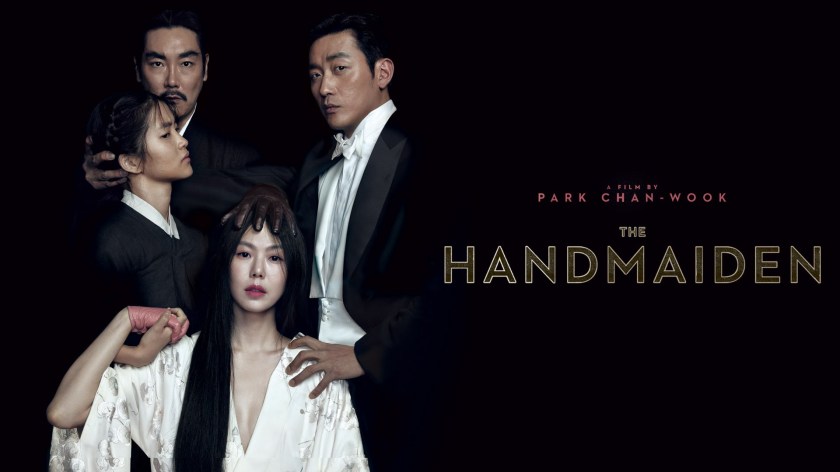
The Handmaiden film review ****

maxresdefault

The Handmaiden, 19th May 2017

I don’t read too much fiction these days. I prefer theatre, the visual arts and music. I have also found much of the contemporary fiction that I have read in the last few years a little underwhelming. I have a long list of classics I need to read but figure that will happen in the fullness of time.

There are however some contemporary authors that I do have a lot of time for. Sarah Waters is certainly one of those. Fingersmith, on which this film is based, is my favourite of her novels to date.

I am also pretty picky about the films I see – though I guess if it is a decently reviewed art-housey offering then it will make the cut, even if it doesn’t translate into an immediate viewing. There are also an eclectic handful of directors whose work I will try and see come what may: Mike Leigh, Terence Davies, Michael Haneke, Paul Thomas Anderson, Terence Malick and Martin Scorsese. No logic here. And this list also includes the director of the Handmaiden, Park Chan-wook, who is back to his Korean native film-making best after the English language Stoker. Oldboy is one of the best films of the last couple of decades in my view and the Vengeance trilogy isn’t half bad either.

So finally I got to see this and blimey what a feast it is. If you don’t know the plot of Fingersmith I won’t spoil it but suffice to say you get proper switchback twists, not once but twice, which makes for a proper thriller. In this respect it goes well beyond the book to explore fresh perspectives of deceit and desire. Yet this plot is punctuated with a knowing humour which is just as well given some of the less than subtle symbolism that is on show. And this all revolves around a lesbian love story with no stinting on the eroticism. There is a fair smattering of mucky stuff as my dear aunt would have said. This is set against a backdrop of a Korea at the time of Japanese colonial rule in the 1930s just to add another layer of confection.

It looks extraordinary with the bulk of the action filmed in wide-screen and set in a house which combines a Western style gothic pile with a Japanese palace. And an interior which is full of all manner of surprises, kinky and otherwise. I am a terrible judge of what is appropriate or not when it comes to issues of the documentation of sexuality in art so I don’t know whether this is lascivious or empowering but it is convincing in its depiction of the main protagonists’ relationship and of the pornographic impulses that drive some of the characters (at one point there a number of fellas who are literally very hot under the collar- hilarious). Apparently Sarah Waters herself has given the film the thumbs up so I guess all is well.

So we have a playful, wry, suspense-filled thriller/whodunnit, dressed up as a very fruity Victorian costumed melodrama, dressed up as a yearning love story, which looks quite stunning. And that’s just for starters. What’s not to like. I have a feeling that for quite a few people pretty much everything. But if you think you might fall into the target audience don’t hesitate (though you might what to ask yourself what qualifies you to be the target).

And if you do accidentally walk into the wrong screen whilst looking for Guardians of the Galaxy Vol 2 I suspect you will realise your mistake well before the subtitles pop up.


Howard Hodgkin at the National Portrait Gallery review ***

self-portrait-of-the-artist

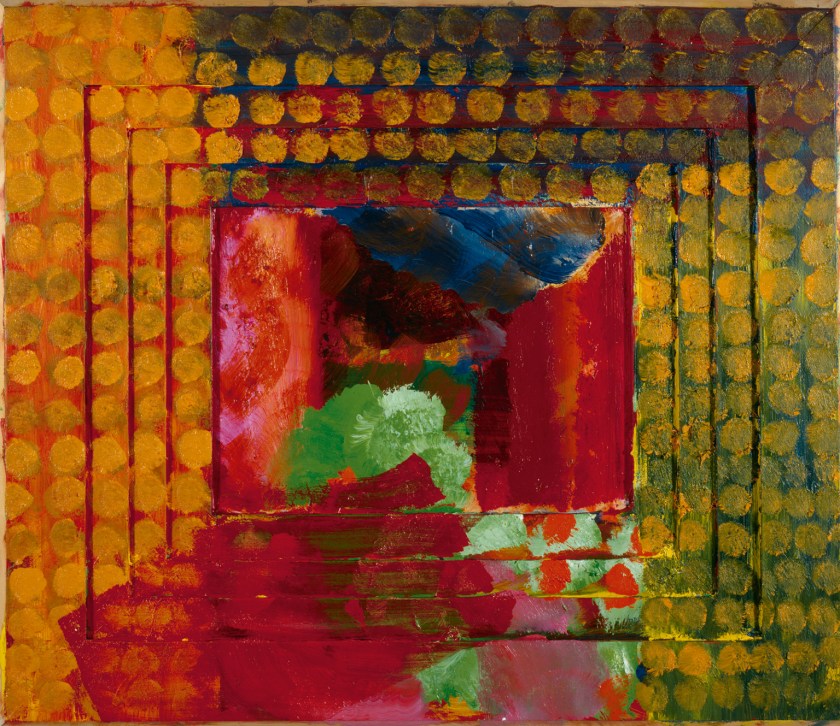
Howard Hodgkin: Absent Friends

National Portrait Gallery, 18th May 2017

I haven’t really known what to make of the work of Howard Hodgkin who sadly passed away just before this exhibition began (having been involved in its creation). And I am still not sure what to make of it.

This was the first time I have seen a solo exhibition; previously I had only seen a few works in permanent collections. Now clearly it is impossible, at least for me, not to bowled over by the vibrant colours that he employed in his work and by the exuberance of the mark making. On the other hand I cannot say that I get any great reaction beyond this.

This exhibition focusses on his portraiture. This was largely done from memory and Hodgkin was always trying to capture the essence of the person or persons he was painting – the memory if you like. This means that his portraits became ever more abstract through his career, such that, by the end of his life, just a couple of broad brush strokes might suffice to capture the emotional core of his subject.

The problem for me is that as an observer I have no knowledge of these subjects (many of whom were fellow artists or collectors) and so cannot relate to the essence he has focussed on. So I am then just left with the colour and the patterns which, in some, though not all cases, are extraordinarily bold, vivid and certainly uplifting, with beautiful paint, but, unfortunately, offer me nothing beyond that. With more figurative portraiture, though not mimetic, I am able to see and examine the subject in a way that Hodgkin’s work precludes.

So definitely worth a good look and I have learnt far more about this important, though taciturn, British painter of the last few decades, but I am not sure he is an artist I will seek out in future visits unlike some of his contemporaries. Though as with other vivid colourists, there is no doubt that a good stare at their work makes subsequent real world colour burst into life, at least for a few hours. Be happy.

Some ideas for the culturally inclined in London

london-travel-guide-lede

Here is a very brief round-up, (apparently I can drone on a bit so have tried to be disciplined), of the current and forthcoming major theatre and exhibition events in London that have caught my eye (and ear). I have a list of classical concerts which is still good to go for those that way inclined (Some forthcoming classical music concert ideas (with a bit of nostalgia thrown in) and will take a look at the best of the forthcoming seasons at the two major opera houses in another post.

No particular order and not at all obscure. There should be tickets available for all of these but in some cases you may need to get your finger out.

Hope this helps if, unlike me, you are not over endowed with time.

Theatre

I can vouch for the first four below and the rest are those which I think are likely to be the most likely to turn into “must-sees”.

  • Hamlet – Harold Pinter Theatre – June to September 2017

If you think Shakespeare is not for you then think again. Andrew Scott as our eponymous prince could be chatting to you in the pub it is that easy to follow (mind you, you’d think he was a bit of a nutter) and Robert Icke’s direction is revelatory. Plenty of tickets and whilst it’s not cheap they aren’t gouging your eyes out compared to other West End shows. Here’s what I thought.

Hamlet at the Almeida review *****

  • The Ferryman – Gielgud Theatre – June to October 2017

This will almost certainly be the best play of 2017 and will be an oft revived classic. It is better than writer Jez Butterworth’s previous masterpiece, Jerusalem. Prices are steep but the Gielgud is a theatre where the cheap seats are tolerable. If you see one play this year make this it.

The Ferryman at the Royal Court Theatre review *****

  • Babette’s Feast – Print Room Coronet – to early June 2017

There are a couple of weeks left on this. Probably helps if you know the film or book. I was enchanted though proper reviews less so. Loads of tickets, cheap as chips, not demanding at all, lovely venue.

Babette’s Feast at the Print Room Coronet review ****

  • Othello – Wilton’s Music Hall – to early June 2017

Again just a couple of weeks left here. Once again perfect Shakespeare for those who don’t think it is for them. Big Will’s best play and an outstandingly dynamic production. Another atmospheric venue, though I would say get right up close. A bargain for this much class.

Othello at Wilton’s Music Hall review ****

  • The Tempest – Barbican Theatre – July and August 2017

This is the RSC transfer from Stratford. Simon Russell Beale, our best stage actor, as Prospero. Some fancy dan technology is employed. Reviews generally positive though you always get sniffiness from broadsheets whenever RSC plays a bit fast and loose with big Will. Not cheap but at least at the Barbican you will be comfy (if you don’t go too cheap).

  • Macbeth – Barbican Theatre – 5th to 8th October 2017

More bloody Shakespeare. Literally. On this you are going to have to trust me. Ninagawa is a Japanese theatre company renowned for its revelatory productions. So in Japanese with surtitles. But when these top class international companies come to the Barbican it is usually off the scale awesome. I’ve been waiting years to see them. Enough tickets left at £50 quid a pop but it will sell out I think.

  • The Suppliant Women – Young Vic – 13th to 25th November 2017

Reviews when this was shown at Royal Lyceum in Edinburgh were very good. Aeschylus, so one of them Greeks, updated to shed light on the refugee crisis. Maybe not everyone’s cup of tea, and you can probably wait until closer to opening, but I still think this will turn into a must see.

  • Ink – Almeida Theatre – June to August 2017

Writer James Graham’s last major outing, This House, about politics in 1970s Britain, was hilarious and insightful. This is based on the early life of Rupert Murdoch so expect a similar skewering. Directed by Almeida’s own Rupert Goold with Bertie Carvel the lead (the sh*t of a husband in that Doctor Foster off the telly). I have very high hopes for this,

  • Against – Almeida Theatre – August and September 2017

New play which sounds like it is about some crazy US billionaire taking over the world (I could be hopelessly wrong as Almeida doesn’t tell you much). Written by American wunderkind Chris Shin, directed by master of clarity Ian Rickson, and with Ben Wishaw in the lead. Don’t know how much availability as public booking only opens 25th May, but I would get in quick here and buy blind. Almeida now a lot comfier with the padded seats and still a bargain for what is normally world class theatre.

  • Prism – Hampstead Theatre – September and October 2017

New play from the marvellous Terry Johnson who writes brainy comedy Robert Lindsay in the lead role of a retired cinematographer. I have a feeling there will be more to this than meets the eye (!!) and will buy blind on the public booking opening. Usually around £30 a ticket so if it turns into a hit, as Hampstead productions sometimes do, it is a bargain.

  • Young Marx – The Bridge Theatre – October to December 2017

So this is the opener from the team at the Bridge which is the first large scale commercial theatre to be opened in London for decades. The genius Nick Hytner directs and the play is written by Richard Bean and Clive Coleman. The last time these three came together out popped One Man, Two Guvnors. Rory Kinnear and Oliver Chris (trust me you will know him off the telly) play the young Marx and Engels in London. Hard to think of a set up that could get me more excited but if any part appeals to you I would book now. There are loads of performances so no urgency but, if they have any sense at all, the seats here will be v. comfy with good views as it is all brand new, so taking a punt on a cheap seat will probably turn out well.

  • Julius Caesar – The Bridge Theatre – January to April 2018

Bridge again. Julius Caesar so probably need to know what you are letting yourself in for as solus Roman Shakespeare’s can sometimes frustrate. BUT with David Morrissey, Ben Wishaw, David Calder and Michelle Fairley, it is a super heavyweight cast. Same logic as above – it might be worth booking early and nabbing a cheap seat on the assumption they would be mad not to serve up the best auditorium in London if the venture is to succeed.

  • The Retreat – Park Theatre – November 2017

The Park often puts on stuff that sounds way better than it actually turns out to be, but this looks the pick of its forthcoming intriguing bunch. Written by Sam Bain (Peep Show and Fresh Meat) and directed by Kathy Burke. Comedy about a City high flyer who gives it all up but can’t escape the past. If anything is guaranteed to wheel in the North London 40 and 50 somethings then this is it. No cast announcement yet but I bet they rope some comic into the lead.

  • The Real Thing – The Rose Theatre Kingston – 2nd to 14th October

A co-production with Theatre Royal Bath and Cambridge Arts Theatre of one of Stoppard’s greatest plays. I really want this to be a cracking revival for my local.

Exhibitions

Here is the pick of the forthcoming blockbusters which I hope to get to see. The Jasper Johns and the Cezanne Portraits are the ones I am most excited about.

  • Giacometti – Tate Modern – just opened until 10th September 2017
  • Pink Floyd: Their Mortal Remains – V and A – until 1st October 2017
  • Into the Unknown: A Journey Through Science Fiction – Barbican Art Gallery – from 3rd June 2017
  • Grayson Perry: The Most Popular Art Exhibition Ever! – Serpentine Gallery – from 8th June 2017
  • Jasper Johns: Something Resembling Truth – Royal Academy – from 23rd September 2017
  • Opera: Passion, Power and Politics – V and A – from 30th September 2017
  • Cezanne Portraits – National Portrait Gallery – from 26th October 2017
  • Monochrome: Painting in Black and White – National Gallery – from 30th October 2017
  • Impressionists in London – Tate Britain – from 2nd November 2017
  • Red Star Over Russia – Tate Modern – from 8th November 2017
  • Modigliani – Tate Modern – from 23rd November 2017