

As You Like It at the Barbican Theatre review ***

As You Like It

Barbican Theatre, 15th January 2020

As You Like It? Not really like this. Mind you I have yet to see a production of the play that really bowled me over. The NT production from 2016 directed by Polly Findlay looked great, office chairs becoming the Forest of Arden, and reminded us of the immense talent of Rosalie Craig and Patsy Ferran, but didn’t quite do it for me and I have a vague recollection of a previous RSC outing with Niamh Cusack as Rosalind and David Tennant as Touchstone. So maybe it is the play that doesn’t quite persuade.

I get that Will’s exploration of gender roles, sexuality and the rules of attraction still intrigues and resonates. And I get that, as a paean to the joy of love, and specifically the slippery notion of “love at first sight” there isn’t much better in the Shakespeare, or any other, canon. And it has a couple of pukka roles for women. As a generally miserable f*cker I can’t help but be attracted to eeyore Jaques and there are plenty of laughs, though they don’t always land from the lips of the sketchier supporting characters and some are just too knowing. What I don’t really buy is the whole pastoral, simpler life vibe, the magical forest is more convincing in AMND, and, absent Rosalind and Celia, I have never been convinced by many of the relationships, courtly and common, of which there are too many to really round out character. The banishments, and reconciliations, of Fred and Duke Senior, and the du Bois boys (here Leo Wan and Aaron Thiara), isn’t properly explained or resolved. The songs are a bit ropey. The prose and verse inversion and switching can be distracting and adds to the bitty, “a string of chance encounters”, quality of the play.

There are however plenty of other WS plays where similar criticisms might be levelled. But plot, character, language, message and spectacle, or some combination thereof normally finds a way to lift you up and into the world of breathless, nothing else matters, concentration that is the magic of the Bard. So maybe as I say I just need the right production of AYLI.

Here Kimberley Sykes, the brains behind the RSC Dido from 2017 which the Tourist annoyingly overlooked, has offered up a timeless Arden, supported by Stephen Brimson Lewis’s design, which focuses on the key connections, between the excellent Lucy Phelps’s confident Rosalind, her forthright bessie coz Sophie Khan Levy and a gentle, though ardent, Orlando in the form of David Ajao. Sophie Stanton, as a detached, almost inert, female Jaques, was polished, and Sandy Grierson, once again, stood out with his grotesquely camp Touchstone.. A whole bunch of gender switching for the other roles left the characters even less defined than normal, and, whilst it was not difficult for an actor of Antony Byrne’s quality to pull off the roles of both Dukes, I am not sure I got the point in a play already stuffed with mistaken identities.

There were a lot of nice visual touches, but there were also times when the cast seemed to be keen to move on to the next scene, lines a bit too hurried, and some of the blocking felt a little unconnected on the roomy Barbican stage. And then there was the lighting, designed, as were the costumes, by Bretta Gerecke, which was often the wrong side of insistent. And then there was the audience participation. And a giant puppet of Hymen, god of marriage, looming over Lucy Phelps as she delivers her, slightly desperate, epilogue at the end.
Measure for Measure at the Barbican Theatre review ****

Measure for Measure

Barbican Theatre, 8th January 2020

I like Measure for Measure. I find the weird cocktail of morality play and satirical “comedy” fascinating. No one comes out of it well, not even the ostensibly virtuous Isabella who goes into bat to save brother Claudio from death, but is prepared to sign off on a pretty dodgy deal to further this aim. The stench of corruption infects even the pure. This makes it a very “modern” play I guess, which is why it is getting multiple airings, with much to say, in the right hands, about the complexities of power and desire. Not quite at the top of Will’s oeuvre but certainly in the top ten. Which, for your edification, I set out below.

  1. Othello
  2. Hamlet
  3. Julius Caesar
  4. Much Ado About Nothing
  5. Richard III
  6. Coriolanus
  7. Henry VI, Part I, II, III
  8. Richard II
  9. Measure for Measure
  10. Pericles

What no Lear? Or Dream? Or Romeo and Juliet? Or Tempest? Or Twelfth Night? And Coriolanus included? And, are you mad mate, also Pericles? Well yes I like the latter’s daft fantasy travelogue, even those bits which stem from the unsubtle hand of George Wilkins, and Coriolanus strikes me as the very model of classical tragic hero, not prone to bouts of soul sharing pace Lear, Macbeth or your boy Hamlet. And the list shows pretty clearly that I like history plays. Power, politics, virtue, honour, social as well as individual psychology, the ruler and the ruled, corruption, narcissism, jealousy. These are the things that interest me. The dark side of human nature that Will explored forensically and which make many of these plays relevant to our, or any other, time. Don’t worry though. I am not a weirdo. Much Ado About Nothing is in there.

Of course much depends on the productions I have seen and I think I have been blessed in recent years in the history and “Roman” play departments in particular. Maybe one day I will see a Macbeth or Lear that truly persuades. That’s the thing with Shakespeare. Ultimately malleable, such that creatives and cast can usually find something, language, message, narrative, character, spectacle, in which to delight and illuminate.

As here. Gregory Doran is probably the most reliable Shakespearean director of our time, useful when you are the big cheese at the RSC. Maybe not the most spectacular of interpreters but always clear in purpose and execution. No gimmickry with this, which I think is his first stab at MFM, unless you count setting the play in fin de siecle Vienna, a point in the city’s history when virtue and corruption, intellect and expedience, reached there apogee, and, arguably laid the ground for what followed, good and bad, very bad, in much of the Western world through the first half of the C20. It is almost as if big Will, with his fictional late C16 fictional Vienna could see what the real city would become three centuries later. (I gather this connection has been made in previous productions).

Otherwise GD, and designer Stephen Brimson Lewis using the set structure common to the season’s productions of As You Like It and The Taming of the Shrew, with added monochrome projections as well as 1900s period costume, don’t muck about with text or cast. Paul Englishby’s score echoes with waltz. Escalus, in the hands of Claire Price, is re-gendered, as is the Provost (very effectively by Amanda Harris), but then again Mistress Overdone is, campily, handed to Graeme Brookes. But there is no wholesale gender politics reinterpretation here. And the text is, I think, complete so that said Overdone, Pompey (David Ajao versed with Afro-Caribbean sonority), Elbow (Michael Patrick) and the major, (Joseph Arkley especially as supercilious Lucio), and minor fops and fop-esses, all get their due, though the wordplay comedy requires our close attention.

RSC veteran Antony Byrne unsurprisingly nails the Duke/Friar, a man convinced of his own righteousness as he is blind to the flaws in his exercise of power, James Cooney is a quietly desperate Claudio and Lucy Phelps excels as the virtuous novice, at least until the scheme to uncover Angelo’s hypocrisy is set in motion, Isabella. But the whole is held in place by a marvellous performance by Sandy Grierson as said self-scourging Angelo, who really gets to the heart of said Angelo’s conflicted nature. Or is he, as here, not really quite as conflicted as he makes out, revelling in the opportunity to root out Vienna’s impurity whilst lusting after the eloquent nun. The ghost of an approving Freud was probably sitting in the gods.

Mr Grierson stood out in Jude Christian patchy OthelloMacbeth at the Lyric, Pity at the Royal Court and in As You Like It (of which more to come) in this RSC season but, unfortunately, I have missed him in the other RSC roles he has played in recent years, and on various stages in his native Scotland. I suggest you ensure you see him next time he treads any accessible boards.

The trick in MFM, assuming no re-interpretation, is having the two main characters in Isabella and Angelo both repelled by sex, but also, somehow, fascinated by the idea of desire, which drives the pivotal argument scenes between them. They are both, literally in joint prayer, holier than thou, at least until Angelo cracks. GD’s clear headed direction, and Lucy Phelps’s and Sandy Grierson’s delivery of the text, expertly unfolds the dichotomy between the sacred and the profane. And there is no hiding from the fact that Angelo, and, through his casual “proposal” at the end, the Duke, even maybe against his preference, are choosing to be rapists.

Lots of detail, well thought through, ambiguity and double binds not brushed away. This is not a problem play. The problem, as ever, is us humans. If you want a contemporary feel-gooder with a happy ending go see Everybody’s Talking About Jamie.

OthelloMacbeth at the Lyric Hammersmith review ***

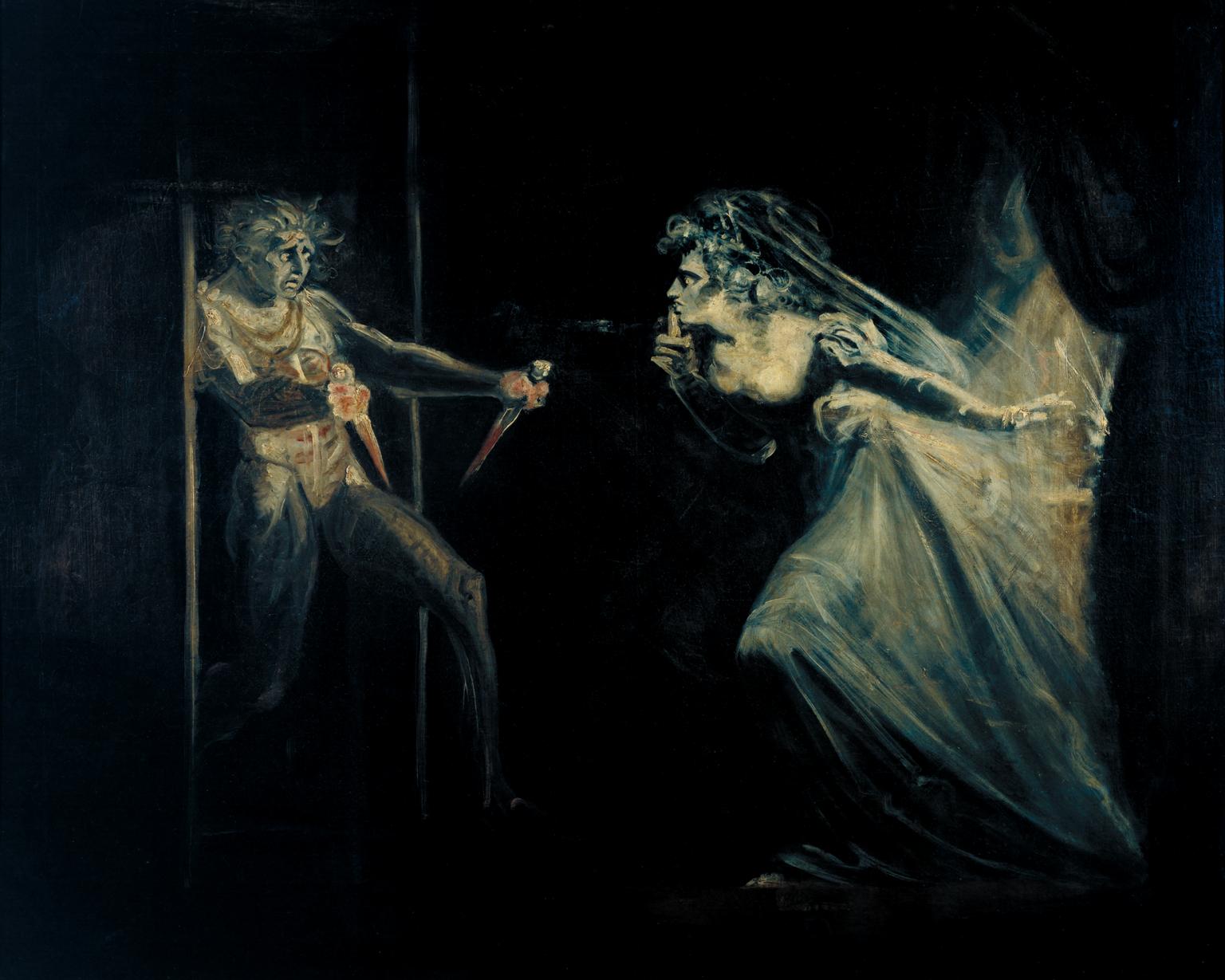
Lady Macbeth Seizing the Daggers ?exhibited 1812 by Henry Fuseli 1741-1825

OthelloMacbeth

Lyric Hammersmith, 8th October 2018

OK so this has its moments. By splicing together Othello and Macbeth, excising out extraneous context, sub-plot and characters, director Jude Christian has largely succeeded in achieving what she set out to do. That is to recast the two famous tragedies from the perspective of the female protagonists, Desdemona, Emilia and Bianca, the Ladies Macbeth and Macduff and, with a twist, the Three Witches. Without messing too much with the main plots. And with some occasionally breathtaking transfer of lines from one play to the other. However it is the Macbeth half that gets the best of the treatment, in large part because it benefits most from Basia Binkowska novel set design as it opens up. And this is definitely not for the purists who relish the verse. (I overhead some grumbling on the way out).

In part this reflected the cuts, in part the slightly uneven verse delivery on show and in part what happens when the psychological insight offered up by Shakespeare’s “roundest” characters is sold short. Samuel Collings as Iago/Macduff and, especially, Ery Nzaramba as Othello/Banquo had the most to lose. On the other hand there was much to learn from Kirsten Foster’s alert Desdemona and Caroline Faber’s measured Lady M, and the Witches, our two/three murdered/abused women from Othello. For this conceit, their revenge, as they unleash Lady M’s “unsex me now” monologue, and strumming on high pitched wires, is both clever and, in part, insightful.

Nagging away at me though is the belief that Shakespeare did offer up multiple vistas into what these women saw and felt whilst still getting on with the business of showing us that ambition, violence and jealousy are intrinsic, if ugly, facets of the human condition. I am not arguing that Shakespeare’s treatment of his female characters should be excused, the body count and violence meted out to them, tells its own story, just that, as in some much of his writing, there is insight and ambiguity when you look for it. And at least he has the excuse of history. The men today who continue to “fridge” women do not. After all Jude Christian in this mash-up, by using WS’s lines, is only highlighting what is already there in the text.

The cur-down version of Othello doesn’t need to tell us why “the Moor” is so hated, nor to have Iago poisoning his and our ears, but without it they come across a bit cartoonish. They are basically wankers from the off. The harsh brushed metal wall, there to mask the Macbeth reveal, only serves to highlight the static staging, and rushed delivery, with very rapid jump–cuts, of the first half of the first play. It does heat up post hanky mind you. Sandy Grierson squeezes a lot out of Cassio as do Kezrena James as Bianca and, especially, Melissa Johns as a blunt no-nonsense Northerner Emilia, who can sense what is coming. But this is maybe more to do with the “air-time” they have relative to standard interpretations rather than the actors really finding something new to say in the characters.

Sandy Grierson’s Macbeth does convince, because we know what to expect, because the call-back is more profound, because his is a fine performance and because the relationship with Caroline Faber’s Lady M stacks up. The early filleting of the text is less distracting, the motives of the power couple are still examined. Ms Faber makes chilling sense of the final Othello speech which falls to her. Even so at the end of the day it is Lady M who hatches the murderous plan, even if the narrative here is revenge for the wrongs of the first half. Once again I think there is more than enough complexity in Lady M as written by the Bard to make Jude Christian’s re-direction superfluous. Watch Judi Dench at work if you don’t believe me.

So a successful exercise on its own terms. I am just not sure that those terms were entirely necessary. New plays by women, telling women’s stories, with women creatives, would be more fruitful I think. (Lela & Co by Cordelia Lynn for example which Jude Christian directed). Or Jude Christian let loose on either one of this plays. Or a Caryl Churchill classic for example. This strand of wilful innovation has dogged the last few years of Sean Holmes’s stewardship of the Lyric. It hasn’t always worked as here. It will be interesting to see who, and what, comes next. It is a lovely theatre, thanks in large part to Mr Holmes’s industry, which deserves the best.