
A Day in the Life of Joe Egg at Trafalgar Studios review *****

A Day in the Life of Joe Egg

Trafalgar Studios, 30th November 2019

Not a fan of the Trafalgar Studios which has been asking daft prices for mediocre seating in the last year or so, (though it seems to have eased up a bit now and is nowhere near as egregious as another ATG venue the Playhouse Theatre). So waited this out and finally secured a decent perch at the back (which to be fair is not too much of a problem in this venue, sight-line wise).

Peter Nichols’ most (in)famous play had been on my wish list for a few years. Written in 1967 and first staged at the Citizens Theatre, (also on my theatrical to-do list and mention of which just sparked a 3 hour diversion though the web – focus Tourist focus). The play, which has subsequently been turned into big and small screen versions, tells the story of married couple, stoical Sheila (here played by the marvellous Claire Skinner) and overwought Bri (equally marvellous Toby Stephens) and their daughter Joe, who has cerebral palsy, and is played by less-abled actor Storme Toolis. They are joined by liberal do-gooder Freddie (Clarence Smith), who runs the am-dram group which Sheila has joined, and his heartless younger partner Pam (Lucy Eaton) and then by Bri’s tactless and hidebound mother (effortlessly played by Patricia Hodge).

The caustic play examines the coping mechanisms that Sheila and Bri have created to bolster their failing marriage and to look after Joe, who is confined to a wheelchair and cannot directly communicate. Sheila just gets on with it but Bri is starting to unravel. What makes this such a powerful play is the tone that Peter Nichols adopts; an ironic, almost detached humour with little in the way of sentiment or homily. I can see why some might find Bri in particular, with his black humour and lack of fortitude, a difficult character and might view this approach to disability as somehow inappropriate or capricious. I disagree. The way the couple act and speak is entirely believable and relatable and shows the reality of disability and the love the family needs to stick together.

It is true that in the over 50 years since the play appears attitudes to disability have changed, (though as Storme Toolis observes in the programme less able young people and their families still often struggle to secure the resources they need to improve life quality), and the subject a far less “controversial” source for drama. The private role-play that the couple employ to verbalise and visualise Joe’s emotions and to leaven the routine therefore sounds even more awkward particularly in the hands of Toby Stephens who is, presumably at director Simon Evans’s behest, keen to show up Bri’s desperation and guilt at wishing for Joe’s institutionalisation. The differences between the couples attitudes to Joe, Sheila’s unconditional love compared to Bri’s self pitying are most visible in the direct to audience addresses that Peter Nichols’ uses to reveal their interior thoughts, (about each other and Joe), and to provide back-story.

In the second half, as the views of the other characters on disability, Joe and the couple are gently skewered, the humour becomes more comfortable and the play less raw, though maybe less powerful and humane as a consequence. Whilst the two leads excel the rest of the cast are careful to eschew caricature despite the obvious unease of their characters around Joe, and at the centre of it all is Joe. There is enough drama, and surprise, built into PN’s plot, even if it is unsurprising, and Peter McKintosh’s faithful 1960s room set, out of which Bri and Sheila step, alongside Prema Mehta’s broad lighting and Edward Lewis’s sound, create no serious distractions.

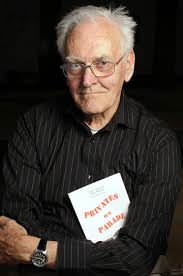
It probably comes as no surprise that Peter Nicholls, with wife Thelma, based the play on their own experience of bringing up disabled daughter, Abigail, who died aged 11. He went on to tackle big issues though the 1970s in other plays, The National Health, Poppy, Passion Play, Blue Murder and Privates on Parade, through formal experimentation (with copious reference, as in ADITLOJE to music hall and vaudeville), and ironic humour. However in 1982 he retired, apparently dissatisfied with the way his work was presented and was seen as unfashionable by many. Yet, based on this and what I have read about these plays, I would think there is an opportunity for contemporary theatre-makers to have a go at revisiting other of his frank, if sometimes unsubtle works, as has been done with Passion Play for example. Prickly and unsettling is not such a bad thing for theatre. PN passed away just before this revival opened but I hope he had a chance to see the justice that was I think done here to his breakthrough play.

Nightfall at the Bridge Theatre review ***

nightfall-sky

Nightfall

The Bridge Theatre, 10th May 2018

If you haven’t been yet the Bridge Theatre offers up London’s best large scale flexible space. And very nice toilets. You’ve probably know that if you have any interest in things theatrical. You will also have probably have read that the space, and specifically the stage itself, here “thrust” into the audience, is the biggest handicap, as well as attraction, for this production of Barney Norris’s new play.

For mercurial designer Rae Smith, after the grim dystopian disappointment of the NT Macbeth, has conjured up a belter here along with lighting designer Chris Davey. A farmhouse cottage, its unkempt back garden, a massive, rusty oil pipe which runs behind it and a stunning realisation of the twilight sky, the backdrop for both acts. It looks amazing. Unfortunately the play itself, and its four characters, struggle to match its majesty. This is a play, as the criterati have unanimously observed, that would work better on a smaller stage. Not just because the subject, a dysfunctional family, is intimate, but also because the production, under the direction of Laurie Sansom, (he of the James Plays), is necessarily static.

That is not to say this isn’t an interesting drama, especially after the disclosures at the end of the first act. It just takes a bit of time to get going. We are on familiar territory. The inverse of the rural idyll. The trap that is the contemporary farm. I have raved before about director Hope Dickson Leach’s The Levelling, one of the best films of last year. which turns this setting into a visually and dramatically compelling narrative (The Levelling film review *****. The idea of Simon Longman’s Gundog at the Royal Court was powerful even if the play itself couldn’t support its weight (Gundog at the Royal Court Theatre review ***). Barney Norris himself has explored relationships in the rural setting of his native Hampshire before I gather, though I haven’t seen any of this work.

Jenny’s (Claire Skinner) husband has died leaving her the struggling farm. She is still grieving and prone to a sip or two of pinot grigio. Daughter Lou (Ophelia Lovibond) works at a local estate agent/developer but dreams of escape. Son Ryan (Sion Daniel Young, so good in Gary Owen’s Killology) has taken on the labouring. We first encounter Ryan with his friend Pete (Ukweli Roach) illegally tapping into the pipe, a ruse to rescue the farm. Pete has a bit of history with crime we learn and had a relationship with Lou, though she is now wary of him.

I understand why Barney Norris takes his time to flesh out his characters before advancing the plot but the wait does drag a little and, curiously, we don’t really get to appreciate why they have ended up tied to this place and each other. There are tensions, though again wisely, there are also still clear bonds between the four of them. As the secrets come out, as you knew then would, the pressure ratchets up. It doesn’t end well. Chekhov’s fingerprints are all over this.

Claire Skinner (a wonder in Terry Johnson’s underrated Prism at the Hampstead) does a grand job of showing Jenny’s slow disintegration and her desperation to keep the kids close at hand. Ukweli Roach and Ophelia Lovibond flesh out the relationship between Lou and Pete, alternately tender and matter-of-fact, and Sion Daniel Young shows us how immature Ryan tries to dodge reality.

It is worth staying with it, for there is truth in these characters, and it is easy to see what attracted Nicholas Hytner in wanting to stage it. I could also see, and hear, why people might be attracted to Barney Norris’s novels, where description and insight presumably augment any overly elegiac plotting. Writing about the everyday for the stage is hard, (the novel or film always works better), but Mr Norris knows how to. Just maybe not for this stage. Mind you I see that £15 will get you a seat up close in the pit for the last week or so and that is well worth it.


Prism at the Hampstead Theatre review ****

prism

Prism

Hampstead Theatre, 14th September 2017

Full disclosure. I love Terry Johnson’s plays. The marrying of “high” and “popular” culture themes and structures, the mix of humour and, as he calls it “brainy stuff, the abrupt lurches in tone: all this works for me. I have many more plays to get through (here’s hoping for some revivals) but favourites so far are Insignificance, which explores the nature of fame by throwing together Marilyn Monroe (of which more later), Einstein, Je DiMaggio and McCarthy (and is coming up shortly at the Arcola), Hysteria which pits Freud and Dali in a farcical set-up and Dead Funny which pulls apart the nature of comedy. So this is not likely to be an unbiased review. And it isn’t. I thoroughly enjoyed Prism with just a couple of tiny misgivings.

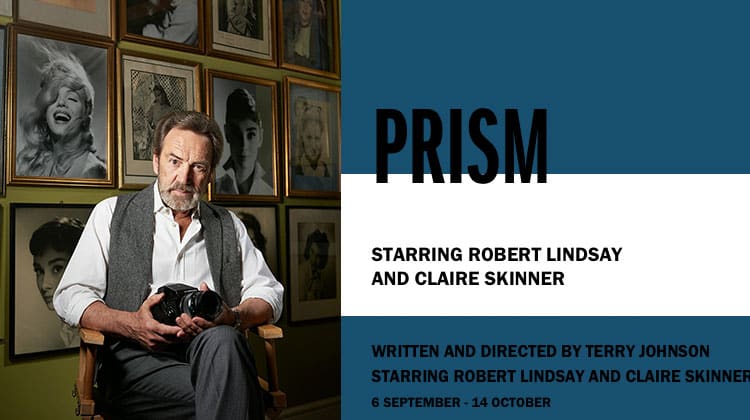
This is Mr Johnson’s first full length play in a decade or so though he keeps busy directing and writing for television and film. So for me this was something of an event. The idea for the play came from Robert Lindsay who is also a rareish sighting on the stage nowadays, which is a shame as he is a great actor in my book. Prism is based on the life of Jack Cardiff (1914-2009) about whom, I cheerfully admit, I knew nothing before this evening, though I was aware of his work. For Cardiff, who won a couple of Oscars, was the cinematographer behind such classic films as Powell and Pressburger’s Life and Death of Colonel Blimp, A Matter of Life and Death, Black Narcissus and The Red Shoes and John Huston’s The African Queen, of which more below. There were many others over his six decade career, as well as some directing assignments. By all accounts Mr Cardiff revolutionised the art of cinematography and he mixed with all the Hollywood greats. He was also something of a “ladies man” as my gran would say, and a fine looking fellow in the mould I think of a young Michael Caine.

If you are familiar with the films I name-checked above, as I am sure you are, you will know that the way these films are lit is jaw-droppingly impressive. Light, and the way we see things, is sort of the point of this play. And the golden age of Hollywood film has served Terry Johnson well as context before with the plays Insignificance and Hitchcock Blonde.

We first meet Jack Cardiff with his son Mason (Barnaby Kay), who has fashioned a studio of sorts out of a garage for his Dad to write his memoirs. This studio has one of his cameras (minus its vital prism thanks to Mason past carelessness) as well as photos of Hollywood leading ladies and Mr Cardiff’s own capable reproductions of Old Masters, such as Vermeer, Rembrandt, Renoir and Van Gogh, who captured light in paint before the photographic age and inspired our Jack.

Mr Cardiff is sliding into dementia, which provides the backdrop for much of the first act gentle humour here, so needs the help of a carer Lucy (Rebecca Night), who is also tasked with keeping the memoir on track. We also meet Jack’s second wife, Nicola (Claire Skinner) who was his assistant so is somewhat younger than Jack and is finding his decline difficult to cope with.

There is more than meets the eye here, quite literally. In a smart second act coup de theatre we shift to the location set for the filming of The African Queen with Barnaby Kay now playing Humphrey Bogart and Rebecca Night playing Lauren Bacall. And Claire Skinner metamorphoses into Katherine Hepburn. Now I go weak at the knees at the very though of Katherine Hepburn so, again, may not be the best judge of Ms Skinner’s performance but I was captivated. The flirting scene between Cardiff and Hepburn is terrific as are the references to the much reported hardships the cast had to undergo in the filming.

Mr Johnson also pulls another cracker from his bag marked “theatrical devices” with a scene involving Jack lighting Marilyn Monroe (Rebecca Night) followed by a fracas with Arthur Miller (Barnaby Kay). But this is an exact repetition of an earlier scene where Jack is explaining his work to carer Lucy. The doubling and trebling of roles here is a key element of the structure of the play as we probe Jack’s fading memory.

We learn about Jack Cardiff’s life, with Terry Johnson working his usual magic by stretching and shifting real events, the nature of light and ways of seeing in art and film, and the nature of memory. Lovely, very funny, insightful dialogue, the usual big ideas refashioned in comedy drama with real narrative and momentum and a more poignant, valedictory note (I won’t spoil the ending) than in previous Terry Johnson plays.

As usual Mr Johnson directs his own work, (some very interesting insights in the programme about this process), which means what he wrote and intended is what you see and hear. Tim Shortfall’s set is clever but not clever, clever and the performances are excellent. Minor quibbles are the slight lack of momentum through the middle of Act 1 as the “real” characters are mapped out, with Mr Cardiff’s dementia milked for laughs a little bit liberally, and the slicing in of Lucy’s tough background and circumstances, I didn’t see the point of this other than to lurch us from laughing to sadness in an instant which is a bit of a trait from this playwright.

So, as you can see, I really enjoyed and admired this, but like I say, I am a sucker for Terry Johnson’s plays. My guess, judging from the audience reaction, is that the overall reception may be a little more muted. But this seems to have been the fate of Terry Johnson’s work from the start. Some people rave, some people shrug their shoulders. What I would say is that even if you are not familiar with his work, if you have any interest in the subject, in film, like the cast or just want a funny, interesting night out then don’t hesitate.