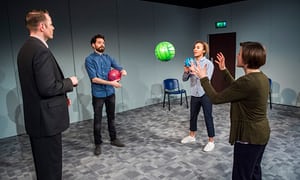
The War Has Not Yet Started at the Southwark Playhouse review ***

the-war-has-not-yet-started-700x455

The War Has Not Yet Started

Southwark Playhouse, 18th January 2018

I don’t really read that much anymore. Which means I take a rather circuitous route to the acquisition of knowledge and satisfaction of curiosity. The page has been replaced by the stage, the museum and gallery, visits, music and my dear friend, Wiki. Books can then fill in the gaps. (Though I must call out the wonderful OUP Very Short Introductions. If I need a way in to something brainy here is where I start. Bite and pocket sized, though a bit variable in tone.)

This means some “stuff” has become more prominent that other “stuff” in my head. Bear in mind the capacity of my head RAM has opened up exponentially now that is is largely free of my work-life specialist subject. I knew a lot about very little. Now I am trying to find out a little about a lot. Which suits me as I am a consummate bullshitter who relies on knowing a tiny bit more than any conversational partner, and a sonorous delivery that bores them into agreeing with me.

One of the things that has crept up on me in the journey has been the modern(ish) history and state of Russia. A bit of Chekhov, too much Shostakovich, a handful of art exhibitions and a couple of conversations, and, to paraphrase Winnie Churchill, the enigma is revealed. Well not revealed but I go from nothing to something. It is a tiny something, but, at the risk of going all epistemological on your ass, it is more than I know about the state of Hounslow, my next door neighbours or our cat.

The point is that the relationship between State, as in the instruments of power, and the individual, has been a fertile one for the Russian/Soviet Artist. In the rapid lurch from backward, pre-revolutionary, feudal autocracy, through Revolution to oligarchical Capitalism, it looks like it has paid to keep things close to your chest.

Which in a roundabout way brings me to TWHNYS. Mikhail Durnenkov is an actor on stage and TV, as well as a playwright, living in Moscow. The Drunks, written with brother Vyacheslav, aired at the RSC a few years ago, in a translation by the marvellous Nina Raine. I didn’t see it but, from the sound of it, it is a satirical comedy, tracing a long line back through to Gogol, that took the unfortunate adventures of an Everyman, a soldier, as a metaphor for modern Russia and its history.

TWHNYS is a more discursive, experimental affair brought to the Southwark Playhouse in a translation by Noah Birksted-Breen, by way of the Theatre Royal Plymouth. Unconnected characters play out 12 seemingly unconnected vignettes, some banal, some more striking, over 80 minutes or so. Apparently they can be played in any order with any number of actors. Here we have three. Sarah Hadland, (Stevie in Miranda, she of the allure!), Mark Quartly, last seem by me as the gymnastic “real” Aerial alongside his real-time holographic doppelganger in the RSC Tempest, and, most strikingly, Hannah Britland. Many of the scenes are set within the family unit or deal with the impact of violence and propaganda. There is black comedy, confusion, menace, little in the way of entry or exit from the scenes and much obfuscation. The scenarios are all recognisable but throughout is an air of mistrust and uncertainty that sort of compels.

It is really tricky to make this sort of writing work and I am not sure how much is lost in translation, not of the language, but from Moscow to London. Whilst much of the contemporary zeitgeist which Mr Durnenkov is trying to capture is universal, it might make just a bit more sense there rather than here. Cultural specificity is a slippery waif and I always try my best to ditch the dangerous fiction of borders when thinking about this sort of entertainment, but I was still struck by how much the mood of the play fitted with what I think I have learnt about the Russian mindset.

Still anxiety is anxiety wherever you live and the cast and director Gordon Anderson, (who has experience of this sort of mood from his League of Gentlemen days), seem to be enjoying it. Andy Purves’s lighting design is noteworthy.

Go see for yourself. I am still making my mind up.
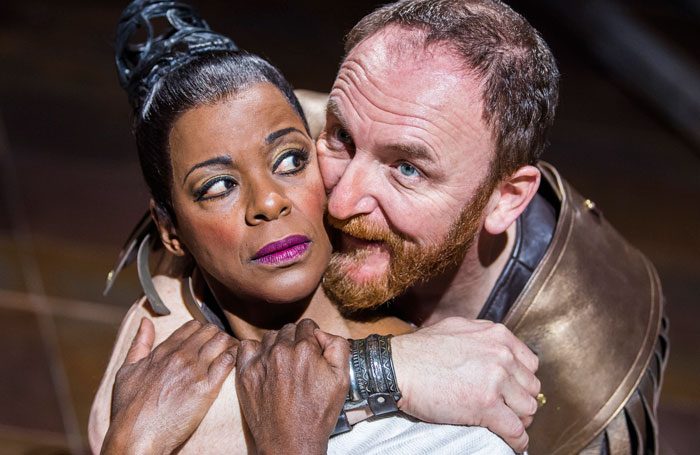
 

Antony and Cleopatra at the Barbican Theatre review ***

antony-cleopatra-rsc-rst-119-700x455

Antony and Cleopatra

Barbican Theatre, 18th January 2018

The last instalment, for me, of the Rome season at the Barbican, and so late in the run that it has been and gone. Sorry. Anyway I have to say this was my least favourite of the four productions, though there was still much food for thought.

I think the reason for this is simple. I prefer the other three plays. Titus Andronicus for its over the top, knowing black comedy, Coriolanus for its astonishing insight into pride, the democratic ideal, the mother-son relationship and homo-eroticism and Julius Caesar for, well, everything you will ever need to know about the use and abuse of political power.

Titus Andronicus at the Barbican Theatre review ****

Coriolanus at the Barbican Theatre review *****

Julius Caesar at the Barbican Theatre review ****

The language in these three is flintier, more muscular, more direct. The drama is played out across a broader backdrop even if this is still measured across individual psychology and the relationships between friends, enemies and family. In A&C the language is way more florid, despite the similar source material as JC (Plutarch via Thomas North), and the focus is firmly on the mature lovers. High Baroque not Early Renaissance if you will.

There is a curious ironic, detached quality to our observation of A&C. I am not saying I identify with unhinged sadist and novelty pie maker Titus A, by way of example, but I can sort of see where he is coming from. Elsewhere in Shakespeare the thrill of recognition is never exhausted, no matter how many viewings, but with A&C I can’t escape the performance, the spectacle. That may well be the whole point. There are times where the pompous grandiosity of these two entitled mid-lifers sets me spluttering, internally and, embarrassingly, externally. Certainly Will S has the right words and right scenes to skewer them. But all the poetry  and “look at me” gets a smidge wearying. I know that complaining that Shakespeare sometimes has too many words is like saying Mozart has too many notes but the platitude applies.

Of course it could just be that I haven’t come across the right A&C yet. I see the NT is set to stage a production with Simon Godwin at the helm, (who sucked all the meat off the bones of Twelfth Night and Man and Superman at the NT), with Ralph Fiennes and Sophie Okonedo. If those two get fired up sparks can fly. Let’s hope so.

Designer Robert Innes Hopkins here chooses to go with a look straight out of Cecil B DeMille. Josette Simon as Cleo has more frock changes than I have underpants, including, at one point, sporting her birthday suit. Costume supervisor Sian Harris, and all the unsung heroes who cut and stitch, must have thought Christmas came early, just in greaves alone (google it). There is a big black cat. natch, and I hear Southall high street is now short of kohl. There are even some steamy Roman baths and an impromptu harbourside bar on display. I bet they only ruled out the incense sticks at the first rehearsal. Mind you I get it is tricky to take A&C out of its historical context.

Ms Simon captures Cleo’s unpredictability, grace and caprice but maybe not the extremes of cruelty and vulnerability. Some of her vocal delivery, to use football commentator parlance, “takes the wrong option”. She does have stage presence though, even when brooding on the sidelines. Workaholic Antony Byrne, who knows his way about the Shakespearean stage, has a cursive way of delivering lines and character and a grizzled, martial look about him. Yet, at times, he felt a bit mechanical and MA’s intense fear of shame was not fully realised.

I was never entirely persuaded of the couple’s passion or plotting.  There was none of the seemingly spontaneous physicality that Hans Kesting and Chris Nietvelt brought to the parts in the TA Roman Tragedies. That really stank of sex, with Marieke Heebink’s Charmian the …. well I better stop there as I am getting hot and bothered. Alexandria never looked so decadent, and the cropping of action and lines, as well as the translation process, seemed to help me overcome my objections to the play.

I am not sure if Ben Allen’s Octavius here was intended to be quite so limp, and the contrast with David Burnett’s roister-doister Pompey, quite so sharp. Andrew Woodall swapped Caesar for Enobarbus, taking world-weary to a previously untested level. When it comes to ironic commentary on what is going on around him, Enorbarbus has some of the best lines in the play and these were delivered with relish by Mr Woodall, though he does have an uncanny resemblance to my brother-in-law. I am much taken with James Corrigan here playing Agrippa as upright conciliator. Amber James as Charmain and Kristin Atherton as Iras provide sterling support as ego-masseurs-in-waiting to Queen Cleo.

Director Iqbal Khan offers a straightforward account of the play, in line with the staging, and somewhat of a contrast to his previous Shakespeare, where he has mixed it up a bit. That means that each line is pretty clear but the overall rhythm a little baggier than Angus Jackson’s Julius Caesar. There comes a point in many a Shakespeare history play, when the to-ing and fro-ing between locations, and the long line of messengers bearing news, can distract. A&C, nominally a tragedy, can fall into the trap. If your head is filled with contemplation of motive or poetry you won’t see the joins. Here, once or twice, I did.

So there you have it. It seems I was far more taken with Angus Jackson’s Coriolanus and Julius Caesar in this season than consensus, reckon Blanche McIntyre fully got to grips with the uncertain tone of Titus Andronicus and agreed with most that this Antony and Cleopatra was more stately than seductive.


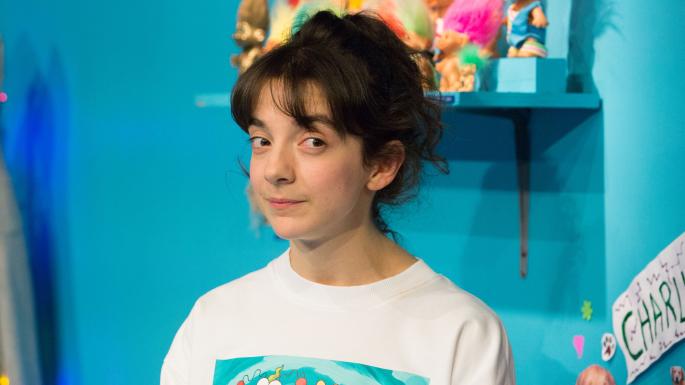
My Mum’s a Twat at the Royal Court Theatre review ***

methode2ftimes2fprod2fweb2fbin2fbc4692b8-f61d-11e7-a789-003e705b951e

My Mum’s A Twat

Royal Court Theatre, 16th January 2018

I am a fat bloke with a dodgy heart and a sore back in his 50s. So I should not be swanning around London without a care in the world hoovering up culture to make up for lost time. I should be grinding away engaged in pointless labour for 12 hours a day to ensure late Western capitalism can continue to eke out basis points of economic growth. “Growth” that is only secured by measuring the wrong things or by mortgaging the future. But, in some unseemly regress to my student and early post student years, that, (the swanning), is what I am doing.

Which in turn means I end up seeing theatre where I am plainly not the target audience, surrounded by youngers who could be my kids, on seating which has not been designed with me in mind. There is an excellent tendency amongst the most progressive theatres, the Gate, the Young Vic, the Royal Court, in London to incorporate the audience seating into the set design. I probably had a lucky escape from The Jungle at the Young Vic recently, (no allusion intended), as I was unable to make the booked date. From the sound of it that was a cultural loss, given the sparkling reviews, but a medical gain as the chances of me sitting for an hour or so on a cushion without the entire audience sensing my discomfort was miniscule.

And so to My Mum’s a Twat where a quick scan on the way in saw me quickly bypass the floor cushions and opt for the sturdiest wooden chair I could find, which just about did the trick. Now to be absolutely clear I am not moaning about any of these design concepts. Quite the reverse. Bringing the audience in, rather than shutting it out, can only be a good thing. And, at the end of the day, if I could just lay off the pies, the discomfort could be dialled down. No, this is simply an awkward, space-filling preamble to the bland realisation that My Mum’s a Twat may not have been for me.

Which is galling in so many ways. The Girl in this 75 minute monologue was played by my favourite stage pixie, Patsy Ferran. By my calculations you could secure maybe 4 Patsys for every 1 of me. And since Patsy Ferran delivers more joy in 30 seconds of stage performance that I could muster across several lifetimes, (even learning from my mistakes), then this would be a very valuable trade. She was the stand-out actor in Polly Findlay’s As You Like at the National in 2015 and in Ms Findlay’s most recent RSC Merchant of Venice. And her turn in Blithe Spirit in the West End a few years ago near upstaged some way more venerable colleagues. I note she is set to take the lead in the Almeida’s forthcoming TW’s Summer and Smoke – can’t wait.

Anyway she was made for this part. This debut play by Anoushka Warden, (whose day job is schmoozing the press for the RC – good on her), is a forthright memoir of the Girl’s childhood after her Mum and partner join a ropey (“batshit crazy”) cult. She tells tales of her siblings, her stepdad (“Moron”), Mum obviously, (the twat), the pious cult leader (sorry can’t remember her name), her Dad, who she eventually rejoins after Mum and stepdad move to Canada to set up a new outpost of the cult, her friends, drugs, sex, music. In fact all the things you would expect from a memory play about childhood and teenage years. It is not too gentle though it is pretty funny, and it captures many of the pleasures, the disappointments, the self-absorption, the bedroom rebellion, of those years. At its heart lays the bond between the Girl and her Mum, despite the nonsense that her Mum subscribes to in the cult.

I wished it had gone a little bit darker, especially into the workings of the cult. The story would allow that, the anger is rooted, but Ms Warden’s writing defaults back to comedy. And it might have benefitted from a little more surprise and revelation along the way, especially towards the end, where it becomes a little bit “teenage rebel” predictable. It does though have moments of real insight and acuity which expand beyond the specific’s of the Girl’s story and it serves as a perfect vehicle to showcase Ms Ferran’s undoubted talents. Some actors recede from the memory post performance, some actors intensify. Patsy Ferran is one of the latter.

Seating aside, Chloe Lamford’s teenage bedroom design is a winner, and Ms Warden has secured the services of, not one, but two, of our finest directors in boss Vicky Featherstone and Jude Christian. Ms Christian directed Parliament Square at the Bush and in Bath (Parliament Square at the Bush Theatre review *****), to thrilling effect, and Bodies (Bodies at the Royal Court Theatre review ****) in this very space. Next up she will be bringing Trust to the Gate Theatre. A post-theatre, dance based German-Dutch collaboration having a pop at global capitalism, in the tiny Gate space. It will either be genius or ludicrous. Probably a bit of both.

Three Billboards Outside Ebbing, Missouri film review *****

threebillboards

Three Billboards Outside Ebbing Missouri, 16th January 2018

Best film of 2018.

Settle down Tourist. We are only three weeks in. Well I am confident that nothing will come along to match this so I stand by my sensationalist claim. You see I spent all of 2016 waiting for a better play than Hangmen, also penned by Martin McDonagh, to come along and it never did. In Bruges is a top 10 ever film for me and The Pillowman is another favourite play. I have not seen all of the five “Galway” plays that Mr McDonagh tossed out in the space of a year in 1994, in the absence of a proper job, but I have read them. I love theatre but trust me, I don’t read many texts, that would be a step too far. But these cried out to be read. Heavens I even think Seven Psychopaths could do with more meta references.

So, as you can see I have a (un)healthy admiration for Martin McDonagh. And now, to cap it all, I read that he is courting the prodigiously talented Phoebe Waller-Bridge.

Even by his high standards though, Three Billboards is a terrific achievement. I believe he has argued in the past that film is a better artistic medium than theatre, (he is transparently wrong in this regard), but the simple fact is, the reason he is such a brilliant film-maker is precisely because he is such a brilliant playwright.

He can tell a story. And he does it in a classically Aristotelian way. Perfect plotting. Take a character, or in this case three characters in the form of Mildred Hayes, the transcendent Frances McDormand, Bill Willoughby, played by a pitch-perfect Woody Harrelson, and Jason Dixon, entrusted to another McDonagh regular, the Sam Rockwell, and present them with problems to solve, or not.

The bitter, careworn Mildred wants justice for her daughter, Angela, who was brutally raped and murdered. The target for her fury is police chief Willoughby, who, we soon learn, is dying of cancer. And one of his officers, Dixon, is a violent racist whose redemption is prompted by Willoughby’s intervention. These major characters, and those supporting the story, could not be more vivid.

Justice, rage and revenge, as we know from other contemporary film directors, (there are echoes of Tarantino and Asian masters here), and playwrights down the ages, are themes that are guaranteed to grip any audience. I think those who have got hooked up on race, the state of America, sexual violence or a host of other themes they think this film should be addressing have missed the point.

Language: well I have no idea how the good and bad people, of Missouri speak, but I know there is poetry here. And you never know what anyone will say next. There is so much small detail to relish in the dialogue. There is spectacle aplenty with a string of WTF scenes and some stunning cinematography. The multiplicity of tone, and “ordinariness” of location, constantly left me searching for cinematic references.

The jerky rhythm that is created from the interplay of plot, character, language and spectacle carries us along breathlessly. What just happened? What is about to happen? Do I like them? Do I hate them? Why did they do that? These are questions you need to keep asking to make a drama come alive. Three Billboards delivers this. Again and again and again. The wonderful score and intelligently curated musical excerpts only add to the story.

McDonagh’s writing is economic and fearless as is his directing. There are multiple occasions where he rushes in where others fear to tread, but he is no fool. Bait and switch followed by bait and switch, but never really stretching credulity, (which is an overrated requirement in naturalist drama anyway). Suffused with violence sure, but also with humanity. And plenty of characters whose primary mode of expression is “f*ck you” which, as well know, is as naturalistic as it comes.

This then is a tragedy full of comedy. Or a comedy full of tragedy. There was another playwright who mastered that art and was unafraid of going straight for the audience’s jugular. Big Will didn’t deal in stereotypes either and the good, the bad and the ugly could crop up on the same page in the same character. And he was wowing them 400 years ago. Further back there were 3 Greek fellows who nailed drama – so good they defined it. All good people to emulate.

Once you strip out the fantasies, the horrors, the rom-coms, the puerile, the childish, the introspective, the experimental, the “real life” dramas, the biopics, the historical, the spys, the super-heroes ….. and so on and so on, there just aren’t that many films that want to take a human story, and make it mythic. I appreciate that those who prefer their entertainment where the violence is frequent, unremarkable and bloodless and the comedy broad, or those who want drama that scrupulously adheres to their world-view of what is just, (best steer clear of Othello then), but, for those of you who prefer your meat a little rarer, (or your tofu a little spicier), then DO NOT MISS THIS.

Predictably I have got carried away. I just think this is an amazing film by an amazing writer. So I’ll stop now. For those of us Londoners who love this man’s work we are in for a couple more treats this year with a revival of The Lieutenant of Inishmore from end June at the Noel Coward Theatre directed by Michael Grandage, (who successfully revived The Cripple of Inishmaan in 2013), with that sex-bomb Aidan Turner playing Mad Paidrac, and with his new play A Very, Very, Very Dark Matter opening at the gorgeous Bridge Theatre in October. This sounds like it will revisit the dark and twisted territory of The Pillowman. I’ve booked it to replace the usual family panto trip.


The Twilight Zone at the Almeida Theatre review ***

ttz_1470x690v2

The Twilight Zone

Almeida Theatre, 13th January 2018

Based on my entirely objective reviews, (of which more to follow when I get round to it), I see that the Almeida has, over the last three years or so, consistently offered the best theatrical experience in London. No great surprise really given the writers, casts and especially directorial talent, (notably AD Rupert Goold and Associate Director Robert Icke), at its disposal, but, still, it has been a remarkable run. There have been hiccups along the way though and one of these was, for me, if not for many others, Mr Burns. Too drawn out once you have got past the central conceit, and too pleased with itself.

Having said that the riff on contemporary culture, in that case one episode of the Simpsons (Cape Feare), was a splendid nugget of an idea and I could see where writer Anne Washburn was headed. So it didn’t seem like too much of a risk to sign up for the Twilight Zone, her reshaping of 8 of the original episodes from the ground-breaking, eponymous 1960s CBS TV show. For the benefit of you young’uns think vintage Black Mirror. Now I am pretty sure I have seen a few of the episodes, they must have been on terrestrial telly decades ago when we had no choice over what we watched, but I can’t really remember any of them. So its appeal lay more in its reputation. Same for the SO who was keen to come along, the Almeida being one of her favourite haunts as well.

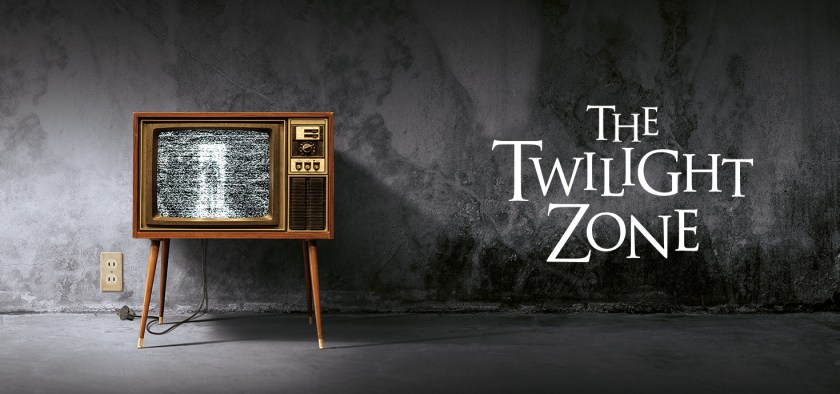
Now a domestic crisis meant the SO had to leave at the interval, which was not a cause for deep regret. Why? Well this production didn’t quite come together in our view. The cutting up of the stories is, by and large, an admirable idea, highlighting their fractured, and paranoiac, nature, and keeping the audience on their toes, but it also led to an overdose of scene shifting. The way the cast was incorporated into these shifts, rigged up in dark boiler suits and googles, like disturbed chemical industry technicians, was inventive, and the set and costumes from Paul Steinberg and Nicky Gillibrand was immensely creative. The monochrome tones, the use of spinning cut-outs to simulate the memorable graphics of the TV series, the framing of the set as if in a retro TV screen, incorporating a back and white TV set dangling above the stage, the starry background. All this conjured up the look and feel of the series. The lighting design from Mimi Jordan Sherin, together with the sound and music from Sarah Angliss, Christopher Shutt and Stephen Bentley-Klein, and the illusions of Richard Wiseman and Will Houstoun, all elevated the visual and aural impression.

Now none of this should come as a surprise given the provence and history of director Richard Jones who revels in the playful, or, dare I say, cartoonish. The problem is the uncertain tone this creates. The production is an homage to the original series but the concept and design leaves it veering towards parody. Not saying this is wrong: there are plenty of funny moments here, most notably the running gap with cigarettes, and a theatrical adaption of a “cult 1960’s sc-fi series” for a contemporary audience was hardly ever going to get away with any other approach. But it does rather drown out the messages of alienation, delusion and psychosis that permeate the original. The Twilight Zone was all about projecting inner fears onto apparent external realities. Nightmares, other possible lives, cracks in time and space, paradoxes, you get the picture. With an unhealthy fear of the other.

Once the conceit in each story is revealed however, there is little room to develop and there is nothing in the characters. As drama then this lacks dimension. Which is unfortunate for an entertainment that seeks to explore human reaction to other dimensions. Now I don’t think this is the fault of the cast, all ten of them hurl themselves into the many roles they are asked to play. Nor, as I say, is it the fault of the creative team. And I would not criticise Anne Washburn’s text. No I think the problem is that the stories themselves do not stand up to theatrical adaption because there is not enough there in the first place. What works for half an hour on the box falls short on the stage however clever the manipulation.

So, overall, a flattish evening. Well worth seeing, and hearing, and in places there are some real thrills, but not a truly engaging piece of theatre. Maybe we set our expectation bar to high. Blame the Almeida. Too good at what they do.

Twentieth Century Masters: LSO at the Barbican review ****

orig_59afd6d959fea7-94052844

London Symphony Orchestra, Simon Rattle, Isabelle Faust

Barbican Hall, 14th January 2018

  • Janacek – Overture: From the House of the Dead
  • Elliott Carter – Instances
  • Berg – Violin Concerto
  • Bartok – Concerto for Orchestra

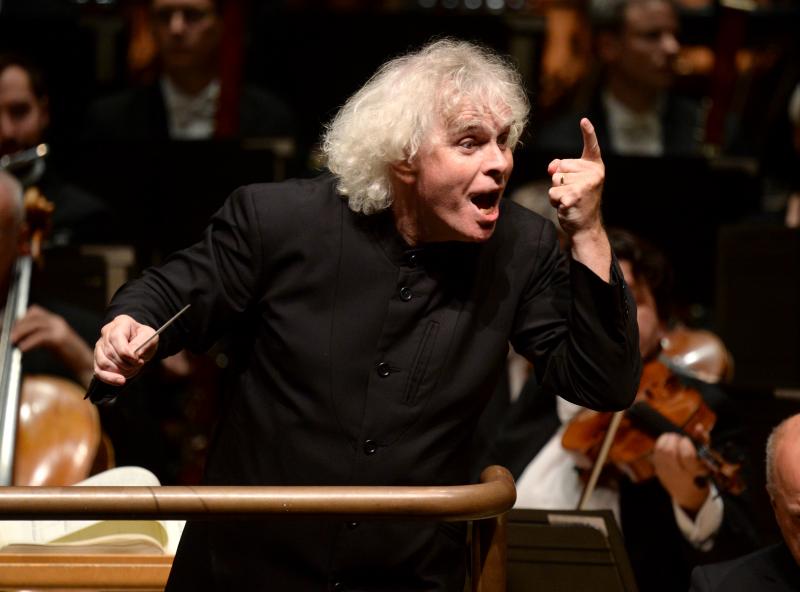
Back to the Barbican for another round with Sir Simon Rattle and the LSO, though this was more familiar ground (for me) compared to the previous outing (Rameau to Mahler: LSO at the Barbican review ***) a few days earlier. And back to my more usual perch. Once again the Hall was pretty much full to the rafters, and, encouragingly, it looked liked a very youthful audience. (Or I am ageing more rapidly than I thought). Anyway, on the subject of age, the thread here was orchestral works written near the end of their lives by these four very different composers. All of which gave a chance for the whole orchestra to shine.

Now the main draw for me here was Isabelle Faust. I think she is probably the best current violinist in the world. Mind you, as is my wont, I have gone all hyperbolic in this claim with little evidence to back this up. So, more exactly, the best violinist I have heard in the past couple of years, based on recordings and her Bach outing last year at the Wigmore Hall (Akademie fur Alte Musik Berlin at the Wigmore Hall review *****).

As it happens I saw a fine rendition of the Berg Violin Concerto performed by another favourite violinist in the elfin form of Patricia Kopatchinskaja last year at the RFH with the LPO under the baton of Vladimir Jurowski. And I recently invested in the benchmark Levine/Mutter recording, (even though I am not entirely convinced by Ms Mutter). Now I am not going to pretend that listening to Berg comes easily to me, but even I can hear that there is a rich depth in his works from the combination of passion, intelligence, serial technique and romanticism, that rewards persistence. I rashly signed up for a performance of Wozzeck at the Frankfurt Oper a couple of years ago in German with German sub-titles (FYI I don’t speak German). Unforgivably I bought the cheapest ticket up in the gods. It is a wonderful auditorium but I could only see half the stage. That was still enough to be transfixed by an outstanding production. But most of all it meant I had no choice but to get lost in the score. Stunning. Add to this the Lulu in 2016 at the ENO directed by William Kentridge, which I confess was beyond me in parts, but was visually spectacular, and I am now well on the road to Bergian conversion. Mind you, what with his long(ish) musical education under Schoenberg, the proscription of his music under the Nazis and his early death, aged 50, after a bizarre insect biting incident, there isn’t too much composition to get your head around.

Now this Violin Concerto isn’t like others in the canon. It’s tricky for sure, and asks a lot of the soloist, but it isn’t showy. Orchestra and soloist have to mesh together. It is pretty much the last piece Berg wrote and is dedicated to the memory of Manon Gropius, the daughter of Alma (Mahler’s widow) and Walter Gropius (Bauhaus founder), who died from polio at 18. Apparently she was a captivating young woman in the manner of her mother.

The two movements are each split into two parts and with the waltz emerging from the material set out in the first movement, and the chorale emerging from the more rhythmic, almost cadenza, in the second movement. This the tempo is reversed in each. I can sort of pick out the established musical structures from within the twelve tone architecture but couldn’t tell you exactly what was going on. Suffice to say this is a dark, brooding, self-absorbed piece for the violinist and Ms Faust seemed to capture this utterly. She seemed lost in music, caught in a trap, to paraphrase Philly’s finest sisters, There are times when the whole edifice becomes just that bit self indulgent but this is where Sir SR’s insistence on picking out the orchestral instrumentation pays dividends. I hadn’t realised how detailed are the parts for harp, clarinet, viola, flute and trumpet were in this piece. I do now.

Which brings me to the Bartok Concerto for Orchestra. Now this is a piece written with the express intention of letting everyone in the band have a solo, like some prog-rock group in its 1970s pomp, It is an obvious, but still inspired, choice to present to an audience in a first season, and, I would hazard a guess, if you are engaged in a bit of musical team-building. I have Rattle’s first, (I think), stab at this when he was a younger at the CBSO, (though the bargain basement Solti/Chicago Symphony Orchestra version tops it). Anyway Sir Simon knows his way around it, and it brilliantly matches his predilection for coloration and deliberation.

I am not going to lie. It blew my socks off. There is just so much to listen to here. The first movement strings and brass, coming out of the undergrowth, with the woodwind, led by a solo oboe, getting their turn in the spotlight. The wonderful second movement scherzo with its contrasting intervals, an eerie disco. Next up an Elegia, exactly as it says, with the strings swirling around and up to be met by bold brass chords and a piccolo sticking its little nose in. The second scherzo quotes, mocks and, ultimately, compliments Shostakovich with tuba and harps getting involved, and the final movement works in classic Bartok folky stuff with a gallop to a rousing chorale at the conclusion.

I reckon we won’t have seen the last of this piece, or of Bartok, from Sir Simon and the LSO and it can probably get even better from here. Hopefully too we will see him rework some of his other C20 repertoire. Some more Stravinsky for sure, but I’d loved to hear his latest takes on Britten’s music for orchestra and, please, some, no all, of the Nielsen symphonies.

Anyway the other two pieces in this concert were tried and trusted composers for Sir Simon, Janacek’s Overture From the House of the Dead didn’t quite get the pulse racing in the way the Bartok did, but still suggested what the LSO is heading towards. (I see the House of the Dead will see a new production at the Royal Opera House in the forthcoming season. That has contemporary relevance written all over it). Sir Simon has always championed Elliott Carter and I can see why. This was another of those short, but inventive, comedy pieces that Carter was turning out in his musically fecund 90s and even into his 100s, but it has a strangely, moving ending.

Can’t wait to see what the Scouse Gandalf will programme with his band for the forthcoming season. Hopefully not too much Mahler, Bruckner, Sibelius please.


Julius Caesar at the Barbican Theatre review ****

screen-shot-2017-04-07-at-10-31-13

Julius Caesar

Royal Shakespeare Company, Barbican Theatre, 11th January 2018

The third instalment, (for me), of the RSC “Rome” season at the Barbican which originally aired at Stratford. And, as is so often the case with this idiotic blog, it is about to end and is sold out anyway. Et tu numbnut.

Now JC (1599) was written a fair few years before its sequel, Antony and Cleopatra (1606), but both draw heavily on Plutarch, (via Sir Thomas North’s translation), for the guts of the story. Yet they could not be more different in tone. JC is austere in its construction of architecture and language, dripping with rhetoric. A&C is loose-limbed and florid as we watch the saucy couple get it on, often funny, and certainly over the top. All will be revealed when I see A&C as the last part of the RSC quartet shortly. (I note this attracted the most glowing reviews of the four).

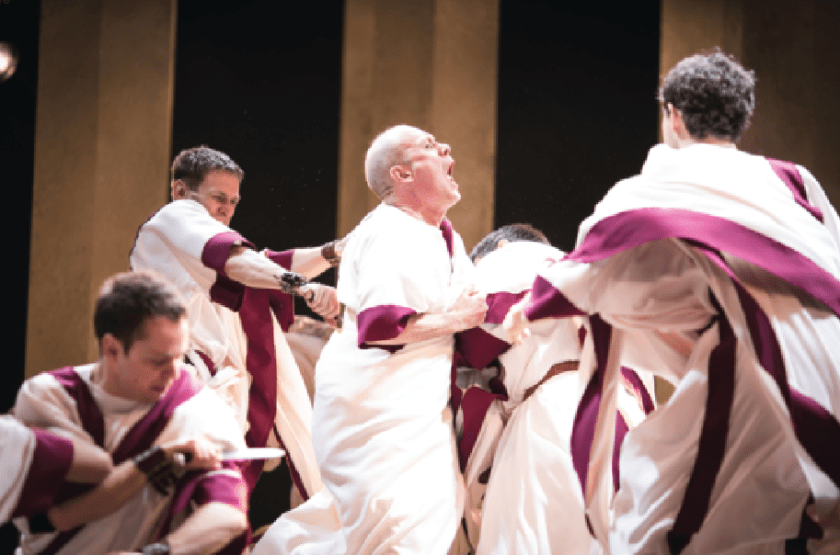
I have to say that, generally, JC is my favourite of the two. Here we have four chaps, (unfortunately this is a terrible play for female roles even if the sensible trend to cast Cassius as a woman is followed, though it is not here), whose actions and relationships can be interpreted in an infinite variety of shades. In this production we have an unyieldingly peremptory Julius Caesar courtesy of Andrew Woodall, (nailing all that third person humblebragging), an overly smug and somewhat vain Brutus from Alex Waldmann, a Mark Antony who is more devious than he at first appears from James Corrigan and a vituperative, beguiling Cassius from Martin Hutson. I have to say this latter performance brought out facets of Cassius that I had not observed before, and, as with his Saturninus in the RSC Titus Andronicus, Mr Hutson near stole the show. Alex Waldmann is the go-too if you want a character “plagued by doubts”, (last seen by me as a brilliant Henry VI in the Rose Kingston’s War of the Roses), but the way Martin Hutson works off of his uncertain Brutus is just mesmerising.

Will S’s brilliant innovation in JC is to telescope all of the action up to the big man’s brutal knifing by the conspirators into what seems like just a couple of days. This means the reasons for the conspiracy, to take down Caesar who has got way too high and mighty in an echo of the Roman kings of pre-Republic days, come flying out of the blocks thick and fast. This resolutely includes the personal as well as the political.

Angus Jackson’s direction allows the momentum to build whilst still clearly laying the arguments around the use and abuse of power, the morality of rebellion against oppression and the legitimacy of political assassination. It is not what Caesar has done, but what he might do. On whose behalf are the conspirators acting, the people or themselves and their own class? The hoi-polloi is never happier than when they have a “strong” leader remember. The uncertainty around what would happen after QE1 died, in the context of the struggle between Protestant and Catholic, would have been clear to Will S’s contemporary audience. The impact of uncertainty is just as clear now.

But big Will didn’t stop there. Oh no. The carnage “unleashed” in the aftermath of JC’s death as Mark A and Octavius put the plotters to the sword, whose own resolve is shattered, is just as effective and thought-provoking. That is the problem with regime change. It usually goes t*ts up because none of these blokes thinks about what happens next. All summed up in two minutes with the horrific murder of Cinna by the confused mob.

Because we never learn Will S can keep on teaching us. Clever huh.

And, in this production, with complete clarity in the delivery of the lines, it was very easy to see that the main players were as much victims, as shapers, of events. The conspirators were uncertain, their tone and movement revealing the dissension between them. Caesar has got all imperious in part because no-one stopped him. Mark A’s sycophancy reflected an eye to the main chance: his famous rhetorical speech to the crowd, cynical, a man realising he could seize control. Watch him build up, then tear up, Caesar’s will. Cassius egging on Brutus, not prepared to take the lead. Brutus and Cassius falling out big time in the tent but always knowing they had to make up since they only, ultimately, had each other. Kidding themselves they really were “honourable” even to the end by getting some poor sap to administer the “coup de grace”. Honour in our appallingly individualistic society may look like an anachronistic concept, but the effect on the audience of its study in this play suggests it still has a place in our hearts and minds.

No need for modern dress. Togas are fine. Would sir like Doric or Corinthian columns. No need for video of an orange Donny spouting hate or rioting millenials. No need to ham up the famous lines or cut out Will’s words. Frankly no need for an interval if it were my choice. One of the best ways to see and hear JC is still Mankiewicz’s 1953 film with Gielgud. Mason and Brando. Not to be confused with Stuart Burge’s 1970 film with Gielgud effortlessly shifting from Cassius to Caesar, but with execrable performances from Charlton Heston as MA and, worse still, Jason Robards as Brutus who appears to have wandered out of an old folks’ home.

Now I am not saying that JC cannot benefit from a little bit of tidying up and reshaping. I think Phyllida Lloyd’s all-female outing at the Donmar was the best of her trilogy last year, (and was a top ten production for me), and Hans Kesting’s speech to the crowd in Toneelgroep Amsterdam’s Roman Tragedies might just be the best 10 minutes of theatre I have ever seen. It’s just that the play can be as, if not more, powerful as a whole, without needing the full directorial vajazzle. I see that many of the proper reviews felt this production was all a bit old-skool, declamatory. I disagree. It is about the power of language to change the direction of political action. Praxis if you will. So emphasising that language should not be seen as embarrassing.

The good news is that we have another chance to see JC in the very near future, (from 20th Jan), as Nick Hytner and team at the Bridge Theatre have a crack. With Ben Wishaw as Brutus, Michelle Fairley as Cassius, David Morrissey as Mark Antony and David Calder as Caesar. How about that for casting. Can’t wait.


Rameau to Mahler: LSO at the Barbican review ***

rattlelsoedit7

London Symphony Orchestra, Simon Rattle, Magdalena Kozena

Barbican Hall, 11th January 2017

  • Schubert – Symphony No 8 Unfinished
  • Mahler – Ruckert Lieder
  • Handel – Three Arias
  • Rameau – Les Boreades Suite

Now I admit I hummed and harred about this particular gig. I am as excited as the next person about the return of Sir SR to London to lead the mighty LSO, but also recognise that, as his musical taste and mine are not entirely congruent, I had better carpe diem where I can. When he does serve up a favourite, chances are it is going to be the dog’s proverbials, to wit the simply stunning triptych of Stravinsky ballets, a highlight of last year (Stravinsky from Rattle and the LSO at the Barbican review *****).

So eventually I took the plunge here, intrigued by the Baroque on offer, recognising that I need to do more work on Schubert and wanting to see whether Sir SR is as nice to his wife, mezzo-soprano Magdalena Kozena, on stage as he is to the LSO and everyone else. The Mahler Ruckert Lieder and the three showy Handel Arias, one from Agrippina and two from Ariodante, certainly meant the missus had to put a shift in, two frocks and an hour in total either side of the interval. The Rameau has been a staple party piece for the Berlin Philharmonic for years, and it seemed interesting to see what the LSO would make of it.

As it turned out this programme also piqued the interest of Mrs TFP, who is rightly suspicious of my Renaissance/Baroque and Contemporary leanings, but who was happy to come along for the ride here. The Germanic quotient was also sufficiently high for her.

So what did I learn. Well …. aaah … I still don’t think I am ever going to embrace Schubert. I assume Sir Simon and the LSO gave this a respectable work-out but it is still just doodling for me, without the rhythmic discipline of Beethoven and with too many strands. Even the finished bits sound unfinished to me. I am really sorry as I know there are a lot of Schubert groupies out there.

Now the Mahler took a bit of time to get going but songs 3,4 and 5 (in Rattle’s sequence) let loose all of that Mahlerian drama and suspense, with the growly stuff at the bottom, the sniff of folk tunes and the aching strings all deployed to great effect. Mrs TFP combed the text scrupulously for mistranslation and therefore snaffled up the stories. I didn’t understand a word of what Ms Kozena was saying and, given it is the usual Romantic, Love/Fate/Man/Artist tripe, (with one about a lime tree apparently), I didn’t really care, but at times the noise was ravishing. Unsurprisingly I guess soloist and band were well matched thanks to Sir SR, though I wonder if Ms Kozena may have topped these renditions in previous performances. No matter. This was concentrated Mahler which for me is a good thing.

On the subject of concentrated musical pleasure, I cannot believe I am the only one who prefers to take his Handel operas from the set lunch, and not the full tasting, menu. The music induces a nice warm glow, for sure, but they can go on a bit. So I thought a triple helping of well chosen arias would hit the spot. These three are undoubtedly showy, particularly the final Dopo notte, but it didn’t feel as if orchestra and soloist were entirely comfortable in parts, and, I was reminded that old George Fred, once his lady singers got up a head of steam, was apt to encourage them further with interminable repeats. Even so it left me grinning from ear to ear.

As did the Rameau suite. So this is apparently one of those all singing, all dancing (literally) extravaganzas that the French Baroque invented. It was Rameau’s last opera tragedie and boy did he chuck the kitchen sink at it judging by this suite. An everyday tale of windy Gods, the orchestral colour is dazzling, with state of the art technology to boot. I absolutely adored it, as did Sir SR and the LSO. Very funky.

So another entertaining evening in the hands of Sir Simon, but also a reminder not to push the boat out too far in terms of repertoire I enjoy.


Cell Mates at the Hampstead Theatre review ***

cellmatesv2list

Cell Mates

Hampstead Theatre, 10th January 2018

This was my first experience of the work of prolific playwright/novelist/diarist/academic Simon Gray whose stage texts were so adored by luminaries such as Peter Hall, Harold Pinter, (who directed many of his premieres), and Alan Bates, (who starred in them). Cell Mates, of course, is (in)famous for being the play that national treasure, and all round wonderful person, Stephen Fry bailed out of whilst suffering a bout of depression. Simon Gray in turn wrote, somewhat acerbically, about this very episode.

This is the first London revival of the play since that fateful night in 1985. It is based on the true story of the relationship between notorious Dutch-born, British spy and double agent George Blake, and Irish petty criminal and fixer Sean Bourke. After divulging top secret intelligence and details of military exercises to the Soviets in the 1960s Blake had been sentenced to 42 years for treason. In Wormwood Scrubs he met Bourke and they hatched a plan to “spring” Blake in 1966, with help from communist sympathisers on the outside, who then fled to “sanctuary” in Moscow. When Bourke got out he followed Blake to Moscow and then found himself trapped there, by the KGB, with, it seems, the connivance of Blake.

So a meaty story of prison breakout and spy drama. But Simon Gray is less interested in the plot which might naturally unfold from this extraordinary story and more in the relationship between the two men. Both clearly were remarkable in their own ways. Blake, by all accounts, was a gifted, if flawed, character. Schooled in Egypt after his father’s early death, flirting with religious vocation, he joined the Dutch resistance in his teens, was caught by the Nazis, but escaped to Britain. His linguistic skills saw him posted to some hairy places fairly early on in his career before he was turned by a Soviet agent whilst he was imprisoned in Korea. His idealogical shift had, ironically, been fuelled in part by a course in Russian he took at Cambridge. Bourke, as his plan demonstrates, was a resourceful man, with a liking for a drink, and ” a strong sense of the dramatic, an ability to dissemble and an obsessive pride” to use Blake’s own words. Textbook Irish Rover.

We see the conspiracy hatched in prison, the immediate aftermath of the breakout and then four scenes set over a year or so in Blake’s flat in Moscow. So with this back story, and these characters, you might expect high drama. You would be wrong. The tone is surprisingly low-key. The two men clearly come to depend on each other but we do not, I think, really understand why. They find themselves effectively imprisoned once again and I guess we are supposed to reflect on how this came to pass, and whether, in the case of Blake (who is still holed up in Moscow in his 90s), a life of duplicity doomed him to permanent unhappiness and loneliness.

There is some, unsubtle, humour provided by the two KGB agents played by Danny Lee Wynter and Philip Bird, who “observe’ the pair along with maid Zinaida played by Cara Horgan. The two leads, Emmet Byrne as Bourke and, especially, Geoffrey Streatfeild as Blake, do an admirable job in fleshing out the enigmatic couple and Edward delicately directs what is clearly a cherished project for him.

Overall it was just a little too restrained for my liking though. I could see that I was watching something worthwhile but I was never quite persuaded that it really was worth my while. Alan Bennett’s double header, Single Spies, is also by no means a perfect drama, but shed more light, for me, on the curious mix of arrogance, principle and self-loathing that seemed to compel the likes of Blunt, Burgess and Blake on their journey to treachery.

The Here and This and Now at the Southwark Playhouse review ****

4189

The Here and This and Now

Southwark Playhouse, 10th January 2017

OK homo sapiens. Enough with the exceptionalism. There is nothing special about you. Maybe you are more “intelligent” than any species that has inhabited the earth so far but you have only been around for a couple of hundred thousand years. Peanuts. You will likely be just background extinction, likely a consequence of your own selfish, insatiable behaviours. Annoyingly you will take a load more species with you. But your Holocene existence will barely register in earth history terms and you will be soon forgotten. Actually never remembered. And you will have proved pretty rubbish in terms of adapting to your environment for all your boasts if you can’t even manage a million years of existence.

So, whatever dystopian future awaits, no point getting too worked up about it. Worth trying to slow it down a bit but all your technology and institutions won’t prevent the inevitable.

Happy New Year.

Which brings me to THATAN. (I thought the acronym sounded suitably sci-fi and pharmacological, appropriate to the play). Southwark Playhouse has snapped up this and the forthcoming The War Has Not Yet Started from the Theatre Royal Plymouth. Great theatre, great city, great county. And, give or take a couple of flaws, it is well they did. For this latest offering from fashion journalist turned playwright, (and Plymouthian), Glenn Waldron, is, at its best, very, very funny. It kicks off with its four characters, Niall (Simon Darwen), Helen, (Becci Gemmell), Gemma (Tala Gouveia) and Robbie (Andy Rush), at an off-site (or away-day, take your pick, it is still one of modern Western capitalisms most unattractive inventions). It transpires they are sales reps for a pharma company. Niall, the boss, is making a pitch. The script they work from is excruciating but very funny. Newbie Gemma then has a faltering turn, followed by bolshie cynic Robbie, and finally the less assured, turning into hysterical, Helen. Mr Waldron’s observation here is truly acute, and because of this, his satire is bitingly effective. They are selling a useless drug for, prosaically, liver spots with minimal benefits in a desperate, faux-sincere way.

Then the gears switch. First Gemma and Robbie do a “what is life all about” dialogue, with background flirting. Slight but still effective, with its message of savouring the “special moments” in life. And then we roll forward to the 2020’s, post apocalypse, caused by, ta-dah, increased antibiotic resistance which has led to half the population popping its clogs. I won’t spoil the scene. Suffice to say that Mr Waldron gets away with this outrageous leap in tone, because, once again, his writing is laugh out loud funny. And best forget about Bill Paterson’s sonorous contribution at the very end.

The performances are uniformly perfectly pitched, Bob Bailey’s design does just about what it needs to do and Simon Stokes direction shows why his Plymouth stronghold is such a vital hub.

So forgive Glenn Waldron for joining the long list of playwrights wrestling with the “what will wipe us out” schtick and applaud the fact he has, at least, found a new scenario. Forgive the slightly clumsy shift in tone and banish any implausibilities which pop into your head. Just relish the very funny. black comedy that he has served up. And will him to find a way to take the tone he has expertly crafted in the first half of this 80 minute play and inject into another contemporary story. For that might result in something truly magnificent. I can now see I was an utter berk for missing his previous work, Natives, at this very venue. On the strength of this I hope it pops up elsewhere one day soon.