Queen Anne at the Theatre Royal Haymarket review ***

aa_qa_home

Queen Anne

Theatre Royal Haymarket, 3rd August 2017

Tricky customers history plays. How to introduce the characters and explain events without slackening the dramatic pace. It’s OK if your Will Shakespeare. He wrote the history. Or at least someone before him wrote something, which he then purloined and turned it into a great work of art with those words, oh those beautiful words. And ever since people have half-believed his stories were based on solid facts. Mind you historical “facts” are a slippery business anyway. Always shaped by the narrator. I’m with the master of wry Alan Bennett: “History is just one f*cking thing after another”. A quote he stole in any event from a distinguished academic, though no-one seems sure which prof. said it first. See what I mean.

Anyway the writer of Queen Anne, Helen Edmundson opts for the direct approach to exposition with characters bluntly announcing their identity and, when necessary, the unfolding key events. This ensures that we the audience can follow the action without the need for intensive background reading but it does mean the first third of the play feels a little disjointed. However once the dramatis personae are established and the various themes laid out we then get a fine story simply told under the direction of Natalie Abrahami.

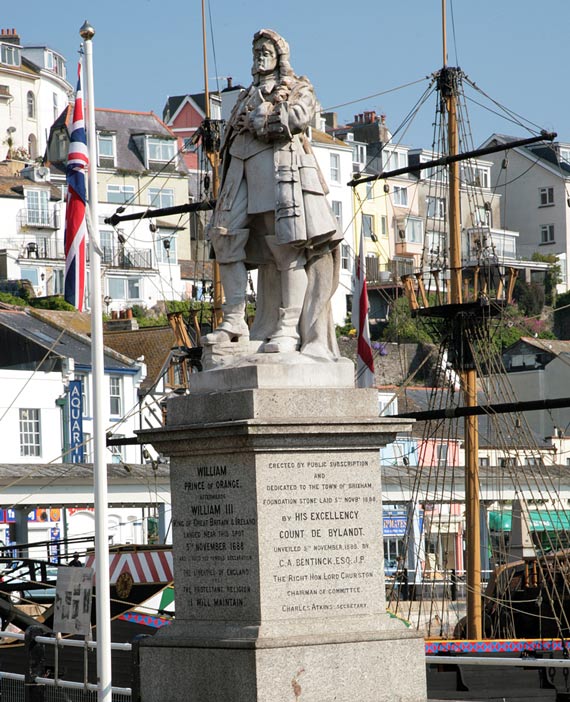
The focus of the play is the relationship between Queen Anne (Emma Cunniffe) and Sarah Churchill, Duchess of Marlborough (Romola Garai). Anne accedes to the throne on the death of her childless brother in law William III (played in barking king mode by Dave Fishley). You know he was the Dutch fella we invited over with wife Mary to keep the Catholics off the throne. He landed at Brixham, also famous as the birthplace of the Tourist. Hurrah. Here he is. Unusually without a seagull crapping on his head.
william-of-orange

Anyway Anne is a Stuart but the right sort as a Protestant. She is also childless despite seventeen pregnancies, a very sorry state of affairs. Her husband, Prince George of Denmark (Hywel Morgan) is a full on booby. Anne is, initially at least, physically and temperamentally, not really up to the job, so her childhood friend Lady Sarah and her circle of Whigs do their best to manipulate her to their own ends. Our Lady Sarah just happens to be the wife of John Churchill, whose rise to become leader of the Protestant forces across Europe in the War of the Spanish Succession against mighty France and Spain, (after a few false starts), brings recognition, wealth and prestige. This was a turbulent time in English (and with the Act of Union in 1707, British) politics and the play does an excellent job in drawing this out, as Anne seeks to make her mark and shifts allegiances towards the Tories led by Speaker Robert Harley (very well played by James Garnon). This was the era when Britain moved into the first division of European powers (though war proved an expensive business) as the Catholic powers were faced down and as capital was accumulated largely on the back of the slave trade (yes all you proud Brexiteers, these are the foundations your glorious country is built upon).

The tempestuous Lady Sarah gets the hump as her influence on Anne dissipates and gets properly jealous of Abigail Hill (played by Beth Park) another scheming ingenue who comes from nothing to become the Queen’s new bosom buddy. Sarah leaks some salacious correspondence but this backfires and she, her husband and her circle are debilitated (though the family has seemed to rub along ever since down the centuries – go see Bleinhem Palace is you don’t believe me).

These events are interspersed with some entertaining song and dance routines. This was after all the period which saw the rise of the popular press, in the form of pamphlets, and the emergence of political satire. The great British public, OK the emergent newly rich grasping oligarch Whigs (land alone no longer being the route to power), had put the monarchy back in its box and weren’t above any ruse to slap down the Tories, high Church and sniff out any whiff of Jacobitism.

So a fascinating time, an important monarch who ruled at a pivotal period in England’s history, and a well realised portrait of an intense relationship. Emma Cunniffe and Romola Garai both give very credible performances as Anne and Sarah and there is real passion in parts of the second half. But this is no Mary Stuart and there were times when I was hoping for a few more twists and turns. On the other hand if this is the sort of thing that floats your boat, and on balance I would say it should, then I see there are plenty of tickets left at very attractive prices, so give it a whirl.

Angels in America at the National Theatre review *****

angels-in-america-cast-portraits-1280x720

Angels in America: Part One Millennium Approaches and Part Two Perestroika

National Theatre, 29th July 2017

That Tony Kushner is an ambitious playwright. This will comes as no surprise to you experienced theatre lovers but, having seen this and The Intelligent Homosexual’s Guide to Capitalism and Socialism with a Key to the Scriptures at the Hampstead Theatre last year, this has come as a revelation to this newbie.

Ostensibly Angels in America is a play about the impact of HIV/AIDS on a handful of characters beginning in mid 1980s New York and the denials that dominate their lives. Into this Mr Kushner weaves an examination of religion (specifically Mormonism and Judaism) and personal salvation, the rise of economic neo-liberalism and fall of communism, national, personal and sexual identity, the nature of responsibility and even the march of history itself – fin de siecle anyone?. The characters generally don’t do much in the way of small talk, yet all the exposition is punctured by genuinely funny humour. These people do not lack self awareness, that’s for sure.

Part One generally remains within the bounds of the naturalistic, Part Two goes into metaphysical overdrive as the curiously ineffectual angels (who themselves have been deserted by God) start to pile up. If I am honest it is all a bit nuts at times but the points that Mr Kushner wants to make more than justify the formal experimentation. And he does make a lot of points as I said. Sometimes repeatedly and with no let up in the erudition.

Now you might think the thick end of 8 hours of this, for those of us who opted for the one day experience, might turn into too much of a good thing. I have to say though that, with the exception of a few longueurs, you would be wrong. Mr Kushner’s writing creates, in me at least, a kind of heightened perception of the themes he is exploring, whilst still delivering a story, or stories more precisely, with forward momentum, and characters that you can love (or hate) despite, or perhaps because of, their intensity. As with all very. very clever people, Mr Kushner is maybe occasionally guilty of mislaying the “less is more” filter but this is a small price to pay to be dazzled on this scale. And whilst the direct impact of HIV/AIDS may have changed in public discourse in the last three decades or so, the questions the play poses directly and indirectly are still painfully relevant.

As for the production, well it is brilliant. Marianne Elliot’s direction is faultless. Meticulous precision has been applied to the combination of Ian McNeil’s set, lighting, sound, and yes, even the angels, which means the rhythm of the play is never impeded. And the cast. OMG. I don’t think I have ever seen as many high level performances as in this production. Andrew Garfield is astonishing as Prior Walter whose campness turns to courage. If anything Nathan Lane is even better as Roy Cohn, whose denial of his illness is as aggressive as his delusional politics. This two performances alone would be enough to justify the ticket price but then you have James McArdle chiming in with an impeccable portrayal of Louis Ironson, Prior’s lover who is riddled with guilt and hypocrisy. And then you have Russell Tovey as Mormon Joseph Pitt whose sexual denial has to crack, and, maybe most memorably for me, Denise Gough, who takes the part of Harper Pitt. Joseph’s pained wife and turns it into triumphant release. On and then you have Susan Brown, Amanda Lawrence and Nathan Stewart-Jarrett, lighting up the stage as they cover most of the remaining parts. Collectively this is acting of the highest order.

So you can see I liked it. A lot. Like I said it does sprawl a bit, and the brain did need a few minutes of time out across the hours, but this is what theatre is all about. So if you are a theatre luvvie stick it on your bucket list. If you are a philistine run a mile.


The Tempest at the Barbican review ****

19919tempeste1

The Tempest

Barbican Theatre, 27th July 2017

Now I would watch Simon Russell Beale read the telephone directory. Particular past favourites of mine include a Brechtian Galileo, a Face in the Alchemist, alongside Alex Jennings and Lesley Manville, his Stalin in Collaborators, a Timon in the Hytner production, which persuaded me this is a greatish play, and his persuasive Lear. So his return to the RSC after a couple of decades was always going to be an event, particularly in the role of everybody’s favourite grumpy polymath/magician Prospero. The Tempest is not my favourite Shakespeare though I thoroughly enjoyed the all female Phyllida Lloyd Donmar production so maybe I am slowly coming round.

Anyway this production directed by Gregory Doran had secured very good if not outstanding reviews from its Stratford run so, one way or another, it had to be seen, Initially I plumped for the cinema option figuring this might prove a better way to soak in the technology on show. However, after a mix up with tickets and me throwing a tantrum (don’t ask), I missed out. So off to the Barbican it was.

Much has been made of the digital technology conjured up by Intel and Imaginarium Studios which has been used to conjure a real-time, holographic avatar of the Ariel played by a physically graceful Mark Quartley. Well there is no doubt this is an impressive spectacle, especially when combined with the striking designs of Simon Brimson Lewis, a set with a shipwrecked hulk with overtones of whale skeleton, and the dramatic lighting of Simon Spencer. And by and large it augments rather than supplants the words of the Bard notably around the storms, imagined drownings and some very dangerous dogs. In particular the masque created for the marriage of Ferdinand (an earnest Daniel Easton) and Miranda (a surprisingly worldly Jenny Rainsford) was spell binding with some beautiful singing from Samantha Hay, Jennifer Witton and Elly Condron and landscape projections which out-garished Hockney.

But the Tempest for me is a play of subtle shifts and meanings and sometimes all the gubbins on show (including the loudish soundscape conjured up by Jeremy Dunn and Andrew Franks) did just detract a little from the magic Shakespeare conjured up through, er, the magic of words. Once you cut out the comedy interludes supplied by Caliban, Trinculo and Stephano (with Joe Dixon, Simon Trinder and James Hayes respectively suitably broad) and the perfidy of the human aristos, you are left with tales of love and forgiveness (father-daughter, Miranda/Ferdinand, Prospero and pretty much everyone else on the Island). For these lessons to, er, work their magic sometimes needs a bit of peace and quiet. Which is why the last 10 minutes or so of this production, largely SRB speaking the verse in a pool of light, turned out to be the most satisfying, and moving.

A fine addition then to the panoply of big name Tempests and well worth a view (there are plenty of tickets left for the remaining performances). But also a reminder that, at the end of it all, it s the text that matters.


Directors’ Festival at the Orange Tree Theatre review

jvudn7az

Directors’ Festival 2017

Even Stillness Breathes Softly Against A Wall ***

The End of Hope *****

Albert’s Boy ***

Orange Tree Theatre, 26th, 27th, 28th July 2017

Now this really is a mighty fine idea. Take five short plays by some of Britain’s finest contemporary playwrights and hand them over to five talented young directors currently completing their MA’s at the local St Mary’s University (just down the road). Assemble fine actors and students to support the enterprise, carve out a week of rep, and charge just £7.50 a ticket to us punters. Everyone’s a winner.

Now I was only able to make 3 of the 5 offers, missing out Enda Walsh’s Misterman and Kate Tempest’s Wasted. But the three I did see where very good, and, in the case of David Ireland’s The End of Hope, outstanding.

Brad Birch has form at the Orange Tree with his The Brink being performed a couple of years ago and Black Mountain coming up. Even Stillness …. has some of the qualities I observed in the Brink. There is an anger and paranoia in the way characters react to contemporary life which is interesting if not entirely satisfying. In the Brink the lead character, teacher Nick, may have stumbled across a conspiracy or may be cracking under the stress of the job. It is funny and sharp but, once the direction of travel was established, seemed to run out of steam a bit for me. Here,  Even Stillness ….. shows a couple, Him and Her, in full on alienation at work mode, who then slowly retreat into each other at home, but whose rejection of their rubbish modern life spells another type of disaster. It is spiky and angry but in some ways lacks surprise. On the other hand it is hard to see how the direction of Hannah de Ville and the acting of Orlando James (last seen by me as a convincing Leontes in Cheek by Jowl’s Winter’s Tale) and Georgina Campbell could have been bettered.

Albert’s Boy is, I believe, the first play from the pen of James Graham. Mr Graham is now the master of the socio-political comedy – witness Ink at the Almeida (Ink at the Almeida Theatre review *****). This two hander sees Andrew Langtree’s Bucky, friend of the family and Korea vet/POW, visiting Robert Gill’s Einstein, in the US in 1953. Einstein is tortured by his involvement in the programme that led to the launching of the atomic bombs, Bucky is scarred by his recent internment. Cue an examination of the big picture political landscape of the times and smaller scale demons of our two leads. Like Mr Graham’s more mature works this has some laugh out loud lines and easy to digest learnings. yet is is a little worthy and static. Once again though I couldn’t fault cast or the direction of Kate Campbell.

Now I have to say I think The End of Hope is a terrific play. I ended up having to cancel Cypress Avenue at the Royal Court last year (bloody kids were up to something) which annoyed me immensely. And I missed Everything Between Us at the Finborough recently. That was stupid judging by this. The End of Hope takes a slightly surreal one night stand and proceeds to mercilessly skewer notions of identity, political, religious, sexual, the nature of fame, high and low culture and pretty much anything else that takes Mr Ireland’s fancy over 50 minutes or so. It is hilariously funny with twists and turns which are not at all forced. As with his other plays sectarian division in his native Northern Ireland acts as the backdrop for the satire. But this is far from geographically bound. Breathless stuff with a real chemistry between Elinor Lawless and Rufus Wright as Janet and Dermot. And hats off to director Max Elton. I suspect getting the pace of performance right here is much trickier than it looks.

So there we have. Three fine plays. Theatre alive and well in the hands of these lovely young people and an urgent need to see more of David Ireland’s plays.

Ink at the Almeida Theatre review *****

tony-turner-bertie-carvel-geoffrey-freshwater-richard-coyle-jack-holden-tim-steed_c-marc-brenner

Ink

Almeida Theatre, 24th July 2017

Recipe for a very satisfying night at the theatre.

  1. Choose your company. I spend the vast majority of my theatre going life flying solo. So it is such a pleasure to be joined by some choice chums. In this case the SO, the Blonde Bombshells, BUD and KCK. Lovely.
  2. Have a bite to eat beforehand. Now having a “pre-theatre supper”, (I f*****g loathe the concept of “supper” and all who refer to it – it is called dinner), is sailing perilously close to the limits of poncey stuckuppery as far as I am concerned. But I have to say plate of delicious comestibles at that Ottolenghi realy did hit the spot even if the price/volume interplay was very suspect. I may go again. What a toff I have become.
  3. Go to the Almeida Theatre. This is starting to get silly. As far as I can see the Almeida under Rupert Goold has not put a foot wrong in the last four years and is now, in my humble opinion, London’s best theatre. Mr Goold is blessed with Robert Icke as a wingman and can call on just about any stage acting heavyweight he fancies. And he and his team are fortunate to be well oiled by the cash of the professional and chattering classes of Islington. But what has been most impressive for me is the string of new works that have been showcased alongside the classics. As proof I give you Hamlet, Mary Stuart, Oil, They Drink it in the Congo, Richard III, Uncle Vanya, Little Eyof, Medea, Oresteia, Bakkhai, Carmen Disruption, Game, King Charles III. 1984 and American Pyscho. All great and, in many cases, outstanding works of theatre. Even the misfires have had something of value.
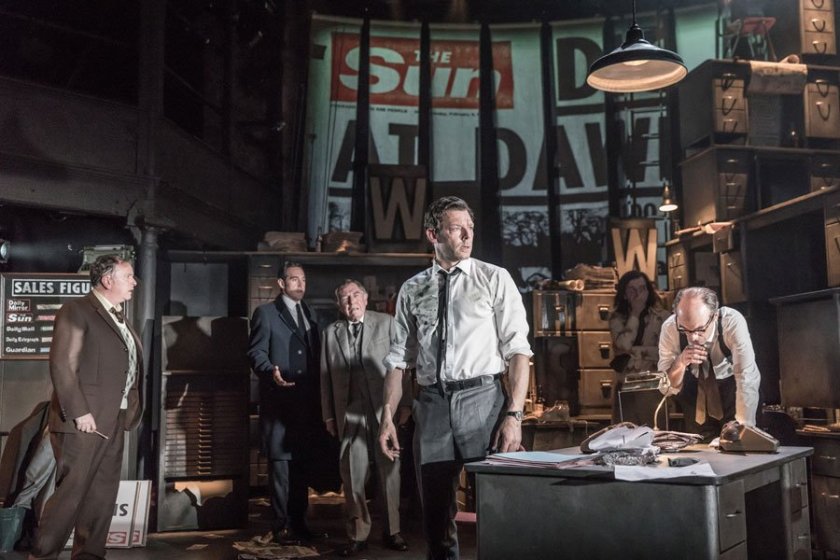
  4. Choose your writer, James Graham. Now it looks to me as if Mr Graham has found his groove and is now busy perfecting it. Dramatising relatively recent socio-political events brings recognition to us, the audience, which means we can ruminate on the parallels with the right now, whilst still being thoroughly entertained. Mr Graham just has the knack of picking and writing a good story. That is not as easy as it sounds. In the case of Ink he has gone one stage further than in This House for me by shining a light on the genesis of the populist tabloid, here the Sun, just at the point when maybe, the power of this particular beast is waning. The story of the first year of the Sun, following Rupert Murdoch’s purchase of the title in 1969, turns out to be theatrical gold. Murdoch’s desire to take on the British establishment and “give the people what they want”. his relationship with editor Larry Lamb, Lamb’s own personal battle with Daily Mirror editor and mentor Hugh Cudlipp, the pulling together of a team of Fleet Street rejects, waifs and strays to create the new style tabloid, the shocking kidnapping and death of Muriel McKay, wife of Murdoch’s lieutenant, the provocation of Page 3: all of this is deftly and pacily explored by Mr Graham in an often acutely amusing way. The motives for recasting journalism and the press in the UK are laid bare: the consequences we know from the intervening decades. Brilliant stuff.
  5. Savour the performances. Unsurprisingly the attention of the critics has focussed on Bertie Carvel’s Murdoch. It’s another bravura performance from an actor who seems to relish “the method” as far as I can see. I thoroughly enjoyed the physicality of his Yank in the Old Vic’s Hairy Ape (which was underrated in my view) and here he captures the awkwardness of Murdoch, his prudishness, his curious accent and his “outsider” psychology perfectly. He is not the caricature demon we “liberal” types need him to be but he is the archetype of “destructive capitalism”. (As an aside I once had a breakfast meeting in Washington. Rupert Murdoch sat down alone on the table next to us. His presence dominated our meeting for the next hour. All he did was eat toast and read the paper but all eyes were on him.) However, if I were Bertie I might have fancied taking on the Lamb role instead. On the other hand Richard Coyle does such a good job there was probably no vacancy. I have seen, and I am sure will see, more virtuoso, scenery chewing, thespianism on stage this year (Lars Erdinger/Greg Hicks in Richard III, Andrew Garfield in Angels in America, Cherry Jones in the Glass Menagerie, Andrew Scott in Hamlet, Brendan Cowell in Life of Galileo, by way of example) but Mr Coyle absolutely nails this from the off. This is a character whose seems compelled to test boundaries. He carries much more of the play than I expected but, even so, this really is an ensemble piece, and that is what makes the “us against the world” dynamic so persuasive.
  6. Take your hat off to Rupert Goold as director. I could be wrong but I reckon that Mr Goold is one of those rare leaders who can control his own ego. What you see on the stage in his productions is what writers, cast, designers and all the other good folk around want to show. I am guessing he guides, he doesn’t dictate. the world needs more leaders like that. My guess is Mr Murdoch would disagree.
  7. Set, Light, Sound, Action.  It is a tabloid in 1969/1970. Activity, headlines, demarcations, flares, eyeliner, dodgy haircuts and dodgy views. You can conjure up a picture in your mind I reckon but what you actually get far surpasses this. Bunny Christie’s set is the antithesis of minimal but so perfectly captures place and time. Some of the movement and dance (yep) is very witty and the scene elucidating the production process is inspired.

All in all a tip, top piece of theatre that I defy anyone not to enjoy. It lifts you up and carries you along from the open and makes you laugh, whilst still getting a little bit vexed about how this instrument of shabby, public discourse could have become so powerful.

So if it were to pop up in a transfer, as so much of the Almeida’s work now does, and you haven’t seen it, don’t hesitate. A proper story. Popular not populist.

The Philanthropist at Trafalgar Studios review *

6126-1487766065-thephilanthropistencorebrands500x500px

The Philanthropist

Trafalgar Studios One, 6th July

So the Philanthropist has been and gone. A combination of a visit late in the run, the Tourist’s usual dilatoriness and a holiday meant no review until now. Probably just as well. This wasn’t great I have to say.

I think I just have to accept that where others see a sharp wit in the writing of Christopher Hampton I just see a rather tired, dated smartarsery I am afraid. I seem to remember enjoying Les Liaisons Dangereuses (play and film) all those years ago but the recent Donmar revival left me a bit cold. Same thing apples to some of his screenplay adaptions like The History Man and Atonement for example. But one is supposed to admire him so I thought I would give this a whirl.

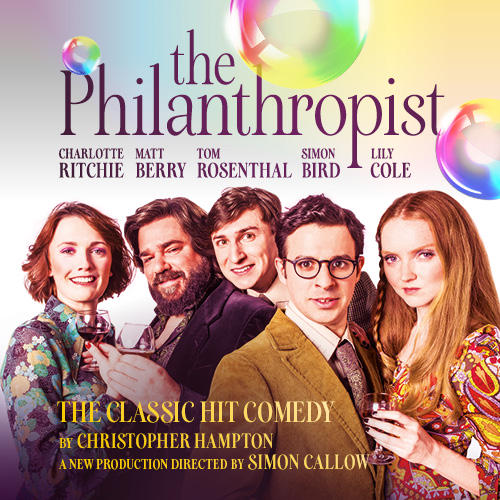
In other contexts I am also very partial to the cast on show here notably Simon Bird and Tom Rosenthal in the magnificent Friday Night Dinner and Matt Berry in his various incarnations (with IT Crowd matching FND as a family favourite chez Tourist). Here though they weren’t really up to the task I fear. Simon Bird did an excellent impression of Simon Bird but that wasn’t really what I think the part required. Matt Berry could have got away with a full on Toast performance here playing an arrogant writer, but was curiously underpowered. Tom Rosenthal was better but his performance along with the character just started to grate. Lily Cole was captivately dreadful. Only Charlotte Ritchie as Mr Bird’s put upon girlfriend really gained the measure of the piece.

A bunch of 70’s academic types and hanger ons moping about and behaving carelessly turned out not to be my cup of tea and the jokes were stilted. I am sure director, the lovely Simon Callow, had an idea of what he wanted but it didn’t seem to get through to his cast. I just didn’t care about any of them and barely laughed.

So a lesson for the tourist. when buying think text first, director second and cast last of all. And do not take a punt on novelties. And stay wary of the Trafalgar Studios which seems wedded to such novelty to pull in the audience (and full price, it ain’t cheap).

It isn’t the worst play the Tourist has seen in the last few years. That accolade goes to Jamie Lloyd’s excruciatingly bad Faustus at the Duke of York’s. I know the idea here was to get a new audience into the theatre by getting Kit Harington to flash his bum at them but we had to walk out of this halfway through.

And talking of walkouts we did the same at the Open Air Theatre’s Tale of Two Cities recently. No review as I only managed the first half but you can check out the proper reviews. Believe them. This is a dog’s breakfast where the laudable concept and over complex staging end up grinding the Dickens’s story into the dust. And whilst I pride myself on being as sweary and as confrontational as the next man the Open Air really isn’t the place to do this when you are asking families to part with their cash for a magical evening’s entertainment.


Some forthcoming London theatre ideas

image

So we have had a few new season announcements over the past few weeks so here is a wrap up of what I think looks interesting in terms of stuff coming up on various London stages.

To spare you crawling through all this guff here is my top ten, including the best of these recent new season announcements in my view, and some other incumbent recommendations.

  1. The Ferryman at the Gielgud Theatre. So I know the decent seats are exorbitantly priced and this has come in for a bit of “paddywackery” backlash but it is still a towering play and is a must see.
  2. Hamlet at the Harold Pinter Theatre. Ditto. This is just a brilliant Hamlet from Andrew Scott and must be seen whatever you view on Will S.
  3. Network at the National Theatre. Should be a cracker – more details below
  4. Macbeth at the Barbican. In Japanese (with surtitles) but this is a classic production which I am very excited about.
  5. I Am Rachel Corrie at the Young Vic. Erin Doherty in the lead in this revival.
  6. Gundog at the Royal Court Theatre. I have a feeling this will be good.
  7. Albion at the Almeida Theatre. The next hit from the Almeida?
  8. Young Marx at the Bridge Theatre. I have banged on about this before but all is in place for the Bridge’s first offer.
  9. Insignificance at the Arcola Theatre. Revival of Terry Johnson brainy classic.
  10. Poison at the Orange Tree Theatre. I think this will be another triumph of discovery at Paul Miller’s Orange Tree.

More detail below.

Young Vic

New season is up. Best of the bunch for me is a revival of I Am Rachel Corrie based on the eponymous activists diaries with Erin Doherty in the lead. I have said before that I think Ms Doherty will become a stage legend and this should support that idea. The Jungle also caught my eye, with a whole bunch of tip-top creatives weaving stories from the Calais refugee camp. This is the sort of thing the Young Vic excels at. I am also looking forward to Wings with Juliet Stevenson in the lead and the Suppliant Women.

Royal Court Theatre

A whole bunch of goodies in the new season with three takes on the impact of war, Minefield, Bad Roads and Goats, and a US transfer, Grimly Handsome which has already sold out. My money is on My Mum’s a Twat a debut play from Anoushka Warden which RC’s Artistic Director Vicky Featherstone is directing, Girls and Boys, a relationship drama from Dennis Kelly (who writes for the telly) and directed by Lyndsey Turner, and, sounding best of all, Gundog, which has a nice ring of folk horror about it in the blurb. As usual with the RC there is not much to go on but I have a very good feeling about this. Ms Featherstone also directing.

Almeida Theatre

The Almeida can’t put a foot wrong under Rupert Goold with Ink the latest hit (sold out at the Almeida but go see it in the West End Transfer – you won’t regret it). I am booked for all 3 of the new season productions.

Mr Goold himself will direct Albion, Mike Bartlett’s new play. This has “state of the nation” written all over it but Mr Bartlett is a terrific writer so no need to fear. His last outing Wild at the Hampstead was good if not outstanding but this seems to have all the ingredients including a rareish outing for Victoria Hamilton on stage (you will have seen her in numerous period dramas).

Also intriguing is the Twilight Zone a world premiere from Anne Washburn based on, you guessed it, the Twilight Zone TV series from the 60’s. Now I can’t pretend I was bowled over by Ms Washburn’s Mr Burns but you have to admit this sounds quite exciting especially as it will be directed by the reliably controversial opera director Richard Jones.

After all this excitement the last play in the new season is a bit more classical in Tennessee Williams’s Summer and Smoke directed by Rebecca Frecknall (who has taken on this relative rarity before at the Southwark Playhouse) and with Patsy Ferran seemingly perfectly cast in the lead.

Donmar Warehouse

There are still a few tickets left for the new version of Ibsen’s Lady from the Sea and more for the Knives in Hens revival which should show director Yael Farber in her best light after the tricky Salome at the NT. Knives in Hens is a spare, poetic love triangle that gets regular revivals because, er, it is very, very good.

Old Vic 

Tickets now on sale for The Divide the new dystopian drama from the pen of Alan Ayckbourn. It is in two parts and I have no idea how it will pan out. It will be premiered at the Edinburgh Festival so probably worth waiting to see how it is received. It does have my favourite Erin Doherty (see My Name Is Rachel Corrie) above so I have already taken the plunge to get my favourite seats but I might have gone too early.

Arcola Theatre

A slew of interesting stuff in the new season including the Grimeborn opera offerings, but the standout plays for me look like the revivals of Terry Johnson’s Insignificance (his new play Prism is also coming up at the Hampstead Theatre) and Howard Barker’s Judith: A Parting from the Body with Catherine Cusack in the lead.

Orange Tree Theatre

Everything in the new season looks interesting to me including productions of Duncan Macmillan’s Every Brilliant Thing, Elinor Cook’s Out of Love and Brad Birch’s Black Mountain, but I think the UK premiere of Poison by Dutch writer Lot Vekermans may turn out to be the best of the bunch.

National Theatre

I am seeing Angels in America shortly (always seem to end up near the end of the run) so review will follow. Common is still trundling on – I didn’t think it was too bad but others were less forgiving (Common at the National Theatre review ***). No official reviews for Mosquitoes by Lucy Kirkwood which kicked off recently but I am looking forward to this immensely. Unfortunately the run is sold out so queueing on the day is the only way in.

Coming up are Follies, the Sondheim musical with Imelda Staunton belting out the tunes, Oslo, the sold out Broadway transfer which already has a West End transfer, St George and the Dragon, which I would take a punt on as a “modern folk tale” (expect Brexit allusions) written by Rory Mullarkey and directed by Lyndsey Turner, and Beginning, which I am guessing is a relationship drama (I assume with twists) written by David Eldridge and directed by the inestimable Polly Findlay.

My highest hopes are reserved for Network, based on the mid 70s Oscar winning film satire on the media, to be adapted by Lee Hall, directed by Ivo van Hove and with Bryan Cranston in the lead. Now film adaptions and Ivo van Hove disappointed on the last outing (Obsession at the Barbican – Obsession at the Barbican Theatre review ***) but I still would take the risk. This isn’t going to work if it follows the minimal, psychological insight route so I am assuming it will look more like Mr van Hove’s relentlessly busy Shakespearean efforts. There are tickets left for later in the run.

Barbican Theatres

Mr van Hove will also be bringing his Tonnelgroep Amsterdam team to the Barbican for After the Rehearsal/Persona and the main theatre will also show all the RSC Roman Shakespeares transferring from Stratford. I am signed up for the marathon Smile On Us Lord (I hope he/she does) from Russia’s Vakhtangov State Academic Theatre though I recognise this might be a bit hardcore for most. I do think the Ninagawa company’s Macbeth will be worth the £50 though. This is a revival was the production that first brought this innovative visual feast to the “West” so it really is a “once in a lifetime” theatrical experience.


Salome at the National Theatre ***

salome-olivier-285

Salome

National Theatre, 5th July 2017

Salome, much like Common also currently residing on the Olivier stage, has been given a bit of a pasting by the criterati. Not utterly trashed but its obvious flaws have been highlighted. And much like Common I have to say I think the criticism is a little misplaced (Common at the National Theatre review ***.

The text is ponderous, with a strange mix of bombastic Biblicality, overwrought imagery and sometimes vague, paradoxical didacticism but the themes are still revealed and once you adjust to the style and pacing it exerts a sort of spell. Yael Farber has directed some cracking theatre, not least the NT’s Les Blancs on this very stage last year. She is not afraid of bashing you over the head with the messages she whats to convey and is the antithesis of theatrical reserve. Having set out to direct Wilde’s version of the Salome “story” she found that the truth of that “story” had been revised, reviled and distorted at the hands of the unholy trinity of history, religion and patriarchy. So, following a bout of impressive scholarship, she set out to write her own version.

Nameless (our Salome in her dotage), played with sonorous venom by Olwen Fouere, acts as our “narrator” as we are introduced to Judea c. AD 26. Cue flashback. Pontius Pilate is whinging about getting the gig here, the Pharisees are getting all orthodox and hanging on to their cash. Herod (there were a few of them) is swanning about as vassals do and getting all lathered up about his niece who may be Salome. John the Baptist pitches up, berating everyone in Aramaic (I assume) for being insufficiently hairshirt. Authorities decide to lock him up rather than crucify to stop the hoi-polloi turning nasty. Dance, head, plate, end. But the crafty Salome/Nameless and John B have outwitted the Roman occupier for martyrdom and revolt are the consequence.

Ms Farber, through the shouty stuff, shows that the whole Salome myth was laid on top in subsequent centuries and gives a flavour of these fervent times when monotheistic religions was developing. And it looks and sounds spectacular courtesy of Susan Hilferty and Adam Cork respectively. Renaissance art comes to life. I know that set, sound, movement. lighting, costume and other visual flummery is not enough on its own to justify a trip to the theatre but this comes mighty close. The singing of Yasmin Levy and Lubana Al Quntar was spell-binding. And the multi- nationality cast largely gives a full-throated bash at delivering even the most pretentious twaddle. In particular I was taken with Lloyd Hutchinson’s Pilate, the aforementioned Olwen Fouere, and especially Ramzi Choukair’s Iokanaan (the Baptist to you and me). 

So yes it is all a bit elliptical, it is trying too hard to be good for you and the text is undeniably orotund (I bloody love that word) but it has a hazy, mystical quality which I think suits the “action” such as it is. Myth and ritual are central to any conception of art and the ideas here do eventually penetrate the fog, particularly the tragedy of occupation and the masculinisation of history through the metaphor of the female body. So I say good on ya, Yael and don’t let the bastards grind you down.


Gloria at the Hampstead Theatre review ****

fillwyi3ntailci0mjiixq-gloria-final-landscapesmall2

Gloria

Hampstead Theatre, 4th July 2017

Right. This might actually be a review of, albeit dubious, utility. There are 3 weeks or so left on the run and there are  a fair few tickets left. And this is a fine piece of theatre with an interesting premise, formal innovation, enough material to cogitate on but not so taxing as to ruin your night out, and all in the convivial and convenient location that is the Hampstead Theatre.

The proper reviews give you a realistic flavour, though I think they maybe oversell the “frustrated millenials in workplace” drama that characterises the first half, and undersell the sharpness of the satire on “ownership of stories in today’s world of commoditised fake empathy” that drives the second half.

On the face of it this is a very different play from flavour of the month Branden Jacobs-Jenkins last London outing, An Octoroon at the Orange Tree (review here An Octoroon at the Orange Tree Theatre review ****). That play was a dissertation on the notion of identity in the theatre using the guts of C19 playwright’s Dion Boucicault’s “slavery” melodrama, The Octoroon. Very clever, very entertaining. Gloria is also clever and entertaining but in a more subtle way (one coup de theatre aside). Moreover it also riffs on the ownership of narratives which for me is something theatre is uniquely able to address.

The first half is set in an NYC magazine publishing house where three put-upon late 20s assistants bemoan their lot with a mixture of anger, humour and resignation. Kae Alexander plays Kendra, an entitled Asian-American princess who is long on railing against the iniquity of the thwarted career opportunities for her generation, but short on any work ethic that might help to change this. Ellie Kendrick (last seem by me out-Oscaring all those Hollywood chumps in the brilliant film The Levelling, which cost about the same as one Oscar night table of goodie bags to make) plays Ani, whose outward show of sweetness and light likely masks a more ruthless streak. Colin Morgan (you know Merlin in a former life) plays Dean, just turned 30 and still lapdog to unseen editor Nan. They are joined by the seemingly ineffectual intern Miles (Bayo Gbadamosi), and visited by the eponymous frustrated office lifer Gloria (Sian Clifford) and stressed fact checker Lorin.

The detail of the frustrations that each of these characters face is well observed (BJJ spent a few years at Vanity Fair) and pretty funny. This first half does get close to outstaying its welcome but BJJ has a cunning and surprising trick up his sleeve to bridge us into the second half. I will leave the description there: suffice to say that the second half explores its chosen themes with the same economy and insight as the first. I see some of the criterati don’t recognise the office workplace on show here: I think that says more about them than it will about you (assuming you are not some ancient has-been like me and the other educated pensioner types who are always getting in the way of the more worthy younger punters in the quality London theatres).

In contrast to An Octoroon this play is not chock full of meta devices and playful alienating effects. It is, broadly, a naturalistic structure but the use of doubling for “new” characters in the second half, whilst hardly revolutionary, works well, at least for me. I can’t wait to see more of BJJ’s plays over here. and, given the reception afforded to this and An Octoroon, these should not be too long in coming. And best of all when asked in the programme interview who his favourite playwright is, he answered Caryl Churchill. What an astute young(ish) man.

I am dubious about filling a cast up with young names off the telly even if it does offer the prospect of better economics for producers/artistic directors. Here however it worked a treat. The entire cast was faultless but our three millenials shone. Michael Longhurst is blessed with the ability to perfectly pace any play he directs and Lizzie Clachan turned in another set which which offered an elegant solution to functional necessity. It is possible to make a vernacular theatrical settings elegant, but I bet it’s not easy.

So if I were you I would give this a whirl. Worst case you get to here a bit of JS Bach (a slightly different take on Gloria).


Common at the National Theatre review ***

common_960x230_tcm618-162513

Common

National Theatre, 28th June 2017

Is it possible to feel sorry for a play? Common has had some pretty poor reviews from the criterati and the public alike and there are tons of tickets left for the month or so left on the run.

Well I can’t pretend it isn’t without some pretty deep flaws but I didn’t think it was as bad as some have painted. As usual the Tourist has come late to the run. I gather it has been subject to some judicious cuts and it might be that the cast has become more attuned to playwright DC Moore’s curious and fruity language. It is a bit bonkers and a long way from what I had expected but I have seen much worse.

Our heroine Mary, played by Anne-Marie Duff who proves once again she is incapable of a having an off day at work, returns to her unspecified “home” after a spell in the den of iniquity that is London. Why she returns is never made clear. She might be seeking to exact revenge on her “brother” King (John Dagleish), she might be returning to her love, and “sister” Laura (a spirited Cush Jumbo), she might be seeking to help the ‘”villagers” succumb to the pernicious consequences of land enclosure. She has run ins with a bunch of Irish labourers, with the “Lord” (a perfectly cast though somewhat reticent Tim McMullan) and the Lord’s henchman Heron (Trevor Fox in full on Geordie) and with assorted villagers including the naive Eggy Tom (a touching Lois Chimimba). She, Mary, dies, is resurrected and then wreaks various revenges. Is she a con-woman, a seer, a harbinger? Who knows.

The programme some excellent essays. One is on the impact of enclosure on rural England from the late Medieval period, through the Tudors and, most aggressively, in the last C18 and early C19, when Common is set (1809). Capital has been screwing over labour, in more or less brutal ways, from the off and there is hardly anything more vital for theatre to examine. Another essay is on the importance of magic and spirits in the everyday existence of the “common people” alongside established religion and in the absence of universal education. These are interesting and important themes that the play seeks to explore. However, the slipperiness of the plot, and the focus on how the characters sound and look, serves to obscure these themes in my view.

DC Moore’s text in parts is written in a mangled, “rustic” English (think Yoda as a Wurzel) with plenty of profanity. Most of the criterati don’t seem to get on with this at all. I did. It takes a bit of getting used to but I think this, together with the lighting (Paula Constable deserves a special mention), the sound, the costumes, the set (though once again the Olivier stage offered too much space to the production) and the appropriate music written by Stephen Warbeck, all served to create an atmosphere which I think worked to the play’s advantage. And, as I have indicated, the performances, in large part, gave as good as they got with the material on offer.

The faults then for me largely lie in the meandering plot and the absence of an overarching narrative. This was not some non naturalistic, surreal or absurdist theatre. There was a story and there were ideas; they simply didn’t coalesce. I think Jeremy Herrin, the director, and the Headlong production team, who can normally be relied upon to manufacture a “hit”, probably know Common is a way off what they all hoped to create, but I for one would still applaud their bravery in trying to make this work.

So overall then I don’t think this is quite the turkey that some have painted it as. Yes it does fall down on many counts but it is also, in my view, interesting in other ways. You have been warned but if your expectations have been set low you might be pleasantly surprised if you do splurge all of £15 on one of the remaining performances.

And I wouldn’t mind betting that one day, after a re-write and a re-think, it comes back and is heralded as a misunderstood classic. Mind you it won’t be at the National I suspect.