Anatomy of a Suicide at the Royal Court Theatre review *****

anatomy-of-a-suicide

Anatomy of a Suicide

Royal Court Theatre, 22nd June 2017

There are many extraordinary things about Anatomy of a Suicide. One is that there are still tickets left in the run at the Royal Court. Snap them up. Another is that as far as I can see all the serious reviews give it 4 stars. I have no idea why they dropped a star. This is as good as theatre gets in my book.

To be fair it is an intense couple of hours. And the formal construction will keep you on your toes. But it connects emotionally and intellectually. We know Katie Mitchell is a brilliant director. We know Alice Birch is a writer of rare talent from Ophelia’s Zimmer and Revolt she said, revolt again as well as the recent. screenplay for Lady Macbeth. Together though they have, along with the three outstanding lead actors, created another powerful and brave piece of theatre. I can’t get it out of my head and the more I think about it the richer the experience becomes.

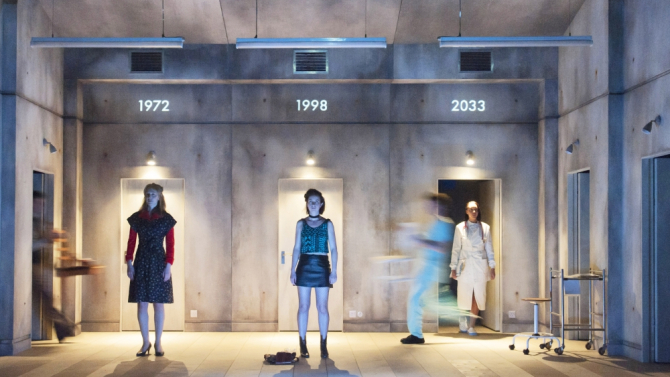
The title and the proper reviews will tell you the story. Hattie Morahan plays Carol, Kate O’Flynn plays her daughter Anna and Adelle Leonce in turn plays Anna’s daughter Bonnie. The play opens in the early 1970’s in a hospital following Carol’s attempted suicide. The emptiness brought on by her depression is painstakingly mapped out by Hattie Morahan whose every gesture reeks of defeat. The birth of Anna only serves to increase her despair. In turn we first see Anna in hospital. intoxicated, having injured herself. She eventually seems to straighten out and start a new life but pregnancy and the birth of Bonnie cannot lift her depression and erase the memory of her mother’s eventual suicide. She too ends her life. Bonnie, whose story starts in the 2030’s is haunted by the fate of her mother and grandmother and plots a path to avoid this through career and childlessness.

This is the bare bones. As I am writing this I am conscious that it doesn’t even get close to describing just how much detail and insight Alice Birch is able to wring from her intricate text. She indicates in her notes that the play is “scored” and the three stories are presented in landscape across the page in the playtext. The three lives are revealed concurrently and the lines intersect and, at some points, are spoken simultaneously even down to the same word. This creates all manner of profound juxtaposition which echo across the three generations.

Most of the reviews I have seen focus on the portrayal of depression and “mental illness” which directly afflict Carol and Anna, and reverberate through Bonnie’s life. I see this but I think I also saw a profound essay on the role of women in modern Western society. “Wife” and “Mother” seem to crush Carol and Anna and leave no space for their own identity, and Bonnie’s alternatives still leave her seemingly unable to connect. The other characters are generally thinly drawn, deliberately I surmise, but brilliantly serve to show how the women are boxed in. The scene and costume changes, with the three leads reduced to mannequins, reinforced this idea of lives being shaped by others.

With such an ambitious text and with such a creative form (others have drawn the parallel with Caryl Churchill – I agree) it needed expert direction. It got it. The set is minimal (until a minor coup de theatre at the end which maybe offered some redemption) leaving prop and costumes to mark change. The delivery of the text seemed perfect to me. The sound design was immense. The background ambient noise was augmented by off-stage accents of music, parties, babies crying – happier lives if you like – which made the disconnection of the characters more striking. And the intricacy of the words and sound was matched, maybe surpassed, by the intricacy of the movement, within and between scenes. There was even room for a couple of trademark Ms Mitchell slow motion shuffles

I will stick my neck out and say that the reputation of this play and production is only going to grow through time. It is dense and it requires attention but I found it deeply profound and emotionally involving. I am going to stop now because I don’t think I am getting anywhere close to explaining how powerful this is. Please go even if the subject puts you off.

Terror at the Lyric Hammersmith review ****

terror-website-image

Terror

Lyric Hammersmith, 19th June 2017

Terror is not your typical piece of theatre. It is a courtroom drama yes, but not in the form of a classic “did he/she or didn’t he/she do it”. Nor is it especially interested in probing the psychological make-up of accused, victim or legal representatives. Instead it is focussed on a classic moral dilemma: which takes precedence, the rule of law and the principles that lie behind it, or the conscience of the individual.

Writer Ferdinand von Schirach sets the stakes pretty high though. The defendant Lars Koch (Ashley Zhangazha) is an exemplary major and fighter pilot in the German air force. He has admitted shooting down a commercial plane which had been hijacked by a terrorist. In doing so 164 people have died but potentially he has saved the lives of 70,000 in a football stadium, the known target of the terrorist. The facts are succinctly laid out by Christian Lauterbach (John Lightbody), the air force officer tasked with co-ordinating any response to this sort of event. Major Koch was expressly ordered not to shoot down the plane but chose to go ahead. The judge (Tanya Moodie), prosecuting (Emma Fielding) and defence (Forbes Masson) counsels lay out the arguments with some eloquence and pull in a few classic examples from ethics and moral philosophy (the trolley problem for example). We also here the testimony of one of the victim’s wives played by Shanaya Rafaat.

We the audience then toddle off to the short interval, have a debate about what we think (as a number of people around me were doing – Billy No Mates here once again had to have a debate inside his head) and then return to press a button to decide if the major is guilty or not guilty.

It is thought provoking stuff but only works as a piece of theatre because of the canniness of the writing. Mr von Schirach’s day job is as a lawyer. I am guessing he is a flipping good lawyer. I have no idea how “accurate” a representation of the German legal system this “trial” is, but I am not sure it matters, so deftly is the dilemma set up. The set design by the very talented Anna Fleische is imposing and the direction by the Lyric’s own Sean Holmes is typically confident. The excellent cast also rises to the occasion. For me though the real hero here is translator David Tushingham. The role of translator is often overlooked but if I admired the economy of the text here this evidently reflects the skill of translator as well as playwright. I note that Mr Tushingham also translated Winter Solstice by Richard Schimmelpfenning which enthralled me at the Orange Tree earlier in the year. He was also dramaturg for the Forbidden Zone, one of Schaubuhne Berlin’s finest exports to these shores.

So if you and some mates are looking for a thought provoking night out, (with plenty of time for some grub and/or a livener or two afterwards as this comes in well under 2 hours even with the break), then you could do worse than secure some tickets for Terror. And after it is all over, check out the Lyric website to see how your audience jury compared to the many previously across the world. I won’t say what I thought.


Twitstorm at the Park Theatre review ***

chris-england-claire-goose-justin-edwards-jason-merrells-l-r-in-twitstorm-at-park-theatre1-700x455

Twitstorm

Park Theatre, 15th June 2017

Right then. Where to start with Twitstorm, a new play by Chris England, which has a couple more weeks to run at the Park Theatre.

Well once again the Park has taken an intriguing and a la mode idea and stuffed it full of faces off the telly to pull in the punters. However once again it has not quite lived up to the billing, although this in large part I think reflects the mixed messaging on the part of the writer.

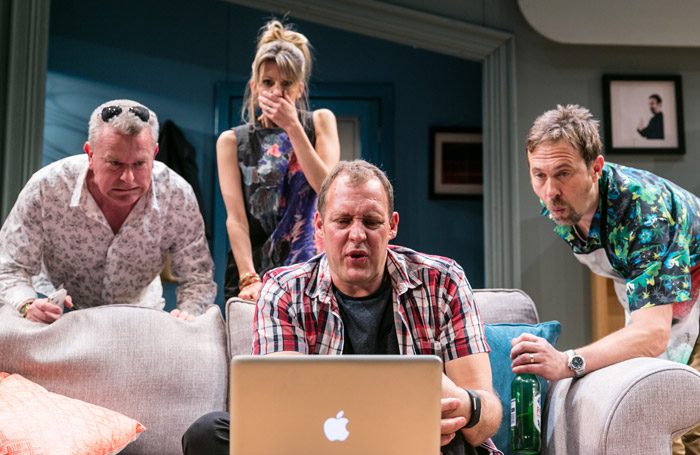
In essence it is a satire on the modern predilection for mock outrage on social media. Jason Merrells plays Guy Manton a supercilious day-time TV presenter of a show called “Arguing the Toss” who prides himself on being the scourge of “political correctness”. It is not too difficult to see writer Chris England’s own alter ego in this character though he himself has chosen to play Rupert, Guy’s manager. Guy’s writing partner, Neil, played by the instantly recognisable Justin Edwards whose facial tics are comedy gold, resentfully takes something of a professional back seat and still hankers after Guy’s wife Bex, played by Clare Goose. With minimal preamble Tom Moutchi is pitched in to proceedings as Ike, the now grown up “child from Africa” that Bex and Guy had disinterestedly “sponsored” and who is invited to stay.

Obviously this plot device bears little scrutiny but it’s what you do with it that matters so we can let it pass for the moment. From this beginning (and incorporating the excellent Ben Kavanagh doubling as work colleague Steve and new media commentariat Daniel Priest) Mr England fashions his satire as (no detail to avoid spoiling) Guy’s twitter feed posts a highly offensive tweet which provokes a media frenzy, and then parlays into a further bizarre plot twist involving Ike.

Now clearly there is scope for a very interesting satire to evolve from this premise. Unfortunately Twitstorm is not quite that satire. It definitely succeeds in pricking the bubble of the self serving, sententious nature of the modern entertainment and digital media eco-system. Guy is a grotesque and deluded egotist and Jason Merrells captures his type perfectly. If Mr England had just stuck to the story of his downfall we would, I believe, have had a funnier and more successful play. But his compulsion to turn his acerbic pen against all manner of “things we are no longer allowed to say” creates some frankly very odd and uncomfortable moments.

Just to be clear I get that satire has no boundaries and we should not be afraid of saying the unsayable. But some of the lines here and bits of the plot look like they have dropped straight out of some 1970s “blimey Dad did people really say/think that in those days” sitcom. And therein lies the problem. Even if these crass lapses in tone are intended to be ironic they just weren’t funny and make Mr England sound like some apoplectic Mail reading sub Clarkson. It feels like the Ike character has been shoehorned in to an underwritten plot simply so Mr England can up the outrage quotient. Having done this the play then gets trapped by its own deus ex machina. This is not a farce (though the middle class show home set gives that impression), so taking liberties by piling up the improbable detracts from the justified ridicule.

So these are the drawbacks. Unfortunately for this liberal, PC, metropolitan elite Guardian reader it was also pretty funny at times. And as I said its scattergun approach to bringing down modern cultural shibboleths does sometimes hit the target, even if the intent is unclear. It is also interesting to think about that dividing line between what is funny for the “right” reasons and what is funny for the “wrong” reasons. I worship at the altar of comedian Stewart Lee but find Mrs Brown’s Boys puerile and unfunny. But given my class, education and world view that is not surprising.

So I would ignore the reviews that dismiss this out of hand, and ignore most of what I have said above and go see for yourself. At the very least it will clarify your thoughts on what you and others find funny and where you sit on the “political correctness gone mad” and “synthetic outrage” debates. Which, in Mr England’s defence, I suppose, was what he was trying to do in the first place.


An Octoroon at the Orange Tree Theatre review ****

an20octoroon20-20orange20tree20theatre20-20publicity20photo20by20the20other20richard

An Octoroon

Orange Tree Theatre, 14th June 2017

Crikey. An Octoroon. I am not entirely sure what I saw and learnt here. I do know it will stay in the memory for many years though and I am very glad I saw this.

Playwright Branden Jacobs-Jenkins takes the bones of early Irish playwright/impresario Dion Boucicault’s hugely popular 1859 melodrama, The Octoroon, to create a riveting meditation on slavery and on black voices in the theatre. (As an aside this immediately puts the lie to the idea of American drama only really getting going in the C20 – there was clearly vibrant theatre in the C19 – it just might not be palatable to modern audiences).

It starts with lead actor Ken Nwosu (last seen by me as a laconic Face in the RSC’s tip top Alchemist) ambling on in his undies ostensibly as the “black” playwright BJJ to explain why he came to write the play and what he wanted to say. Droll and self reverential. We start to guess we are in for a treat. He then starts to “white-up” in order to play George the lead in DB’s original. He is joined by Kevin Trainor playing DB who proceeds to go “red-face”. The assistant to BJJ played by Alistair Toovey then also “blacks up” to play two different slaves, Pete and Paul, on George’s soon-to-be inherited plantation.

All the female characters, in contrast, are played by “colour-appropriate” actors – I don’t know how else to say that. Emmanuella Cole and Vivian Oparah play Dido and Minnie, house slaves in George’s inheritance plantation, though their sass is entirely contemporary. Iola Evans is Zoe, the Octoroon of the title whose father I think was George’s uncle, and who is one-eighth black. This means that George cannot marry her. Celeste Dodwell is Dora, a rich, white, heiress neighbour who is pursuing George. Cassie Clare plays Grace, a pregnant slave and Br’er Rabbit (I am still not entirely sure why). Oh and lest I forget, Ken Nwsosu also plays M’Closky the evil neighbour (and former overseer on the plantation) who tries to secure George’s land and slaves on the death of his aunt.

All clear? It will be. The plot of DB’s play revolves around a mortgage foreclosure and an intercepted letter and sees the villain M’Closky’s dastardly deeds undone with the help of cutting edge technology (for the 1850’s), to whit, a camera. It is, despite its material, a rollickingly good tale by itself which BJJ plainly recognises. It both uncomfortably wallows in the conventions of its time and the subject of its setting, but also partially unpicks those mores. With BJJ himself then subverting and critiquing DB’s play and by implication the nature of racial stereotyping, whilst getting plenty of laughs along the way, it is unlike anything you will ever see. There is all manner of deconstruction going on – quite literally at one point as the stage is pulled to pieces. A lot of references passed me by but there was enough to feast on despite this.

I know this sounds preposterously oblique but the whole mash-up put me in mind of the work of artist Robert Rauschenberg who also created funny and insightful works from stuff he “found”. BJJ shows a similar fierce intelligence and delight in unsettling his audience. This is play as well as a play. You will be properly entertained in a broad Vaudevillian way but simultaneously made to squirm and therefore think long and hard about race and the theatre’s depiction of race.

Highly recommended. Another hit for the ever inventive Orange Tree. The cast is outstanding, director Ned Bennett pulls all the strands together, (and trust me there are many), and the solutions that designer Georgia Lowe has conjured up to deal with the limitations of the OT stage are endlessly inventive. I am now looking forward to BJJ’s next play, Gloria, which is coming up very soon at the Hampstead Theatre, though I gather it could not be more different in subject.


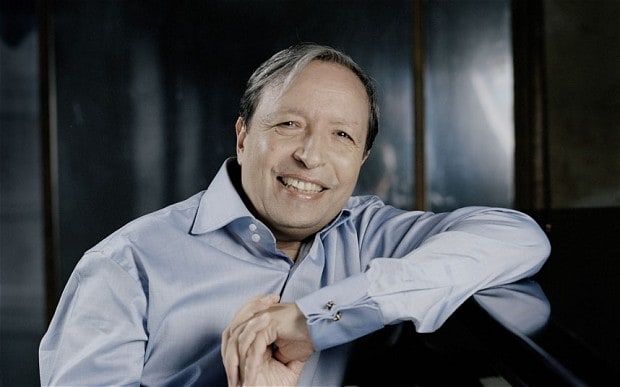
Murray Perahia at the Barbican Hall review ***

murray_2540364b

Murray Perahia

Barbican Hall, 11th June 2017

  • J S Bach – French Suite No 6 in E major, BWV 817
  • Schubert – 4 Impromptus Op 142, D 935
  • Mozart – Rondo in A minor, K 511
  • Beethoven -Sonata No 32 in C minor, Op 111

Murray Perahia is a great pianist. No doubt about that. And I am always keen to hear his Beethoven interpretations. However the last few concerts I have seen in London from him have been a mixed bag. The solo recital this time last year was a little underwhelming with a fine Mozart A minor sonata offset by a curiously underpowered Hammerklavier. In contrast his Beethoven Piano Concertos 2 and 4 earlier this year, with the Academy of St Martins in the Fields which he also directed, were marvellous. Another performance of PC No 4 under the mighty Bernard Haitink’s baton was also sensational.

In this concert we had a similarly puzzling evening. The Bach was the best of the bunch, played with great clarity and musicality and with that lovely counterpoint revealed in all its perky glory. I won’t comment on the Schubert – I just don’t really get on with it – but the audience was clearly persuaded. I didn’t know the mournful Mozart Rondo but this was a compelling rendition so I will need to check it out.

The Beethoven, his final sonata, with its curious structure and strange, ethereal musings, took a bit of time to get going. Mr Perahia’s treatment of the Maestoso opening of the first movement was more deliberate than the recordings I know (Pollini and Paul Lewis are my favourites) but by the time we reached the fugal development, which uses the whole keyboard, it was back in the groove. The longer second movement, with its six variations largely in C major, was much more convincing and here I got lost in the beauty of Beethoven’s music. The movement is near 20 minutes in total but always seems timeless to me.

So a fine evening of solo piano music but not quite as engrossing as I had hoped.

Richard III at the Arcola Theatre review ****

tn-500_greghicksandsarapowellinrichardiiidirmehmetergencalexbrenner

Richard III

Arcola Theatre, 10th June 2017

I have had a surfeit of Dickie IIIs over the last few years. Mind you I am not complaining.

Mark Rylance on his return to the Globe found a vulnerable, despairing Richard who didn’t seem to care about his actions. Ralph Fiennes was a ruthlessly efficient c**t which left next to no room for audience complicity. Lars Erdinger was the narcissistic showman, even in the buff, in the Schaubuhne Berlin production at the Barbican. Benedict Cumberbatch, in the Hollow Crown II version (just get this on DVD if you “don’t like Shakespeare” and then change your mind), upped the comedy quotient which I enjoyed but was ingratiating for others. Robert Sheehan (the pretty boy off the telly’s Misfits) was one of the best things in Trevor Nunn’s marathon, “proper Shakespeare” War of the Roses at the Rose Kingston (yep all in one day for me) with his youth offering up a more bolshie Dickie. Best of all was Hans Kesting in Toneelgroep Amsterdam’s Kings of War. Like the War of the Roses this had the advantage of providing the back-story for Richard’s tale that the standalone productions don’t have, which ensures the other characters are in the flow of the action from the off. Kesting, with his tight fitting suit and birthmark but with no limp or withered arm, created a Richard with physical presence and superior intelligence who is able to bully all those around him. His actions almost seem reasonable such was his charisma making the final “I am a villain” monologue, when his loneliness is laid bare, here delivered to a mirror, even more disturbing.

I have to say though that Greg Hicks, in this Arcola production directed by its inestimable head honcho Mehmet Ergen, tops the lot. This is because he captured all of the facets of what it is to be a Richard III in my view. Now remember this is a piece of Tudor propaganda as filtered through Will S’s imagination so no need to get too hung up on the “reality” of the body count or the misogyny. A bloody route to kingship was par for the English course through most of history. What matters is how the performance and production seeks to balance the contradiction between the audience’s repulsion and attraction to our leading man and the dialectic between the thirst for power and the self loathing that torments him. The best plays obviously feast on contradiction and big Will serves these up in spadefuls in this play.

Greg Hicks was not setting out to play the joker here, though the delivery of some of the classic asides to audience served that purpose. His crystal clear delivery of the lines, together with changes of tone and phrasing, and the masterful use of pauses, revealed intent in ways that had not been clear to me before, notably in the “group’ scenes with Rivers, Hastings and Stanley. His constant movement of face and body (with leg permanently chained to arm) and habit of getting right in the face of the other characters emphasised the desire to twist events to his advantage. This was a Richard in a hurry. The crown was the payback for the hate meted out to him in the past. The unhidden misogyny and careless manipulation was simply the means to this end. Not “pure evil”, not a charming pantomime villain, not solely motivated by self hate and a desire to avenge, self-aware but still consumed by the deception of rightful inheritance. This is when an intervention by a trained psychotherapist in childhood might had saved a whole lot of bother later on.

The compact Arcola space with its steepish seating, the sparse staging and costumes, sympathetic staging and lighting, all served to focus attention on the actors. The support from this medium sized cast (there was a bit of doubling) was admirable, particularly Paul Kemp as Clarence/Stanley, Sara Powell (so good in the recent The Plague on this very stage) as Elizabeth and Matthew Sim as a full-on psycho henchman Catesby, but matching Mr Hicks proved a big ask.

We know Greg Hicks is an outstanding Shakespearian actor having been and done it with the RSC and NT and I hope there are many more to come. But I would love to see him revisit some Pinter, create a hard-arsed Volpone or have the lead role in a future Martin McDonagh play.  For the moment though I have this performance to savour.

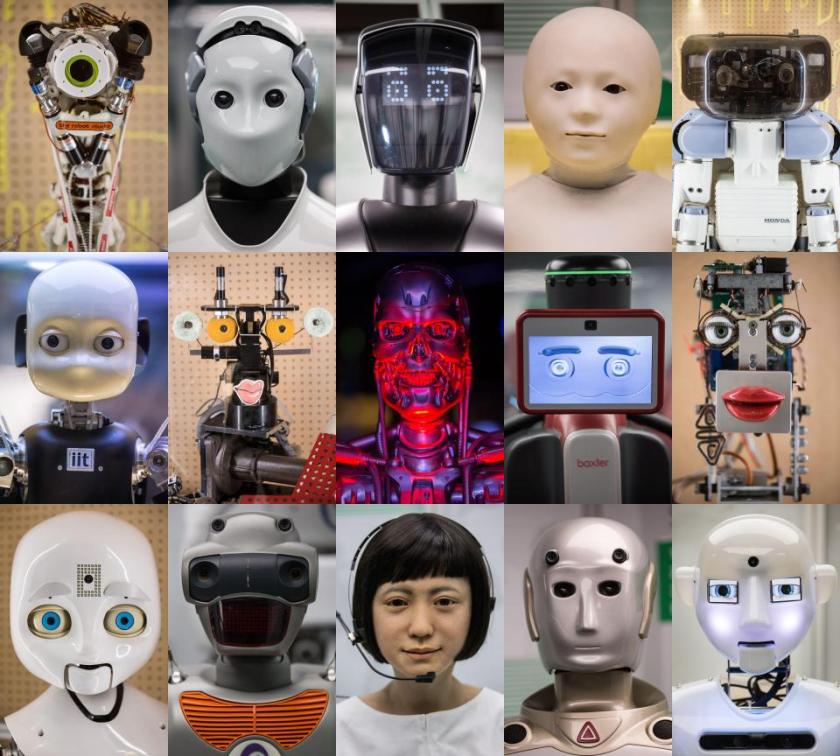
Robots at the Science Museum review *****

nintchdbpict000299905116

Robots

Science Museum, 7th June 2017

The Robots exhibition at the Science Museum is now around half way into its run (ends 3rd September) and with school holidays done and dusted I figured it was safe to take the plunge and have a look. Mid afternoon slot and near empty when I went in.

Now don’t get me wrong. I like children. I have three of them in my collection and over the years they have provided me with hours of, albeit expensive, entertainment. There was even a time when this exhibition might have been, with appropriate concessions granted after intense negotiation, a candidate for a “family trip out”. But time marches on so now I am flying solo with this sort of thing. 

Anyway an opportunity to have a good nose around. I had high hopes. The Cosmonauts exhibition from a couple of years ago at the Science Museum was a triumph. The exhibition certainly starts with a flourish with a collection of Medieval and Early Modern automata and other beautifully constructed machines. I would have been happy just with these though I suspect they may not be exactly what the average punter has in mind when it comes to robots. These pieces are, understandably, in vitrines, and the atmospheric lighting veers towards the murky, but they are beguiling.

If I am honest the next section is a bit half hearted. I guess it would have been possible to assemble a few crackerjack machines from the golden age of the industrial revolution across the West in C19, but, again, this might not have sat neatly with the exhibition offer. What followed this was also a little underwhelming, a collection of classic “science fiction” style toy robots from the mid C20 with accompanying imagery, and some full size early humanoid-like robots. You know the score. Knocked up by earnest blokes with beards in sheds using whatever materials they had lying around. Ingenious.

It is though the final couple of sections that really sends the head spinning. There are demonstrations of the key current areas of focus for roboticists through some well chosen exhibits accompanied by short explanatory videos from the top boffins in each field. And then we see, and in a couple of cases, get to play with, some of the most advanced commercial robots from the last decade. I defy anyone not to be swept along by the possibilities that are opening up. The curators though also diligently explore some of the wider issues that will arise from a world where robots become more widespread.

So all up if you have any curiosity at all about this subject, and you probably should, then get along if you haven’t already. Kids of all ages welcome. Despite my curmudgeonly comments above.

Killology at the Royal Court Theatre review ****

killology

Killology

Royal Court Theatre, 8th June 2017

There are a few plays every year where I kick myself that I missed them. Gary Owen’s Iphigenia in Stott from 2015 was definitely one of them. So I was determined to see Killology (pre-reviews) even though I wasn’t entirely persuaded by the Royal Court blurb. I shouldn’t have worried, there was way more to this play than this teaser implied. If I was a brighter boy I probably also would have conducted a rudimentary search of the title for this would have led me to the inspiration for Mr Owen’s play Lt. Col. Dave Grossman, who research is referenced in the text.

Killology deals with male failure and violence, notions of responsibility and the troubled relationships of son to father and father to son. It is not an easy watch. Through a series of pacey, interlocking, non-linear monologues, it tracks the stories of three men, Alan, his son Davey and Paul, whose own unseen father also looms large. Alan has left Davey to the care of his mother. Davey is bullied, and with no viable alternative he takes revenge on his tormentors, but, in turn, the bullies take revenge on him. This act of torture is animated by a shooter video-game. Killology. Alan in parallel takes revenge on Paul, who is the creator of the game. Paul describes the pain and anger that has damaged him, and skewed his own morality, because his own unseen scornful father only sees his failings.

There are a few convenient leaps in these narratives, but these devices are easily forgiven as they get to the core of the humiliations that fuel the violent reactions. There is no proselytising from Mr Owen, no glib answers and no simple resolutions even if he does explore the possibility of good in one of the apparent narratives. Monologues are, of course, brilliant story telling vehicles as they make us, the audience, create detailed pictures in the theatre of our minds (sorry for the unquestioning dualism here – just run with it). Yet sometimes this means the emotional power is compromised. Not here. This really packs a visceral punch.

Rachel O’Riordan (the artistic director of the Sherman Theatre in Cardiff) directs the work with flexed efficiency amplified by the set of Gary McCann and the sound world of Sam Jones. An awful lot is asked of all three actors but they respond magnificently. Sean Gleeson captures the sense of Alan as a broken man with no hope of redemption. Richard Mylan turns Paul into a repellent nihilist but still invokes our compassion as we learn what shaped him. And Sion Daniel Young as Davey simply astonishes.

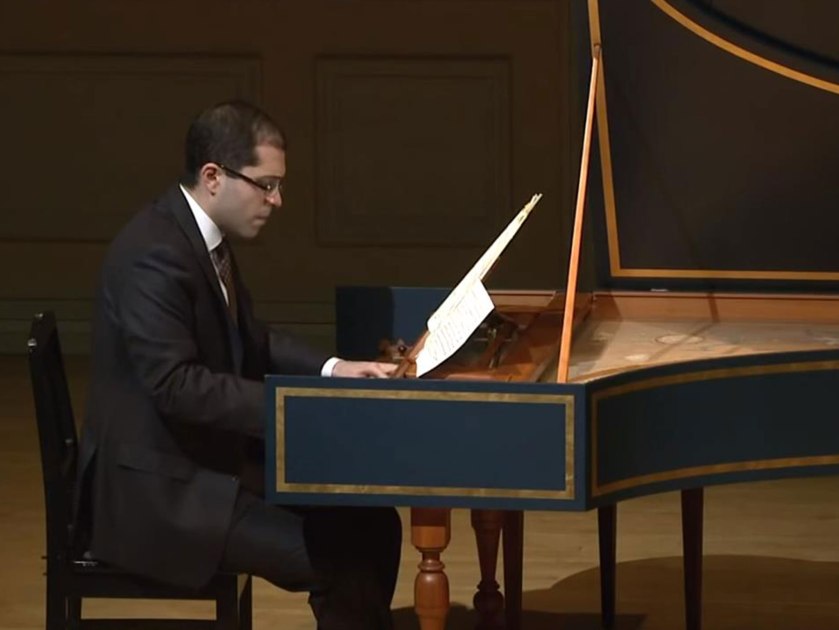
Mahan Esfahani at the Wigmore Hall review ****

mahan-esfahani

Mahan Esfahani

Wigmore Hall, 5th June 2017

  • Thomas Tomkins – Pavane in A Minor
  • Giles Farnaby – Woody-Cock
  • Henry Cowell – Set of Four
  • WF Bach – Sonata E Flat Major
  • Steve Reich (arr Esfahani) – Piano Phase

The harpsichord is certainly not my favourite instrument. (Electric guitar since you ask). More than happy listening to it tinkling away as continuo in the best of Baroque but less persuaded of its solo virtues. Yet in the spirit of adventure, with an appealing programme and with Mr Esfahani’s reputation as one of the best in the harpsichord business, this was worth a shot. (For those that don’t know £15 for these lunchtime recitals at the best chamber music venue in the world is a bargain so, if you work locally, get in).

Now a cursory glance at previous posts will show that I am a sucker for liking most of what I see. I like to think this is because I have a eye for the best that the London cultural world has to offer (within the self-imposed boundaries I have set). However, I know that the reality is somewhat different. I am simply far too polite to offend and anyway I am enjoy reminding myself just how discerning I am in my solitary little echo chamber. So you would be wise to ignore everything I say.

In this case though I took a bit of a punt on something and I was genuinely bowled over. I didn’t know it was possible to hear a harpsichord make these kinds of sounds. The two early pieces from Tomkins and Farnaby show, in astounding fashion, just what the bewigged musicians of the Jacobean and Tudor period where up to following the example set by the master William Byrd. Woody-Cock (no sniggering at the back please), the piece by Giles Farnaby, takes a simple Scottish folk tune and turns into a dazzling display of keyboard virtuosity –  the woodcock being a dowdy nondescript little brown fellow until he starts displaying when he turns into the Nureyev of the air. Anyway it was a real lesson in what the harpsichord can do.

As was the piece by Henry Cowell. The programme notes tell me that Mr Cowell set out to marry the musical structures of the Baroque golden age of the harpsichord with the tonal language of composition in the 1960s, and with more than a nod to the then voguish fascination with the gamelan and Balinese music. It was certainly fascinating with a wide range of colours that I had not thought possible on the harpsichord. Not sure if I would seek it out again but I am glad to have been given the opportunity to hear it. The WF Bach took us back to more familiar ground although this era, the galant, the bridge between Baroque and Classical, when all was lightness of touch, can still sometimes come across as a bit frou-frou. Not here to be fair as there was still enough of the Baroque rhythmic backbone and a few darker touches in the piece.

Finally Mr Esfahani took on Steve Reich’s piano phase which he has arranged for harpsichord. So on with the headphones and the tape machine, and off with the jacket, leaving him looking like the least cool DJ on the planet. As he himself freely admits this piece pulls in a new audience to hear the harpsichord – including me. My musical education has come on in leaps and bounds but this still was the main draw for me. The harpsichord creates avery different sound-world when compared to the piano. The slight delay of the tape recording, which is the signature of Reich’s technique, created sonorities which were closer to Reich’s percussive pieces that the piano version. It certainly seemed to forge a more repetitive structure than the versions I am more familiar with.

Overall then this was an excellent journey through the possibilities that are offered by the harpsichord and I will certainly look out for Mr Esfahani’s next visit to London.

Britten Sinfonia and Thomas Ades at the Barbican Hall *****

beethoven-600x600jpg

Britten Sinfonia, Thomas Ades

Barbican Hall, 6th June 2017

  • Gerard Barry – Chevaux-de-frise
  • Beethoven – Symphony No 3 in E Flat Major. Op 55 “Eroica”

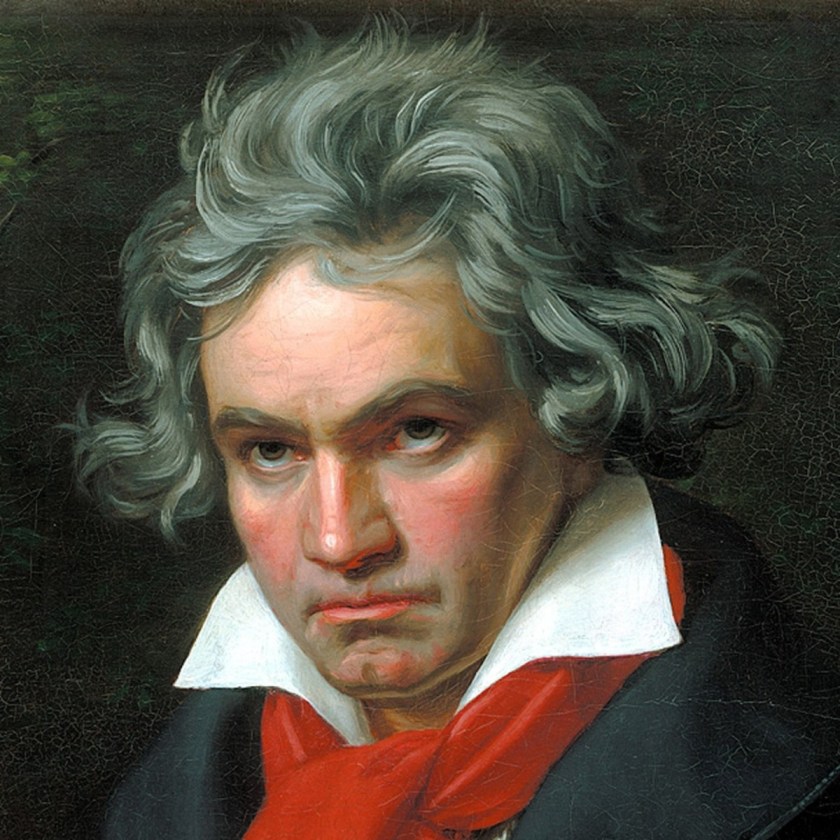
That Beethoven eh. Too busy being a genius to get a decent haircut. Another reason why he is my sort of bloke.

I have raved about the other two concerts in this cycle, Britten Sinfonia and Thomas Ades at Milton Court review ***** and Britten Sinfonia and Thomas Ades at the Barbican Hall ***** so I suspect you won’t be too surprised if I do the same again here. Whilst I am not sure I would want my Eroica to always sound this way it was, as with the performances of Symphonies 1 and 2, an exhilarating restatement of this mighty work.

First though the Gerard Barry piece that Thomas Ades chose to pair with it. Apparently this got a kicking when it premiered at the Proms in 1988. I don’t know why. Yes it is loud, sometimes excruciatingly so, but it is hardly difficult. It was inspired by the destruction of the C16 Spanish Armada off the west coast of Barry’s native Ireland. and the title refers to those pointy wooden array of fixed spears that were used on battlefields to defend against cavalry attacks. You educated types will also know that it refers to a spiky piece of prose deliberately inserted by an author to unsettle you.

So Mr Barry didn’t hide his intentions. The piece begins and continues with a wall of sound from strings, then brass and woodwinds and then the whole shebang, and pretty much continues in this vein for most of the first ten minutes. There are then some “softer” interludes and a glockenspiel (I think) chimes in which offers the only percussive influence (thus making the noise-fest more interesting I think). The chords are comprised largely of crotchets and quavers, the score is marked “spikily” or “brutally” and the effect is of pounding dissonant rhythms. I loved it and I suspect that anyone who has been near any form of “loud” rock music from any genre would feel the same way.

Having located the inner Napalm Death in the Britten Sinfonia Mr Ades seemed keen to channel this into the Beethoven symphony. From the off we were treated to fast tempi which is my preferred default setting (one of my favoured Beethoven cycle recordings is John Eliot Gardiner’s with the Orchestre Revolutionnaire et Romantique which will hearld a few sniggers from classical buffs). Minimal vibrato and a clear, brilliant sound really pumped up the score which, as any fool knows, is a work of unparalleled genius. (I know the “great male genius” narrative of artistic endeavour is bullsh*t but Beethoven just was, so yah boo sucks to you).

It was just really exciting though in places it did threaten to career out of control. Yet the detail of the phrasing and the dynamic breadth more than compensated. This will sound cliched but it really did feel like the whole score had been given a thorough cleansing, like a restored old master.

I cannot recommend this cycle highly enough based on the three symphonies so far. Thomas Ades and the Britten Sinfonia will be back in May next year to take on 4. 5 and 6. Please go along. If you have never been to a classical concert and don’t think it is for you make this your debut. Get a decent recording of these pieces, shove them on your IPhone, wait for the movements to shuffle through a few times to get to know the tunes, then take the time to listen to the whole thing one evening (phone off). This will mean you are tooled up for the real thing come next May. Then sit back and wait for your socks to be blown off.