The Madness of George III at the Nottingham Playhouse review *****

The Madness of George III

Nottingham Playhouse, 13th November 2018

Flushed with success from his visit to Manchester the Tourist hopped on a train across the Peak District to the proud city of Sheffield, (where I see the Theatres will be staging a Rutherford and Sons next year ahead of a version at the NT, and will then attempt to stage The Life of Pi, which should be interesting), and then on to Nottingham.

An interesting exhibition at Nottingham Contemporary – Feminisms, Gender, Resistance – but the main aim of the visit was the Playhouse and The Madness of George III. Now I booked this on the assumption, as with the Death of a Salesman at the Royal Exchange, that this was as near to a sure-fire winner as it was possible to get in theatrical terms. Alan Bennett at his witty best, but armed here with a riveting biographical story, directed by the ebullient new(ish) Artistic Director at the Playhouse, Adam Penford, and with Mark Gatiss in the lead, and Adrian Scarborough as Dr Willis, in a uniformly excellent cast. 

And sure-fire winner it turned out to be. Apparently it has become the biggest box-office hit in the Playhouse’s history. It was screened to millions (I may be exaggerating here) via the NT Live cinema programme and ensured a bunch of critics left their London mansions to deliver a slew of 4* and 5* reviews. The audience on the evening the Tourist attended plainly loved, explicit in the congratulations during the after-show discussions.

I saw the original NT production with Nigel Hawthorne as George back in 1991, the Apollo Theatre revival a few years ago with David Haig at his actorly best, and have seen the film version a fair few times. So you can probably tell I am a bit of a fan. I will assume that, since you are one of the very select band reading this, that you are too, so won’t bore you with plot or historical details. If you don’t I suggest you see the film tout suite. 

So what was so good about this production? Well first off Adam Penford has cut out a handful of scenes. AB’s play is already, like most of his work, structured as a series of very short scenes in multiple locations. This guarantees momentum but, allied with AB’s constant urge not to leave a potential quip on the table (which is why it is a comedy after all), can mean the characters, other than the King, come across as a bit thinly sketched. Cutting scenes out might seem counter-intuitive but it does actually mean we become more focussed on the “tragedy” of the King’s breakdown, and then the jubilation of his apparent recovery. I was also more aware here of the King’s relationship with his retinue. The political machinations, Whig vs Tory, the plotting of the Prince Regent and his faction, took a bit more of a back seat.

George III’s 59 year rule saw not just the Regency crisis, but the “loss” of American, the union of GB and Ireland, wars in Europe and throughout the burgeoning Empire, rivalry with France, the Agricultural Revolution and the accumulation of capital to fuel the Industrial Revolution, a new way to finance the monarchy, constitutional change and scientific advances (which George was keenly interested in when he was on top form). Whilst AB’s play only incidentally touches many of these profound changes it does brilliantly capture the dichotomy between the public and private life of the monarchy and the metaphor of the King’s breakdown mirroring the political struggle catalysed by the American War of Independence. 

The dynamism of the production was also very well served by Robert Jones’s ingenious set. The various locations were smartly rendered with a series of Georgian style duck-egg painted flats, on stage and suspended, which were moved into place with no interruption to the action at all. Richard Howell’s lighting design, Tom Gibbons’ sound and Lizzi Gee’s movement, as well as some blisteringly quick costume changes, all further contributed to the pace and period feel of the production (most memorably at the end of the first half). A theatre set to point up the theatricality which underpins royalty. 

However, and perhaps unsurprisingly, it was the performance of Mark Gatiss that really made the difference. Adrian Scarborough’s Dr Willis, alarmingly forthright in his proto-psychiatric treatment of the King, (pointing up that he was just a man), in the second half, Debra Gillett’s devoted Queen Charlotte, Louise Jameson’s callous Dr Warren, Nicholas Bishop’s morose Pitt, Amanda Hadingue’s presumptuous Fox and Will Scolding’s nincompoop Prince Regent all caught the eye, but all eyes were on Mr Gatiss. As you might expect the comedy flowed easy for him: but better still was the way he caught the pathos of the king as he was plunged into a mania which he could not control but which he understood. “I am not going out of my mind, my mind is going out of me”. The production also doesn’t hold back from showing the physical pain that was inflicted on him by doctors who didn’t have a clue what they were doing. Mr Gattis’s detailing of the King’s speech, tics, convulsions and agonies is mesmerising. Adam Penford was keen to offer a more sympathetic, and contemporary reading, of the King’s mental illness and to avoid seeing his behaviour solely through the lens of humour. Thanks to Mark Gattis’s performance he certainly succeeded. 

History play, political drama, comedy. tragedy? This production makes the case for all of these in a forthright way. Thank you Nottingham Playhouse. I’ll be back. 

Forgotten at the Arcola Theatre review ****

Forgotten

Arcola Theatre, 10th November 2018

I was much taken, if not entirely convinced, by the British East Asian Yellow Earth Theatre company’s version of Tamburlaine at the Arcola 18 months ago. And this co-production, with Moongate, of a new play, Forgotten, by Daniel York Loh, which kicked off at the Theatre Royal Plymouth, sounded like it needed seeing.

Daniel York Loh looks like he is a busy fellow. When he is not writing he is acting, directing films or performing in a folk trio. Busy. Just like this play. It started off as a 5 minute script. It now runs to a couple of hours. Apparently his first draft ran to 300 pages. DYL has a lot to say and he means to say it. Mind you this is a story evidently worth telling. Giving a voice to the 140,000 Chinese labourers who left China to initially assist the French, and then the British, effort in WWI. Largely written out of history.

In trying to cram in as much of his research into these events as he can, the appalling famine and poverty blighting China at the turn into the C20, the hierarchical, violent and patriarchal village society, the volatile political situation and domination by foreign powers, the dream of escape and wealth, the Western view of China, and the Chinese view of the West, and Japan, at the time, the experience of the labourers in France and their shabby treatment, and their legacy, after the War, DYL offers a little too much exposition, a slight overdose of plot and leaves his characters looking a little too one-dimensional. Especially given only a six strong cast, (with some doubling up), the compact Arcola studio space and an experiment in form, namely having his band of villagers putting on a Chinese opera as they embark on their adventure.

So the cast and the creative team, director Kim Pearce, designer Emily Bailey, composer Liz Chi Yen Liew, lighting designer Jessica Hung Han Yun, sound designer Luke Swaffield and movement director Quang Kien Van had their work cut out to make this work.

Work it does though and this I think is largely down to the fact that, weaved into the important history lesson, there is a believable human drama here, especially when the friends get to the Western Front in the second act. The play begins at the end but I’ll keep schtum on that. The cast are performing an opera which tells the tale of a Miraculous Traveller, (I am afraid I know nothing about Chinese classical literature),  paralleling the story of the villagers. When all calms down we are in Horse Shoe Village in Shandong province in 1917 where Old Six (Michael Phong Le) and his wife Second Moon (Rebecca Boey) are struggling to earn enough to feed their young child. Big Dog (Camille Mallet de Chauny) is the village outcast, addicted to opium. Eunuch Lin (Zachary Hing) was castrated in a failed attempt to secure a position in the Emperor’s household. All are subject to the cruel whim of foul-mouthed Headman Zhang (Jon Chew). They agree to be recruited into the Chinese Labour Corps (from 1917 China declared war against Germany and Austria-Hungary) meeting the educated Professor (Leo Wan), and when they get to France, Wild Swan (Jon Chew again, equally potty mouthed) along the way. 

Whilst there are battlefield scenes DYL wisely cuts these with other encounters and other characters, as well as the highly stylised opera, to offer multiple perspectives on the experience of the friends. This shines a little light on the more universal East Asian diaspora myth, “silent”, “hard-working” but largely disregarded and culturally held at arms length. 

A valuable, if slightly awkward epilogue, explains what happened to Shandong province after the war and how the Chinese contribution was, literally, painted over in the now largely Americanised Pantheon de la Guerre. (America has a long history of mocking the contribution of France in global conflict). China was properly shafted at Versailles. Most of the surviving CLC returned home, but a few thousand stayed to build a Chinese community in Paris. The British CLC were given a medal, but it was bronze, not the silver awarded to everyone else who fought. There is a cemetery at Noyelles-sur-Mer on the Somme which honours 842 CLC dead. 

So overall Forgotten is an ambitious play, generously and vigorously told by an excellent British East Asian cast (Leo Wan, in particular, is as good here as he was in Tamburlaine and The Great Wave, and I look forward to seeing Michael Phong Le again). Lucy Bailey’s set is effective, Kim Pearce’s direction manages to maintain the momentum even as the scenes jump around. It may not quite be the finished article but it definitely deserves a wider audience. I spy a couple of harsh reviews in the national press. Ignore them. 

Don Carlos at the Rose Kingston review ****

Don Carlos

Rose Theatre Kingston, 9th November 2018

No one could accuse Friedrich Schiller of holding back in Don Carlos. Goethe inspired Sturm und Drang Romanticism, a Kantian paean to the centrality of personal freedom and democracy, the clash of liberty and tyranny, a stab at the sublime, a (loose) history of a turning point in the Spanish Golden Age, a political thriller chock full of intrigue, an (incestuous) love story, an increasingly intense Renaissance style tragedy lifting directly from Shakespeare, most notably Hamlet and Othello, but also Lear, Julius Caesar and Henry IV, which spills over into melodrama: it is big on passion and big on ideas. Operatic in scope you might say. Which is why Verdi wasn’t the only one who espied its potential. 

It took five years to write, finally published in 1787, which might also explain its meandering nature and abrupt tonal shifts, and, if you were unfortunate enough to sit through the original, ostentatious five acts of blank verse in their entirety you wouldn’t get much change out of seven hours. No one ever has mind you. This is kitchen sink drama. As in Freddy chucked the dramatic kitchen sink at it, not as in a pint-sized slice of domestic realism. 

This production, in a translation by Robert David MacDonald, clocks in at 3 hours. Schiller was largely ignored by the English speaking world for a couple of centuries. One reason why he no longer is, as well as Goethe, Lermentov, Gogol, Goldoni and Racine, is Mr MacDonald. Fluent in 8 languages he was the brains behind the Glasgow Citizens Theatre as well as an accomplished playwright in his own right.

Nor could one accuse Israeli director Gadi Roll, and actor Tom Burke, whose inaugural production as theatre company Ara this is, of holding back. Ara is intended to bring non-naturalistic theatre to the regional masses (though I am not sure the good people of Kingston, half an hour by train away from the South Bank, qualify as regional). They have started with a bang here. This is stripped back minimalist European auteur theatre which prizes style as well as content. Designer Rosanna Vize, who normally offers just a little more, makes do with the bare Rose stage and a few chairs, and modern dress with a vague Golden Age/Matrix flourish (and a lot of shades). The constantly moving lighting rigs in Jonathan Samuels’s design are dramatic and very effective (he worked with Gadi Roll on the Belgrade Coventry productions of The House of Bernarda Alba and Don Juan Comes Back From The War which is where Tom Burke met Mr Roll). The mingling of the private and public spheres.

The actors move around the stage in stylised straight lines. In the first couple of acts, the cast, notably Samuel Valentine as Don Carlos himself and Alexandra Dowling as the Princess of Eboli, (though with the notable exception of Tom Burke himself as the Marquis of Posa, the cool, calm voice of reason perhaps), spit their lines out with machine gun intensity, requiring the audience to keep ears and brains on their toes as it were. And there is a lot of shouting, notably from Darrell D’Silva’s Philip II. It is very, very, very dark most of the time and black is the dominant fashion. A nod to Velasquez, Ribera, Murillo et al?

I loved it. I see that the proper critics were less enamoured. Maybe the novelty of the play itself has worn off for these cynical hacks? The less than dynamic staging, the delivery of the lines and some of the acting didn’t past muster for many of them. Now I admit that the deliberately non-naturalistic choices made by Gadi Roll, in terms of look, movement and speech, did take a bit of getting used to, but necessary adjustment made, actually helped to see through to the core of Schiller’s text and messages and helpfully circumvent the worst of the melodrama. And it wasn’t just me. The SO, attracted by the history, and Mr TFP, an expert on German literature and culture, and a man who has read Schiller in German, agreed with me. I am guessing though that not all of the audience were as persuaded.

Young Don Carlos, the Infante, has the hots for Elizabeth of Valois (Kelly Gough). The only problem is Dad, Philip II, has married her. Dad also doesn’t trust the hot-headed Prince to get stuck into the affairs of government. And big Phil remember ousted his own Dad to seize the throne. When Carlos’s boyhood chum, the Marquis de Posa, returns to Court he confides his love and de Posa agrees to advance his suit if he in turn will help free the rebellious people of Flanders, oppressed by nasty Spain. Carlos asks Phil if he can go to Flanders (more exactly the Spanish Netherlands). Phil refuses and instead sends the Duke of Alba (Vinita Morgan). Cue bust up between the Duke and Don Carlos. There is a note and a key and Carlos ends up in the Queens bedroom with the Princess de Eboli who fancies him and wants to escape the clutches of the randy King. Thwarted she goes to Domingo (Jason Morell) the King’s Confessor. He plots with Alba to bring down the Queen and Carlos. A trap is laid but the suspicious King enlists de Posa to help uncover it. The Marquis’s enlightened ideas start to persuade the King but tyrants will be, albeit pragmatic, tyrants. There are some letters. misunderstandings, arrests, imprisonments, failed murders, accusations, double crossings, realisations, escapes and then, just when everyone least expects it, the Spanish Inquisition arrives (with Tom Burke doubling up as the Grand Inquisitor). To remind us that in C16 Spain it was ultimately the Catholic Church that held, literally, the whip hand. 

Obviously it does get a bit silly but the bare bones of the romantic tragedy are involving and there is a brio to the story which is irresistible. The intellectual set piece between the Marquis and the King, “give men the right to think”, is powerful, affecting stuff, which gets to the heart of the struggle between absolutism and representation, filtered, as it is, through the recognition by Philip that the Marquis, even with his heresies, is the son he really wanted. Especially when you realise that the “real” Don Carlos was an utter f*ckwit. A victim of Hapsburg inbreeding, deformed, mentally unstable even before he underwent a trepanation, he might have blinded all the horses in the Royal stables, and was prone to chucking servants out of windows. Phil eventually locked him up. The despot in Philip is plain to see, but we also see his humanity, and his justifications. And de Posa may have right on his side but boy does he know it and, intoxicated by his own argument, he will manipulate anyone and everyone to get what he wants. 

What next for Ara? This was a pretty bold first move. On the assumption that the style, the look, feel and intent of the company is set, I wonder if they might not be better served, at least in terms of critical response, by reviving a more recent play. We shall see. I hope they continue to aim high though. 

Now a few words on the “gosh, how did that Greek/Jacobean/Restoration/Spanish Golden Age/French classicist/German romantic playwright create something so uncannily relevant to today” trope. It’s not because they could see into the future or were especially politically prescient. It is because we, as human beings, either individually or collectively, haven’t moved on much. We may have smartphones, good teeth and a colossal amount of debt, but the way we interact with each other in the body politic, and the core of our individual psychologies, haven’t changed much in the pitifully tiny amount of time where we have, to the detriment of other species I fear, “ruled” this planet. So if a playwright can nail these truths, whether in the 5th century BCE or yesterday, we will listen. Don Carlos was first staged two years before the French Revolution: by the time he published the final version in 1805 the dream has collapsed into the Reign of Terror and Napoleon was Emperor. Then Schiller popped his clogs. And you think we live in worrying times. 

Having now seen this production, and the Almeida Mary Stuart, I hope to be able to bag another Schiller one day, The Robbers, Intrigue and Love, the Wallenstein Trilogy: all look likely candidates. He makes you work hard for your money, there is a lot, maybe too much, discussion, debate, confrontation and contemplation, but that is what the best dramatists do. And his characters are not just good, bad or indifferent. That is the true test of the playwright, the ability to show us many facets of the human condition, not all of which make sense or stack up. Nuance, ambivalence, enigma, complexity. To be on both sides, and on neither. 

Peterloo film review ****

peterloo_carlile

Peterloo, 2nd November 2018

I doubt that there has ever been a more carefully researched, painstakingly assembled or more vividly imagined “history” film than Peterloo. If you like Mike Leigh (I do) you are going to love this. If you like British social, economic and political history (I do) you are going to be very interested in this. If you are concerned about the brutality with which power can crush the legitimate appeals of the ordinary person, (you should be wherever you sit in the system), this is going to stir you. If you understand the power of oratory, (words are what turn ideas into action), then this is going to draw you in. If you like the cast, Rory Kinnear, Maxine Peake, Pearce Quigley, Karl Johnson, Nico Mirallegro, Tim McInnerney, and especially Neil Bell and David Bamber, all stood out for me, but honestly this is a massive assemble of British acting at its best, then you will relish this.

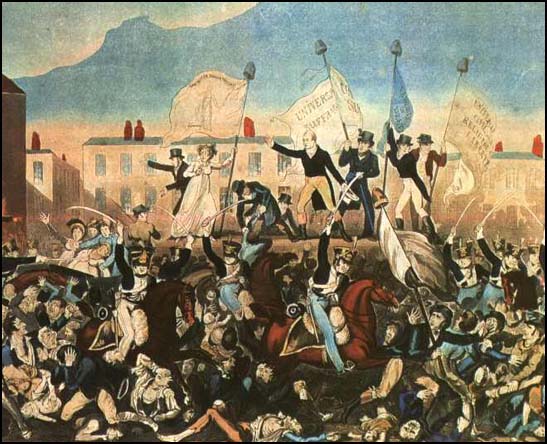
However if you are after a satisfying personal drama, or complex plotting, then you might want to look elsewhere. Which given that this is a film that documents one of the darkest days in British history shouldn’t come as too much of a surprise. (Mind you this wasn’t the only massacre of peaceful protestors in the first half of the C19, more followed in the 1830s, notably in Wales). There is a lot of talking, at the meetings called by the various political radicals and reformers in and around Manchester in 1819, between the founders of the Manchester Guardian and the firebrand liberal orator Henry Hunt who was invited to address the rally in St Peter’s Field, within the family of Joseph (the real life John Lees) which is the emotional centre of the film, between the moreorless vicious magistrates who look to Government to break the sedition and between the Home Secretary and the lackeys who do his business. In this way Mike Leigh shows us why the people of Manchester and their leaders sought reform, of representation, of taxation, of the punitive Corn Laws, and why the authorities became so fearful, and were so consumed with the threat that the radicals posed, that they wilfully sanctioned a cavalry charge by volatile yeomanry and troops into the innocent crowd of 100,000 crammed into a square with minimal exits.. It is also what ensures the universal relevance of the film and the events it portrays. The power of rhetoric and the paranoia of the State are constants in the human condition.

This final scene is as awful as you might imagine but Mr Leigh doesn’t overdo the sound and fury and cleverly links the massacre back t the field at Waterloo which opens the film and which gave the events their sobriquet. As so often with Mr Leigh the film is assembled from linked montages though here many of the scenes are splendidly expansive. The interiors especially, of the powerful and the dispossessed, of Parliament, magistrates houses, pubs, meeting houses, parlours, mills, are richly detailed. The moors around Manchester offer a wild, lyrical contrast to urban industry. I think I saw parts of Lincoln standing in for historic Manchester and, of course, Chatham Dockyard, the period film’s spiritual homeland.

This was the time when “entrepreneurial” capital was looking to the State to underpin its privilege at the expense of labour, the very struggle Engels was to highlight three decades later, when, despite apparent reforms, conditions for the working class had only got worse. Peterloo may have fired up the press in London and no doubt fuelled legislative change but, as the film shows, didn’t cause the mill-owners of Manchester to question their consciences.

Any other director, without the freedom that Mr Leigh has secured, (say thanks to all the producer money here, especially Amazon), would have been forced to compromise. There are one or two occasions when, maybe, just maybe, he might had left some of cinematographer Dick Pope’s stunning assemblies on the cutting room floor, but if he had then he wouldn’t be Mike Leigh and we wouldn’t have this film. And he has ben able to spend his handsome budget to create a film of incredible ambition. In addition to Mr Pope, I would also call out the work of costume designer Jacqueline Durran and her team, the set decoration of Charlotte Watts, composer Garry Yershon’s score and finally, and I might contend most importantly, historian Jacqueline Riding.

If you don’t see it at the cinema make sure to see it at home one day. It is “serious” and it is “important”, so clear the mental decks beforehand but it is richly rewarding and, shot through with humour, it is as entertaining as didactic gets.


Hogarth’s Progress at the Rose Kingston review ***

william_hogarth_-_self-portrait_-_google_art_project

Hogarth’s Progress: The Art of Success and The Taste of the Town

Rose Theatre Kingston, 21st October 2018

South West London was a popular place for the cultural, liberal, metropolitan elite in the first half of the C18. It still is. Hogarth, Horace Walpole, David Garrick, Henry Fielding, Alexander Pope, Henrietta Howard (the King’s mistress no less), Lord Burlington, Richard Steele, Paul Whitehead, Lady Mary Montagu, John Beard, Kitty Clive, Peg Woffington, James Thomson, John Moody, GF Handel (for one summer), Stephen Duck, John Stuart, Thomas Twining, Augustin Heckel. Oh, and early on in the period, no less than the Queen herself, Anne, at Hampton Court, following in the footsteps of William and Mary. Royalty and the Thames is what made it desirable,

OK so I can’t pretend I had heard of all of these luminaries but some of the big names, Walpole, Garrick and Fielding, play a big part in Nick Dear’s brace of plays about one of the area’s most famous residents, Hogarth himself. The first play, The Art of Success, premiered at the RSC way back in 1986, with Michael Kitchen and Niamh Cusack starring (seen last year on this very stage in the marvellous adaptation of Elena Ferrante’s Neapolitan Novels (My Brilliant Friend at the Rose Theatre Kingston review ****). This tells the story of Hogarth’s early years carousing his way through Georgian London with Henry Fielding and their mates, Frank and Oliver. The new, companion, piece, The Taste of the Town, revisits Hogarth, now in Chiswick, at the end of his life (1697-1764). His house is now supported by the Hogarth Trust, owned and run by LB Hounslow and can be visited most afternoons. Worth a peak especially if you take in he neo-Palladian beauty that is the recently refurbished Chiswick House just round the corner. And, once in your life, you have to see the flamboyant spectacle that is Strawberry Hill House. This is why interior designers are best avoided.

Now for those who aren’t familiar with William Hogarth, he was a painter, printmaker, social critic and cartoonist in the first half of the C18. This period saw a huge increase in the wealth of Britain, (in full union with Scotland from 1707), built on trade, specifically trade in people, specifically slavery. With this came the rise of the liberal Whigs who took power from the Tories in 1715 and drew their support from the new industrial and merchant classes. It was a period of vigorous political debate. At least it was if you were rich. If you were poor …. well you were still f*cked over as always. Anyway Hogarth and his mates were dead centre in this cultural maelstrom, specifically in criticism of the great and good. Journals, newspapers, pamphlets, clubs, all mushroomed. And these boys were bad to the bone.

Hogarth himself came from a less privileged background, enough to get an apprenticeship as an engraver, but precarious enough to see his teacher Dad have spels in the debtors prison. This is where his satirical edge was sharpened. His morality tale “comic strips”, such as A Harlot’s Progress and A Rake’s Progress, were dead popular at the time and have remained so ever since, and sort of defined the entire genre. Yet he was also a renowned painter, largely society portraiture that being the mode at the time, and the tension between his “popular” and his “high” art is one of the themes that Nick Dear explores in the plays.

Dear also doesn’t hold back on portraying the seedier side of Georgian life. The Art of Success kicks off with Hogarth (Bryan Dick), Fielding (Jack Derges), Frank (Ben Deery) and Oliver (Ian Hallard) lashed up after a meeting of the Beefsteak Club and contemplating their next move, which is going to involve sex for money I am afraid. There is a lot of this sort of thing going on in the first play set in the 1730s. Indeed Hogarth’s relationship with prostitute Louisa (Emma Cunniffe), and its discovery by his wife Jane (Ruby Bentall) forms a major part of the plot of this play, such as it is. Alongside his encounter with murderess Sarah Sprackling (Jasmine Jones) who was the subject of The Harlot’s Progress and who seeks to wrest control of her image back from Hogarth after he draws her in prison. This question of who “owns” a representation in art, the observer or the observed, is another central theme of the play.

In the hands of Antony Banks as director, alongside period costumes and a striking, if s;lightly unwieldy, set from Andrew D Edwards, some fine video work from Douglas O’Connell, lighting from James Whiteside, sound from Max Pappenheim and music from Olly Fox, scene after scene unfolds with distinctive verisimilitude. The Queen, Caroline of Brunswick (Susannah Harker complete with comedy German accent) gets a look in, and reveals herself ken to get inside Hogarth’s britches, as does Prime Minister Robert Walpole (Mark Umbers) who reveals himself keen to see a liaison between Sarah and Jane (it’s a long story). Walpole indeed cuts a deal with Hogarth to push through the copyright deal that WH craves to stop his work being ripped off. Yet, alongside Fielding he rails against the political censorship that Walpole introduced to the theatre, a process that persisted until 1968.

This personality parade though gives an inkling into the plays’ problems. The comedy smut becomes a little wary after a while and the crowbarring into the script of biographical and historical fact after fact leaves little room for any change of pace or tone. There is the vulgar, which is fun, or there is the art history lecture, which is a little less so, once you know what is coming. The repellent power of men over women in the Georgian booms out through both plays but to no great end, as the strands are never pulled together..

The second play with Hogarth now retired to Chiswick, and railing against rivals like Sir Joshua Reynolds feels even slighter in some ways. Hogarth is now played by Keith Allen. One word. Irascible. Perfect casting. Jane Hogarth, now played by Susannah Harker, puts up with his grumpiness and abuse, but is a little tired of the suburban life. Hogarth and his mother-in-law, Lady Thornhill, the majestic Sylvestra Le Touzel initially in full on Lady Bracknell mode, do little to disguise there dislike. Things perk up for Hogarth however when old chum, near neighbour and charming egoist David Garrick (Mark Umbers) comes to call and the two go on a road trip. Of sorts. On foot. Down the Thames. Drink intervenes and Hogarth swans off to visit another local celeb, the ostentatious Horace Walpole (Ian Hallard, who seems to be having a lot of fun) who has dissed Hogarth’s painting skills in his stab at classicism Sigismunda (which is. to be honest, pretty limp). They argue, they make up. More misadventure etc, etc.

It’s not that I didn’t appreciate the history lesson. I really did. It’s not that I wasn’t impressed by the acting, notably Bryan Dick, (who impressed in Great Apes and Two Noble Kinsmen recently on stage and as Joe Orton on the box), and Keith Allen, as the main event. And many of the scenes are, of themselves, striking and entertaining. It’s just that the plot, and the arguments it seeks to explore, seem to have been welded together from the events and the personae that are portrayed, and the bawdy and the pedagogic never quite gel.

There is a book, which we seem to have acquired, which you can find in most National Trust shops. Scenes From Georgian Life by Margaret Wiles. It is a collection of period caricatures and cartoons, including some from Hogarth. From the tamer end of his oeuvre for sure. We wouldn’t want to upset the gentle, middle classes. Nick Dear’s two sketch plays are muckier and cleverer but ultimately not that much more impactful.

The Sweet Science of Bruising at the Southwark Playhouse review ****

fight-306372_1280

The Sweet Science of Bruising

Southwark Playhouse, 16th October 2018

Now that MS, BD and LD have turned into exemplars of their youthful generation, (I am their Dad so may be biased), we no longer watch Doctor Who. However with Malorie Blackman, Ed Hime, Pete McTighe and Vinay Patel (An Adventure at the Bush Theatre review ****) on the writing roster, and Jodie Whittaker as the good Doctor, perhaps I need to rethink.

Even more so since the writing team also comprises Joy Wilkinson, who is the pen behind The Sweet Science of Bruising, which is, if you get your skates on, still playing at the Little at Southwark Playhouse. Joy Wilkinson first wrote the play in 2007 but it has taken until now for it to be stage thanks to the enlightened team at Troupe theatre under Ashley Cook, (who takes on three of the minor males roles here), responsible for Rasheeda Speaking, Dear Brutus and The Cardinal (The Cardinal at the Southwark Playhouse review ***), and the theatrical factory that is the Southwark Playhouse.

The reason it has taken so long to come to life is that it demands (here) 10 actors for 15 named parts. Thus making it an expensive proposition to stage. Still here it is, and what a fine, and novel, play it is. Its subject is the world of women’s boxing in pre-suffrage, Victorian times, 1869 to be exact. Its message is powerfully feminist. Four women, earnest nurse and would-be doctor Violet Hunter (Sophie Bleasdale), clever Irish street-walker Matty Blackwell (Jessica Regan), suppressed and abused upper class wife Anna Lamb (Kemi-Bo Jacobs) and gutsy Northern pugilist Polly Stokes (Fiona Skinner), a real life boxer, come to the boxing club of “Professor” Charlie Sharp (Bruce Alexander) to seek fame, fortune, validation, redemption and political awakening.

Joy Wilkinson cleverly intertwines their personal stories with the oppression and prejudice that women faced from men and society in Victorian times, with boxing, it transpires, the perfect metaphor to realise this. It proceeds energetically across 26 scenes. Director Kirsty Patrick Ward, designer Anna Reid and, especially, fight and movement director Alison de Burgh bring the spirit of time, place and spectacle alive. There are a few scenes where the message is a little shoe-horned in, as often happens when playwrights wish to expose their scholarship, but this is more than compensated by the genuine connection Ms Wilkinson creates to the stories of these four (yes four, how good is that) women.

There is an awful lot of drivel shown on stages much bigger than this, with much less to say and much less entertaining. This really should find a bigger home, or, if there is any justice, some shrewd TV type should commission Joy Wilkinson to adapt it for the telly.


An Adventure at the Bush Theatre review ****

world_map

An Adventure

Bush Theatre, 26th September 2018

Now I cannot pretend that, when the lovely people at the Bush moved the matinee performance of An Adventure that I attended forward by an hour, and indicated it had metamorphosed into a three hour plus extravaganza, I wasn’t concerned. And reading the proper reviews, which were variable, but generally pointed to narrative ambition trumping dramatic momentum, didn’t help.

Well I can report that this is, give or take, a wonderful story, superbly, and smartly, told. The Bush is still claiming a 3 hour 15 minute running time but it isn’t, it certainly doesn’t feel anywhere near it, and there are a couple of intervals to catch your breath anyway. If anything I would have liked, whisper it, a bit more. It kicks off with feisty Gudjarati Jyoti, ostensibly 16, interviewing callow Rasik, ostensibly 22, one of the five suitors chosen by her father, on a stormy night on the outskirts of Ahmedabad in post-partition India in 1954. Not best qualified, Rasik doesn’t start his wooing too well but eventually, after a little sparring, Jyoti warms to him and the match is made. It is a cracking opening scene with emotional warmth set against the non-naturalistic set of Rosanna Vize, a golden plinth flanked by Louise Rhodes-Brown’s video designs (which help to anchor time and place throughout). The second scene, on a beach where Rasik, who can’t swim, clings on to Jyoti, is no less powerful and is the metaphor from which the rest of the story unfolds.

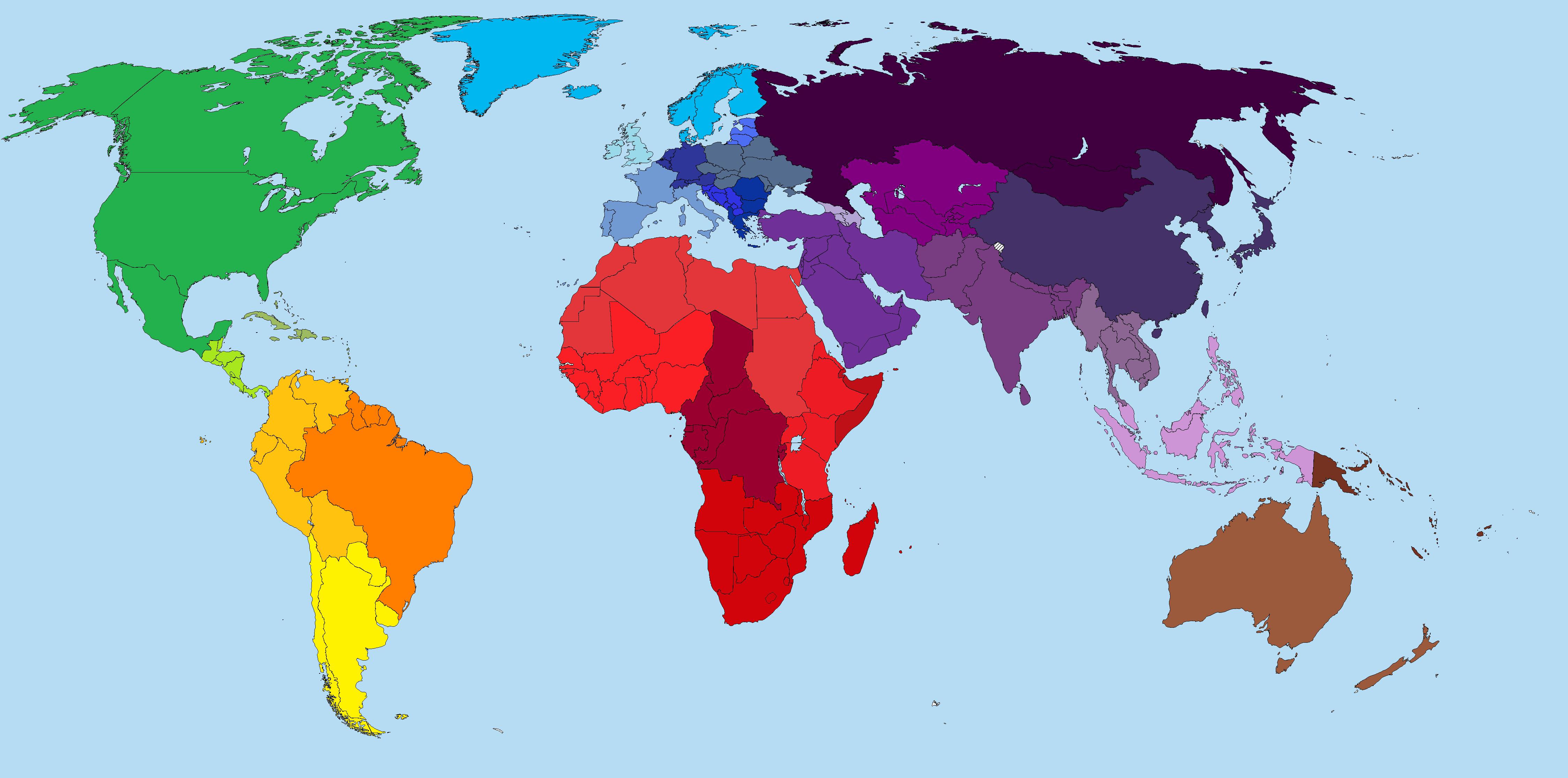
We then track the couple through Nairobi, during the fight for Kenyan independence in the late 1950’s, where Rasik goes into business with patriot David and buys him land, to London where the couple arrive in 1968, through the 1970’s, and daughter Sonal, and back to India, for the funeral of Joyti’s mother, where we meet niece Joy, and then finally Nairobi, in the present day. Along the way we see the India diaspora experience unfold, with exposition which generally doesn’t interrupt the flow, entwined with the personal journey of the couple. Home, emigration, immigration, post-colonialism, racism, gender roles, political activism, ageing, parenthood, the tyranny of everyday life, in fact just about everything that matters, is lightly ticked off along the way, but all is coherent.

The first part, (and the finale), in Kenya, is the most pointed in terms of political message, contrasting Kikuyu David’s support for violent Mau-Mau resistance with Rasik’s more pragmatic faith in a peaceful transition. This in turn contrasts with the personal politics of Jyoti who joins a union and campaigns to improve the conditions of British Asian working women in the 1970s. At the same time we see the racism that Rasik endures in his work and the strains that the struggle to get on put on their marriage. We see the next generation in the shape of Sonal looking to move up and on through education and travel encountering Jyoti’s motherly resistance.

This is though more a love story than history lesson and is all the more successful for it. In the final scenes, with the couple in their seventies, Rasik’s sight failing and mobility impaired, they look back and this, frankly, is where it really connected emotionally. I cannot claim to understand the journey of Jyoti and Rasik but I can certainly empathise with the prosaic intimacy of their relationship. For these final scenes Jyoti and Rasik are played by Nila Aalia and Selva Rasalingam, but you can still feel the essence of the characters shaped by the superb Anjana Vasan and Shubham Saraf in the earlier years. Jyoti may be headstrong but her inner strength shines through from the off. Rasik may be less certain, earnest in his youth, irascible in his old age, but they make an entirely believable couple. Writer Vinay Patel based his story on the life of his grandparents which is maybe just why.

Mr Patel’s expansive tale wears its learning pretty lightly. As with his previous work, notably his play True Brits and his TV drama Murdered By My Father, he shows that he has a way with story and character and can conjure up a lot of content from relatively straightforward starting points. An Adventure is more ambitious that his previous works, and maybe this time he has tried to pack a bit too much in to create his odyssey of marriage, but it is still a very entertaining and skilful attempt. I imagine he is a confident young man and I suspect he believes, as do I, that he will get even better from here. Madani Younis is, unsurprisingly, a completely sympathetic directorial presence; you get the feeling writer and director brought the best out of each other from the very start of the project. It will be very interesting to see what Mr Younis brings to the South Bank in his new role.

The cast, including a resolute Martins Imhangbe as David and impressive work from Aysha Kala as Sonal/Joy, is well matched to character, though, for me, Anjana Vasan stood out, as she did Life of Galileo at the Young Vic and Behind the Beautiful Forevers at the NT. Sally Ferguson’s lighting and Ed Clarke’s sound were able to navigate the intimate and expansive as the story demanded.

Six actors and seven characters, (well eight when you include younger daughter Roshni who literally phones in at the end), is not a lot to span this much history and geography. Then again the best way in drama to understand the big stuff is to see its repercussions at the human level. This is where Vinay Patel’s play works. He gets away with shoehorning in maybe just a bit too much of what he wantt to say because the characters are so real and the dialogue, with a few overly dreamy, symbolic interruptions, so apothegmatic. Above all there is that fearless enthusiasm for the power of drama that the best writers convey which makes this, for all its obvious faults, work.

Losing Venice at the Orange Tree Theatre review ***

L0064135 Map of Venice

Losing Venice

Orange Tree Theatre, 24th September 2018

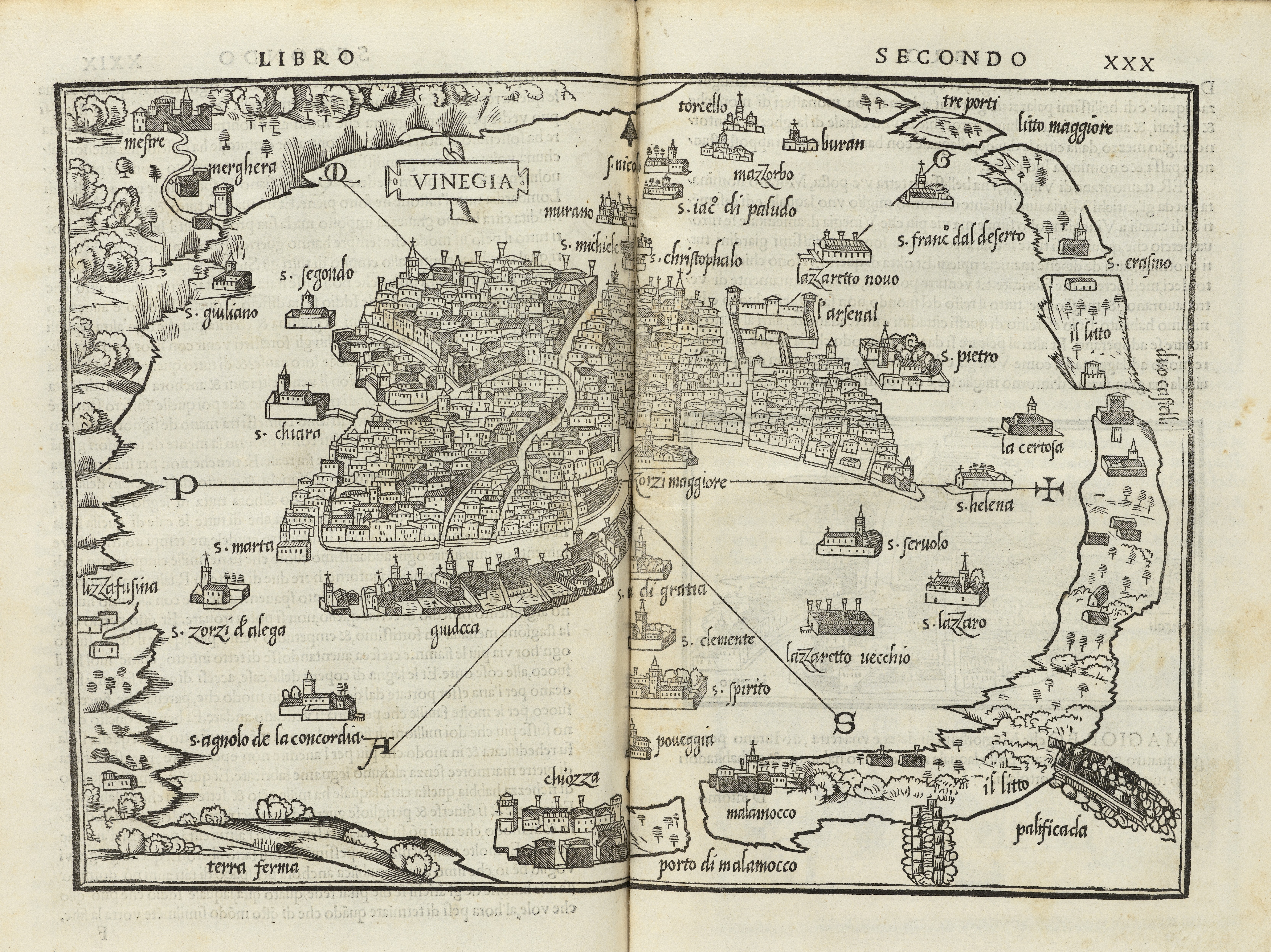
A modicum of research was all that was required to realise that this was going to be a curious, but also intriguing, entertainment. Which is near enough exactly what it was. Jo Clifford’s play was a hit at the Edinburgh fringe when it first appeared in 1985. With its story of a great Empire now in decline, and its scrutiny of strict gender roles in society, it is easy to see why the OT’s Paul Miller was drawn to revive it. The play certainly chimes with key contemporary debates on Brexit and toxic masculinity, and Jo Clifford’s own personal journey makes it more absorbing, but it is, structurally at least, something of an acquired taste.

Tim Delap plays the Pedro Tellez Geron (1574-1624) the third Duke of Osuna, a military adventurer, who, after becoming Viceroy of Sicily, and then of Naples, for Golden Age Spain, plotted to conquer Venice. The plot was uncovered and Osuna subsequently fell from favour after Philip III’s death in 1621. Jo Clifford’s play teams the Duke up with Francisco de Quevedo y Villegas, (played by Christopher Logan), a poet and secretary to Queen Ana in the Spanish Court of Felipe II. He put himself about a bit, generally ruffled feathers and was one of the prime exponents of a dramatic writing style at the time known as Conceptismo, characterised by rapid rhythm, directness, simple vocabulary, witty metaphors and word-play. It prized multiple meanings and conceptual intricacies, in stark contrast to the ornateness of rival style at the time of Culteranismo. Both were obsessed with honour, reputation and chastity building on the sort of flummery that had bedevilled the world of secular culture for centuries prior.

Now knowing this, and that Jo Clifford had previously translated some of the greats from Spanish Golden Age theatre such as Calderon de la Barca, and you can begin to understand the structure of Losing Venice. For this to is a story with multiple meanings which moves rapidly across space and time and appears quite stylised. Ms Clifford sought to take a current (in the 1980s) sensibility on politics and gender and fuse it with this ostensibly “true” history with a contemporary (for 1618) dramatic style. Designer Jess Curtis in this revival has highlighted this synthesis with her costumes which mix the Golden Age with a 1980s post-punk, New Romantic look.

The adventures of the strutting Duke and affected Quevodo draw in other parties, servants Pablo (Remus Brooks), Maria (Eleanor Fanyinka), the rejected and oddly coiffed Duchess (Florence Roberts, also a Priest), Secretary (Dan Wheeler who also provides some music), the grouchy King (David Verrey) and the prosaic “Mr and Mrs Doge” (David Verrey and Eleanor Fanyinka again). A key role is that of the Sister here played by Tia Bannon and not, unfortunately given the extra dimension this would have brought, the originally cast Josh-Susan Enright. Not that Ms Bannon didn’t try to fully commit, as did her colleagues, to the play. It is just that it is so striking in tone that I wasn’t entirely clear just how “inside” the characters Paul Miller wished them to be. The knowing, and sometimes farcical, tone, the sense that the performers, indeed the whole play, was “looking into” the events as a metaphor or lesson for something else, the decline of Empire and the desire of boys to always go fighting, didn’t completely take over, such that it could just be read as a rapid, and somewhat bitty, and increasingly odd, history play, (where I would guess most of the audience didn’t know the history).

Still once you adjusted to this idiosyncratic form there was stuff to savour and it didn’t drag on, even giving us an interval to ponder what was going on. The Duke doesn’t really do consequences, is locked in the past, sees everything as a contest and takes vanity to extremes. His fading libido is conjoined with that of his country. All in all a prize dickhead not unlike a few of our current crop of deluded politicians. Quevedo’s pen may be mightier than his sword but his fine words don’t necessarily resonate with his master and there are a whole heap of unbuttered parsnips here. The women and servants look on with various degrees of exasperation. Eleanor Mayinka stands out as the sympathetic Maria but maybe just because she is the most sincere character in the play.

So this might be a play whose novelty has played out, or it might be a play that was over-praised in the first place. Or maybe it is, as my Mum would have said, “too clever for its own good”. Or maybe it is a production where the normally very reliable Paul Miller couldn’t quite make up his mind. Or rather where he couldn’t quite pin down this slippery, and odd, fish. Or maybe, for once, the OT space was a hindrance not a help. I think it might be a little bit of all of these things but offsetting this is a spark of invention and bravado that I, for one, am always happy to see. Even if it didn’t quite come off, I can safely say I haven’t ever seen anything like it. And that it itself is no small praise. A counter to the excess of lazy literalism which pollutes the body politic is surely no bad thing.

Henry V at the Tobacco Factory Bristol review *****

geograph-2470375-by-Steve-Daniels

Henry V

Tobacco Factory Theatre, 22nd September 2018

Hello. I feel another bout of hyperbole coming on. It could just be that cumulative exposure is making me realise what the smarter punters and all the luvvies have known for hundreds of years, that nothing comes close to Shakespeare. It could be that my first visit to the Tobacco Factory has revealed a near perfect space, intimate but airy, in the round, with the right vibe of industrial chic, (and a good value curry in Thali next door). It could be that the Shakespeare at the Tobacco Factory company, under retiring founder Andrew Hilton, continues to churn out top quality productions of the Bard, and a few others, as it has done since its founding in 2000. Last year’s Othello set the ball rolling for me (Othello at Wilton’s Music Hall review ****) and I now intend to make a note in the diary for future pilgrimages to Bristol.

However I think the special ingredient in this particular production lies in the direction of Elizabeth Freestone. Ms Freestone is not afraid to offer up a contemporary slant on big Will, which usually works for me. Indeed she is the director behind Jeanie O’Hare’s composition of Queen Margaret at the Royal Exchange Manchester as we speak. Queen Margaret is one of Shakespeare’s best, no question, and I gather the magnificent jade Anouka is doing the business in the title role, though she will need to to get anywhere near the visceral walloping Sophie Okonedo gave the character in The Hollow Crown. (Can’t wait to see ms Okonedo as Cleo at the NT which the critics are loving).

What is patriotism? How to tread the line between the glorification and the senseless horror of war? What makes a “national hero” and how does this get weaved into a nation’s view of itself? How does Henry go from playboy Hal to warrior king? Is he just a cipher, whatever we want him to be? Sincere, scheming or both simultaneously? How to think about Katherine? Simpering pawn or power broker? A lot of good questions to ask at any time but especially when a bunch of utter cocks are playing dangerously fast and loose with our national identity. Once again Shakespeare shows he is the man for all ages when it comes to shedding light on the business of politics.

Lily Arnold’s blissfully simple set, four metal cages filled with stones, is put to work as battlefield and meeting hall, military and political space. A quartet of strip-lights, (recycled from Othello I’ll warrant), megaphone, radio and mic, suitcases and kit-bags, bottles of voddy, clip-boards, melancholic Union Jack and Tricolore. It’s all you really need. Less can so often be more in both the history plays and the tragedies. Go with the standard battle-dress/fatigues of so many modern-dress productions because it just works, but then add some twists to underscore the symbolism. A tutu dress for Mistress Quickly, a sharp suit for Cambridge and the King of France, a T shirt for King Henry, “the Artist formerly known as Prince” – I loved that – and turn Katherine into an imposing skinhead with elegant purple frock-coat suit and DM’s to match.

Cut out superfluous roles, in this interpretation, and double up (most intriguingly Chorus/Burgundy, Canterbury/King of France, Cambridge/Fluellen, York/Bourbon and Nym/Orleans). The armies are interchangeable after all. Lose a few of those pesky Dukes on both sides, Westmoreland, Exeter and York on the English side, with just Cambridge to face the traitorous music, and Bourbon and Orleans, and eventually Burgundy, on the French side. Make Exeter a skilled, female, negotiator. Slim down the English and French armies as well, and lose Queen Isabel and, in a real coup, merge the Dauphin into Katherine (and thus make her relationship with Orleans potentially very weird). And turn the Chorus into a detached, Bristolian, history lecturer.

Start off with a big party night choreographed to Boys Will Be Boys. Make Henry physically and metaphorically begin to stand tall as we move through the battles and make Katherine fight him and the English tooth and nail to the end. Don’t make too much fuss about those tennis balls. Let Henry whizz through the “breach speech”. Turn Katherine’s comedy English/French body part translation into a bitter and furious lament for lover Orleans which scares Henry (and us) witless. See Montjoy humiliated in defeat. Watch Henry only just keep it together after the brutal dispatch of Bardolph then wipe away the tears to receive the patronising French embassy. Ensure maximum ambivalence for our Harry as he wanders the camp for this is surely where the mantle of power is most keenly felt. Believe that Henry is probably bluffing when he threatens the citizens of Harfleur so belligerently.

The comedy relief of Pistol, Nym, Bardolph, Quickly and the Boy doesn’t fare quite as well in this production but their cannon fodder status, even as accident, certainly does. When Exeter reads out the list of the English dead at Agincourt the Boy is “none else of name” but we know his pointless sacrifice. A comparatively modest Harry, as here, makes Pistol’s over the top grandiosity less of a counterpoint. Fluellen is as annoying as ever though.

Now young Ben Hall has a bit of history here having played Henry V at the Guildhall when a student. He obviously has the genes for the theatre being the grandson of Sir Peter, nephew of Edward, (now moving on from Hampstead Theatre), and son of producer Christopher. You probably know him as the bespectacled tutor of Gerry and would be suitor of Margo in The Durrells off the telly, (a Hall family affair of sorts). He left an impression in the recent RSC Coriolanus but here he steps up and given a very interesting performance. Deliberatively tentative and awkward in parts, not entirely conversational but certainly not a master of oratory, with shaved head and red beard, he is believable as soldier if not, even in victory, as king. He spits out the lines too rapidly at the start but as Henry rises to the challenge so his speech becomes more measured, though never entirely, assured, as his disturbing “wooing” of Katharine at the end shows. He is not Olivier’s square-jawed hero, Branagh’s reborn statesman or Lester/Hytner’s war criminal hardman. Ben Hall’s Hal is constantly “wrestling with the moral responsibility of what it means to be a good leader” as Ms Freestone says in the programme. That crown certainly still lies uneasy on that head.

Offering us an androgynous Katherine who is near Henry’s equal in terms of destiny, passion, integrit,y as well as duplicity and xenophobia, with the same hair-cut to boot, is inspired. It is hard to take your eyes off Heledd Gywnn. She prowls the stage with an air of aggressive disdain, coming on all Joan of Arc like, (she popped up a decade, and one play, later). You just know that marriage isn’t going to solve anything at the end.

I was also drawn to the performances of Joanne Howarth as the patient Chorus who at one point is moved to tears, Alice Barclay’s largely composed Exeter, Luke Grant’s York/Bourbon, Zachary Powell’s Nym/Orleans, David Osmond’s verbose Fluellen and Melody Brown’s seasoned Gower. The re-gendering here doesn’t shout out. It just works.

Matthew Graham’s contrasting lighting design and Giles Thomas’s martial though still unobtrusive sound design all contributed to this thoughtful interpretation and experienced movement director Lucy Cullingford, even with this thinned out cast, was at the top of here game. There are some astonishing tableaux in this production, though nothing feels consciously artful. Elizabeth Freestone and Lily Arnold took visual inspiration from the battlefield art of WWI, (go see the Aftermath exhibition on now at Tate Britain for some of the most striking). I can see that and it also reminds us just how after this corner of Northern France has been the host of carnage. (Aftermath at Tate Britain review ****).

For me this is a near perfect production, considered, insightful, innovative and genuinely relevant. The company is drilled to perfection and battle hardy and it looks and moves beautifully. Like I say at the top, it could just be that nobody does it better than Will, but there are many ways to skin the ambiguity of this particular dramatic cat, and it still needs an inspired creative team and cast to bring the verse to life. STF is taking the production on tour so if you are lucky enough to be anywhere near these venues on these dates I implore you to get tickets.

9-13 Oct – Stephen Joseph Theatre Scarborough
16-20 Oct – Dukes Theatre, Lancaster
23-27 Oct – Malvern Theatres
30-3 Nov – Theatre Royal, Bury St Edmunds
6 -10 Nov – Exeter Northcott

Aristocrats at the Donmar Warehouse review ****

8799251458_84c30ef984_o

Aristocrats

Donmar Warehouse, 20th September 2018

Brian Friel, like his own dramatist hero Chekhov, can take a bit of time to get going. Faith Healer, at this theatre a couple of years ago, exerted a vice like grip on me from the open, though that may have been because it is such a brilliantly crafted and slippery multiple monologue, and thanks to the directorial magic of Lyndsey Turner (the director here as well), and the heavyweight thespian trio of Stephen Dillane, Gina McKee and Ron Cook. Translations, at the NT earlier in the year, is painted on an altogether broader and more thematic canvas, so required a little more cerebral investment (Translations at the National Theatre review ****). Aristocrats is closer to the Russian master, but once again we have a diversity of characters, all with, shall I say, the gift of the gab, so it takes some time for the pot to come to the boil.

But when it does Mr Friel certainly scales the dramatic and semiotic heights,as revelations tumble out, and we watch this sad, trapped family fade from view. The play is set in “the big house”, the Hall, in Friel’s fictional Donegal settlement of Ballybeg. These (largely) Georgian country mansions were found throughout Ireland apparently, but were largely the domain of the Anglo-Irish Protestant families exported by us British to b*gger up Ireland through the centuries, and gifted their land by the Penal Laws from 1695. in Aristocrats the family though is, unusually, Catholic. Not quite Brideshead but cut from similar cloth.

The play is set in the 1970’s and the only income the O’Donnell family now derives from the land is through sales. For three generation the law has been their prime source of income with the largely unseen, and terminally ill, Father (James Laurenson) having been a District Justice. The only son, effete fantasist Kasimir (David Dawson), has failed as a solicitor and now, implausibly, works in a sausage factory in Hamburg with wife Helga and three kids. This leaves long suffering oldest daughter Judith (Eileen Walsh) to look after Dad and shoulder the burden of the decaying house and estate, with substantial help from local fixer Willie Diver (David Ganly). London based daughter Alice (Elaine Cassidy), mired in drink, is unhappily married to Eamon (Emmet Kirwan), the son of an ex-housekeeper, who fully grasps the family’s, and his own, plight. Youngest daughter Claire (Aisling Loftus) is recently engaged and the reason why the family has come together, though clearly vulnerable in her diagnosed depression.

The family is completed by the taciturn Uncle George (Ciaran McIntyre) who has lived in the house since the year dot, and, for the weekend that they all initially come together, an American academic Tom Hoffnung (Paul Higgins), who is researching the history of these very families and houses. The family celebration, predictably, evolves into a bout of ugly soul-searching and thwarted ambition.

This is a family isolated by geography, class, religion and history. Long resented by, and now largely irrelevant to,  the local “peasantry”, ignored by their Protestant peers, wealth dissipated through long economic decline, waiting for the patriarch to die so they can be set free. Dysfunctional, motherless, fearful families are meat and drink in the Irish dramatic tradition, indeed BF himself took this (and the O’Donnell surname) as the starting point for his breakthrough Ballybeg play Philadelphia Here I Come! Both feature three sisters, (well four here as it momentously turns out), and one brother, just like Anton, indeed Aristocrats might be best viewed as a bit too reverential a mash up of Three Sisters and The Cherry Orchard. This is, at heart, a story of a family who haven’t really come to grips with the reality of what they have become, just like Chekhov’s families. The past, in BF’s world, is constructed through the language of the present, “false” memories abound.

Indeed this is a little big a part of the problem with Aristocrats. BF’s evident enjoyment in building layer upon layer of character development and in analysing this particular social, cultural and economic milieu does make the first couple of acts just that teensy big tardy. The set of Es Devlin is the non-naturalistic, bluish sunken box, and carefully arranged objects, including a dolls house to signify Ballybeg Hall, that we have come to expect from her which doesn’t offer any visual distraction, adding further distance. When not involved the cast sits at the back, killing time. Uncle George is largely employed to peel away the covering on the back wall to reveal an idyllic C18 arcadian scene, the history of the house in reverse. This play is, after all, one long goodbye.

Fortunately we are treated to some vibrant performances and it is this that brings BF’s melancholic language to life. I expect it didn’t take long for David Dawson to be cast in the role of the “peculiar” Kasimir. Now nervous Kasimir clearly has a bunch of issues, probably caused by Mummy (a suicide) and Daddy. His elaborate invention of a family in Germany, presumably to mask his own sexuality, his apparent inventions about the distinguished literary and musical figures, most improbably Yeats, who visited the house in the past, his belief in Mother’s piano playing ability. Yet there is a kind of child-like desire to be liked which elicits sympathy. it would be pretty easy to under- or over- play Kasimir but Mr Dawson avoids both temptations.

Elaine Cassidy’s Alice is a more recognisably damaged character, purposeless, and here visibly lost to alcohol, with occasional painful glimpses of self-awareness. Eileen Walsh is persuasive when Judith finally gets to free herself from the house and its routine, and the ambiguity of her relationship wth David Ganly’s Willy (as it were), is neatly conveyed. After all his regard for Claire surely explains why he keeps helping, or maybe there is some residual duty and/or pity.

If the family cannot see the truth then it is left to the outsiders to supply it and Emmet Kirwan shows us Eamon’s duality as part of of, but not born into, the family, and the one who may perversely be most attached to the house. Paul Higgins can’t really convince us as to the reasons why Tom is there, he really is a device for BF to “look into” the play and prompt context, but it isn’t too intrusive.

There are some plays that work better after you have seem them. Aristocrats may be one of them for me. Not as perfectly constructed as Faith Healer, as pointed as Philadelphia Here I Come! or as densely clever as Translations, it takes time to break free from its artifice (which this production does nothing to allay). Yet, and in contrast to received critical wisdom, I have a feeling that the impressions left by the characters and the play may linger as long, if not longer, than these masterpieces. Funny things, memories.