BBC Symphony Orchestra and Vilde Frang at the Barbican Hall review ****

vilde_frang_wikipedia

BBC Symphony Orchestra, Sakari Oramo, Vilde Frang (violin)

Barbican Hall, 21st March 2018

  • Anna Clyne – This Midnight Hour
  • Benjamin Britten – Violin Concerto, Op 15
  • Ludwig van Beethoven – Symphony No 6 in F major “Pastoral”, Op 68

The Violin Concerto is one of those Britten pieces that takes a bit of time to get used to. It was written in 1939 so contains plenty of the youthful flashiness, and debts to Stravinsky, which characterise early BB, but with a more serious intent which reflects his admiration for Alban Berg, whose own Violin Concerto, was the last in a frustratingly thin oeuvre. BB attended the posthumous premiere of Berg’s masterpiece in 1936, in Barcelona in the shadow of the forthcoming Spanish Civil War, as well as two further performances later in the year. Understandably he was mightily impressed.

BB’s own concerto was premiered in New York in March 1940 by the Philharmonic under John Barbirolli, given that he and Peter Pears were stuck there following the outbreak of war. The British premiere was in April 1941 in BB’s absence. Despite BB’s revisions in 1950, 1954 and 1965, which brings a little more of the late Britten’s soundworld to the violin part, the piece has historically been more admired than loved, but it has developed a bit more of a following in recent years.

Which means that some of today’s finest violinists have taken up the BB VC cause. These include Janine Jansen who played the piece with the LSO last year under Semyon Bychkov in this hall last year. This is not a concerto full of showy virtuosity, the soloist works on the ideas with the orchestra, but it does require a formidable technique. Ms Jansen certainly has that but the performance overall was a bit more athletic and weighty than I might have liked (though maybe that was the influence of the Mahler on the bill).

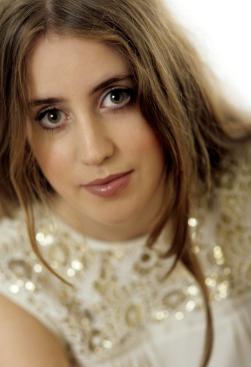
In contrast Vilde Frang, who has also recently recorded the piece, seemed a little bit more delicate, most obviously in the pianissimo sections, and the double stopping, of which there is a surfeit in the Scherzo, more Baroqueish than Modernist. This lighter, though still enthralling touch, made the final coda, constructed in BB’s favourite Passacaglia form, even more irresolute. a good thing in my book. The first movement, in sonata form, opens with a little rumble on the timps, then the bassoon takes up the tune, and then the rest of the orchestra, returning to it ostinato through the movement, whilst the violin moves in and out with its uneasy, song-like lament. The second theme is also martial in intent; there is a link to Shostakovich, but with more elegance and less hectoring. This theme is taken up by the violin, not the orchestra, in the recapitulation which ends with an unsteady coda. The second movement scherzo is spiky and Prokofievian in feel, with a very sinister transition to a tutti before ending with a cadenza, based on the first movement tunes, in which Ms Frang excelled. The ground bass which underpins the variations in the final movement is a bit wobbly in terms of tone, at one point D major triumphs, ending with a simple chant, over which the violin dances around, never quite closing out.

I think it is the uncertain tone, literally and metaphorically, that makes the BB VC seem like harder work than it actually is. Played like this though it is up there with the very best of BB’s works which require a full orchestra, the contemporary Sinfonia da Requiem and the War Requiem. It is a lot less knotty that the Cello Symphony that’s for sure. Having said that BB’s textures always work better for me in the pieces for smaller orchestras. I went back to the benchmark recording I have, the ECO under BB himself with Mark Lubotsky as soloist. Maybe I was just in a good mood at the concert but I reckon Ms Frang and Sakari Oramo gave them a pretty good run for their money, especially in the opening movement, which seemed to get to the point more quickly.

The BB VC was preceded by the London premiere of a 12 minute work written by Anna Clynne, British born now working in NYC. It was written for the Orchestre National d’Ille de France where she was resident composer. It is resolutely tonal and packs a hell of a punch. It is pretty sexy stuff too, as was her intention, based, as it is, on Baudelaire’s poe Harmonie du soir and one line from a poem by a chap called Jimenez about a nude lady running through the night. She packs a lot into the piece, kicking off with a rushing theme low down in the bass and cellos, moving to some sparkling woodwind, a slab of Brucknerian grandeur and then a Ravel like sharp waltz, before the whole thing seems to whirr around again. Apparently Ms Clyne notates her score with mood markings, intimate, melting, ominous, feverish, ferocious, aggressive, skittish, beautiful, eerie, which is easily comprehended. I have got much better at taking in contemporary compositions at the first, (and often only), outing, but this piece doesn’t require too much concentration, so immediate is its impact. Seems like the audience agreed judging by the reaction and deserved applause when Ms Clyne came out of the audience.

Which meant that, unusually, Beethoven took the back seat. Absolutely nothing wrong with Mr Oramo and the BBCSO’s take on the Pastoral but there wasn’t too much to get the pulse racing. The detail was there but the pacing was relaxed and the orchestra didn’t seem as engaged as when they are getting their teeth into unfamiliar repertoire or having to convince the big crowds at the Proms. Brooks babbled, birds sand, peasants partied, lambs gambolled, the storm came and went, but Mr Oramo didn’t seem to find the genuinely symphonic in the way others have. Still it’s Beethoven so pipe down Tourist and be happy with your lot.


My favourite classical concerts of 2017

623x512xrattle625_2-pagespeed-ic_-clbnppbu_4_0

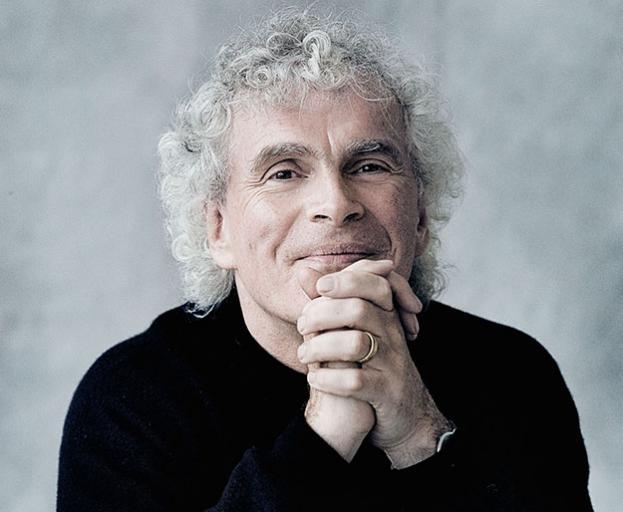
Right I know it is a bit late in the day but I wanted to make a list of the concerts I enjoyed most from last year. So everything that got a 5* review based on my entirely subjective criteria is ordered below. Top is Sir Simon and the LSO with their Stravinsky ballets. Like it was going to be anything else.

Anyway no preamble. No waffle. Barely any punctuation. Part record, part boast. Comments welcome.

  • LSO, Simon Rattle – Stravinsky, The Firebird (original ballet), Petrushka (1947 version), The Rite of Spring – Barbican Hall – 24th September
  • Colin Currie Group, Synergy Vocals – Reich Tehillim, Drumming – Royal Festival Hall – 5th May
  • Isabelle Faust, Akademie fur Alte Musik Berlin, Bernhard Forck – JS Bach Suite No 2 in A Minor BWV 1067a, Violin Concerto in E Major BWV 1042, Violin Concerto in A Minor BWV 1041, Concerto for Two Violins in D Minor BWV 1043, CPE Bach String Symphony in B Minor W 182/5 – Wigmore Hall – 29th June
  • Jack Quartet – Iannis Xenakis, Ergma for string quartet, Embellie for solo viola, Mikka ‘S’ for solo violin, Kottos for solo cello, Hunem-Iduhey for violin and cello, ST/4 –1, 080262 for string quartet – Wigmore Hall – 25th February
  • Britten Sinfonia, Thomas Ades – Gerald Barry Chevaux de Frise, Beethoven Symphony No 3 in E Flat Major Eroica – Barbican Hall – 6th June 2017
  • Nederlands Kamerkoor,Peter Dijkstra – Sacred and Profane – Britten Hymn to St Cecilia, Gabriel Jackson Ave Regina caelorum, Berio Cries of London, Lars Johan Werle Orpheus, Canzone 126 di Francesca Petraraca, Britten Sacred and Profane – Cadogan Hall – 8th March
  • Tim Gill cello, Fali Pavri piano, Sound Intermedia – Webern 3 kleine Stücke, Op. 11, Messiaen ‘Louange à l’Éternite du Jesus Christ’ (‘Praise to the eternity of Jesus’) from Quartet for the End of Time, Henze Serenade for solo cello, Arvo Pärt Fratres, Xenakis Kottos for solo cello, Jonathan Harvey Ricercare una melodia for solo cello and electronics, Thomas Ades ‘L’eaux’ from Lieux retrouvés, Anna Clyne Paint Box for cello and tape, Harrison Birtwistle Wie Eine Fuga from Bogenstrich – Kings Place – 6th May
  • Britten Sinfonia, Thomas Ades, Mark Stone – Gerald Barry Beethoven, Beethoven Symphonies Nos 1 and 2 – Barbican Hall – 2nd June
  • Academy of Ancient Music, Robert Howarth – Monteverdi Vespers 1610 – Barbican Hall – 23rd June
  • Academy of St Martin-in-the-Fields, Murray Perahia – Beethoven Coriolan Overture, Piano Concertos No 2 in B flat major and No 4 in G major – Barbican – 20th February
  • London Sinfonietta and students, Lucy Shaufer, Kings Place Choir – Luciano Berio, Lepi Yuro, E si fussi pisci, Duetti: Aldo, Naturale, Duetti: Various, Divertimento, Chamber Music, Sequenza II harp, Autre fois, Lied clarinet, Air, Berceuse for Gyorgy Kurtag, Sequenza I flute, Musica Leggera, O King – Kings Place – 4th November
  • Maurizio Pollini – Schoenberg 3 Pieces for piano, Op.11, 6 Little pieces for piano, Op.19, Beethoven, Piano Sonata in C minor, Op.13 (Pathétique), Piano Sonata in F sharp, Op.78 (à Thérèse), Piano Sonata in F minor, Op.57 (Appassionata) – RFH – 14th March
  • Britten Sinfonia, Thomas Ades, Gerald Barry – Beethoven Septet Op 20, Piano Trio Op 70/2. Gerald Barry Five Chorales from the Intelligence Park – Milton Court Concert Hall – 30th May
  • Bavarian Radio Symphony Orchestra, Mariss Jansons, Yefim Bronfman – Beethoven Piano Concerto No 4, Prokofiev Symphony No 5 – Barbican Hall – 24th November
  • Britten Sinfonia, Helen Grime – Purcell Fantasia upon one note, Oliver Knussen, George Benjamin, Colin Matthew, A Purcell Garland, Helen Grime Into the Faded Air, A Cold Spring, Knussen Cantata, Ades Court Studies from The Tempest, Britten Sinfonietta, Stravinsky Dumbarton Oaks – Milton Court Hall – 20th September


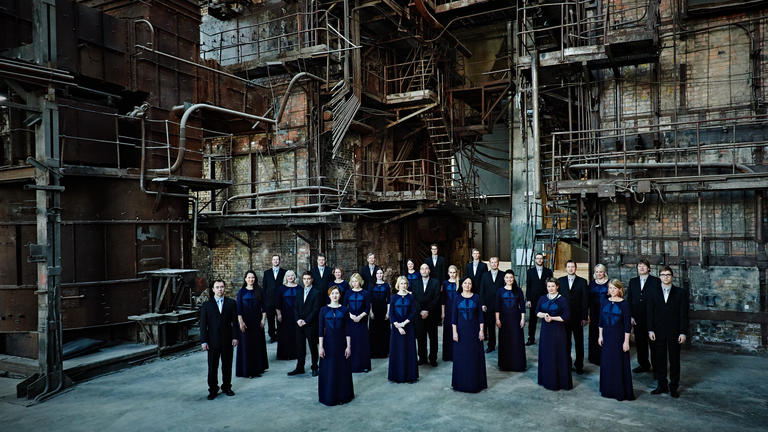
Estonian Philharmonic Chamber Choir at Milton Court review ****

estonian20chamber20choir2028c2920kaupo20kikkas

Estonian Philharmonic Chamber Choir, Kaspars Putnins (conductor)

Milton Court Concert Hall, 30th January 2018

Arvo Part

  • Solfeggio
  • Summa
  • Magnificat
  • Zwei Beter
  • The Woman With the Alabaster Box
  • Nunc dimittis
  • Dopo la vittoria

Cyrillus Kreek

  • Onnis on inimene (Blessed is the Man)
  • Psalm 104

Jonathan Harvey

  • Plainsongs for Peace and Light
  • The Angels

Veljo Tormis

  • Kutse jaanitulele from Jaanilaulud (St John’s Day Songs for Midsummer Eve)
  • Raua needmine (Curse Upon Iron)

Now I gather that the Estonian people like a sing-song. Choirs are a big deal there and choral singing and national identity are tightly bound together. They even had a Singing Revolution between 1987 and 1991 as they sought independence from the Soviet Union. So this evening was an event and was graced with the presence of no less than Estonia’s Prime Minister Juri Ratas.

Now I am not going to pretend this was the main draw for me. Profound apologies Your Excellency, but what intrigued me was the opportunity to here some of the choral works of the mighty Arvo Part sung by his country men and women. Albeit mostly in Latin, with a German, English and Italian text thrown in for good measure. Now I genuinely believe that the magic of Part’s “holy minimalist” tintinnabuli can work on anyone. I believe I am right in saying he is the most performed living “classical” composer. That doesn’t mean people are whistling Speigel am Speigel on every street corner though. This is still a minority pastime, but I do think there is something in his music, (and the spaces between the notes), which can burrow into the soul of all who come across it. Not that they have souls. That is obviously mumbo-jumbo. Old Arvo might sign up to Orthodox Christianity but not me. But it does something. Even if it is just to clear the head and leave you suspended in the sound for the duration of the piece.

So it was a pleasure to rope in MSBD to the Part party. Now, in retrospect, it might have been better to break him in gently with the usual programmatic device of interspersing Part’s choral works with other contemporary composers who relish the challenge of a choir as well as selected Renaissance masters. Even I have to admit that seven of Part’s choral works back to back can induce a slowing of the heart rate that is difficult to distinguish from slumber.

The opener Solfeggio is particularly interesting. It was originally written in 1964, though I think refined in 1993, which means it actually came before Part announced himself to the world with the bang. crash, wallop of Credo for chorus, orchestra and piano in 1968. This remember was when Part was a paid-up serialist, although Credo for my money is still a cracking piece of music. Solfeggio asks the choir to trot out an ascending C major row in strict serial fashion, singing, would you believe, “do re mi … “, but you’d be hard pressed to tell it apart from the “classic” Part style which emerged in 1977 after the several year hiatus and his personal enlightenment.

Summa is a setting of the Credo from the Latin Mass, though its title conceals its origin,  composed in the pivotal year of 1977. It was, along with Part’s settings of the Magnificat (1989) and Nunc dimitis (2001) for the Anglican evensong, the most entrancing of the evening’s performances. The Estonian Philharmonic Chamber Choir has a bewitching and very exact delivery with clear definition across the parts. This means the intriguing shifts that Part employs here, and the shimmering climaxes, especially in the Nunc, seemed more suited to their style. In contrast the more direct The Woman with the Alabaster Box from 1997, sung in English and which sees adjacent thirds appear under long sustained notes, was less thrilling to me than the Latin texts, which are all based on Part’s “classic” stepwise triads.

Zwei Beter, based on the parable of the Pharisee and the Publican I gather, is a more complex beast, (it’s all relative mind you), with denser harmonies and sung in German. Now one way or another I have recordings of most of Part’s works, (I think some remain unrecorded), but I didn’t know this piece at all. In contrast I am familiar with Dopo la vittoria from 1996 which is also somewhat more “complex” than the Latin texts. Sung in Italian this “piccolo cantata” tells the story of the baptism of Augustine by St Ambrose, (who apparently broke into song whilst doing the necessary), the patron saint of Milan for which city it was written. There is a discernible story with defined sections, including a brisk opening and ending, and some pronounced homophony at crucial, uplifting points. Who said Part all sounds the same.

After the interval we were treated to a pair of psalm settings by Cyrillus Kreek, an Estonian composer from the generation prior to Part, and a man who devoted his life to setting the country’s rich legacy of folk songs into choral arrangements. These songs stem from the wave of Estonian nationalism that stirred in the second half of the C19. These two pieces were very easy on the ear and sung with real conviction by the choir. A pair of works by British composer Jonathan Harvey followed, from the end of his career. Harvey regularly turned to choirs alongside his electronic and chamber pieces. The Angels was set by the Bishop of Winchester to which Harvey adds a hummed accompaniment. Plainsongs is more substantial polyphony with some beautiful, gently dissonant passages across its sixteen parts.

Finally the EPCC treated the audience to two works from Veljo Tormis, who passed away last year, after actually retiring in 2000. Slightly older than Part, but possibly even more renowned in his homeland, with a huge body of choral work to his name. Most of the settings stem from Estonian folk songs and I gather it is fair to say he has inspired multiple generations with his music. He was born during Estonia’s short lived inter-war period of independence, lived through the German and Soviet annexations and the Socialist Republic, and through to independence again. He mixed with all the big names during his musical education in Russia and was “honoured” with his own KGB files.

The first piece belongs to a cycle which describes the important Midsummer celebrations. It starts simply enough but builds into something more sophisticated. The Germanic influence is clear. But this was just a taster for the extraordinary Curse of Iron which followed. Apparently this gets a fair few airings outside Estonia and it isn’t difficult to see why. To the rhythm of a simple drum beat throughout, and with solo bass and tenor parts, Mr Tormis sets a story based on a Finnish epic, but sung in Estonian. It is, like it says, a curse on iron, as you do, and it is very dramatic. A ritual with repeated ostinatos, I have never heard anything like it. Neither had MSBD. Imagine a kind of shamanistic chant which ends up with sopranos warning against nuclear proliferation. Can’t. Well go and hear it then. It’s on I-Player since the concert was recorded for Radio 3.

Estonian Philharmonic Chamber Choir concert recording

A riveting way to end the concert and unsurprisingly the EPCC, and especially their Latvian conductor Kaspars Putnins, were having a ball during it. If I were part of the Estonian guest party I would have found it pretty difficult not to get up and join in. Pride in their country but pride in Europe too methinks. Great stuff.

Britten Sinfonia at Wigmore Hall review *****

jackie-shave-900x900

Britten Sinfonia

Wigmore Hall, 24th January 2018

  • Heinrich Biber – Mystery Sonata No 1 “The Annunciation”
  • Philip Glass – Orbit
  • Leo Chadburn – Five Loops for the Bathyscaphe
  • Arvo Part – Spiegel am Spiegel
  • WA Mozart – Piano Trio No 3 K502

There is something of the spirit of punk about the Britten Sinfonia. They don’t have a principal conductor or director and play with pretty much who they like. They also play pretty much what they like with a refreshingly cavalier attitude to programming. I love them, whether it be a Bach St John Passion, electrifying accounts of the Beethoven symphonies under Thomas Ades, minimalist classics, Stravinsky, Ravel or contemporary British composers, all of which I have heard them perform in the last year or so.

So I was looking forward to this. Leo Chadburn’s new work Five Loops for Bathyscaphe, is scored for piano trio and electronics and runs for 10 minutes or so. So Jacqueline Shave (that’s her above), one of the violin leaders of the BS, Caroline Dearnley, the principal cello, and Huw Watkins, principal piano, had another 50 minutes or so to fill. What to choose? Mozart? Why not. After all his B flat minor trio is pretty much the first piano trio as we know the form, with all three instruments contributing rather than just a piano sonata with a bit of string diddling attached which previously defined the Classical form. And Arvo Part’s Speigel am Speigel? Yep, it’s a slam-dunk crowd-pleaser for violin and piano. But chucking in Philip Glass’s short piece, Orbit, for solo cello. And the first of Biber’s Mystery sonatas? Well as it turned out it all slotted together perfectly.

Now I have been unlucky in my endeavours to hear a performance of Biber’s Mystery, (or Rosary), sonatas for violin and continuo live. There are 15 of these chaps, divided into 3 cycles, Joyful, Sorrowful and Glorious, plus a closing Passacaglia for solo violin. Each one takes as its subject one of the Catholic “rosary”episodes in the life of the Virgin Mary. They were likely written in 1676 but were unknown until 1905 ,and they are one of the earliest and best known examples of “scordatura”, where the violin is tuned in a way that is not standard. This permits all sorts of funky effects. Don’t test me on this but it is pretty straightforward even for a dumbass like me to hear the differences. One of the Vivaldi Op 9 Le Cetra concertos does this, Stravinsky does it at the start of the Firebird and Ligeti’s Violin Concerto is a prime example. Mind you Ligeti chucks so many effects into his concerto I am hard pressed to know where it is.

Biber tests the skill of the violinist to the max so it is a unlikely anyone was up to the job in the C17. What is on the page doesn’t correspond to what hits the ear. Don’t worry it doesn’t get too weird but it does create sounds, chords and harmonies with real drama. Now unfortunately we only got the first instalment here, which is the one which doesn’t arse about with the tuning, but it was still a blinder to open the concert with and Ms Shave delivered. It opens with a virtuoso figuration, being the Angel appearing before  our Mary, and them moves into a gentler sort of theme and variations.

The Glass “sonata” was new to me. The programme notes suggest Glass is referencing Bach’s mighty cello suites. He is. But then again anyone that writes a piece for solo cello is working in the shadow of the master. Even so lots of fancy figuration and double stopping does conjure up Bach’s counterpoint and Glass’s ordered repetitions are redolent of JSB’s own structures. Ms Dearnley is at home here as she is in the Baroque.

Now I have listened to, and seen performed, Part’s Speigel am Speigel, more times than I care to remember. It is one of my favourite pieces of music period. Which probably shows how easily pleased I am. This was one of his first “tintinnabuli” works, along with Fur Alina, from 1978, and it is “minimal” even by his standards. Simple arpeggios in piano and rising, then falling, scales from violin. If you are ever too worked up about anything just pop this on. Hey presto, blood pressure plummets. Now Ms Shave and Mr Watkins seemed to take this at a marginally faster tempo than I am used to, (it is all relative as not much happens), and took a minute of two to get in the groove, but once there it was as good a performance as you will hear.

I tried with the Mozart. Honestly. If I switch off and let it drift around and through me then it is pleasant enough but I still don’t really get it. Just too nice. Obviously there are bits of Mozart, and times when I listen to it, like watching a great Figaro, where it lifts me up and takes me away, but this wasn’t one of them.

Which brings me to the Leo Chadburn premiere, co-commissioned by the BS and Wigmore. I knew nothing about Mr Chadburn but I gather he is one of these new brand of musician/composer who doesn’t give a fig for established boundaries. He writes and performs across genres, releasing three synthpop albums a few years ago as alter ego Simon Bookish, and remixing for the likes of Grizzly Bear. He can certainly sing a bit I gather. This piece takes the classic piano trio instrumentation and hooks in pre-recorded voices from himself and Gemma Sanders, and some sparse electronica. It graphically describes the journey on 23rd January 1963 of oceanographers Jacques Piccard and Don Walsh to the bottom of the ocean. Eleven kms down to be exact in the Mariana trench, in that little ball Bathyscaphe Trieste thing. The idea of the piece is to create a sense of motionlessness in the music, deep and watery I guess, and allow the voices and words to tell the story. It succeeds admirably. There is nothing to scare anyone off in this simple but very effective sound-world. Think eerie harmonics from the strings and muffled chords from both ends of the range for the piano, as well as some theatrical plucking from inside the piano. The whole thing grips from first to last. It deserves a much wider audience. I am sure Mr Chadburn knows how to make that happen.

This whole concert was a joy. Music for everyone. Even if they know absolutely f*ck all about any of it. Still I suppose if they all prefer listening to a little ginger chap who has the temerity to suggest he is the next Van Morrison, then who am I to argue. Just seems a shame. Still that’s your pesky, high/low culture divide in late neo-liberal, capitalist society for you.

Colin Currie Group at Kings Place review ****

colin-currie-group_3_credit-chris-_web-billboard-2000x1125

Colin Currie Group

Kings Place, 20th January 2018

Steve Reich

  • Music for Pieces of Wood
  • New York Counterpoint
  • Mallet Quartet
  • Drumming Part 1
  • Vermont Counterpoint
  • Quartet (2013)

So off to Kings Place for another immersion into the sound world of Steve Reich guided by his finest living advocates (probably), the Colin Currie Group. Having seen the CC Group perform Reich a couple of times in the past couple of years, (at the RFH), I consider myself something of a groupie. I was honoured this time to be accompanied by not one, but two, potential converts to the live, minimalist music cause in the shape of MSBD and MSBDB. And, to emphasise, you really do need to hear this live for the full effect.

I won’t bore you with another hagiography extolling the virtues of Mr Reich. Take a look here if you want that (Steve Reich’s Drumming and Tehillim at the Royal Festival Hall review *****). Suffice to say I urge anyone to give his music a whirl and see what you think. I won’t hold it against you if all that repetition sends you to sleep. Me, I am fascinated by it. Out of apparent rhythmic simplicity emerges music of shimmering and unsettling intensity.

On the subject of repetition in music I promised myself I would not use this blog to eulogise the now departed Mark E Smith. Let’s just say RIP. Hands down the most important creative force in my lifetime.

Anyway this gig kicked off with Music for Pieces of Wood written in 1973. Which is exactly that. Though these are not any old offcuts having been specially selected for their pitches, A, B, C, sharp D sharp and another D sharp an octave higher, and timbre. It is built entirely on patterns of beats and rests over three lengths 6/4, 4/4 then 3/4. That’s it. As so often with Mr Reich the apparent simplicity though belies its careful planning and the subtlety of outcome. There is no place to hide for the players here.

New York Counterpoint from 1985 sees a clarinettist, here Timothy Lines, pre-record ten different parts, including for bass clarinet, which is prominent in the last movement, against which he plays a final, eleventh line, live. Vermont Counterpoint from 1982, here performed by flautist Rowland Sutherland, employs a similar, though to my ear more complex, technique for flute, alto flute and piccolo, across 10 pre-recorded parts and one solo line using each instrument. In both cases, despite the discipline employed in terms of relationships of rhythm, tempo and meter, the effect is of often “melodic” and ambiguous counterpoint, with more than a whiff of Stravinsky’s neo-classical chamber works. Maybe at times in both pieces the solo line could have been brought forward a little “in the mix” but I was persuaded.

Mallet Quartet is a more recent piece from 2009 scored for two vibraphones and two five octave marimbas extending down to cello C apparently. Once again three movements, fast/slow/fast, with some fancy changes of mallets. The marimbas create the rhythmic backdrop linked by a canon structure in the fast movements, with the vibraphones providing the melodies, again largely in canon. In the slow movement it all gets pared back however, and the effect from the vibraphones is of a far more atonal world which I am not sure would be to everyone’s taste and is a fair way from “typical” Reich.

Back on track though with the iconic Drumming, or at least the first of the four movements. This is divided into four clear parts and is for four pairs of tuned bongos. (This makes me think once again of MES with his quip that The Fall was him and your granny on bongoes. Now if your granny could only play bongoes like this ……). Anyway this is quintessential Reich, building from one beat to twelve beats, alternated with rests, and then with the rests replaced with beats until the cycle is completed, and then reversed. This pattern is repeated in the other three movements with the different instruments, and it was a shame not to hear this (see review above), especially the spellbinding third movement with glockenspiels (and whistling !) and the thrilling final movement, where the whole lot gets chucked in. There is so much in the sound created that is it is impossible to believe the structure is so simple. This is Reich at his most hypnotic, made more so in this performance by the strobic effect of the movement of the sticks in the “fastest” passages. MSBD loved it so much he nodded off apparently – trust me that is a compliment. When Reich, (and other minimalist music), succeeds your mind and body can “drain away” leaving just the rhythm. Far out. Sorry for this hippy gibberish but it’s true.

Which brings me to Quartet from 2013. This piece, scored for two pianos and two percussion, which is the building block for many of Reich;s earlier works, shows what he is now up to. This is melodically much more complex than the previous works on show, with multiple key changes, breaks and pauses, frequent gentle dissonance, and shifts into new ideas. In fact more like most contemporary classical music. Fast/slow/fast once again, but the slow movement contains harmonic variety which you won’t find elsewhere in Reich’s compositions, though once or twice it veers towards doodling. Don’t worry, there is still rhythm at the core but this takes the players up a further notch in terms of level of concentration. Which is why is was written for, and dedicated to, this ensemble. I was much taken with it and will need to add it to the list of recordings of Reich’s music I need to lay my hands on. (I see there is one about to be released, And CCG are releasing their own recording of Drumming which will surely be a treat).

Loved it and so did the audience. Kings Place acoustic is terrific, warm and offering up waves of sound, so I doubt I will hear a better treatment of these works.

Next up CCG will play Reich;s Tehillim, based on psalms and reflecting his Jewish heritage, and which uses voices and wide instrumentation to drive melodic invention. Still Reich but this is more minimalism meets Baroque. Annoyingly the BBCSO also takes on Berio’s Sinfonia in this concert but I will be pandering to my new found fascination with Ligeti at the South Bank. Seems like the Barbican and the South Bank are going head to head in competition for the geeks.


Peter Wispelwey (cellist) at Kings Place review ****

42545-pieter-wispelwey-2-c-frits-de-beer-bt

Peter Wispelwey, cello

Cello Unwrapped: Bach Through Time Concert III. Kings Place Hall 1, 8th December 2017

  • JS Bach – Cello Suite No 1 in G, BWV 1007
  • Benjamin Britten – Cello Suite No 3, Op 87
  • Gyorgy Ligeti – Sonata for solo cello
  • JS Bach – Cello Suite No 3 in C, BWV 1009

If I had to pick my favourite venue in London for classical music it would probably be King’s Place. The design is lovely. The acoustic is perfect, especially upstairs. The welcome is warm. (I lost a book there once. They found the book and then they found me). The programming is interesting. In particular the year long seasons which artfully pull together chamber music across a genre or theme. This year, Cello Unwrapped; in the last couple of years, the Baroque and Minimalism. Next year, Time Unwrapped, a more ambitious conceit which is chock full of interesting programmes. To be fair it has helped that the last three years have focussed on particular favourites of mine in terms of period and instrument but, even so, I heartily recommend Kings Place to anyone who isn’t already a regular. Bear in mind too that I am only really a consumer of the classical events: there is plenty of other stuff, music, comedy, spoken word, going on there as well. Finally they make a decent cup of tea in the caff upstairs, the loos are spotless, and there is usually some free art to soak in before, after or during the interval. And, in the summer, there is a pleasant saunter available along the canal.

Now I appreciate that the very best chamber music is likely to be found elsewhere in London, specifically the Wigmore Hall. The Wigmore certainly has its charms, but the legroom isn’t up to much and, if you intend to spend a fair time in her formidable company, you had better get used to seeing the back of other peoples’ heads. I am partial to Cadogan Hall but the repertoire is mostly orchestral and requires careful sifting. St John’s Smith Square delivers some stirring stuff for Early Music, Baroque and Contemporary enthusiasts like the Tourist but there is no hiding the fact that it is a Church, atmosphere therefore trumping sound and comfort. Mind you it is a beautiful lump of Baroque, fancy enough to satisfy, but not so fancy as to make one queasy. Thomas Archer’s buildings have taken a bit of a hammering in London, (go see St Paul’s Deptford if you don’t believe me), so it is good that this, maybe his best, looks so perky. I am also very, very partial to Milton Court Concert Hall, largely for the same reasons as Kings Place, and St Luke’s Old Street, where the interior has been brilliantly re-crafted by architects Levitt Bernstein. But, in both cases, the number of concerts which match the Tourist’s tastes, is constrained.

I digress. It was the programme here that attracted me as I confess no knowledge of Ms Wispelwey before this evening. Bach obvs, it being impossible to hear the cello suites too many times in a lifetime, but also the Britten which echoes old JSB, and the Ligeti, which, in its own way, is also an homage to the old boy. Ligeti is rapidly becoming my favourite mid/late C20 Modernist. It’s great this “finding out about new music” lark.

Apparently Britten intended to emulate Bach and compose six cello suites but this, unfortunately, was the last, written in 1972. His last operas, Owen Wingrave and Death in Venice, and then his failing heart, got in the way. Shame. I prize Britten’s chamber pieces above all of the rest of his glorious music. Obviously more personal but deeper, spikier and, if it is possible, cleverer. There are times, though, when Britten’s genius can be too satisfying, like a musical Vermeer, You just want him to cut loose. In some of the knottier passages of the chamber music this is what you get.

Actually scrub all the above. The reason why BB is the greatest English composer since Byrd, (sorry Purcell and Elgar fans), is the operas, of course. You can keep your Italian melodramas: give me Billy Budd, The Turn of the Screw or Curlew River, (yep opera doesn’t have to be full orchestra and divas belting out love arias, in fact it is better when it isn’t), any day of the week. The whole must always be greater than the sum of the operatic parts in my book, and singing cannot smother drama.

Now this last suite has some deceptively simple ideas but the overall effect is still one of immense variety of expression. A four note motive is set against a repeated bass in one of Britten’s favoured mournful Passacaglias, with repeated pizzicato, which precedes the 3 Russian folk songs arranged by Tchaikovsky and the Orthodox hymn the Kontakion chant, which act as the conclusion. Remember this was written for, and first performed by his friend, the great Russia cellist Mistislav Rostroprovich, after hearing his performance of the Bach suites. After BB’s death Mr Rostroprovich couldn’t bear to play this piece.

Earlier in the piece we have a very quick, unsettling Moto Pertpetuo which appears to invert the motif and a stately Fuga which sets it against the main line, and suggests the counterpoint which JSB famously conjures up in his suites. Elsewhere we hear a Dialogo, marked allegretto, which flips across two staves, a Barcarola, which echoes the famous Prelude from JSB’s No 1 Suite which opened this recital, a jittery Marcia, and a strange Canto. Mr Wispelwey, in very droll fashion, introduces the piece by, er, introducing each of the short movements, which provided both bearings and an insight into Britten’s compositional process. All in all, a very satisfying rendition of one of BB’s finest works, IMHO.

The Ligeti sonata is made up of two movements, both written relatively early in his career, 1948 and 1953. The first, Dialogo, a slow movement, was written for a cellist who GL fancied. It is based on Hungarian folksong, (always a rich source of inspiration for the great man), and alternates from high to low ranges, apparently representing a conversation between a man and a woman. The Second movement is a Capriccio is a rapid Moto Perpetuo that, in places, would be tricky enough on a violin, let alone cello. It’s brilliant. Like the Britten the debt to JSB isn’t hidden, notably in the manic string crossing, as ears and mind rush to keep up with the musical invention. The thing about Ligeti for me is that his music always seems to be having a laugh. None of this thorny intellectualism that can so often block your path into contemporary music. There is a celebration of Ligeti’s music at the South Bank in May. Yea. I am signed up.

No need for me to rabbit on about the Bach in detail. You will know these pieces. They are, in essence, just dances. But what dances. If you don’t know them then you should. No point living a life without the best of Bach. Make it your New Year’s resolution.

I shall be looking out again for Mr Wispelwey’s recitals. He made these technically demanding pieces look easy, (well maybe not that easy), and has a very direct style which made it relatively straightforward to follow the line of the music. He has a winning charisma, and a natty shirt/waistcoat combo, but when it all got seriously emotional on stage, we were rapt. He knows the Bach suites like the back, front and sides of his hands, he has recorded them three times. I just bought the last recording, played on a Baroque cello, tuned at a lower pitch (392 vs 440 normally). Apparently he plays fast and loose with the usual tempo interpretations. Can’t wait to find out what it sounds like.


Stockhausen’s Stimmung at the Barbican ****

3672

Singcircle

Barbican Hall, 20th November 2017

  • Jacqueline Barron – soprano
  • Zoe Freedman – soprano
  • Heather Cairncross – mezzo-soprano
  • Guy Elliott – tenor
  • Angus Smith – tenor
  • Gregory Rose – bass/director
  • Robert Henke – laser artist
  • Kathinka Pasveer – sound projection
  • Stephen Montague – assistant sound projection
  • Reinhard Klose – sound engineer

Karlheinz Stockhausen

  • Stimmung
  • Cosmic Pulses

Right you had to be there OK. Stockhausen is the great big looming presence that hangs over the whole of modern classical music. A whole new way of thinking about music. A whole new sound world. Music as mathematics. Rigorously intellectual. A control freak whose vision extended well beyond this earth into our wider universe. A mystic. A teacher. An inspiration. Certainly bonkers.

That’s the myth anyway. I have never been brave enough to take the plunge on a recording or concert previously, figuring it was going to be well beyond me, and probably painful. Yet there comes a time in every man’s life, (well probably not yours I suspect), when he has to step up to the plate and take on the musical challenge. I would be willing to bet though that I was not the only one in the packed Barbican Hall who was new to this and approaching it with some trepidation. Seriously they can’t all have been Stockhausen devotees.

I was totally unprepared then for what followed. For this is actually a pleasant piece of music which, for me, turned out to be comparable with listening to the best of Renaissance vocal music. It takes a bit of getting used to the “pure harmonics” sound and the way that the six voices are used, and the text, with all its sexist, priapic boasting, and barking out of various gods’ names, is nonsense. But the sounds and patterns of the voices are fascinating and, at times, just beautiful. Like a motet, honestly.

Mr Stockhausen takes the high pitches that shadow every natural note, or fundamental as he termed it, and asks his singers, by shifting the position of tongue and lips, to draw out these high pitches and expose the “harmonics”. Starting with a low B flat he then takes five ascending notes and creates a new vocabulary of harmonics. From this he conjured up Stimmung. There are 51 different parts or “models”, with each male voice leading 9 of the parts and each female 8. The “lead” for each part waits for the rest of the ensemble to merge their previous material into their “lead”, to achieve “identity” in terms of tempo, rhythm and dynamic, and then, with a flick of the hand, passes on the “lead” to whoever comes next. This means the performance can vary depending on how long the “identities” take to emerge and in what order the “models” are taken. In 29 sections the “magic” god words ring out and there are some other recognisable words popping up elsewhere (“barber shop” being the funniest). All clear. Well the surprising thing is that the structure is clear, crystal clear.

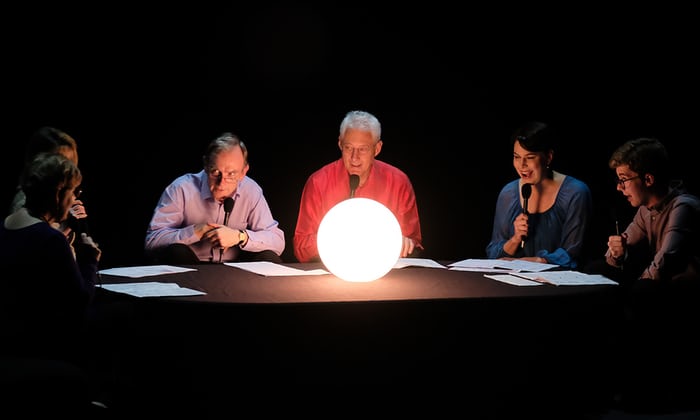
I know it sounds daft. But it isn’t. It is captivating. Not much to look at mind you. Six people sat round an IKEA bubble lamp with microphones, (mind you it does look a bit retro 70s cool), gurning and sometimes waving. But it sounds divine. Literally.

Singcircle were founded in 1976 by Gregory Rose, who is still there. They have performed Stimmung over 50 times. It is clearly a tricky thing to pull off. This was the last ever performance so certainly poignant. Kathinka Pasveer, the sound projectionist, was one of Stockhausen’s leading acolytes and interpreters so no-one better to mix the whole. I think I heard a couple of electronic grunts along the way but who cares. You closed your eyes and just let the transcendent sounds swirl over, around and through you. Jeez I am travelling back in time to my long-hair days in the mid 70s.

Stimmung though was enough for me. I passed on the second piece, Cosmic Pulses, which came after the interval. No point pushing my luck I reckoned. I had checked it out ahead of the gig and could see that this was likely to be a step too far. One of Stockhausen’s last purely electronic works, from 2007, it is a knotty mathematical puzzle built on 24 structured loops, in a pitch range of seven octaves, played through 8 speakers. It looks intimidating on paper, there is an extract of the “score” in the programme to prove the point. In reality it is terrifying. Even with a fancy laser show I could tell this wasn’t going to do it for me.

So just Stimmung then. One revelation was more than enough on the night. This gets performed by other vocal groups, who presumably know what they are doing. When it does do not hesitate if you have any interest at all in music, of whatever form. I am off to search out a decent recording.


Luciano Berio: London Sinfonietta at Kings Place review *****

luciano_berio

Luciano Berio: Theatre of the World

London Sinfonietta, Kings Place Choir, Jonathan Cross (presenter), John Woolrich (curator)

Kings Place, 4th November

  • Lucy Schaufer – mezzo-soprano
    Michael Cox – flute
    Darragh Morgan – violin
    Paul Silverthorne – viola
    Timothy Lines – clarinet
    Lucy Wakeford – harp
  • Young violinists from Waltham Forest Music Service and the Kurumba Youth Orchestra
    London Sinfonietta

Luciano Berio

  • Lepi Yuro
  • E si fussi pisci for solo viola and for choir
  • Duetti: Aldo
  • Naturale
  • Duetti: Various
  • Divertimento
  • Chamber Music for clarinet, cello, harp and mezzo-soprano
  • Sequenza II for harp
  • Autre fois
  • Lied for clarinet
  • Air arr John Woolrich
  • Berceuse for Gyorgy Kurtag
  • Sequenza I for flute
  • Musica Leggera
  • O King
  • Chants Parallelles

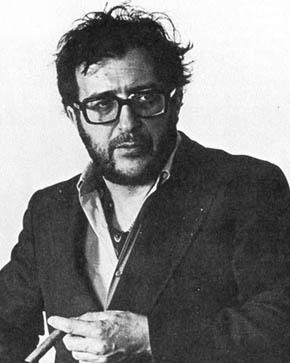
Many years ago, maybe 30 or so, I heard a piece by Luciano Berio in a mixed programme at the Barbican. The ticket was free, courtesy of FF, and I cannot, for the life of me, remember the other pieces, the performers or the name of the Berio work. But I remember being completely blown away by the music, making a firm mental note that it was by Berio and that I should explore his music further.

Of course I didn’t. Modern classical music was just too tricky to grasp and I had a life to get on with. But there must have been the germ of something there. Now that I am older, and maybe wiser, I am beginning to understand that this was not a one-off novelty experience. There was something about Berio’s music that had left a mark. There seem to a handful of other modernist classical composers who similarly create a connection for me and I am still working my way through other candidates. Outside of the minimalists and a handful of contemporary names, Berio, along with Iannis Xenakis, Gyorgy Ligeti and Krzysztof Penderecki are the chaps that float my boat. There may be more.

So I am actively seeking out performances, live and recorded, of these lads. Heaven knows why they stand out but I think I am drawn to the fact that they all seem to engage with the musical past in some way, they pump up the rhythm, they can create extraordinary sound worlds (if you can’t hum it best to get wowed I find) and they favour dramatic and dynamic contrasts. No doubt if you know what you are talking about when it comes to music you would be able to offer me more comprehensive explanations (feel free to do so – I would be very grateful). There is still a lot of modern and contemporary classical music that leaves me absolutely baffled so there must be something going on in my head with these particular composers.

Here was a marvellous opportunity to enjoy a variety of Berio’s small scale output as part of the Turning Points series at Kings Place curated by British composer John Woolrich with the London Sinfonietta, who excel in modern works and premiered many of Berio’s pieces in the 1970s and 1980s. Now Mr Berio didn’t seem to suffer from any form of “composer’s block”. Prolific doesn’t begin to describe it. He composed for all manner of instrumental forces, including electronics and tape, and was particularly adept with the human voice, as well as strings, piano and flute Their are many large scale works, Coro and Sinfonia are maybe the most well known, but there is also a wide range of chamber and solo pieces which left Mr Woolrich with a serious curating challenge. One which I think he responded to with aplomb.

If there is one thing that characterises Berio’s oeuvre it is the way he incorporates the music of the past into the music of his present (the second half of the C20 to be exact). The references can be direct in terms of source material, (he arranged the work of diverse composers from Monteverdi to Mahler), or indirect in terms of fragments, quotes and styles. He saw this as transcription rather than collage but the effect, for the non-musical listener like me, is like a comfort blanket which anchors the “avant-grade” in the familiar.

Folk music played a large part in his framework and this concert kicked off with Lepi Yuro, a classic Croatian folk song scored here for viola. That was followed by a famous Sicilian folk song, E si fussi pisci, set first for solo viola and then, in its more usual format, for mixed chorus, with some suitably fishy impersonations at its conclusion. This choral arrangement was one of the very last pieces Berio composed. Nothing challenging here at all.

We then moved on to one of Berio’s short 34 duetti (1983) for two violins. These were originally written as teaching pieces to introduce the techniques of contemporary music to students, with one half of the duet given a much higher level of technical difficulty than its partner. Each was dedicated to a performer. composer or musicologist and, through time, they increased in sophistication as Berio took a playful view on the history of violin composition and just what it was possible to do with the instrument. The first piece was dedicated to Aldo Bennici, one of Berio’s favourite champions and a multiple dedicatee. After Naturale we were treated to ten more of the Duetti with Darragh Morgan, the LS’s lead violin, charmingly accompanied by young members of the Waltham Forest Music Service and Kurumba Youth Orchestra. Bartok, Stravinsky, Boulez and Berio’s Italian contemporary and sidekick in his electronic adventures, Bruno Maderna, were all name-checked.

Naturale from 1985 takes a recording of a raw and passionate Sicilian folk singer, Peppino Celano, belting out street vendor cries, (if you get the chance listen to Berio’s Cries of London for six unaccompanied voices which is just amazing), and frames it with an extremely expressive viola playing material transcribed from folk songs as well various percussion effects from marimba, rototoms and tam-tam. It is a extremely affecting and the most substantial piece on show in the programme. 

Next up was Divertimento, an early piece from 1946 (revised in the mid 1980s) composed for string trio, before he went to the US and discovered serialism, and which pays homage to Stravinsky and Bartok. This was followed by the first of the two Sequenzas on show, this being No II for harp with No I for solo flute following later on in the programme. Berio’s 18 Sequenzas are amongst the most well known and performed of his compositions and are staples of the solo repertoire for the instruments they showcase. In each case they exploit, with Berio’s trademark humour and musical knowledge, the full gamut of playing possibility with extended techniques piled up high. Watching Lucky Wakeford thumping the side of her harp or picking up the very highest registers was a joy. Berio wanted to show just what was possible beyond pretty glissando for the harp and he surely does. This was also true for the more commonly encountered Sequenza for flute played by Michael Cox which was another highlight of the evening.

Autre fois from 1971, scored for harp, flute and clarinet, is a miniature subtitled Berceuse Canonique pour Igor Stravinsky, which tells you pretty much everything you need to know about its mood and structure. This was followed by Lied for solo clarinet (here played by Timothy Lines) which, as the title suggests, sounds like a mournful song. The orchestral version of Air dates from 1969 but the following year it was recast for soprano and piano quartet. Our mezzo-soprano for this evening was Lucy Shaufer who was in fine voice. Remember Mr Berio’s works for voice comprise some of the finest contemporary pieces for mezzo-soprano given his muse was the American Cathy Berberian whom he married in 1950 and whose professional partnership extended well beyond their divorce in 1964. 

Air was followed by Berceuse per Gyorgy Kurtag, another short piece written in 1998 and dedicated to the redoubtable Hungarian master of the very small. This was followed by Musica Leggara (1974) for flute, viola and cello, (and I gather a tambourine if required), dedicated to a certain Godfreddo Petrassi, which is a spiky canon and not I think the “light music” of the title. Another joke maybe. The concert ended with  one of Mr Berio’s most famous vocal pieces, O King, written in 1968 for mezzo soprano and here strings and woodwinds. This was later incorporated into Sinfonia, possibly Berio’s most influential work. This was written to commemorate the death of Martin Luther King and, as you might expect, packs a powerful emotional punch as the civil rights leader’s name gradually emerges from the soprano’s voice line, If you could pick one work that gets to the heart of Berio’s music this might be it.

i was, annoyingly unable to stick around for the post concert discussion, (I know this sort of thing smacks of obsessive nerdiness but you can learn a lot), but the insight into Berio from the interviews showing in the other Hall at Kings Place was very welcome. He didn’t sound like he was the easiest chap to get on with but the reminisces did show just how broad were his influences and how much he influenced. His role as a teacher and mentor and his fascination with the business of making music, with sound itself, was also emphasised.

And we got to listen to Chants Paralleles, one of his ground-breaking electronic works from 1975. Now a lot of this sort of thing is just so much electronic bubble and squeak in my very limited experience but once again, somehow, Berio makes it vital and intriguing.

There you have it. I am a fan. Give him a whirl. You never know you might like it

And hats off to Kings Place for these Turning Points events. There is a bit of cheesy novelty involved in some of them but this can be overlooked given the learning on offer. The concert on 24th March 2018, from the London Sinfonietta again, which brings together some classic chamber works from the early C20, and links this to space-time and Einstein, (if every playwright on the London stage seems to be intent on shoehorning in brain-bending science, why not music?), looks interesting. As does the OAE’s contrasting of Haydn’s first and last symphonies on the 12th May.

I don’t suppose the bigwigs at the Wigmore Hall are quaking in their boots but Kings Place has emerged as a worthy foil to the grand old dame of Wigmore Street.