Blimey. The Thelmas, director and founder Madelaine Moore and writer Guleraana Mir, together with the writer here, Madeline Gould, aren’t pulling any punches here. The company is “dedicated to the development and promotion of early career female writers and theatre makers”. They “crave authentic and bittersweet stories outside of the traditional female stereotype and socially impactful narratives that reflect society but don’t look to solve prevalent issues”. They have certainly met the brief here.
Lights (from Jennifer Rose) up. Her, played by Hannah McClean, is a hotel chambermaid. Drenched in blood with a body (artfully made by Baska Wesolowska) at her feet. She appears to have killed a guest. In fact she has killed a guest. But, as she says, “it’s not what it looks like”. Over the next hour she takes us through her motives, means and opportunity. Initially because she is pissed off at having to clean up after someone who has shat the bed leaving no explanation or apology. She hold backs though and waits to plan the perfect murder. Because she can and because she enjoys it. And because she is overlooked and looked down on. That’s the premise. A woman with no reason to kill. She walks us through the history and typology of serial killing, invites us to consider our own reactions to her psychopathic tendencies and shows us how the sexist expectations of others have allowed her, maybe, to literally get away with murder.
The monologue constantly defies audience expectations often with a knowing wink or line. It is very funny in places and, which really surprised me, actually a little disturbing, inviting us to consider our own darkest impulses. (The Tourist may yet one day exact an ultimate retribution against those who put their feet on seats in trains).
That this should be the case is done to the brilliant performance of Hannah McClean. If acting is all about making a courageous leap to eliminate all traces of self-consciousness, to show no fear, so that an audience can suspend its own disbelief then Ms McClean succeeds in spades. Of course she hasn’t killed anyone and is not a killer for her own pleasure but she certainly makes you feel like she could be. Whilst simultaneously debunking and deconstructing the very idea. She is charming and unnerving by turns. Just occasionally the feminist message is a little too calculating, a little too strident, but it is still a powerful and effective conceit.
Unreliable narrators, especially the darkly comic, can often be relied on to tell a good story. To do this, and make telling points about gender expectations, in just 50 minutes or so, is a real coup. Pretty much every review of Ladykiller I have seen raves about it. With good reason. Definitely worth seeing should you get the opportunity. And I hope to see Hannah McClean again.
I see The Thelmas are working on a new show, Bootcamp, which involves women and boxing. I look forward to seeking that out too. (BTW The last play I saw which entered similar territory, The Sweet Science of Bruising by Joy Wilkinson, is getting a run at Wiltons in June. Well worth a visit in a venue which should suit it).
There was all sorts of cutting edge theatre, comedy and performance on at the Vault Festival this year, but being the old fart that he is the Tourist largely plumped for the safe options of comic takes on Greek myths. Satisfying his pretensions and ensuring he doesn’t get too close to all the intimidating, fashionable London twenty-somethings who all seem to be permanently switched on whilst the Tourist languishes in his catatonic bubble. So having really, really enjoyed Pants on Fire’s Ovid’s Metamorphoses it was off to an hour or so in the company of Unmythable from Brighton based Out of Chaos.
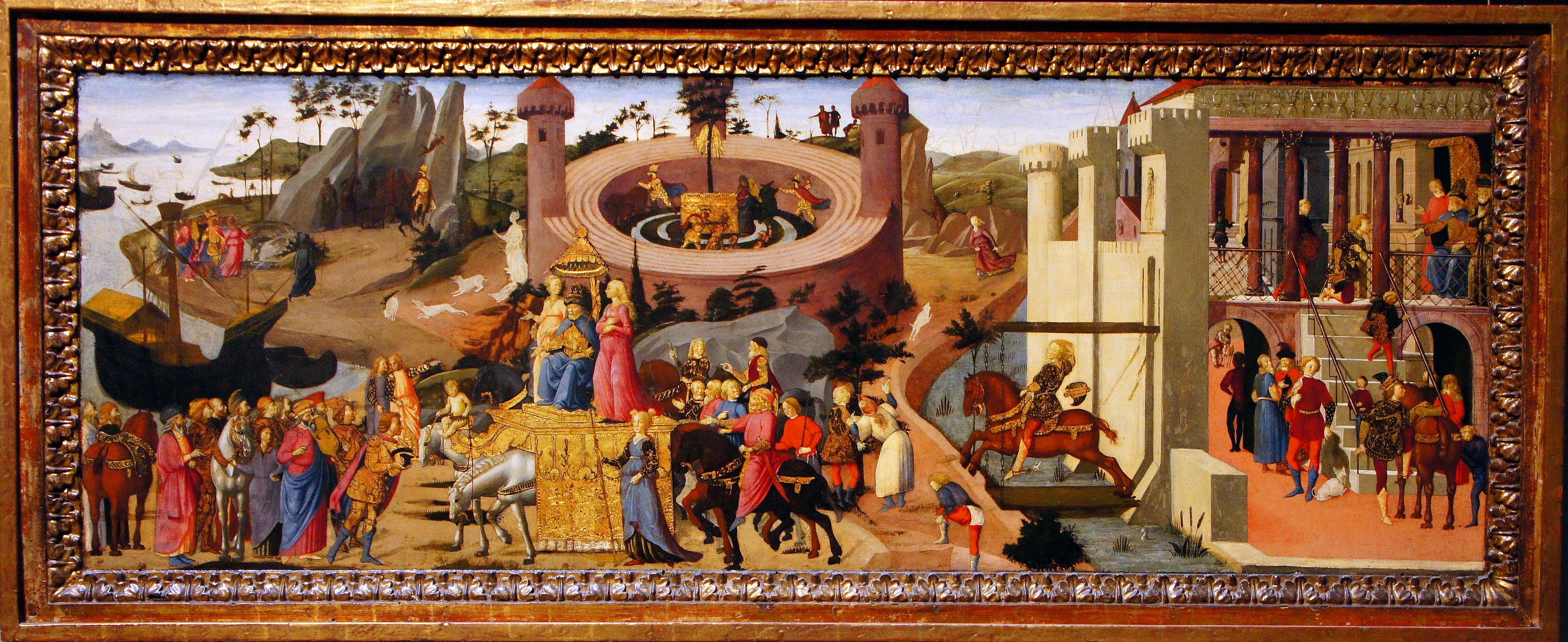
Devised by the company and directed by Paul O’Mahony and Mike Tweddle, with sound from Rob Castell and Phil Ward and designed by Claire Browne (just a couple of boxes if truth be told), Unmythable offers a comic take on all the Greek myths (well maybe not all of them but a remarkably wide spread in just an hour) courtesy of three actors, I think Alice Haig, Hannah Barrie and one other whose name, to my eternal shame, I can’t find, having failed to secure a flyer. It takes the story of Jason and his 50 odd Argonaut mates and their city break to Colchis on the hunt for that Golden Fleece (above is a quattrocento Florentine take on the story) . The big name Argonauts get their own turns, as do I think, some non Argonaut gods and heroes, in the form of songs and skits. However Jason’s key wing-persons are the slightly less courageous bessies, Beta and Gamma. Nice touch.
Physical comedy, funny accents, costume changes, contemporary pop culture references, audience interaction, narrative, dialogue, monologue, are all employed with the emphasis on pointing up the brutality and often weirdness (and misogyny) of the myths. They don’t hang about so occasionally the switches are a little too swift, and the humour isn’t too subtle, but when to works it is genuinely hilarious. Jason dragging his feet, understandably, when out comes to marrying Medea, The Labours of Hercules, shushing in the Trojan horse, Midas at the salon, Aeetes as Brando as Don Corleone, Persephone as an adventurous pony club member and, simultaneously, peeved mum Demeter, trying to avoid the clutches of Hades.
Unmythable has already toured the globe over the past few years and I suspect if has many more years to go, though I think this years outing may be over. If you haven’t see it, and get a chance to, don’t hesitate. Ideally with mates and beer. No need to bone up on the Greeks. Didn’t bother me.
Like Martin McDonagh’s The Cripple of Inishmaan, and written at the same time, Marie Jones’s Stones in His Pockets is a comedy which examines the impact when a Hollywood film crew descends on a small Irish community. But where one is sharp, dark and intriguing, this, for all of the sorrow at the heart of the play, is a much slighter affair, and can’t seem to make up its mind whether it is satirises or celebrating the outsider view of Ireland it examines. Maybe it was just the production, but the two hander structure, with both actors jumping incessantly between characters, seems to animate the broader, physical humour at the expense of the message about tired stereotyping which, I think, Marie Jones is trying to get across.
Not that it wasn’t funny in places. Though not as funny for me as it seemed to be for others. Some of the audience at the Rose were doubled up in mirth, others sat near stony-faced. Still there was pretty enthusiastic applause at the end for the efforts of Owen Sharpe (Jake) and Kevin Trainor (Charlie), which was very well deserved. Yet I had expected something more given the reception the play was afforded in its early years as it snowballed from its Belfast Lyric premiere, through a community tour, Edinburgh Fringe, the Tricycle and then into the West End for an award winning run of three years. Though perhaps this reflected the combined talents of actors Sean Campion and Conleth Hill (last seen by me steadfastly refusing to be out-acted by no less than Imelda Staunton in Who’s Afraid of Virginia Woolf). It has been revived on numerous occasions in Ireland, the UK and around the world. I even note that Kare Conradi, the AD of the Norwegian Ibsen Theatre (who was over here for The Lady From the Sea a couple of weeks ago), did a stint in a production over there. If it works in the land of Ibsen then who am I to argue.
Charlie Conlon and Jake Quinn are two friends in a rural town in County Kerry who sign up as extras for the Hollywood film. Charlie, on the run from his failed business, has written a script he dreams will be made into a film. Jake has recently returned from NYC, knows everyone in the village, and is besotted by the star of the movie, Caroline. The producers, directors and crew only care about getting the film done on time with plausibility, plot and accents taking a back seat. The “colourful” locals are initially excited at the arrival of Hollywood but soon tire of the glamour, and things take a turn for the worse when one of the villagers, druggie Sean, commits suicide after being humiliated by Caroline in the local pub. The flashpoint is Sean’s funeral. Jake and Charlie get the chance to pitch the script but it is rejected by the film’s for being insufficiently romantic and commercial.
Easy enough to see the tension between the Hollywood view of Ireland and reality. Martin McDonagh takes more direct aim at the liberties taken by Robert J Flaherty in his “documentary” Man of Aran in 1934, but the intent is similar. This touring co-production (with Bath Theatre Royal), is directed by Lindsay Posner, who has delivered it in NYC recently, and is as safe a pair of hands as it is possible to get, whether in classic or lighter theatrical fare (Mamet, Miller, Ben Johnson and Noises Off being particular highlights in my book). Peter McKintosh’s set is your standard Irish outdoorsy caper (see Rae Smith’s bigger budget version for the NT’s Translations last year), with the two actors manipulating a large chest to simulate the indoor scenes.
Moderately entertaining. For sure. Thought provoking. Nope, Fraid not.
Seven years in to the Vaults Festival and finally the Tourist takes the plunge. If there is a cutting edge to avoid you can be sure the Tourist finds it. It is not even as if the Waterloo location is inconvenient. It could hardly be more accessible. Still better late than never.
Last year the Festival, which I read somewhere is now the biggest outside Edinburgh, attracted some 70,000 punters over 8 weeks. This year there are over 400 shows from around 2000 artists and performers. You pay £15 or so for an hour or so’s entertainment. The organisers get 30% of the take to cover costs, the artists 70%. That, I am assured, is way more attractive for the creative that the usual economic model. So everyone’s a winner.
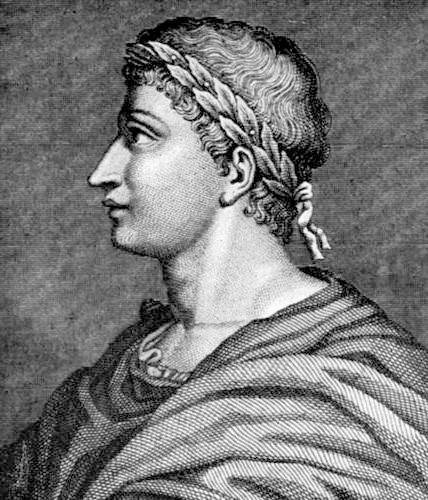
Especially when the hour, or in this case, 80 minutes or so is of the quality of Pants on Fire’s Ovid’s Metamorphoses. Now I could bullshit you and pretend I have read Ovid’s magnum opus, basically a history of the world from the creation to the deification of Julius Caesar, part mythic, part factual, in the form of a narrative poem made up of 12,000 lines over 15 books and incorporating over 250 myths. I haven’t. But, such is the pervasive nature of these myths in Western culture, I am, like any reasonably aware culture vulture, au fait with most of the stories.
And that is all you need to enjoy this show. The selected stories are, adroitly, set in Britain during WWII. Think period uniforms. Each of the chosen myths, (I would have been happy to watch the cast of seven take on the entire 15 books, but I guess they, and we, had homes to go to), takes the form of a sketch if you will, with narration, performance, on stage music, various props and enterprising video, lighting and sound design. There is even some puppetry and animation. Whilst the Crescent may be the biggest of the various venues across the Festival this is still a tiny stage so the creative team, led by director Peter Bramley, had to be pretty ingenious to fit it all together. The four panels centre stage which served as backdrop and screens seemed to be in constant motion. Favourite setting? The Underground as the Underworld. Genius. Favourite transformation? Io complete with tin can hooves and gas mask. Double genius. Favourite scene? Narcissus as Hollywood idle with Echo as usherette. Triple genius.
Now I can’t pretend I clocked all of the stories on show but the following were all name-checked. The Creation, Sirens, Gorgons, Apollo, Daphne, Io, Mercury, Cadmus, Diana, Semele, Bacchus, Tiresias, Narcissus, Echo, Cupid, Icarus, Salmacis, Hermaphroditus, Perseus, Arachne, Marsyas, Medusa, Jason, the Minotaur, Hercules, Orpheus, Eurydice, Midas, Achilles, Ajax and Ulysses. At least I think they were. I might have got confused with Unmythable from Out of Chaos that I saw a week or so later, equally as entertaining. Anyway the point is that Metamorphoses is innovative, imaginative and above all very, very funny. I gather that Ovid’s poem ticks the form box marked epic but also takes in the elegiac, tragic and pastoral along the way. It is certainly keen to mock and subvert its own pretension; it is properly “meta” in the modern argot. This is wryly captured in Pants on Fire’s routines. As is the theme of metamorphosis or transformation from one form to another, and the power of love, Amor, to upset various narrative apple carts.
Pants on Fire was founded by AD Peter Bramley, who trained with Jacques Lecoq, in 2004, alongside Heather Winstanley who devised the visuals and produced Ovid’s Metamorphoses. Lucy Eggers composed the original music for OM, the Andrews Sisters style chorus numbers being one of the highlights. Whilst POF have created a number of shows it is this that has garnered awards and toured extensively following its debut in 2010 (at the dear old Greenwich Theatre and then Edinburgh). It is easy to see why. (I do like the sound of their Splice mind you, an hour long theatrical tour through the history of cinema). They are currently working on creating a festival of one person, performance “shorts”. Sounds good.
The cast here included Beth Lockhart who is the other principal of Pants on Fire along with Adam Boakes, Max Gallagher, Sindre Kaurang, Chloe Levis, Bridget Mylecharane and Rosie Ward. A splendid ensemble largely drawn from Rose Buford College where Peter Bramley teaches movement. There were moments when the timing went awry and accents wobbled but frankly that is all part of the improvisational charm.
Theatre is about transformation and can be transformative. Ovid was ploughing the same furrow. Certainly one of the best hour’s entertainments I have seen in this or any other year. It will be back. Don’t miss it.
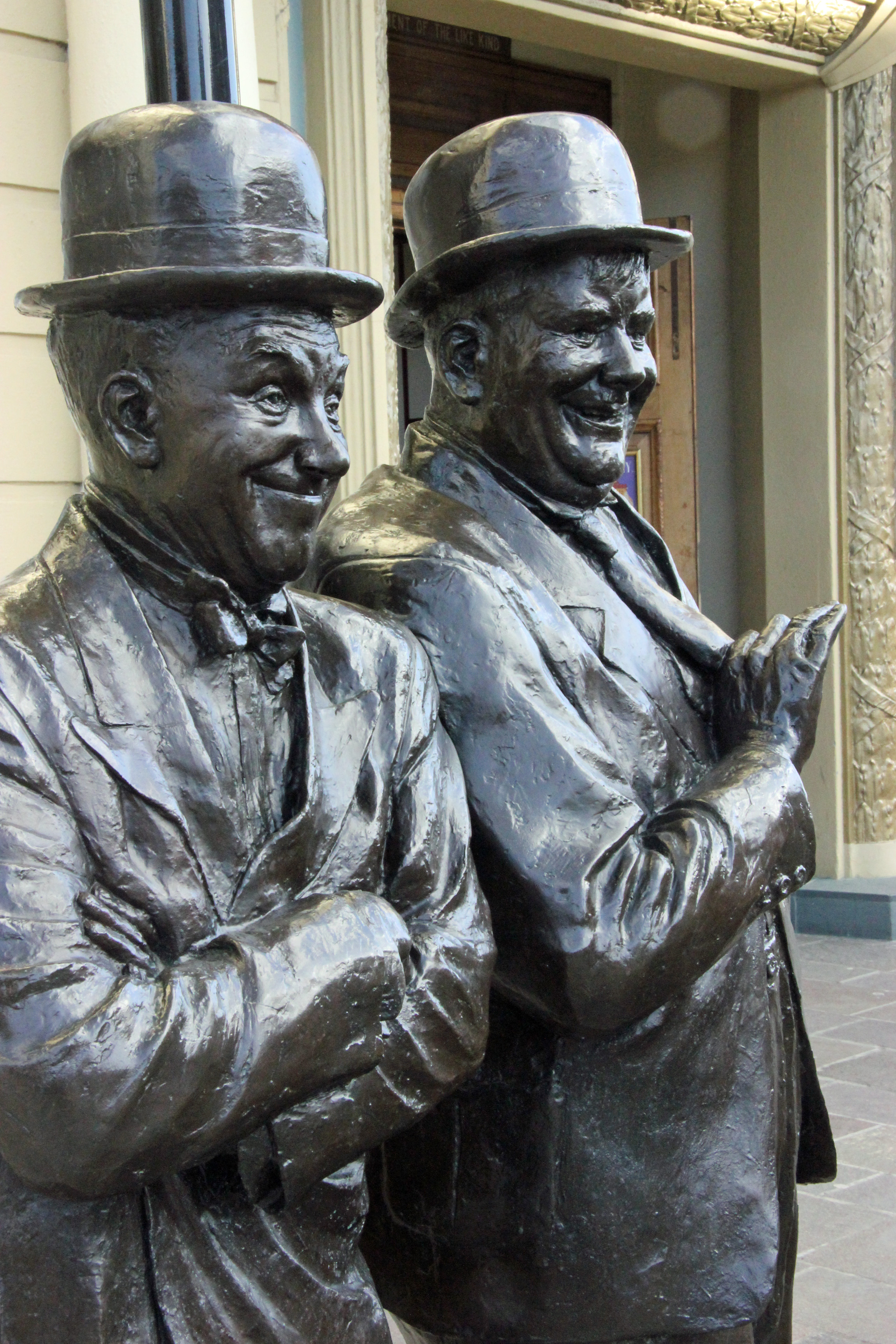
For the avoidance of doubt the two fellas above are not Steve Coogan and John C Reilly, the stars of film Stan and Ollie, nor indeed are they yer actual Stan Laurel and Oliver Hardy. No this, obviously is a statue of the comedy duo, courtesy of artist Graham Ibbesson, propped up against a lamp post outside the Coronation Hall in Ulverston near the seaside in South Lakeland, Cumbria. Where Stan Laurel was born. Pretty good likenesses you’ll warrant. Art initiating life imitating art imitating life …. you get the picture.
For imitation is what the film does best as the two lead actors turn in a couple of memorable, painstakingly detailed, turns as the beloved S&O. The story charts the return of S&O, down on their uppers, to Britain in 1953 to undertake a tour, organised by impresario Bernard Delfont (a well cast Rufus Jones). Only the boys are not offered much in the way of quality venues, (Delfont preferring the questionable comedy talents of one Norman Wisdom), so start off playing to tiny, nostalgic crowds Oop North, with Stan reassuring Ollie that, once in London, he can secure the backing for a new film script, a Robin Hood spoof, that will rehabilitate both reputation and bank balance. Word of mouth, and immortal talent, turns the tour into a massive success, and the lads are joined by wives, the devoted and fiercely protective Lucille H (the ever brilliant Shirley Henderson) and the terse Russian Ida (a pitch perfect Nina Arianda), comically hamming up their own rivalry (“two double acts for the price of one”). Cue a falling out and reconciliation when Ollie’s health takes a turn for the worse.
So cliched you could barely make it up. Except that it is true. And these are about the most lovable pair, as portrayed and in reality, that you could want to watch. There are obviously generations, my age or older, who are familiar with Laurel and Hardy from repeats on the telly. There will be other youngun’s as well, I am sure, who will have discovered them through their own volition or Mum and Dad’s reminiscing. Whatever, there was clearly going to be enough of an audience to make this film a success.
Which may also be why it is played so straight. Not straight as in lacking humour. Like I say Messrs Coogan and Reilly have the routines of S&O down to a tee. As they do when it comes to the more complex off-stage/screen personalities. Vocally and physically the resemblances are uncanny. No, it is just that the way the story is told contains next to no surprises. It isn’t mushily sentimental, but it doesn’t take any risks at all. It is cheesy, sweet and melancholic in all the right places. The two leads, director Jon S Baird and writer Jeff Pope (co-writer on Steve Coogan’s other major big screen success Philomena), all plainly, and rightly adore their subjects but a slightly less decorous tone might have paid dividends.
Still the best bits, the dolly shot opening in the Hollywood back-lot, Stan sticking it to Hal Roach (a cameo from Danny Houston), Newcastle in the rain, the “hospital sketch” repetitions (especially the exchange on Ollie’s actual sickbed), the double door routine, the ladies bitching at the reception, the venue interiors, Stan looking wistfully up at the Abbott and Costello film poster, are undoubtedly effective, laden with pathos, humour and affection. Cinematographer Laurie Rose takes much of the credit and the make-up and prosthetics of Jeremy Woodhead and Mark Coulier, turning John C Reilly into Oliver Hardy, especially in the later scenes, is remarkable.
All in all a very nice, touching and amusing film. Make of that what you will.
Beckett, Pinter, Stoppard, Kitson. I know, I know. He is only a stand-up comedian. So comparing him to these master explorers of the absurdity of the human condition is, to say the least, stretching it a bit. However, as those of us who have become addicted to his “story shows”, (I don’t think DK would like to think he has “fans”), as well as his “stand up”, in recent years. he is a very clever fellow, as are the chaps above, he is very funny and he delivers startling insights. Yes the conceits that underpin the structures of these stories can be as pretentious as they are inventive, and once set-up it is usually pretty easy to see where they will end up, (though the pay-off here is still worth the wait), and yes the man himself, or rather his persona, and his repeated tropes can be annoying, but when he hits it no-one comes close. And that includes many great dramatists who search for tragic-comic perfection.
In Keep he hits it. No question. The preamble, where he gives the audience a chance to excuse itself, as he describes what is coming, the threat, to read out a list of everything he owns, the diversions and repetitions which follow, the self reference, self reverence and self revelation, (now’s who’s being pretentious), the gentle provocations, the playful aphorisms, all are present and correct and all beautifully delivered. Maybe by the end the various layers become a bit too meta, and maybe, as DK himself admits the metaphor of stuff in filing cabinet for mind and self is a bit too creaky, and could be applied by anyone to anyone, but frankly I don’t care as no-one else comes close to being able to create this kind of work.
Don’t worry, there are plenty of laughs. And for those who appear to think it is too long I suggest they need to work on their attention spans. I would have taken another couple of hours no problem. Of course it meanders and digresses, it’s Kitson FFS, but, certainly not in the performances I saw, without considered effect. Love, loneliness, hope, regret, memory, agency, language, he has covered this territory before, but these are the staples of many of the modern dramatic greats including those mentioned above.
And all this for £12. It’s gone now. Don’t miss the next one.
Now everyone know’s that Restoration comedy is a tricky customer. What with the humour built on misogyny, that’s if it is funny at all. The satire of a social class few of us recognise. Texts are so thick, built on repartee, wordplay, punning and double entendre. Plots and sub-plots are labyrinthine. Intrigues, trysts, disguise, mistaken identity, off stage shenanigans, eavesdropping, knob gags, duplicity, comeuppances. Characters are stock: rakes, roues, ingenues, cuckolds, randy older women, buffoons. The debt to French and Spanish contemporaries, Jacobean classics, commedia dell’arte and the Roman foundations of Plautus and chums, is obvious even if it is firmly of its time.
I’ve swerved a few in my time, including recently the Donmar Way of the World, which sounded a bit too full-on. There was a Simon Godwin Beaux Stratagem at the NT a few years ago which had its moments and the “Bright Young Things” Country Wife last year from Morphic Graffiti was diverting in parts but I am still waiting to be shown the “real thing”. Director Selina Cadell, who is a veteran of the Restoration, (you know what I mean), as both actor and, increasingly, director, (Love for Love at the RSC, Way of the World at Theatre Royal, Northampton, The Rivals at the Arcola, in addition to a Stravinsky Rake’s Progress at Wilton’s), offers valuable insight in the programme. To make the comedy work actors need to trust the text and stop their natural, modern tendency to interpret and emote.
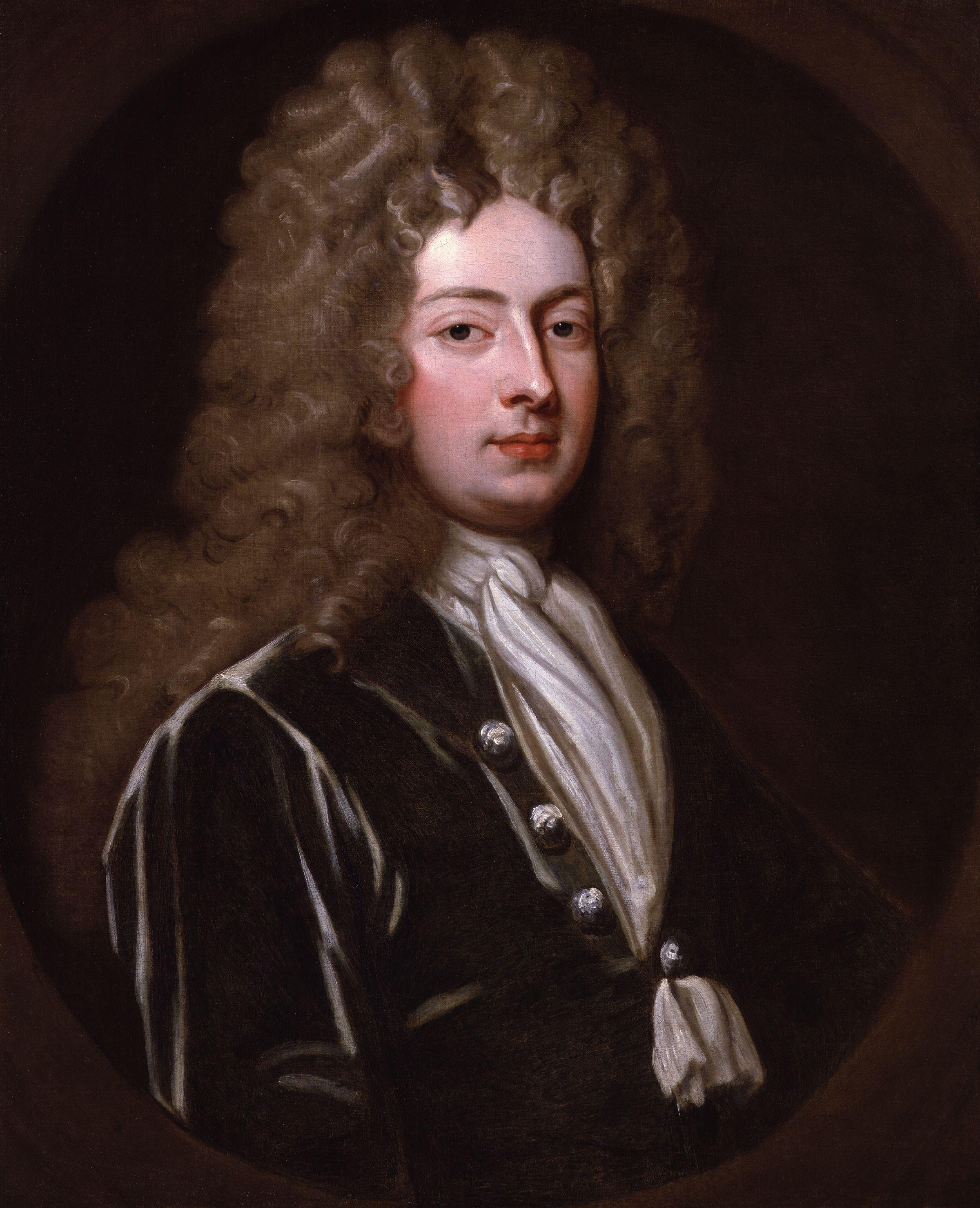
I can see the sense of that and also the idea that we the audience shouldn’t worry too much about trying to unravel the plot. To that end, in this Double Dealer, William Congreve’s 1694 less successful follow up to his hit debut The Old Bachelor, Selina Cadell and Eliza Thompson have offered up a short prologue telling us to do exactly that. So, with that in mind, I settled in, though, given the string of less than enthusiastic reviews, expectations were low.
So I was more than a little surprised when I found myself starting to enjoy the proceedings. Not to the point of being converted to the Restoration cause but certainly enough to justify 4*, admittedly on the Tourist’s extremely flawed, subjective and overly generous ranking system. (I reason that all involved have gone to the effort so it is only reasonable for me to be generous in my appreciation. And the hard laws of cognitive dissonance mean I am hardly likely to admit I ballsed up by booking to see something in the first place).
This is not to say that the plot isn’t convoluted. Earnest young Mellefont (Lloyd Everitt), heir and nephew to Lord Touchwood (Jonathan Coy) can’t wait to marry Cynthia (Zoe Waiter) who is the daughter by a former wife of Sir Paul Plyant (Simon Chandler). Sir Paul is also the brother of Lady Touchwood (also Zoe Waites) who just happens to have the hots for young Mellefont. Lady T, rejected by said Mellefont, gets the hump and resolves to ruin his reputation. She recruits the rakish Maskwell (Edward MacLiam), the Double Dealer of the title, and Lady T’s former lover, into her plot. As it happens the villain Maskwell is actually in love with the virtuous Cynthia. So Maskwell attempts to persuade Sir Paul P that his missus, the randy Lady P (Jenny Rainsford), is getting it on with Mellefont, and Lord T that Mellefont also has designs on his wife. Into this fray are plunged Mellefont’s mate Careless (Dharmesh Patel), Lord Froth (Paul Reid) and his pretentious wife Lady Froth (Hannah Stokely) who responds to the advances of coxcomb Brisk (Jonathan Broadbent), who also plays a chaplain as the trysts pile up and the plots unravel.
Easy really. Seriously though, a quick scan of Wiki, as you might prior to a Shakespeare, Marlowe or Jonson play, a shifty glance at your programme as the various punters run on and off in the first few minutes, and it becomes pretty easy to follow. So I am not sure that constitutes a fair criticism. The constant entrances and exits do get a little repetitive but so it can in Shakespeare history plays and there ain’t a lot of options space-wise at the OT, that is normally one of its joys. The reasons for the doubling of Lady Touchwood and Cynthia remain a mystery but Zoe Waites offers more than sufficient distinction between the two, in some ways rather to the detriment of her colourless Cynthia. And, when we get to the scene where Cynthia eavesdrops on Lady T’s intrigues, we witness the rather daft sight of her rolling on her side to signify who is speaking. Still at least she didn’t have one of those split down the middle costumes on.
Lloyd Everett gives more definition to Mellefont but the the star turn by a country mile is Jenny Rainsford’s Lady Plyant, who is hilarious, both in the delivery of her lines and her movement. Hannah Stokely also gets real laughs out of Lady Froth and Edward MacLiam gradually, though not entirely, fleshes Maskwell out beyond the pantomime. The rest of the cast is solid if not always spectacular. As an aside I think this might have been my first full house in terms of the ten strong cast. All seen in the last couple of years in other productions. Madeleine Girling’s set did the job as did Rosalind Ebbutt’s costume’s and Vince Herbert’s lighting though I couldn’t escape the feeling, (very rare at the OT where less is normally defiantly more), that more space and more money would have helped.
BUT what I can say is that this was a production which persuaded me that Restoration Comedy can be not just something I, (and I suspect most audiences), should enjoy, but something that I could enjoy, and in fact something that I would enjoy. If there were an entire cast operating at the same level as, say, Jenny Rainsford here, so that every line, every exchange, every character trait, every situation, registered then it could be very bright and very witty. If this were overlaid with more expansive visual cues, the entertainment could be further enhanced. Not to the exclusion of the text but in support thereof. And if the differences between the characters are fully defined by movement, costume and through variations in the rhythm of dialogue and action then the plot should be less of a hurdle.
Even the most perfect production might have its work cut out to bring relevancy to the social satire or to contemporise the sexual politics. Congreve’s play dates from the period of the second wave of Restoration comedy from 1690 through the turn of the C18 which broadened out the interaction between social classes beyond the purely aristocratic subjects of the original craze from 1660 to 1680. Even so it is still essentially a bunch of toffs running around stunting innuendos the Carry On script writers might have rejected. Easy to see why the stuffy Victorians took umbrage and the plays fell out of fashion.
This is the first production of the Double Dealer in London for a few decades. It’s not perfect. The tension between the pantomimic and the dramatic is never really resolved. There is precious little weight to the characters. The space constrains, even though the play is nominally set in the “gallery” of Lord T’s house over the three hours of the (unabridged) play. Yet, despite this, the Tourist sniggered a fair bit and emerged in quite a perky mood. Which is not always the case post theatricals. And, armed with a greater understanding of the genre, hoping, one day, to chalk up a 5* Restoration comedy.
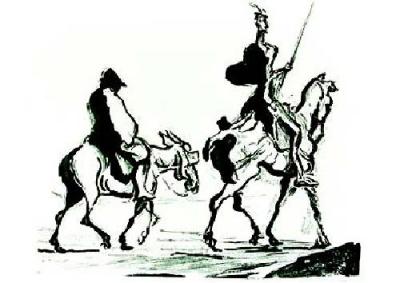
Finally the Tourist gets to see this. Took a chance that it would, after the mostly strong reviews, eventually find a home in London, and waited for the run to settle in to secure a fairly priced ticket. If you are of a similar mind, and haven’t seen it yet, I would advise you to do the same in the remaining few weeks. I am not sure it is quite the triumph some of the criterati would have you believe but the spry adaptation of James Fenton, the creative staging under Angus Jackson’s animated direction and the straight man – funny man double act of David Threlfall and Rufus Hound make it impossible not to enjoy.
Indeed once you strip out the comedy, Rufus Hound’s audience patter, the gags, the pratfalls, the puppetry, the knowing asides, the gurning, the mugging, the bun fight, all superbly orchestrated by comedy director Cal McCrystal, this is actually a moving, and occasionally, insightful play. In that regard it captures the spirit of the Cervantes novel(s). DQ may be an aged eccentric, living in a fantasy world, harking back to a world of chivalry unknown by early C17 Spain, let alone today, but he is also a man of conviction and belief, and this, surprisingly, just about squeaks through in this RSC production.
As the bond between DQ and sidekick Sancho Panza develops, and as we see the melancholic DQ doggedly stick to his quest despite the incredulity of those around him, we get ever closer to the “real” character. Result: a hushed audience taking in a closing deathbed scene, (sorry folks DQ does snuff it), where DQ regains his sanity, that is both moving and poignant. That this should be so is in part due to the sincere warmth that a padded-out Rufus Hound brings to SP, but mostly thanks to the wonderful performance of David Threlfall. Whilst the rest of the cast shifts, swirls, sings and dances around him, playing characters who, predominantly see him as a figure of fun to be endlessly mocked, DT plays it absolutely straight, even when flying Peter Pan like above the stage.
Mr Threlfall is no longer, unfortunately, the most prolific performer on stage or screen. The Tourist has only seen him once before, in the Young Vic Skellig many years ago. The last TV outing I can remember is his performance in the valuable, if flawed, recent BBC/Netflix retelling of the Greek myths, where he played Priam. Now it looks to me like DT is only interested in parts that allow him to proudly display his magnificent silver hair and beard. For his Don Quixote there is a whiff of aged Frank Gallagher, in looks, if not moral complexion, with whiskers, straggly hair and crumpled stockings. After the humorous introduction to SP, his wife and the villagers, all it takes is a few quick deft touches, by both adapter and actor, before we are convinced that reading too many chivalric romances from previous centuries could inspire our geriatric hidalgo to become a knight-errant and set off on his fantastic adventures. He may be deluded but we believe that the world he sees is all too real.
A short three hour play (it breezes by) is never going to be able to capture the complexity of Cervantes’s picaresque novel. There is a reason, actually there are many reasons, why DQ is considered the greatest literary work from the Spanish Golden Age, indeed one of the greatest of all time, comparable with contemporary Shakespeare. The first “modern” novel indeed. It is both stirring adventure (the Tourist’s take on first reading when a tween) and fountain of intertextuality (the lesson from the second reading a couple of decades latter). It is tragicomedy, genuinely both funny and sad, a plea for the primacy of the individual non-conformist and a nuanced social commentary, a satire on misplaced nationalism, a discourse on the nature of truth and reality and a tragedy centred on the corruption of idealism. It is road movie, buddy movie, heroic fantasy, action movie, tall tale, parody, burlesque, fairy tale, slipstream fiction and psychological thriller.
Cervantes’s own precarious upbringing and life of adventure (duels, midnight flits, military service, serious illness, paralysis, years of slavery in Africa, prison sentences, stabbings, affairs) are reflected in its pages. It is pretty much the only work for which Cervantes is remembered but, despite the great success of Part 1 (1605) and then sequel Part 2 (1615) he barely made a penny out of it. He died in poverty a few days after Shakespeare.
All this sort of stuff was meat and drink to writers, and readers, in C17 Spain, and clearly given the speed with which its fame spread, the rest of the Western world, but its cultural ubiquity ever since speaks to its resonance. Films, TV shows, books, songs, paintings, illustrations, tapestries, sculptures, operas, ballets, tone poems. And of course a Broadway musical in the form of The Man From La Mancha. A quick perusal of London entertainment guides will show you that in the next few weeks you can see this very musical at the ENO or, should you prefer, Marius Pepita’s ballet version at the Royal Opera House.
Whilst not quite matching the stirring cheesiness of Joe Darion and Mitch Leigh’s To Dream The Impossible Dream, this production has plenty of catchy Hispanic-inflected songs courtesy of Grant Olding and James Fenton. This does add to the somewhat episodic nature of the production, as does the need to wheel out the various sceneries, props, puppets and the like. Then again that is entirely in keeping with the tone and structure of the novel, as is so much here, and there is enough pantomime distraction to maintain momentum. The attempt to mimic the meta-theatricality of the novels by having DQ’s fame preceding him in the second half is a little stilted but, again, offers something to chew on besides the generous humour.
The set design of Robert Innes Hopkins, in common with his other recent RSC outings, has an elegant simplicity (and he does like to emphasis the vertical), and another meta touch with the giant cut-out of our hero as a backdrop, and the lighting of Mark Henderson and sound of Fergus O’Hare expertly delineates the mundane from the fanciful. Most notable however is the puppetry of Toby Olie, notably a peckish falcon, an angry lion and some convincing sheep (though maybe not quite the army that DQ sees!). Now frankly the Tourist is a bit fuzzy on the art of puppetry so he can’t be sure that the constructions signifying horse and donkey, with their human appendices, fall into the category, but they are the basis for some mighty fine entertainment.
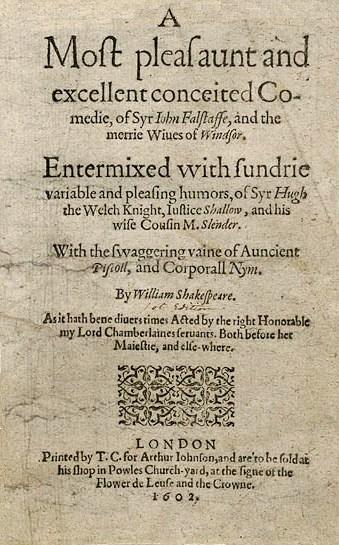
Confession. This was the first time I had ever seen a production of The Merry Wives of Windsor. The Tourist can’t remember there being an opportunity, RSC or otherwise, in those few periods of his intensive theatre-going in the past, and I don’t think there was a production of sufficient quality over the more fallow years to drag him away from the reality of life, work, kids, drink and the like.
Also, I have to admit, TMWOW has always sounded a bit limp, with the Shakespeare industry being a bit sniffy about its worth, dubbing it “the first sit-com”, compared to the other comedies, Twelfth Night, Dream, Much Ado, As You Like It, Errors, Shrew ….. in fact only The Two Noble Kinsmen of the “pure” comedies seems to get a worse rap. (Well maybe The Taming of the Shrew with its impossible to mitigate misogyny without some dubious directorial device). The other criticism seems to centre on the disappointment of taking one of WS’s most “rounded” characters, analytically as well as literally, out of the history plays and plonking him into a class-based farce as the butt of the comedy.
Well just as Barrie Rutter made a case, albeit not entirely convincing, for WS’s (with John Fletcher) last contractural obligation with his Two Noble Kinsmen at the Globe, so director Fiona Laird has served up a peach for the RSC, (though it is just about to end its run at the Barbican). All I can say is that if TMWOW is normally this funny then all those naysayers who are supposed to know their onions when it comes to the Bard need their heads examined.
If it isn’t normally this funny then Ms Laird is to be further congratulated for making it so to a contemporary audience. Shakespeare’s humour comes from plot – usually will they/won’t they romances and unlikely assignations, from – word-play – badinage, punning and bawdiness – and from physical comedy – which, obviously, is not something made explicit in a text. To make a modern audience laugh it usually makes sense to trust Will and let the plot do what it will, play down the anachronistic, and not always easy to follow, wordery and massively ramp up the caricature, mannerism and visual gags. Which is exactly what this production does. With plenty of new interpolations.
If the audience reaction at the performance the Tourist attended was anything to go by, and it seems this has been supported by critics, professional and amateur alike, this definitively worked. I laughed. A lot. In fact as much as I can ever remember for a Shakespeare comedy. It is not as all round satisfying as the best Much Ado or Twelfth Night production but it was still a revelation.
The plot is contrived. And daft. No question. One theory alleges that Will only had 14 days to come up with it after the Queen requested an entertainment for the Order of the Garter festival in 1597 to feature her favourite of his comic creations, Sir John Falstaff. Now, as I sure you all know, Falstaff is way more than just a comic buffoon, as we see in Henry IV Parts I and II, and as Mistress Quickly explains in her eulogy in Henry V. He may be vain, boastful, corrupt, cowardly, a drunk and petty criminal, but he is charismatic and he embraces life and we, and Prince Hal, therefore love him despite his faults. And he is, of course, fat and as everyone knows us fat people, with our seeming inability to control our appetites, and our apparent physical limitations, are just funny.
Humour invariably validates superiority. It takes what the group or society has deemed as unsettling, threatening or just different and turns it into something safe and tolerable. Falstaff, because the genius Shakespeare created him, is doubly funny because he is both the object of our laughter and also, because of his wit and intelligence, the source. Tricky business humour. I am sure that there are plenty of people who would be happy to make a joke at my expense because I am fat. In the same way it would probably make me happy to make a joke at their expense because they are stupid. Like I say tricky business.
Anyway I suspect big Will didn’t waste too much time mulling over the psychology of humour and just got on with the task, knowing which way the Elizabethan bread of patronage was buttered. Which explains the oft observed “lack of subtlety” in the plot and character. Yet, as all students of the situation-comedy know, the best characters in the genre have one, or more, personality traits amply exaggerated. And the best sit-com plots begin with a plausible set-up that gets incrementally ever more ridiculous. Which, give or take, is what happens in TMWOFW.
Falstaff is on his uppers. He pitches up in Windsor, or, in this production a place that feels suspiciously like Chigwell. He resolves to woo a couple of wealthy married women, Mistress Alice Ford and Mistress Margaret Page. He commands his servants, Pistol and Nym, to deliver the ladies identical love letters. They refuse and tell the ladies’s husbands. Page (Paul Dodds) isn’t too bothered but Ford is the jealous type, and he is introduced to Falstaff by the Host(ess) of the Garter Inn masquerading as a Master Brook in order to unveil Falstaff’s plans. Meanwhile, (yep there is always a meanwhile or two in these plots), three other chaps are trying to woo the Ford’s daughter, Anne; absurd French doctor Caius, asinine youth Master Abraham Slender, cousin (here nephew) to Justice Robert Shallow and young Fenton (Luke Newberry), a gentleman now bereft of his fortune.
Cue confusions, set-ups and comic revenges. By the three suitors on the Host(ess), by the two Mistresses on Falstaff, by “Brook” on Falstaff, by Ford on his wife, by everyone on Falstaff, and by Page and his wife on Slender and Caius, and by Anne and Fenton on the parents. It all ends happily though.
These farcical set pieces, replete with disguise and concealment, offer plenty of opportunity for clowning, which the cast, directed by Spymonkey specialist Toby Park, relish and have perfected over the run in Stratford and now London. David Troughton is a brilliant Falstaff, decked out in “fat suit” and priapic codpiece, and booming out his perfectly timed lines. Rebecca Lacey and Beth Cordingley are sensational as the conspiratorial and true friends, Mistresses Page and Ford, with exaggerated TOWIE accents and hamming up their humiliations of Falstaff, both in the laundry basket scene, here a wheelie-bin, and in the Woman of (now) Brentwood scene. Vince Leigh, who I remember pulled off a similar trick in Propellor’s all -male Taming of a Shrew as Sly/Petruchio, manages to make Ford’s jealousy palpable, and not a little pungent, but still amusing, and even gracious, when his suspicions prove unfounded. It is possible to believe that he and Beth Cordingley could be a couple who care beneath the mutual scorn.
Tim Samuels and Tom Padley make a fine double act as Shallow and Slender. All the servants, Ishia Bennison as Mistress Quickly, here housekeeper to Caius, Steve Basaula as his man Rugby, Nima Taleghani as Falstaff’s pageboy and John Macaulay as Simple, offer wry indulgence to the whims of their “betters”. Charlotte Josephine, Afolabi Alil and Josh Finan are also able to inject at least some of the personalities of Bardolph, Pistol and Nym, though these are more developed in the history plays. TMWOW is, at its heart, a satire on the pretensions and affectations of the “middling” class, their preoccupations with wealth, marriage prospects and position in society. Aristocracy is conspicuous by its absence, other than Falstaff and his young doppelgänger the spendthrift Fenton, though Shakespeare chucks in enough references which gently mock his Court audience, and the servants are generally enablers rather than protagonists. This then is obviously immediately recognisable territory for the modern audience, “we are all middle class now”, made more so here by the Essex milieu.
The comedy also takes a swipe at that staple of “English” comedy, foreigners, and specifically their funny accents. No obviously progressive way to do this so best wade right in. David Acton does exactly that with loquacious Welsh parson Sir Hugh Evans, another from the Shakespeare school of Welsh windbags, but Jonathan Cullen goes even further with Dr Caius, offering a Gallic strangling of the English language which goes well beyond the simply Clouseau-esque. A couple of deft retouches create some priceless, and filthy, moments, one of which I fear I might have made up in my own dirty mind as no-one else seemed to laugh. I particularly enjoyed the addition of the East Europeans who come to remove the wheelie-bin, who are snootily looked down on by the assembled throng whilst they, it transpires, are chatting about the scene’s resemblance to Proust.
The final theme of TMWOW seems to me to lie in the power executed by the women. By casting Katy Brittain as the Hostess of the Garter pub she too, along with the Mistresses, Anne, (another fine performance from Karen Fishwick to set alongside her Juliet in this season), and Mistress Quickly, run rings around the lads. They get their own way, and get revenge on the sexual predators, not through compromise, simpering or abasement but through their own agency, and they have a right laugh in the process. Switching the denouement to the town square, rather than Windsor Great Park, with Elizabeth’s statue towering over it, may slightly invalidate Falstaff’s Herne the Hunter garb, though Epping Forest isn’t too far away I’ll warrant, but it does, finally, leave the women on top. I wonder if Liz I herself would might been pleased with this ending.
Lez Brotherston’s set, turning seamlessly to reveal the skeletal interiors and exteriors of the half-timbered houses, is as ingenious as his hybridised costumes, which mix modern and Elizabethan fashions. There is plenty of blingey accessories on show, particular favourites for the Tourist were the blow-up flamingos, Mistress Page’s all in one cerise pink throne and foot-bath, Anne’s fluffy pooch, the f*ck-off massive gas barbecue, the remote-control golf cart and the white leather bar stools. Caroline Burrell has recreated Tim Mitchell’s lighting design particularly effective when the houses turn neon. Gregory Clarke’s sound design didn’t intrude and Fiona Laird’s own composition completed the jolly mood.
OK so there are a couple of occasions when my snob-o-meter vibrated. The Bread of Heaven chorus and the Dick Emery reference might have been steps too far but that is my problem not Ms Laird’s and the RSC’s. Overall this is a cracker of a show, very funny, easily digested and with a few points to prove. Carry On.
Pinter at the Pinter Four: Moonlight and Night School
Harold Pinter Theatre, 6th December 2018
The Tourist is a bit off the pace what with that the holiday celebrations to enjoy/get through (delete as appropriate). Still three more of the Pinter one act plays season to look forward too as well as the Betrayal with that nice Mr Tom Hiddleston playing the part of Robert (with the actors for Emma and Jerry yet too be announced).
Pinter 4 though brought together a couple of the master’s longer one-act efforts leaving no room for any of the add-ons that have characterised the prior outings. Moreover Jamie Lloyd stood aside here to leave the directorial duties to, respectively, Lyndsey Turner and Ed Stambollouian. Moonlight, from 1993, is concerned with the way memory is constructed, and comes from a similar place to Landscape and A Kind of Alaska, the plays that anchored Pinter 3, whilst Night School, from 1979, is a more “conventional” comedy matching many of the smaller scale comic works in the previous collection.
Now I see that many of the proper reviews were not altogether convinced by Moonlight. The Tourist however actually found it to be one of the most intriguing plays of the season so far, even accepting its recondite character. Civil servant Andy (a testy and crude Robert Glenister) is dying and confined to bed. His wife Bel, (the wonderful Brid Brennan who I had unaccountably never seen on stage until The Ferryman) is, with good grace at his ingratitude, getting on with the job of tending to him. Andy, perhaps whilst dreaming, and in bracing conversation with Bel, looks back on the highs, and lows, of his life, including, maybe, an affair with Maria (Janie Dee) and affection for an old friend, football referee Ralph (Peter Polycarpou). We cut alternately to his two sons, the affected Jake (Al Weaver) and more prosaic Fred (Dwayne Walcott), ostensibly in another flat, engaged in enigmatic, (and on occasion near-nonsensical), conversation and impersonation, which, it transpires, is partly their way of avoiding the death of their father. Their younger sister, Bridget (Isis Hainsworth), dressed in bright red duffel coat, also flits in and out: my guess is she might already have died. She certainly has the best lines at the end.
Lyndsey Turner, never one to make her life easy, lets all of her excellent cast do their stuff leaving Pinter’s words and our imagination do the working out. Which is exactly as it should be. Like I say this is a play about a family constructing and re-constructing their past and present. As we all do. There is no definitive “reality” when it comes to our own stories. We only mis-remember fragments of our lives. HP might not be alone in understanding this but he is pretty much the only playwright whose language can turn this into a stage drama where, whilst the old grey matter is whizzing and fizzing in its quest for meaning, we can still simultaneously care about how so and so and such and such can get from A to B.
In Night School, which started life out on the TV, the versatile Al Weaver (it would be good to see him tread the boards more often) is an ex-con, Walter, who returns home to find his room has been let to the enigmatic femme fatale Sally (Jessica Barden). She, we discover, leads a double life as PE teacher, night-school student and hostess in a night-club owned by the seedy Tully (Peter Polycarpou). Walter, when he is not being verbally prodded by retired East End gangster sort Solto (Robert Glenister thoroughly enjoying himself). or molly-coddling landlady spinster aunts Annie and Milly (Bird Brennan and Janie Dee, likewise), falls hook, line and sinker for Sally, bigging up his gang-land connections whilst falling well short with his chat-up lines.
It is actually quite shocking in its ordinariness. As if Pinter were writing a Pinter play with all the Pinter removed and replaced by Ealing comedy and a dash of Orton. It is East End boarding house in the early 1960s right down to the tea trolley and extravagant dropped aitches.
Pinter may have clicked through the gears in terms of power, class, politics, gender, absurdity and metaphysics across his writing career, becoming part of, whilst remaining critical of, the elite, but I reckon his affection for the early days spent in rep and doing odd-jobs never left him. Maybe that’s the reason for Night School’s relative lack of guile. Ed Stambollouian shakes it up a bit though by having Abbie Finn pounding out rhythms on an on-stage drum kit when she is not playing Mavis and having the prodigiously talented Jessica Barden play Sally with a rudimentary ordinariness. No-one here is special, no-one here is either particularly good or bad and no-one here is judged. I could imagine that in the hands of a less talented cast the humour in the characters could come across as very stilted but I loved it.
I have to assume that Soutra Gilmour had, unbeknownst to me, visited the SE London home of my grandad Sid and grandma Lil in the 1960s, in order to secure inspiration for yet another pitch perfect set. Though not the night-club scene in Night School obviously. Mind you it wouldn’t surprise me at all if there was more to Sid’s younger days than met the eye. All I remember is his bottles of Pale Ale, him telling us kids to “sod off” if we came anywhere near him or his newspaper, a bladder-damaging procession of tea courtesy of Lil, an outside privy, wash-basins and shockingly overt racism.
Moonlight was actually the longest play HP wrote in his last three decades and tends to be dismissed thanks to its awkward and uber-cryptic structure. I disagree and reckon Lyndsey Turner has made a case for more frequent revival. Hard to be as ardent about Night School but committed actors made me laugh and I am very grateful for the opportunity to add it to the Pinter tick list.





 At Home He Feels Like A Tourist