Beethoven’s Missa Solemnis at the Barbican Hall review ***

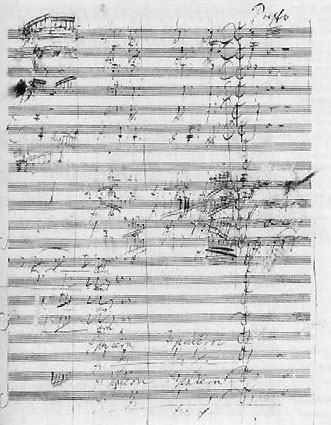
beethoven-missasolemnis-manuscript

London Symphony Orchestra, London Symphony Chorus, Michael Tilson Thomas, Camilla Tilling (soprano), Sasha Cooke (mezzo-soprano), Toby Spence (tenor), Luca Pisaroni (bass-baritone)

Barbican Hall, 20th May 2018

Beethoven – Missa Solemnis

Hard to believe that the scruffy scrawl above is from the hand of the greatest ever composer in one of his greatest ever works. At least he thought so. And so does Michael Tilson Thomas, Conductor Laureate of the LSO, judging by the number of times he has taken it on.

I am not so sure though and find myself siding with Adorno on this. This will probably be the one and only time I can make this absurdly pretentious claim since, however hard I try, I cannot understand a word of what the Frankfurt School of Marxist critical theory was about, though the intellectual posturer in me dearly wishes I did. I would love to know a lot about a lot, or even a lot about a little bit of what there is to know. Instead I am doomed to know a little bit about very little.

The thing is there isn’t much of the theme and variation repetition thing than Beethoven took to unparalleled heights (at least until The Fall and Wire came along) in the Missa Solemnis. The giant fugues at the end of the Gloria and Credo provide me with some structural understanding, and connect with other late works like the piano sonatas and string quartets, but otherwise there is quite a lot of, well, Romantic meanderings.

Now it is Beethoven with massed choral forces offering up a Mass on a scale comparable with the Choral Symphony so it can’t all be bad. And it isn’t. There are stills scraps of cracking tunes which are explored in imitation to conjure up the goose-bump feel that the earlier masters of polyphony managed. Especially in the second half of the Gloria, the middle of the Credo and the beginning of the Sanctus. But there just isn’t the overarching structure to help my little head stay happy. LvB intended to complete the MS for his patron and mate, Archduke Rudolph, who was receiving some honour or other in March 1820. He missed the deadline so didn’t actually complete it until 1823 just ahead of the Ninth. Maybe that changed it.

The LSO chorus is now so bonkersly brilliant that it sort of didn’t matter when they were belting it out. Especially in the soprano section. And, like I say, MTT knows his way around the score. The soloists seemed well matched to me, though I would marginally take Sasha Cooke’s mezzo and Toby Spence’s tenor over Camilla Tilling’s soprano and Luca Pisaroni’s bass-baritone.

I will keep trying but I don’t think I will ever fully succumb to the MS. Whisper it but I am happier listening to the Mass in C which, as Beethovian experts will tell you, leaves me on the nursery slopes and forever banished from the pistes. So be it. Vita summa brevis.


Christoph Sietzen and the Wave Quartet at the Concertgebouw review ****

11611295963_46a7279b5a_o

Christoph Sietzen, Wave Quartet (Bogdan Bacanu, Vladi Petrov, Emiko Uchiyama, Christoph Sietzen)

Het Concert-Gebouw, Recital Hall, 16th May 2018

  • Emmanuel Séjourné – Attraction for marimba, vibraphone and tape
  • Iannis Xenakis – Part B (from ‘Rebonds’) for percussion
  • J.S. Bach/Brahms – Chaconne (from Second Partita in D, BWV 1004) (arr. B. Bacanu) for marimba
  • Stewart Copeland – Sheriff of Luxembourg for marimba, percussion and tape
  • Ivan Boumans – The Cloth, op. 140 (encore) for percussion
  • Josh Groban – The Wandering Kind (arr. E. Uchiyama) for marimbas
  • J.S. Bach – Allegro (from Concerto in C, BWV 1061a) (arr. B. Bacanu) for marimbas
  • Astor Piazzolla – La muerte del ángel (arr. E. Uchiyama) for marimbas
  • Astor Piazzolla – Oblivion (arr. E. Uchiyama) for marimbas
  • Reentko Dirks – Danza non Danza (arr. The Wave Quartet) for marimbas
  • Astor Piazzolla – Milonga del ángel (arr. E. Uchiyama) for marimbas
  • Astor Piazzolla – Libertango (arr. E. Uchiyama) for marimbas
  • Rodrigo Sanchez / Gabriela Quintero – Tamacun (arr. E. Uchiyama) for marimbas
  • Rodrigo Sanchez / Gabriela Quintero – Juan Loco (arr. The Wave Quartet) (encore) for marimbas

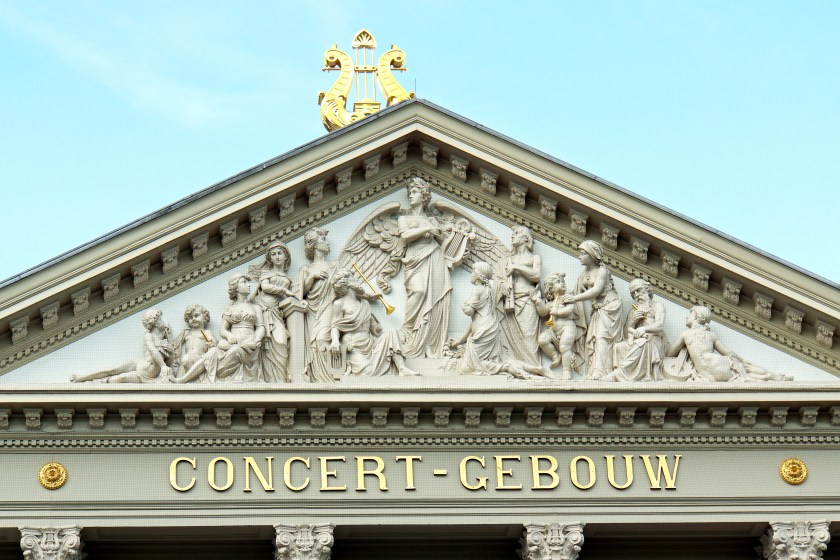
OK so I confess I was a captive buyer for this. This was what was on in the Concertgebouw on the night I was there. There were a few other tourists in the same boat, and a healthy contingent of local Amsterdammers. Which, even in the smaller, though still resplendent recital hall, made up a full house. The recital hall, in full blown neo-classical style, is topped by a rotunda with the names of the Romantic greats immortalised, and some not-so-greats as well.

Anyway whilst I didn’t know the percussionist Christoph Sietzen, and the crack marimba team of which he is a member, the Wave Quartet, this programme intrigued. In particular the Xenakis, who is near the top of my further investigation list, the Bach and the Piazzolla. The programme consisted of the first five pieces for solo percussion with Mr Sietzen and then the pieces for the entire quartet, largely arranged by Ms Uchiyama. Bogdan Bacanu, who might just be the most accomplished marimba player ever, and certainly its greatest advocate, was a child prodigy and went on to teach the other three members, amongst others, in Linz and Salzburg I believe. He is also responsible for the Bach arrangements, which are completely faithful to the originals.

Remember there are a lot of works by Bach that weren’t necessarily written for specific instruments but its a fairly safe supposition that he didn’t have a percussion instrument in mind when he set down the pieces here. On the other hand the marimba, which is by some way the most expressive and dynamically sophisticated of the percussion stable, ranging across 4 or 5 octaves, even if its timbre is so particular, isn’t too far away from the harpsichord in terms of effect. It is, as we see here, becoming increasing popular in contemporary classical music and the technical proficiency of playing has come on in leaps and bounds in part thanks to Mr Bacanu.

The first piece was by Emmanuel Sejourne who is the pre-eminent composer for marimba and vibraphone and a world renowned player. It was originally written for violin and marimba but here Mr Sietzen substituted violin with a vibraphone. I have to say it was impressive though I might have preferred to here it later on once I had adjusted to the marimba sounds. Even so it is breathtaking to hear what is possible for these instruments.

Xenakis composed two pieces for solo percussion, this piece Rebonds, and Psappha. It isn’t much of a surprise given the composer’s mastery of rhythm and structure but it is genuinely mind-boggling in its complexity. There are two movements in Rebonds. Mr Sietzen only played Part B, a shame as I would love to have heard Part A as well. It is scored for two bongos, one tumba, one tom-tom, one bass drum and a set of five wood blocks or wooden slats. Xenakis leaves some decisions on the score to the performer, all part of the mathematics of his music, (remember he was architect, engineer and mathematician as well as composer and not averse to shunting the laws of physics into his work). Xenakis is so far beyond what I understand in music but, trust me, the intensity of the rhythms here, despite the abstraction, still provokes a basic, primal reaction which needs no maths degree. You will laugh at me, but if you have listened through a John Bonham drum solo in Moby Dick (Google it kids), you will understand, though this is way more sophisticated than Bonzo thrashing away.

I took the opportunity to listen to Psappha. Amazing.

You will likely know the Bach Chaconne from the Violin Partita No 2 which Brahms amongst others transcribed for the piano left hand. (There is a YouTube performance by Danile Trifonov no less if you are interested and if you want the violin original please listen to Rachel Podger’s recording). I am not going to pretend that this marimba version matches that but it is still absolutely the same beautiful piece of music and shows astonishing virtuosity.

The Stewart Copeland piece, which was commissioned for Mr Sietzen, was a little less convincing by comparison to what else was on offer in this recital but was pleasant enough. Mr Copeland, for you youngsters who regard this as ancient history, was the drummer for popular English beat combo The Police in the 1980s, whose cod-reggae sound should never have worked, and never have been as popular, but it did, and it was. Mr Copeland has gone on to write film and game soundtracks and some classical compositions including this. Prior to the Police he was manager and drummer for Curved Air for those of you with an unhealthy interest in progressive jazz-rock. (Never ever get into conversation with me about Soft Machine).

After Mr Sietzen’s marvellous show of musical, and physical, prowess in the first half we might have expected something more sedate after the interval. No way Jose. (That being a reference to the Latin fuelled energy of the last few pieces). The Wave Quartet were decked out in bright red shirts, think Kraftwerk circa Man Machine without the black skinny ties and Fascist undertones.

There are many areas of music which are a complete mystery to me. I had never heard of Josh Groban before. Apparently he is a big noise though in the popera world. I can happily maintain my aloof indifference on the basis of this piece.

The second Bach piece is arranged from the first movement Allegro two harpsichord version of the Concerto BWV 1061 for the same instruments. So each of the four marimbas players with their two mallets (called knobs) in each hand is effectively one hand of the score. Given that the harpsichord notes can’t really sustain there is sound logic (literally) to transcribe to marimbas. It works, though I am not sure I would turn to this again in a hurry. I can’t deny Mr Bacanu’s dedication in adapting Bach in this way. I see the Wave Quartet have recorded the other harpsichord concerto arrangements with orchestra.

Astor Piazzolla was the genius Argentine who meshed the tango, the Baroque and jazz into a fresh and exciting musical world in the 1950s and 1960s. I can see exactly why the Wave Quartet would want to play these pieces. You will definitely know the Libertango. (I first heard in I’ve Seen That Face Before by Grace Jones). You will think you know the other pieces. The arrangements didn’t seem too complex which meant the Wave Quartet could pull of all sorts of flourishes. They were having a ball and so was the audience. The Reentko Dirks and Sanchez/Quintero pieces, originally for guitar, have similar heritage, with the final Juan Loco seeing young Vladi Petrov showing off on a simple beat box drum. Cheesy but undeniably joyous.

There you have it. A celebration of just what percussion can do and a salutary reminder not to get bogged down in serious classical music.


Spira Mirabilis at the Queen Elizabeth Hall review ****

Messier51_sRGB.jpg

Spira Mirabilis

Queen Elizabeth Hall, 15th May 2018

Beethoven – Symphony No 7 in A Op 92

Spira Mirabilis is a group of talented young musicians from around the world who play in various European orchestras. They hole up in Formigine in Northern Italy near Bologna to learn from each other and devote themselves to intensive study of major orchestral works of the canon which they then take around Europe to entertain us punters, and, more importantly, show us how it is done. I suspect they also have a bit of craic along the way.

The twist is that they have no conductor. Which means, in the spirit of a chamber ensemble, they have to “immerse themselves in the score with the aim of reaching an interpretative consensus on a shared vision and a complete synthesis with the work”. Now if you thought that the conductor of an orchestra, as I did a few years ago, was just there on the podium to provide a bit of visual light relief,  you would be very much mistaken. Someone has to impose a musical vision on even the most detailed score involving all manner of decisions on tempi, dynamics, who does what where, when and why, and all manner of other stuff way above my pay grade. If you dump his or her direction then I imagine you are collectively setting yourselves up for one hell of an away day. Yet this is exactly what they do with the intention then of trying to explain to us how they did it. Wonderful.

In this case they just happened to pick, IMHO, the most perfect piece of music ever written. I believe Beethoven to be the greatest of composers, the symphony to be the most complete musical form and this to be his best. Though I can see why others might disagree with any and every part of that statement. Moreover I admit that there are individual pieces by modern composer/performers in popular music genres that would just edge it for me on the eponymous desert isle. (I should probably post something on that).

Spira Mirabilis have in fact already been through an entire Beethoven cycle, good call, so this constituted something of a revival. Yet there was still a palpable sense of excitement in the Hall ahead of, and through, this performance. When Beethoven wrote this his hearing had significantly deteriorated and he had retired to the spa town of Teplice in order to gee himself up. There is no programmatic intent, unlike its predecessor the Pastoral, yet it is an astonishingly uplifting, happy work. That maybe because it is essentially dance music. Anyway it was a hit from the off and it is easy to see why.

The first movement starts slowly but when the “dotted” rhythmic figure finally kicks in LvB proceeds to push and pull it around in so many ways that it barely seems plausible that it can tolerate this level of innovation. If you ever need to understand Beethoven’s genius in taking simple material and wrestling it into music of unparalleled emotional and intellectual power through progressive variation, it lies here. This is the longest movement of any of the symphonies.

Then there is the Allegretto. A funeral march where the ostinato is repeated and repeated until it attains monumental proportions. Strings largely in minor keys, woodwinds take the major. If you need to give someone important to you a good send off, alive or dead, this is the music you need. It is the most hummable tune ever written. The Presto that follows is joyous and funny and contrasts with its central hymnal trio and the Finale cuts loose completely. I’ll warn you. Avoid sitting next to a fat bloke, likely in shorts, probably leaning forward, imperceptibly wiggling his fingers, in time just about, if the Finale of the Seventh should be playing. He might just start sobbing. With joy. Truly pathetic.

It takes a marvellous performance to overwhelm me and I have to confess this wasn’t quite there. It was insightful in glimpses, especially in the third movement, the negotiation between the players was intriguing and there was a slippery quality I liked. Tempos were sensible but I might have preferred something a little brisker in the first two movements, especially in the second subject of the Allegretto. But I still think the necessary compromises made everyone hold back just a bit. A sense of “after you Claude”. I am all about consensus in the “real” world but in the realm of the creative democracy can only take you so far.

I also have to confess that I didn’t stay for the post match replays and interviews. No good excuse other than wanting to see the SO and LD that evening. Though they of course completely ignored me when I got home early. I discovered that Spira Mirabilis had repeated the second movement, this time whilst randomly sitting in the audience. Damn. I wish I had stayed for that.

Still overall a fine performance of a transcendent work intriguingly delivered.


Ligeti in Wonderland at the South Bank review *****

ligeti1

Ligeti in Wonderland

Queen Elizabeth Hall and Purcell Room, 11th, 12th and 13th May 2018

Pierre–Laurent Aimard (piano), Tamara Stefanovich (piano), Patricia Kopatchinskaja (violin), Marie-Luise Neunecker (horn), Daniel Ciampollini (percussion)

  • Ligeti – Poeme symphonique for 100 metronomes,
  • Ligeti – 3 pieces for 2 pianos (Monument, Selbstportrat, Bewegubg),
  • Ligeti – Trio for horn, violin and piano
  • Steve Reich – Clapping Music
  • Ligeti – Etude No 8 for piano and percussion
  • Conlon Nancarrrow – Piano Player studies Nos 4 & 9 arr. for 2 pianos
  • PL Aimard – Improvisation for 4 hands on Poeme symphonique for 100 metronomes
  • PL Aimard – Improvisation for piano and percussion on Ligeti’s Etude no 4 (Fanfares)

Shizuku Tatsuno (cello), Katherine Yoon, Yume Fujise (violins), Tipwatooo Aramwittaya, Ilaria Macedonia (harpsichords), lantian Gu, Laura Faree Rozada. Joe Howson (Pianos)

  • Sonata for solo cello
  • Ballad and Dance for two violins
  • Continuum for solo harpsichord
  • Passacaglia Ungherese for solo harpsichord
  • Musica Ricercata for solo piano

Pierre–Laurent Aimard (piano)

  • Etudes Books 1,2 and 3

Pierre–Laurent Aimard (piano), Patricia Kopatchinskaja (violin), Marie-Luise Neunecker (horn), Nicholas Collon (conductor), Aurora Orchestra, Jane Mitchell (creative director), Ola Szmida (animations)

  • Chamber Concerto
  • Piano Concerto
  • Hamburgisches Konzert
  • Violin Concerto

Hello. The review starts down here. As you can see the Tourist, along with many others, similarly intrigued and maybe enraptured by the music of Gyorgy Ligeti, put in a shift enjoying this weekend of music dedicated to his music.

Not one second was wasted. Some of the pieces stood out, the Trio, the piano works especially the Etudes and the Violin Concerto, but overall this was a fantastic array of performances of this brilliant composer. Wonderland for sure.

Now it takes a few decades before the new in all art forms is appreciated. Classical music, even in its most saccharine form, is not going to be for everyone. Yet it seems pretty clear to me that Ligeti, ahead of the other big name Modernists who transformed Western art music in the middle of the last century, is the one most people would choose to listen to. There is innovation and extension in his sound world for sure, there is intellect aplenty and there is memorable structure, though not the mathematical -isms of his peers, but most of all there is a depth of expression that anyone, even this muppet, can grasp. Add to this rhythm, of sorts, power, humour by the bucketload, and it’s easy to see why he gets performed a fair bit more than his contemporaries. He wasn’t sniffy about minimalism and he embraced music from other cultures. If you want to dip your toe in the modern classical world then this is definitely where to start.

There is a grand, ambitious, searching quality to his music, audible even in these smaller scale chamber and solo works. More often than not the works teeter on the brink of chaos but always, one way or another, resolve so I think it is optimistic on the whole. And, importantly, as with Luciano Berio, (another favourite for me alongside Xenakis and Penderecki), the history of art music is not smothered or ignored.

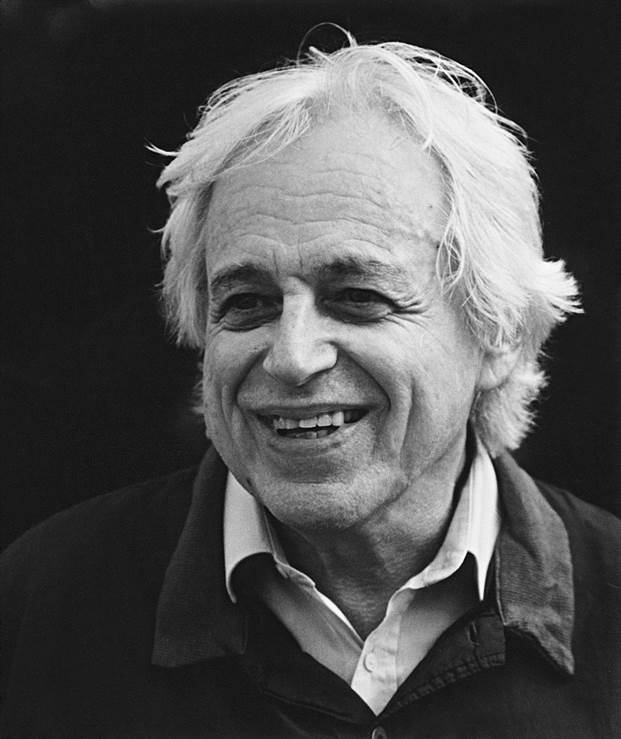
Where, variously Romania, Hungary, Germany and Austria, when, the War, (only his mother survived the concentration camps from his Jewish family), the Cold War, the 50s, 60s and 70s, what, as he moved through electronic and the Cologne School, to “micropolyphony” and then “polyrhythm”, all tumble out of his music like an avant garde encyclopedia. Know all those sounds that inhabit movie and TV soundtracks, when the creatives what to think big, go cosmic or generally scare the pants off you. Ligeti kicked it off, when Kubrick nicked his grooves for 2001. Music as texture. He even looks the part.

One more thing before I end this wall of pretentious guff. He always knew when to stop. Twenty minutes tops, even for the concertos. Most works clock in under ten minutes. Even opera Le Grande Macabre is under two hours. Genius.

The first concert kicked off with the Poeme symphonique for 100 metronomes. Yep there are 100 metronomes on stage set up with different beats. The performers skip on and set them off. Randomly. Of course it’s a joke, intended to explore the notion of chance in music (a la John Cage) but it becomes hypnotic, even a bit tuneful as patterns emerge from the chaos, and the gambler in me was desperate to have a punt on the last metronome clicking as it were. The survivor. An important concept for Ligeti given his personal history.

Pierre- Laurent Aimard was joined by regular collaborator Tamara Stefanovich for the two player piano pieces which preceded the Etudes. The first, Monument, sets up a cyclical rhythmic pattern which is then toppled with both players ending up at the very top of the keyboard. The second is an homage to minimalists Reich and Riley, fast scales and arpeggios with a backdrop of “silent” keys. This ends up in the bass. The third, Motion, is a canon, if you concentrate, which echoes the first piece.

The Trio is apparently an homage to Brahms. Search me. I suppose it does have a more Romantic structure than the polyrhythmic later Ligeti pieces. There is a sonata form opening, followed by a rapid ostinato with folky tunes wrapped around it, then a crooked march and a finale nicked from chords in Beethoven’s Les Adieux sonata. The main interest lies in the way the natural horn, with no keys and therefore lots of “out-of-tune” strange notes contrasts with the mannered piano, leaving the violin to hop between the two given its ability to produce natural harmonics. Since Ligeti dedicated his horn concerto (heard in the last concert) to Marie-Luise Neunecker, PL Aimard is the towering interpreter of Ligeti’s piano music and Pat Kop is my absolute favourite violinist in C20 music, there is no way this could have been bettered.

Then the fun started as PL Aimard and Daniel Ciampollini gave us a short rendition of Reich’s Clapping Music, (if you don’t know it the clue is in the title), which segued into Liget’s eighth Etude with Mr Ciampollini playing around it on his percussion kit, Nancarrow wrote his 49 Etudes for player piano because they were unplayable. Not so it seems, for these two particular studies, when four hands get involved. Then our percussionist interrupted on PL Aimard’s piano, and then both page turners, so all five were dinking out a version of the metronome piece that kicked things off. It was very droll though I admit you had to be there. Finally a dressed down version of Ligeti’s fourth etude.

Who knew classical music could be this much fun? OK maybe fun is stretching it but this whole performance emphasised the sharp humour which underpins Liget’s work as well as being a showcase for his rhythmic genius.

The next (free) concert was in the Purcell Room and involved students from the Royal College of Music. It mixed up some of the later solo Ligeti works with some from his early days in Romania and Hungary. As is always the case with RCM students the performance was at a very high level, better than many “professional” equivalents. Indeed this bunch already, largely, are on the circuit already. They all have jaw-droppingly impressive CV’s. I would single anyone out – they were all marvellous.

I heard the solo Cello sonata recently (Peter Wispelwey (cellist) at Kings Place review ****). It has been a nailed on cello classic since its premiere in 1979, though it was written in 1954. It was initially banned in Hungary by the “Composers Union”, a Stalinist censor. Two movements, a Dialogo, a conversation between a man and a woman, two ostinatos alternating between the upper and lower registers, and a Capriccio which has all sorts of thrilling extended techniques. (As an aside it would have been great to have recruited a cellist to the weekend cause to have a crack at the Cello Concerto with its bonkers high sustain at the end of the first movement).

The Ballad and Dance (1948) echoes Bartok with its loose transcriptions of Romanian folk songs. It is as easy to listen to as it sounds. Ligeti went on to explore Romanian folk songs in his Concert Romanesc (which sounds about as un-Modern and late C19 as it is possible to get).

Continuum was written for a two-manual harpsichord which can’t get up to much dynamically. The idea is that the notes are played so fast that the rhythm melts into a continuous blur. Almost to stasis. It looks and sounds like hard work to play but Tipwatooo Aramwittaya, (who appears to have medicine to fall back on if music and performance doesn’t pan out, which it will), was as cool as a cucumber. Like much of Ligeti the sounds are viscerally arresting but this is not mere novelty. Apparently it has been adapted for barrel organ to make it even simpler and even faster. The Passacaglia Ungherese, in contrast, is a repeated four bar descending ostinato intended to mimic the ground bass of the Baroque and was intended as a p*ss-take for his students, and those of us today, who love to keep moving to those Baroque grooves. It has some dancey counterpoints, obviously, and is marvellous. I need a recording.

The Musica Ricerta, like the Cello sonata, is a kind of experimental training work that Ligeti wrote in Hungary in the early 1950s away from the gaze of the censors. In each of the eleven pieces he places various restrictions on pitch, intervals and rhythms. they get sequentially more complicated as the number of pitch classes increases from the basic A in the first piece. Music for the brain for sure, but, as ever, Ligeti doesn’t skimp on the aesthetic. He loved sound you see.

This brings me neatly to the concert devoted to Ligeti’s 18 Etudes set across three books, started in 1985 and completed in 2001, his final work. All the influences on his “final late” period are there, central European folk music, Debussy, fractals, African cross-rhythms and Conlon Nancarrow. They are fiendishly difficult to play as Ligeti explores the entire range and possibility of the piano and piles layer upon layer of music. A fair few have a hectic, even aggressive quality, as they pile up into a rapid resolve but there are also poetic moments. There is a reason why M. Aimard is the pre-eminent performer of these pieces and the full house here was privileged to witness it. One of the best concerts I have ever attended.

The final concert expanded the player forces with the Aurora Orchestra under Nicholas Collon taking to the stage. The Chamber Concerto is a nailed on classic of the modern era, small-scale orchestra, 20 minutes in length, (no-one dares go further in new music, if only because it won’t get performed), and boundary-pushing. The opening movement has the instruments sliding around until they bash up against each other, then the winds sing out, before it all subsides. The second movements is a kind of mashed up Romantic fantasia which goes a bit awry, to be followed by a mechanical march, a clock factory under attack. The Presto finale is in a similar vein though ends perkily. If you ask me it is like a mini Rite of Spring, though as if some talented musicologist had discovered a partially burnt, muddled up copy of the score many years later. I am still trying to work it out.

The Piano Concerto is an even more uncompromising chap. Movements 1, 3 and 5, all quickest require the pianist to set the rhythms against which the orchestra adds snatches of melody. The second and fourth movements are more of a partnership. In the second the silly instruments, whistles and ocarinas, enter the chorale and in the fourth Ligeti sets up his head-spinning fractal structures. It is pretty quirky overall, sometimes confrontational, but immensely rich. I think it was the one piece over the weekend which really pushed the audience.

The Hamburgisches Konzert, Horn Concerto, was written for Marie-Luise Neunecker and in honour of Hamburg where he lived for 30 years. It is written, in part, for natural horn and exploits the strange harmonies which can emerge from the pure overtones of that beast. Finding out what sounds can do is part of the modern classical world but Ligeti, even here, never forgot to ensure this was set in a profoundly musical context. There are seven short movements. The soloist shifts between natural and valved horns, the four horn players in the orchestra, (all fine players, Pip Eastop, James Pillai, Ursula Monberg and Hugh Sisley), accompany on natural horns, the orchestra, except in the fourth movement takes a back seat. Now there is no doubt that the horn sound is a beautiful, extraordinary and eerie thing, (listen to Britten’s Serenade for a more comfortable alternative), but, to be fair, it can’t get up to much. But what it can do is showcased in this concerto and Ms Neunecker is probably the best person on the planet to show us how.

Having said that it was the Violin Concerto that brought the house down. Pat Kop is a magnetic stage personality, as she skips about, every inch the gypsy fiddler, in bare feet. The work is meat and drink for her, she even chucked in her own, entirely sympathetic cadenza, roping in the lead violin of Alexandra Wood. But the Aurora Orchestra also rose to the occasion. There are all sorts of non-standard tunings at work here, in the brass, in the woodwinds, even in one violin and viola. And, of course, the soloist, if they know what they are about, can bounce around to exploit the strange harmonics as GL intended. There are five movements, all of which exploit the coincidences, but the clarity of the interplay makes these sound more chamber-like than its two concerto peers. And dear reader there are passages, like the Aria at the beginning of the second movement, that are not at all scary. I promise. It’s a masterpiece I reckon.

So there you have. Possibly the best composer of the latter half of the C20 shown off to stunning effect by musicians who clearly love his work. You could feel the buzz in the room/s. The Barbican, courtesy of the BBCSO, has a “Total Immersion” day devoted to Ligeti on 2nd March next year, which repeats some of these works but offers up some choral and larger scale orchestra works. Do go.



Gustavo Dudamel and the Los Angeles Philharmonic Orchestra at the Barbican review ***/***

image-disney_concert_hall_by_carol_highsmith_edit

Los Angeles Philharmonic Orchestra, Gustavo Dudamel (conductor)

Barbican Hall, 2nd May and 4th May 2018

  • Esa-Pekka Salonen – Pollux
  • Edgar Varese – Ameriques
  • Shostakovich – Symphony No 5
  • Beethoven – Symphony No 9 “Choral”

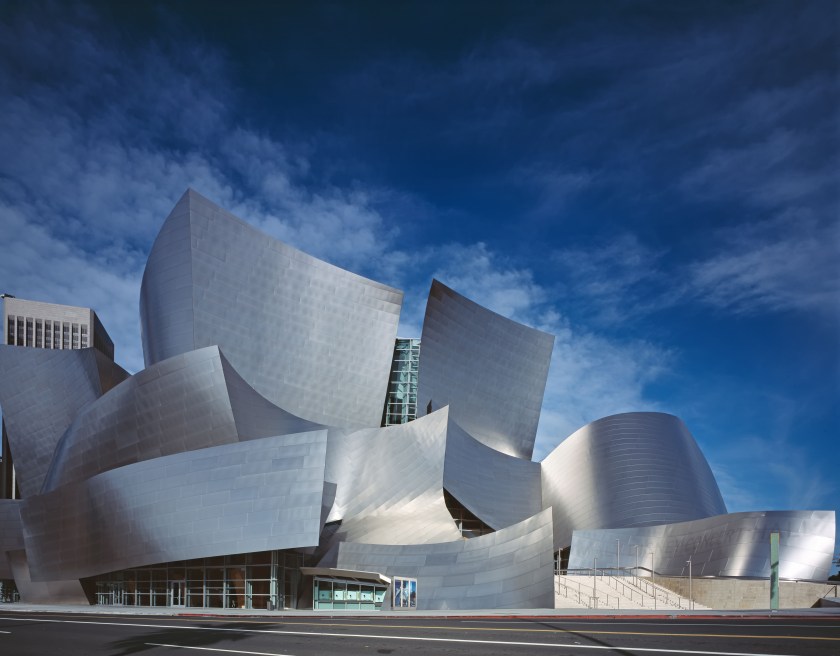
Canny students of architecture will realise that the pic above is not of the Barbican. The Brutalist Barbican Estate is a thing of beauty to my eyes, though not to many others I realise, but surely no-one can be anything other than blown away by Frank Gehry’s Walt Disney Concert Hall, home to the LA Phil under current Music Director Gustavo Dudamel. I’ve never been there but I think have been driven past a couple of times. On the bucket list.

There was enough in the two main programmes on offer this year from the LA Phil’s residency at the Barbican for the Tourist to pitch up to both, albeit with some trepidation. The last time I saw Senor Dudamel and his fine head of hair was with his other band, the legendary Simon Bolivar Symphony Orchestra. They bashed out a showy Petrushka and Rite of Spring. In places it was electrifying, in others mystifying, (not mystical). I don’t know if at 37, and into his ninth year at the LA Phil, building on Esa Pekka Salonen’s legacy, S. Dudamel can still be counted a wunderkind. He is still as wilful as ever though.

As was revealed here. The first concert kicked off with a piece by Esa-Pekka Salonen himself, the man who is credited with turning the LA Phil into a contender for the US’s best orchestra, and certainly its most innovative in terms of contemporary classical music. We are lucky to have the fiery Finn, (fiery as Finns go I reckon), in London with the Philharmonia Orchestra, especially when he turns his baton to Stravinsky. As a composer though, I am less sure. This was the European premiere of Pollux, which, in time, will be paired with Castor, to mean both twins of Greek legend, immortal and mortal, are brought to musical life. Pollux is slow and dark, in the composer’s words, Castor will be faster. EPS nicked a bass line from a post-grunge band, slowing it right down, a chorale from a Rilke sonnet about the boy Orpheus and slipped in an Ancient Greek Aeolian echo. All right over my head. It bubbled along pleasantly enough, all clusters and modes, but I am afraid left no mark on me.

I have tried Varese’s Ameriques a couple of times now with limited success. I get how important Varese was, in retrospect, to the development of modern classical music, and I enjoyed the programme of chamber scale pieces delivered by Guildhall School students as part of the Varese immersion day at the Barbican this time last year. But Ameriques is just a noise. Of noise. And it is very noisy. Especially here as GD let his percussion and brass sections run riot. It is difficult not to feel something from the sheer, physical energy of the piece, and the Debussyian and Stravinskyian shards provide texture, but it just doesn’t go beyond the immediate wow.

Now I read a review that contained a remark along the lines that US orchestras can’t really do Shostakovich because they are “too well-fed”. I think that about sums it up. In my limited experience the best performances of DSCH’s symphonies are either the very lean, uncompromising performances from Russia orchestras in days gone by, or from contemporary European orchestras who can capture the essence of those orchestras, whilst harnessing their greater playing skills. Put a Russian conductor in charge of a British orchestra and you have a guarantee of success. Or better still just hand it over to maestro Haitink.

This Fifth would have left a smile on Joe Stalin’s face. DSCH’s Mahlerian tendencies were loud and proud and the D major finale was bombastic, yes, but still felt like genuine, not forced, adulatory. I think GD and the LA Phil were at their best in the second movement scherzo, (as they were in the imposing, fugal scherzo of the Choral Symphony), with its waltzy rollercoaster rhythms and distinct central trios. The Largo third movement, just strings and a touch of woodwind, was way too rich for my blood and the first movement was too mannered as it shifted from slow to fast and back again. The canons, at the opening for strings, and then between flute and horn, and violin and piccolo, in the recapitulation were as striking as ever but the lyrical second theme was too smooth by half. DSCH strings need to have a bit of acid about them, even in this, the friendliest and most “classical” of his symphonies.

GD and the LA Phil were at it again a couple of nights later for the Choral Symphony. I didn’t bother with the Chichester Psalms in the first half as I don’t like it. Sorry. Most of the Beethoven I listen to is “period informed” and/or nips along at a fair lick. The plushest of the recordings I have is probably the oldest, (in terms of how long I have had it), in the form of Karl Bohm and the VPO. GD and the LA Phil offered an even weightier interpretation. As you might have guessed I didn’t take to it.

I heard a fantastic rendition from the LSO in this very Hall under Bernard Haitink. My favourite concert of 2015. The London Symphony Chorus was in fine fettle on that evening as they were here. For me they were the best of the instruments on show. Actually let me rephrase that. All the instruments on show were impressive, it was just that by the time, every one had had their say, the line and structure of Beethoven’s masterpiece got a little lost. The release at the start of the finale felt a little reserved and the coda was bashed through like a getaway car. Julianna Di Giacomo’s soprano is a thing of some beauty but got a little to bright here, Jennifer Johnson Cano’s mezzo was a little indistinct. The lads done well, Michael Konig tenor and especially Soloman Howard’s bass.

All in all then an interesting couple of evenings, if not as involving as I would have expected, for what are, two of the greatest major works ever written. The LA Phil is well upholstered, professional to a man and woman, but put together with GD’s over-emphases and exaggerated tempi, (including the relaxed in the paddock approach to start times), not quite as astonishing as I had been led to expect. To be fair the Barbican Hall acoustic doesn’t take kindly to this sort of full throttle treatment but that’s what rehearsals are for.

Mind you I clearly was in a minority. On both nights the full house went bananas at the end. Horses for courses I suppose.


Shostakovich from the Philharmonia and Ashkenazy review ****

vladimir_ashkenazy

Philharmonia Orchestra, Vladimir Ashkenazy (conductor), James Ehnes (violin)

Royal Festival Hall, 29th April 2018

Dmitri Shostakovich

  • Violin Concerto no. 1 in A minor, Op.77
  • Symphony no. 4 in C minor, Op.43

Apparently Vladimir Ashkenazy was at the premiere of the Fourth Symphony. In 1961, in Moscow, 25 years after it was written, DSCH having withdrawn it after Stalin metaphorically beat up him and his music in Pravda. How amazing is that. 57 years after that premiere a still sprightly 80 year old Mr Ashkenazy bounded up to the podium and delivered as committed a performance of the Fourth Symphony as you are likely to hear. Ably assisted by the massed forces of the Philharmonia, of which he is Conductor Laureate, let loose on a piece of the repertoire which is outside their normal C19 staples.

For those they don’y know it the Fourth is a curious beast. It contains plenty of recognisable DSCH tropes across its hour and a bit and its three “movements”, and is more Mahlerian in concept and execution, than the later symphonies. Indeed it shares the same key, C minor as the Resurrection, and a second movement akin to that symphony’s Des Knaben Wunderhorn third movement scherzo. Alas, if you were a Russian apparatchik in the 1930s it was bereft of the required redemptive triumphalism that Mahler delivered in his final movement. Mahler’s third was also an inspiration though it takes a knowing conductor to locate it.

It has a lot of bits and pieces, showing a resemblance to the modernism of DSCH’s early works, which he was supposed to have left behind. Idea after idea is introduced then discarded. Fun, but a little wearing, especially when compared to the long arcs of narrative in the later symphonies. You can see where all those polystylist Russian composers that followed DSCH, like Alfred Schnittke, got their ideas from. The shorter central movement is easier to read, with its nagging four note motif, but the opening fastish, and the closing slow/fast movement with its two massive codas are, to coin a phrase, all over the shop. DSCH is showing off, but it does get you to wondering where he might have gone if he hadn’t had to tread the line between undermining, and seeking the approval of, the capricious regime. Not saying that old Joe was good for Dmitry just that the ugly reality made him do more with less (ideas not instruments).

I have the well regarded recording by Vasily Petrenko and the Royal Liverpool Philharmonic Orchestra which doesn’t dilly-dally in either of the outer two movements which allows the ear, and brain, to discern a sonata-like structure amidst all the madcap invention. I don’t think Mr Ashkenazy was quite as bold with his tempi, so I don’t think it hung together quite as well as this recording, but this was still a performance to intrigue rather than confuse. Anyway you look at it though, these outer movements, clocking in just under half an hour each are going to have intervals of misunderstanding. Best then to admire the playing of the ton, literally, of members of the PO on stage, especially the woodwind, a match for the LPO in the DSCH symphonies, though the LPO has the benefit of Vladimir Jurowski’s increasingly brilliant readings.

So not the place to start if you don’t “get” Shostakovich. The popular First Violin Concerto certainly is though, especially with a soloist as assured as James Ehnes. The last time I heard Mr Ehnes was in a magical Messaien Quartet, alongside the Shostakovich Second Piano Trio at SJSS (Quatuor pour la fin du temps at St John’s Smith Square review *****). Mr Ehnes is a tall fellow, think Elrond to Mr Ashkenazy’s Bilbo Baggins, and it takes a seeming age for his bow to move across the strings given his very upright style. Looks can be deceiving though, as we all know, for, when Shostakovich asks the soloist to deliver in the lengthy cadenza between the third movement Passacaglia and Burlesca finale, he answered with aplomb. He was similarly convincing in the Passacaglia itself, one of DSCH’s genuinely “grand” inventions with its references to the Leningrad Symphony and the fate motif from Beethoven’s Fifth.

As with the Fourth Symphony there was a hiatus between the work’s completion in 1948 and first performance in 1955 (after Stalin’s death in 1953), by its dedicatee David Oistrakh with the Leningrad Philharmonic, a consequence of the Zhdanov decree. The piece is apparently Hamletian in scope, can’t see it myself, as well as symphonic in form, with a gentle, Elgarian Nocturne, preceding a “possessed” Scherzo (with the classic autobiographical DSCH motif, so common in later works, snuck in for the firs time), the aforementioned Passacaglia and the pumped up finale with glimpses of material from the other movements, including the folky dance of the Scherzo. Once again the PO woodwind shone.

So a fine evening presided over by a genuine grade A maestro. I am a big fan of Mr Ashkenazy piano playing, especially in Beethoven and Chopin, and even when it goes a bit off-piste. Unfortunately I never saw him play the piano live. I don’t suppose I ever will. Meanwhile this was more than adequate compensation.


Stravinsky, Debussy and Shostakovich: LPO and Leif Ove Andsnes at the Royal Festival Hall review ****

16794762330_2b22b89018_z

London Philharmonic Orchestra, Vladimir Jurowski, Leif Ove Andsnes (piano)

Royal Festival Hall, 18th April 2018

  • Stravinsky – Symphony in C,
  • Stravinsky – Tango arr. for orchestra
  • Debussy – Fantaisie for piano and orchestra
  • Shostakovich – Symphony No 6 in B minor, Op 54

I am pretty confident that no-one reads the reviews of classical music concerts posted here, not should they, since I know so very little about the music I hear, and what I do learn is ruthlessly plagiarised. But if you do stumble across this “content” by accident it really helps if you like Igor Stravinsky and Dmitry Shostakovich. A combination of my taste and that of those responsible for programming in the finest London venues means there is a lot of these two fellas on show here. More than I had realised.

This was another instalment of the Stravinsky Changing Faces festival at the South Bank, this time from the LPO under Vladimir Jurowski’s baton rather than one of their guest conductors.

Before I get to this a shout out for the free concert in the Hall just before this from members of the LPO Foyle Future First programme. This has been created to nurture talented young musicians who aspire to a career in the orchestra. They kicked off with a bouncy rendition of Stravinsky’s “Dumbarton Oaks” Concerto, then tackled some short pieces by Elliott Carter, Luciano Berio, Edison Denisov as well as Stravinsky’s own Epitaphium, a commemoration piece for flute, clarinet and harp, which acted as the inspiration for the other pieces which, in their turn, commemorate IS. The last piece was the more substantial Furst Igor, Strawinsky by Mauricio Kagel, drawn from Borodin’s opera Prince Igor and showcasing the dramatic singing talents of young bass Timothy Edlin, and some startling percussion effects.

I chanced upon this concert. On the basis of this I will endeavour to seek out any future offerings as should you if you are in the vicinity.

On to the main event. The Symphony in C was first performed in 1940 in Chicago conducted by IS himself. The first two movements, a Haydnesque shuffle with prominent oboe, here taken briskly, and a concertante with strings sandwiched by woodwind, were written in Paris, at the same tine as IS lost his daughter, first wife and mother. No grief on show though in this effervescent neo-classicism. The last two movements were composed after IS had moved to the US and comprise a scherzo with nods to IS’s early works and a slower conclusion focussed on woodwind. The trumpet of, I think, principal Paul Berniston, also got a good workout. Like everything Stravinsky wrote, the more times you listen to it the more you are astounded by how easy it all seemed to come to him, whatever form or style he was writing in, and however “academic” the music. This IMHO is about the best Neo-classical piece ever written.

The proceeding tango for chamber orchestra was originally a piano piece, as revealed by Leif Ove Andsnes later on in his encore. Even the stuff IS churned out for money, like this, is captivating, with strings, guitar, woodwinds and more brass than you might expect. Mr Andsnes is a confident fellow, I’ve heard him play a couple of times before, and have enjoyed his interpretations of Beethoven, the Nordics and Chopin, without being utterly convinced, I regard Debussy as a bit of an occupational hazard, as it often, as here, crops up in the programmes that appeal to me. All that swirling impressionism and general diddling about doesn’t really do it for me I am afraid. The piano being the chief instrumental purveyor of the diddling about tendency for composers so inclined, I wasn’t looking forward to this.

Once again my idiotic prejudices were confounded. The Fantaisie was written in 1890 as part of a prize young Claude secured but only the first movement was performed, leading CD to huffily withdraw it. Every time it was scheduled for performance thereafter, after revisions, he missed his deadlines, so that the original published score only appeared in 1919. The revisions were finally published in 1968. Leif OA has made a signature dish from this later version which is what we heard here. The first movement introduces the theme which turns up in the final allegro, there is a bit of the “exploratory” stuff which worries me but it settles into a tune by the end. The slow movement is grandly Romantic and in F sharp major. I shouldn’t like this but I did. Maybe I have a thing for this key. This moves into the the quicker, colourful finale which is underpinned by a repeated bass figure, and that, dear reader, is why I liked it. Probably because it doesn’t sound much like Debussy.

I don’t know how much rehearsal the orchestra got with the soloists. I am guessing it was limited since the programme implied we were getting the original 1919 version suggesting a bit of miscommunication. It didn’t matter. The more I hear the LPO with VJ at the helm the more I admire their unruffled ability to support, but never, overwhelm the soloist.

There is nothing diddly about Shostakovich’s 6th. After getting back in the Politburo’s good books with the 5th he went and upset the apple cart again with this bizarrely “unbalanced” though not “formalistic” symphony. 18 minutes or so of B minor largo slow movement with one of those never ending intros followed by a funeral march second theme, which is then repeated, but in a very subdued, passive way with solo flute from Juliette Bausor, ending with the briefest of recapitulation of the first themes. Then a scherzo, with trio accent, and strident climax, straight out of the DSCH copybook and a closing rondo, with contrasting waltz, that only needs a few clowns to gallop on stage to be complete and even has the enigmatic William Tell Overture which punctuates his last Symphony No 15. No fourth movement, all done in half an hour, audience always a bit taken aback, then relieved that it’s all over. And that’s the contingent, here thankfully large, who love this stuff. The best parties don’t go on too long. Who knows what it all means.

There is a lot of opportunity for pianissimo in the first movement, with most of the orchestra resting most of the time, and VJ and the LPO were keen to show what they could do. The extended second theme of the Largo was as close to eerie Shostakovichian, chair-pinning, perfection as you could ever want to hear,  and the closing presto faultless. Bish, bosh. It might still be on I Player if you’re interested.

Bach: The Late Concertos from the Feinstein Ensemble at Kings Place review ****

classic-185798_1920

The Feinstein Ensemble, Catherine Mason, Miki Takahashi, Sarah Moffatt (violins), Robin Bigwood (harpsichord), Martin Feinstein (flute, director)

Kings Place, 13th April 2018

JS Bach

  • Triple Concerto in A minor for flute, violin & harpsichord BWV 1044
  • Concerto in D minor for violin (reconstructed from BWV 1052)
  • Concerto in F for harpsichord & two recorders BWV 1057
  • Concerto in D for three violins (reconstructed from BWV 1064)

More Bach. Once again in the company of MSBD. Can you listen to too much JSB. Of course not. Mind you, you would have to if you ever wanted to get through all that he composed. Good luck with all those cantatas, chorales, songs, preludes, fugues, suites and toccatas. I will keep chipping away at the works for keyboards but, if I am honest, I think the solo string works and the concertos are enough to keep me satisfied.

Here we get a quartet of slightly less often performed concertos, composed in his maturity, when JSB was directing performances at the Collegium Musicum. That’s when he wasn’t occupied with composing music for his day jobs at four Leipzig churches. Three of the works are triple concertos, one reconfigured for 3 violins as opposed to 3 harpsichords and one single concerto for violin which was superseded by the harpsichord.

The first piece the Concerto in A minor for flute, violin and harpsichord in fact started life as two separate organ works, and is configured for the same orchestra as the Fifth Brandenburg even down to just having the three soloists play in the middle, slow movement (based on the organ sonata BWV 527). Moreover the harpsichord gets its own cadenza. the outer movement material is drawn from the Prelude and Fugue for A minor for harpsichord BWV 894 from 1717, and it is a lot less bright in mood that the Fifth Brandenburg. The outer two movements, marked allegro and presto, are complex even by JSB standards and. together, turn this into his longest concerto work. This was a big noise for just nine period instruments.

The harpsichord concerto in D minor BWV 1052 probably started out as a violin concerto, as we hear it here, witness the string-crossing formations in the first movement. This is unusual for having all three movements in minor keys. JSB’s use of riternello is most marked here.

The Concerto in F for harpsichord and two recorders is a subtle reworking of the Fourth Brandenburg in G major, with the solo violin part cleverly rewritten for the harpsichord and with the two recorders really coming to the fore.

As with the solo violin concerto the triple violin concerto in D was lost and only survived in the later harpsichord form. This has been reconstructed for the violins based on alterations made to the surviving score and it is a spectacular tour de force. Some of JSB’s stuff for multiple harpsichords can induce ear confusion I admit but not this work.  Hearing the melody lines played on shared violins, (above an often shared bass line), makes the work so much clearer.

Martin Feinstein, and his squad of crack Baroque musicians, are regulars at this venue, and he assembled a series of programmes here, alongside this, to celebrate the regular “Bach Weekend”. I am no flute expert but I would say Mr Feinstein knows where he is at on the pipes and his performance, alongside I think Catherine Manson on violin and Robin Bigwood on harpsichord, was thrilling, after a couple of minutes to get in the zone. Ms Manson took the lead for the solo violin concerto, with Emily Bloom joining Mr Feinstein for the recorder concerto. Ms Manson was joined by Miki Takahashi and Sarah Moffatt for the triple violin which was probably the highlight for me, although the two recorders ran it close, largely because I know the tunes.

The thing with JSB, as with Beethoven, is that the perfect logic and structure of the music makes you feel like you have heard it before and you know what is coming next. As it happens,, with JSB plundering his own back catalogue in this concertos, it is quite possible you have heard it before, but that is not what I mean. The instantaneous emotional joy is interlinked to the sustained intellectual pleasure. I still don’t really know what I am listening to in purely musical terms, all that counterpoint, harmonic and motivic organisation. I am though extremely grateful to all those Bach scholars, starting off with that nice Mr Felix Mendelssohn, who have got us to where we are now.

And to JSB himself for knowing that all those notes could, together, make these sounds. No Bach, no tonal system. No Bach, no modern instruments. No Bach, no instrumental solos.  Well maybe not entirely true, but his was the great leap forward in Western music. So kids, when you are listening to whatever Spotify chucks at you, and moving to the beat, you have JSB to thank.


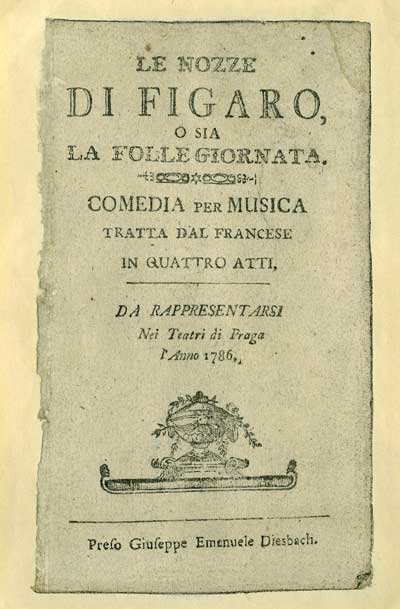
The Marriage of Figaro at the ENO review *****

mozart_libretto_figaro_1786

The Marriage of Figaro

English National Opera, 12th April 2018

It isn’t easy to think of a better opera than the Marriage of Figaro. And, as we culture vultures know, when opera works there is scarcely any entertainment to match it. It is just a shame that opera so rarely all comes together. It did here though making a perfect treat for BUD, and myself, as we continue to advance the young fella’s cultural education. One more Mozart to go, Cosi fan tutte, maybe the ROH revival next year, Britten now opening up, chuck in some Janacek after that and I’ll find a contemporary candidate which won’t scare him off.

It will be hard to match this though. Figaro may be the least daft and offensive of the classic Mozart operas but it still takes a wily director to render the sexual politics and dissection of class conflict entirely palatable to my modern eyes. Fiona Shaw certainly does this in her production, revived here for the second time with Peter Relton doing the honours. When I have something meaty to chew on in terms of message, to add to the comedy, and, of course, that divine, (might as well trot out the cliches), music, then there is nothing to do but sit back and enjoy. Singers who can act, constant movement through an imaginative. labyrinthine set from Peter McKintosh which intrigues and illuminates (and revolves, a lot!), and a concept which doesn’t overwhelm the story, but points up its darkest elements and is true to the Sevillian setting.

Now there is no doubt an army of opera bores who can tell me how much better it would be with top drawer international stars or a big name maestro in the pit. Piffle I say. What I like is an ensemble who can create a drama, rather than stepping off the plane, plonking themselves centre stage, screeching and then milking the applause. I was also more than satisfied with young Matthew Kofi Waldren’s handling of the ever exact ENO Orchestra. MKW is assistant to Martyn Brabbins and, in this uncluttered performance, was a more than capable deputy.

Even a musical numbnut like the Tourist can hear that Lucy Crowe, now graduated to the role of Countess, possesses a voice of exquisite power once she gets in the groove. When she comes in with that first aria hairs on backs of necks collectively stood on ends. Even when conspiring with Susanna to get back at the cocksure Count there was a tinge of heartache stiffened with revenge in her demeanour. Ashley Riches’s Count may not match her singing but he shows us a brutally direct aristo who is more confused than contrite when he gets his comeuppance. Thomas Oliemans may not be the most savvy of Figaros but he is perky enough. Rhian Lois as Susanna was the stand out for me though, as good as actor as I have seen on any stage, with a voice that needed no sur-titling. Katie Coventry’s Cherubino wasn’t annoying – that’s rare praise in my book.

Best of all though is getting to hear Jeremy Sams’s English translation of Da Ponte’s libretto in turn based on Beaumarchais’s play. The originals are exemplars of energy, suppleness and wit. Mr Sams’s verse matches them. It is often laugh out loud funny but still doesn’t blunt the sharper edges that puncture the mistaken identity and cupboard-hiding bromides. This is a comedy of cruelty not romance, as the Picasso-like bull skulls, (and minotaur allusions), the weapons, the confrontations, the barbs, the contracts, the tantrums, remind us. The cast, like the characters, relished turning the screw on each other. Remember this is a story where one woman (Marcellina) wouldn’t hesitate to use the law to catch her man (Figaro), a young boy (Cherubino) can’t keep his c*ck in his britches, the Countess agrees to feign adultery, she and her own fiance pimp out Susanna to the Count, a marriage (Marcellina and Bartolo) is agreed to legitimise an illegitimate child, Figaro is prepared to beat up his fiance on the basis of a lost pin and a bunch of blokes lurk beyond trees to watch the Count getting it on with Susanna. Nice eh.

The droit du seigneur that the Count will not relinquish may be the dramatic crux, but there is much more to Mozart/da Ponte’s plot, (even when it is shorn of the revolutionary monologue from Figaro berating the Count to be found in Beaumarchais). Fiona Shaw draws this out in ways that other, more frivolous, productions do not. Having the Countess walk out at the finale made sense. Men in positions of power haven’t changed much it seems so need to be reminded why then they are being w*nkers.

So a wonderful production of a wonderful opera. Don’t just take my word for it. Ask BUD.


Bryce Dessner and the London Contemporary Orchestra Soloists at Queen Elizabeth Hall review ***

bryce_dessner_2015.jpg

London Contemporary Orchestra Soloists, Galya Bisengalieva (violin), Rakhi Singh (violin), Robert Ames (viola), Oliver Coates (cello) – Bryce Dessner (electric guitar)

Queen Elizabeth Hall. 10th April 2018

  • Bryce Dessner – Aheym for string quartet
  • Mica Levi – You belong to me for string quartet
  • Steve Reich – Electric Counterpoint for electric guitar and tape
  • Steve Reich – Different trains for string quartet and tape (with film from Bill Morrison)

I am pretty sure the last time I was in the Queen Elizabeth Hall was with a young BD and LD and the SO to see Slava’s Snow Show as a “Christmas Treat”. The SO booked the entertainment without, as is her wont, looking too closely at the details. Which is a shame as she has an aversion to clowns. Not a full blown psychic horror but enough to engender a vague sense of unease. Which is unfortunate as, for those that don’t know, Slava’s Snow Show involves clowns. A lot of clowns. On a journey. In Russian. Being the supportive family that we are we found the SO’s discomfort funnier that the show. We still do.

This was my first visit to the newly refurbished QEH and I can report an already handsome building is now even better looking. It looks like it will pursue a course of adventurous programming, which is marvellous, though I can’t pretend it is all to my taste.

This concert was though. Arse that I am I hadn’t recorded the details correctly in my foolproof diary system so I hadn’t realised Different Trains was on the menu and had no idea the evening would be graced by the presence of Mr Bryce Dessner. Now I am guessing this was in stark contrast to most of the audience, for whom, I assume, he was the main attraction. I do not know if the punters that can now be counted on to fill a hall showcasing minimalist classics have always been there, or whether they are new to the genre, but it doesn’t matter. The whole of arty. trendy, creative London turns up in droves now, (though not so much at venues without the social media presence of the Southbank)., which leaves me looking and feeling even more conscious of my shocking lack of style.

(Where did it all go wrong? I used to be a contender in the sartorial stakes and could oft be found propping up the bar at cutting edge London venues. Honestly. No longer. Now even the pensioner tribe at midweek theatrical matinees looks down on me. That it should come to this. Mind you, it’s all my fault. This too stolid flesh needs melting).

All this crossing of musical boundaries is immensely energising though, and, in some ways, it was minimalism that first brought together the the “high” art of classical music with the “popular” art of rock and pop. I would also contend that if it hadn’t been for “classical” composers in the 1950s and 1960s exploring what technology and music from other cultures had to offer, dance music would be much the poorer.

Anyway our man Mr Dessner stands astride the divide, as it were, with his well regarded minimal classical works and his day, or night, job as guitarist for The National. Now, as it happens, I like The National. No expert but I have a few of their albums and saw them support that dreadful old rocker Neil Young a few years ago in Hyde Park. Obviously I don’t mean Neil Young is dreadful. he is akin to a god in my eyes. What I can say though is that The National, along with the likes of Beach House, Death Grips, Eels, John Grant, The Knife, Metronomy and TV on the Radio, ensure that the non-classical section of my CD collection, (I know CDs, ho-ho-ho grandad), isn’t entirely made up of artists who are either older than me or dead. I also appreciate that this is hardly evidence of cutting edge musical taste, and is very white, but, I fear, so is your correspondent. And it also doesn’t mean that as far as I am concerned the best music made in the last few years has come from The Fall, (sadly no longer, why are we not still in a period of national mourning?) and Wire. Worse still, whilst writing this I am listening to Soft Machine. Could it be any worse?

Unsurprisingly Mr Dessner was terrific. I listened to Aheym for string quartet a couple of times before this and it is a worthy and apposite work to set alongside Steve Reich’s string quartet masterpiece. Written in 2009, early on in his catalogue, the title is Yiddish for “homeward” and is inspired by his granny’s stories about Eastern Europe and coming to America. There is a five beat jagged chordal rhythm that runs through the piece which is cut up and syncopated in various ways until a short solo cello line, with pizzicato breaks, takes us to a slower, murky fugal passage, above the cello rocking. This is repeated in a different way before the rhythm returns, with col legno bowing, some scratchy stuff, some very high harmonics and a bit of double stopping to round things off. It is not structurally complex but it is very arresting and every string effect on show was “enhanced” by the close microphones. I loved it though I don’t suppose it will pop up at the Wigmore any time soon.

Mica Levi’s work, written in 2016 for this very ensemble, takes the 1950s song of the title and zeroes in on scraps of music within it. There are three sections to be played in any order. Hannah, a kind of set of passacaglia variations with mad trilling, Jumping, sort of fugal with odd chords moving to tremolos over a cello grind, and Sun, with the higher strings sliding up over the cello drone. It is less interesting than it sounds. Again it was over-amplified for my liking.

Ahed of the interval and before the main event Mr Dessner took to the stage with electric guitar for a performance of Electric Counterpoint. No rock’n’roll razzamatazz here. He looked like one of the stage managers despite having taking a bow earlier after Aheym. EC has one live guitar part, obviously, alongside twelve recorded guitar parts, two on bass. There are three movements, without breaks, the first an 8 part canon with the live guitar over the top and harmonic pulse from the other recorded guitars, the slow movement is similar but with 9 parts and, er, a slower theme, and the final part, again a canon, but with more tonal variation and rhythmic change. It is pure Reich and here the QEH acoustic, the amplification and, obviously, our rock god, really delivered.

Different Trains, commissioned, like Aheym, by the Kronos Quartet, and premiered in this very venue in 1988, is way more interesting than it sounds. The live string quartet is backed by three recorded versions of themselves. This creates the opportunity for 16 part counterpoint and, in line with the concept of the piece, means we listen to a “past we did not witness”. The tape line also includes lines of speech, from Reich’s governess and a train porter, as well as Holocaust victims, as well as “train” noises. The idea is to contrast Reich’s train journeys across America as a child with the horrific journeys made by Jewish children in Europe during the war. The accompanying film from Bill Morrison reinforces the contrast and is, at times, disturbing. The first movement is upbeat, the snatches of conversation brief, and the rhythmic patterns clear and harmonics tonal. The second second is slower and darker with frequent sustains, more harmonic dissonance, and with the train ambience increasing. The final movement takes the voices from the first time and melds them into the music.

I wasn’t entirely persuaded by the performance with the recordings sometimes overwhelming the live performers though I was perched right at the back. Oliver Coates’s cello playing was very fine, as I know from previous performances, and Galya Bisengalieva’s first violin sang, but the second violin and viola parts were a bit muddied. On the other hand having the film footage definitely enhanced the powerful meaning behind Steve’s Reich’s music. (I am assuming the age of the footage is what delivered the “blotchy effects”). The performers were standing and split two by two on stage which made for an antiphonal effect, in mind if not ear.

Even with the sound this was still a fine rendition of a modern masterpiece near Reich’s best. More of this at the QEH please. I promise to smarten up next time.

Oh, and no clowns please.