Mortal Voices: Academy of Ancient Music at Milton Court review ****

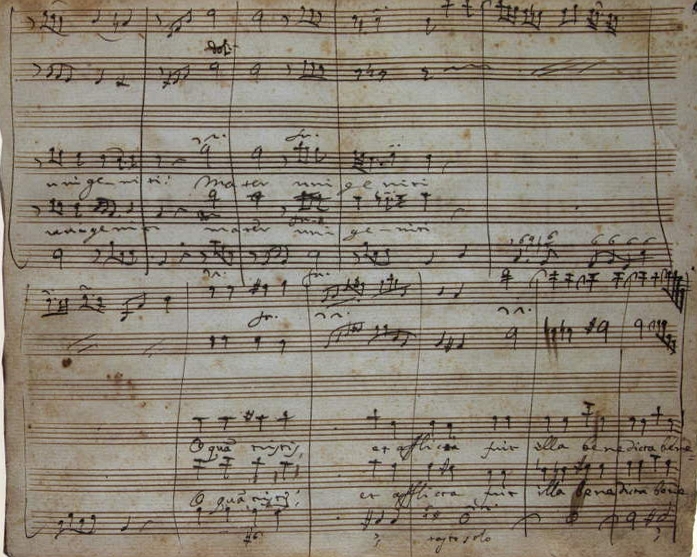
Pergolesi_Stabat_Mater_Autograph

Academy of Ancient Music, Christian Curnyn (director and harpsichord), Keri Fuge (soprano), Tim Mead (counter-tenor)

Milton Court Concert Hall, 15th February 2018

  • Corelli – Concerto grosso Op 6 No 1 in D major
  • Handel – Cantata HWV 230 “Ah! Che troppo inequali”
  • Handel – Cantata HWV 82 “Il Duello Amoroso”
  • Pergolesi – Stabat Mater

As usual after BUD and I had chewed over the big economic, social, philosophical and political questions of the day, and reminded each other just how clever we are, as well as scoffed on some tasty, if evil, fare at the redoubtable Bad Egg in Moorgate, there was minimal time for a preview of the evening’s entertainment. Which meant that BUD got the shock of his life when Tim Mead opened his mouth in the second of the Handel cantatas in the programme. He wasn’t expecting a counter-tenor. Especially from a man who could easily pass as the next James Bond given his rugged good looks and sartorial elegance.

My what a voice though. Now if you are a fully paid up, Baroque, (especially Baroque opera), and, increasingly, Contemporary classical, music enthusiast, you are going to come across a fair few counter-tenors. I think I have heard voices with more power and range than Mr Mead’s but not as much clarity and brilliance. This was apparent in the “Il Duello Amoroso”, a decidedly dodgy tale of unrequited love between a shepherd and a goddess, where the counter-tenor and soprano voices sparred elegantly. It really came to the fore however in Pergolesi’s wham-bam, smash hit Stabat Mater.

Pergolesi didn’t get up to much musically. Dying at 26 from TB didn’t help, and, if I am honest, the bits of his output I’ve heard, (or have recordings of), beyond the Stabat Mater aren’t that memorable. Churning out lightweight, comic operas, for your ADHD aristocratic patrons is not, unsurprisingly, a recipe for a lasting musical legacy. When he hit upon this medieval Latin setting of the Christian staple of Mary lamenting her son’s suffering on the cross, he struck gold though. Just a shame it was only completed a few days before he popped his clogs. Still thanks to Bach, and others, the score was widely disseminated in the C18 and has never gone out of fashion.

That’s because, musically and lyrically, he doesn’t hang around. The 12 verses make a virtue of brevity. None is more than 5 minutes long and the whole comes in at 40 minutes. There is loads of contrast, audible human touches and plainly programmatic twists where text and music are perfectly matched, and the fusion, for that is what it is, of Baroque and early Classical, means it is easy, and very affecting, on the ear. Others have had a stab at setting the Stabat Mater, Vivald and Haydn, come to mind, but this tops the lot.

Obviously the AAM, especially the strings, nailed the score, and gave plenty of space for the two excellent soloists to capture the drama and pathos of the setting. Whether individual aria or in duet both singers seemed to really care about the music and text. Forget the religious mumbo-jumbo, this is the moving story of a Mum’s grief. Best bit. The Fac ut portem Christi mortem from Tim Mead alone. Very moving.

I was less convinced by the Handel. That’s just me and Handel though. It is always a pleasant experience listening to GFH but it never really involves me.  Even 4 hours of his operas. I hope to get lifted up and swept along but always end up earthbound. Even, whisper it, in a Messiah. He’s a flash Harry make no mistake, and all those voices, here, there and everywhere, is proper WOW, but it all feels a bit devoid of emotion. A man can only have so much bouncing bass and celebratory trumpet action. Anyway I was happy enough to go with the pleasant enough flow in these two cantatas.

The programme kicked off with Corelli’s Op 6 No 1 Concerto Grosso. You cannot go wrong with that. The 12 Concerto Grossi are like a Corelli greatest hits collection. There will always be some stunning concertante work, the two violins and the darker cello, beefed up by the ripieno players, the rest of the band. This concerto has some brutally fast semiquavers stuff for the solo cello and his violin mates and some lovely lyrical, slower dances to kick off the first couple of movements. There is plenty of room to blag which Bojan Cicic, (he really is a top violinist), Rebecca Livermore and Joseph Crouch took full advantage of. The whole band though seems to delight in playing together. That is why, even if I am not absolutely sure of all the musical ingredients, I will try to see all their London concerts.

I recommend you try to do the same, especially if you are new to the Baroque. And I also heartily recommend you dip into recordings of Pergolesi’s Stabat Mater and Corelli’s Concertos if you haven’t already. You won’t regret it.
My favourite classical concerts of 2017

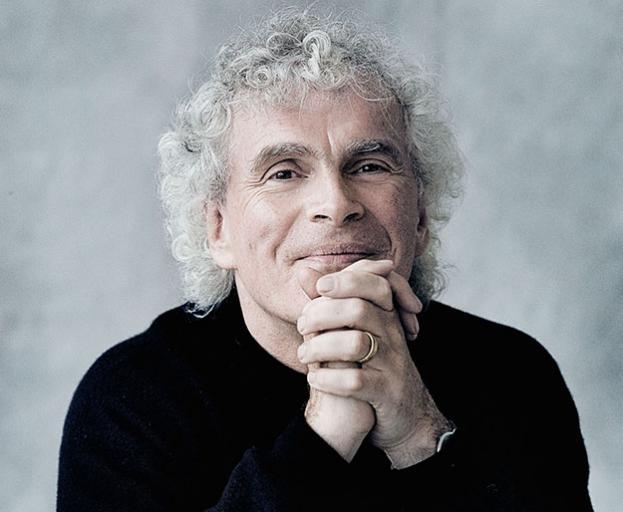
623x512xrattle625_2-pagespeed-ic_-clbnppbu_4_0

Right I know it is a bit late in the day but I wanted to make a list of the concerts I enjoyed most from last year. So everything that got a 5* review based on my entirely subjective criteria is ordered below. Top is Sir Simon and the LSO with their Stravinsky ballets. Like it was going to be anything else.

Anyway no preamble. No waffle. Barely any punctuation. Part record, part boast. Comments welcome.

  • LSO, Simon Rattle – Stravinsky, The Firebird (original ballet), Petrushka (1947 version), The Rite of Spring – Barbican Hall – 24th September
  • Colin Currie Group, Synergy Vocals – Reich Tehillim, Drumming – Royal Festival Hall – 5th May
  • Isabelle Faust, Akademie fur Alte Musik Berlin, Bernhard Forck – JS Bach Suite No 2 in A Minor BWV 1067a, Violin Concerto in E Major BWV 1042, Violin Concerto in A Minor BWV 1041, Concerto for Two Violins in D Minor BWV 1043, CPE Bach String Symphony in B Minor W 182/5 – Wigmore Hall – 29th June
  • Jack Quartet – Iannis Xenakis, Ergma for string quartet, Embellie for solo viola, Mikka ‘S’ for solo violin, Kottos for solo cello, Hunem-Iduhey for violin and cello, ST/4 –1, 080262 for string quartet – Wigmore Hall – 25th February
  • Britten Sinfonia, Thomas Ades – Gerald Barry Chevaux de Frise, Beethoven Symphony No 3 in E Flat Major Eroica – Barbican Hall – 6th June 2017
  • Nederlands Kamerkoor,Peter Dijkstra – Sacred and Profane – Britten Hymn to St Cecilia, Gabriel Jackson Ave Regina caelorum, Berio Cries of London, Lars Johan Werle Orpheus, Canzone 126 di Francesca Petraraca, Britten Sacred and Profane – Cadogan Hall – 8th March
  • Tim Gill cello, Fali Pavri piano, Sound Intermedia – Webern 3 kleine Stücke, Op. 11, Messiaen ‘Louange à l’Éternite du Jesus Christ’ (‘Praise to the eternity of Jesus’) from Quartet for the End of Time, Henze Serenade for solo cello, Arvo Pärt Fratres, Xenakis Kottos for solo cello, Jonathan Harvey Ricercare una melodia for solo cello and electronics, Thomas Ades ‘L’eaux’ from Lieux retrouvés, Anna Clyne Paint Box for cello and tape, Harrison Birtwistle Wie Eine Fuga from Bogenstrich – Kings Place – 6th May
  • Britten Sinfonia, Thomas Ades, Mark Stone – Gerald Barry Beethoven, Beethoven Symphonies Nos 1 and 2 – Barbican Hall – 2nd June
  • Academy of Ancient Music, Robert Howarth – Monteverdi Vespers 1610 – Barbican Hall – 23rd June
  • Academy of St Martin-in-the-Fields, Murray Perahia – Beethoven Coriolan Overture, Piano Concertos No 2 in B flat major and No 4 in G major – Barbican – 20th February
  • London Sinfonietta and students, Lucy Shaufer, Kings Place Choir – Luciano Berio, Lepi Yuro, E si fussi pisci, Duetti: Aldo, Naturale, Duetti: Various, Divertimento, Chamber Music, Sequenza II harp, Autre fois, Lied clarinet, Air, Berceuse for Gyorgy Kurtag, Sequenza I flute, Musica Leggera, O King – Kings Place – 4th November
  • Maurizio Pollini – Schoenberg 3 Pieces for piano, Op.11, 6 Little pieces for piano, Op.19, Beethoven, Piano Sonata in C minor, Op.13 (Pathétique), Piano Sonata in F sharp, Op.78 (à Thérèse), Piano Sonata in F minor, Op.57 (Appassionata) – RFH – 14th March
  • Britten Sinfonia, Thomas Ades, Gerald Barry – Beethoven Septet Op 20, Piano Trio Op 70/2. Gerald Barry Five Chorales from the Intelligence Park – Milton Court Concert Hall – 30th May
  • Bavarian Radio Symphony Orchestra, Mariss Jansons, Yefim Bronfman – Beethoven Piano Concerto No 4, Prokofiev Symphony No 5 – Barbican Hall – 24th November
  • Britten Sinfonia, Helen Grime – Purcell Fantasia upon one note, Oliver Knussen, George Benjamin, Colin Matthew, A Purcell Garland, Helen Grime Into the Faded Air, A Cold Spring, Knussen Cantata, Ades Court Studies from The Tempest, Britten Sinfonietta, Stravinsky Dumbarton Oaks – Milton Court Hall – 20th September


Britten Sinfonia at Wigmore Hall review *****

jackie-shave-900x900

Britten Sinfonia

Wigmore Hall, 24th January 2018

  • Heinrich Biber – Mystery Sonata No 1 “The Annunciation”
  • Philip Glass – Orbit
  • Leo Chadburn – Five Loops for the Bathyscaphe
  • Arvo Part – Spiegel am Spiegel
  • WA Mozart – Piano Trio No 3 K502

There is something of the spirit of punk about the Britten Sinfonia. They don’t have a principal conductor or director and play with pretty much who they like. They also play pretty much what they like with a refreshingly cavalier attitude to programming. I love them, whether it be a Bach St John Passion, electrifying accounts of the Beethoven symphonies under Thomas Ades, minimalist classics, Stravinsky, Ravel or contemporary British composers, all of which I have heard them perform in the last year or so.

So I was looking forward to this. Leo Chadburn’s new work Five Loops for Bathyscaphe, is scored for piano trio and electronics and runs for 10 minutes or so. So Jacqueline Shave (that’s her above), one of the violin leaders of the BS, Caroline Dearnley, the principal cello, and Huw Watkins, principal piano, had another 50 minutes or so to fill. What to choose? Mozart? Why not. After all his B flat minor trio is pretty much the first piano trio as we know the form, with all three instruments contributing rather than just a piano sonata with a bit of string diddling attached which previously defined the Classical form. And Arvo Part’s Speigel am Speigel? Yep, it’s a slam-dunk crowd-pleaser for violin and piano. But chucking in Philip Glass’s short piece, Orbit, for solo cello. And the first of Biber’s Mystery sonatas? Well as it turned out it all slotted together perfectly.

Now I have been unlucky in my endeavours to hear a performance of Biber’s Mystery, (or Rosary), sonatas for violin and continuo live. There are 15 of these chaps, divided into 3 cycles, Joyful, Sorrowful and Glorious, plus a closing Passacaglia for solo violin. Each one takes as its subject one of the Catholic “rosary”episodes in the life of the Virgin Mary. They were likely written in 1676 but were unknown until 1905 ,and they are one of the earliest and best known examples of “scordatura”, where the violin is tuned in a way that is not standard. This permits all sorts of funky effects. Don’t test me on this but it is pretty straightforward even for a dumbass like me to hear the differences. One of the Vivaldi Op 9 Le Cetra concertos does this, Stravinsky does it at the start of the Firebird and Ligeti’s Violin Concerto is a prime example. Mind you Ligeti chucks so many effects into his concerto I am hard pressed to know where it is.

Biber tests the skill of the violinist to the max so it is a unlikely anyone was up to the job in the C17. What is on the page doesn’t correspond to what hits the ear. Don’t worry it doesn’t get too weird but it does create sounds, chords and harmonies with real drama. Now unfortunately we only got the first instalment here, which is the one which doesn’t arse about with the tuning, but it was still a blinder to open the concert with and Ms Shave delivered. It opens with a virtuoso figuration, being the Angel appearing before  our Mary, and them moves into a gentler sort of theme and variations.

The Glass “sonata” was new to me. The programme notes suggest Glass is referencing Bach’s mighty cello suites. He is. But then again anyone that writes a piece for solo cello is working in the shadow of the master. Even so lots of fancy figuration and double stopping does conjure up Bach’s counterpoint and Glass’s ordered repetitions are redolent of JSB’s own structures. Ms Dearnley is at home here as she is in the Baroque.

Now I have listened to, and seen performed, Part’s Speigel am Speigel, more times than I care to remember. It is one of my favourite pieces of music period. Which probably shows how easily pleased I am. This was one of his first “tintinnabuli” works, along with Fur Alina, from 1978, and it is “minimal” even by his standards. Simple arpeggios in piano and rising, then falling, scales from violin. If you are ever too worked up about anything just pop this on. Hey presto, blood pressure plummets. Now Ms Shave and Mr Watkins seemed to take this at a marginally faster tempo than I am used to, (it is all relative as not much happens), and took a minute of two to get in the groove, but once there it was as good a performance as you will hear.

I tried with the Mozart. Honestly. If I switch off and let it drift around and through me then it is pleasant enough but I still don’t really get it. Just too nice. Obviously there are bits of Mozart, and times when I listen to it, like watching a great Figaro, where it lifts me up and takes me away, but this wasn’t one of them.

Which brings me to the Leo Chadburn premiere, co-commissioned by the BS and Wigmore. I knew nothing about Mr Chadburn but I gather he is one of these new brand of musician/composer who doesn’t give a fig for established boundaries. He writes and performs across genres, releasing three synthpop albums a few years ago as alter ego Simon Bookish, and remixing for the likes of Grizzly Bear. He can certainly sing a bit I gather. This piece takes the classic piano trio instrumentation and hooks in pre-recorded voices from himself and Gemma Sanders, and some sparse electronica. It graphically describes the journey on 23rd January 1963 of oceanographers Jacques Piccard and Don Walsh to the bottom of the ocean. Eleven kms down to be exact in the Mariana trench, in that little ball Bathyscaphe Trieste thing. The idea of the piece is to create a sense of motionlessness in the music, deep and watery I guess, and allow the voices and words to tell the story. It succeeds admirably. There is nothing to scare anyone off in this simple but very effective sound-world. Think eerie harmonics from the strings and muffled chords from both ends of the range for the piano, as well as some theatrical plucking from inside the piano. The whole thing grips from first to last. It deserves a much wider audience. I am sure Mr Chadburn knows how to make that happen.

This whole concert was a joy. Music for everyone. Even if they know absolutely f*ck all about any of it. Still I suppose if they all prefer listening to a little ginger chap who has the temerity to suggest he is the next Van Morrison, then who am I to argue. Just seems a shame. Still that’s your pesky, high/low culture divide in late neo-liberal, capitalist society for you.

Rameau to Mahler: LSO at the Barbican review ***

rattlelsoedit7

London Symphony Orchestra, Simon Rattle, Magdalena Kozena

Barbican Hall, 11th January 2017

  • Schubert – Symphony No 8 Unfinished
  • Mahler – Ruckert Lieder
  • Handel – Three Arias
  • Rameau – Les Boreades Suite

Now I admit I hummed and harred about this particular gig. I am as excited as the next person about the return of Sir SR to London to lead the mighty LSO, but also recognise that, as his musical taste and mine are not entirely congruent, I had better carpe diem where I can. When he does serve up a favourite, chances are it is going to be the dog’s proverbials, to wit the simply stunning triptych of Stravinsky ballets, a highlight of last year (Stravinsky from Rattle and the LSO at the Barbican review *****).

So eventually I took the plunge here, intrigued by the Baroque on offer, recognising that I need to do more work on Schubert and wanting to see whether Sir SR is as nice to his wife, mezzo-soprano Magdalena Kozena, on stage as he is to the LSO and everyone else. The Mahler Ruckert Lieder and the three showy Handel Arias, one from Agrippina and two from Ariodante, certainly meant the missus had to put a shift in, two frocks and an hour in total either side of the interval. The Rameau has been a staple party piece for the Berlin Philharmonic for years, and it seemed interesting to see what the LSO would make of it.

As it turned out this programme also piqued the interest of Mrs TFP, who is rightly suspicious of my Renaissance/Baroque and Contemporary leanings, but who was happy to come along for the ride here. The Germanic quotient was also sufficiently high for her.

So what did I learn. Well …. aaah … I still don’t think I am ever going to embrace Schubert. I assume Sir Simon and the LSO gave this a respectable work-out but it is still just doodling for me, without the rhythmic discipline of Beethoven and with too many strands. Even the finished bits sound unfinished to me. I am really sorry as I know there are a lot of Schubert groupies out there.

Now the Mahler took a bit of time to get going but songs 3,4 and 5 (in Rattle’s sequence) let loose all of that Mahlerian drama and suspense, with the growly stuff at the bottom, the sniff of folk tunes and the aching strings all deployed to great effect. Mrs TFP combed the text scrupulously for mistranslation and therefore snaffled up the stories. I didn’t understand a word of what Ms Kozena was saying and, given it is the usual Romantic, Love/Fate/Man/Artist tripe, (with one about a lime tree apparently), I didn’t really care, but at times the noise was ravishing. Unsurprisingly I guess soloist and band were well matched thanks to Sir SR, though I wonder if Ms Kozena may have topped these renditions in previous performances. No matter. This was concentrated Mahler which for me is a good thing.

On the subject of concentrated musical pleasure, I cannot believe I am the only one who prefers to take his Handel operas from the set lunch, and not the full tasting, menu. The music induces a nice warm glow, for sure, but they can go on a bit. So I thought a triple helping of well chosen arias would hit the spot. These three are undoubtedly showy, particularly the final Dopo notte, but it didn’t feel as if orchestra and soloist were entirely comfortable in parts, and, I was reminded that old George Fred, once his lady singers got up a head of steam, was apt to encourage them further with interminable repeats. Even so it left me grinning from ear to ear.

As did the Rameau suite. So this is apparently one of those all singing, all dancing (literally) extravaganzas that the French Baroque invented. It was Rameau’s last opera tragedie and boy did he chuck the kitchen sink at it judging by this suite. An everyday tale of windy Gods, the orchestral colour is dazzling, with state of the art technology to boot. I absolutely adored it, as did Sir SR and the LSO. Very funky.

So another entertaining evening in the hands of Sir Simon, but also a reminder not to push the boat out too far in terms of repertoire I enjoy.


Peter Wispelwey (cellist) at Kings Place review ****

42545-pieter-wispelwey-2-c-frits-de-beer-bt

Peter Wispelwey, cello

Cello Unwrapped: Bach Through Time Concert III. Kings Place Hall 1, 8th December 2017

  • JS Bach – Cello Suite No 1 in G, BWV 1007
  • Benjamin Britten – Cello Suite No 3, Op 87
  • Gyorgy Ligeti – Sonata for solo cello
  • JS Bach – Cello Suite No 3 in C, BWV 1009

If I had to pick my favourite venue in London for classical music it would probably be King’s Place. The design is lovely. The acoustic is perfect, especially upstairs. The welcome is warm. (I lost a book there once. They found the book and then they found me). The programming is interesting. In particular the year long seasons which artfully pull together chamber music across a genre or theme. This year, Cello Unwrapped; in the last couple of years, the Baroque and Minimalism. Next year, Time Unwrapped, a more ambitious conceit which is chock full of interesting programmes. To be fair it has helped that the last three years have focussed on particular favourites of mine in terms of period and instrument but, even so, I heartily recommend Kings Place to anyone who isn’t already a regular. Bear in mind too that I am only really a consumer of the classical events: there is plenty of other stuff, music, comedy, spoken word, going on there as well. Finally they make a decent cup of tea in the caff upstairs, the loos are spotless, and there is usually some free art to soak in before, after or during the interval. And, in the summer, there is a pleasant saunter available along the canal.

Now I appreciate that the very best chamber music is likely to be found elsewhere in London, specifically the Wigmore Hall. The Wigmore certainly has its charms, but the legroom isn’t up to much and, if you intend to spend a fair time in her formidable company, you had better get used to seeing the back of other peoples’ heads. I am partial to Cadogan Hall but the repertoire is mostly orchestral and requires careful sifting. St John’s Smith Square delivers some stirring stuff for Early Music, Baroque and Contemporary enthusiasts like the Tourist but there is no hiding the fact that it is a Church, atmosphere therefore trumping sound and comfort. Mind you it is a beautiful lump of Baroque, fancy enough to satisfy, but not so fancy as to make one queasy. Thomas Archer’s buildings have taken a bit of a hammering in London, (go see St Paul’s Deptford if you don’t believe me), so it is good that this, maybe his best, looks so perky. I am also very, very partial to Milton Court Concert Hall, largely for the same reasons as Kings Place, and St Luke’s Old Street, where the interior has been brilliantly re-crafted by architects Levitt Bernstein. But, in both cases, the number of concerts which match the Tourist’s tastes, is constrained.

I digress. It was the programme here that attracted me as I confess no knowledge of Ms Wispelwey before this evening. Bach obvs, it being impossible to hear the cello suites too many times in a lifetime, but also the Britten which echoes old JSB, and the Ligeti, which, in its own way, is also an homage to the old boy. Ligeti is rapidly becoming my favourite mid/late C20 Modernist. It’s great this “finding out about new music” lark.

Apparently Britten intended to emulate Bach and compose six cello suites but this, unfortunately, was the last, written in 1972. His last operas, Owen Wingrave and Death in Venice, and then his failing heart, got in the way. Shame. I prize Britten’s chamber pieces above all of the rest of his glorious music. Obviously more personal but deeper, spikier and, if it is possible, cleverer. There are times, though, when Britten’s genius can be too satisfying, like a musical Vermeer, You just want him to cut loose. In some of the knottier passages of the chamber music this is what you get.

Actually scrub all the above. The reason why BB is the greatest English composer since Byrd, (sorry Purcell and Elgar fans), is the operas, of course. You can keep your Italian melodramas: give me Billy Budd, The Turn of the Screw or Curlew River, (yep opera doesn’t have to be full orchestra and divas belting out love arias, in fact it is better when it isn’t), any day of the week. The whole must always be greater than the sum of the operatic parts in my book, and singing cannot smother drama.

Now this last suite has some deceptively simple ideas but the overall effect is still one of immense variety of expression. A four note motive is set against a repeated bass in one of Britten’s favoured mournful Passacaglias, with repeated pizzicato, which precedes the 3 Russian folk songs arranged by Tchaikovsky and the Orthodox hymn the Kontakion chant, which act as the conclusion. Remember this was written for, and first performed by his friend, the great Russia cellist Mistislav Rostroprovich, after hearing his performance of the Bach suites. After BB’s death Mr Rostroprovich couldn’t bear to play this piece.

Earlier in the piece we have a very quick, unsettling Moto Pertpetuo which appears to invert the motif and a stately Fuga which sets it against the main line, and suggests the counterpoint which JSB famously conjures up in his suites. Elsewhere we hear a Dialogo, marked allegretto, which flips across two staves, a Barcarola, which echoes the famous Prelude from JSB’s No 1 Suite which opened this recital, a jittery Marcia, and a strange Canto. Mr Wispelwey, in very droll fashion, introduces the piece by, er, introducing each of the short movements, which provided both bearings and an insight into Britten’s compositional process. All in all, a very satisfying rendition of one of BB’s finest works, IMHO.

The Ligeti sonata is made up of two movements, both written relatively early in his career, 1948 and 1953. The first, Dialogo, a slow movement, was written for a cellist who GL fancied. It is based on Hungarian folksong, (always a rich source of inspiration for the great man), and alternates from high to low ranges, apparently representing a conversation between a man and a woman. The Second movement is a Capriccio is a rapid Moto Perpetuo that, in places, would be tricky enough on a violin, let alone cello. It’s brilliant. Like the Britten the debt to JSB isn’t hidden, notably in the manic string crossing, as ears and mind rush to keep up with the musical invention. The thing about Ligeti for me is that his music always seems to be having a laugh. None of this thorny intellectualism that can so often block your path into contemporary music. There is a celebration of Ligeti’s music at the South Bank in May. Yea. I am signed up.

No need for me to rabbit on about the Bach in detail. You will know these pieces. They are, in essence, just dances. But what dances. If you don’t know them then you should. No point living a life without the best of Bach. Make it your New Year’s resolution.

I shall be looking out again for Mr Wispelwey’s recitals. He made these technically demanding pieces look easy, (well maybe not that easy), and has a very direct style which made it relatively straightforward to follow the line of the music. He has a winning charisma, and a natty shirt/waistcoat combo, but when it all got seriously emotional on stage, we were rapt. He knows the Bach suites like the back, front and sides of his hands, he has recorded them three times. I just bought the last recording, played on a Baroque cello, tuned at a lower pitch (392 vs 440 normally). Apparently he plays fast and loose with the usual tempo interpretations. Can’t wait to find out what it sounds like.


Bach and Telemann: Academy of Ancient Music at Milton Court review *****

maxresdefault

Academy of Ancient Music, Bojan Cicic (director and violin), Rachel Brown (flute and recorder), Rachel Beckett (recorder), Alistair Ross (harpsichord) 

Bach and Telemann: Reversed Fortunes, Milton Court Concert Hall, 7th December 2017

I see I am now close to being a Academy of Ancient Music groupie. Not in a sinister way, that would be very strange. Just that I seem to pitch up to most of their London concerts. Unsurprising given their repertoire I suppose. And what a joy it always is to hear them play. This was no different. And I had a new chum in MSBD to join me.

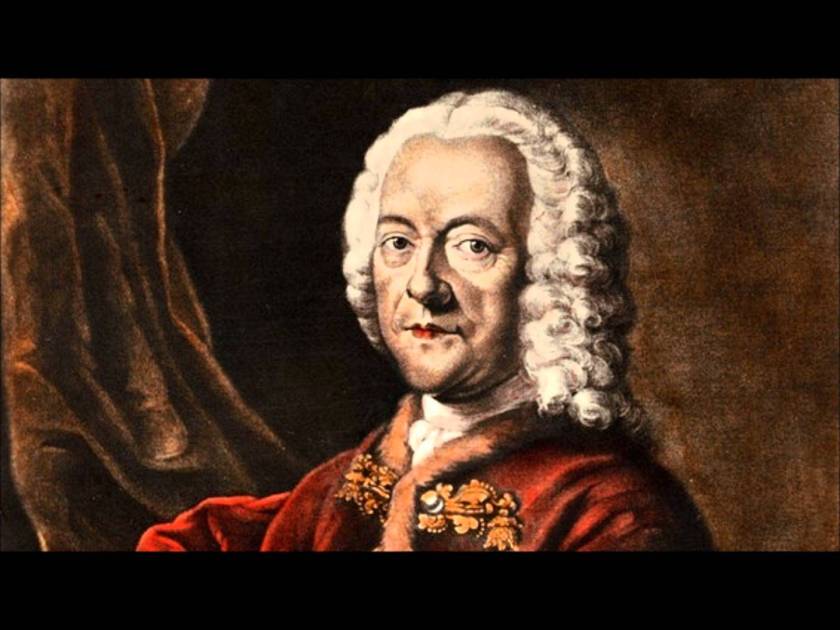
Now the theme here was to contrast the contrasting fortunes of a certain Johann Sebastian Bach and Georg Philipp Telemann. They were mates in the 1720s, 30s and 40s, with GPT becoming CPE Bach’s godfather, and both successively securing the reputation of the Collegium in Leipzig. Back in the day though Telemann (pictured above), with his suave, easy listening modelled on his French contemporaries, was by far the more popular composer, with JSB and his knotty, brainy counterpoint, and strong Lutheran faith, some way behind. As we all know JSB’s music languished for centuries, now some might say his is the daddy of all Western art music. Meanwhile whilst Telemann maintains a cherished place in the baroque world of the Baroque enthusiast, he is not much performed beyond this.

The influence of Vivaldi’s vast concerto output was much greater on JSB, and is clearly visible in the Brandenburg’s especially when played one to a part as here. In particular in the Fifth with its single tutti violin, though it is the solo harpsichord cadenza, the first ever of its type, that is the most memorable part of the concerto. Alistair Ross didn’t hold back once the harpsichord emerged from the string ritornello and his rubato was unleashed. A bit showier than Steven Devine in the last BC5 I heard in SJSS with the OAE. However, I think the Brandenburg 4 here with Rachel Brown and Rachel Beckett on the recorders was the highlight. Once the two Rachels got into the swing of it there was no stopping them, propped up by Bojan Cicic masterful violin playing, and by the end those recorders produced as sweet a sound as you could imagine (not always the case for the period recorder).

Having said that I think the most satisfying piece of the evening was the Telemann Concerto for flute and recorder. He wasn’t the only one to pair the “old” and the “new” wind instruments, Quantz was on to this, but he clearly mastered it. Written in 1712, the Concerto has some very attractive galant homophonic playing from the two instruments looking forward to the Classical. Elsewhere the soloists chase the lines from one to the other against very attractive dances, including nods to the eastern European folk tunes that he studied. The French influence on GPT is more apparent in the Overture suite, (he wrote over two hundred of these), with its simple dance rhythms and story based on Don Quixote. There is plenty of easy on the ear comic effect, (listen out for donkeys), and lots of colour. It is all so pleasant (though if I was critical maybe a tad too pleasant).

So another fine concert from the AAM who really seemed to be enjoying themselves. As I think did MSBD. In fact I know he did as he said so. I shall miss the AAM Messiah in the Barbican Hall and their intriguing Haydn and Dussek programme in April, but will be back here for the 15th February Pergolesi, Corelli and Handel gig, and for the 31st May concert in the Hall with Nicola Benedetti. Unmissable I reckon.

The Cardinall’s Musick at St John’s Square review ****

The Cardinall’s Musick // Andrew Marwood - London Wednesday 5

The Cardinall’s Musick, War and Peace

St John’s Smith Square, 19th November 2017

  • William Byrd – Kyrie from Mass for five voices
  • William Byrd – Ad Dominum cum tribularer
  • Benjamin Britten – Advance Democracy
  • James MacMillan – When you see the millions of the mouthless dead
  • Orlando Gibbons – O Lord in thy wrath
  • James MacMillan – A Child’s prayer
  • William Byrd – Agnus Dei from Mass for five voices
  • William Byrd – Kyrie from Mass for four voices
  • Philippe de Monte – Super flumina Babylonis
  • William Byrd – Quomodo cantabimus
  • James MacMillan – Emitte lucem tuam
  • Arvo Pärt – Da pacem
  • James MacMillan – Christus vincit
  • William Byrd – Agnus Dei from Mass for four voices
  • William Byrd – Peccavi super numerum

Sitting in Thomas Archer’s fine Baroque masterpiece church, rapt audience, listening to one of the UK’s finest ensemble interpreters of C16 and C17 British vocal music, here singing a diverse set of texts from composers past and present framed by extracts from William Byrd’s finest works, the Masses for four and five voices. And all to remember the fallen of past conflicts.

The Britten piece is packed with drama and I see nothing wrong with the pungent warning against Fascism in the text. As ever with the James MacMillan’s work the directness and invention wins you over but I have to say A child’s prayer, written in memory of the victims of Dunblane, pulls you right up with its repeated dirge of “Welcome”. Even by Part’s standards Da pacem is sparse but still so powerful. The biggest surprise of this excellent evening however was the Philippe de Monte motet which apparently stuck a chord with the nominally recusant Byrd. And the concluding five part Byrd motet, Peccavi super mumerum, which was new to me, left me pinned to my seat.

Don’t go through your life without William Byrd. I should probably stop there. So I will.

Australian Chamber Orchestra at the Royal Festival Hall review ****

dynamic-b98b42fc-d3b2-53c9-ba00-88eac54e2b7f

Australian Chamber Orchestra, Richard Tognetti (director), Pierre-Laurent Aimard (piano)

Royal Festival Hall, 3rd November 2017

  • Bach The Art of Fugue Contrapunctus 1 to 4
  • Mozart Piano Concerto 15
  • Shostakovich Two Pieces for String Octet
  • Tchaikovsky Souvenir de Florence

There is something truly thrilling about watching a group of string players, some standing, going hell for leather, as one, in a piece written exactly for them. Not to decry the full blown symphonic experience or the intimacy of the quartet but this is a special treat. Normally I see (and hear) this as part of a Baroque programme, normally Italian, or maybe a spot of Bach. Here we had a powerful modern ensemble.

Now we, for I was accompanied by the discerning ear and brain of Mrs TFP, that the wide expanse of the Festival Hall might swallow up the band but we needn’t have worried, as even from our perch astern, the sound was splendid. What was something of a shame is that the Hall was barely half full, a real shame since the ACO under Richard Tognetti, are world class. It was not as if the programme was challenging in any way. Even in the repertoire that we found less appealing, (I favoured the Shostakovich, Mrs TFP the Mozart), namely the Tchaikovsky, the finesse and control of the ACO was astounding. In those passages in the Shostakovich and Tchaikovsky which called for the strings to come together the unanimity of sound and movement (bows moving exactly in unison) was uncanny. Like one instrument.

Now I have heard the Art of Fugue performed by harpsichord, piano, string quartet and viol consort. All different, all fascinating as the simple theme is worked through with increasing complexity across the 13 completed, and 1 unfinished, fugues and, sometimes, the 4 canons. There is probably someone out there who has had a crack at Bach’s masterpiece on the stylophone. (I’d paid good money to see that). I gather that Richard Tognetti, who has led the ACO since 1990 (that presumably explains the discipline of playing on show), can sometimes get a little carried away with his arrangements. Not here. Now admittedly the first 4 of the contrapunctus are easy for even my ears to follow, as the meticulous theme is set out in the first, the dotted rhythm added in the second, turned upside down and filled out in the third and expanded and “sped up” in the fourth (here through the use of pizzicato). So I am not sure how much further they could go with this work, even with their technical mastery, but this was very interesting and flawlessly delivered.

I hate to admit it but the Mozart was beautiful. I don’t know the 15th Piano Concerto but I am well aware of Pierre-Laurent Aimard’s qualities, last heard by me in a majestic Emperor Concerto under Essa Pekka Salonen. You can hear how young Wolfgang, (well not so young by the time he wrote this), created the piano concerto form we know and, usually, love today. There is some lovely woodwind action, lots of sublime tunes and some fiendish piano playing, but all wrapped up in a charming bow. Once again the playing of orchestra and soloist was technically precise, but with no lack of emotion.

Now my prime reason for booking this concert, other than the reputation of the orchestra, was the Shostakovich piece since this, in my experience is rarely performed. Written in 1924, when DSCH was still a student, in memory of his friend Volodiya Kurchavov, there are obvious signs of the composer DSCH would be come. The Prelude is still rooted in the Romantic Russian composers of the late C19 but in the plunging response to the initial theme and with the high accompaniment to the second theme there is more modernity. The Scherzo second piece could easily have dropped out of a DSCH symphony from twenty years later. Sardonic, ghostly, then a comedy march, with all that thrilling dissonance.. A joy to hear and brilliantly executed by the eight musicians.

The Tchaikovsky was the (good) surprise of the evening for here Mr Tognetti’s arrangement of this sextet, for all his strings, really showed just how extraordinary their playing is. Don’t get me wrong, there are still plenty of passages in this near 40 minute piece, that annoy me intensely, it’s all just too show pony, but I did get sucked in I admit. Not sure it is the same Florence that I know and love but all that lushness and heart tugging yearning is hard to fight. And to be fair the ACO’s muscular approach dials down the sentimentality (though not the pony).

There isn’t much about Aussies that makes me jealous (actually that’s a lie, there is) but this orchestra is definitely one of them. I will add them to my list of must see orchestras/ensembles when they come to London alongside the Concertgebouw, Bavarian RSO, Leipzig Gewandhaus, Staatskapelles Berlin and Dresden, Chamber Orchestra of Europe, Spira Mirabliis, Ensemble Intercomtemporain, Orchestre Revolutionnaire et Romantique, Akademie fur Alte Musik Berlin, Les Arts Florissants, Freiburg Baroque, Europa Galante, Budapest Festival Orchestra, Mahler Chamber Orchestra and, vain hope, Lucerne Festival Orchestra. Mind you with the LSO under Rattle we now have the best in the world, fact.


“Italy in England”, Academy of Ancient Music at Milton Court review ****

mi0002869560

Academy of Ancient Music, Bojan Cicic (director and violin), Frank de Bruine (oboe)

Italy in England: When Handel Met Corelli, Milton Court Concert Hall, 19th October 2017

  • Corelli – Concerto Grosso in D major Op. 6 No. 4
  • Handel – Concerto for Oboe No. 3 in G minor
  • Geminiani – Concerto Grosso Op. 5 No. 3 (after Corelli)
  • Sammartini – Sinfonia in G major
  • Avison – Concerto Grosso in D minor No 3 ‘The garden of harmony’ (after Scarlatti)
  • Sammartini – Concerto for Oboe in E flat major
  • Handel – Concerto Grosso Op. 6 No. 5

We don’t know too much about Arcangelo Corelli (1653-1713). From the late 1670’s through to his death though he was a big noise in Rome, heralding a great leap forward in violin playing and an instrumental (ha ha) influence on the sonata and concerto form. Unless you are a Baroque nutjob, (there are more of them than you might think), you may only be peripherally aware of him. Yet you will certainly have heard snatches of his most famous composition the Op 6 12 Concerto grossi. Odds are if you hear Baroque music on a telly or film soundtrack, (and it isn’t Vivaldi Four Seasons or a blast of Handel), then it will be Corelli.

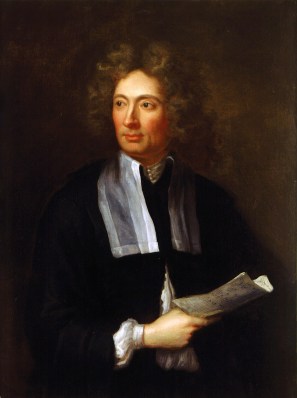
If you are just an occasional dipper-in to the Baroque canon, or just fancy some nice background stuff, get your hands on a recording of his Op 6. You won’t regret it. Here he is. Poodle wig and all. Fine looking fellow.

arcangelo_corelli2c_portrait_by_hugh_howard_28169729

By the late C17 Italy was the bees knees for all things musical, (as it had been in art for a couple of centuries), albeit with stiff competition from the French. Europe was stuffed with on trend Italian musicians and performers. Printed music was now ubiquitous assuming you mixed in the right circles. This concert from the consistently brilliant Academy of Ancient Music under its new(ish) leader Bojan Cicic sought to show how the the Italian Concerto grosso form, perfected by Corelli, and here his compatriots Geminiani and the Sammartini brothers, influenced composers in England, especially the mighty GF Handel. Both Geminiani and the elder Sammartini, Giuseppe, an oboist, ended up living in London, jus as Handel did. Handel had travelled to Italy from 1706 through to 1710  to learn from both Corelli and the other great master (of the keyboard especially) Scarlatti.

The Concerto grosso, as its probably not too complicated to surmise, is a piece of music where a small group of soloists, maybe a couple of violins and another instrument, called the concertino, pass the ideas between themselves and a larger orchestra, the ripieno. Simples. Mind you this is the Baroque so the orchestra is still pretty tiny by later standards. It is the forerunner of the single instrument concerto with orchestra we see today and which developed in the later Classical period. Vivaldi set the ball rolling with his acres of beautiful single violin (and other single instrument) concerti though the musical patterns are similar to his mates elsewhere in Italy.

Here, in addition to the violin led concerti on show from Corelli himself (the very jolly No 4), Geminiani, based on material from one of Corelli’s works, and Handel (No 5 from his own Op 6), we also had the same from Charles Avison, new to me, but I gather a big favourite of the cogniscenti. This was based on some of Scarlatti’s harpsichord sonatas and was really absorbing. The oboe of Frank de Bruine joined the AAM in two other concerti and we had a sinfonia from the younger Sammartini Giovanni, a form that would develop further into the Classical period. Like the Avison I really enjoyed this and will investigate further.

Now I deft anyone now to get perked up by these pieces. They are dramatic, with vibrant rhythms, the typical motoric underpinning from cello and double bass, the continuo underpinning of the harpsichord, and the immediately catchy tunes from the other strings. It is dead easy to follow, the movements are short and sweet and the tempi unwaveringly fast-slow-fast.

The playing of the experienced AAM was pretty much faultless. We even had a moment of high drama (sort of) as Frank de Bruine had to simultaneously play and re-order his music in the Sammartini piece. I could listen to hours of this stuff, especially in this hall. Can’t wait for the next fix.