
Detroit at the Guildhall School review ****

Detroit

Guildhall School, Milton Court Theatre, 5th February 2019

The Tourist has remarked before on the benefits of checking out the productions staged at Britain’s major theatre schools. Excellent actors and creatives destined to to go on to greater things, usually professional directors, interesting repertoire, often first revivals of recent lauded plays, and usually a bargain, no more than a tenner in most cases. Right now a quick perusal shows a production of Orca by Matt Grinter at the Bristol Old Vic, one of my top ten plays of 2016, Alice Birch’s Anatomy of a Suicide at the Royal Central School opposite the Hampstead Theatre, similarly a top tenner in 2017, Woman and Scarecrow by Irish dramatist Marina Carr at RADA, Pomona by Alistair McDowall, (who should turn up with a new play at the Royal Court soonish), which I contrived to miss at both the Orange Tree and the National, a Doctor Faustus at the Royal Conservatoire of Scotland, Boy at the Mountview Academy, a success a few years ago at the Almeida, a production of Peter Flannery’s Our Friends in the North, which you might know from the TV adaptation, at the Manchester Metropolitan School of Theatre, the adaptation of Nikolai Erdman’s classic The Suicide by Suhayla El-Bushra, which I loved at the National in 2016, and man of the moment Martin Crimp’s shocker Attempts On Her Life at the Guildford School.

Not bad eh. I strongly suggest you follow what they are up to if you love theatre. Makes a change from spunking £60 or £70 on a West End or NT turkey.

So this is how I came to see Lisa D’Amour’s Detroit. Ms D’Amour was, and still, is something of a bright young thing in US theatre, and now interdisciplinary performance, (for which read site specific extravaganza), circles, with a long association with the Steppenwolf Company. Detroit was a Pulitzer finalist and it is pretty easy to see why. It focuses on the unravelling of the American Dream (as do, I loosely estimate, 50% of all US plays, with the other 50% centred on dysfunctional families), but with a twist as it is set, metaphorically at least, in the suburban sprawl of Detroit, colonised, like so many American cities by whites fleeing the centre in the 1970s, 80s and 90s. Around half of all Americans live in suburbs apparently.

Anyway all is not well in this particular street. The marriage of Mary (Poppy Gilbert) and Ben (Oli Higginson) is under pressure. Ben has been made redundant from his job at the bank but claims to be seizing the opportunity to strike out on his own as a financial adviser by setting up a website, armed with self-help homilies. Neurotic paralegal Mary is all about appearances and is a bit too fond of the drink. Things seem to take a turn for the better when younger couple Kenny (Nick Apostolina) and Sharon (Laurel Waghorn) move in. They come with an admitted past of drug abuse but our now clean, working in a warehouse and a call centre and, whilst they haven’t much in the way of bucks, they appear excitingly YOLO’ish and curious to make friends. Cue a round of BBQs in their respective backyards. Eventually they all get sh*tfaced and things, shall we say, get a little out of hand. The truth, and a blast of nostalgia, emerges when Kenny’s uncle Frank (Wyatt Martin) pays a visit.

Ms D’Amour’s dialogue is vibrant and dynamic, the characters are interesting and well matched, the plot is sufficiently engaging and the themes it examines are never oversold. It resembles a kind of modernised, reversed, Who’s Afraid of Virginia Woolf which is no bad thing. It doesn’t have the range, acerbity, humour or pain of Albee’s classic but in its odd, twitchy, serendipitous way it manages to make the mundane come to life on the stage. It asks for performances from the four leads beyond the naturalistic, but not lurching into the exaggerated, which director Charlotte Westenra grasped, and the set design of Charlie Cridlan, albeit with a little man-handling from cast and SMs, did the job.

At the end of the day I guess the point is that all four of them are living a lie, unhappy with their lot, and looking for a way to escape. A satire on precarious middle-class America, the shattering of dreams, and the urge to connect in misfortune, in an increasingly uncertain world. Worked for me. Especially with some fine performances. Poppy Gilbert was a particular delight, though Mary’s unravelling gave her plenty of opportunity to shine. Oli Higginson brought an air of vulnerability to Ben, Nick Apostolina made sure we saw the chip on Kenny’s shoulder and Laurel Waghorn revealed Sharon’s emotional, if not intellectual, intelligence.

Next up from the School an Orestes. Reworked. Like we would ever get a literal translation from Ancient Greek.

Colder Than Here at Guildhall School Milton Court Studio review *****

geograph-2563352-by-Eugene-Birchall

Colder Than Here

Milton Court Studio, 13th February 2018

Another visit to see the final year actors at the Guildhall School take on a fascinating contemporary play. Another excellent production laced with outstanding performances. Even better than the production of Edward Bond’s Saved, (Saved at Guildhall School Milton Court Studio review ****) which I had not expected.

Now playwright Laura Wade is best known to you culture vultures from her play Posh, later remade as the film The Riot Club directed by Lone Scherfig (who is an excellent director BTW). It is a not so thinly veiled parody of the infamous Bullingdon Club at Oxford University, the proving ground for rich, obnoxious toffs and, I fear people, many of your leaders. If you are only a casual theatre-goer put this on your list. I guarantee you will love it. That is why it has been so frequently revived since its Royal Court premiere in 2010.

I can’t vouch for any of Laura Wade’s other work with the exception of her adaptation of Sarah Water’s novel Tipping the Velvet, directed by the wonderful Lyndsey Turner at the Lyric Hammersmith. Now there is no easy way to say this but I did initially fell a little self-conscious when I rocked up to this as a solo, 50 year old fat bloke amongst such a glamorous audience. Once I had relaxed into it however I enjoyed the entertainment. The music-hall setting worked well, the musical arrangements were jolly, there was plenty of eye-catching capers, the cast attacked the text with gusto, especially Sally Messham, (seen recently in the Orange Tree/Paines Plough/Theatre Clywd triple bill), and Laura Davies, (the best actor in Rose Kingston’s recent revival of Rules for Living – Rules For Living review at the Rose Theatre Kingston ***). It was, as others observed, maybe a bit tame and less gritty in tone than Sarah Water’s book but a pleasure nonetheless.

So this then was an opportunity to see one of Ms Wade’s highly regarded earlier plays. And what a fine play it is. Down-to-earth, (no pun intended), Myra has terminal bone cancer. She determines to have a green burial and ropes husband Alec, and two daughters, headstrong Jenna and more measured Harriet, into her plan. As Myra says “you’s got to keep busy if you’re off work with dying”. That’s about it. Yet Laura Wade’s writing is so exact and light of touch that we learn a lot about, and laugh a lot with, this normal family having to deal with death. Frankie Bradshaw’s set is a commonplace front room flanked by copper piping which extends to the video design of K. Yolland. This serves as the backdrop for the six scenes where the family, in various combinations, visits potential natural burial sites.

Myra’s matter-of-fact approach to the end of her life, Alec’s refusal to talk directly about it and his frustrations with bureaucracy, Jenna’s drama-queen, boyfriend troubles and the eventual breakdown of Harriet’s composure, all reveal that their displacement and coping mechanisms are fragile. We can feel the sorrow beneath the comedy but the play never feels sentimental or mawkish.

So plenty for the four actors to get their teeth into. I was particularly impressed by the two sisters played by Phoebe Marshall and Mhairi Gayer. To be fair they probably have the best of the play in the scenes where they visit potential burial sites together. Phoebe Marshall cleverly shows us that Jenna’s truculent exterior is thin disguise for a sweeter interior. Mhairi Gayer, who was outstanding as Anya in the Guildhall’s Cherry Orchard last year (The Cherry Orchard at Milton Court Theatre review ***), was utterly convincing as Harriet. I expect an illustrious career lies ahead of her. Tallulah Bond and Jonny Lavelle had a bit more work to do playing characters twice their age but both delivered admirably. Director Lisa Blair precisely captured the tone of the play.

Now you can see plenty of contemporary and new plays in our great subsidised or, when the reputations justify it, commercial theatres where the whole turns out to be less than the sum of the parts. Ambition trumps execution. So it really was a pleasure to see this very fine, gentle play, which still has much to say, performed with such care and attention. Even down to, with the odd wobble, the West Midlands accents. And all for a tenner. Brilliant.


Saved at Guildhall School Milton Court Studio review ****

bondbw

Saved

Milton Court Studio, 10th February 2018

Now one of the manifold pleasures of being a layabout theatre addict is the ability to pitch up midweek to one of the invariably excellent performances served up by the students at London’s prestigious drama schools. Outstanding talent, likely to go on to glittering careers, matched by similarly gifted technicians and creatives and often guided by big name directors and designers. The auditoria at the Guildhall and RADA are some of the best in London, state of the art, comfortable, with perfect sight lines, and tickets are a bargain.

What’e not to like. Well as one, slightly confused, old boy at one performance I attended remarked afterwards, “they’re a bit young aren’t they”. Even if we accept the literal truth of this it rarely matters, with audaciousness often trumping inexperience. Best of all it often gives the curious theatre-goer a chance to see “classic” plays which maybe don’t often get an airing for one reason or another.

That certainly describes Saved. Edward Bond’s (in)famous 1965 play. The play premiered at the Royal Court Theatre to a private audience, as writer and director, William Gaskell, refused to make the cuts demanded by the Lord Chamberlain’s Office to secure a licence. The Lord Chamberlain decided to prosecute. The theatrical world was outraged, and, despite those involved in the production pleading guilty and getting fined, the absurdity of this censorship eventually helped to hasten the demise of this licensing system in 1968. The play was then immediately revived at the Royal Court, but was rarely performed thereafter, (in large part because Mr Bond rejects most professional requests to perform it), until Sean Holmes, (of course given his pedigree with provocative theatre), took it on in 2011 at the Lyric Hammersmith.

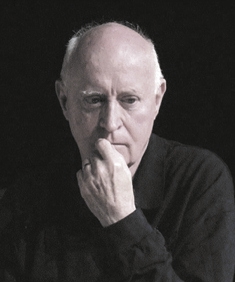
Autodidact Edward Bond, (there he is above), brought all the violence he had seen through the war years, and in his working-class upbringing, to bear on Saved, his second full length play. Indeed violence is the theme that runs through much of his work and his influence on later generations of British playwrights is patent. Saved is set in the South London of the 1960’s, socially, culturally and economically impoverished. This is no “kitchen-sink” period piece though. In some way it could have been written yesterday with a few tweaks to the language, (it being a fairly hackneyed, “gor-blimey”, argot with fairly pedestrian swearing).

Len and Pam hook up. They go boating, where Pam meets Fred, who she falls for even though he is a prize sh*t. Len has moved in with Pam and her parents, Mary and Harry. Theirs is not a happy marriage. Pam has a child by Fred, though neither turn out to be naturally suited to parenthood it’s fair to say. Fred goes fishing, watched by Len. Fred’s mates turn up ,as does Pam with the baby. She leaves the baby. Goading each other on, the gang taunts, and then stones, the baby in its pram. When Pam returns she doesn’t realise her child is dead. Fred is jailed for his part in the crime. When he gets out Pam begs him to come back to her. Len and Mary flirt. There is a huge row. Len fixes a broken chair: offering some hope of redemption at the end.

It may sound like bleak, visceral stuff. The central scene which so offended the critics at the public premiere is brutally shocking. As shocking as I have seen on stage. Violence may permeate contemporary culture, but theatre makes it more “real”. To the gang the baby is no more than a “thing”, such is their poverty of empathy. Despite this extreme, the play seems to me to present some real truths about an alienated society and the psychological damage it inflicts on people. No need to chuck drink, drugs, crime, consumerism, media into the mix. The essence of the relationships, fuelled by anger, resentment, bitterness, jealousy, boredom and frustration, rang true to me without foregrounding these addictions. The violence simmering under the surface of humanity colours each scene, each line, each interaction. The tone is not moralising, hectoring or judgemental. These are delicate, damaged, hopeless people. The final, wordless scene, is almost as affecting as the central, brutal scene.

Edward Bond’s plays were increasingly ignored from the 1980s, in part reflecting his own dissatisfaction with contemporary theatre practice. His most recent plays have been largely confined to the Big Brum company in Birmingham in this country, though his work is more widely performed in Europe, especially France. This is a shame, if that is the right word for drama suffused with violence. I would love to see, Early Morning, the surreal satire that followed Saved, or his other “classic”, Bingo, which puts a violent twist on Shakespeare’s later years. In fact, on the basis of Saved, I would try any of his work now that I have read about it.

He does though allow students to take on his work regularly. Which gave this accomplished cast an opportunity they all grasped with both hands. Toheeb Jimoh as Len had something of the observer about him, complicit in his manipulation by Pam, Fred and Mary. Shalifa Kaddu’s Pam was riveting, initially confident, crushed by Fred’s rejection, finally consumed by anger. I was also extremely impressed by Ellie Rawnsley as Mary, who effortlessly captured the brassy bearing and rancour of a character twice her age. Similarly Alex James-Cox, with very little dialogue until his heart to heart with Len near the end, shows Harry as a careworn, shuffling man clinging to routine to fill the void of his life and marriage. Joe Bolland, who played Fred, was perhaps the most assured. This is a powerful, brilliantly constructed play, make no mistake, and this cast, under experienced director John Haidar, did it real justice.


The Cherry Orchard at Milton Court Theatre review ***

cherry_orchard_image_only

The Cherry Orchard

Milton Court Theatre, 17th October 2017

I have remarked before on the attractions of the Guildhall School final year productions. Lovely venue, clear interpretations which eschew directorial licence, and the chance to see some potential future stars of stage and screen.

I must say these students are an extraordinarily attractive bunch. I guess an acting factory isn’t that interested in churning out fat uglies like yours truly. Shame since people are a diverse lot. As our leading British thespians bear witness too. This also highlights the other caveat which I would raise about these productions. Obviously if everyone on stage is in their twenties those tasked with playing the more mature characters are presented with a challenge that the age appropriate characters are spared. I have to say though that overall, the entire cast performed admirably, especially in the second half, though for me the standout performances came from Georgina Beedle as Madame Lyubov Andreievna Ranevskaya and Mhairi Gayer as Anya.

The Chekhovian symphony always takes a little time to build as we embrace the characters, both in terms of their individual psychologies, and what they stand for in pre-Revolution Russian society. Director Christian Burgess let each of the actors find their voices without rushing things, which softened some of the slightly uneven casting. This was Tom Stoppard’s translation. Since Chekhov pervades a great deal of his own work it is no surprise that it hits the spot. Any playwright worth his or her salt will take a shot at adapting Chekhov but some are more sympathetic than others. This production (designed by Polly Sullivan) was as historically specific as it is possible to get – ushankas, birch trees, even a samovar I think. A complete contrast to the current Sherman Theatre interpretation from Gary Owen and Rachel O’Riordan which sounds terrific. I see too that Mike Bartlett is not averse to infusing his latest (great) play Albion with the spirit of the Cherry Orchard, both directly in terms of plot and also through the character of Audrey Walters, (Victoria Hamilton turns in one of the best performances of the year – just see it).

For of course there are always plenty of themes in Chekhov’s plays that resonate with today’s world. That is generally because there is just a lot in Chekhov’s plays full stop. Regret about an imagined past is a powerful driver of society in the present and that applies throughout human written history (I may have made that up but you get the point). These regrets and disappointments are played out through the personal, and always with a wry humour in the background.

Overall then a fine production. Not the best you will ever see, but that is unsurprising. And the two actors I mention above have a bright future ahead of them. Mind you, what do I know.