
Thomas Ades and the LPO at the Royal Festival Hall review *****

London Philharmonic Orchestra, Thomas Adès (conductor), Kirill Gerstein (piano), Ladies of the London Philharmonic Choir

Royal Festival Hall, 23rd October 2019

  • Sibelius – Nightride and Sunrise, Op 55
  • Thomas Adès – Concerto for piano & orchestra
  • Holst – The Planets, Op 32

An opportunity to break MS into the world of modern/contemporary classical music in the admittedly unthreatening person of the mighty Thomas Ades, here both composer and conductor. Mr Ades is quite possibly my favourite living composer and his take on Beethoven with the Britten Sinfonia provided some of my favourite performances in the last few years. I am pleased to say that my favourite son, whose intellectual curiosity fortunately knows no boundaries. is now a convert. Indeed we both regarded this UK premiere of TA’s 2018 piano concerto, his second after In Seven Days from 2008, as the highlight of the evening, surpassing his predictably astute reading of The Planets.

First up though Sibelius’s sleigh ride inspired tone poem. Now there must have been a time when I thought I liked Sibelius. I have a symphony cycle recording from Simon Rattle and the CBSO and the violin concerto, and I seem to remember both were purchased on the back of live renditions. But now I find him pretty much unlistenable. Big slabs of music where not much happens. Organic yes, nature in all its glory as here, yes, clear themes gently mutated. Night Right and Sunrise is a game of two halves. The chugging sleigh ride rhythms giving way to a restorative chorale. Audience and orchestra deep in concentration, the string players especially in that dotted quaver/semi-quaver repeat, but even TA was unable to help me get it.

Kirill Gerstein, with TA conducting, first performed the piano concerto with the commissioning Boston Symphony Orchestra in March, with performances following in New York, Leipzig, Copenhagen and Cleveland, with Helsinki, Munich, Amsterdam and LA to come. So you can see that this is a “big thing” music wise and will have given TA and KG the opportunity to play with some of the top rank orchestras worldwide. I would be very surprised if this isn’t seen as an instant classic with KG, who plainly loves it, (already performing from memory), being compelled to yield his first mover advantage in the very near future. Hopefully he will get his recording in first as this definitely deserves it.

The first movement, marked Allegramente, jolly, opens with drum rolls and is in sonata form with a march tune between the two themes and an extended cadenza at the end. The second slow movement, Andante gravemente, starts with a melody and countermelody after a chordal intro, and follows this with a lovely second melody idea set against a rising harmony. The final Allegro giojoso restores the merry mood, with a jaunty canon following an opening tumbling theme before a brass clarion heralds a new bouncy boogie with a choral climax. These themes and the call to arms that punctuate them are reworked in many ways but always with soloist, orchestra and conductor flaunting their Gershwinian jazz trousers. Like so much of TA’s music it probably couldn’t exist without Stravinsky, Ravel and Britten, but there is also, more surprisingly as sense of Bartok in the slow movement and Rachmaninov in the finale. But it is Prokofiev that keeps coming to mind especially in the improvisatory piano line with shifting tonality, syncopation, counterpoint, imitation, repetition and light-hearted dissonance all contributing to the buoyant mood. Like a contemporary artist who believes in the enduring value of paint and colour, TA takes inspiration from the best that his forebears have come up with in the last 150 years for this combination and defiantly reworks it. We weren’t the only happy punters.

I love The Planets but recognise that, outside of the big thrills, over familiarity can sometimes dampen the wow factor. Not here though. As with his fresh take on Beethoven, TA, isn’t all driven tempi and flash harry. There are passages of surprisingly muted, dare I say traditional, interpretation, in Mars, in Jupiter, in Uranus. Mind you that’s not to say the LPO, all 109 of them just about crammed on to the RFH stage, didn’t make a heck of a racket in said Mars and Jupiter. Mercury and Uranus showed up TA’s ear for detail amidst the perky Disney bops. However it was in the pulse-y interplay between harp and flute and the strings in Saturn and Neptune that impressed me most.

Top class. MS has asked for another. I will need to tread carefully after this.
Thomas Ades and the LPO at the Royal Festival Hall review ****

Lutoslawski2

London Philharmonic Orchestra, Thomas Ades, Kirill Gerstein (piano)

Royal Festival Hall, 26th September 2018

  • Igor Stravinsky – Symphony in Three Movements
  • Thomas Ades – In Seven Days (Concerto for piano and orchestra)
  • Witold Lutoslawski – Symphony No 3

Thomas Ades is a talented chap. As composer, conductor and performer he follows in the footsteps of some of the greats., and I for one think there is a lot more to come. Some of the most memorable classical music evenings I have enjoyed in the past few years have been graced by his presence.

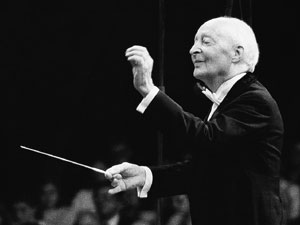
So although his own piano concerto, and the Lutoslawski (there he is above), were pieces I knew only by reputation, this, the opening concert of the LPO 18/19 season, looked a good bet. And it certainly came up trumps. Mr Ades has a way with Stravinsky as you might expect, his own music was greatly enhanced by Kirill Gernstein as the soloist (of sorts), who showed his affinity with TA’s music in one of his mazurkas as encore, but it was actually the Lutoslawski symphony that turned out to be the highlight of the evening.

Stravinsky’s Symphony in Three Movements marked another step in the ongoing Changing Faces retrospective of his music at the Sot Bank. It is trademark IS, sparkling brass, bubbling woodwind and pulsating strings, smoothed off spikiness if you will. Though for me the fact that the three movements were composed independently over time shows through, so it isn’t right at the top of his orchestral oeuvre. The Allegro overture first movement definitely has its moments, harking back to the early revolutionary ballet scores with prominent piano here played by John Alley. The second movement, marked Andante, is comprised of material originally intended for a film versions of the St Bernadette Soubirous, Our Lady of Lourdes, (she of the multiple visions and Catholic granny’s favourite) and has an innocent charm, with a couple of interruptions, and vocal harp line. The finale, con moto, is a lot more aggressive, reflecting its completion at the end of the war in 1945, with that motoric quality that inhabits IS’s music, at least until the final austere serial phase.

In Seven Days doesn’t muck about, taking as its inspiration the Creation. The religious one or maybe the real one. Hard to tell. It was originally performed alongside a video composition from TA’s then husband Tal Rosner. It certainly has a vivid, cinematic approach to go with the programme, think Ligeti in terms of mood if not structure. But it didn’t need any visual assistance. Tiny particles of sound combine, break-up, recombine, ever expanding as we move through the seven movements, out of Chaos through to Contemplation. It was originally scored for a smaller orchestra. Here TA had the freedom to really crank up the engine especially in percussion and brass. Eat your heart out Haydn and all the others who have also had a go at the greatest story ever told. God as scientist not mystic.

It is one of those fractal compositions, music made out of algorithms or rules, built on repetition, where the very small mimics the very large. Maths as music, or maybe the other way round. So it is in a state of constant flux but the thing with Ades is that he cleaves close enough to conventional tonality, and, the secret sauce (for me I now realise) that is rhythm, not to disappear out of sight into the impenetrable. I can’t say it all fell into place on this first hearing, but it “made sense” which is all I need to revisit. The more modern and contemporary classical music I encounter the clearer it is becoming to me what is needed to rule it in or out. I do seem to have a penchant for ever changing repetition in music with rhythm and harmony, not melody, as the hooks (as it were). Ades kicks off with extremes of pitch in the opening perpetuum mobile, (I know now these could be my favourite two words in Latin), led by strings. This breaks with a chorale and the piano kicks in leading the orchestra to further rising and falling repetitions, with some very snazzy percussion, to mark the second day. The third day is another variation starting in the bass and rising up before the glittering harmonies of day four. Days five and six are a linked fugue, sort of Bachian, with the piano appearing in the second. A calmer interlude and then back to the beginning.

Witold Lutoslawki’s third symphony is probably his most well known composition. WL’s first symphony came out in 1948 but he was, like any worthwhile composer behind the Iron Curtain, derided by the authorities for “formalism”, which as far as I can make out was anything that wasn’t rum-pum-pom patriotic. WL didn’t return to the symphony until 1965 by which time the world had changed politically and musically. He was a big fan of John Cage’s experiments in chance in music which he embraced as “aleatory counterpoint” in his work, including the second, and this, the third symphony. Never fear folks, it doesn’t mean some knotty, joyless, meandering. Just some passages where some of the orchestral players have a bit of fun as far as I could tell in this performance. (Actually what I have learnt about Cage, which isn’t much I fear, says to me he was a pretty jolly sort).

The original commission from the Boston Symphony Orchestra came in 1972 but WL couldn’t find the format he wanted.  In 1981 he alighted on the toccata which sits at the centre of the piece. Another two years and the rest of the work was signed off and delivered. A short prologue precedes the first of the two main movements, the toccata which is divided into three parts, each getting progressively “faster” by stretching out the basic rhythms, and punctuated by slower “intermezzi”. Apparently the Beethovian opening, and oft returning, four note motto is comprised of E naturals. Good to know. Then comes a shorter, slower “movement”, a swirling theme with string offsets. The symphony ends with a rapid coda and tutti. It is played through and comes across as a building of momentum culminating in huge crescendoes which subside and then build again. There is certainly a cosmic dimension which echoes the Ades piece, and like In Seven Days it always stays the right side of the tonality gulf and features some breathtaking instrumentation.

I could imagine that the symphony, even with this structure marked out, could get fuzzy. Not in Mr Ades’s hands though. It is a big leap to compare this performance to his ongoing, and outstanding, Beethoven cycle with the Britten Sinfonia at the Barbican, but, because he doesn’t hang about tempo wise, and because he prizes textural clarity over pompous showiness, in both cases, the layers of music are revealed not muddled.

So a big evening marshalled by a big man. There was much to bind the music together in terms of ambition, structure and feel. It normally takes Vladimir Jurowski, and the right repertoire, to bring the very best out of the LPO. He wasn’t missed here.