
Pergolesi and Vivaldi: OAE at the Queen Elizabeth Hall review ****

Orchestra of the Age of Enlightenment, Katherine Watson (soprano), Rowan Pierce (soprano), Zoe Brookshaw (soprano), Iestyn Davies (counter-tenor), Katharina Spreckelsen (oboe), Choir of the Age of Enlightenment 

Queen Elizabeth Hall, 11th November 2019

  • Giovanni Battista Pergolesi (1710-1736) – Stabat Mater
  • Tomaso Giovanni Albinoni (1671-1751) – Oboe Concerto in D minor, Op.9 No.2
  • Antonio Vivaldi (1678-1741) – Gloria RV 589

Last year a Pergolesi Stabat Mater with BUD from the AAM. This year the OAE take with MSBD and Katherine Watson (braving a cold) and Iestyn Davies in the soloist chairs. I’ve already banged on about Pergolesi before. This is his most famous work. Written just before his early death from TB. More than a hint of the comic opera about its style, which are, largely, his other, authenticated contributions to Baroque musical history, (I have a recording of some of his instrumental offerings). Though certainly not its serious religious subject, a C13 poem depicting Mary’s vigil at the foot of the Cross. Took the European musical world by storm and, on and off, has been a favourite ever since. Immediate, direct and very effective, it is impossible not to be carried along by the lean, melodic strings offset with deliberately nostalgic stile antico effects, (from the time before Monteverdi revolutionised Western music). These include prolonged cadences and delayed resolutions. Feel the pain. Lovely but a couple of times a year is enough for me.

Albinoni was a prolific composer, around 80 operas, 40 chamber cantatas, 60 concertos and 80 sonatas, and was, in his day, as popular as Corelli and Vivaldi. Though not quite as good IMHO. Then again he only really considered himself a violinist and, being a rich toff, didn’t have to work. SO we should applaud his industry. And, in the oboe concertos, he did come up with some of the finest music ever written for the instrument. His Op 9 set contains 4 for solo oboe and 4 for two oboes and this one, No 2 is considered the best of them. It kicks off with an elegant medium paced Allegro, follows with a sublime and generous slow movement, with an aching, bel canto solo line against a rocking string ripieno, (which MSBD was much taken with), and a bouncy, scurrying finale, which again gives the soloist plenty of opportunity to show off. And, when it comes to Baroque oboe, very few can match the OAE’s Katharina Spreckelsen.

Last live listen to Gloria was with MS and MSC at the Cadogan Hall with the ECO, so it has become something of a family affair, (even the SO and BD have grinned, and, to be fair, more than bore it, in the past. Famously AV wrote the Gloria for a full SATB choir. despite their being, at least officially, no blokes in the Ospedale della Pieta, bar carrot top himself. Which means they were drafted in, or perhaps, in the array of talents in the convent, there were females basses or at least voices low enough to take the parts, maybe with the whole pitched an octave higher. The contemporary audience would never have known, the young women being concealed behind a grills at the balconies where they performed. We had the OAE’s dedicated chamber choir, thankfully in full view, a scratch outfit of professionals perfectly matched to the OAE’s beefy sound. This I can listen to more than a couple of times a year.
Bach St John Passion: OAE at the Royal Festival Hall review ****

Orchestra of the Age of Enlightenment, Simon Rattle (conductor), Peter Sellars (director), Choir of the Enlightenment

Royal Festival Hall, 2nd April 2019

JS Bach – St John Passion

  • Camilla Tilling (soprano)
  • Christine Rice (mezzo-soprano)
  • Andrew Staples (tenor)
  • Mark Padmore (tenor, Evangelist)
  • Roderick Williams (baritone, Jesus)
  • George Nigl (baritone)

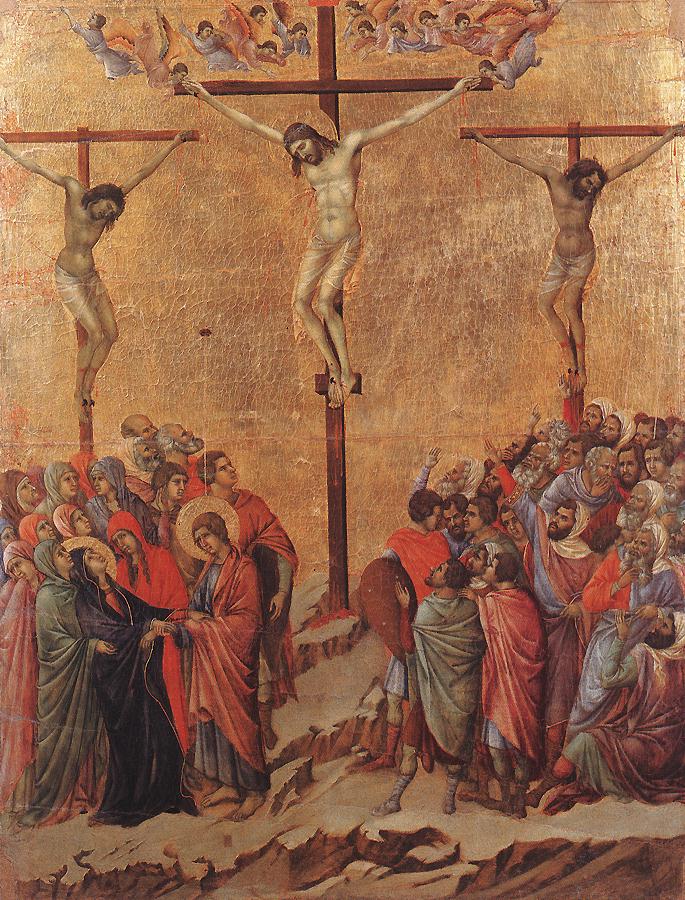
The Tourist, along with chum for the night TMBOAD, was recently blindsided, in a good way, by the staging of Britten’s War Requiem at the ENO which was far more theatrical than he had anticipated. Well blow me if if didn’t happen again with this St John Passion. I had not really clocked the presence of Peter Sellars on the list of creatives so had only anticipated a semi-staged version, a bit of movement, some subtle lighting, that sort of thing. However, from the moment we saw the OAE lined up on one side of the stage, it was clear something more was on the cards. What we didn’t expect was a full blown, punch to the gut emotional, acted out Passion, complete with modern dress costumes, (red and blue for the Marys, monochrome for the rest), occasional props, an immensely atmospheric lighting design courtesy of Ben Zamora, musical solos from memory, (my favourite was Simone Jandl and her viola d’amore and Katharine Spreckelsen and her oboe da caccia), and even walk-on contributions from Sir Simon Rattle himself.

The St John Passion is a powerful work of act even without the dramatisation, reflecting the subject, (even for those of us who have no faith), and the direct, even simple, way that JSB chose to set it. I can imagine that there will be those who would prefer, in theory, to be left to focus on the music, the voices and the text, but I would defy them not to be bowled over by the extra dimension that Peter Sellars staging brings to the work. This is not the first large scale Bach vocal work that the Tourist and BUD have shared in recent years, we have a B Minor Mass and a Christmas Oratorio under our belt, and the Tourist has a number of independent Bachian choral sojourns on top of this. The Tourist may have waited until his middle ages before he “got” Bach but now he consumes with the zeal of the convert.

Now as it happens Bach himself was reproached by some in the 1720s and beyond for the theatricality of his Passion settings and the fact that he revised them on multiple occasions in later years partly reflected this as well as a more realistic approach to the logistics of the piece and to tighten it up musically. So those who might initially object to this Sellars/Rattle ritualised version as liturgically inappropriate or offensive are in “good” company. There will have been a time after all when staging the Passion in the concert hall rather than the Church will have provoked the ire of some.

Whilst there are some belting chorus parts and chorales in the SJP the thing that really strikes me is the starkness of the settings with minimal instrumental accompaniment to many of the arias and with much use of recitative, and not just from The Evangelist’s narration. A lot of the first two parts is told from the perspective of those around Christ, and, assuming this translation is accurate, the text is very immediate and shorn of ornamentation. JSB cleverly creates a symmetrical structure, centred on the chorale Durch dein Gefangnis, as Pilate seeks to release Jesus, either side of which is the same pattern of choruses, some fugal, solos and chorales but in reverse order. This creates a musical order and narrative structure which informs the “drama”. It is not, as Sir Simon observes in the programme, a very melodic piece even if it does have some very arresting, and surprisingly experimental, musical passages. In short, with these forces, six soloists, a choir of 32 and the OAE numbering 30, it very much has the feel of opera, putting aside its subject. It certainly has emotional clout.

So easy to see why Sir Simon and Peter Sellars long cherished the idea of staging it in this way, finally realised in 2014 in Berlin when Sir Simon was head honcho at the Berlin Phil. The soloists here, led by the very deliberate Mark Padmore, who is pretty much the go too Evangelist, and the superb Roderick Williams as a visibly suffering Jesus, as well as Camilla Tilling, Christine Rice, Andrew Staples and George Nigl, were on top form and all can act as well as sing and the chorus brought real drama to their turns. The fact that the latter four soloists take multiple “roles” creates a texture and an audience empathy that a straight concert hall performance can lack. Contemporary resonance abounds with George Nigl’s equivocating politician Pilate yielding to the “will of the people” and the blindfolding and torture of Christus under investigation.

OK so occasionally some of Mr Sellar’s choreographic tropes grated a little, the hand gestures, the just-so re-creations of classic Renaissance paintings, the singing from prone positions, the pauses to get everyone in the right place, and the sur-titles, whilst a necessary part of the staging, were a bit too curt at times, and, whilst I don’t know where to take the interval the second half, as is usual, is a bit long compared to the first. Overall though this definitely ticked the box for BUD and myself.

Mind you we are, contrary to all appearances a couple of avowed modernists where it comes to our dramatic preferences. And so, I am willing to bet, are the vast majority of punters. Two hours plus of Bach and the story of Christ’s death may not float the boat of many outside us classical music buffs but I doubt there could be a better way to spread the word. Which ultimately is why the old fella wrote this masterpiece in the first place.