

Amsterdam at the Orange Tree Theatre review ***

Amsterdam

Orange Tree Theatre, 5th October 2019

The UK premiere of Israeli playwright Maya Arad Yasur’s “strikingly original, audacious thriller”. Hmm. Striking yes. Original. I guess so. Audacious thriller. Not so sure. It is a fascinating story with a powerful message but its formal construction serves to distract and obfuscate rather than illuminate.

An Israeli violinist, living in Amsterdam, and about to give birth, receives an unpaid gas bill dating from 1945. From this premise the cast of four, deliberately diverse, tell the story of how this came to happen ranging across time, place and character. They start off bickering about where to start, interrupt, and comment on, each other, fracture and distort their narratives and regularly interrupt to ring a bell to amplify or translate. It takes time to adjust to the structure and the script is packed with details, repetitions, overtones and undertones, which can make events hard to follow.

Maya Arad Yasur (through Eran Edry’s translation) makes sure we understand the complexity and self-fabrication of narrative through her conceit and highlights the corrosive effect of hostility to the “other” but the expansion into contemporary conflict has the perverse effect of blunting the central historical fact. Over 75% of the Jewish population in the Netherlands was murdered by the Nazis and once the war was over, those returning home were forced to pay the utility bills of their wartime occupiers. The unnamed violinist’s own investigation, and disturbing discovery, and her personal journey as immigrant and mother to be, strike me as more than enough to make the point. Especially when the “scenes”, the arrival of the €1700 bill, the blithe response of the bureaucrat, the paranoiac unease in the supermarket, the birth anxiety, the “discussions” with her agent and the hairdresser, emerge through the conceptual fog. Dramatisation would have equally served as provocation and testament. We might then have been better able to see more clearly what she could see in a “foreign” place haunted by history.

I am all for experimentation and can’t fault the performances of Daniel Abelson, Fiston Barek, Michal Horowicz and Hara Yannas but, at the end of the day, this was harder work than I wanted it to be. Director Matthew Xia, as the new head honcho of the Actors Touring Company, who co-produced this with the OT and Theatre Royal Plymouth, is obviously a true believer in the power of the work though his previous engagements, Blood Knot here, Wish List at the Royal Court and the revival of Blue/Orange at the Young Vic, show his is equally at home in more naturalistic forms. Here though he opts to exaggerate the already contrived structure with lurches in tone and pace, simple staging (designed by Naomi Kuyck-Cohen) with dissonant props and constant motion (Jennifer Jackson).

The production will run in Plymouth in February next year before moving on to Salisbury, Glasgow, Manchester, Oxford, Coventry, Leeds, Birmingham, Newcastle and Bath. On balance? You should see it.

Out of Love at the Orange Tree Theatre review ****

review-out-of-love-paines-plough-orange-tree-theatre

Out of Love

Orange Tree Theatre, 6th February 2018

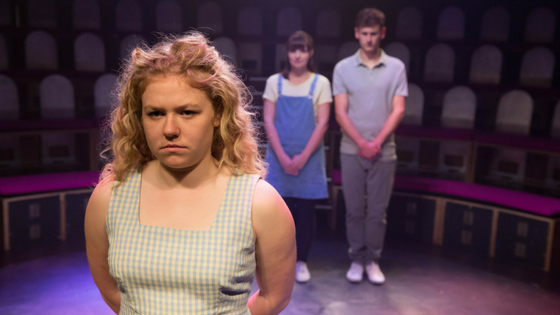
The second of the three co-productions with Paines Plough and Theatre Clywd and, for me, somewhat more persuasive than Black Mountain (Black Mountain at the Orange Tree Theatre review ***), though very different in subject and scope. Mind you, in both cases, out the door at 7, a quick dramatic fix, and back home by 9ish for a cup of tea, is surely the perfect evening. Out of Love is from the pen of Elinor Cook and garnered acclaim last year at Edinburgh with this same creative team and cast.

Now the SO and I were not entirely persuaded by the recent Donmar Warehouse production of Lady From the Sea, which was adapted by Elinor Cook, though, on my part, this is because I like my Ibsen icy. (The Lady from the Sea at the Donmar Warehouse review ***). There is no doubt though that she is a writer who persuasively captures the experience of women. At least I think so, as it is tricky to judge from my perspective as a fat, old, privileged white bloke. I did learn a lot about the two characters, Lorna and Grace, at the heart of this play.

Now telling the story of two friends, throughout their lives, is not revolutionary. Especially when one escapes their roots and one remains. This, after all, lies at the heart of Elena Ferrante’s quartet, (though I accept there is a great deal more here to feast on), which April de Angelis and Melly Still so ingeniously brought to the stage last year (My Brilliant Friend at the Rose Theatre Kingston review ****).

Elinor Cook though has shaken this up though by abandoning strict chronology. Instead we get a series of rapid, kaleidoscopic scenes which chart the women’s relationship with each other, with their parents, with their various partners and, poignantly, with Grace’s child, Martha. Grace is the feistier and more headstrong of the two, Lorna more measured and initially less confident. From the outset, a game of “weddings” in the park, we see that Lorna attracts more male attention, which fuels Grace’s jealously and protectiveness. Lorna has rejected her absent father but resents her stepfather’s attempts to cool the intensity of the friendship. Lorna’s academic success sees her go to university and build a career. Grace falls for local lad Mike and falls pregnant, and cannot follow Lorna’s path. This creates a gap between them that proves difficult to bridge.

Like I say, nothing exceptional in the plot. Yet Elinor Cook’s writing is so exact and so true to life that, together with the dynamic structure, we are fully drawn into the friendship. Katie Elin-Salt is very impressive as Grace, her outward show of gobbiness failing to conceal her wounded vulnerability. Sally Messham matches her showing how Lorna grows in confidence, and independence, as she pushes back against family, partners and, yes, Grace. Hasan Dixon has his work cut out playing the eight, count ’em, incidental male roles, but any marginal audience confusion in the first few minutes soon evaporates. No costume changes, no lighting or sound pyrotechnics, (in contrast to Black Mountain), so we are reliant on text and actors. Oh and some very nifty work from Movement director Jennifer Jackson to demarcate both characters and place.

So a frank, smart, poignant, realistic, if not naturalistic, portrait of a friendship, which creates a deep impressions, actually impressions, over its compact 70 minutes. Definitely worth a visit, there are a couple of weeks left to run, and, if you are anywhere close by, it would be a crime to miss it.


Parliament Square at the Bush Theatre review *****

parliament-square

Parliament Square

Bush Theatre, 6th December 2017

As a few slightly unkind people have pointed out most of the “reviews” I somewhat sadly post on this “blog” are worse than useless as, more often than not, they appear after the event. Fair criticism but I can’t be toddling off to everything in the first week and I judge that most plays at least are best seen about two thirds of the way through. If they have flaws by then, they can be corrected where possible, or parts excised if really necessary. Cast can get the full measure of character and interaction, timings, pauses and rhythm honed. So I reckon I will get more for my money. So yah boo to you.

In this case though I am doing you a favour. Parliament Square runs until 6th January having first appeared at the Royal Exchange, Manchester, there are plenty of tickets left and full price is just twenty quid. The main space at the Bush is airy, comfy and sightlines are terrific. Oh and it is a mightily good play, with an excellent cast, skilfully directed by emerging talent Jude Christian. It has an absorbing central concept, just how far will an individual go to protest against injustice, is formally inventive, each of the three sections has some sort of clever conceit, and it is very well written by James Fritz. It is probably fair to say that the ending is a little too calculated. On the other hand the first section, in large part thanks to exceptional performances from Esther Smith and Lois Chimimba, is as exhilarating a piece of theatre as I have seen this year.

The play won the Judges Award for Playwriting in the Bruntwood Prize in 2015 and, like other plays I have seen which have been recognised here, it has that spark of invigorating originality from the outset which characterises the best new writing. Kat (Esther Smith) gets up one morning, skips work, leaves her husband and young daughter behind, gets the train to London, and commits a premeditated, dramatic, act of self sacrifice. Through the first act, Fifteen Seconds, she is, literally, coached by her conscience in the form of Lois Chimimba, (last seen by me in the unfairly maligned Common, in Peter Pan and in the excellent Diary of A Madman at the Gate). Lois Chimimba also doubles up as Jo, Kat’s sullen teenage daughter in the final act, Fifteen Years. I expect she, and Esther Smith, will go on to bigger, (and maybe even better), things as they are both superb actors.

Kat “fails” in her protest thanks to an intervention by Catherine, another excellent performance from Seraphina Beh. In the second act, Fifteen Steps, we see Kat, vividly and painfully, reconstructing her life and explaining why she did what she did to husband (a perplexed Damola Adelaja), mother (a bluntly perceptive Joanne Howarth) and health professionals (a sympathetic doctor in Jamie Zubairi and demanding physiotherapist in Kelly Hotten) as well as, eventually, to Catherine herself. The rest you can see for yourself.

James Fritz’s writing is very spare but very accurate. We never get to know exactly what Kat is protesting against but it doesn’t matter. We do get to contemplate why someone might choose this idealistic course to try to make a difference, why some might be inspired and some revulsed and why some might see this as futile and selfish. Jude Christian’s direction, (along with Fly Davis’s design, lighting from Jack Knowles, sound from Ben and Max Ringham and movement from Jennifer Jackson), is perfectly matched to the text. There is nothing extraneous here but the required ambiguity about the wisdom of such action is brilliantly conveyed.

James Fritz’s previous plays (The Fall, Comment is Free, Ross and Rachel and Four Minutes and Twelve Seconds) have garnered significant acclaim. I can see why. This is great theatre, well executed. You will come out likely annoyed by some of the behaviour of the characters, but, that is kind of the point given the subject. I think you will admire both writing and acting though. So get along to the Bush. Now.