Orchestra of the Age of Enlightenment, Katherine Watson (soprano), Rowan Pierce (soprano), Zoe Brookshaw (soprano), Iestyn Davies (counter-tenor), Katharina Spreckelsen (oboe), Choir of the Age of Enlightenment
Queen Elizabeth Hall, 11th November 2019
Giovanni Battista Pergolesi (1710-1736) – Stabat Mater
Tomaso Giovanni Albinoni (1671-1751) – Oboe Concerto in D minor, Op.9 No.2
Antonio Vivaldi (1678-1741) – Gloria RV 589
Last year a Pergolesi Stabat Mater with BUD from the AAM. This year the OAE take with MSBD and Katherine Watson (braving a cold) and Iestyn Davies in the soloist chairs. I’ve already banged on about Pergolesi before. This is his most famous work. Written just before his early death from TB. More than a hint of the comic opera about its style, which are, largely, his other, authenticated contributions to Baroque musical history, (I have a recording of some of his instrumental offerings). Though certainly not its serious religious subject, a C13 poem depicting Mary’s vigil at the foot of the Cross. Took the European musical world by storm and, on and off, has been a favourite ever since. Immediate, direct and very effective, it is impossible not to be carried along by the lean, melodic strings offset with deliberately nostalgic stile antico effects, (from the time before Monteverdi revolutionised Western music). These include prolonged cadences and delayed resolutions. Feel the pain. Lovely but a couple of times a year is enough for me.
Albinoni was a prolific composer, around 80 operas, 40 chamber cantatas, 60 concertos and 80 sonatas, and was, in his day, as popular as Corelli and Vivaldi. Though not quite as good IMHO. Then again he only really considered himself a violinist and, being a rich toff, didn’t have to work. SO we should applaud his industry. And, in the oboe concertos, he did come up with some of the finest music ever written for the instrument. His Op 9 set contains 4 for solo oboe and 4 for two oboes and this one, No 2 is considered the best of them. It kicks off with an elegant medium paced Allegro, follows with a sublime and generous slow movement, with an aching, bel canto solo line against a rocking string ripieno, (which MSBD was much taken with), and a bouncy, scurrying finale, which again gives the soloist plenty of opportunity to show off. And, when it comes to Baroque oboe, very few can match the OAE’s Katharina Spreckelsen.
Last live listen to Gloria was with MS and MSC at the Cadogan Hall with the ECO, so it has become something of a family affair, (even the SO and BD have grinned, and, to be fair, more than bore it, in the past. Famously AV wrote the Gloria for a full SATB choir. despite their being, at least officially, no blokes in the Ospedale della Pieta, bar carrot top himself. Which means they were drafted in, or perhaps, in the array of talents in the convent, there were females basses or at least voices low enough to take the parts, maybe with the whole pitched an octave higher. The contemporary audience would never have known, the young women being concealed behind a grills at the balconies where they performed. We had the OAE’s dedicated chamber choir, thankfully in full view, a scratch outfit of professionals perfectly matched to the OAE’s beefy sound. This I can listen to more than a couple of times a year.
Handel’s Messiah, Barbican Hall, 19th December 2018
Jacqueline Shave (violin/director), Sophie Bevan (soprano), Iestyn Davies (countertenor), Allen Clayton (tenor), Roderick Williams (baritone)
Christmas on the way. Full house at the Barbican. MSBD as wingman. Messiah. A quartet of outstanding soloists. The Britten Sinfonia Voices. The Britten Sinfonia. And the very wonderful Jacqueline Shave leading the band.
It is of course impossible not to delight in the Messiah. At least that is the received wisdom. Yet, like so much Handel, I was worried it might, well, go on a bit. For this my friends was amazingly the first ever time I had seen and heard a live performance, Which given its Baroque lineage, its status as a Christmas fixture and its frequency of performance, especially by amateur choirs, is something of a surprise even to me. I suspect its appeal to a certain sort of Englishman (and woman), of which there were plenty on show at this performance, explains part of my reticence. The type that stands for the Hallelujah chorus, showing up our shared sheepish enthusiasm for imagined tradition. (And look what a mess that has got us into). It might also be my fear (not too strong a word) of really large scale choral performance. You know, where it all just becomes and aural blur.
So I figured the best way to get over this likely unfounded prejudice was to see an appropriately scaled performance, from an orchestra, choir and soloists at the top of their game, and in the company of MSBD, whose enthusiasm and all round gracious affability knows no bounds.
Well I can report that divvying up the Christ story (with the lead actor written out as it happens) into three sections and loads of parts (I think 54 in total), arias, recitative and chorus, plus the overture and pastoral symphony instrumental, makes for a much lighter affair, with more contrast and texture, than I had expected. Of course you will already know that no doubt, but for the uninitiated, this HIP style of performance, on modern instruments, is definitely the way in. You are probably familiar with the big numbers, the aforementioned Hallelujah chorus (we are suckers for anything fugal), “I know that my redeemer liveth” for soprano, “The trumpet shall sound for bass” as well as the choruses “Surely he hath borne our grief”, “Worthy is the Lamb” and the final Amen with its OTT dramatic pause before the end. Yet to be fair to old GFH is is rammed with good tunes. Pretty much throughout.
GFH never had a problem finding good tunes. he just had a bit of a problem in stopping them. At least that is my limited experience of the operas. other oratorios and assorted vocal extracts I have heard. And it wasn’t just in the vocal music. Those organ concerti can grind on a bit. I prefer those works when the format keeps it short, sweet and long on variation. The Concerti Grossi, bits of the Latin music and some of the trio sonatas. But frankly the old boy churned out, and recycled, so much stuff that I reckon, like your man Vivaldi, it is impossible to really know where you are in any of it, so best to just let it flow.
Messiah benefits from the fact that GFH only had 24 days to turn it around. I don’t hold with all that “genius in direct group chat with God” theory of inspiration, though I can see why the original 700 strong audience at the Musick Hall in Dublin (there it is above), might have felt that way. Sometimes, whatever your skill, you are just on it. And he certainly was here. Though infamously his librettist, who sort of commissioned him, Charles Jennens, didn’t think that much of his score. Bit rich coming from a man whose text, cobbled together from bits of the St James’s Bible and Coverdale Salter, is the very definition of fruity and defiantly non-linear (though to be fair this gave GFH a chance to properly ham up his own music). Anyway the fact that GFH had to take the rich outpouring of ideas and get them down without overworking or extending them was to his, and ultimately our, advantage. And for once he didn’t, or couldn’t, nick tunes from other composers, as he was wont to do. No shame in doing that then as there isn’t now.
Of course Messiah is just an opera without sets or costumes. With a plot we likely know inside out. By 1742 GFH’s actual operas were out of fashion. The public who now turned up and paid to hear music couldn’t be doing with this expensive and drawn out entertainment. (My theory is that the royals and aristos who generally funded opera and similar such entertainments in the C17 were, like the rich have done since time immemorial, mostly just showing off and couldn’t be arsed to watch what they paid for). So the resourceful Handel yet again, a few decades late, simply nicked an idea from Italy, fitted his music to English and served it up to us Protestant Brits (and the Irish) under our then German ruler. Interesting that Jennens became GFH’s bessie and advocate, publishing all his later scores, as he originally opposed the Act of Settlement that brought the Hanoverian line to England.
And he didn’t just nick the idea of the oratorio from Italy. Some of the tunes here are lifted from Italian madrigals that he had previously written, which, together with Jenner’s eclectic libretto, explains why it doesn’t really feel that sacred. And that ultimately is its genius and what probably explains its enduring appeal.
I have said before that the Britten Sinfonia is on the way to being my favourite band, probably because of the repertoire they tackle but also because their ethos, no principal conductor or director, means they can’t. and won’t, get away with just dialling in a performance or grumpily going through the motions with a parachuted in conductor. I get the impression they choose who they work with, and what they work on. And if, as here under Jacqueline Shave, the leadership comes from one of their own, then so much the better. This means the energy they bring to performance, the direct connection with the audience and the texture they create through interpretation is second to none. Now having a professional choir of the calibre of the BS Voices under Eamonn Dougan has opened up even more opportunities.
Now GFH’s original manuscript score is for 2 trumpets, timpani, 2 oboes, 2 violins, viola, and basso continuo (cello, double bass, and harpsichord). The might have proved just a little too hair-shirt for the Barbican Hall so on this evening the BS sported the bassoon of Sarah Burnett, another cello alongside Catherine Dearnley, and another viola alongside Clare Finnimore, and a full 13 violins. Which is still, given the standard Baroque practice leaving later copyists to specify the appropriate instrumentation, as perfectly minimal a band as the work requires. With the 21 strong choir we were treated to absolute clarity with none of the blaring out using huge orchestras and choirs that started at the end of the C18 and continued through the C19. Apparently in 1857 at the Crystal Palace there was a performance with an orchestra 500 strong and a chorus of 2000. And that was not the record. Nuts.
For the bizarre thing is that the beauty of GFH’s invention lies in its restraint. His tunes are always pretty simple to understand, that is what makes them wonderful, and Messiah has a conveyor belt of terrific ideas. But GFH doesn’t feel the need to overdo with the orchestra, often surprisingly spare, and holding back, for example the trumpets and timpani until near the end. The music thus fits the text like a glove and the absence of a defining tonal scheme means that GFH can go where he will with the key to match the “emotion” in the words.
Having the soloists at either side of the stage, walking to the centre for their turns, was at first a little distracting but the payoff, each singer able to “tell”their part of the story and allowing us to focus solely on them and their voices, quickly became apparent. Now I am not smart enough to work out why, in choral works, any particular soloist is more convincing than another, it is a gut feeling, but normally there are one o0f two that stand out. Not here though. All four genuinely wowed. I remember Sophie Bevan from her performance in The Exterminating Angel. Here she had lifted time in the spotlight (not literally, this isn’t Broadway) but the was sublime. I could listen to Iestyn Davies’s countertenor all day, which trust me a few decades ago is not a phrase I thought I would ever write. He probably gets the best of the Messiah arias but even so he didn’t rest easy, ramping up the emotion. Like Mr Davies, I had heard Roderick Williams rich and dramatic baritone pretty recently, in the ENO War Requiem. Wonderful. And hearing the phrasing and virtuosity of Allen Clayton in this, rather than the recent LSO Spring Symphony, which I didn’t really get on with, was a joy.
So, I admit, I get it. Britten Sinfonia under Stephen Layton with Polyphony and two of these soloists now on order.
Aurora Principal Players, Iestyn Davies (countertenor), Sally Pryce (harp), John Reid (piano), Nico Muhly
Kings Place, 23rd November 2018
Satie – Gymnopédie No. 3
Thomas Adès – The Lover in Winter
Nico Muhly – Clear Music
Debussy – Danse Sacrée et Danse profane
Brahms – Gestillte Sehnsucht
Nico Muhly – Old Bones (world premiere of ensemble version),
Nico Muhly – Motion
Thomas Adès – The Four Quarters
Dowland (arr. Nico Muhly) – Time Stands Still (world premiere)
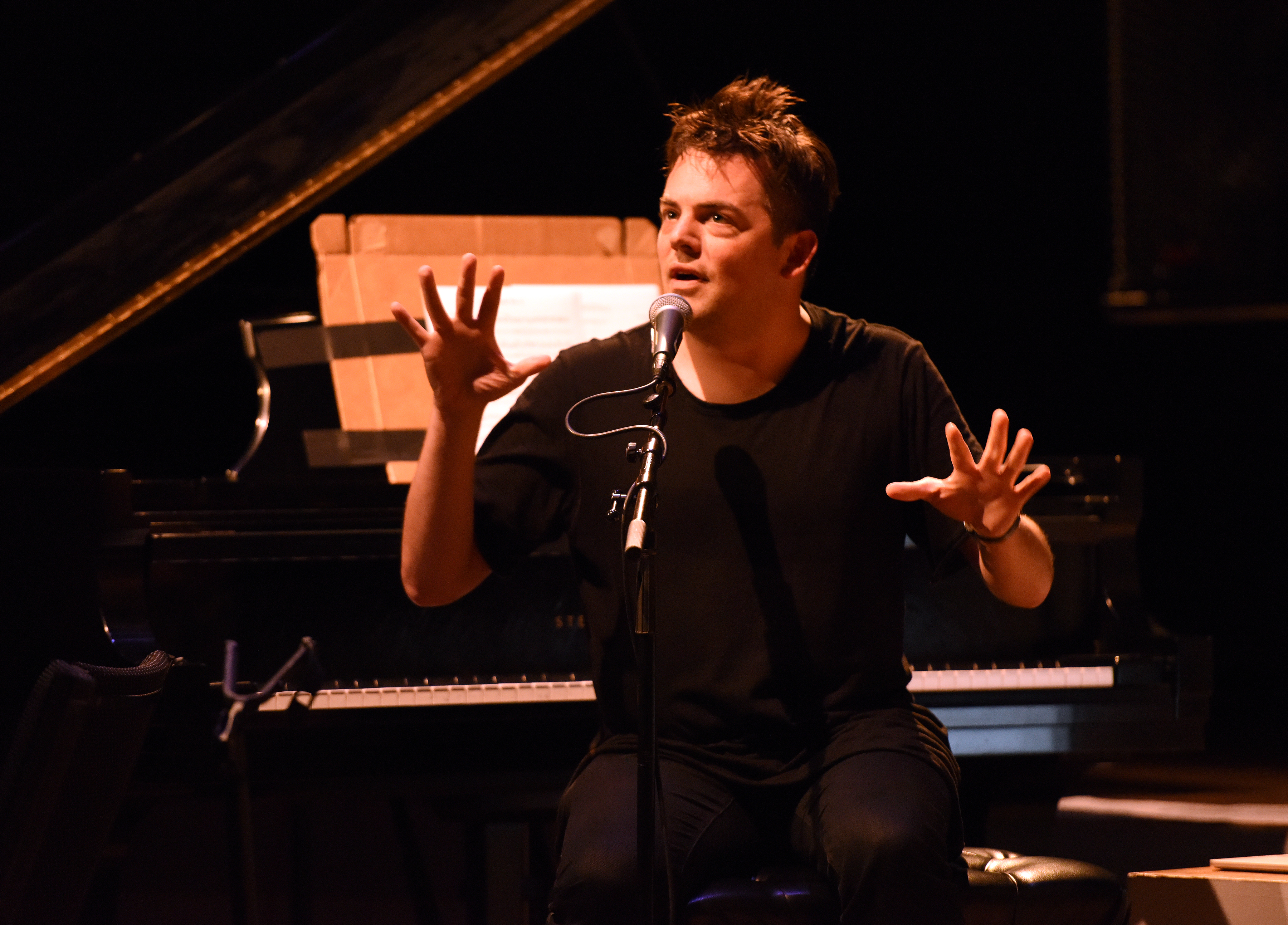
A full house, moreorless, for a diverse programme of chamber music and songs anchored by (relatively) well known works from Thomas Ades and Nico Muhly, whose effervescent presence also graced the evening as performer, conductor and even compere. Oh and did I mention he “curated” the event. The evening was part of the year long Kings Place Time Unwrapped season now coming to an end with the pieces ostensibly linked through their meditation on, er, time and music from an earlier age.
The musical backbone was provided by the graceful pianism of John Reid, with strings and clarinet from Aurora principal players, Alex Wood, Jamie Campbell, Helene Clement, Sebastian van Kuijk and Peter Sparks. Against this a number of the pieces showcased the unusual harmonies of the harp (Sally Price whose playing was certainly not backward in coming forward), celesta (John Reid again) and the ethereal countertenor of Iestyn Davies
There was a world premiere of a new chamber version of Old Bones, a song cycle about the rediscovery of the body of Richard III in a Leicester car park in 2012, (an event which also formed the opening sequence for the Almeida Theatre production of Shakespeare’s play with Ralph Fiennes in the lead). The arioso of Iestyn Davies was originally accompanied only by a lute, which can be discerned in the fragments of poems about Sir Rhys ap Tomas, the alleged killer of the king, which follows the news commentary intro. The momentum builds into a processional as the text, from Philippa Langley of the Richard III society, eloquently connects the infamous monarch to today.
Muhly’s Motion for string quartet, clarinet and piano takes as its starting point a verse anthem from Orlando Gibbons, See, see the Word, and applies his trademark post-minimalism energy to Gibbons’s complex vocal counterpoint .
In contrast Clear Music is based on just a fragment of a John Taverner motet. Mater Christi Sanctissima, and is scored for cello. harp and celesta with the latter gifted an inventive solo part for an instrument normally reserved for adding orchestral colour. The texture doesn’t change and the piece is locked in a pretty high register, even in the cello line, but, as usual with Mr Muhly, he creates an engaging piece that doesn’t come anywhere outstaying its welcome.
Thomas Ades’s Four Quarters from 2010 is a string quartet which takes as it subject the ebb and flow of time, in common with the TS Eliot Four Quartets, poems from which it surely drew inspiration. As usual Ades serves up all sorts of striking sounds, a wide dynamic range rhythmic complexity, beginning with the eerie babble of Nightfall, followed by Morning Dew evoked through pizzicato, the steady pulses of Days and the astounding harmonic complexity of the last movement, the Twenty Fifth Hour, which is measured in an unusual 25/16 time.
The evening’s outstanding piece of me though was The Lover in Winter, written when Ades was only 18. It is made up of 4 very short songs, in Latin drawn from an anonymous text. It has a bleak, brittle, chilly feel, just chiming piano chords and Iestyn Davies’s exquisite countertenor, though the last song fails up the passion. Melismatic with candid word-painting.
Mr Davies was also superb in Time Stands Still, a Dowland song which Nico Muhly has re-arranged. The melody is defined by the singer, based on an anonymous love song, with the whole band coming together to provide complementary but recognisably contemporary harmonies.
The programme kicked off with John Reid in Satie’s ubiquitous piano waltz Gymnopedie 3, blink and you’d miss it, as well as a helping of (to me) an unremarkable Brahms song and Debussy’s showcase for the harp with its “medieval” first part and bouncy Spanish inflected second “profane” part. At the end we were treated to Messrs Muhly and Davies presenting an aria from Marnie, which has just finished at the Met, and which I bloody loved at the ENO.
For someone who I gather lives in NYC, Nico Muhly seems to spend a lot of time in London. No surprise that to the Tourist. Indeed he will be back at Kings Place on New Years Eve with the Aurora Orchestra. I can think of worst places to be. Mind you I do have a better offer for once.



 At Home He Feels Like A Tourist