A (flawed) guide to London theatres

5082213817_08e9837e3f_z

When I was a young teenager I took to making up some very odd games. I wasn’t lonely, with a handful of very good friends as I remember, and my very earliest encounters with the ladies were amongst my most successful, since my true nature, an awkward mix of the needy and the misanthropic, had yet to be revealed. I was something of a swot, what you might call bookish and then, as now, was sometimes a little confused by what others did or said in social situations. But definitely not on any sort of spectrum I reckon, beyond that of the awkward 16 year old lad with lank, long hair, (despite the advent of punk), robust flares, bumfluff and the ability to make a pint of lager last a whole evening.

But enacting an entire Subbuteo World Cup, sixteen teams, (these were the days when FIFA could just about control its financial appetites – if you want to see what the future, actually present, of human “governance” looks like, like no further than the masters of the beautiful game), then quarters, semis and a final. All stats carefully recorded in a special notebook. All done on my own. That’s right. I played with myself, (no titters at the back please). Which meant that, whilst pretending to myself that this was an entirely objective exercise exercise, I got to see England play Holland in the final. England because that’s the fiction that is most deep-rooted in my psychology. But Holland won. Retribution for the injustice meted outed in the “real” World Cup final in 1974, (and, though I did not know it, but somehow feared it, again in 1978), and an early indication of my rabid pro-Europeanism.

Sounds a bit weird right. Except that PlayStations hadn’t been invented. So I like to think of myself as an early adopter, not a sad adolescent.

Anyway responsibility, albeit of a most shrunken kind, has meant I have had to let go of such childish things but I still like a good list, dictated by me, which purports to be based on “facts” but is in fact nothing of the kind. Though, as you know, (tautology alert), there are no such things as facts, only theories yet to be unproven, and “information” is mediated, and mutilated, by both provider and consumer. Do not believe anything, least of all if it comes out of your own head. Proud to be a sceptic.

So you can safely ignore what follows.

Since theatre is my current passion, I thought I would tot up the ratings that I had given the entertainments I had enjoyed over the past three years, derive some averages, adjust for frequencies and thereby show what London theatres reliably put on the best work. Thereby confirming my own biases, with my own biased ratings, mashed through a filter of spurious statistical analysis. Just the kind of woeful shite that organisations, opinion formers and your governors do everyday apparently on your behalf.

So here’s my top ten (well eleven actually). Turns out that it is a proven fact (!) that the Almeida under Rupert Goold is the best of the bunch, the Royal Court is a thing of wonder, especially when you reflect on the fact that the work is almost entirely new, and the National Theatre under Rufus Norris is not, repeat not, undergoing any sort of existential crisis, despite what some would say. The trouble with all those right-wing cultural commentators is that they are only happy when they have something to moan about; they can only argue the negative. I hope the Theatre Royal Haymarket continues its more enlightened programming under the new owners. The Young Vic remains the most exciting major theatre, even if that means a few misfires, and the one where I learn the most. The Barbican benefits from the RSC and the International companies that come through the door. The Donmar rarely drops a bollock but here you really have to be quick at the gate to get a seat. The Arcola and The Orange Tree get my vote for best of the fringe, and the Gate for those with more adventurous tastes. The Old Vic doesn’t always belt it out of the park but is pretty reliable.

In fact overall I doubt there is anything here that would surprise the seasoned theatre-goer. thus adding a nice line in utter pointlessness to the sins of commission I have already committed in compiling, and worst still, writing up this list.

There are a couple of lessons though for the more casual consumer of drama. Firstly, do not think for one moment that watching a film or series on a tiny screen can in any way match the thrill of live theatre, and secondly, if you want to avoid being the sap who comments that “I would liked to have seen that but it was all sold out before the reviews appeared … ” or end up paying three times the price for a painfully uncomfortable seat in some West End mausoleum, then sign yourself up to the Almeida, Royal Court and National lists and take the plunge as soon as you seen something half-interesting.

  1. Almeida Theatre 4.33
  2. Royal Court Theatre 3.87
  3. National Theatre 3.81
  4. Theatre Royal Haymarket 3.80
  5. Young Vic 3.79
  6. Barbican Theatre 3.78
  7. Donmar Warehouse 3.75
  8. Arcola Theatre 3.71
  9. Orange Tree Theatre 3.67
  10. Old Vic 3.60
  11. The Gate Theatre 3.60

Suzy Storck at the Gate Theatre review ****

npo2yrr80p17jyxhc4xc

Suzy Storck

Gate Theatre, 4th November 2017

The Gate under Ellen McDougall has found another blinding play, this time courtesy of French writer Magali Mougel (translated by Chris Campbell). Visceral only begins to describe it. Ms Mougel has created a modern-day Medea and invested it with an arresting, and bleak, poetry. This is about as sharp a dissection of the prison of gender roles and maternal “instincts” as you could hope to see in just over an hour.

Suzy Storck has three kids and hates her life. A patronising mother, a selfish husband who offers no support and whinges about how hard he works, an untidy flat, a career that stopped with bagging chickens, a baby that won’t sleep and two older siblings who never stop needing. She’s knackered, it’s boiling hot in her tiny flat, so she opts to knock back the vino and escape with an unfortunate consequence. We flashback to her life before the kids, her childhood memories, meeting and dreaming with husband Hans Vassily, enjoying her job at the poultry factory before it closed, an agonising interview arranged by Mum, the conception of the children.

So far, so predictable you might be thinking. You’d be wrong though. Not because the plot turns up anything extraordinary, quite the reverse. But the disorientating language, rhythm and structure of the play brings the story to exhausting life creating a very recognisable universal out of the painful specific. We have a Chorus in the form of Kate Duchene (also the Mother) and Theo Solomon (also the Children) who comment, probe and articulate. We have some creative intervention from props, video, lighting and sound. The audience even helps out. We have pained monologue and recollection. We have some powerful argument.

Jonah Russell as Hans Vassilly Kreuz, who has popped up to admirable effect in a few things I have seen, is spot on as the ineffectual male sh*t full of self-pity. The whole thing though hinges on the performance of Caoilfhionn Dunne who is shatteringly magnificent. She caught my eye in Mike Barlett’s Wild at the Hampstead Theatre last year as well as in The Nest at the Young Vic and Our Country’s Good and The Veil at the NT. Up close, in the scene where she won’t play the game in an interview for a job in a shop, and in the drunk scene at the end, she is utterly, physically real. Her eyes dull, her limbs hang heavy, the stuff of life drains out of her. Terrific stuff.

Director and designer, Jean-Pierre Baro and Cecile Tremolieres seem to have effortlessly opened up what I suspect is a very existential French text into an equally powerful English equivalent. There is no let up until you get out and down the stairs. But at least you can get out. Unlike Suzy. Well worth seeing.

The Unknown Island at the Gate Theatre review ***

slrciwfzkz0knn1res2c

The Unknown Island

The Gate Theatre, 23rd September 2017

Saturday matinees at the Gate Theatre  represent an astonishing bargain by “that London” standards (as do Wednesday matinees though they are limited to us economically unproductive types).

So I could traipse up to Wembley to watch Spurs stuff Bournemouth for just £30 in a couple of weeks. But I would be a mile away from the action, there would be all the hassle of getting there and there would be extra trimmings to be paid for. For just a tenner at the Gate though I get to see epic theatre of the highest quality from around the world right up close (this is, along with the Finborough, the most intimate of the “quality” fringe venues). This formula has been perfected over years, but took a step up under the stewardship of Christopher Haydon, and, on the basis of this offering, should continue now that Ellen MacDougall has taken the helm (she directed Chris Urch’s Rolling STone at the Orange Tree, one of the finest new plays of the last couple of years).

I am not going to pretend that this adaption by Ms MacDougall and dramaturg Claire Slater of a short story by Portuguese writer Jose Saramango was the finest work of theatre I have seen in recent months, but there was more than enough nourishment. And I don’t just mean the olives, bread and wine on offer as the cast fittingly broke character halfway through proceedings. This is a slippery, childlike but not childish, parable with multiple interpretations which was presented very well by the four strong cast of Jon Foster, Hannah Ringham, Thalissa Teixeira and Zubin Varla.

A man comes to the court of a King and will not leave until he is granted a ship to set out to discover the “unknown” island. The aloof King is reluctant at first but the persistent man’s wish is eventually granted and, in the absence of a crew and sufficient provisions, he sets off with the cleaning woman from the Court. They don’t get “there” but the man has a whacky dream along the way. That’s about it.

Except that within the tale are all manner of allusions to the structure of society, individual agency, the power of the imagination and ultimately what really matters in life. I spent the first half wrestling with the idea that there was some long arc of allegory here relating to the history of Portugal and the nature of revolution. Then it seemed to become more of a plea for the value of “self-discovery” but not in the way of the arse-hole, narcissistic blogger (for the avoidance of doubt I am aware of the irony here), but in a more humanistic, reflective way. Anyway wherever Mr Saramango was trying to take us there was value in the journey.

The set design by Rosie Elnile is striking, walls, floor and the benches around the entire space are bathed in a (practical as it turns out) turquoise, rubbery material and the actors are dressed head to toe in crimson. There is a striking red model boat and some comic balloons put in an appearance. The actors switch characters and often overlap. And at the end, in a nod to the end of our story, a window is opened to take us back into the real world of gullible tourists filtering down to the Portobello Road to buy tat.

I suspect that those who prefer their entertainment to be of a more literal or mimetic persuasion may come out feeling a little diddled, but if you are a bit more elastic in your tastes this could be for you. Of the rest of the season Suzy Storck looks most interesting though I have no real notion as to why. Still for the price of a couple of pints in the Prince Albert downstairs I will happily test that notion.


Grounded at the Gate Theatre review ****

image_crop-1-e1488913174438

Grounded

Gate Theatre, Notting Hill Gate, 15th March 2017

Given that Grounded is now into its third run at the Gate and that is has had critical acclaim heaped upon it the last thing it needs is this chump adding to the sound and fury. But it seems I am something of a completist when it comes to recording my cultural journey so so no let off for you I am afraid.

And it is good. I mean really good. There was a bit of me that was a bit dubious going in to this. Potentially obvious target with an an obvious outcome (I swear no irony intended in this). But it is some much more than it appears on the surface. To check this I whizzed through the script. Do that and compare to what you have just seen and I think what the writer George Brant has created and, in particular, what Lucy Ellinson, conjures up alone on stage is just really, really good theatre. Makes you care and makes you think without overtly moralising (well maybe right at the end).

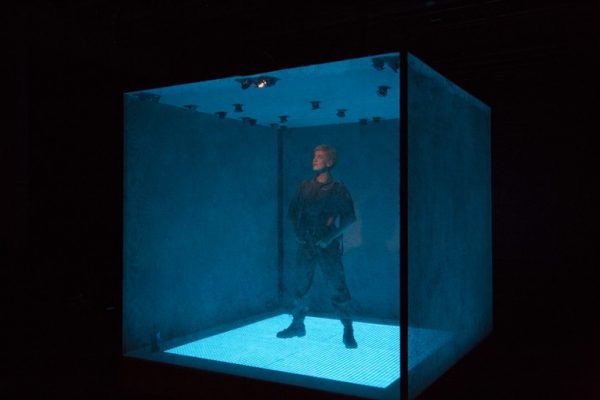
The Pilot at the outset is exactly what you might expect of an F-16 fighter pilot. Then love, husband and child take over and the Pilot ends up flying a drone from a base in the Nevada desert. That is when the dilemmas and the twists (of a sort) kick in. The pace of the monologue is rapid but full of imagery (sky, desert, Vegas, family life, being boxed in amongst many others) and Lucy Ellinson completely inhabits the character. In some ways the journey the pilot takes and where she ends up is, in retrospect, predictable but the insight into being a woman in this world, into balancing home and this sort of work (including its drudgery and social interaction as well as its obvious purpose), into the psychological stress of killing from afar, into the morality of this sort of war, are all revealed in a smart way.

Now it is possible that this worked for me because I am a liberal type who knows f**k all about what it is to be the person who is tasked with killing but Brant certainly got me thinking about all of that.

Anyway see for yourself whilst it is still on. Or make a mental reminder should in pop up elsewhere in future.

Oh and a reminder that the best way to see theatre is not in some poxy, neo-classical Edwardian fol-de-rol but above a pub on a bench (though I confess the Gate’s benches are back-breaking – just as well most everything I have seen there has captivated).