
Rachel Whiteread
Tate Britain, 25th September 2017
If you take even a passing interest in contemporary British art you are probably aware of Rachel Whiteread, and you may well have seen some of her work. Even if you are not interested, or are firmly in the nihilistic, hater camp that thinks this is all bollocks (a diminishing minority I am pleased to say), you will have heard of her. In the early 1990’s the “popular” press got it another one of their pathetic lathers about her work House, in East London, which helped her win the Turner Prize. The “controversy” was then comically ratcheted up as Tower Hamlets council proceeded to knock it down, thereby getting us arty-farty, liberal types in a tizz. Thus proving the whole point of public art – engagement.
You might also remember her project Monument for the fourth plinth in Trafalgar Square, a resin cast of the very plinth on which it is set. A perfect transparent mirror image. I seem to recall it was one of the more loved of the commissions in this most public of locations, but that might just be me.
You are also likely then to be aware of her making process which generally involves complex casting in a wealth of materials at a range of scales. Her chosen subjects are normally mundane, sinks, bog rolls, windows, doors, even rooms and buildings, but what she achieves is mesmerising.
For me this exhibition is a must see. It encompasses some her earliest work from the years following the Slade through to the exhilarating resin casts of doors and windows from the last few years. I gather she started as a painter but shifted to sculpture thanks to Richard Wilson. Thank goodness for that. Mr Wilson is concerned with with the nature of architectural space, and with creating striking ways of seeing this space, and it is pretty straightforward to read the thread through to Ms Whiteread. If you ever get a chance go see 20:50, Richard Wilson’s installation of sump oil. It will take your breath away. Or if you turn up early for some gig or other entertainment at the 02 walk east along the river until you see a bit of ship otherwise know as Slice of Reality. Or look out for Square the Block at the bottom of Kingsway or stop for a moment to admire the giant “wing”, Slipstream, before you enter the purgatory of Heathrow’s Terminal 2.
Sorry back to RW. I think Closet is the earliest work in the room (the gallery has been opened up to encompass all the works in the exhibition). This is a plaster cast of the interior of a wardrobe encased in felt. No immediate aesthetic attraction for me but it opens up the possibilities that RW has subsequently mined from the idea of “negative space”. That is the space around and, more importantly, inside the subject. Often explored in two dimensional images through the Modern age but less so in sculpture (though Bruce Naumann and other US minimalists/conceptualists had kicked off the exploration). Obviously casting is a fundamental part of the sculptural process but as a means to an end not usually the end. And this is what makes RW so important and interesting, especially when compared to other British artists of her generation who are a little more “shouty” and a little less insightful than RW in more opinion.
Next door to Closet is a plaster cast of a dressing table which is more interesting, as not only does the material itself have more appeal to me, the stimulus to eyes and brain as you try to unravel the “reversal” of the space gives far more pleasure. This carries through to the rest of the early works” sinks, baths, beds and furniture. They both are, and are not, what they purport to be.
Around the corner is a vitrine of 9 hot water bottles (and similarly shaped objects like enema bags!), another common subject for RW, and here we see the dimension that the variation in materials brings, resin, plaster, aluminium, wax, concrete and rubber. These are termed Torsos. A seemingly obvious process, with seemingly obvious subjects and seemingly obvious materials is transmuted into an homage to classical sculpture and the Renaissance masters who worshipped their forebears. There is also something of the womb about them. So we see the “concept’ become the subject and finally the object. Absolutely thrilling. Trust me.
In Room 101 and the floorboards cast in resin next to it further dimensions of RW’s art are revealed. Room 101 is a plasticised plaster cast of a room in BBC Broadcasting House where George Orwell worked and which was allegedly the inspiration for the eponymous space in 1984. So lots to chew on there in addition to the effect of the reversal of the space on a much larger scale than other subjects in the exhibition. Whilst there is a cast, Chicken Shed, in the garden in front of the Tate, and we have materials relating to the planning of RW’s more monumental outdoor works (definitely read up on these) ,we can only imagine what they look like but Room 101 helps. Next door the light falling on the resin floorboards emphasises the grain of the wood with every mark, scratch and knot evidence of time passing.
Nearby there is another fascinating large scale work in a cast of some library bookshelves. The detail of the pages from the books is intriguing as the spines are positioned inwards on shelves. So the shelves turn the knowledge inwards but we are not shut out. Imagine this on a much larger scale. That would be a sight to behold. And that is why I want to see the Holocaust Memorial or Nameless Library in Vienna which is exactly that.
The coloured objects and boxes along the back wall and far corner (relative to the entrance) of the exhibition room are less successful in my view, (along with the papier mache architectural fragments where are definition and detail is lost). Turning toilet roll cardboard tubes into things of rare chalky beauty is a masterly achievement, but, overall, the “fact” of the process, and any beauty in the form and function of the object (in contrast to the architectural subjects), is less visible to me. These pieces were produced after RW had completed Embankment for the Tate Modern Turbine Hall which had a mixed public and critical response I understand. I never saw it so can’t comment but the photographic record, conjuring up an ice palace, looks pretty groovy to me.
In contrast the mighty cast Untitled (Stairs) is exactly that, mighty. Like the floors on show the wear and tear of use sing out, but the reversal of the space is somehow less interesting, or maybe too familiar from the works of Escher and others. This is not true though of the wall of doors and windows, the most recent works, and for me the very best of RW’s work on show here. There are just beautiful. Especially the coloured resin casts. Seeing “through” the windows echoes their purpose. I couldn’t take my eyes off the resin doors, especially the two “antique” subjects from the C17 and C18 century, with the light casting shadows and reflections through on to the wall behind them. Mind you I do like old doors.
So when you finally tear yourself from these works, pass through the room of works by other artists curated by RW, which show the association with other British conceptual sculptors of an earlier vintage who also weren’t prepared to sacrifice aesthetic appeal in their work. RW has followed a clear and identifiable artistic journey but the link bank to the first generation of US minimalists and US/UK conceptualists is strong.
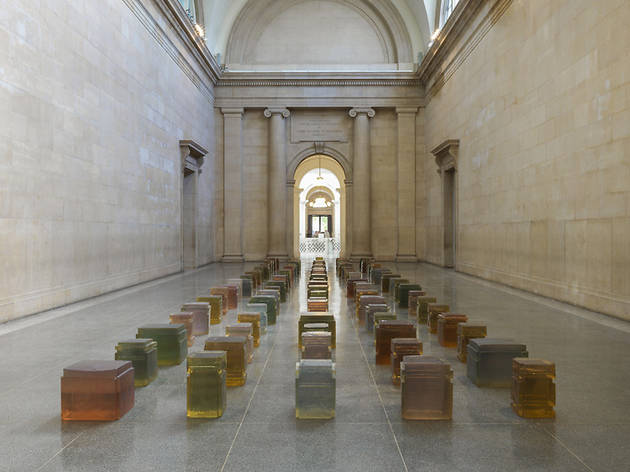
Then make sure to see Untitled (One Hundred Spaces) in the solemn Duveen Gallery. 100 coloured resin casts of the “internal” space of little side tables arranged in, I think, random order. Like tiny sentinels, ice cubes, soaps, sweets or children’s toys. A “terracotta army” of plastic. A New York panorama. The pastel colours echo the use of plastic in modern consumer goods. Yet the colours are faded, the opacity compromised, creating an air of melancholy. Sad, baby tables. Or rather the insides of sad, baby tables. I think I better stop there.
The exhibition goes on to 21st January next year. If a quick glance at pictures of her work leaves you cold then maybe you are excused (though I still think you are missing out) but if you have even the vaguest interest please check this out. The best exhibition in London this year (so far)? For me yes. If you crave colour, emotion, passion then this may not cut it. If you like simplicity, volume. form, function, detail – if you are in touch with your inner ascetic – then pop on your sharpest threads (all black was a favoured look on my visit) and get down to Millbank.
PS. I note on Wiki that Ms Whiteread spent a little time working at Highgate Cemetery fixing lids on time damaged coffins. I cannot think of work that would have bettered informed her art.
 At Home He Feels Like A Tourist