
A Day in the Life of Joe Egg at Trafalgar Studios review *****

A Day in the Life of Joe Egg

Trafalgar Studios, 30th November 2019

Not a fan of the Trafalgar Studios which has been asking daft prices for mediocre seating in the last year or so, (though it seems to have eased up a bit now and is nowhere near as egregious as another ATG venue the Playhouse Theatre). So waited this out and finally secured a decent perch at the back (which to be fair is not too much of a problem in this venue, sight-line wise).

Peter Nichols’ most (in)famous play had been on my wish list for a few years. Written in 1967 and first staged at the Citizens Theatre, (also on my theatrical to-do list and mention of which just sparked a 3 hour diversion though the web – focus Tourist focus). The play, which has subsequently been turned into big and small screen versions, tells the story of married couple, stoical Sheila (here played by the marvellous Claire Skinner) and overwought Bri (equally marvellous Toby Stephens) and their daughter Joe, who has cerebral palsy, and is played by less-abled actor Storme Toolis. They are joined by liberal do-gooder Freddie (Clarence Smith), who runs the am-dram group which Sheila has joined, and his heartless younger partner Pam (Lucy Eaton) and then by Bri’s tactless and hidebound mother (effortlessly played by Patricia Hodge).

The caustic play examines the coping mechanisms that Sheila and Bri have created to bolster their failing marriage and to look after Joe, who is confined to a wheelchair and cannot directly communicate. Sheila just gets on with it but Bri is starting to unravel. What makes this such a powerful play is the tone that Peter Nichols adopts; an ironic, almost detached humour with little in the way of sentiment or homily. I can see why some might find Bri in particular, with his black humour and lack of fortitude, a difficult character and might view this approach to disability as somehow inappropriate or capricious. I disagree. The way the couple act and speak is entirely believable and relatable and shows the reality of disability and the love the family needs to stick together.

It is true that in the over 50 years since the play appears attitudes to disability have changed, (though as Storme Toolis observes in the programme less able young people and their families still often struggle to secure the resources they need to improve life quality), and the subject a far less “controversial” source for drama. The private role-play that the couple employ to verbalise and visualise Joe’s emotions and to leaven the routine therefore sounds even more awkward particularly in the hands of Toby Stephens who is, presumably at director Simon Evans’s behest, keen to show up Bri’s desperation and guilt at wishing for Joe’s institutionalisation. The differences between the couples attitudes to Joe, Sheila’s unconditional love compared to Bri’s self pitying are most visible in the direct to audience addresses that Peter Nichols’ uses to reveal their interior thoughts, (about each other and Joe), and to provide back-story.

In the second half, as the views of the other characters on disability, Joe and the couple are gently skewered, the humour becomes more comfortable and the play less raw, though maybe less powerful and humane as a consequence. Whilst the two leads excel the rest of the cast are careful to eschew caricature despite the obvious unease of their characters around Joe, and at the centre of it all is Joe. There is enough drama, and surprise, built into PN’s plot, even if it is unsurprising, and Peter McKintosh’s faithful 1960s room set, out of which Bri and Sheila step, alongside Prema Mehta’s broad lighting and Edward Lewis’s sound, create no serious distractions.

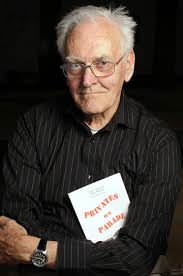
It probably comes as no surprise that Peter Nicholls, with wife Thelma, based the play on their own experience of bringing up disabled daughter, Abigail, who died aged 11. He went on to tackle big issues though the 1970s in other plays, The National Health, Poppy, Passion Play, Blue Murder and Privates on Parade, through formal experimentation (with copious reference, as in ADITLOJE to music hall and vaudeville), and ironic humour. However in 1982 he retired, apparently dissatisfied with the way his work was presented and was seen as unfashionable by many. Yet, based on this and what I have read about these plays, I would think there is an opportunity for contemporary theatre-makers to have a go at revisiting other of his frank, if sometimes unsubtle works, as has been done with Passion Play for example. Prickly and unsettling is not such a bad thing for theatre. PN passed away just before this revival opened but I hope he had a chance to see the justice that was I think done here to his breakthrough play.

Hamlet at the Hackney Empire review ****

hackney_empire_2

Hamlet

Hackney Empire, 19th March 2018

Working on the premise that it surely is impossible to see Hamlet too often in a lifetime, and keen to make sure the RSC continues to bring as many productions as possible to London, I signed up some time ago for this gig. This despite having already seen the cinema broadcast from Stratford in 2016. A bit excessive I hear you cry. Nope, not when you have an actor as gifted as Paapa Essiedu. His Edmund in the RSC King Lear in 2016 was the best thing about the production, which was pretty good despite some misgivings about the play and Antony Sher’s Lear. Hopefully you had a chance to see him on the tour of this production before it came to the venerable Empire. If you are anywhere near the Kennedy Centre, Washington (DC not Tyne and Wear) in early May I commend you to get along for the last leg of this tour.

There is more to this production, directed by Simon Godwin, than Mr Essiedu however. Mr Godwin has demonstrated that he has a way of breathing new life into classic texts, combining innovation and fealty. (Twelfth Night at the National Theatre review ****). Denmark has been re-imagined as a West African state which yields some interesting insights and a design concept for Elsinore a long way from the usual Northern European Stygian gloom. The programme notes, (I don’t know why people don’t buy programmes, at the very least at the major subsidised theatres, there is so much to learn from them), refer to Hamlet coming “home” after his years studying in Wurttemberg and how he is torn between cultures. There is some mileage in this idea which the production gently explores. There are parallels with Tshembe Matoseh, the main protagonist in Lorraine Hansberry’s masterpiece Les Blancs. No doubt you clever people can think of other theatrical “culture-clash” conceits. Of course transporting the look and the backdrop of the play to West Africa, whilst still retaining a text and characters anchored in Shakespeare’s vague Denmark, throws up a few contradictions but I think that was largely the point. Your man Hamlet after all isn’t short of cognitive dissonance.

So our sweet Prince is already on edge and suspicious of how Claudius came to power. When he sees Dad’s ghost on the ramparts all togged out in tribal chief paraphernalia, in contrast to the modern dress of the present Court, he quickly resolves to action. There is a sense throughout that this Hamlet, whilst not knowing how and when, and running through the gamut of hesitant self examination, is powered by the powerful urge to right a wrong. His feigned madness, his toying with Polonius, the verbal sparring with Horatio, Rosencrantz and Guildenstern, the taunting of Claudius and Gertrude, the carousing with the players, are all in the service of avenging the old fella. The production breaks at the Claudius prayer scene with Hamlet circling in the shadows, gun in hand. I wasn’t sure but I reckon this was only ever going to be a reprieve for Claudius. (Of course I was sure, we all know what happens, but my point is this was a Hamlet who was just gearing up to the main event not a bottler with an uncertain grip on his own reality). “To be or not to be” is a pep talk to self here, not a page from Kierkegaard.

Paapa Essiedu fits this conflicted, mischievous Hamlet like a glove. There is not one single word, let along line, that doesn’t sound entirely right. He doesn’t hang around or over-elaborate, but there is still enough space around the words to take them in. Not the conversational musing of Andrew Scott at the Almeida or the irked ironic philosophising of Benedict Cumberbatch at the Barbican. Just a spontaneous intelligence which makes you wonder why other actors seem to agonise over the right tone to take for this admittedly complicated young fella. His movement and expression is flawless. He can project a single glance to the back of the balcony. He seems to find the shifts from comedy to tragedy, well, just easy. Look out for the laugh he conjures up when pulling Polonius’s body from behind the arras. And I know it shouldn’t matter but it really helps that he is the right age and he is beautiful. PE himself seeming to be a combination of child, student, lover, playboy, artist, he knows enough to question what it is all about, but not enough to buckle under the weight of his own existentialist uncertainties. And, despite all the moping about and hissy fits, you can see why people are really drawn to him and crave his approval.

Compare this to Clarence Smith’s Claudius which is far more old-skool declamatory, though this works pretty well in this context. A far cry from the last time I saw this fine actor as the broken Selwyn in Roy Williams’s brilliant latest play The Firm (The Firm at the Hampstead Theatre review *****). I wasn’t entirely convinced initially by the versatile Lorna Brown’s seemingly withdrawn and inert Gertrude, but this made more sense as the production unfolded and the final death scene was very poignant. He’s still her little boy you see.

In the scenes between Polonius (Joseph Mydell), Laertes (Buom Tihngang) and Ophelia (Mimi Ndiweni) there was a real sense of a loving family, something I had not really felt before. Matching Papa Essiedu’s dazzling performance was a tall order for the rest of the cast but Mmi Ndiweni, (taking on the role from Natalie Simpson in the first Stratford incarnation), came pretty close. The mad scene was both very moving and very scary. Mind you I am a sucker for a distraught Ophelia. And, thanks to both actors, Hamlet’s dismissal of Ophelia, here played out whilst writhing around in bed, actually made sense. Romayne Andrews and Eleanor Wyld as Rosencrantz and Guildernstern struck all the right notes, dislocated in this very different Denmark, and Ewart James Walters turned in some scene stealers doubling as a booming Old Hamlet and a Gravedigger who, judging by his accent, had taken a long way round to get to this particular Denmark.

The production really comes to vibrant life when the colours, sounds and dance of West Africa are brought to the stage thanks to Paul Anderson (lighting), Sola Akingbola (composer), Christopher Shutt (sound) and Mbulelo Ndabeni. The players are no afterthought here. Locating Hamlet’s antic disposition in the artistic milieu of Jean-Michel Basquiat works far better on stage than on paper. You are left wondering if Simon Godwin and the team might have found a few more visual or textual signifiers to flesh out Claudius’s rise to, (diplomatic duplicity alongside an arranged murder?), and fall from, power, and the effect of conflict with the “Norwegian” neighbours, though I get this might have made for an uneasy narrative. It may have helped ease the shift into the bloody carnage of Act V though.

Anyway not quite a perfect Hamlet (play) if such a thing where ever possible. But certainly a near perfect Hamlet (bloke) thanks to Paapa Essiedu. I think I have been guilty of saying too often that I can’t wait to see what xxxx does next on stage in this blog. In this case it is really true and I suspect most of those who have seen this production would agree. On this evidence anything is possible from this rare talent. There are some actors who convince but stay firmly rooted to the stage behind the invisible wall. There are some though that seem to magically come off and out to play to you alone. PE is one of these.


The Firm at the Hampstead Theatre review *****

the2bfirm2breview2bhampstead2btheatre2bflyer

The Firm

Hampstead Theatre Downstairs, 22nd November 2017

N.B. The Firm is returning to the Hampstead Theatre Downstairs for another run between the 3rd May and 8th June 2019. The Tourist goes to a lot of theatre in London and, trust him, there is no better value than a preview ticket at HTD. Just £5. And here you are taking no risk as it is an excellent play. Even during the main run, at just £14, it is a steal. You’d be a mug to miss this. 

How does the Tourist choose whether to see a play?

Writer first, since he/she is the wellspring from which all else flows. In the end all there is is text, actors and audience. And observers and observed have nothing to share without the text. Poor text, poor play. Nothing anyone else can do about that.

Venue second. A function of convenience and familiarity, but also, not unreasonably, if you have enjoyed one production at a theatre, you may well enjoy another. This will probably reflect the vision of the artistic team and the rather grubbier fact of the demographic the executive team wants to prise cash from. On the downside, there are venues where comfort is so compromised that price does not represent value and must be avoided.

Then there is the subject. Not always easy to divine for new plays from the blurbs, teasers and trailers but something needs to pique my interest. As it happens most new drama has its finger firmly on the pulse or contrives relevance from places or times far removed from my cosy little world.

Director next. Same principle as the writer, if you have enjoyed their way of doing things once you may well do again, though this is not guaranteed.

Reviews of course, but the Tourist’s addiction and simple economics, (why paid 70 quid in the West End when I can get a top seat for half the price or less at the original production at the Royal Court or Almeida), means that reviews only help for transferred in productions.

Cast, relevant but not a deal breaker, though expectations rise when favourite names are announced.

Ideally a number of these factors come together. Sometimes though the Tourist takes a punt. As he did with The Firm. Downstairs at the Hampstead normally serves me well, but this is by no means guaranteed. I was interested in the subject, a gang reunited, but concerned it might lurch into cliche. I knew nothing about the work of playwright Roy Williams, director Denis Lawson or designer Alex Marker. I had not seen any of the cast on stage as far as I could remember (based on their bios), with the exception of Clarence Smith. I would like to pretend I had a feeling but I didn’t. And to cap it all I pushed my just-in-time arrival strategy to the limit. So a quick Jimmy, an inward groan at the 1hr 40mins run time and the only seat left tucked in a far corner (mind you the HT Downstairs benches are comfy).

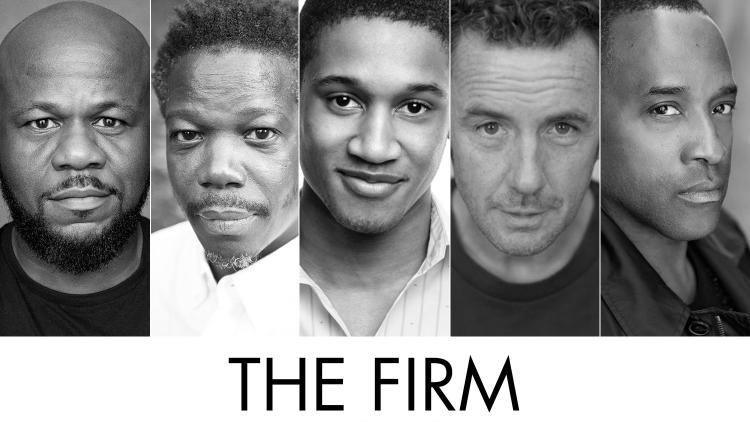
As it turns out this is an excellent play and probably the biggest surprise of the year for me. Alex Marker’s set transformed the reconfigured Downstairs space into a “sophisticated” urban bar, complete with pristine Wurlitzer juke box and array of aspirational spirits brands. We first encounter the nattily dressed Gus (Clinton Blake) who owns the bar, (and, as we discover, quite a tidy portfolio of assets elsewhere), bantering with Leslie (Jay Simpson), the archetypal (and white) Sarf Londoner who has recently left prison. Gus and Leslie are waiting for Shaun to arrive. A party in his honour is planned followed by a night out on the town and then a trip to the Palace, (Selhurst Park not down the Mall, for regrettably they are Eagles), the next day. Shaun never comes. The rest of the “The Firm” do pitch up though, first stout Trent (Delroy Atkinson) followed by a nervous and limping Selwyn (Clarence Smith). But Selwyn brings a young stranger with him, Fraser (Simon Coombs) who, for various reasons, unsettles the gang. He comes with a proposal.

I’ll stop there. This all sounds way more mysterious than it actually is. This is an absolutely riveting insight into the nature of manhood, the camaraderie of criminality, the value of loyalties, the meaning of success and the trials of friendship. These forty/fifty somethings were happiest in the past, right the way back to when they first embarked on their “life of crime”, by The Wall near their school. The pace at which Roy Williams releases the many revelations that show who the characters are, and what they have become, is perfect. We learn enough, but not too much, to keep the dramatic intensity on the boil. We see the damage the past has done and we witness the final break-up of the gang. We see the love and the jealousy the mates have. There is a Pinteresque threat of violence and malice as you might expect throughout, most notably from Gus, who was the leader of the gang, and who is the only one to have avoided a stretch inside. He probes and manipulates the others, until they begin, in their various ways to fight back.

It is also very funny. The dialogue is utterly believable, the banter is spot on. The interplay between the cast is superb. Clinton Blake’s Gus is preening bully, but it is clear from the off that he is troubled. Jay Simpson excels as Leslie, the mediator and the joker, who is trying to start again. (If anyone is ever looking for a Joe Strummer in a play about the Clash here’s you man). Delroy Atkinson as Trent, at first submissive, gradually asserts himself and, in a very powerful scene, shows himself as the only one of the gang capable of pacifying the psychologically damaged, and desperate, Selwyn of Clarence Smith. Simon Coombs as “younger” Fraser is insolent and cocky, but, in a neat inversion, shows some maturity that escapes the others. His final scene with a defeated Gus is gripping.

The play offers no moral perspective on gang membership. It does make abundantly clear though that for men of current, this and proceeding generations, in the absence of other opportunities, this way of life, and the crime that comes with it, is the clearest path to securing the validation and respect of others. It also shows how fragile this respect can turn out to me and how poor men are in admitting, articulating and coping with their frailties and failings.

I may be guilty of reading too much into the play but that is what I saw. I highly recommend it. Roy Williams actually references Goodfellas and West Side Story in the dialogue to remind us of other masterful portrayals of this subject. Don’t get me wrong: this isn’t Goodfellas, but in its own way it is similarly involving. I understand that Mr Williams has mined issues of race, sport, poverty, random violence and teen parenthood in previous works, as well as the father/son relationship in Soul, his last play about the death of Marvyn Gaye. I really hope I get an opportunity to see some of them. He really, really has the measure of his stories and characters.