

Satyagraha at English National Opera review ***

01/00/1998. File pictures of Mahatma Gandhi

Satyagraha

English National Opera, 27th February 2018

Finally I have got to see all three of Philip Glass’s seminal operas, Einstein on the Beach (the science-y one), Akhnaten (the religious one) and now this Satyagraha (the political one). Einstein on the Beach was a recreation of the original Robert Wilson production at the Barbican a few years ago. Gruelling in places, daft as well, and it looked pretty lo-fi. Akhnaten, also at the ENO with substantially the same creative  team, looked and sounded sublime, but overall I was middle-whelmed. And so it was with Satyagraha. Improbable’s staging certainly tops the already lofty heights they achieved in Akhnaten, and there was probably more to the story unfolding in Sanskrit, but the pleasure, and marginal pain, derived by this observer was not dissimilar.

Since I can’t really imagine more committed advocates than this creative team for these two operas I think I have to conclude that, if pushed, I prefer my Glass in other formats. Like the string quartets or the works for keyboards. That’s a terrible admission isn’t it. Anyway probably as well I know now as Mr Glass has written a fair few operas, 29 and counting, including the chamber works. Mind you he has been pretty busy across all genres. He’s already snuck in another string quartet this year for example I see. Anyway the profligacy of PG is both joy and curse for the committed fan of minimalism, or, as he terms it, repetitive music.

There is no doubt that there is a unique pleasure in succumbing to its hypnotic effect. Hearing the structures slowly change as the notes are added or subtracted. Melodies, motifs and harmonies appearing, disappearing and reappearing. Wave upon wave of sound, altering, circling, revisiting, but never really getting anywhere. Timeless. Meditative. All transcendent when it’s just you and the music. But with opera the whole point is to witness the music interact with the drama. And this is where the disconnect emerges. If you succumb solely to the music then the visual spectacle risks taking too much of a back seat. There is way too much stagecraft trickery to admire here though to permit drifting off into an hypnotic trance. Who would have thought so much could be done with papier-mache and sellotape? Yet the structure and pace of PG’s score, the episodic structure of the “action”, largely based on key events in the struggle for emancipation by Indians in South Africa, led by Gandhi, and the Sanskrit text, all make for very static human tableaux. And a lot of slow motion shuffling.

A spell is cast but there are times when it might be nice to be snapped out of the soporific contemplation into some high drama. Having influences on Gandhi past, present and future, in the form of Tolstoy, then Rabindranath Tagore, and finally Martin Luther King, lurking at the back of the set isn’t quite enough, and the wow moments as Improbable make newspaper come to life, create gods and monsters before our eyes or bring crowd scenes to life, don’t always articulate with the, you guessed it, non-linear story (based on my reading of the synopsis).

Still admire the parts. The marvellous chorus and orchestra led by Glass expert Karen Kamensek, (as in Akhnaten), moulded PG’s musical shapes effortlessly. I didn’t know that I had seem Improbable’s work before in a very different context, namely Lost Without Words at the National Theatre, improv theatre from a cast of older actors, which worked a bit better than I might have expected. AD’s Phelim McDermott and Lee Simpson, and here associate Julian Crouch, don’t lack for imagination or, based on Satyagraha, brilliance of execution. The go-to team for video design, 59 Productions, also leave their mark. Toby Spence gives us the Gandhi of myth, standing stock still for long periods, then bursting into his sumptuous tenor, but no sign of the man himself. The rest of the cast have even less opportunity to shape characterisation beyond the puppets they share the stage with. They all sounded great to me though, especially soprano Charlotte Beament, as Gandhi’s assistant.

The central message of Satyagraha, a Sanskrit word which Gandhi defined as “holding on to truth”, and which underpinned his theory and praxis of nonviolence, does sort of emerge from the production, but a bit of reading around, before and after, helps. The denial of self, the power of the collective, the effectiveness of planned and self-critical resistance. Think of this as a project. Put a bit of effort in and you might just learn something.

Or just do what I suspect the majority of the packed house at the ENO were doing, (this has been revived thrice, it is so “popular”). Gaze and listen in wonder and don’t get antsy about the fact it is all over the shop. At the end of the day the ENO has its hit and this, with its predecessor, is pulling in all sorts of punters who might, rightly in my view, give a wide berth to Verdi and Puccini.

Mind you I reckon this new generation of Glass converts might draw the line at the 5 hours of hippyish clap-trap that is Einstein on the Beach.



Life of Galileo at the Young Vic review ****

log-blog

Life of Galileo

Young Vic, 21st June 2017

My Brechtian education continues apace. Who would have thought that until a couple of years ago I hadn’t see any Brecht plays at all and frankly wasn’t that interested having been put off by the great man’s reputation. What a klutz I was. Turns out that our Bertolt is just the man for me.

Director Joe Wright (the go to man now for cinematic literary adaptions – and responsible for the best of Season 3’s Black Mirror) makes a number of incisive observations in the programme. Notably he was struck by just how emotionally rich this play is. So was I. You expect Brecht to load you up with ideas and get the grey matter putting a shift in, but you don’t expect to empathise with the characters. Brechtian epic drama requires a distancing between action and audience. That is still achieved, but here however I was also properly drawn in to Galileo’s struggles.

This in part reflects the committed performance of Brendan Cowell. Even before the play “opens” he is pumping up the audience along with the pounding beats of Tom Rowlands’ score (he of Chemical Brothers fame). Through the popularisation of the telescope in C17 Padua and Venice, the observation of planetary motion that supported Copernicus’s theories, the protection accorded to him in Florence, the promulgation of his ideas in vernacular Italian, his years of silence, the summoning to Rome, the torture by the Inquisition, the recantation of his theories, and the final secret dissemination of his ideas, Mr Cowell is a constant and imposing presence. He is just so physically full of belief.

This is ultimately a play about ideas, and specifically pits the rationalism of Science against the dogmatism of the Church. But this production also delivers an emotional wallop and explores Galileo’s (not historically accurate) relationship with his daughter (played by Anjana Vasan, whose advantageous marriage is sacrificed to her father’s certainties) and his pupil Andrea (played by Billy Howle, whose worship turns to disillusionment and finally to advocacy).

This being Brecht though there was still plenty of Verfremdungseffekt to keep you on your toes. A song and dance routine, some excellent puppetry from Sarah Wright to accompany each scene’s introduction, some interesting costume choices, plenty of doubling or more of roles, a “disappearing” scene, aggressive lighting and sound. Best of all though was Lizzie Clachan’s set, in the round, with a circular runway enclosing brave audience members, topped by a dome on to which the techies at 59 Productions (last seen by me working their magic in City of Glass at Lyric Hammersmith) projected cracking images of the cosmos. Our very own planetarium with punters acting as planetary bodies. This is not the first time that I have seen a set designed by Ms Clachan that has prized function as much as form.

Once again I doff my cap to the translator here, John Willett, for providing such a clear and involving rendition of the text. In particular the big speeches are perfectly rendered especially the best of the bunch in the penultimate scene. This is where, I understand, in 1947, Brecht revised the play, goes beyond technological determinism and questions the objectivity of scientific rationalism and the dangers of the Enlightenment project. This chimes with the Marxist Critical theorists in the US at the same time as Brecht (before he went back to East Germany) whose ideas had been shaped by the horrors of WWII. Most of this whizzes over my head but it is still powerful stuff. Remember people a bit of Marxist dialectics isn’t going to turn you into a raving Commie despite what some would have you believe. The nature of Truth in human discourse plainly never goes away.

Sorry veering off again. I just like this combination of drama, theatre craft and ideas. This production is nearly over but I crave the next fix of Brecht. In particular, whilst I loved this “big” production of Life of Galileo, I do hope one day to see a more stripped back version by way of contrast.

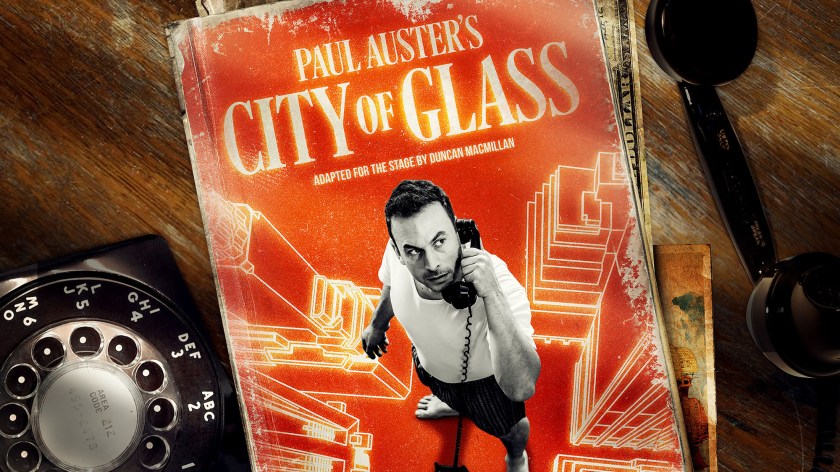
City of Glass at the Lyric Hammersmith review **

city-of-glass-final-image1

City of Glass

Lyric Hammersmith, May 11th 2017

So I remembered too late. I have thumbed copies of Paul Auster’s New York Trilogy so I think I must have read it, or at the very least City of Glass, when it came out in the 1980’s as any young, trendyish, new-to-theworld-of-work-but-still-able-to-go-out, indie man about town type would have done. I may even have professed to like it. But I’m not sure that I actually did. It is, as this adaptation (of orginal novel and a subsequent graphic novel augmentation) reminded me, a bit silly and a bit pleased with itself. No problem with subverting genres and getting all postmodern meta in books but you have to be very careful that you steer well clear of your own back passage or risk the proverbial disappearance.

So, in my view, this incredibly talented team comprised of Duncan MacMillan who did what he could to adapt the book into a suitable work for the stage, a score by Nick Powell, whose music is a vital part of The Ferryman at the Royal Court as we speak, and 59 Productions, including first time director Leo Warner, maybe just picked the wrong starting point. The staging is extraordinary showing just what can be done using cutting edge technology, but this has been employed to so much better effect in other productions by the 59 team (not the least of which was their contribution to the 2012 London Olympics Opening Ceremony).

The opening gambit is promising enough with the telephone call out of the blue to our hero/narrator/writer, Daniel Quinn, (DQ same as Cervantes original meta hero), conjuring up the expectation of a classic noir detective thriller. He then proceeds to find himself drawn into ever more fracturing realities leading him, and us, to question what is real and what is imagined here and ultimately into questioning his own sanity. The production however relies on heavily a narrator to move the “action” such as it is along and to explain “what” is happening, and the characters are more ciphers than individuals with whom we might want to make an emotional investment. The pace is unvarying which only led me to keep on questioning whether this might all have been better left on the pages of the original novel. And as I say the novel itself is, in my view, ultimately an exercise in pretension, though I freely admit my heart and head will always lie with the modernism daddies and not the post-modernist bastard offspring.

So sorry I couldn’t like this, though I recognise the extraordinary technical skill brought to bear on how this looked, and will definitely keep an eye open for 59 Productions next project (hoping they steer clear of Auster). And I continue to think that the Lyric Hammersmith’s ongoing ambition will be rewarded with a home-grown, or bought in, slam dunker at some point and I want to be there when it happens.