Knives in Hens at the Donmar Warehouse review *****

christian-cooke-pony-william-and-judith-roddy-young-woman-in-knives-in-hens-at-the-donmar-warehouse-directed-by-yael-farber2-700x455

Knives in Hens

Donmar Warehouse, 21st September 2017

Now I guessed I was going to like this. All the clever folk who know about plays and stuff had raved about it. Written in 1995 by David Harrower it is considered a classic of British modern theatre. Its ostensible subject matter, the power of language, and its setting, an imagined English medieval past, is right up my street (thanks in part to the vicarious interest generated from MS’s journey).

But I had no idea just how brilliant this was going to be. Easily joins my top 10 all time best plays. It is staggeringly good and director Yael Farber’s production could scarce be bettered I would think.

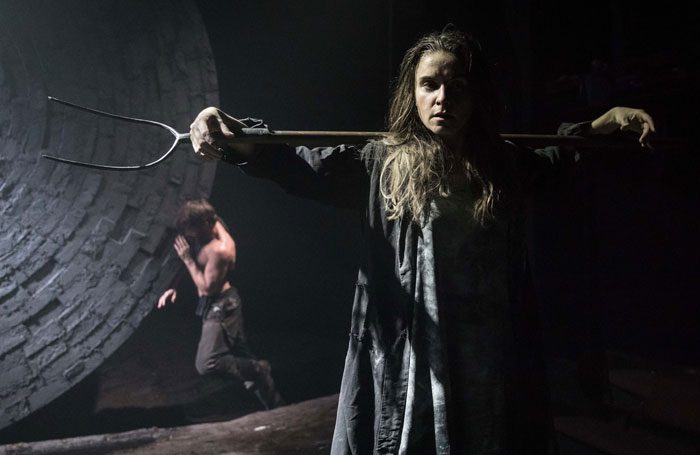
For those like me who weren’t up to speed on Knives in Hens, it goes like this. The Young Woman, an outstanding performance from Judith Roddy, is married to ploughman Pony William, a brutal but fearful, Christian Cooke, in a village somewhere up North. Her knowledge of the world is bounded by her role as wife, the work she has to do, by language and by location. Husband sends her with their grain to the Miller, Gilbert North, played by Matt Ryan with profound depth. His wife has died, he is alone, and the village has cast him out, in part because they are dependent on him. But he can write and he can think and see beyond the everyday. She is wary of the Miller but their relationship develops. Pony William betrays her. There is a dramatic denouement. That is basically it.

The language is spare. The lighting is monochrome. The set, with a giant grindstone, behind a muddied, brickstone floor, is austere. We have a mournful cello and a near unbroken drone. There is even some flour drifting through the air at one point. For those familiar with Yael Farber’s work, including the somewhat unfairly maligned Salome at the NT, (Salome at the National Theatre ***) all this is likely familiar. But in this play these directorial tropes were bang on.

So what is so special about the play? Well for me the text perfectly captures the world in which it is set. The medieval mind was very different from the modern mind. Knowledge was largely derived from immediate experience or dictated by the Church. The supernatural was very real. Nature informed existence. Language for this class was largely spoken not written. Writing was the medium for power, the word of God and contract. The schism between the rural and the urban. David Harrower’s text inhabits this world. No nostalgic arcadia here.

But this is only the starting point for more universal questions. How do we gain knowledge? Why are we scared of knowing? How does language define what we know? How does the written word differ from the spoken word? What do people invent gods to explain the world? How do women secure agency (one of Ms Farber’s vital themes, and, as in Salome, we have a nameless woman here)? What actions can be justified in the pursuit of freedom?

Now I appreciate that I am getting quite carried away here but this is where the play took me. An epistemological triumph if you will, woven out of the most mythic of threads. I can fully appreciate that others might just see a rather bleak, love triangle, fable but this floored me. In fact I had to sit down and have a cup of tea before heading home just to think about what I had seen. And I am still thinking about it.

So thank you Mr Harrower. Thank you Donmar. Thank you Ms Farber. And thanks to our three actors.

“All I must do is push names into what is there the same as when I push my knife into the stomach of a hen”. Indeed.

Oslo at the National Theatre review *****

maxresdefault

Oslo

National Theatre, 19th September 2017

Well I’ll be damned. I didn’t book Oslo at the earliest opportunity, as is my wont for most of the NT output, and only took a swing at it because of the NYC reviews. And even then I wasn’t sure. I mean how could a near 3 hour, straight dramatisation of the negotiations which led to the signing of the Oslo Accord between the Israeli government and the Palestine Liberation Organisation in 1993, possibly form the basis for a riveting work of theatre?

Well it turns out riveting is exactly what it is. Writer JT Rodgers has understood from the master of such entertainments, a certain Will Shakespeare, exactly how to write a “history play”. Get the context in early and make sure we know who is who and why they are there. Weave this information into the drama, but don’t hesitate to repeat it, in this case through the use of a direct to audience narration from Mona Juul, played by Lydia Leonard. Make the scenes short and sweet. Do not permit long, expository monologues. Show the human side of the people but don’t hold back on the process (we the audience don’t need to be patronised – we will get it). In this case, given that the whole purpose of the negotiations in Oslo was to bypass the confrontational and procedural approach of the formal peace negotiations sponsored by the US, showing the humanity of the key protagonists came naturally through the dialogue. Don’t fret too much about sticking too closely to the exact facts – this is drama after all. Finally give us some ebb and flow, some tension, some heroics and sacrifices and some cliffhanger moments. Oh and stuff in plenty of humorous interludes.

Mona Juul is an official in the Norwegian Foreign Ministry. Husband Terje Rod-Larsen (Toby Stephens) runs an Institute and meets pragmatic Israeli Deputy Foreign Minister Yossi Beilin (Jacob Krichefski). They offer a neutral, and clandestine, forum in Oslo, to the desperate PLO finance minister Ahmed Qurie (Peter Polycarpou), and his Marxist sidekick, Hassan Asfour (Nabil Elouahabi), to meet two scruffy Israeli economics professors played by Paul Herzberg (who also doubled as Shimon Peres no less) and Thomas Arnold, to discuss the route to peace. As progress is made, the Israeli side is upgraded with the arrival of colourful Foreign Ministry senior official Uri Savir, (Philip Arditti) and eventually wary legal big cheese Joel Singer (Yair Jonah Lotan). With the assistance of Howard Ward, Geraldine Alexander Daniel Stewart, Anthony Shuster and Karoline Gable doubling up in the supporting roles, the ensemble is completed.

And what an ensemble. Whilst the writer is possessed of of an impeccably direct, funny and natural style, this was never going to work as well as it did without such perfect casting. Toby Stephens nails Rod-Larsen’s urbane mateyness but also left us wondering over his motives. Lydia Leonard (with whom I am a little bit in love I admit) was all archness and efficient charm You really believed that Peter Polycarpou and Philip Arditti’s characters found a shared bond that could bridge their massive political differences. And you reflect, with Toby Stephens’ final lines, on how uplifting the better side of our nature can be, even if so often, we (and our politicians on our behalf if we choose them), fail to let it shine.

This is a properly gripping and affecting story, expertly told, directed with stonking momentum by Bartlett Sher and with a suitably ambassadorial set from Michael Yeargan. If there is any justice it should fill the house at Harold Pinter Theatre for the transfer. I heartily recommend it.


Mosquitoes at the National Theatre review ****

mosquitoes-v2-2160x2160

Mosquitoes

National Theatre, 18th September 2017

Two sisters. Some sad stuff happens to them. Sciencey backdrop.

There you go. That’s Mosquitoes. Except that is isn’t. Lucy Kirkwood is not the type of playwright to let us off the hook that easily. She chucks a lot into this pot, brings it to the boil and what a tasty stew comes out after two and a half hours or so. It may be a bit rich but, ultimately, is easily digestible.

Mind you without the two Olivias, Colman and Williams, I doubt this would be half as good. You know the thing where you see a play, and the leads are so utterly convincing that you swear no one else could carry it off. Until you see someone else playing the part as well or better and you realise that the actors were just bloody good at their jobs. Well in this case I really doubt the performances could be bettered. They were the two sisters, Alice and Jenny, made more potent because they look like they could be sisters. (I know this leaves me caught in a simplistic, mimetic trap but in this case really helps that they looked the parts).

For at the heart of this play is the relationship between them. Whilst Ms Kirkwood is becoming ever more ambitious in her plays, and the themes that they engage with, what I love about her writing is the portrayal of the relationships. From the moment Alice feels Jenny’s pregnant bump to the last moment, having come full circle, to substantially the same scene, the sisters dilemmas felt vital and real. Indeed the metaphor of the circle is writ large in the play with the set comprising two giant circles, in part to represent Alice’s work as a scientist at CERN (the home of the Large Hadron Collider). The mosquitoes of the title also get a couple of metaphorical look-ins.

Along the way Ms Kirkwood asks some big questions. How should scientists, for whom science is defined by uncertainty, engage with us lay-people, who fervently need science to deliver certainty? What is the value of physics to society and where are we in reconciling the quantum mechanics of the very small with the forces that govern the universe and the physics of the very large? Where does “God” fit in? What will happen at the end of time? What is the nature of intelligence and how does this relate to emotion? What drives the “success” and “failure” of siblings within a family? Why has women’s contribution to science been so undervalued? How to balance work and family? Yet this all sits comfortably inside the boundaries of the drama – even when we go off the naturalistic piste.

I gather Olivia Colman is a bit ambivalent about the stage. She shouldn’t be. We see from her TV performances that she possesses an uncanny ability to create an intense emotional connection with us the audience, even when playing the most “ordinary” of characters. And she repeats the trick here. Jenny isn’t as bright as sister Alice, as Alice and mother Karen, pointedly, patronisingly and repeatedly remind her. And Jenny makes mistakes. Foregoing the MMR vaccine having swallowed the autism connection bullshit from the media, and in spite of Jenny’s protestations, has fatal consequences for her child. She is estranged from her husband. She sells dodgy insurance from a call centre. But when Alice’s life unravels, as her awkward son Luke is bullied and then absconds after engaging in some over-enthusiastic hacking, it is Jenny that Alice turns to. And it is Jenny that is dealing with Mum’s incipient dementia.

Olivia Colman plays Jenny with an earthy, matter-of-factness. There are a lot of laughs from her lines. She says what she feels and takes risks that Alice cannot or will not. The “emotional intelligence” yin to the “academic intelligence” yang of Olivia Williams’s Alice. Olivia WIlliams perfectly captures Alice’s emotional uncertainty. Luke’s father has left and her devotion to work leaves her son even more alone. The absent father pops up as The Boson, who is also our narrator for the big science lessons, a satisfying conceit. Paul Hilton, last seen by us as Peter Pan here at the National, grabs this role with both hands. I was also mightily impressed with Joseph Quinn as Luke, in a role with some similarities to the last time I saw him in Katherine Sopher’s devastating Wish List at the Royal Court. Amanda Boxer’s Karen is also beautifully realised: you can see echoes of her personality in her two daughters. Sofia Barclay, as Luke’s treacherous friend, and Yoli Fuller, as Alice’s beau, turn in skilful performances in vital roles.

Rufus Norris’s direction is as astute as ever. There is a lot packed in her, and even with the excellent performances and stunning set (courtesy of Katrina Lindsay), sound, lighting, music and video, this still required an expert hand at the tiller. If the director’s job is getting people on and off the stage to paraphrase Peter Brook, then Mr Norris can feel well satisfied, for on and off was perfectly executed.

So all in all a hit. I don’t know if it will pop up elsewhere but this is another production that gives the lie to the “NT has gone wobbly” nonsense meme. And, having covered the secrets of the universe and the mysteries of particle physics here, I have no idea where Lucy Kirkwood’s unbounded imagination will leap to next.

Man to Man at Wilton’s Music Hall review ***

man20to20man20new_720x580-2-720x500-blur

Man to Man

Wilton’s Music Hall, 15th September 2017

I am confused about this. Is it an expressionistic masterpiece that explores the nature of gender identity and German history through devastating poetry, or a piece of pretentious fuck-wittery which couldn’t be bothered to serve us up a coherent story? Was it a visual and aural treat using the best that lighting, sound, video and set designers can conjure up in this always atmospheric space, or a bunch of hackneyed theatrical tropes to mask the fact that the content was tired and banal? Was this an intense bravura one woman metamorphosis or an actor crawling up the wall in a baggy suit doing funny accents?

Truth to tell is was a bit of both but net, net I am pleased I saw it. This might, though, have been one of those nights when I should have been flying solo. Instead I roped in the SO and the TFP’s who I suspect got more sustenance from the curry beforehand than this work. And I have form with the TFP’s. It was the German connection you see. Still maybe next time I will get it right.

Man to Man tells the (true) story of Ella Gericke who is forced to assume the identity of her dead husband Max to keep herself alive in pre WWII Germany, Her struggle to evade exposure is set against the rise of Nazism, the war itself, the reconstruction of Germany and, finally, in an addition to the original play, the fall of the Berlin Wall. But this is no ordinary narrative. This is a memory play and Ella’s memories are, to say the least, personal, confused and distorted. Which means over the 75 minutes or so you have to be on your mettle to keep up. We see Ella forced to deceive her workmates and enter a masculine world fuelled by beer and schnapps. We see her rueing, I think, the absence of a child in her life. She gives up her own passport to a woman she cares for so that the woman might escape Germany. She has to avoid conscription but cannot bring herself to renounce her Max identity to do so. She denounces one of her neighbours. She ends up, I think, in the SA and has to kill to evade capture. She works in a factory after the war and conspires with the bosses to illegally bring in female labour posing as men. She returns to the grave of her husband.

And these are just the bits I can remember. The story is like a series of inchoate shards colliding through time (sorry that is the best I can come up with). It examines themes of identity, gender obviously, but also Germany itself over the period (I started thinking about Ella’s male/female divide as a metaphor for East and West though I may have got carried away with all the symbolism), as well as grief, loss, deception, alienation and power.

Now all this is portrayed by one woman, Maggie Bain, in one room, though this is as far from a monologue as it is possible to get in a theatre. She adopts a broad Glaswegian accent to portray the husband, which I fear to say, was not always as clear as it might have been. My ears and the Wilton space are to blame. This contrasted with the voice of Ella, though over time the separate identities seemed to bleed into each other. All I can say is that whatever Maggie Bain was paid, it wasn’t enough. The production, created by directors Bruce Guthrie and Scott Graham, with a text translated by Alexandra Wood, from the original German, places huge demands on its sole actor, both in terms of voice and body. Mind you I can see why an actor would relish the chance to take this on. (The UK premiere saw the fiercely intelligent, chameleon Tilda Swinton take on the role of Ella which makes eminent sense).

Now apparently this is what German playwright Manfred Karge is all about. No lazy Anglo-Saxon naturalism for Mr Karge. This is the full-on, modern European theatrical experience (I know we are in Europe but you get my drift). But it isn’t dull, worthy and full of theory in a way that might imply. But it is elliptical and does ask a lot of the audience. So if you do take the plunge, for this production, which is off to Birmingham, Edinburgh, Newcastle and Liverpool (and even New York thereafter), or a future production, do bear this in mind. It looks and sounds amazing, with props, lighting, video, projection, sound, music, movement, even some puppetry, all used to maximum effect, but be prepared to relax into the moments when your theatre of the mind will be frantically asking “what the fuck is going on”.

Consider yourself warned.


Thebes Land at the Arcola Theatre review ****

thebes-land

Thebes Land

Arcola Theatre, 14th September 2017

Thebes Land was a hit last year at the Arcola, winning a Best Production Offie, and is back for another run as part of a short festival of Latin American theatre. Director Daniel Goldman has created a new English translation of Franco-Uruguayan playwright Sergio Blanco’s work, which has been performed around the world. It is not difficult to see why.

Trevor White play T, a playwright who is attempting to dramatise the life of Martin Santos, a parricide who has been imprisoned for life, played by Alex Austin, who doubles up as Freddie the actor chosen to play Martin. From this simple premise the play explores a whole host of themes. Martin’s culpability for his shocking crime in the face of extreme provocation. The nature of retribution and the justice of imprisonment. What is is to be a man and the burgeoning relationship between playwright and murderer/actor. The value of art and education in rehabilitation. The concept of theatrical illusion and the gap between observer and observed. How truth is constructed. The Oedipal impulse and myth.

Now if all this sounds to you like a recipe for bum-aching, brain-numbing, smart-arsed hard work you’d be wrong. Well almost wrong as there are a couple of times when it felt the conceptual envelope had been pushed a little too far, and that some sight excisions might have been contemplated. But overall this is an impressive construct. Our two actors have the exact measure of this play now. Trevor White reveals T’s ambivalent and changing motives and the way in which his intellectualism is slowly punctured by Martin’s humanity. Alex Austin is genuinely outstanding as he shows Martin and Freddie slowly seeping into each other. There is a great deal of leavening humour. There are enough changes in the direction of the “real” and “imagined” characters, and their relationships, to keep you on your toes, if not quite the edge of your seat. There are scenes of real pathos and shock. The set, a large cage, is drenched in metaphor. You even learn a bit about the precepts of theatre.

All in all a very satisfying night out at the ever inventive Arcola. I see the proper reviews focus on different facets of the play though most seemed to like it albeit not entirely convincing as to why. That about sums it up.


Loot at the Park Theatre review ****

loot_460x375

Loot

Park Theatre, 14th September 2017

There has been a lot of progress in the last 50 years in this country. Good people are more tolerant and accepting of the identity of others (though there are still plenty of bigoted d*ckheads to be found polluting the discourse), The fairy tales of religions are losing their grip on peoples’ thoughts, (though some still get fired up by this tosh and just will not leave us unbelievers alone). The police will always have unconscionable biases and corruptions but great strides have been made in remedying institutional failings.

Oh and the idea of shoving a dead body around a set for comedic effect in the theatre is unlikely to outrage any but the most conservative of Mail readers. All this means that the dark satire of Joe Orton’s famous play Loot is now muted, and the outrage which greeted its first performances seems quaint to this observer. BUT it is still, when performed well, a very funny, subversive play and its targets are still worth taking aim at. Taking the piss intelligently out of the institutions which create the superstructure is still a vital artistic imperative. And an antidote to all those digital crusaders who get wound up for nanoseconds about ephemera.

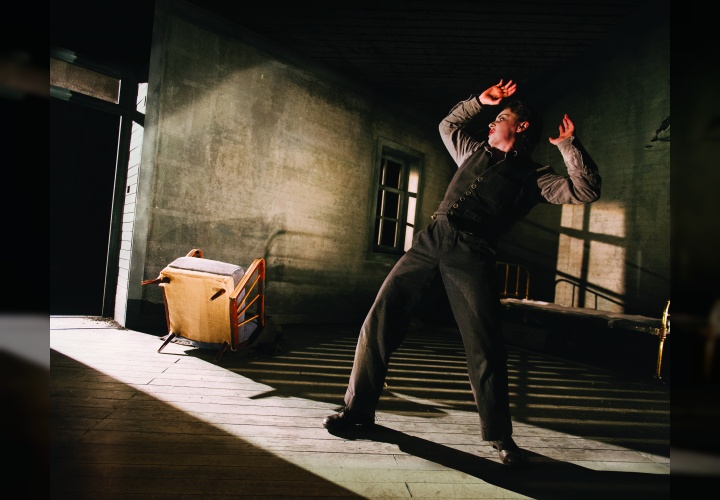
And be assured this production, directed by Michael Fentiman, at the Park is very good indeed, and it would be a shame if the remaining sold out performances are the last we see of it. The set and costumes from Gabriella Slade are exemplary – the action cleverly all takes place in an all-black funeral parlour with a hefty dose of religious iconography. The costumes put us slap bang in the middle of the 1960s, not the flower power generation but the more mundane, tired, conservative world which was the reality. The production kicks off with a speech from that tiresome crone Mary Whitehouse. And we have an actor as corpse rather than a dummy which adds a new and funny dimension.

The excellent cast take a great delight in playing up the characters faults and rapidly firing off the lines in the faux sincere way that they require (and largely avoiding the Carry On-esque trap that bedevils amateur interpretations). Everyone here is on the take in some way. Following a “bank job” lovers Dennis (Calvin Demba) and Hal (Sam Frenchum) need somewhere to store the loot. Hal’s Mum has just passed away but her murderous nurse Fay (Sinead Matthews) has designs on his Dad, McCleary (Ian Redford), or, more exactly, his money. Truscott (Christopher Fulford) is the copper investigating the bank robbery but poses as an inspector from the Water Board to grill the others. Cue the acid humour and farcical form and a conclusion where everyone gains financially though loses morally, not that they give a sh*t.

Sam Frenchum show’s up Hal’s jealously in the face of Dennis’s bisexuality and avarice. This is where the restoration of the cuts demanded by the Lord Chamberlain (yes kids we had a bloke in a wig telling us what we could watch until the 1960s) is most welcome, sharpening the ambivalent relationship between the two lads. Shades of Orton and Halliwell’s own relationship? Ian Redford’s McLeary feigns, but cannot entirely claim, innocence. Sinead Matthews is outstanding as the hypocritical Irish nurse and her comic timing is flawless. And Christopher Fulford as Truscott defines splenetic as our bent copper whose twisting of judicial logic ends up with, for example, the priceless concept of Christ’s crucifixion as a put up job. Oh and Anah Ruddin as Mrs McLeavy almost steals the show despite not uttering a word.

So no longer a shocking black satire: more a clever parody with astute commentary on “that old whore society” as Orton observed.  I am guessing it helps if you have a feel for the period but the stereotypes and absurdities are recognisable and the laughs abundant. Like Ben Johnson but without the need for a degree in Ben Johnson studies to understand it. If the production pops up somewhere else (beyond Newbury where it is off to next) take a look. It is perfectly possible to make a sh*tshow of Loot which entirely misses the points in the pursuit of forced laughs and overplayed farce. Indeed, by all accounts, the first productions failed until Orton rewrote and licked it into shape and the 1970 film version is weak.

If you are interested get along to the Queer British Art exhibition at Tate Britain (Queer British Art at Tate Britain review ***). Not a treasure trove of great art but a fascinating journey through gay history in Britain in the century or so proceeding the Sexual Offences Act 1967 which partially decriminalised homosexuality. Orton’s play premiered a couple of years before the Act. The exhibition shows some of the library books that Joe Orton and Kenneth Halliwell “defaced” and for which they were unbelievably imprisoned for 6 months.


Encounter drawings at the National Portrait Gallery review ***

encounter-press-release-banner-4-600x204

The Encounter: Drawings from Leonardo to Rembrandt

National Portrait Gallery, 7th September 2017

Short, sweet and eclectic. The exhibition of 50 or so portrait drawings at the NPG contains works by some of the greatest draughtsmen revered by art history from the Renaissance and Baroque, but blink and you might miss them.

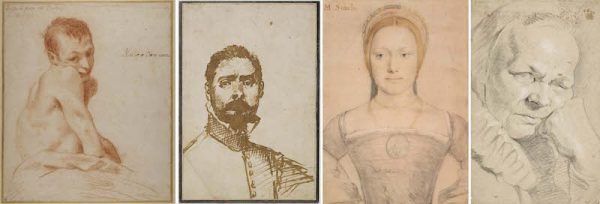
Now drawings from masters are rare treasures indeed, either being disposed once the work for which they were prepared having been completed or having suffered through the vicissitudes of time. So it is always welcome to get a chance to have a good long peek. We get a quick overview of the process of drawing at the outset and the survey covers a range of media; chalks, charcoal, pastel, ink, metalpoint. There are a series of 8 Holbein sketches from the Queen’s collection, (which were full of life in a way I had not anticipated), a wall of fine drawings from the Carraccis with 4 I think from Annibale, courtesy of the Chatsworth collection, a couple of dashing young men from sculptor Bernini, some exquisite little heads from Rembrandt, a preparatory sketch of a toff from Durer, a Rubens, a van Dyck, a Pisanello, a Pontormo, a Parmigianino, a muscle man from Leonardo and a partridge in a pear tree (I may have made the last bit up).

My highlights were the Head of an Old Woman by Domenico Ghirlandaio, Michelangelo’s teacher, in metal-point with white shading on some sort of orange paper, a curly-haired youth also in metal-point on grey paper from Benozzo Gozzoli, (he of the fancy and perfectly preserved frescos in the Magi Chapel in the Palazzo Medeci-Riccardi in Florence), and the final drawing another Old Woman in a ruff and cap attributed to Jacob Jordaens.

So if this is your bag then well worth a detour but for us generalists I wonder if there may not be quite enough here to make this a must see. Sacrilege for some I suspect but your time might be better spent focussing on a part of the National Gallery next door (not forgetting to hand over a few quid for that privilege).


Cat On a Hit Tin Roof at the Apollo Theatre review ***

l-r_jack_oconnell_brick_and_sienna_miller_maggie-_cat_on_a_hot_tin_roof_-_photographer_credit_johan_persson

Cat On a Hot Tin Roof

Apollo Theatre, 13th September 2017

Hmm. I was expecting so much more of this production. It’s Tennessee Williams. An all star cast. The imprimatur of the Young Vic. And Benedict Andrews, who was responsible for the, by all accounts, revelatory A Streetcar Named Desire at the Young Vic, is directing, with the help of a top notch creative team.

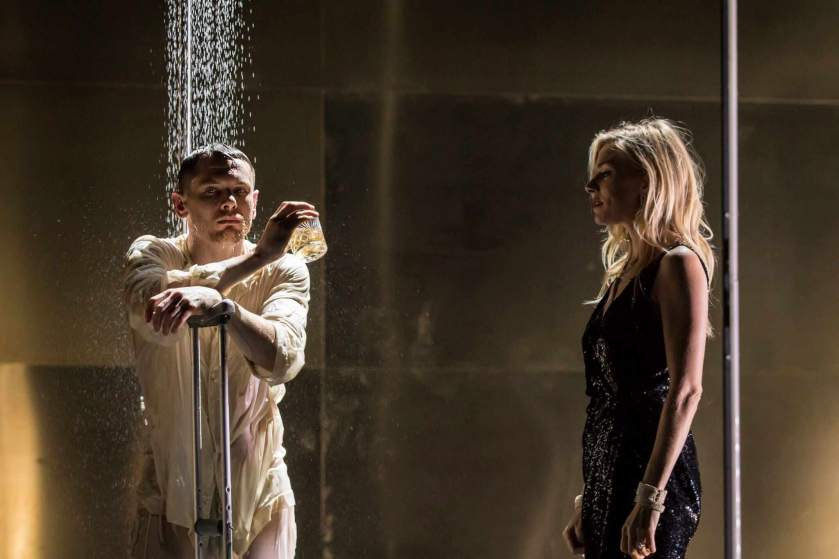
To be fair, in large part, it delivered. The motives, pain, frustrations and jealousies of the characters were laid bare. In particular I liked (slightly against my expectation) Sienna Miller’s Maggie whose breezy confidence and famously catty (doh) put-downs belied her internal mortification. Lisa Palfrey (last seen by me in the excellent Junkyard) perfectly captured Big Mama’s desperate optimism, especially in the face of the revelation of Big Daddy’s diagnosis. Rising star Hayley Squires (so emotionally powerful in I, Daniel Blake) embraced Mae’s grasping with vigour shoving her fertility into Maggie’s face. When Brian Gleeson finally got the chance to let rip, as Gooper’s mask slips, we saw what a fine actor he is. Colm Meaney’s Big Daddy was moreorless on the money, but I wasn’t entirely persuaded by his key scene with Brick, and his accent left me straining to hear on a few occasions, (and for once I hadn’t been a skinflint so was in prime position). Big Daddy should bully everything in his orbit, inanimate as well as animate.

Which brings me to Jack O’Connell’s Brick. Other than his performance in This is England I don’t really know Mr O’Connell, but I can see the intent behind his casting. Brooding yes, intense yes, self loathing yes, but I am not sure he fully inhabits Brick’s vulnerability. This is not a easy character to play but there are, in the angry exchanges with Maggie and Big Daddy, enough lines to create a more ambiguous character than was offered here. In fact overall I was not as persuaded as I would have liked to be by the interaction between the characters. Tennessee Williams’s poetry gives ample opportunity for the main protagonists to project their inner demons but this has to work as a whole and this dynamic fell a little short for me. All this deception, of self and each other, all this conflict, has to weave together.

This was compounded by the set and design of the production. Taking the action out of the historical specificity of the mid 1950s Mississippi Delta plantation was brave, but a little foolhardy I believe. The brushed metal panelling which surrounded the bright space may have suggested sun, heat and, the blindingly obvious, gold, but opened up the stage, when claustrophobia might serve better to convey the stench of death and decay which haunts this play. Tennessee Williams plays work so well because of the language he gifts to his damaged people but also because he simultaneously shines a light on the society in which they are trapped, here a world of immense wealth built originally on the immense cruelty of slavery. This wasn’t really visible in this production. And sticking Jack O”Connell and eventually Sienna Miller in the buff certainly renders explicit the theme of repressed desire but Mr William’s words are just as effective. Mind you they are both mightily beautiful.

Now I feel like I am carping a bit. I would not put any one off seeing this production in the remaining weeks. It is just that with this company, with this director and this cast taking on this C20 masterpiece, I expected a winner. Still onwards and upwards.

Judith at the Arcola Theatre review ***

howard-barkers-judith-a-parting-from-the-body-credit-nick-rutter

Judith: A Parting from the Body

Arcola Theatre, 7th September 2017

I am guessing they don’t watch Bake-Off in the Barker household.

Howard Barker does not write easy plays. By his own admission he wants each of us to experience his plays as an individual: none of that namby-pamby rush of joy in the realisation that we are all sharing in the theatrical experience. His “Theatre of Catastrophe” will always try to make themes more complex and ambiguous. He has created his own company, The Wrestling School, to produce his work in Britain. Obviously he is adored in the rest of Europe where there like a challenge. Oh and he doesn’t backslide on the subjects for his plays, taking historical or literary stepping off points to create works with multiple viewpoints which explore the darker side of the human condition. Mischief Theatre it ain’t.

Judith: A Parting from the Body was originally produced by RENO Productions at the Arcola in 2015 as part of a double bill with the premiere of The Twelfth Battle of Isonzo. This is the same cast but just a workout for Judith which clocked in at an hour or so. Now you arty types will know the Old Testament story of Judith beheading Holofernes like the back of your hand. It was a Renaissance and Baroque art staple based on a story which I understand is itself a common subject in the so called Power of Women topos, “heroic or wise men dominated by women”. Through time the depiction of Judith became more sexualised and titillating. On the face of it antifeminist claptrap but there may be scope for more complex readings and this is what Mr Barker succeeds in doing with his play.

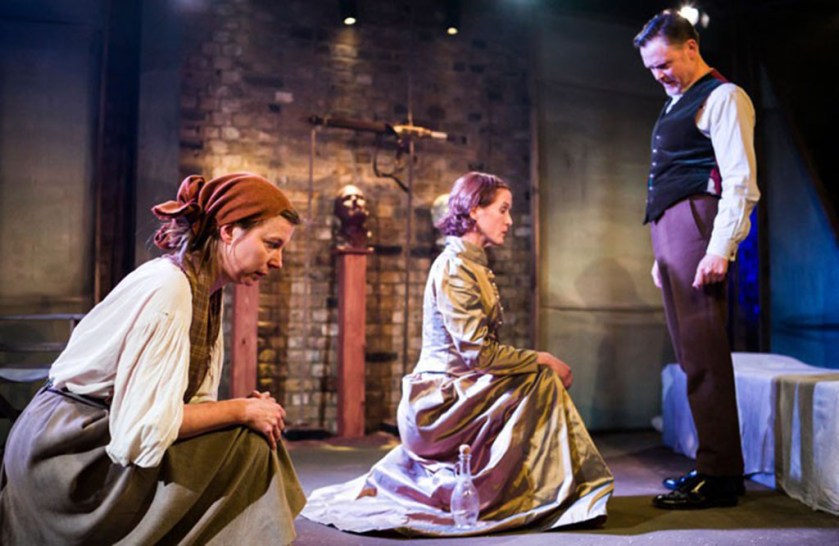
Liam Smith as general Holofernes expounds on the nature of power and sacrifice demanded by war. But his philosophising gives way to loneliness and vulnerability. Judith, a beautiful widow played by Catherine Cusack, with her plebian maid (Kristin Hutchinson), enters the enemy Assyrian camp on the eve of the battle and gets to his tent. There is much enigmatic chat and sexual frisson  between the three before Judith does the deed to save her city of Bethulia. Yet Judith and the maid become fascinated with Holofernes and his motives and Judith’s emotions become conflicted.

Now I am not saying this was an comfortable night out. Mr Barker is not interested in simply getting us from A to B in the standard way. The language veers abruptly between mellifluous poetry to profane banality. These characters are full of contradiction. Love and violence are intertwined. Nothing is made easy to grasp. I can’t pretend I was bowled over but it was intriguing and as I whizzed through the script on the way home, I started to get more out of it. I will add Mr Barker to my list of challenging playwrights where I must do more work.

The three strong cast were faultless, they know this inside out. Same was true of director Robyn Winfield-Smith and the set of Rosanna Vize was perfectly imagined. The small space at the Arcola was also a perfect fit. So no better advocates than these I think. Yet is is still a hardcore offering. So if you fancy a bit of dramatic pummelling take the plunge. I see the production is off to Poole and Colchester.


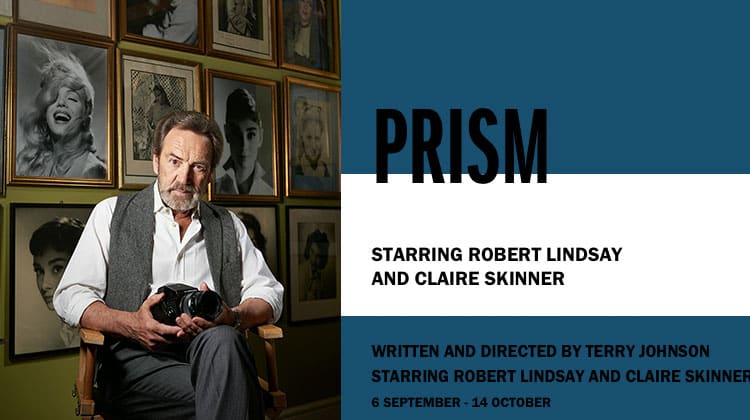
Prism at the Hampstead Theatre review ****

prism

Prism

Hampstead Theatre, 14th September 2017

Full disclosure. I love Terry Johnson’s plays. The marrying of “high” and “popular” culture themes and structures, the mix of humour and, as he calls it “brainy stuff, the abrupt lurches in tone: all this works for me. I have many more plays to get through (here’s hoping for some revivals) but favourites so far are Insignificance, which explores the nature of fame by throwing together Marilyn Monroe (of which more later), Einstein, Je DiMaggio and McCarthy (and is coming up shortly at the Arcola), Hysteria which pits Freud and Dali in a farcical set-up and Dead Funny which pulls apart the nature of comedy. So this is not likely to be an unbiased review. And it isn’t. I thoroughly enjoyed Prism with just a couple of tiny misgivings.

This is Mr Johnson’s first full length play in a decade or so though he keeps busy directing and writing for television and film. So for me this was something of an event. The idea for the play came from Robert Lindsay who is also a rareish sighting on the stage nowadays, which is a shame as he is a great actor in my book. Prism is based on the life of Jack Cardiff (1914-2009) about whom, I cheerfully admit, I knew nothing before this evening, though I was aware of his work. For Cardiff, who won a couple of Oscars, was the cinematographer behind such classic films as Powell and Pressburger’s Life and Death of Colonel Blimp, A Matter of Life and Death, Black Narcissus and The Red Shoes and John Huston’s The African Queen, of which more below. There were many others over his six decade career, as well as some directing assignments. By all accounts Mr Cardiff revolutionised the art of cinematography and he mixed with all the Hollywood greats. He was also something of a “ladies man” as my gran would say, and a fine looking fellow in the mould I think of a young Michael Caine.

If you are familiar with the films I name-checked above, as I am sure you are, you will know that the way these films are lit is jaw-droppingly impressive. Light, and the way we see things, is sort of the point of this play. And the golden age of Hollywood film has served Terry Johnson well as context before with the plays Insignificance and Hitchcock Blonde.

We first meet Jack Cardiff with his son Mason (Barnaby Kay), who has fashioned a studio of sorts out of a garage for his Dad to write his memoirs. This studio has one of his cameras (minus its vital prism thanks to Mason past carelessness) as well as photos of Hollywood leading ladies and Mr Cardiff’s own capable reproductions of Old Masters, such as Vermeer, Rembrandt, Renoir and Van Gogh, who captured light in paint before the photographic age and inspired our Jack.

Mr Cardiff is sliding into dementia, which provides the backdrop for much of the first act gentle humour here, so needs the help of a carer Lucy (Rebecca Night), who is also tasked with keeping the memoir on track. We also meet Jack’s second wife, Nicola (Claire Skinner) who was his assistant so is somewhat younger than Jack and is finding his decline difficult to cope with.

There is more than meets the eye here, quite literally. In a smart second act coup de theatre we shift to the location set for the filming of The African Queen with Barnaby Kay now playing Humphrey Bogart and Rebecca Night playing Lauren Bacall. And Claire Skinner metamorphoses into Katherine Hepburn. Now I go weak at the knees at the very though of Katherine Hepburn so, again, may not be the best judge of Ms Skinner’s performance but I was captivated. The flirting scene between Cardiff and Hepburn is terrific as are the references to the much reported hardships the cast had to undergo in the filming.

Mr Johnson also pulls another cracker from his bag marked “theatrical devices” with a scene involving Jack lighting Marilyn Monroe (Rebecca Night) followed by a fracas with Arthur Miller (Barnaby Kay). But this is an exact repetition of an earlier scene where Jack is explaining his work to carer Lucy. The doubling and trebling of roles here is a key element of the structure of the play as we probe Jack’s fading memory.

We learn about Jack Cardiff’s life, with Terry Johnson working his usual magic by stretching and shifting real events, the nature of light and ways of seeing in art and film, and the nature of memory. Lovely, very funny, insightful dialogue, the usual big ideas refashioned in comedy drama with real narrative and momentum and a more poignant, valedictory note (I won’t spoil the ending) than in previous Terry Johnson plays.

As usual Mr Johnson directs his own work, (some very interesting insights in the programme about this process), which means what he wrote and intended is what you see and hear. Tim Shortfall’s set is clever but not clever, clever and the performances are excellent. Minor quibbles are the slight lack of momentum through the middle of Act 1 as the “real” characters are mapped out, with Mr Cardiff’s dementia milked for laughs a little bit liberally, and the slicing in of Lucy’s tough background and circumstances, I didn’t see the point of this other than to lurch us from laughing to sadness in an instant which is a bit of a trait from this playwright.

So, as you can see, I really enjoyed and admired this, but like I say, I am a sucker for Terry Johnson’s plays. My guess, judging from the audience reaction, is that the overall reception may be a little more muted. But this seems to have been the fate of Terry Johnson’s work from the start. Some people rave, some people shrug their shoulders. What I would say is that even if you are not familiar with his work, if you have any interest in the subject, in film, like the cast or just want a funny, interesting night out then don’t hesitate.