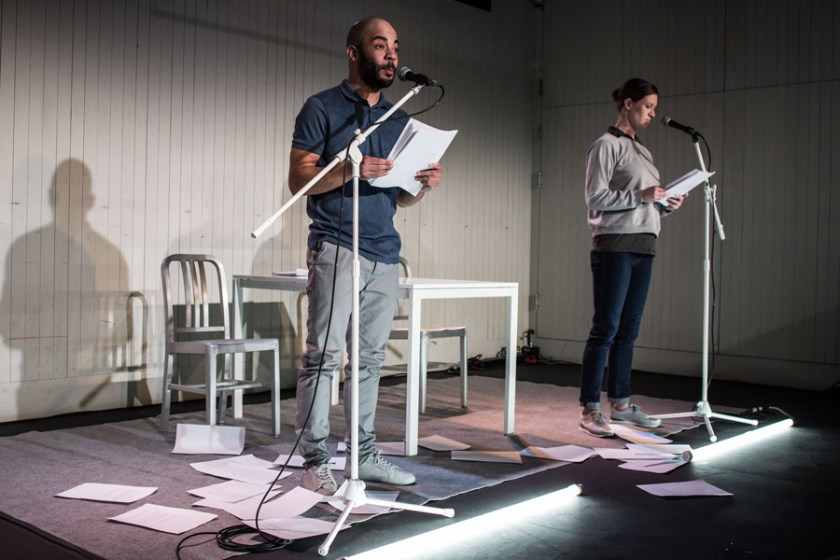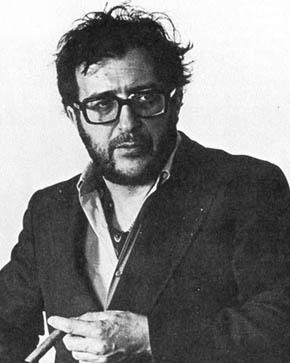
Luciano Berio: London Sinfonietta at Kings Place review *****

luciano_berio

Luciano Berio: Theatre of the World

London Sinfonietta, Kings Place Choir, Jonathan Cross (presenter), John Woolrich (curator)

Kings Place, 4th November

  • Lucy Schaufer – mezzo-soprano
    Michael Cox – flute
    Darragh Morgan – violin
    Paul Silverthorne – viola
    Timothy Lines – clarinet
    Lucy Wakeford – harp
  • Young violinists from Waltham Forest Music Service and the Kurumba Youth Orchestra
    London Sinfonietta

Luciano Berio

  • Lepi Yuro
  • E si fussi pisci for solo viola and for choir
  • Duetti: Aldo
  • Naturale
  • Duetti: Various
  • Divertimento
  • Chamber Music for clarinet, cello, harp and mezzo-soprano
  • Sequenza II for harp
  • Autre fois
  • Lied for clarinet
  • Air arr John Woolrich
  • Berceuse for Gyorgy Kurtag
  • Sequenza I for flute
  • Musica Leggera
  • O King
  • Chants Parallelles

Many years ago, maybe 30 or so, I heard a piece by Luciano Berio in a mixed programme at the Barbican. The ticket was free, courtesy of FF, and I cannot, for the life of me, remember the other pieces, the performers or the name of the Berio work. But I remember being completely blown away by the music, making a firm mental note that it was by Berio and that I should explore his music further.

Of course I didn’t. Modern classical music was just too tricky to grasp and I had a life to get on with. But there must have been the germ of something there. Now that I am older, and maybe wiser, I am beginning to understand that this was not a one-off novelty experience. There was something about Berio’s music that had left a mark. There seem to a handful of other modernist classical composers who similarly create a connection for me and I am still working my way through other candidates. Outside of the minimalists and a handful of contemporary names, Berio, along with Iannis Xenakis, Gyorgy Ligeti and Krzysztof Penderecki are the chaps that float my boat. There may be more.

So I am actively seeking out performances, live and recorded, of these lads. Heaven knows why they stand out but I think I am drawn to the fact that they all seem to engage with the musical past in some way, they pump up the rhythm, they can create extraordinary sound worlds (if you can’t hum it best to get wowed I find) and they favour dramatic and dynamic contrasts. No doubt if you know what you are talking about when it comes to music you would be able to offer me more comprehensive explanations (feel free to do so – I would be very grateful). There is still a lot of modern and contemporary classical music that leaves me absolutely baffled so there must be something going on in my head with these particular composers.

Here was a marvellous opportunity to enjoy a variety of Berio’s small scale output as part of the Turning Points series at Kings Place curated by British composer John Woolrich with the London Sinfonietta, who excel in modern works and premiered many of Berio’s pieces in the 1970s and 1980s. Now Mr Berio didn’t seem to suffer from any form of “composer’s block”. Prolific doesn’t begin to describe it. He composed for all manner of instrumental forces, including electronics and tape, and was particularly adept with the human voice, as well as strings, piano and flute Their are many large scale works, Coro and Sinfonia are maybe the most well known, but there is also a wide range of chamber and solo pieces which left Mr Woolrich with a serious curating challenge. One which I think he responded to with aplomb.

If there is one thing that characterises Berio’s oeuvre it is the way he incorporates the music of the past into the music of his present (the second half of the C20 to be exact). The references can be direct in terms of source material, (he arranged the work of diverse composers from Monteverdi to Mahler), or indirect in terms of fragments, quotes and styles. He saw this as transcription rather than collage but the effect, for the non-musical listener like me, is like a comfort blanket which anchors the “avant-grade” in the familiar.

Folk music played a large part in his framework and this concert kicked off with Lepi Yuro, a classic Croatian folk song scored here for viola. That was followed by a famous Sicilian folk song, E si fussi pisci, set first for solo viola and then, in its more usual format, for mixed chorus, with some suitably fishy impersonations at its conclusion. This choral arrangement was one of the very last pieces Berio composed. Nothing challenging here at all.

We then moved on to one of Berio’s short 34 duetti (1983) for two violins. These were originally written as teaching pieces to introduce the techniques of contemporary music to students, with one half of the duet given a much higher level of technical difficulty than its partner. Each was dedicated to a performer. composer or musicologist and, through time, they increased in sophistication as Berio took a playful view on the history of violin composition and just what it was possible to do with the instrument. The first piece was dedicated to Aldo Bennici, one of Berio’s favourite champions and a multiple dedicatee. After Naturale we were treated to ten more of the Duetti with Darragh Morgan, the LS’s lead violin, charmingly accompanied by young members of the Waltham Forest Music Service and Kurumba Youth Orchestra. Bartok, Stravinsky, Boulez and Berio’s Italian contemporary and sidekick in his electronic adventures, Bruno Maderna, were all name-checked.

Naturale from 1985 takes a recording of a raw and passionate Sicilian folk singer, Peppino Celano, belting out street vendor cries, (if you get the chance listen to Berio’s Cries of London for six unaccompanied voices which is just amazing), and frames it with an extremely expressive viola playing material transcribed from folk songs as well various percussion effects from marimba, rototoms and tam-tam. It is a extremely affecting and the most substantial piece on show in the programme. 

Next up was Divertimento, an early piece from 1946 (revised in the mid 1980s) composed for string trio, before he went to the US and discovered serialism, and which pays homage to Stravinsky and Bartok. This was followed by the first of the two Sequenzas on show, this being No II for harp with No I for solo flute following later on in the programme. Berio’s 18 Sequenzas are amongst the most well known and performed of his compositions and are staples of the solo repertoire for the instruments they showcase. In each case they exploit, with Berio’s trademark humour and musical knowledge, the full gamut of playing possibility with extended techniques piled up high. Watching Lucky Wakeford thumping the side of her harp or picking up the very highest registers was a joy. Berio wanted to show just what was possible beyond pretty glissando for the harp and he surely does. This was also true for the more commonly encountered Sequenza for flute played by Michael Cox which was another highlight of the evening.

Autre fois from 1971, scored for harp, flute and clarinet, is a miniature subtitled Berceuse Canonique pour Igor Stravinsky, which tells you pretty much everything you need to know about its mood and structure. This was followed by Lied for solo clarinet (here played by Timothy Lines) which, as the title suggests, sounds like a mournful song. The orchestral version of Air dates from 1969 but the following year it was recast for soprano and piano quartet. Our mezzo-soprano for this evening was Lucy Shaufer who was in fine voice. Remember Mr Berio’s works for voice comprise some of the finest contemporary pieces for mezzo-soprano given his muse was the American Cathy Berberian whom he married in 1950 and whose professional partnership extended well beyond their divorce in 1964. 

Air was followed by Berceuse per Gyorgy Kurtag, another short piece written in 1998 and dedicated to the redoubtable Hungarian master of the very small. This was followed by Musica Leggara (1974) for flute, viola and cello, (and I gather a tambourine if required), dedicated to a certain Godfreddo Petrassi, which is a spiky canon and not I think the “light music” of the title. Another joke maybe. The concert ended with  one of Mr Berio’s most famous vocal pieces, O King, written in 1968 for mezzo soprano and here strings and woodwinds. This was later incorporated into Sinfonia, possibly Berio’s most influential work. This was written to commemorate the death of Martin Luther King and, as you might expect, packs a powerful emotional punch as the civil rights leader’s name gradually emerges from the soprano’s voice line, If you could pick one work that gets to the heart of Berio’s music this might be it.

i was, annoyingly unable to stick around for the post concert discussion, (I know this sort of thing smacks of obsessive nerdiness but you can learn a lot), but the insight into Berio from the interviews showing in the other Hall at Kings Place was very welcome. He didn’t sound like he was the easiest chap to get on with but the reminisces did show just how broad were his influences and how much he influenced. His role as a teacher and mentor and his fascination with the business of making music, with sound itself, was also emphasised.

And we got to listen to Chants Paralleles, one of his ground-breaking electronic works from 1975. Now a lot of this sort of thing is just so much electronic bubble and squeak in my very limited experience but once again, somehow, Berio makes it vital and intriguing.

There you have it. I am a fan. Give him a whirl. You never know you might like it

And hats off to Kings Place for these Turning Points events. There is a bit of cheesy novelty involved in some of them but this can be overlooked given the learning on offer. The concert on 24th March 2018, from the London Sinfonietta again, which brings together some classic chamber works from the early C20, and links this to space-time and Einstein, (if every playwright on the London stage seems to be intent on shoehorning in brain-bending science, why not music?), looks interesting. As does the OAE’s contrasting of Haydn’s first and last symphonies on the 12th May.

I don’t suppose the bigwigs at the Wigmore Hall are quaking in their boots but Kings Place has emerged as a worthy foil to the grand old dame of Wigmore Street.


Scythians exhibition at the British Museum ****

telemmglpict000137671553_trans_nvbqzqnjv4bqoqs0bxrj0vmcthymjmv0p4xicgr5rwvxeifgf8inawq

Scythians: Warriors of Ancient Siberia

British Museum, 2nd November 2017

I have been bowled over by most of the recent exhibitions I have seen at the British Museum, covering the history of Sicily, the art of South Africa, US modernist art printmaking, (The American Dream at the British Museum review ****), British Watercolour art (British Watercolour Landscapes at the British Museum review ****) and the culture of the Celts. I am also, as the preponderance of glowing “reviews” on this blog testifies, pretty easily pleased. I like to think I have discerning taste in what I choose to see and am open-minded. The reality is I am childishly indiscriminate. 

So based on past experience and the reviews I was looking forward to this exhibition. I dredged up what I knew about the Scythians from my early teens as a speccy, bookish, solitary swot who had a brief fascination with ancient history (yes I did play wargames, on boards, before we have computers kids). Good with horses, large empire ranging over big chunks of Northern Asia, pointy hats, gold. I remember I quite liked the idea of them though I might have got confused with Parthians. Mind you so did Kit Marlowe whose Timburlaine the Great is portrayed as Scythian when he was obvs Turkic-Mongolian.

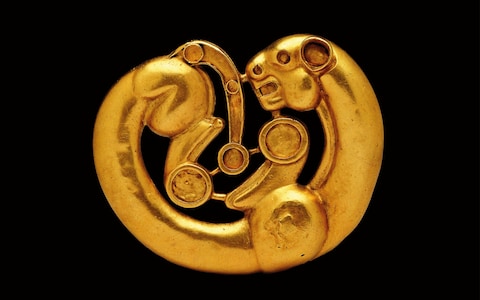
Anyway turns out Siberia was their manor. It also turns out that Siberia is not the snowy tundra, forests, god-forsaken Soviet compounds and mining desolation of popular imagination. At least not when the Scythians were in charge from 900 BCE to 200 BCE. They were nomadic yes, old Siberia wasn’t that hospitable, but they had a rich culture, with fancy threads (squirrel coat anyone?) and luxury tombs (kurgans), and they were a match for anyone else on the planet when it came to art fashioned from gold. especially when that art was based on animals. And especially when those animals were their beloved horses. You know when someone is said to be a bit “horsey, in that they are so keen on Dobbin. Well these Scythians were pretty much indistinguishable from their clippety-cloppety friends. They were even buried with them. They were also very handy with bow and arrow. from atop their horse. Lethal.

They were, even at their territorial height, a loose confederation of peoples and tribes, with Western and Eastern arms, with no state apparatus as such, primarily defined by their Greek and Persian neighbours. In one of the more fascinating insights from the exhibition though, they could trade at scale, in goods, grain and, it seems, people. It seemed they acted as the trading glue between Greece, Persia, India and China who all went on to bigger and better things. In fact it seems that, by around 500 BCE, these Scythian lads may have had a capital in Ukraine bigger than any other settlement anywhere in the world at that time.

They were also not shy of getting stuck into Middle Eastern affairs, controlling parts of modern Iran, knocking on the door of Egypt and fighting with the Assyrians and the first Achaemenid Empire (that’s the Persians to you and me). Whilst this is described by the exhibition I am not sure that the warring history of these people is fully brought to life. Nor therefore is the way in which in the Ancient, and even Early Medieval, worlds the “Scythian” came to symbolise all warlike, Barbarian outsiders. That’s Greek propaganda for you. Old Shakespeare has a Scythian nibbling on his kids in King Lear. Stravinsky had them writhing around in The Rite of Spring, probably the most important piece of music in Western culture.

What are undeniably fascinating though are the remnants of Scythian culture that do survive precisely because of chilly places they frequented. Weapons, saddles and harnesses, fabrics, clothing, a giant coffin, some cheese and, in eye-catching fashion, bits of tattooed skin and a bashed in head, have survived through freezing, (I got a bit lost on the exact science of preservation). To add to the alarm it seems sacrifice, a lot of booze and a bit of reefer played a big role in Scythian culture. They even, in a Pythonesque twist, seemed to wear false beards. These artefacts, together with the metalwork, largely in gold, and with clear links to craftsmanship in China, India and Greece, are the highlight of the exhibition. I think a majority of the most interesting exhibits come courtesy of the State Historical Museum in Moscow so Спасибо. We see how carefully Russia’s past rulers have treasured these objects, once they realised they came from their own predecessors.

Eventually these mighty warriors got battered by Macedonians and old rivals the Sarmatians in the West (and eventually subsumed into the Slavic world), and, in the East, by various nomadic sorts so that they ended up in the bits of what is now North West China that no-one else cared about. Always the way. Mighty nation goes downhill and disappears (though rarely self-inflicted through arrogant exceptionalism writ large by facile plebiscite).

So another piece of stunning scholarship, adept curating and generous lending from those flipping “experts” here and in Russia. A leisurely couple of hours is all it takes to bring to life an entire world which, at its peak, was the largest, and one of the most important, in the world. I would have liked just a little on how the “Scythian” impacted contemporary and later culture but I guess the team rightly, didn’t want to detract from the objects. Makes sense if you’ve got a skull with an axe hole in it.

The exhibition runs until January 14th. Perfect material for a Christmas family outing I would have thought.

The Party film review ****

 The Party, 2nd November 2017

Other than Orlando this was the first Sally Potter film I had seen. Neither have I seen any of her theatrical events. Which is surprisingly because I would have thought I was bang up the target audience for her work. Ho, hum. So much to see, so little time. Anyway, based on the proper reviews, and the potent cast, this was a must-see.

Now it has been one of my dreams to end up with a cinema all to myself. A combination of art-house sensibilities, day-time opportunity and indolent booking means I have come close a few times. Well my dream was finally realised. I am not entirely sure why the very classy PictureHouse Central, (which as the more observant amongst you may have surmised occupies a prime Central London pitch) was showing this film mid-afternoon on two screens. However, their seemingly thin grasp on retail cinema economics left me sitting in the box seat like some latter day Howard Hughes. I am certainly armed with all the necessary behavioural tics and misanthropic tendencies.

On to the film. We have a very dry, black (and white) comedy of manners which skewers the pretensions of an assembly of metropolitan elite types. Kristin Scott Thomas’s Janet has just been appointed as a left-leaning Shadow Health Minister. She is throwing a small gathering in a Bohemian, bookish London townhouse to celebrate. Think Hampstead old money. Our first sight of her is alarming but brief. One of her phone calls goes well beyond perfunctory congratulations.  The ever watchable Timothy Spall is her gloomy academic hubby Bill, who we first see slumped in his chair, glass of red in hand, then fiddling with his album collection (vinyl of course and extremely tasteful – no Bananarama greatest hits lurking at the back like some people I know). Bill clearly has “something on his mind”.

First guests to arrive are caustic cynic April (Patricia Clarkson) and her ageing hippy German boyfriend Gottfried (Bruno Ganz) who turns out to be a vacuous “life coach”. They are followed by feminist writer Martha (Cherry Jones) and her younger girlfriend Ginny (Emily Mortimer) who is pregnant, but not sure Martha is overjoyed at the prospect of parenthood. Finally we have unhinged coke fiend and “banker” Tom (Cillian Murphy) who claims his wife, Marianne, will join the throng later. Bombshells of various sorts are then dropped at regular intervals. It doesn’t end well. The usual schtick for a dramatised party. I guess a bunch of fifty-something, suburban, middle class Londoners getting shit-faced, carefully skirting around the political and dancing badly to 80s classics isn’t going to get anyone a film festival prize.

The action is restricted to the house lending a theatrical air and the cast is phenomenal. You can practically hear Ms Potter licking her lips with relish as she sets to work on all the hypocrisy and narcissism that her Leftish character types display. It is so satisfying to see the starkly lit, black and white close-ups reveal the true emotions of these brittle bourgeoisie. There is an air of Bunuel about the set-up if not the outcomes, some Chekhov, (he is always lurking somewhere whenever posh people are holed up somewhere), by implication Stoppard with the brainiac dialled down and some non-malevolent Pinter. Very good company to keep. The humour flows from the inability of the characters to elevate their real responses to the stream of revelations over what they think are the right responses.

The film is sharp, short, (just 70 minutes played moreorless in real time, wouldn’t it be good if more writers/directors had the confidence not to pad out unnecessarily), and relentlessly hits its targets. It is maybe a bit too pleased with itself, and I couldn’t help thinking that the film, its characters, its director and, in this case the audience of one, are all actually in the same echo chamber of “cultural privilege” that it is taking potshots at, but it was still a pleasure. The one-liners end up trumping the message and creaky plot which turns out, in the end, to be to its advantage.


Australian Chamber Orchestra at the Royal Festival Hall review ****

dynamic-b98b42fc-d3b2-53c9-ba00-88eac54e2b7f

Australian Chamber Orchestra, Richard Tognetti (director), Pierre-Laurent Aimard (piano)

Royal Festival Hall, 3rd November 2017

  • Bach The Art of Fugue Contrapunctus 1 to 4
  • Mozart Piano Concerto 15
  • Shostakovich Two Pieces for String Octet
  • Tchaikovsky Souvenir de Florence

There is something truly thrilling about watching a group of string players, some standing, going hell for leather, as one, in a piece written exactly for them. Not to decry the full blown symphonic experience or the intimacy of the quartet but this is a special treat. Normally I see (and hear) this as part of a Baroque programme, normally Italian, or maybe a spot of Bach. Here we had a powerful modern ensemble.

Now we, for I was accompanied by the discerning ear and brain of Mrs TFP, that the wide expanse of the Festival Hall might swallow up the band but we needn’t have worried, as even from our perch astern, the sound was splendid. What was something of a shame is that the Hall was barely half full, a real shame since the ACO under Richard Tognetti, are world class. It was not as if the programme was challenging in any way. Even in the repertoire that we found less appealing, (I favoured the Shostakovich, Mrs TFP the Mozart), namely the Tchaikovsky, the finesse and control of the ACO was astounding. In those passages in the Shostakovich and Tchaikovsky which called for the strings to come together the unanimity of sound and movement (bows moving exactly in unison) was uncanny. Like one instrument.

Now I have heard the Art of Fugue performed by harpsichord, piano, string quartet and viol consort. All different, all fascinating as the simple theme is worked through with increasing complexity across the 13 completed, and 1 unfinished, fugues and, sometimes, the 4 canons. There is probably someone out there who has had a crack at Bach’s masterpiece on the stylophone. (I’d paid good money to see that). I gather that Richard Tognetti, who has led the ACO since 1990 (that presumably explains the discipline of playing on show), can sometimes get a little carried away with his arrangements. Not here. Now admittedly the first 4 of the contrapunctus are easy for even my ears to follow, as the meticulous theme is set out in the first, the dotted rhythm added in the second, turned upside down and filled out in the third and expanded and “sped up” in the fourth (here through the use of pizzicato). So I am not sure how much further they could go with this work, even with their technical mastery, but this was very interesting and flawlessly delivered.

I hate to admit it but the Mozart was beautiful. I don’t know the 15th Piano Concerto but I am well aware of Pierre-Laurent Aimard’s qualities, last heard by me in a majestic Emperor Concerto under Essa Pekka Salonen. You can hear how young Wolfgang, (well not so young by the time he wrote this), created the piano concerto form we know and, usually, love today. There is some lovely woodwind action, lots of sublime tunes and some fiendish piano playing, but all wrapped up in a charming bow. Once again the playing of orchestra and soloist was technically precise, but with no lack of emotion.

Now my prime reason for booking this concert, other than the reputation of the orchestra, was the Shostakovich piece since this, in my experience is rarely performed. Written in 1924, when DSCH was still a student, in memory of his friend Volodiya Kurchavov, there are obvious signs of the composer DSCH would be come. The Prelude is still rooted in the Romantic Russian composers of the late C19 but in the plunging response to the initial theme and with the high accompaniment to the second theme there is more modernity. The Scherzo second piece could easily have dropped out of a DSCH symphony from twenty years later. Sardonic, ghostly, then a comedy march, with all that thrilling dissonance.. A joy to hear and brilliantly executed by the eight musicians.

The Tchaikovsky was the (good) surprise of the evening for here Mr Tognetti’s arrangement of this sextet, for all his strings, really showed just how extraordinary their playing is. Don’t get me wrong, there are still plenty of passages in this near 40 minute piece, that annoy me intensely, it’s all just too show pony, but I did get sucked in I admit. Not sure it is the same Florence that I know and love but all that lushness and heart tugging yearning is hard to fight. And to be fair the ACO’s muscular approach dials down the sentimentality (though not the pony).

There isn’t much about Aussies that makes me jealous (actually that’s a lie, there is) but this orchestra is definitely one of them. I will add them to my list of must see orchestras/ensembles when they come to London alongside the Concertgebouw, Bavarian RSO, Leipzig Gewandhaus, Staatskapelles Berlin and Dresden, Chamber Orchestra of Europe, Spira Mirabliis, Ensemble Intercomtemporain, Orchestre Revolutionnaire et Romantique, Akademie fur Alte Musik Berlin, Les Arts Florissants, Freiburg Baroque, Europa Galante, Budapest Festival Orchestra, Mahler Chamber Orchestra and, vain hope, Lucerne Festival Orchestra. Mind you with the LSO under Rattle we now have the best in the world, fact.


Soutine’s Portraits at the Courtauld Gallery review ****

soutine-1

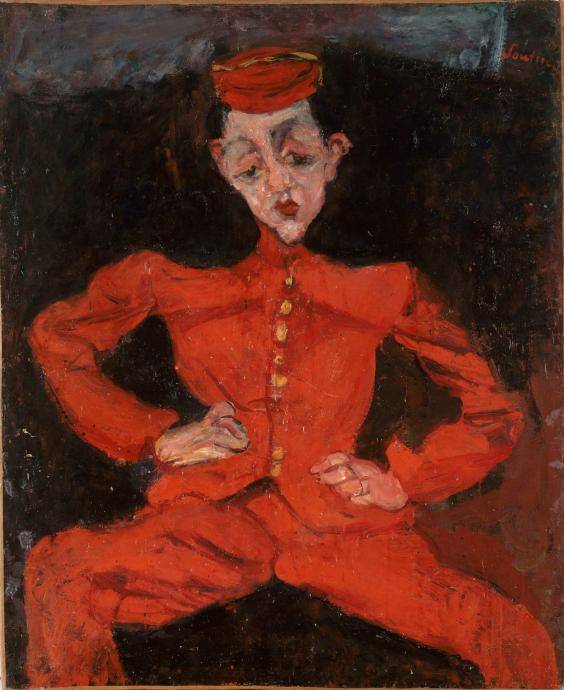
Soutine’s Portraits: Cooks, Waiters and Bellboys

Courtauld Gallery, 31st October 2017

I am afraid that the joys of Soutine’s paintings have passed me by in the past. I could see the vibrant colours and intense animation but all that skew-whiffedness left me a bit bewildered. On my last visit to the Musee de L’Orangerie (sorry for sounding like a pretentious twat) I could see there there was something from the extensive Soutine collection in the Jean Walter-Paul Guillaume Collection, but I got captured by the Cezannes. Easily done.

Anyway turns out I should have looked harder. Which is normally the solution to any art appreciation headache. This collection of Soutine’s portraits of various subjects from the French hospitality industry of the 1920’s turns out to be a brilliant introduction to Soutine’s faculties. These people are, with some notable exceptions, bursting with attitude. Painted head on, legs splayed, arms out, eyes staring right back at you, they seem to be willing you for a fight. It is almost as if they would be doing you a favour by “serving” you. Or, in private, they regard you as beneath their contempt. I appreciate that this sounds suspiciously like the stereotype of the disdainful French waiter but it is, nonetheless, plainly there in the canvases, especially in the, ahem, portraits of the waiters, the bell-hops, the valets and even the young page boys. Anyone oik like me who has ever felt intimidated in a fancy dan restaurant or hotel will recognise the look. There are five paintings hung together of the same subject in different guises, playing different roles and with very different moods. Same bloke with a high forehead, red hair, broken nose, but let’s just say he exhibits various degrees of approachability. A bit like you or me on any given work day.

The chefs give off a different vibe. Here you can see, and almost smell, their craft. Even the pastry chefs seem to have an air of meat about them. There is a post WWI Butcher Boy drowned in red but all the Chef’s whites have a reddish hue or flecks. This is where the influence of Soutine on Francis Bacon is most acute. Bacon normally screams carcasse at every opportunity but it seems old Soutine had a similar fascination for the flesh, what with his homages to Chardin’s still lifes and with the rotting joint he stuck up in his flat to the evident annoyance of his neighbours.

The chambermaids are altogether different. Arms down, hands cupped, meek expressions. I can’t really find anything about Soutine’s sexuality but it looks like his eye was drawn to submissive women and saucy boys based on these portraits. These women have more similarity with the elongated simplicity of his mate and fellow Jewish emigre in Paris Modigliani, and as the catalogue points up, even the ethereal women that the genius Gwen John contrived.

Across the whole exhibition, (just 20 paintings in two rooms so no need to work up a sweat, and the Courtauld, as any fool knows, is the most life-affirming space in Central London), the debt to masters such as Rembrandt and Courbet, and colour master Fouquet from an earlier time, is clear. Soutine painted precisely what he saw. This took time but the resulting effect is that he didn’t hang about when he finally saw what he wanted. Hang dog eyes, misshapen ears, pouty lips, chins, foreheads, pointy limbs, whatever leapt out at him, leaps out at us. And all that sticky, oily colour. Vibrant but not in the cartoonish way of some of the German expressionists, but earthy, fleshy, silky. Just like say your man Rembrandt.

Soutine was an outcast in some ways as a Russian emigre, whose Jewishness meant he had to abandon Paris in both wars. Fortunately he made a few quid in his later life but in the end, on the run, he died because he couldn’t get to a hospital quickly enough to treat his stomach ulcer. A small funeral, this was a “degenerate” artist after all, but Picasso pitched up. That tells you something.

His distinctive position as a bridge between the realism of past Masters, and the abstraction of the generation which followed him, took a bit of time to take root despite the acclaim in his lifetime. I would be surprised if his work was everyone’s cup of tea, but if you open your eyes, like I did, I think you might be very pleasantly surprised. Of course no one looks like this but most of us ordinary people look like this.


St George and the Dragon at the National Theatre review ***

saint_george_and_the_dragon_c_johan_persson-1000x572

Saint George and the Dragon

National Theatre, 31st October 2017

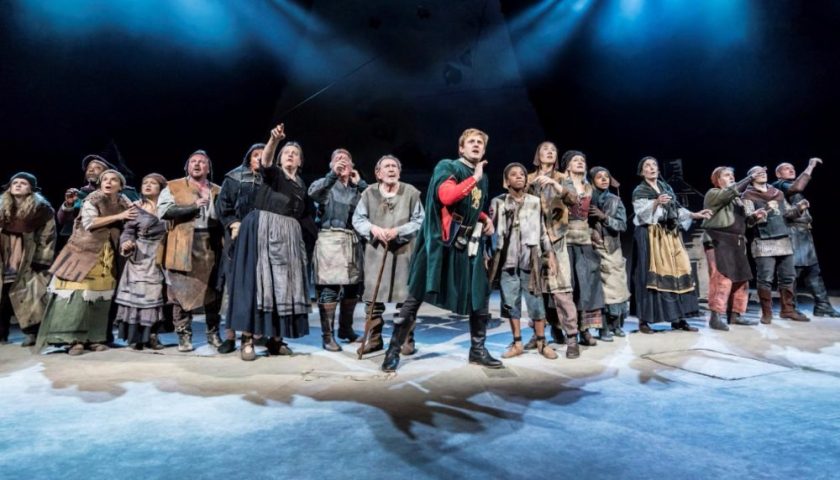
This must have looked a great idea on paper. A state of the nation play, with much to say about ill at ease contemporary Britain, told as allegory, in a format and staging that nods to a fairy tale. Writer Rory Mullarkey took as his inspiration The Dragon, the most well known play from Soviet writer Evgeny Schwartz which was an allegorical satire on Stalinism, with the knight Lancelot in the lead. Clearly Mr Schwartz was a brave man. There is also a whiff of Chaucer and Medieval morality play in Mr Mullarkey’s construction.

Designer Rae Smith has created an imaginative set, like a child’s pop-up book, which roams across the three periods that Mr Mullarkey’s story encompasses, the Medieval, the Early Industrial and our own Post Modern present. Lyndsey Turner, who is expert at these big ideas plays, gives the production plenty of room to breathe, with a light and often amusing tone that matches the “modern fairy tale” mood, and the rest of the creative team conjure up some magical aural and visual effects.

John Heffernan’s George is very affecting, alternately brave, stupid, confused and naive, Julian Bleach’s Dragon is as pantomime camp as you like, Richard Goulding’s henchman who is redeemed has real presence and Amaka Okafor strikes the right balance as feisty champion Elsa. The rest of the 22 strong cast also fit like a glove and we have a groovy 6 strong band.

But there is a but. It just all seemed a bit vague. The idea that we have needed and relied on a hero in the past to rescue us English when things go t*ts up was efficiently conveyed as were some elements of what might constitute our national identity, the things that bind and divide us. A nation remember is just some lines on a map (admittedly some sea is involved here) and a largely fictional shared history and SGATD was neatly rooted in this premise. The dichotomy between the enemy without and the enemy within was also engagingly scrutinised.

It is just that, when all was said and done on stage, we didn’t seem to have moved any further from this point of departure. Enjoyable yes, creative yes but not really very satisfying for me, which, at a time when anyone and everyone theatrical is trying to jemmy in a state of the nation perspective, was a little disappointing. There is more than enough on show to warrant a visit and there are plenty of tickets for the rest of the run, but the play, like the current England it depicts, comes up a bit short.


Mother Courage and Her Children at the Southwark Playhouse review ***

first-look-mother-courage-at-southwark-playhouse

Mother Courage and Her Children

Southwark Playhouse, 7th November 2017

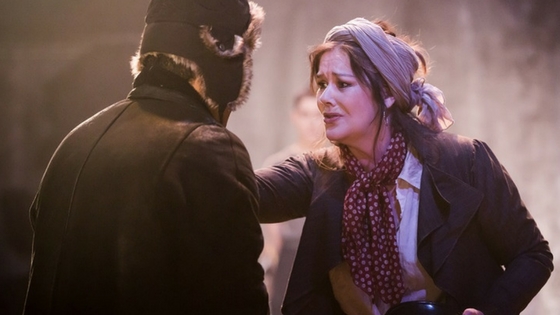
Hmmm. I am torn. This was a mixed bag and no mistake.

The good stuff first. Well it is Brecht so there will always be big issues to chew on, although here the anti-war appeal that lies at the heart of the play felt curiously understated. The production does have a ramshackle design from Barney George which I was quite taken by and which seemed to capture the ravages of a long drawn out war on a society. The transverse staging and the constraining of the larger Southwark Playhouse space had some advantages, particularly when it came to observing the best of the cast. Mind you this did put paid to the Brechtian distancing effect. Hannah Chissick’s direction had some nice touches though this seemed to lack an overall coherent vision. I like the folksy song arrangements by Duke Special which are drawn from the 2009 NT production. Tony Kushner’s translation from 2006 is strong on characterisation but seems somehow to play down the “epic” nature of the action, though the production was partly responsible.

Best of all was the swaggering performance of Josie Lawrence as Mother Courage. Whilst there was a part of me that would have liked a more hard-bitten Courage to ram home the war as commercial opportunity message, her more sympathetic spirit paid dividends in the scenes with her “children”, the Chaplain and the Cook. David Shelley and Ben Fox in these latter two roles also turned in strong performances, as did Laura Checkley’s brassy Yvette and, especially Phoebe Vigor’s Kattrin. I was less convinced though by the rest of the cast whose tone seemed uncertain, notably the sons, Swiss Cheese played by Julian Moore-Cook and Eilif played by Jake Philips Head. Don’t get me wrong, the boxes were largely ticked, it just seemed to me that motivation and understanding was sometimes lacking.

This lack of conviction was ultimately why the production was only a qualified success for me. There were some powerful scenes notably when Courage disowns the corpse of Swiss Cheese, when Courage turns down the Cook’s offer to escape to Utrecht and especially at the end when Kattrin is beating the drum to warn the townspeople, but many of the other scenes have less definition, and those that do work rely too much on the sympathy generated by the performers, which risks melodrama, and which Brecht specifically wanted to eschew. This should be far more threatening and dislocating to convey the true horror and to reveal the economic and religious imperatives that underpin war, whether in the Early Modern Age or now, in the throes of Late Capitalism.

An avowedly non-specific staging also risks, as it does here, the distancing effect offered through Brecht’s setting in the Thirty Years War of the early C17 between Catholic and Protestant. We are supposed to be immersed in Brecht’s epic story but also to think long and hard about what he is telling us, and I am not sure we were fully afforded that opportunity. We are allowed to understand why Courage does what she does, because she has to to survive, but we are not supposed to like her.

The transverse staging was complicated by some early scenes which took place partially in a mezzanine which was, literally, a pain in the neck for half the audience. Music, sound and lighting worked with the staging but the lack of space constrained the pattern of movement, (to avoid problematic sightlines),  which had the perverse effect of slowing the momentum at times.

My conclusion. A brave attempt which is worth seeing for Josie Lawrence’s fine, if ultimately flawed, performance and for some of the ingenuity of the creatives in trying to make this work in this space. And because it is Mother Courage and Brecht. But there have been, and there will be, more coherent and biting productions which do more to reveal the layers of Brecht’s art, passion and instruction.


Suzy Storck at the Gate Theatre review ****

npo2yrr80p17jyxhc4xc

Suzy Storck

Gate Theatre, 4th November 2017

The Gate under Ellen McDougall has found another blinding play, this time courtesy of French writer Magali Mougel (translated by Chris Campbell). Visceral only begins to describe it. Ms Mougel has created a modern-day Medea and invested it with an arresting, and bleak, poetry. This is about as sharp a dissection of the prison of gender roles and maternal “instincts” as you could hope to see in just over an hour.

Suzy Storck has three kids and hates her life. A patronising mother, a selfish husband who offers no support and whinges about how hard he works, an untidy flat, a career that stopped with bagging chickens, a baby that won’t sleep and two older siblings who never stop needing. She’s knackered, it’s boiling hot in her tiny flat, so she opts to knock back the vino and escape with an unfortunate consequence. We flashback to her life before the kids, her childhood memories, meeting and dreaming with husband Hans Vassily, enjoying her job at the poultry factory before it closed, an agonising interview arranged by Mum, the conception of the children.

So far, so predictable you might be thinking. You’d be wrong though. Not because the plot turns up anything extraordinary, quite the reverse. But the disorientating language, rhythm and structure of the play brings the story to exhausting life creating a very recognisable universal out of the painful specific. We have a Chorus in the form of Kate Duchene (also the Mother) and Theo Solomon (also the Children) who comment, probe and articulate. We have some creative intervention from props, video, lighting and sound. The audience even helps out. We have pained monologue and recollection. We have some powerful argument.

Jonah Russell as Hans Vassilly Kreuz, who has popped up to admirable effect in a few things I have seen, is spot on as the ineffectual male sh*t full of self-pity. The whole thing though hinges on the performance of Caoilfhionn Dunne who is shatteringly magnificent. She caught my eye in Mike Barlett’s Wild at the Hampstead Theatre last year as well as in The Nest at the Young Vic and Our Country’s Good and The Veil at the NT. Up close, in the scene where she won’t play the game in an interview for a job in a shop, and in the drunk scene at the end, she is utterly, physically real. Her eyes dull, her limbs hang heavy, the stuff of life drains out of her. Terrific stuff.

Director and designer, Jean-Pierre Baro and Cecile Tremolieres seem to have effortlessly opened up what I suspect is a very existential French text into an equally powerful English equivalent. There is no let up until you get out and down the stairs. But at least you can get out. Unlike Suzy. Well worth seeing.

Minefield at the Royal Court Theatre *****

1063

Minefield

The Royal Court Theatre, 7th November 2017

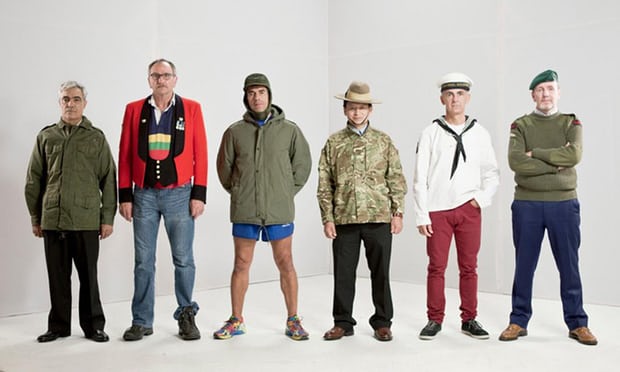
Argentinian writer, Lola Arias, in her own words, explores the “overlap zones between reality and fiction”. Minefield though is all reality, in the rawest, most uncomfortable and, ultimately, moving way imaginable. She has devised a powerful piece of theatre, documenting the tragedy of war, from the testimony of six veterans of the Falklands/Malvinas war. It has toured the world since its original airing in Brighton in 2016 and, if you can’t make it to this run at the RC, I would thoroughly recommend you try to see it should it turn up near you.

The six veterans, now all in their fifties, Lou Armour, David Jackson, Ruben Otero, Sukrim Rai, Gabriel Sagastume, and Marcello Vallejo, are obviously not professional actors, though they are men of immense talent, but boy can they tell a story. They chart, in English and Spanish, with appropriate sur-titles, the audition process (“the rehearsals for this play took a little longer” than the war), how they became soldiers, (by choice on the British side, by random conscription on the Argentinian), the media representation of the war, their arrival in the Islands, the endless waiting, some specific events (the sinking of the Belgrano, an Argentinian patrol blown up by their own mines, a jet attack), key battles, the last day of the conflict and coming to terms with what had happened to them on their return to civil society.

The production mixes projection (of newspapers, magazines, letters, photos), live video, re-enactment, masks, interviews, some very fine live music, props and mementoes, even some model soldiers, with a barrage of lighting and sound, all to mesmerising effect. We see the conflict from multiple perspectives. There was much that was new to me. The key though was the six honest men up there on stage. And their memories. The war has never left them. Most affecting is Lou Armour watching his younger self on video explaining how an Argentinian officer died in his arms. And Marcelo Vallejo describing to David Jackson, now a psychologist, his years of anger and addiction after the war.

No simple resolutions, still visible disagreement about the causes, let alone the outcome of the war, but it seemed to me that the experience provides some shared catharsis for these participants. A moving, intelligent and never inert remembrance.

Heather at the Bush Theatre review *****

heather-bush-theatre-2

Heather

Bush Theatre, 8th November 2017

For me the best plays take a very few ideas, or even better one idea, and then explore those ideas from multiple perspectives. If the writer loads up the text with too many ideas and messages, usually because he/she can and “it would be a shame not to” it can lead to confusion and drift in my simple mind. Less, as is so often the case, is usually more.

Thomas Eccleshare’s play Heather sticks fast to this rule and I loved it. It first popped up at the Tobacco Factory in 2014, again in Edinburgh I gather, and is now at the Bush for a couple more weeks. I implore you to see it.

I won’t detail the plot and central conceit as this would spoil the elegant twist. The play takes a children’s novel, in the vein of that wretched Potter (love JK Rowling, hate her work, sorry), as a springboard to explore the question of authorial identity and the relationship between art and the nature of the artist that creates it. We get to think about who we find acceptable in the creation of mainstream culture, how culture is represented, owned and marketed and whether rehabilitation is possible or desirable.

There is formal invention in the structure of the play, again I won’t delve too deeply to avoid spoiling, and some very clever and funny wordplay. The three parts of the play do not always entirely ring true but this is sort of the point in a play about how we should regard the representation of the written word. The two actors, Ashley Gerlach and Charlotte Mella, have the characters and the relationship between them absolutely nailed down, and the pace and rhythm of the production under Valentina Ceschi’s direction (she partners the writer in the Dancing Brick company) is spot on. As is the design of Lily Arnold.

That’s it. I won’t labour the point. Along with The End of Hope at the Soho Theatre this is the best way I can think of to spend an hour, (actually slightly less in the case of Heather), this weekend. Take a friend, discuss, eat.