Bavarian Radio Symphony Orchestra at the Barbican review *****

71905-brso-jansons-barbican-2102-resized

Bavarian Radio Symphony Orchestra, Mariss Jansons, Yefim Bronfman (piano)

Barbican Hall, 24th November 2017

  • Beethoven – Piano Concerto No 4
  • Prokofiev – Symphony No 5

Concertgebouw, Berlin Philharmonic, Vienna Philharmonic, London Symphony, Chicago Symphony. These are the orchestras usually held up as the world’s best. The smart money though also rates the Bavarian Radio Symphony Orchestra under Mariss Jansons. I know that Mr Jansons has a way with Tchaikovsky and Shostakovich through recordings, but this was the first time I had ever seen him, or his principal orchestra, perform. That just shows what a berk I am, (I have discounted previous visits thanks to repertoire), though I suppose you could say this means I have much to look forward to. Anyway I was quite excited.

The thing is I still don’t know if I really like Prokofiev’s music. Sometimes I am really swept along by the wealth of ideas and colours. Sometimes I am baffled. A work in progress if you will. With the Beethoven however there was enough from the programme to commit. I am so glad I did. I don’t think I have ever heard a conductor who exerts so much control over the dynamics of an orchestra. Mr Jansons seems to have worked out every single detail and every one of the orchestra members knew what to do and when to do it. The lushiest of lush strings, the silkiest of silky woodwind,  the punchiest of punch brass and the most precise of precision percussion.

A bit too perfect. Maybe. I wouldn’t want to hear this sort of performance every day of the week but it worked for me in the Prokofiev. This was SP’s return to the symphonic form after a 15 year hiatus, and the first after his return to the Soviet Union. You could read it like a “celebration” of the Red Army’s victories over the German army, (it premiered in 1944), but it would seem to make as much sense as reading Shostakovich’s symphonies in the same way. It seems to me that it defies any programmatic intent. The first movement opens with a woodwind theme that gets bashed up by brass and percussion, followed by some string development and then a dissonant halt before the B flat major resolution. If this is an epic tale of overcoming the enemy it is a funny way of showing it. The scherzo which follows, with a tune SP nicked from his own Romeo and Juliet, (and which is the theme tune for a telly programme I can’t identify which irks me immensely), is one of those amazing ideas which SP seems to conjure up at will and which defines the word sardonic. Here though he plays with it, rather than discarding it too early and moving on, which is what normally annoys me. It ends with a trademark dissonance. The strings of the BRSO were bonkers fast by the end but still perfectly regimented. The Adagio kicks off with a proper stringy heart tugger then a funeral march before the finale opens with a gallop that gets pulled apart by percussion until a final, odd maybe-heroic conclusion.

It always seems to me that SP never seemed entirely comfortable with what he created and felt compelled to shake ideas back up as soon as they were realised. This is what makes it a bit too bitty for me. Yet in this performance I could hear a line through the movements and all that ADHD nervous intensity was calmed and channelled.

Same in the Beethoven, but because I know and get this, all was pleasure. Yefim Bronfman has a delicate touch for a big fella (like me), and pulled it out for the showy bits, but this was all about the orchestra which was so on the ball in this that it felt like it only lasted 5 minutes. I guess all that sitting around waiting for the soloist in the opening movement after his first tinkle meant the game was over before it started but this was definitely one of those performances where the diva did what they were told, even when they were in the box seat. A good thing. Mind you Mr Bronfman got plenty of opportunity to show his skills in his encore of Schumann’s pretty, if pointless, Arabeske.

The second movement Andante is one of my favourite Beethoven moments with the meek piano weaving its ethereal tune around the dramatic string interjection. And the final movement Rondo is, in turn, one of my favourite Beethoven fist pumpers, which surrounds an enchanting central diversion. Imagine hearing that for the first time. A joy.

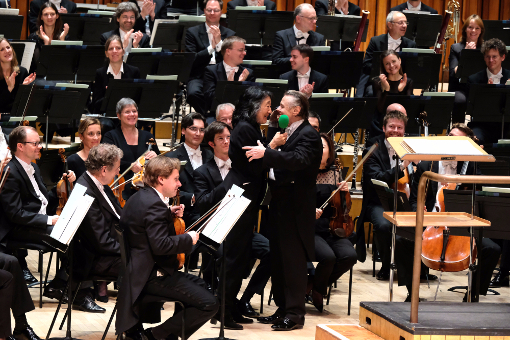
Just like my first time with this orchestra. Mr Jansons, who works the podium energetically despite being near 75 and having a pacemaker, exudes enthusiasm and, I’ll warrant, pride in his achievement with this band. After the concert he was presented with a Gold Medal from the Royal Philharmonic Society. Only around 100 or so of these have been bestowed since inception in 1871, and only 1 or 2 are given out each year (mind you they were pretty generous in the first year). He joins the likes of Mitsuko Uchida, who presented it to him, and, in terms of living conductors, Dutoit, Pappano, Barenboim, Rattle, and the master IMHO, Haitink. Like I said, the smart money rates him.


Poison at the Orange Tree theatre review ****

claire-price-and-zubin-varla-in-poison-by-lot-vekemans-orange-tree-theatre-photo-by-the-other-richard-1024x683

Poison

Orange Tree Theatre, 28th November 2017

Sometimes all you want from a play is for it to do exactly what it says on the packet. No sub-plots, symbolism, pointless characters, formal invention, stilted message. Just a powerful and involving story, well told. This is exactly what renowned Dutch playwright, Lot Vekemans, does in Poison. No wonder it has been translated and performed in multiple locations. Another terrific acquisition by Paul Miller and the Orange Tree team. Here it is translated by Rina Vergano who is the go-to for Dutch and Flemish texts.

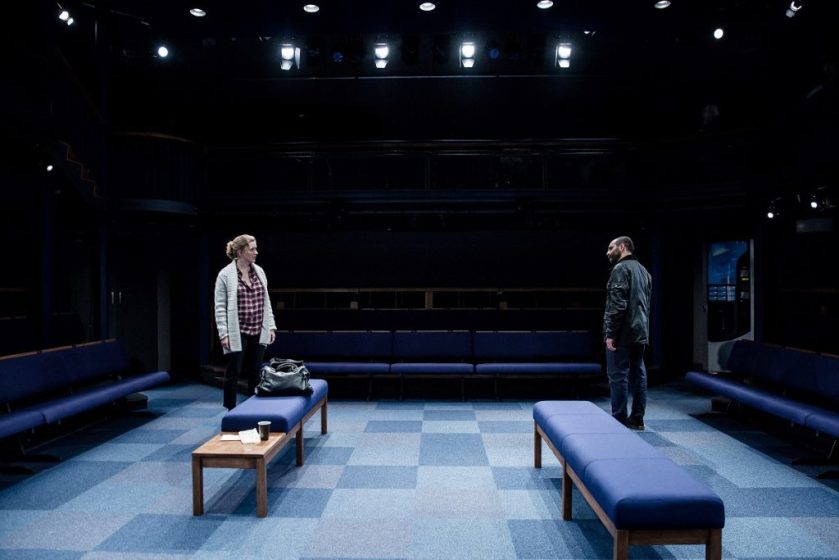
Mind you this doesn’t make this a play that will have been easy to write, create or act in, and, in some ways, it isn’t easy to watch. Its subject, the loss of a child and the impact it has on a couple, is about as painful a subject as it is possible to imagine, for a “domestic” drama. Yet Ms Vekemans, takes us through all the ramifications of this dreadful event, with such a sure and sensitive hand that every line seems to ring true. A divorced couple meet in an unremarkable chapel building in a cemetery in France. (Blue carpet tiles, the designer’s catch-all for the banal, which Simon Daw wisely embraces here, along with those other staples, water-cooler and vending machine). We never get to know there names as, even after a separation of 9 years, they have no need to employ them. They were torn apart by the death of their son, Jakob, in a road accident, which eventually led to the journalist husband walking out on the millennial New Year’s Eve. They are here ostensibly to discuss what will happy to his body given that the land it lies in is contaminated. No one else turns up though (for reasons that become clear halfway through). They talk. There is pain, humour, tenderness, recrimination, jealousy, goading, misconception. In fact there is everything you might imagine a couple in this situation would put themselves through.

Paul Miller seems to have focussed on the “rediscoveries” in the last couple of years at the OT. Here he reminds us he can do contemporary plays standing on his head as well. Not literally. Like I say at the top there is no attempt to get directorially clever with the text here. There is no need. Movement, gesture, pauses, tensions, as well as words, everything worked.

This needed a couple of top drawer performances which, with Claire Price and Zubin Varla (who I have seen a bit of recently), is exactly what we got. Claire Price showed us a woman who could not move forward. Not because she was not trying nor because she was flawed in some dramatic sense. Just because she couldn’t accept what had happened. Which makes sense I think. She could be funny, she could be scathing, she could be analytical but always brittle and nervous underneath. Zubin Varla’s stilted ex husband had tried to moved on, (a new wife, a move to France from Holland), but was struggling with guilt for doing so. I swear I could hear him thinking at times. His intention to write a book about their bereavement is met with anger and incomprehension by her. The pain of their shared past infects this present but will continue into the future unless they can find some way to make it stop. There is some slight hope of redemption to this end at the end, but it is fragile.

Even beyond the bereavement itself though what is really, really striking about the play, in just 80 minutes, is the way it conjures up the whole skein of connections that a parted couple can recreate on meeting up, both comfortable and awkward, in movement, gestures and words. I was watching two real people, intimate strangers if you will, undergoing real experiences in pretty much real time. You’d think that would be easy to dramatise. It isn’t. This really was very, very good. It is one of those plays that gets better as you remember it.

The Lady from the Sea at the Donmar Warehouse review ***

ladyfromthesea600x600

The Lady From The Sea

Donmar Warehouse, 23rd November 2017

I have an uneasy relationship with Henrik Ibsen and this is the first time I have seen The Lady From The Sea, (though I note that plenty of the usual Ibsen obsessions are on show in it). So I may not be best placed to make a reliable judgement. Then again this blog is really only intended for me to process what I have seen so, strictly, if I am both author and reader here, we can both agree that nothing of what follows matters.

Except that the SO was present. And what she thinks does matter. To me at least. And her view echoed mine. We were not completely persuaded that the Caribbean setting of Elinor Cook’s spikey adaption added an extra dimension to proceedings, even if it satisfied the high watery metaphor count, and we felt that Nikki Amuka-Bird’s admittedly full-blooded performance as an unhinged Ellida didn’t entirely articulate with the other characters, especially Finbar Lych’s diffident, decent Wangel. We get that Ibsen doesn’t have to be cold deep fjords, birch trees and not saying what you mean, and that it is beholden on us, the audience, to work with Ibsen and his interpreters to get to the bottom of the drama, but direction and setting just meant this production didn’t suck us in the way the best Ibsen does.

I like it best when I am simultaneously fascinated by, and want to figuratively slap Ibsen’s characters, (not literally obviously, that is worse than eating or arsing about with your phone in terms of theatre etiquette). Ellida is torn between her duty and her desire, to escape for sure, but more importantly to take control of her stultifying life. Bolette is presented with a similar dilemma, duty or desire, albeit without some flash, bad-boy Stranger sailor hanging around. Hilde, as we see when she leads Solness a merry dance in The Master Builder, is free, even if here she is still missing her real Mum. The blokes, in their different ways, have the scales lifted from their eyes, at least Wangel and Arnholm do. Poor Lyngstrand in this production is just a knob, albeit quite funny, as his artistic pretensions are mocked.

That’s the guts of what I see. Ellida, like Hedda, Nora. Helene, Rita and Ibsen’s other women, are not easy to play, but, for me, it is made immeasurably harder if the stifling nature of the society, and, as here, the marriage, they find themselves in, is not foregrounded. We may be a long way from Europe here, in a land built on oppression, but this is never really explored. Reasons for Ellida’s emotional “prisoner’s dilemma” are easy to see, sexual frustration, the loss of a child, an incomplete memory of first “love”, smothered ambition, thwarted intelligence, but solutions should remain knotty and incomplete, even as they appear. At times the production was a little too direct which left some of the intended haunting allusion and symbolism looking pretty awkward.

Kwame Kwei-Armah presents his and Ms Cook’s case with accuracy against the jaunty set of Tom Scutt, but it never really catches fire. Mind you we were both struck with Helena Wilson’s clever Bolette and Ellie Bamber’s pointed Hilde. I reckon both of them could get properly stuck into an appropriate leading role in a new play.

Age of Terror exhibition at the IWM review ***

aot_website_645x426_v3

Age of Terror: Art since 9/11

Imperial War Museum London, 24th November 2017

The IWM has a splendid collection of war art which is always worth seeing and reflecting on when it is exhibited. Here the curating team has assembled 50 or so works from 40 or so artists to reveal how they have responded to war. conflict, terrorism and security since the events of 9/11. So a first for the IWM I think in terms of contemporary work on this scale.

To quote the curators. The exhibition explores four key themes: artists’ direct or immediate responses to the events of 9/11, issues of state surveillance and security, our complex relationship with firearms, bombs and drones and the destruction caused by conflict on landscape, architecture and people. By and large they succeed though the plethora of artists, approaches, media, messages and effect makes it a bit jumbled. It is concise enough though, some very fine contemporary artists are displayed and there are a handful of works that really make you think. Mind you there are also a few that don’t stand up to much scrutiny.

The exhibition begins with a video from Tony Oursler who lived in Manhattan and recorded the day’s events in an immediate and spontaneous way, You may well have seen some of the footage before: that doesn’t make it any less raw or affecting. Hans Peter Feldmann’s 9/12 Front Page, which collated front pages from major newspapers around the world the day after, has a similar effect. And Ivan Navarro’s The Twin Towers which follows is another striking work, a light installation which creates the illusion you are at the top of the towers looking down through them. The next couple of rooms have some interesting works, for example Gerhard Richter’s September from 2005 which depicts the tail-fin of a speeding jet, but here it is a print not the original oil, and one of the rugs created by Afghan craftsman, which also appear later on. But there are some failures as well, Grayson Perry’s pot, Dolls at Dungeness, and the Chapman Brothers Nein! Eleven!, which is pretty facile.

Ai Weiwei’s Surveillance Camera with Plinth, works as do his other marble renditions of everyday objects, and makes its point, but doesn’t really get more interesting on repeated viewing. Jitish Kallat’s Circadian Rhyme, showing the gamut of everyday situations where we are now searched, makes a similar point through the use of model figures. Further on I was most struck by Rachel Howard’s iconic image Study, Mona Hatoum’s Natura morte, delicate, shiny Venetian glass versions of grenades, by Francis Alys’s video, Sometimes Doing Is Undoing and Sometimes Undoing Is Doingcontrasting the maintenance of automatic weapons by both sides in Afghanistan, Head of State by kennardphillips and, especially by Omer Fast’s 30 minute film, 5000 Feet is the Best, with its repetitions, genre swapping and blurring of fact and fiction. The nature of warfare in the age of the drone is also considered by James Bridle Drone Shadow, an outline created on the lower floor of the IWM. 

As I say there are other works, usually video, that didn’t really leave any impression on me I am afraid, and maybe diluted the overall impact of the exhibition. The direct responses to the events of 9/11 and the works which explore the nature of modern warfare were most effective. Worth seeing I think, it’s on until 28th May 2018, and worth taking the time, with the best of the art here, to think about the impact of 9/11 and the way the “war on terror” has changed our world and the nature of conflict.


Natural Selection exhibition at the Former Newington Library review *****

image

Andy Holden and Peter Holden: Natural Selection

Artangel at the Former Newington Library, 24th November 2017

This might just be the best exhibition I have seen this year. The Former Newington Library was new to me I confess, and reeks of institutional instruction, which matched the tone of this “installation” to a tee. Apparently it used to contained the natural history collection of a father and son, Richard and Henry Cumming. Well done to Artangel for sniffing out the space and to video artist/cartoonist/animator Andy Holden, (who i See has his own band, the Grubby Mitts), and his ornithologist Dad, Peter, for creating this marvel.

It all apparently started when Andy, who could have stepped straight out of a 1970s Open University TV programme, saw a blackbird building a nest in Dad’s garden. Cravatted Peter Holden, who could in turn have stepped straight off Blue Peter, (in fact he was did), is an avian guru and, when Andy returned home after art school, their shared passion was rekindled. This then, even before we get to the bird and other stuff, is a poignant study of a father and son relationship. (It even begins with Andy in the pram wrestling with a book on birds).

After a series of joint lectures Andy started to gather material for the first part of the exhibition on bird’s nests. Upstairs there are some marvellous examples of nests contained in a vitrine in an “old style” museum format, another collection of feathers, a smattering of bark, a giant recreation of a bowerbird’s bower and some other bits and pieces. Not all is what is seems: this turned wooden objects are created from sonograms of bird song and some of the nests were created by Andy and mixed in with the real thing. Art and nature start to intertwine.

A quick perusal and then you sit down for the video with father and son taking it in turns to explain and illuminate, whilst a central screen shows footage from their own field trips, as well as various documentaries and the like. They look like old style nature documentaries but as father and son range through types of nests, nest sites and nest materials, some fascinating themes emerge. Peter Holden focusses on the “scientific” explanations of nesting behaviour, Andy gets you thinking about the bird as creator, even “artist”. The “practical” and the “beautiful” are explored.

How do those birds who build these elaborate structures “know” what to do? Do they have a picture in their “minds” of what they want the nest to look like? Why does the bowerbird go to so much effort in creating his bower, and the extraordinary display of themed objects he gathers? How does this relate to the Holdens’ own collections? Can it really just be a process of “sexual selection”? How do partners, families and communities collaborate (various bird species of course but also here father and son)?

Downstairs we first encounter a rook character in a cartoon strip that Andy created which has his father Peter as a “Mr Holden” charged with keeping the rook in line. The father/son relationship mined further. 

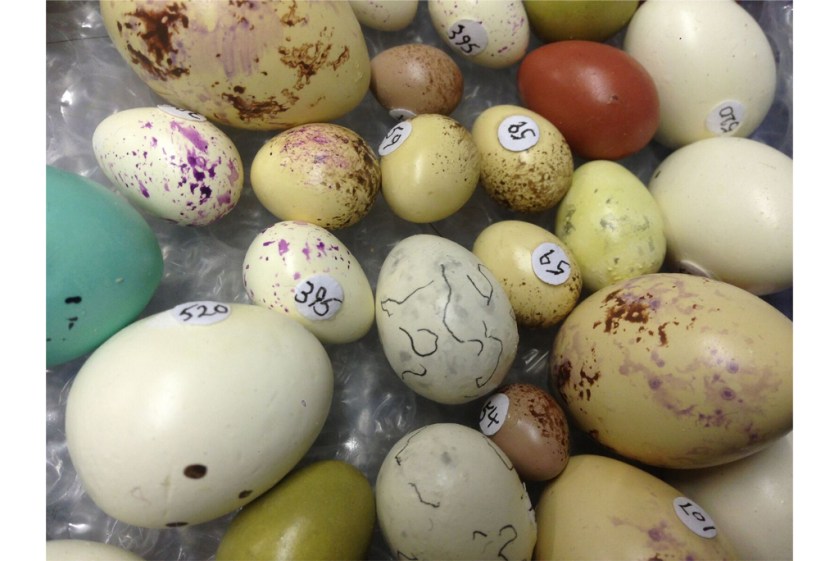
We also have another “collection”, How the Artist was Lead to a Study of Nature, which recreates the hoard of 7,130 eggs police discovered at a “collector’s house in 2006. These eggs are laid out on the floor in cardboard and plastic boxes, as they were on discovery, which also emphasises their fragility and increases the level of temptation for us the audience as these are undeniably beautiful objects. As a kid I was fascinated by birds, and the opportunities the world of ornithology gave to a boy who craved the pleasure of classification. Observing, ordering, listing, collecting. This never extended to eggs, that was already forbidden, but I could see the attraction. This, fortunately, never developed into a full blown, twitching habit, I have seen the impact this can have first hand, but I understand the obsession.

Next door is a video installation, The Opposite of Time, narrated this time by Andy Holden alone, in the form of an animated crow who first appeared in Peter’s RSPB magazine contributions. The crow passes through real habitats, notably when charting the battle between egg “collectors’ and the RSPB and volunteers over the first ospreys to return to Scotland in the 1960s. However the crow, who ages, also flies across multiple paintings, representing the best of the British landscape artistic tradition (Constable, Turner, Nash, Ravilious, Hockney). There is a further screen showing photos and some film which documents the history of egg collecting in the UK, from aristocratic pursuit by “gentlemen of science”, through to the 1954 Act which criminalised it and finally on to the “working-class” undercover activity of more recent decades.

This becomes an insightful analysis of the psychology of collecting, and how the public and scientific consensus on the morality of the “hobby” has changed through time. What makes the desire to possess so powerful that “collectors’ are prepared to destroy the very thing they purport to love? How can we enjoy such aesthetically exquisite objects, knowing their history? What gives humans the right to collect from nature? Why were toffs feted for their “scientific advances”, whilst the dispossessed collectors of today are banged up?

There are multiple parallels through the exhibition with “human” artists. The materials used by sculptors (Andy Goldsworthy), the landscape artists (Richard Long’s mud), the forms we encounter (Barbara Hepworth eggs), the collections and classifications of conceptualists (Susan Hiller), the ready mades and found objects tradition (from Duchamp on), the Pollock like lines on many of the eggs, the watercolour like pastels. Play your own game with this.

So there you have it. A natural history programme. An introduction to aesthetics. A history of landscape art. A lecture on class. Science and art. Father and son. Nature and nurture. Passion and obsession. Nerdiness. Eccentricity. Nostalgia. Some very pretty things. All in a couple of ramshackle rooms in SE17. The exhibition was extended but I think is now over. I do hope it gets another outing. I really, really need to see it again. 


Monochrome: Painting in Black and White exhibition at the National Gallery review ****

telemmglpict000143874513_trans_nvbqzqnjv4bqbxmmpledrwark03csdncgt09r0lytmfjbj_zur1l3m0

Monochrome: Painting in Black and White

National Gallery, 22nd November 2017

For as long as there has been Western art there has been black and white painting. Used in preparation for works in colour, to heighten the impact of light on a subject, to “imitate” other art forms such as sculpture and photography, or simply for its own aesthetic power, it seems like many of the big names in the canon have given monochrome painting, or something close to it, a whirl.

That’s pretty much all I learnt from this exhibition. No matter. There are more than enough wonderful paintings on display to paper over the fact that the thin premise is stretched beyond breaking point. And I don’t care about the “omissions” that the criterati always start bouncing up and down about whenever these thematic overviews are constructed. Of course I would be bloody ecstatic if Guernica was included, or a bunch of Goya’s “black paintings” had filled a room here, (mind you they have way more colour in them than you might think), but I think I get why they are not there. I also get why there are no drawings, the clue is in the exhibition title. Though they have smuggled in van Eyck’s sketch of St Barbara – fair dos though its van Eyck. Oh, and a piece of stained glass. And a manuscript. Hmm this pedantry thing is contagious.  Let’s just work with what we have instead of having a pop at the curators for stuff that plainly they had no chance of borrowing.

So what stood out for me. Well the Hans Memling altarpiece, the Donne Triptych from 1478, is a stunner. Shown partially closed so that we can see through to the intense colours of the Virgin and Child with Saints and Donors, with the saints Christopher and Anthony painted in grisaille on the outside panels looking like stone statues. Memling’s figures always look a bit “softer” to me than say van Eyck from a few decades prior, and the compositions more straightforward. I was also taken with the charming Nativity from another Netherlandish master, Petrus Christus (from around 1450) which was ostensibly included to show off the way grisaille was originally used in the margins of devotional paintings, here to create a frame from an architectural arch with some Old Testament action portrayed

in the same room I was also drawn to a couple of drapery studies from two of the finest Renaissance draughtsmen, Ghirlandaio (this from about 1472) and Albrecht Durer, a spooky women seen from behind from 1521. I know these are just bits of cloth but I can get very excited about cloth in Renaissance pictures and the monochrome heightens the contrast between light and shade.

In the next room most people seemed drawn to Ingres’s Odalisque in Grisaille, a monochrome version of his colour painting of the same nude lady subject. Her skin does have a strange waxy quality here but I am always a little uncomfortable in the presence of nudes (pictorially I mean, in real life I would be mortified). There are plenty of other stunners on show in this room led by the Jan van Eyck St Barbara from 1437, executed in silverpoint and touched up with ink and some oil in the background. Apparently the first deliberate monochrome work in Western art, it is not clear if this was what he intended, but it is amazing to see the detail of its creation close up.

Opposite this is a Maternity from the end of the C19 by Eugene Carriere, a Symbolist, which is striking for its ghostly representation of a serene, but somehow pained, mother and daughter, which echoes a classic Madonna and child. Next door to this is Picasso’s Infanta Margarita Maria from 1957, the little weeble princess from Las Meninas, here rendered in partially cubist fashion. Apparently he rendered all the characters from Velazquez’s meta masterpiece in all manner of ways, but this shows why PP is the man when it comes to monochrome and captures the essence of the brattish Infanta. I don’t know if she was a brat but she always looks pretty Veruca Salt, high maintenance to me.

As if that wasn’t enough there is also one of those scratchy, black and white oils from Giacometti, here of wife Annette from 1957, where he seems to obsessively paw at the paint to capture the spirit of the sitter. Colour never really played a part in Giacometti’s work so no surprise he is here.

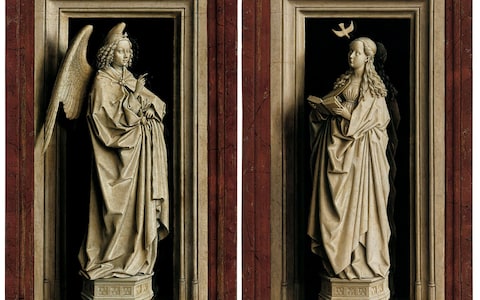
The next room has a whole bunch of paintings intended to mimic sculpture including a Titian and a Tiepolo for those inclined to that sort of thing (I am not). The Mantegna is worth a good peek, with all its different stone colours, and dramatic movement, but it is quite busy. No surprise then that I was drawn to the Jan van Eyck Annunciation diptych from 1433-35. These amazing grisaille figures, unlike the Memling, were inside the diptych panels and were meant to emulate the small devotional panels made in prior periods from ivory. You could touch them. I mean don’t touch them. That will get you into a lot of trouble but they are perfect. The bottom of the plinths sit on the wooden frames, the niches recede into inky blackness, the drapes are incredible, the fingers so elegant yet the lady grasps her bible quite firmly, they both seem to have the best curling tongs ever made for hair, the shadow cast by the angels wings is properly fuzzy and the gravity defying stone dove makes me snigger every time. I say every time. I mean the one time I stood in front of this for an inordinately long time in the Thyssen-Bornemisza where it is housed along with some other Northern Renaissance gems. The Prado done the road has more than its fair share of Netherlandish wonders, best of all van der Weyden’s Descent from the Cross, worth getting on a plane to Madrid all by itself, but the T-B, gets close if you like this sort of thing. And the T-B is great if you want a whizz through Western art, with its half an Ark approach (one of everything).

Next door to this van Eyck is the equally extraordinary Head of A Woman (1520) from that egotist Durer again. It is a drawing, but what a drawing. Hair parted in the middle, eyes closed but not in devotion, head tilted back, round face, sort of chin dimple, light on the forehead, this is a very particular pose and a very particular model. Shiny, like metal. No sign at all of his preparation. He real was a clever fellow.

In the next room the curators have, unsurprisingly, snuck in a Rembrandt from the NG vaults, Ecce Homo, which is the height of drama. The oil from 1770 by Etienne Moulinneuf takes a famous painting by Chardin, La Pourvoiese, which was turned into a best selling print, and then creates the illusion of broken glass on top. It has to be seen to be believed, is a fine addition to the long line of deconstructed art works and the curators are pleased as punch with the inclusion, but the joke wears off pretty quickly. Nothing else to detain me in that room, you may feel differently, that is your prerogative, so on to the next room, where the influence of the camera is writ large.

I got on very well with Norwegian Peder Balke’s landscapes and seascapes. They are the height of romanticism and a teeny weeny bit melodramatic but they stir the soul, no doubt about that. Who doesn’t like wind and waves, and his tiny little Tempest from 1862, looks like it was painted “plein air”, in fact with plenty of air. I imagine the salt in the old fella’s beard and the wind knocking over his easel.

The Image as Burden (1993) from Marlene Dumas, who is new to me, is very striking as is Vija Celmins Night Sky no 3 (1991) inspired by Jasper Johns. Yet the eye is drawn in this room to Chuck Close’s gigantic portrait of American sculptor Joel Shapiro. Close was no mean photographer and his early oils used cropped portraits as the source for hyper realist, monochrome likenesses that show every wrinkle and blemish on the skin and every detail of the sitter’s features. This one however dates from 1993. By now Close was paralysed and had to attach the brush to his arm. He therefore uses a myriad of ovals within squares in different tones to build up the portrait. From afar it is like a pixellated but still very graphic and exact likeness. Close up it dissolves into near abstraction

We are then treated to the master of the “photo as painting” in Gerhard Richter. with his Helga Matura with her Fiance, which amazingly was painted in 1966. Here Richter takes his trademark photo, this time from Quick magazine, as the source. Ms Matura was a prostitute who was brutally murdered, and was the subject of salacious press attention. Richter’s blurring technique and the grey palette, “the ideal colour for indifference”, is intended to create an emotional distance from the subjects and the event. It works. I still curse the fact that  missed the Richter retrospective at the Tate Modern in 2011.

On to the final, (well not quite final), room. Monochromatism, in its purest black and white form, has an obvious attraction for artists drawn to abstraction so there was much to choose from here. Pride of place, predictably, goes to a Malevich Black Square (1929) which, i didn’t know until now, was originally hung high up in a corner to echo Russian icon paintings. Swivelling round you take in a Black and White Bar I from Elsworth Kelly rendered in entirely flat paint, an Op Art classic Horizontal Vibration (1961) from, guess who, Bridget Riley, one of those ropey “closed door” grey tortoiseshell numbers from Jasper Johns, one of Josef Albers’ Homage to the Square, 1965, a slightly dull Frank Stella, Tomlinson School Park I, 1959, one of Cy Twombly squiggly diptych from 1970, which, annoyingly, I was somewhat taken with, and a beautiful sheet of painted grey glass from our friend Gerhard Richter called Grey Mirror (1992, where does he think these titles up from).

Like I say this room is about as minimally abstracted as it gets. Mind you the final room has nothing in it. Except you bathed in yellow sodium light, so that you gradually turn grey as all the colour drains away. This is the court jester Olafur Eliasson playing tricks with you in his Room for One Colour from 1997. He was the chap he put that great big misty sun in the Tate and I saw another installation based on rippling water in Belgium somewhere that blew me away. The man is a marvel, (well the man, his studio and all his collaborators), who twists the basic elements, air, water, light, temperature, fire (well maybe not fire, yet), and then messes about with them using a hefty dose of technology to upset with the perception buttons in our heads. Sometimes daft, usually playful, and always, from the sound of them, beautiful, his large scale installations probably take ages to create and cost a bomb, but create delight. We need more delight.

So a thoroughly enjoyable exhibition even if its purpose is a bit tenuous. Perhaps best of all was the fact that the exhibition was not crowded so you can breathe and, most importantly, look. Some of the NG “Old Master” blockbusters in the bowels of the Sainsbury wing are so preposterously stuffed with punters at all times of the day and evening that, frankly, there is little point going. Not so here. You get to see a who’s who of Western art giants, with their technique exposed.

The Suppliant Women at the Young Vic review ****

suppliant-women

The Suppliant Women

Young Vic, 21st November 2017

Before I get started let us just remind ourselves what a marvellous place the Young Vic is. I don’t just mean the quality and quantity of its productions, though heaven knows under the artistic stewardship of David Lan, this has risen to great heights. Not everything works but it is never for lack of trying. Kwame Kwei-Armah has big shoes to fill, though by all accounts he is well capable of doing so, even if the SO and I weren’t entirely persuaded by his latest directorial outing, The Lady From The Sea at the Donmar.

No it is the “feel” of the place that is the thing and the joy of the experience. It is always busy, it seems to thrive on inclusivity and diversity, though what would I know as a middle-aged, white, straight, rich, liberal, hand-wringing bloke, and everyone involved with the theatre is always so polite, welcoming and jolly. I am a right pain in the arse with my seating demands, but the front of house never fails to calmly sort things out, as they did for this performance. So thank you very much Young Vic.

Now I had been looking forward to this production of the from the Actors Touring Company based on the reviews from the run at the Lyceum in Edinburgh. (I see the Lyceum has a new version of Ionesco’s Rhinoceros and David Greig’s adaptation of Strindberg’s Creditors coming up next year – lucky folk). Your man Aeschylus wrote this 2500 years ago, (it was first performed in 463 BCE), but the issues it examines are just as relevant today. How should we treat refugees, the suppliants of the title? What rights do people have to return to their ancestral homelands? Where do we belong? How should refugees be treated in their new home and how should they in turn behave? Why do we have such a deep fear of the other? How can women be forced into marriage? How do women escape sexual violence? How powerful can women’s voices be when they come together?

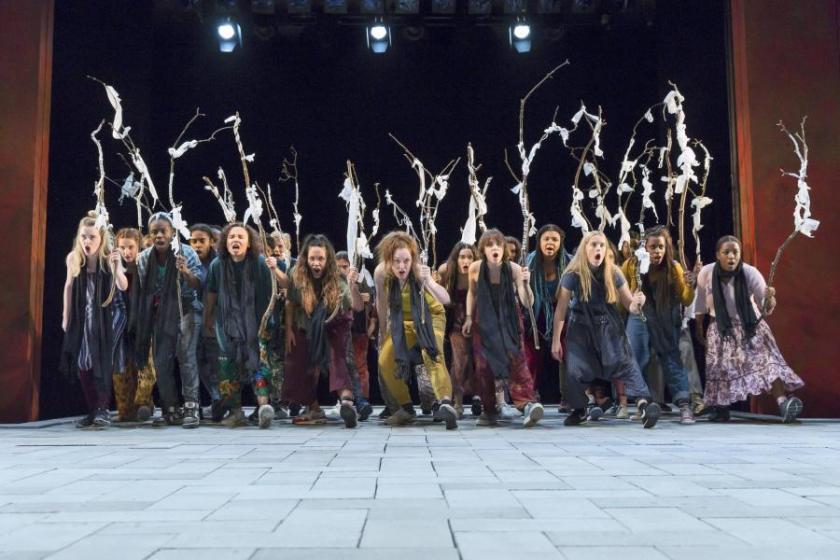
It is all in there. David Greig, as in all modern adaptions, has to take a direct line translation, here by Ian Ruffell, and make it clear to today’s audience. The wonder is that it apparently remains pretty true to the original. I got the text. It is a beautiful read. The rhythms jump off the page. The chorus here is, unusually for a Greek play, the protagonist and has a lot to say, literally and metaphorically. Director Ramin Gray, together with composer John Browne and choreographer Sasha Milavic Davies, takes this structure and conjure up an astonishing feat, and feast, of movement and verse. Percussionist Ben Burton and Callum Armstrong, who has conjured up a real, live double Aulos (the contemporary Greek pipe), are outstanding.

Really. If you want to see the best “musical” in London then come here. Except that it is now over (oops sorry) and it isn’t the best musical in London, not whilst Follies is still on. Oh and I haven’t seen any other current musicals which I guess makes me a somewhat unreliable witness. BTW I note that if you are a) available and b) a party of one, or two at most, and c) enterprising there are normally returns on most days if you still haven’t seen Follies

The whole spectacle of this Supplicant Women is made even more remarkable by the fierce performances of the non-professional chorus of young women playing the supplicants drawn from the boroughs of Southwark and Lambeth. It is not just their verse, their singing and their dance and movement which impresses, but their complete commitment to the story which impresses. All after just a couple of months of rehearsal. Staggering. At the end you could see the pride in the performance of these women felt by the local lads ,who had a smaller involvement as the chorus of Egyptians come back to claim their would be brides, and the more mature amateurs who made up the Athenian citizens who tentatively welcome the supplicants.

Oscar Batterham as King Pelasgos, who agonises before persuading his people to accept the Women and Omar Ebrahim, who switches from Danaos, the “father” of the Women to the brutal Egyptian Herald, in the blink of an eye, as well as acting as our MC, are both excellent. However Gemma May, as the Chorus leader, stood out for me, not just for the clarity with which she delivered the lines specifically carved out for her, but the way she, well er, led the Chorus.

Fidelity to the Greek original includes a libation from an academic, whose name to my shame I have forgotten, which explained, as was the custom, who funded the performances, and a dedication to Bacchus, which involved a mediocre (I hope) bottle of red being poured on to the suitably practical breeze block flooring of Lizzie’s Clachan’s elegant set.

We have Aeschylus to thank for the concept of tragedy, and for the introduction of more than one character alongside the chorus. Only seven of his plays remain including the three that make up the extraordinary Oresteia, which should be seen by everyone at least once. The other two plays which make up the Danaids trilogy alongside The Suppliants are lost. In the Persians he actually had the temerity to warn his fellow citizens about gloating too much over their victories. In fact he fought against the Persians and his military exploits brought him more fame than his playwriting, despite the fact he ruled supreme in the Dionysia through the 470s and 460s BCE. One final lesson we can learn from Aeschylus: don’t stand directly under an eagle in case it drops a tortoise on your head. Unlikely I grant you but this apparently is how he met his end.

So there you have it. All the big questions, one way and another, were covered off by Aeschylus and his mates, Sophocles and Euripides, whilst the best we Brits could manage at the time were a lot of beakers, pointlessly shifting huge lumps of stone to catch the sun one day a year and pining for a decent hairdresser. To be fair, in all these Greek dramas, you do have to get your head around the intervention of the gods. Specifically in the Suppliant Women the somewhat erratic Zeus. For he it was who caused the women to end up being born in Egypt after he got the hots for a cow lady, Io, from whom the Suppliants were descended. And it is to Zeus they turn to help them when they cross the Med. If it was me I might be a little wary of appealing to the very bloke who indirectly got me into this predicament. Mind you that’s the problem with these top gods, especially the monotheistic ones. Simultaneously good cop, bad cop, vengeful then loving, all to keep us on our toes.

I am guessing that this version of the Suppliant Women will engage further communities after having visited Bern in Switzerland. Edinburgh, Dublin, Belfast, Newcastle, Manchester< Hong Kong, as well as London.  If so please seek it out. It is about as perfect a testament to the power of theatre, then (Ancient Greece) as now., and a paean to the collective power of women. It is also the first time the word “democracy” ever appeared in writing, albeit in the form of an arch pun from the Chorus. Precious stuff.

The Firm at the Hampstead Theatre review *****

the2bfirm2breview2bhampstead2btheatre2bflyer

The Firm

Hampstead Theatre Downstairs, 22nd November 2017

N.B. The Firm is returning to the Hampstead Theatre Downstairs for another run between the 3rd May and 8th June 2019. The Tourist goes to a lot of theatre in London and, trust him, there is no better value than a preview ticket at HTD. Just £5. And here you are taking no risk as it is an excellent play. Even during the main run, at just £14, it is a steal. You’d be a mug to miss this. 

How does the Tourist choose whether to see a play?

Writer first, since he/she is the wellspring from which all else flows. In the end all there is is text, actors and audience. And observers and observed have nothing to share without the text. Poor text, poor play. Nothing anyone else can do about that.

Venue second. A function of convenience and familiarity, but also, not unreasonably, if you have enjoyed one production at a theatre, you may well enjoy another. This will probably reflect the vision of the artistic team and the rather grubbier fact of the demographic the executive team wants to prise cash from. On the downside, there are venues where comfort is so compromised that price does not represent value and must be avoided.

Then there is the subject. Not always easy to divine for new plays from the blurbs, teasers and trailers but something needs to pique my interest. As it happens most new drama has its finger firmly on the pulse or contrives relevance from places or times far removed from my cosy little world.

Director next. Same principle as the writer, if you have enjoyed their way of doing things once you may well do again, though this is not guaranteed.

Reviews of course, but the Tourist’s addiction and simple economics, (why paid 70 quid in the West End when I can get a top seat for half the price or less at the original production at the Royal Court or Almeida), means that reviews only help for transferred in productions.

Cast, relevant but not a deal breaker, though expectations rise when favourite names are announced.

Ideally a number of these factors come together. Sometimes though the Tourist takes a punt. As he did with The Firm. Downstairs at the Hampstead normally serves me well, but this is by no means guaranteed. I was interested in the subject, a gang reunited, but concerned it might lurch into cliche. I knew nothing about the work of playwright Roy Williams, director Denis Lawson or designer Alex Marker. I had not seen any of the cast on stage as far as I could remember (based on their bios), with the exception of Clarence Smith. I would like to pretend I had a feeling but I didn’t. And to cap it all I pushed my just-in-time arrival strategy to the limit. So a quick Jimmy, an inward groan at the 1hr 40mins run time and the only seat left tucked in a far corner (mind you the HT Downstairs benches are comfy).

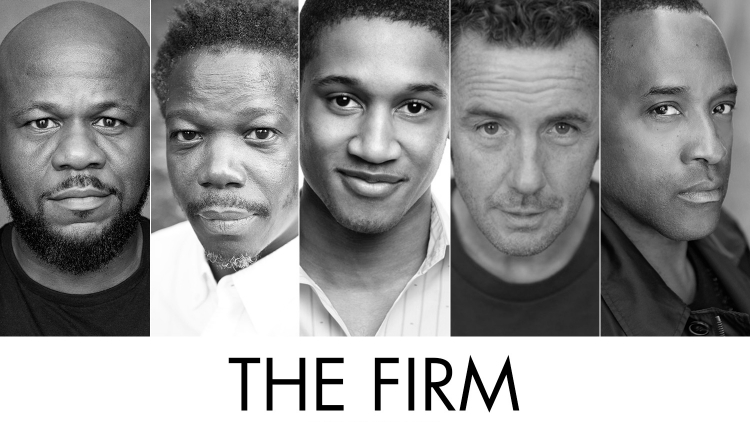
As it turns out this is an excellent play and probably the biggest surprise of the year for me. Alex Marker’s set transformed the reconfigured Downstairs space into a “sophisticated” urban bar, complete with pristine Wurlitzer juke box and array of aspirational spirits brands. We first encounter the nattily dressed Gus (Clinton Blake) who owns the bar, (and, as we discover, quite a tidy portfolio of assets elsewhere), bantering with Leslie (Jay Simpson), the archetypal (and white) Sarf Londoner who has recently left prison. Gus and Leslie are waiting for Shaun to arrive. A party in his honour is planned followed by a night out on the town and then a trip to the Palace, (Selhurst Park not down the Mall, for regrettably they are Eagles), the next day. Shaun never comes. The rest of the “The Firm” do pitch up though, first stout Trent (Delroy Atkinson) followed by a nervous and limping Selwyn (Clarence Smith). But Selwyn brings a young stranger with him, Fraser (Simon Coombs) who, for various reasons, unsettles the gang. He comes with a proposal.

I’ll stop there. This all sounds way more mysterious than it actually is. This is an absolutely riveting insight into the nature of manhood, the camaraderie of criminality, the value of loyalties, the meaning of success and the trials of friendship. These forty/fifty somethings were happiest in the past, right the way back to when they first embarked on their “life of crime”, by The Wall near their school. The pace at which Roy Williams releases the many revelations that show who the characters are, and what they have become, is perfect. We learn enough, but not too much, to keep the dramatic intensity on the boil. We see the damage the past has done and we witness the final break-up of the gang. We see the love and the jealousy the mates have. There is a Pinteresque threat of violence and malice as you might expect throughout, most notably from Gus, who was the leader of the gang, and who is the only one to have avoided a stretch inside. He probes and manipulates the others, until they begin, in their various ways to fight back.

It is also very funny. The dialogue is utterly believable, the banter is spot on. The interplay between the cast is superb. Clinton Blake’s Gus is preening bully, but it is clear from the off that he is troubled. Jay Simpson excels as Leslie, the mediator and the joker, who is trying to start again. (If anyone is ever looking for a Joe Strummer in a play about the Clash here’s you man). Delroy Atkinson as Trent, at first submissive, gradually asserts himself and, in a very powerful scene, shows himself as the only one of the gang capable of pacifying the psychologically damaged, and desperate, Selwyn of Clarence Smith. Simon Coombs as “younger” Fraser is insolent and cocky, but, in a neat inversion, shows some maturity that escapes the others. His final scene with a defeated Gus is gripping.

The play offers no moral perspective on gang membership. It does make abundantly clear though that for men of current, this and proceeding generations, in the absence of other opportunities, this way of life, and the crime that comes with it, is the clearest path to securing the validation and respect of others. It also shows how fragile this respect can turn out to me and how poor men are in admitting, articulating and coping with their frailties and failings.

I may be guilty of reading too much into the play but that is what I saw. I highly recommend it. Roy Williams actually references Goodfellas and West Side Story in the dialogue to remind us of other masterful portrayals of this subject. Don’t get me wrong: this isn’t Goodfellas, but in its own way it is similarly involving. I understand that Mr Williams has mined issues of race, sport, poverty, random violence and teen parenthood in previous works, as well as the father/son relationship in Soul, his last play about the death of Marvyn Gaye. I really hope I get an opportunity to see some of them. He really, really has the measure of his stories and characters.

Stockhausen’s Stimmung at the Barbican ****

3672

Singcircle

Barbican Hall, 20th November 2017

  • Jacqueline Barron – soprano
  • Zoe Freedman – soprano
  • Heather Cairncross – mezzo-soprano
  • Guy Elliott – tenor
  • Angus Smith – tenor
  • Gregory Rose – bass/director
  • Robert Henke – laser artist
  • Kathinka Pasveer – sound projection
  • Stephen Montague – assistant sound projection
  • Reinhard Klose – sound engineer

Karlheinz Stockhausen

  • Stimmung
  • Cosmic Pulses

Right you had to be there OK. Stockhausen is the great big looming presence that hangs over the whole of modern classical music. A whole new way of thinking about music. A whole new sound world. Music as mathematics. Rigorously intellectual. A control freak whose vision extended well beyond this earth into our wider universe. A mystic. A teacher. An inspiration. Certainly bonkers.

That’s the myth anyway. I have never been brave enough to take the plunge on a recording or concert previously, figuring it was going to be well beyond me, and probably painful. Yet there comes a time in every man’s life, (well probably not yours I suspect), when he has to step up to the plate and take on the musical challenge. I would be willing to bet though that I was not the only one in the packed Barbican Hall who was new to this and approaching it with some trepidation. Seriously they can’t all have been Stockhausen devotees.

I was totally unprepared then for what followed. For this is actually a pleasant piece of music which, for me, turned out to be comparable with listening to the best of Renaissance vocal music. It takes a bit of getting used to the “pure harmonics” sound and the way that the six voices are used, and the text, with all its sexist, priapic boasting, and barking out of various gods’ names, is nonsense. But the sounds and patterns of the voices are fascinating and, at times, just beautiful. Like a motet, honestly.

Mr Stockhausen takes the high pitches that shadow every natural note, or fundamental as he termed it, and asks his singers, by shifting the position of tongue and lips, to draw out these high pitches and expose the “harmonics”. Starting with a low B flat he then takes five ascending notes and creates a new vocabulary of harmonics. From this he conjured up Stimmung. There are 51 different parts or “models”, with each male voice leading 9 of the parts and each female 8. The “lead” for each part waits for the rest of the ensemble to merge their previous material into their “lead”, to achieve “identity” in terms of tempo, rhythm and dynamic, and then, with a flick of the hand, passes on the “lead” to whoever comes next. This means the performance can vary depending on how long the “identities” take to emerge and in what order the “models” are taken. In 29 sections the “magic” god words ring out and there are some other recognisable words popping up elsewhere (“barber shop” being the funniest). All clear. Well the surprising thing is that the structure is clear, crystal clear.

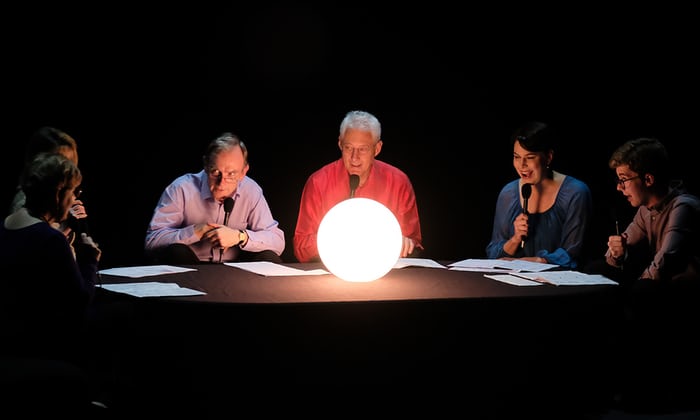
I know it sounds daft. But it isn’t. It is captivating. Not much to look at mind you. Six people sat round an IKEA bubble lamp with microphones, (mind you it does look a bit retro 70s cool), gurning and sometimes waving. But it sounds divine. Literally.

Singcircle were founded in 1976 by Gregory Rose, who is still there. They have performed Stimmung over 50 times. It is clearly a tricky thing to pull off. This was the last ever performance so certainly poignant. Kathinka Pasveer, the sound projectionist, was one of Stockhausen’s leading acolytes and interpreters so no-one better to mix the whole. I think I heard a couple of electronic grunts along the way but who cares. You closed your eyes and just let the transcendent sounds swirl over, around and through you. Jeez I am travelling back in time to my long-hair days in the mid 70s.

Stimmung though was enough for me. I passed on the second piece, Cosmic Pulses, which came after the interval. No point pushing my luck I reckoned. I had checked it out ahead of the gig and could see that this was likely to be a step too far. One of Stockhausen’s last purely electronic works, from 2007, it is a knotty mathematical puzzle built on 24 structured loops, in a pitch range of seven octaves, played through 8 speakers. It looks intimidating on paper, there is an extract of the “score” in the programme to prove the point. In reality it is terrifying. Even with a fancy laser show I could tell this wasn’t going to do it for me.

So just Stimmung then. One revelation was more than enough on the night. This gets performed by other vocal groups, who presumably know what they are doing. When it does do not hesitate if you have any interest at all in music, of whatever form. I am off to search out a decent recording.


Basquiat exhibition at the Barbican review **

3442

Basquiat: Boom For Real

Barbican Art Gallery

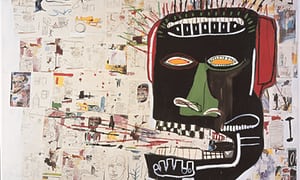
I just don’t get it. Why are punters and critics raving about this broad retrospective of the artistic myth that was/is Jean-Michel Basquiat? I completely understand how significant an artistic/cultural phenomenon he was before his early death in 1988 (aged 27, same age as Masaccio, and various rock’n’roll heroes), and he definitely comes across as an interesting bloke, living in interesting times, mixing with interesting people in an interesting city. But “one of the most significant painters of the 20th century” as the intro to the exhibition claims. Come on. Picasso, Juan Gris, Malevich, Chagall, David Bomberg, Stanley Spencer, Emil Nolde, Egon Schiele, George Grosz, Oscar Kokoschka, Max Beckmann, Otto Dix, Gwen John, Lucien Freud Agnes Martin, Graham Sutherland, Francis Bacon, Bridget Riley, Robert Rauschenberg, Jasper Johns, Rothko, Clyfford Still, Josef Albers, Barnett Newman, Frank Stella, Anselm Kiefer, Richard Hamilton, Alex Katz, Peter Doig, Richard Serra, Gerhard Richter. That’s just some of the painters I think are better, Even Hockney, for all his faults, is a way better artist in my book than Basquiat. 

Maybe his reputation simply reflects the price of his art. If a Japanese collector wants to pay $110m for one of Basquiat’s works who am I to argue. The same fella paid $57m for another one last year. I guess he must like them. Mind you some numpty just paid $450m for a Leonardo that probably isn’t. I hope whoever it is hands out the readies to charities on a regular basis and pays his or her, or maybe its, taxes.

For me this does point up a whole bunch of necessary, (and probably unpleasant), fictions on which our world is hooked. The fiction of money. The buyer presses a key to conjure up some electronic corn, the seller parks it somewhere in a different server, They both believe it is real. The notion of value. The value of a piece of art is a function of who paid for it in the first place, and for what purpose, whether it survived, so how scarce it is, and how it is now viewed by experts (whose opinions change, a lot). We, the viewing public, also now get a look in, if we like what we see. Let us call this the aesthetic value. This may not be synonymous with its use value. Its exchange value, given its unique character, is likely to be its price, and this can be anything that a buyer wants it to be. A unique object, a tiny coterie of buyers, a rigged market. Clearly price is no indication of value. We also have the fiction of legal ownership sitting behind this Leonardo transaction. The seller’s fortune was built on potash. Once a state asset, now his. Right time, right place, right attitude. And finally we have the prosiac fiction that Salvator Mundi may not actually have been painted by the hand of the great Renaissance polymath. Does it matter? No idea.

Anyway Boom for Real kicks off with some early works from the New York/New Wave exhibition in 1981. There are some naive townscapes which stand out and some of the trademark self portrait skulls. We then see J-MB’s gnomic graffiti work as SAMO© and tour through late 1970’s and 1980s New York, meeting some of his chums and collaborators along the way. Music (he was in a band), video, performance, clubs, postcards, photos, flyers, poetry, helmets, other stuff. Not much visible in the way of drugs, best keep that under wraps (no pun intended), though his habit exudes out of the later works. There is no doubt that J-MB got about a bit and that the New York scene of this period was pretty exciting. No wave, new wave, Mudd Club, Club 57. Most of the music that came out of this era is shite, trust me, but it did give us the mighty Talking Heads, and, latterly, Swans, and the first stirrings of hip hop. Of course this was all middle class, white art students feeding off the prior generations of New York cool, but, given the quality of the legacy, this was heady stuff. (We Brits had to make do with proper working class, DIY, Punk and its antecedents – I for one was happy with that deal).

J-MB stood out because of his beauty, his personality, his relentless self-promotion, his nihilism, his “self taught”, status and obviously his colour. No wonder he was embraced and feted by the artistic establishment, (there is a canvas by Keith Haring, J-MB’s most obvious “influence”), including a room devoted to the relationship with the granddaddy of them all, Andy Warhol. As well as some double portraits, the curators are proud to show off a lease for the flat AW rented to J-MB. There is a lot of stuff like this upstairs, whisper it, maybe a bit too much.

Downstairs we finally get to see more substantial work and this, I am afraid, is where I have a beef. Lists of stuff J-MB read, references to canonic Renaissance artists and Jazz greats, anatomical life sketches, self portraits, poetry of a sort, black heroes, cars, planes, repeated signs and symbols. I can appreciate the fidgety energy and the restless enquiry which blares out from these works and their semiotic value. I can see that J-MB had a lot to say about the situation of a black man in a white world. I can definitely see why people were attracted to him. What I can’t see is any interesting drawing or painting marks. There is a lot to read here, and the man undoubtedly had a lot to say, but nothing much to really see. The hyperbolic nonsense from the curators which follows you round the exhibition didn’t help.

I know I am in a minority here and, given that this is the first major exhibition of his work to appear in the UK, (and there is next to nothing in collections), I can see why the punters are rolling in. I just don’t think he was a particularly interesting painter. Person yes, painter no. There was more for me in the few pieces of work from David Hammons in the recent Tate Modern Soul of a Nation exhibition than there is across all of this exhibition. (Soul of a Nation exhibition at Tate Modern ****). And he, Hammons, is a fella who can properly take the conceptual piss. Witness USD 200K some-one paid for his work On Loan.