Satyagraha at English National Opera review ***

01/00/1998. File pictures of Mahatma Gandhi

Satyagraha

English National Opera, 27th February 2018

Finally I have got to see all three of Philip Glass’s seminal operas, Einstein on the Beach (the science-y one), Akhnaten (the religious one) and now this Satyagraha (the political one). Einstein on the Beach was a recreation of the original Robert Wilson production at the Barbican a few years ago. Gruelling in places, daft as well, and it looked pretty lo-fi. Akhnaten, also at the ENO with substantially the same creative  team, looked and sounded sublime, but overall I was middle-whelmed. And so it was with Satyagraha. Improbable’s staging certainly tops the already lofty heights they achieved in Akhnaten, and there was probably more to the story unfolding in Sanskrit, but the pleasure, and marginal pain, derived by this observer was not dissimilar.

Since I can’t really imagine more committed advocates than this creative team for these two operas I think I have to conclude that, if pushed, I prefer my Glass in other formats. Like the string quartets or the works for keyboards. That’s a terrible admission isn’t it. Anyway probably as well I know now as Mr Glass has written a fair few operas, 29 and counting, including the chamber works. Mind you he has been pretty busy across all genres. He’s already snuck in another string quartet this year for example I see. Anyway the profligacy of PG is both joy and curse for the committed fan of minimalism, or, as he terms it, repetitive music.

There is no doubt that there is a unique pleasure in succumbing to its hypnotic effect. Hearing the structures slowly change as the notes are added or subtracted. Melodies, motifs and harmonies appearing, disappearing and reappearing. Wave upon wave of sound, altering, circling, revisiting, but never really getting anywhere. Timeless. Meditative. All transcendent when it’s just you and the music. But with opera the whole point is to witness the music interact with the drama. And this is where the disconnect emerges. If you succumb solely to the music then the visual spectacle risks taking too much of a back seat. There is way too much stagecraft trickery to admire here though to permit drifting off into an hypnotic trance. Who would have thought so much could be done with papier-mache and sellotape? Yet the structure and pace of PG’s score, the episodic structure of the “action”, largely based on key events in the struggle for emancipation by Indians in South Africa, led by Gandhi, and the Sanskrit text, all make for very static human tableaux. And a lot of slow motion shuffling.

A spell is cast but there are times when it might be nice to be snapped out of the soporific contemplation into some high drama. Having influences on Gandhi past, present and future, in the form of Tolstoy, then Rabindranath Tagore, and finally Martin Luther King, lurking at the back of the set isn’t quite enough, and the wow moments as Improbable make newspaper come to life, create gods and monsters before our eyes or bring crowd scenes to life, don’t always articulate with the, you guessed it, non-linear story (based on my reading of the synopsis).

Still admire the parts. The marvellous chorus and orchestra led by Glass expert Karen Kamensek, (as in Akhnaten), moulded PG’s musical shapes effortlessly. I didn’t know that I had seem Improbable’s work before in a very different context, namely Lost Without Words at the National Theatre, improv theatre from a cast of older actors, which worked a bit better than I might have expected. AD’s Phelim McDermott and Lee Simpson, and here associate Julian Crouch, don’t lack for imagination or, based on Satyagraha, brilliance of execution. The go-to team for video design, 59 Productions, also leave their mark. Toby Spence gives us the Gandhi of myth, standing stock still for long periods, then bursting into his sumptuous tenor, but no sign of the man himself. The rest of the cast have even less opportunity to shape characterisation beyond the puppets they share the stage with. They all sounded great to me though, especially soprano Charlotte Beament, as Gandhi’s assistant.

The central message of Satyagraha, a Sanskrit word which Gandhi defined as “holding on to truth”, and which underpinned his theory and praxis of nonviolence, does sort of emerge from the production, but a bit of reading around, before and after, helps. The denial of self, the power of the collective, the effectiveness of planned and self-critical resistance. Think of this as a project. Put a bit of effort in and you might just learn something.

Or just do what I suspect the majority of the packed house at the ENO were doing, (this has been revived thrice, it is so “popular”). Gaze and listen in wonder and don’t get antsy about the fact it is all over the shop. At the end of the day the ENO has its hit and this, with its predecessor, is pulling in all sorts of punters who might, rightly in my view, give a wide berth to Verdi and Puccini.

Mind you I reckon this new generation of Glass converts might draw the line at the 5 hours of hippyish clap-trap that is Einstein on the Beach.




The Shape of Water film review *****

1024px-Logo_The_Shape_of_Water_blau.svg

The Shape of Water, 26th February 2018

I have to confess I wasn’t that interested in seeing The Shape of Water, (I am pleased with my little conceptual joke here). The trailers suggested this was likely in a similar vein to Guillermo Del Toro’s previous gothic horror/romance/fantasy films: lovely to look at but tedious to watch. Yet the reviews were persuasive, Sally Hawkins is a tip-top favourite of mine and I was getting into the swing of seeing all the Oscar nominated films in the manner of a sad armchair critic.

So off I went. Dear reader, I was bewitched. This is not, on the face of it, a complicated fable, but it has a lot to say. Sally Hawkins plays Eliza Esposito, an orphan who has not spoken since being found on a riverbank with scars on her throat. She works as a cleaner at Occam, an aerospace military research facility in Cold War America. Our symbolic “monster”, a merman/amphibian of sorts, direct from the Amazon, arrives. So far, so Del Toro. Class A psycho nutjob, Strickland, played with splenetic relish by the versatile Michael Shannon, is tasked with looking after the creature, which he does, cruelly. Restless scientist Hofstetler, (an austere Michael Stuhlbarg), objects, but, as a Russian spy, he has ulterior motives. Eliza, through that tried and trusted combination of eggs and music, falls in love with the creature and hatches a plan to release him, roping in kindly, gay, commercial artist neighbour Giles (Richard Jenkins) and voluble colleague Zelda (another engaging performance from Octavia Hill). You can guess the rest.

Good triumphs over evil, naturally and there is thrill, if not suspense, in the break-out. This is a timeless story. Beauty and the Beast, set against a world of US-Soviet paranoia. You can feel the references to other classic films, even if, like me, you don’t know what they are. There is an echo of the silent movie greats as well as a nod to the monster movies of the 1950s and 1960s. Indeed Eliza and Giles actually live above a cinema the Orpheum (courtesy of Toronto, as so many of the exterior shots are). It is chock-full of repeated motifs and symbols. Mr Del Toro has a hand in the writing, but has wisely co-opted Vanessa Taylor, who wrote some of the early episodes of Game of Thrones. It shows. There is a hard-edged realism which punctures the fantasy and lends structure to the story.

Unsurprisingly the film looks exquisite with blues and greens predominating and all sorts of arresting images wrung from Mr Del Toro’s box of tricks. Water, water, everywhere. Costumes from Luis Sequeira, Paul Austerberry’s designs, Alexandre Desplat’s inventive score and, especially, Dan Lausten’s cinematography, all coalesce to bring the story to life. Frankly though none of this can work if the two, effectively wordless, performances of the two leads don’t convince. Getting zipped in to a merman/amphibian suit for hours on end and trying to convey emotion through face and body movement alone is a job few can master. Just as well Mr Del Toro has his long time “monster” collaborator, Doug Jones, on hand.

Now it doesn’t take a genius to work out that Sally Hawkins is a gifted actress. I saw her first in 2000 in a pair of Shakespeare productions at the Open Air Theatre. was struck by her performances in the TV adaptions of Tipping the Velvet, Fingersmith and Persuasion, by her collaborations with Mike Leigh and, most impressively, by her performance alongside Rafe Spall in Nick Payne’s Constellations. The two of them turned that into a much better play than it really was, and it was pretty good to start with. Here, as Eliza, she is transcendent. I don’t care how grizzled and cynical you are, this is a love story you should buy into.

So there you have it. I am fortunate to have had the time to see all the Oscar nominated best films, bar Call Me By Your Name. I enjoyed all of them, but only this, Phantom Thread and Three Billboards … really seemed to me to harness the power of cinema. Films where you know the direction of travel or where the camera is just pointed at the action can be satisfying but what I crave is uncertainty and surprise. And insight into the human condition. I see the other films I really liked last year would fail to make the grade because they are either a) “foreign”, b) tiny, in budget, not scope, c) actually from the prior year or d) maybe a bit too full on. I would have shoved Mother!, Detroit and The Florida Project into the list if I where in charge. Mind you, all pointless since Three Billboards … is, unarguably, the best of the chosen bunch but, to my immense surprise, The Shape of Water, runs it close.

I should have realised. Never underestimate a fat bloke born in 1964 (or 1963) with a terrible beard and ill-kempt hair who spends too much time locked in his imagination.

Picnic at Hanging Rock at the Barbican Theatre review ***

HangingRock0005

Picnic at Hanging Rock

Barbican Theatre, 24th February 2018

Picnic at Hanging Rock is an Australian cultural icon. Joan Lindsay’s novel, published in 1967 and Peter Weir’s 1975 film, (and all manner of subsequent examinations, interpretations and meditations), is a metaphor which gets to the very heart of the making of Australia. It is a fictionalised account, purporting to be true, of the disappearance of three students and a teacher, at Hanging Rock in Victoria, from a girls boarding school on St Valentine’s Day 1900. The “rational”, “European” Australia is contrasted with the timeless, “original”, natural Australia. As one character says, “we named things that had not been named”, but it turns out naming isn’t really enough. It doesn’t get any more meta or deconstructed than this.

So no simple attempt to act out the book/film on stage. Mind you that wouldn’t be that simple anyway. Renowned Aussie theatre companies Malthouse, (Shadow King, their take on Lear, was fascinating here last year), and Black Swan State, with writer Tom Wright, came together to create something far more ambitious. Our all-female cast of five appear on stage against a black backdrop, (thus sidestepping the problem of the cavernous Barbican stage for this small scale production), to narrate the story of Picnic at Hanging Rock, in a fragmentary, almost musical fashion. Their uniforms are contemporary – no flouncy Edwardian white frills here – but in that old, fashioned public school way. They inch forward menacingly on the stage. It is not long before they themselves collapse into the characters from the novel, acting out the key scenes. They are, it seems, consumed by the story they are telling.

The staging remains sparse, so text, lighting, soundscapes, and our imaginations, combine to conjure up the settings and, in particular, the mystical, primeval landscape. By having the cast take on the male “roles” and by concentrating on specific parts of the story and of the text, (which are sur-titled for emphasis in each scene), the mystery of the disappearances is downplayed and the colonisers fear of the natural world, the “anti-Eden”, is foregrounded. The sub-text of awakening sexuality is also lent a complexity that was, I seem to remember, more one-dimensional in the film, addressed in particular by the performances of, I think, Elizabeth Nabben, as increasingly beleaguered head Mrs Appleyard, Amber McMahon as the artless English visitor Michael Fitzhubert, who becomes obsessed with finding the girls, and Harriet Gordon-Anderson as the forthright detective set to uncover the “truth”.

There is still a dream-like feeling to events, but not the hot, sun-drenched, woozy “outback” of the film, (though remember this was, even in 1900, a tourist spot a short(ish) hop from Melbourne), but a darker, more nightmarish, fracturing of reality. This does make for a somewhat ardent production, which left me a little puzzled at times, but I guess that is an occupational hazard when trying to unpick a myth, especially in just 90 minutes. Still there was much to enjoy in this bold approach from Matthew Lutton (director), Zoe Atkinson (designer), Paul Jackson (lighting) and J David Franzke (sound). I couldn’t quite work out from the programme who exactly “played” whom but no matter. Harriet Gordon-Anderson, Arielle Gray, Amber McMahon, Elizabeth Nabben and Nikki Shiels made up a uniformly excellent ensemble.


Phantom Thread film review *****

Phantom_Thread_logo

Phantom Thread, 19th February 2018

I saw Daniel Day-Lewis on stage. In Another Country in the early 1980s. That’s why it’s a good idea to buy programmes and stick them in a box. I remember the play a bit but not really his performance. Not sure I would have guessed he would become the “greatest ever actor” and not sure that epithet is entirely justified anyway. Anyway I was lucky since the only other way to have seen him in the theatre was when he was a student in Bristol or early in his ill-fated Hamlet run.

But he is good even if it is just on film. Very good. Brilliant in fact. Always a commanding screen presence. Whatever he does. Up to him but I reckon he is a bit cheeky retiring. His output isn’t what you’d call prodigious. Still he famously leaves nothing on the table when he performs and I guess he has enough to live on.

So we will have to make do with his cinematic legacy. Good for us he didn’t pursue his cabinet-making ambitions. And probably good for cabinet-makers too. He wouldn’t have made very many but they would be best in class.

His work with director Jim Sheridan counts amongst his best obviously as does his Bill the Butcher in Scorsese’s Gangs of New York. But by far his best performance in my view, and that of many others, was as Daniel Plainview in There Will Be Blood, an all time Top 10 film for the Tourist. (Saw a memorable showing with a live performance of the score at the South Bank a few years ago with Jonny Greenwood twiddling his ondes martenot) TWBB was written and directed by none other than Paul Thomas Anderson who also does the necessary here in Phantom Thread.

Mr Anderson is an extraordinary film-maker as the string of awards for his films show. I have seen all his films at least once, with the exception of his feature debut Hard Eight and the documentary Junun, (about the making of Inherent Vice). They are all, by turns, baffling, annoying, claustrophobic, frustrating, stimulating, thoughtful, intense and intriguing. He doesn’t hurry, is not averse to repeating motifs, words or themes, and he asks you to think about the story he is telling. He pushes himself and us the audience. In his “tragic’ films his lead characters are powerful but flawed, cursed by hamartia. In his “comic” films the humour is complex and stylised. His camera never takes a pedestrian position and music and sound is never backgrounded. In short his is a very epic, theatrical approach to film-making. Which is why I like his films I guess.

So what about Phantom Thread? Daniel Day-Lewis plays bachelor Reynolds Woodcock, (I wonder how many other ostentatious names Paul Thomas Anderson mulled over before alighting on this corker), who is an obsessive frock designer for the great and good in early 1950s London. He is a genius with the needle and thread, his clients love him and his sister Cyril, played by the exceptional Lesley Manville. cocoons him and dumps his muses for him when they have outlived their usefulness. He is suave, charming, precise and fastidious, but egocentric, boorish whilst still slightly camp, and prone to childish tantrums if all is not to his liking. He definitely loved his Mummy: his dresses are all ultimately tributes to her. He meets mysterious waitress Alma (Vicky Krieps) whilst away from London and seduces her. She falls for him, and his life, and moves into the London townhouse which also houses the business. He becomes dependent on her. The film charts their intense relationship and the way it affects him and his work. Reynolds has a fair few issues and a masochistic streak: Alma is his match, literally, equally complex and anything but helpless.

Put like this, as a romance, the story sounds commonplace. In the hands of Mr Anderson and the three leads, though, it is riveting and something altogether more rewarding. It looks, (costume designer Mark Bridges must have been in seventh heaven throughout), and sounds, (Jonny Greenwood should get the Oscar for his eclectic score), magical, but what really draws you in is the depth of these characters. There is a lot wrong, sometimes disturbingly so, with both of the lovers. At first you think Reynolds is just going to eat Alma up for breakfast, (breakfast, and specifically the correct way to butter toast, is a key motif here), then cast her aside. She persists, easing Cyril aside, takes on his mores and eventually finds a striking way to control him. This requires Vicky Krieps to match Mr Day-Lewis. The wonder is she succeeds. A stunning performance. PTA must have been ecstatic when she auditioned.

There is a definite Hitchcockian, or Powell/Pressburger, vibe about the whole affair, and not just in the setting. (I was reminded of the opera version of Marnie at the ENO recently). There are allusions to fairy tales here, the Gothic sort where is all goes pear-shaped for the protagonists. It is often very funny. Yet this still feels, even with PTA’s fractured, exaggerated and unpredictable observation, ripe and real.  A triumph which will need another viewing, and another, for sure.


William Kentridge: Smoke, Ashes, Fable at Sint-Janshospitaal review ****

160817985_1c5959480b_o

William Kentridge: Smoke, Ashes, Fable

Sint-Janshospitaal, Bruges, 20th February 2018

Off to Bruges and Brussels for a couple of days. Main purpose. To soak up the best paintings that the Northern Renaissance has to offer. Now you all know that it doesn’t get much prettier than Bruges, (though Ghent may just top it). Which also means that it should be avoided like the plague during the high season. And it should never be insulted with just a day trip. Do not miss the Chapel of St Basil, the Gothic Hall in the Stadhuis, with its “Medieval” murals telling the story of the City from C19 artist Albrecht de Vriendt, and Frank Brangwyn’s drawings and etchings in the Arenthuis. Ooh and don’t be sniffy about taking a boat trip.

The main reason for going though is the art. Specifically the first two rooms of the Groeningmuseum. Go in February. Get there early and you might just have the rooms to yourself. Room 1 has the extraordinary diptych from Gerard David, The Judgement of Cambyses, a warning to dodgy politicians everywhere, and a Bosch Last Judgement. Room 2 though will take your breath away. Impossible to know which way  to look. Hans Memling, Petrus Christus, more David. Further on Adriaen Isenbrandt, Hugo van der Goes and Jan Provoost. And works of astounding beauty from unidentified masters.

Topping it all is Jan van Eyck’s, Madonna with Canon Joris van der Paele. His greatest ever painting? I think so. Thus making it the greatest work of Western art ever. Swing your head round and you see his portrait of his missus Margareta. This must be the single best concentration of art in the world.

Of course you may hate this stuff what with all that religious mumbo-jumbo, preponderance of shiny things and “realism” that is anything but. You’d be a mug though.

In which case the Memlings in the ground floor of the Sint-Janshospitaal are also not going to do much for you. Shame. There are five astonishing works capped by the St John Altarpiece and Shrine of St Ursula. Take your magnifying glass. And see the fascinating videos which show Memling’s underdrawings and his immense skill as a draughtsman.

Or move on. For help is at hand. In the form of William Kentridge. Now I didn’t go specifically to see this carefully constructed collection of Kentridge’s recent work by curator Margaret Koerner. But it was fortuitous timing nonetheless. South African William Kentridge is one of the most renowned of the, how shall I put this, older generation of contemporary living artists. His work covers drawings, prints and sculpture, but he is probably best known for his animated films and for the installations that contextualise them. He makes charcoal drawings, which he then erases and changes, filming the results to create his glorious Expressionistic animations. His subjects are numerous, though history, language and justice are common themes, specifically in his native South Africa, from his perspective as a white Jew whose parents defended the victims of apartheid.

I saw the production of Berg’s Lulu at the ENO in 2016 which he directed and which bore his distinctive visual stamp. I can’t say I was enthralled by the results but that is largely because Alban Berg’s music, and specifically this opera, are works-in-progress for me. There are a number of great artistic statements that may confound or confuse me at first but which I know I should keep working at.. Lulu is one of them. It looked amazing though thanks to WK and the video crew.

I also saw the exhibition of Kentridge’s work at the Whitechapel Gallery in 2016 entitled Thick Time. Now, as in this exhibition, I can’t pretend I was persuaded by everything that Mr Kentridge creates. Yet even in the drawings and videos whose meanings are elusive to me, and there were a few here, there is something compelling which draws you in.

In Thick Time he created six installations the highlight of which, by far, was The Refusal of Time, a meditation on time and fate in which composer Philip Miller provided a hypnotic score to accompany WK’s videos and a “ready-made’ Leonardo-ish “breathing” machine. In Right Into Her Arms WK creates a sort of mini-theatre with a dance drama centred on the disappointment of desire I think. Seven Fragments for George Melies, Day for Night and Journey to the Moon imagined an artist embarking on a series of adventures and was the most obviously Expressionistic of the works with its allusions to early silent cinema.

Here in Smoke, Ashes, Fable the highlight undoubtedly is More Sweetly Play the Dance from 2015. First off it is set in the amazing upstairs room in the Hospital, a cathedral in wood. The works here have all been chosen to reflect the location, but this is the piece which is most evocative. It is based on a medieval Dance of Death. This is a medieval hospital. Across eight massive white panels WK’s charcoal drawing animations see a not quite monochrome processional emerge, drawn from the silhouette of his collaborators. A brass band plays a repetitive tune against this. It is both sombre and celebratory. This Dance of Death though will be more familiar to you from African funeral processions but the characters here seem very different. You literally cannot take your eyes off it and have to sit mesmerised watching at least one, (in my case three), revolutions of the procession. Most everyone there when I visited was drawn in and grinning from ear to ear. For, although this may portray the fragility of human existence, there is something immensely celebratory about the work. Marvellous.

Next door are a set of large scale tapestries which show the silhouettes of African figures, carrying day-today objects, set in maps from the C19. Lives literally carried on their shoulders, a comment on migration perhaps. Downstairs the exhibition opens with drawings and extracts from the monumental 600m long frieze Triumphs and Laments which WK created alongside the Tiber to tell the history of Rome in 2016. I really, really need to see that before it eventually fades away. The installation which titles the exhibition is a little more introspective but still intriguing.

Now I am not saying you should make a special trip to Bruges to see this exhibition, If only for the very good reason that it is now over. But if his work does find a home near you then you must find a way to see it. If you are anywhere near the Reina Sofia in Madrid right now you have just that opportunity in an exhibition centred on his excursions into opera. And later this year he has something cooking in the Turbine Hall at Tate Modern. There will be other stuff I am sure. Go.


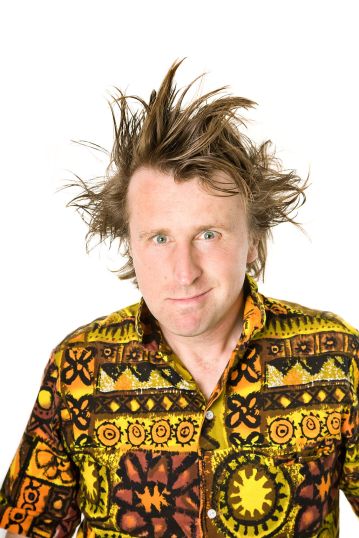
Milton Jones “Is Out There” at Shanklin Theatre review ****

1024px-Lion_Whisperer

Milton Jones: Is Out There

Shanklin Theatre, 16th February 2018

The sunniest place in Britain is Shanklin. Fact. Don’t be deceived by imposters on the South Coast claiming this accolade. It is Shanklin. And, as any fool knows, the Isle of Wight is a paradise on Earth. Beautiful scenery, fascinating history, plenty to do, loads of places to eat, proper British beaches.

Now I admit Shanklin itself is not at the cutting edge of holiday fashion. But if you like crazy golf, amusement arcades, ice-cream, fish and chips, sand between your toes and brutalist lift structures, (to take you down to the front), then this is the place for you. And not too far away is, IMHO, the best eatery in Britain, in the form of the Taverners in Godshill.

Shanklin Theatre, like the town itself, and the IoW, is a bit rough around the edges. That’s why I like it. It’s a proper old style theatre which does a nice line in am-dram, tribute bands and, especially, comedy, and serves the town well.

So, as this is the Tourist’s home away from home, this is where he the SO and LD chose to see the unique wordsmith that is Milton Jones. The regular reader of this blog may be aware that the Tourist’s tolerance for stand-up comedians is low. Milton Jones though is on the approved list along with Lee, Christie, Kitson and Vine. Most of then are just way too lazy in their choice of material. This is not a criticism that can be levelled at Mr Jones. The madcap exterior belies a fierce intelligence. In this latest show he adopts the device of an off-stage publicist putting him up for all suits of unsuitable comedy job opportunities. That is the, admittedly, tenuous thread that holds the show together.

Oh that and Brexit. Now for those that know Milton Jones from previous shows or from his turns on the telly might be surprised that he incorporates the issue de jour. However there is, and has always been, a layer of absurdist satire beneath the wacky wordplay and he puts it to good use here. Which, in the context of the IoW, a firm Leave bastion, created a little bit of enjoyable frisson in the air. This was helped by some adept put-downs from support act Chris Stokes aimed at a bone-headed heckler. Livened his act up immensely and even gave Milton Jones something to work with.

Now the real pleasure in an MJ show, in addition to his brilliant ideas, is hearing the audience react. I get the majority of the jokes, but there are a few that get away, and some that require a little time to sink in. Multiply these reaction times by a few hundred, combined with the pace of MJ’s delivery, and it means that, with a few pauses, the laughter is pretty much continuous. I can’t pretend that many of the lines stick, blame the Tourist’s faltering memory, but no matter, when the pleasure is in just being there.

There are still a couple of months left on the tour. If he is coming anywhere near you just go. You will be hard pressed to find a funnier 90 minutes or so of entertainment anywhere else.

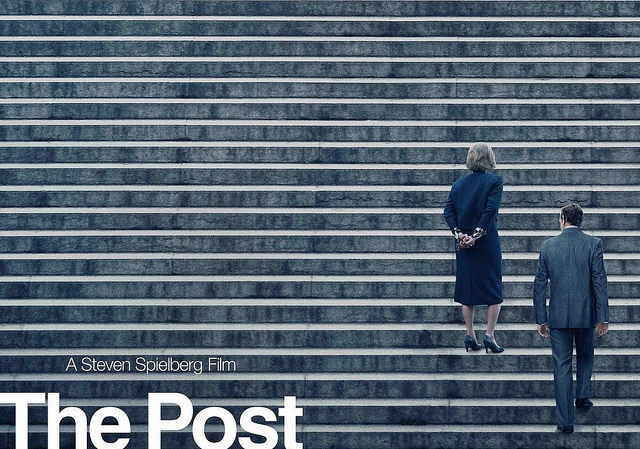
The Post film review ****

24592264017_3d61cdcd9f_z

The Post, 8th February 2018

If it was down to me the Academy Award for Best Picture would go to Three Billboards. No question. I see the bookies just about agree with me though The Shape of Water, which I have just seen, and which, to my surprise, I was bowled over by, is offering stiff competition. Mind you, if it was down to me, Ruben Ostlund’s The Square would be in the main list and the distinction between English Language and “Foreign” would be abandoned. And there might not be any Oscars Night at all since it offends my puritanical, armchair Socialist sensitivities, and because Hollywood churns out so much shite despite so much money.

As an aside I am reminded of an unwittingly hilarious documentary we saw once in the US about Foreign Language Syndrome. All sorts of Middle America types waking up and finding themselves talking gibberish in a dodgy accent rather than true Red American. They all sounded like Russian spies in some woeful Adam Sandler “comedy”. Anyway it transpires that FLS is only documented in the US which, you might have thought, would have raised the suspicions of the various medics on camera. But no. Earnest to a fault they insisted on the verisimilitude of this absurd condition. Only in America folks.

Anyway The Post I see is a rank outsider for an award. Which must irk the producers immensely what with it being a perfectly correct, very serious, liberal indictment on the shocking cover up of the Vietnam War exposed by the Washington Post, and, to be fair, other newspapers in 1971. A vital subject, top drawer direction from Steven Spielberg, Tom Hanks and Meryl Streep effortlessly munching up the lead roles, (first time they have acted together apparently), and a supporting cast to drool over. And make no mistake it is a very, very good film. It is just that it is a teensy weensy bit predictable, even if you don’t know the history, which means any tension slowing drains away through the duration of the picture.

Ms Streep plays the redoubtable Katherine Graham, who reluctantly becomes proprietor of the paper after the unexpected death of hubby. She is daughter of the founder which helped. The regional paper is going public so cue so well crafted scenes of banker types and her Board colleagues treating “the woman” abominably. It also means no boats must be rocked prior to the flotation or the dastardly investors will diss the stock (unlikely; they know what they are buying). Meanwhile ex-military analyst with a conscience, Daniel Ellsberg (Matthew Rhys), gets his hands on incendiary material, the Pentagon Papers, showing how successive administrations lied about the progress of the War. The New York Times is barred from publishing. The Post, led by steely editor Ben Bradlee, (yep Tom Hanks), steps into the breach. No electronic files here. The editorial team steps in and paper literally starts to fly. Lawyers get nervous, Board members eschew idealism, Government gets mean. Ms Graham’s bessie Robert McNamara (Bruce Greenwood) is part of the problem. Hanks makes rousing speeches about journalistic integrity and press freedom and Streep is galvanized, sticks it to the old white boys and says “publish and be damned”. Not literally.

It is a powerful and beautifully made, (filmed in 35mm for vintage effect), and should be seen. It is a class act as you might expect given its creatives. There are a lot of beautifully set up scenes which get under the skin of the newspaper business.  It obviously has A MESSAGE for these troubled times what with “fake” news and an incompetent/unscrupulous political economy, (though trust me human history is littered with “dark times”).

I have to say though I found myself more involved by Spotlight from a couple of years ago in a similar vein. Just that bit grittier. Josh Singer (West Wing) was the writer there as he is here, in tandem with Liz Hannah. So what’s the difference. Well it’s Spielberg. The man literally cannot frame a limp scene or tell a bad story. And that may just be his curse.

My latest London theatre recommendations

Microcosm_of_London_Plate_027_-_Covent_Garden_Theatre

So here is my latest attempt to distil the best of what is on now and what is coming up in the world of London theatre.

There is a huge bunch of new stuff which has been announced relatively recently so some aggressive sifting has taken place, though it may not look like it given the length of the list. I have also stripped out anything which is pretty much sold out. For the booking ahead portion I have focussed on those I think will book out before they open (with a couple of fringe ideas as well). 

Top ideas – all on now

1. The Ferryman at the Gielgud Theatre. It has won every award going and you are probably sick of hearing people wax lyrical about it but if you haven’t seen it you must. It’s that simple.

The Ferryman at the Royal Court Theatre review *****

2. Macbeth at the National Theatre. Rory Kinnear and Anne-Marie Duff, our two finest stage actors of that generation, as the mental Lord and Lady. Will be unmissable. It is literally just about to open. Sold out but always a few tickets for the next couple of days as returns come in but don’t arse about waiting.

3. John at the National Theatre. Over 3 hours at a glacial pace but an absolute spooky gripper. About to end and only a handful of tickets left. Sorry.

John at the National Theatre review *****

4. Julius Caesar at the Bridge. I know. More Bloody Shakespeare. But the cast here is to die for and the reviews uniformly good. It has much to say about the world today. Don’t be too worried about picking up the cheaper tickets here as views are good most everywhere. 

5. The York Realist at the Donmar Warehouse. Very limited tickets for this marvellous tale of a gay relationship in 1960s Yorkshire. 

6. Girl from the North Country at the Noel Coward Theatre. I don’t like Bob Dylan’s music but was drawn in by this tale of America in the Great Depression which incorporates his songs. Don’t be tempted by cheap seats here. Here’s my review – ignore the rant about the youth. Mrs Tourist liked it a lot which is rare.

Girl From the North Country review ****

Top ideas – booking ahead

1. A Very, Very, Very Dark Matter at the Bridge Theatre. I WILL WRITE THIS IN CAPITALS. YOU MUST BOOK THIS. A new play from Martin McDonagh about Hans Christian Anderson (don’t laugh). McDongah’s last play was Hangmen which me and Mrs T think is the best play we have seen in the last 3 years. Mr McDonagh, as you all no doubt know, is about to win Oscars galore for Three Billboards … which you have to see as well. This play feels like it will have something in common with his previous work Pillowman. 

I see Nick Hytner has persuaded his long time collaborator Alan Bennett to switch from the NT to the Bridge for his new play Allelujah. Obviously you have to like AB to take the plunge here.

2. The Lehman Trilogy at the National Theatre. Written by Stefano Messini, this has gone down well across Europe. I understand that 4 hours charting the history of a rubbish investment bank, (and not even covering its demise), may not be for everyone but a must see in my book. Sam Mendes (The Ferryman) directs, Simon Russell Beale, Ben Miles and Adam Godley play the brothers. Public booking for the new NT season opens 16th March. 

3. An Octoroon at the National Theatre. Transfer from the Orange Tree in Richmond. Amazing play which takes a dodgy C19 racist slave melodrama and reworks it into a meditation on blackness. Meta stuff. Not for everyone but the adventurous should give it a go. Read the reviews and see what you think. 

An Octoroon at the Orange Tree Theatre review ****

I would also point you to the revival of Brian Friel’s Translations at the NT, a subtle and rewarding play set in C19 Ireland exploring language and cultural imperialism.

4. Quiz at the Noel Coward Theatre. A transfer from Chichester Theatre so check out the reviews. From the pen of James Graham (Ink, Labour of Love, This House) who is incapable of writing an unfunny line. Based on the infamous coughing Major saga on Who Wants To Be A Millionaire a few years ago but examines the nature of truth and media manipulation. 

5. Machinal at the Almeida Theatre. Right this is a full on, Expressionist, feminist power drama classic from the pen of Sophie Treadwell written in 1928 and based on a real life murder case. No cast announced yet but it’s the Almeida so they will wheel in a big name. It won’t have too many laughs.

Ella Hickson’s new play The Writer is also in the new Almeida season. Ms Hickson’s last effort Oil was near genius. This has Romola Garai in the lead but not much else to go on.

6. The Lieutenant of Inishmore at the Noel Coward Theatre. One of Martin McDonagh’s earlier Irish plays. Aidan Turner, (the sexy fella out of Poldark), plays a terrorist booted out of the IRA for being too violent who loves his cat. Black comedy just like all of McDonagh’s work. Tickets are steep mind.

7. Instructions for Correct Assembly at the Royal Court Theatre. It’s always a bit hit or miss at the Royal Court but writer Thomas Eccleshare’s previous play, Heather, was brilliant. This sounds like it is about genetic manipulation and creating your own child, (this being a current preoccupation on the London stage). The problem with leaving RC productions until they open is they normally sell out so I would give this a whirl though everything in the new season looks interesting to me.

(Notably Pity from the pen of Rory Mullarkey though he misfired a bit with St George and the Dragon at the National Theatre last year). 

8. The Cane at the Royal Court Theatre. Its been many years since the infamous Mar Ravenhill, (best known for Shopping and F*cking), has written a play for the RC. A theatrical event. Sounds like it is about a teacher who gets into a pickle. For the purist only maybe. 

9. The Fall at Southwark Playhouse. No MES (RIP) has not been reincarnated, (sorry if this makes no sense but as a reminder the greatest Briton since Churchill recently died). Instead this is a revival of a play by a fine writer called James Fritz who I like. About the relationship between young and old. If you don’t know it the SP is a bit rough and ready but cheap as chips.

10. Great Apes at the Arcola Theatre. Another rough and ready fringe that churns out marvellous work. New play adapted from Will Self’s novel about a bloke who wakes up to find everyone’s has turned into primates. How mad does that sound. I loved the book. 

11. The Lord of the Flies at the Greenwich Theatre. There have been a few adaptations of Lord of the Flies. This is from Lazarus Theatre company who are brilliant. They are also doing a Midsummer Nights Dream later in the year for kids. They don’t hold back and the casts are straight out of drama school. Greenwich Theatre is a poor tired old dame so she needs your help. Please go. 

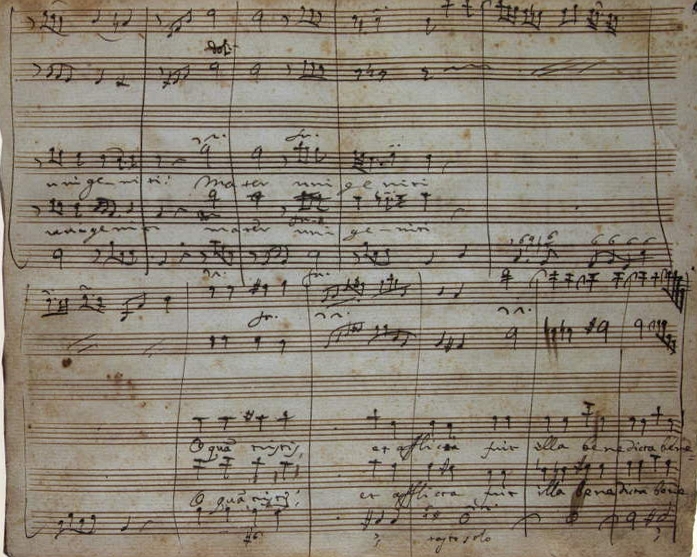
Mortal Voices: Academy of Ancient Music at Milton Court review ****

Pergolesi_Stabat_Mater_Autograph

Academy of Ancient Music, Christian Curnyn (director and harpsichord), Keri Fuge (soprano), Tim Mead (counter-tenor)

Milton Court Concert Hall, 15th February 2018

  • Corelli – Concerto grosso Op 6 No 1 in D major
  • Handel – Cantata HWV 230 “Ah! Che troppo inequali”
  • Handel – Cantata HWV 82 “Il Duello Amoroso”
  • Pergolesi – Stabat Mater

As usual after BUD and I had chewed over the big economic, social, philosophical and political questions of the day, and reminded each other just how clever we are, as well as scoffed on some tasty, if evil, fare at the redoubtable Bad Egg in Moorgate, there was minimal time for a preview of the evening’s entertainment. Which meant that BUD got the shock of his life when Tim Mead opened his mouth in the second of the Handel cantatas in the programme. He wasn’t expecting a counter-tenor. Especially from a man who could easily pass as the next James Bond given his rugged good looks and sartorial elegance.

My what a voice though. Now if you are a fully paid up, Baroque, (especially Baroque opera), and, increasingly, Contemporary classical, music enthusiast, you are going to come across a fair few counter-tenors. I think I have heard voices with more power and range than Mr Mead’s but not as much clarity and brilliance. This was apparent in the “Il Duello Amoroso”, a decidedly dodgy tale of unrequited love between a shepherd and a goddess, where the counter-tenor and soprano voices sparred elegantly. It really came to the fore however in Pergolesi’s wham-bam, smash hit Stabat Mater.

Pergolesi didn’t get up to much musically. Dying at 26 from TB didn’t help, and, if I am honest, the bits of his output I’ve heard, (or have recordings of), beyond the Stabat Mater aren’t that memorable. Churning out lightweight, comic operas, for your ADHD aristocratic patrons is not, unsurprisingly, a recipe for a lasting musical legacy. When he hit upon this medieval Latin setting of the Christian staple of Mary lamenting her son’s suffering on the cross, he struck gold though. Just a shame it was only completed a few days before he popped his clogs. Still thanks to Bach, and others, the score was widely disseminated in the C18 and has never gone out of fashion.

That’s because, musically and lyrically, he doesn’t hang around. The 12 verses make a virtue of brevity. None is more than 5 minutes long and the whole comes in at 40 minutes. There is loads of contrast, audible human touches and plainly programmatic twists where text and music are perfectly matched, and the fusion, for that is what it is, of Baroque and early Classical, means it is easy, and very affecting, on the ear. Others have had a stab at setting the Stabat Mater, Vivald and Haydn, come to mind, but this tops the lot.

Obviously the AAM, especially the strings, nailed the score, and gave plenty of space for the two excellent soloists to capture the drama and pathos of the setting. Whether individual aria or in duet both singers seemed to really care about the music and text. Forget the religious mumbo-jumbo, this is the moving story of a Mum’s grief. Best bit. The Fac ut portem Christi mortem from Tim Mead alone. Very moving.

I was less convinced by the Handel. That’s just me and Handel though. It is always a pleasant experience listening to GFH but it never really involves me.  Even 4 hours of his operas. I hope to get lifted up and swept along but always end up earthbound. Even, whisper it, in a Messiah. He’s a flash Harry make no mistake, and all those voices, here, there and everywhere, is proper WOW, but it all feels a bit devoid of emotion. A man can only have so much bouncing bass and celebratory trumpet action. Anyway I was happy enough to go with the pleasant enough flow in these two cantatas.

The programme kicked off with Corelli’s Op 6 No 1 Concerto Grosso. You cannot go wrong with that. The 12 Concerto Grossi are like a Corelli greatest hits collection. There will always be some stunning concertante work, the two violins and the darker cello, beefed up by the ripieno players, the rest of the band. This concerto has some brutally fast semiquavers stuff for the solo cello and his violin mates and some lovely lyrical, slower dances to kick off the first couple of movements. There is plenty of room to blag which Bojan Cicic, (he really is a top violinist), Rebecca Livermore and Joseph Crouch took full advantage of. The whole band though seems to delight in playing together. That is why, even if I am not absolutely sure of all the musical ingredients, I will try to see all their London concerts.

I recommend you try to do the same, especially if you are new to the Baroque. And I also heartily recommend you dip into recordings of Pergolesi’s Stabat Mater and Corelli’s Concertos if you haven’t already. You won’t regret it.

Gundog at the Royal Court Theatre review ***

geograph-3297652-by-Lewis-Clarke

Gundog

Royal Court Jerwood Theatre Upstairs, 15th February 2018

Always a tricky business knowing what to pick out when booking in advance for productions at the Royal Court. Obviously if it is a big name playwright, or someone with previous form, probably best to get in there sharpish and buy blind. For newer writers it is a trickier proposition. Even I can’t justify/manage pitching up at everything they stage but waiting until productions open, or worse still, reviews trickle in, is a losing strategy given the generally high quality of the offer from the world’s greatest “writers’ theatre”.

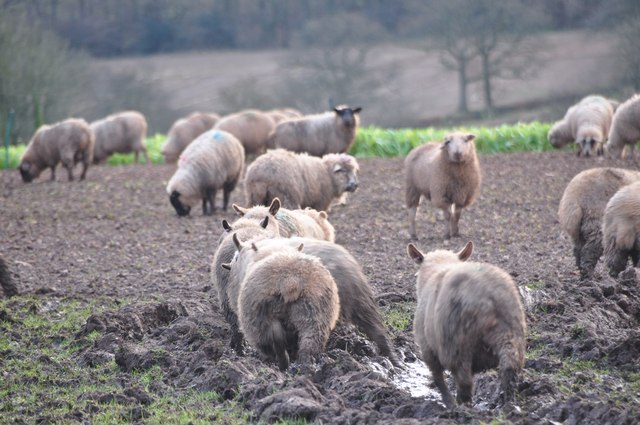
Now I really liked the sound of Simon Longman’s debut major play Gundog. The blurb suggested a meditation on the rigours of rural life, the passing of time and the impact of a stranger. With maybe the prospect of a twist. Which, broadly, is exactly what it was. Without the twist. We were presented with a stage of mud, lots of mud. (I have seen a few of these indoor fields now: Joe Hill-Gibbons’s Midsummer Nights Dream at the Young Vic and Pina Bausch’s Rite of Spring at Sadler Wells – la di dah. In this case I spent maybe a little too long contemplating how long it took, and who got roped into helping, to get the earth up and down the Royal Court stairs/lifts).

Loud bang, A flash of light and we are presented with a dead lamb, (not real so keep calm animal lovers). On stage are garrulous Anna, holding a shotgun, taciturn Becky, and Guy, who is plainly “not from round there”. Turns out Anna and Becky are sisters who run the failing family sheep farm and migrant Guy Tree, (“no-one can pronounce my real name”), has wandered into their world. He stays to help out. For a few years. Mum died way back. Dad, unseen, is mired in deep depression, mourning for his wife. Grandad is losing his marbles, though with flashes of lucid pathos. The less than prodigal son Ben returns after having conspicuously failed to secure his fortune. He’s even had his shoes nicked.

Time passes. In the first and third acts, forwards. In the second act, backwards. Each act ends with the death of an animal, the final and fourth act with a torrential storm. Disease ravages the flock, perhaps caused by Ben’s ineptitude, and the already precarious economics of the farm unravels. The sisters take to rustling. This is a miserable existence make no mistake. Dad takes his own life. Ben has tried and failed to escape, Becky has no choice, consumed, as she is, by the business of running the farm, Anna sees no point in any other life, she has given up on school, and Guy has nowhere else to go. Certainly not the idyllic arcadia we urban softies might dream about.

Lighting courtesy of Lee Curran, sound from Peter Rice, Chloe Lamford’s aforementioned set and Vicky Featherstone’s direction all work to emphasise this static, invariable world. Mr Longman’s dialogue, which is laced with dark humour, and the structure of the play feels very accurate. Perhaps too accurate for without any shift in tone or plot there are times when this became a little wearing. The idea is laudable, the execution powerful. Just a little too, er, still.

Ria Zmitrowicz as Anna once again caught the eye as she did in Alistair McDowall’s wonderful play X at the RC a couple of years ago. I look forward to seeing Rochenda Sandall again based on this understated portrayal of Becky. Alec Secareanu is a talented Romanian actor who, unsurprisingly, convinced as Guy. Alan Williams was as dependable as ever as grandad Mick and I know just how good Alex Austin, who played Ben, can be from his performance in Thebes Land at the Arcola, though in this he pushes a little at the histrionic.

Definitely worth seeing but maybe Simon Longman’s play is just a little bit too enclosed, as it were. The malleability of time and the power of nature are absorbing themes to explore, (look no further than the stage adaption of the mythic Picnic at Hanging Rock brought to the Barbican by Aussies Malthouse and Black Swan State Theatre). The precariousness and grind of rural existence is also a more than legitimate subject for artistic exploration. Mind you this was more satisfactorily captured by Hope Dickson Leach’s recent debut film The Levelling, which also had its own, mysterious plot (The Levelling film review *****). Still Simon Longman is clearly a writer with real credibility so I await his next move with considerable interest.