Nicola Benedetti and the Academy of Ancient Music at the Barbican review ****

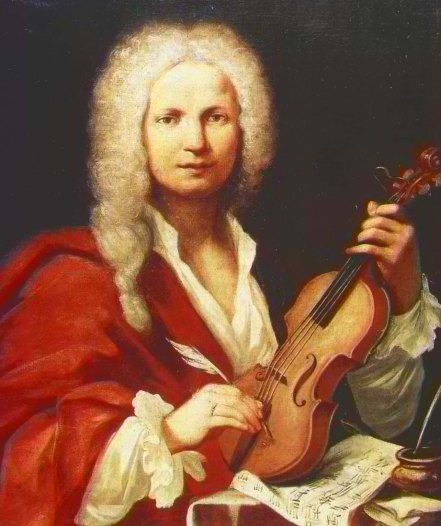
Vivaldi (1)

Academy of Ancient Music, Nicola Benedetti (violin), Richard Egarr (director and harpsichord)

Barbican Hall, 31st May 2018

  • Antonio Vivaldi – Concerto for Violin in D major RV 208 “Il Grosso Mogul”
  • Antonio Vivaldi – Concerto for Harpsichord RV 780
  • Mystery Composer – Sinfonia in D first movement
  • Georg Philipp Telemann – Concerto for Violin in A major TWV 51:A4 “The Frogs”
  • Georg Philipp Telemann – Alster Overture-Suite TWV 55:F11
  • Georg Philipp Telemann – Concerto for Four Violins in C major TWV 40:203
  • Antonio Vivaldi – Concerto in F major RV 569

Time to take BUD to a purely orchestral evening, no voices, albeit in the ostensibly easy on the ear form of the two Baroque masters Vivaldi and Telemann. In the company of KCK who was, rightly, keen to hear the prodigious talent of Nicholas Benedetti. And all of us trusting to the capable hands of Richard Egarr and the Academy of Ancient Music.

Now to accommodate Ms Benedetti some virtuoso music was required. Even by the Red Priest’s breathless standards the D Major Concerto “Il Grosso Mogul” fits that particular bill with its two written out cadenzas in the outer fast movements. I think this showed NB off to best effect with a sharper delineation between soloist and ripieno than some of the subsequent pieces in this well programmed concert, especially in the stunning slow movement. No-one knows where the name grosso mogul comes from but JS Bach was sufficiently impressed to arrange it for organ, BWV 594.

RV 780 is Vivaldi’s only concerto for harpsichord, though only because he noted on the front page of the score that it could be, having originally specified violin and cello. This meant that there was a greater balance across the register than with the double violin peers which AV often wrote and this is what allows for the harpsichord arrangement. Richard Egarr has painstakingly recreated the solo passages, largely with arpeggios and broken chords, which made for fine decoration though I am not sure the Barbican Hall cavern showed this off as well as a smaller more sympathetic space might.

Before the first Telemann piece, the Frogs, Mr Egarr and the AAM had a bit of fun by playing the first movement of a Sinfonia in D by an unnamed composer who we were invited to identify. No answer given but it was plainly Italian so maybe Sammartini (GB) for the simple reason that he churned out a ton of them.

The Frogs is structured in the Italianate three movement fashion, not the Germanic four, and does everything you expect Telemann to do. It is laced with humour, is effortlessly easy on the ears and doesn’t let the soloist hog too much of the limelight. With plenty of riternello and suspension, it made a fine partner to the opening Vivaldi. Not bad for someone, GPT, who never set foot in Italy. The eponymous frog sound on the NB’s first entry is apparently created trough the use of bariolage, the rapid alternation of the same note between fingered and open strings (which Vivaldi was also partial to). There you go. NB was grace personified here, as she was throughout, stepping back into the band when required.

GPT churned out a fair few of his programmatic overture-suites, 600 to be exact, and it is pretty easy to see why the toffs he wrote them for lapped them up. This particular one takes as its inspiration the River Alster which joins the Elbe in Hamburg where GPT was director of its five main churches from 1721 until his death in 1767. (GPT stayed in Paris for a few months during this tenure where he was exposed to the French operatic style – with its dances –  which he incorporated into these suites). In this particular example he serves up an intro followed by eight subsequent movements each of which does exactly what it says on the tin. The “echo” of the third movement, oboes serenely imitating swans in the fifth, the chromatic crows and frogs of the seventh, the lyricism of the strings in the eighth, “Pan at rest” and the joyous winds and horns in the finale as the nymphs and shepherds leave the party. It is “lightweight” I suppose but when it is this much fun who cares.

GPT’s next contribution was one of a set of four concertos each for four violins. And nothing else. No continuo. No other instrumentation. Moreover it is in four movements – slow/fast/slow/fast – like the sonata di chiesa of old. There is plenty going on through its total ten minutes or so and all four violinists get time to shine, Ms Benedetti being joined by three excellent AAM regulars, I wish I could tell you who. Sorry.

The final piece was Vivaldi’s F major RV 569 which has pairs of horns and oboes, and a bassoon, added to the continuo and violins. Here NB took the lead in the outer two fast movements though the horns and wind also have a lot to say. The middle slow movement is the very model of brevity, even by Vivaldi’s economical standards, lasting just 20 bars. I loved it. Mind you I love every note of every concerto that AV ever wrote for violin (and most other instruments). I would it suspect take a lifetime of devotion and an acute and scholarly ear to “know” every one of AV’s five hundred-odd concertos. No matter. With music this immediate it doesn’t matter. Indeed Ms Benedetti encored with a chaconne-like slow movement from a Vivaldi concerto I think but no idea which.

Overworked in his lifetime I reckon, despite his devotion to the education of the orphans in the Ospedale in Venice, underpaid, never given a proper contract, and buried as a pauper in Vienna where he went to get a job when he fell out of fashion. Then ignored for one hundred and fifty years. Always a bit poorly as well. And a ginger, though you wouldn’t know from the stinky wig he is wearing above.

Still no Vivaldi, no Bach. And imagine how much poorer Western art music would have been without Johann Sebastian. GP Telemann, for me, is now quite as satisfying, though BUD and KCK probably disagreed on the night, but he is musical elegance, flair and invention personified. And his music, like Haydn’s later on, will make you happy. As, on every outing, do the AAM. The venue may not be ideal for the intimacy of Baroque even at this scale, but I hope the AAM were able to turn a few quid here because of that. Well deserved.


Echo and the Bunnymen at the Royal Albert Hall review *****

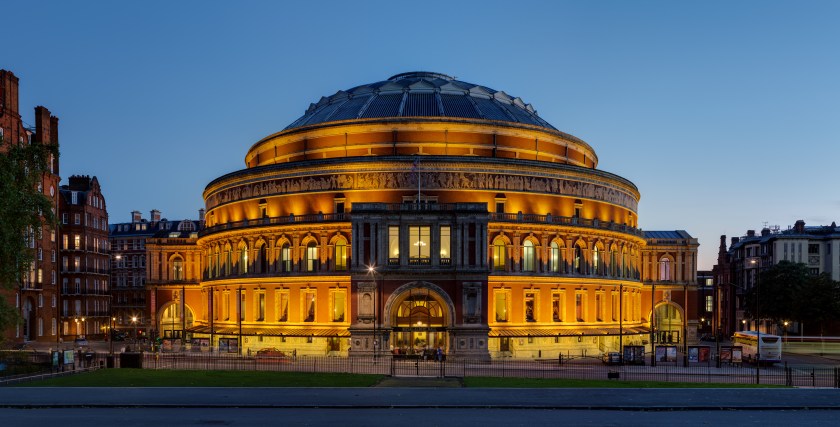
Royal_Albert_Hall,_London_-_Nov_2012

Echo and The Bunnymen: The Stars, the Ocean and the Moon

Royal Albert Hall, 1st June 2018

  • Rescue
  • Villiers Terrace – (Roadhouse Blues)
  • All That Jazz
  • Stormy Weather
  • The Somnabulist
  • Nothing Lasts Forever
  • All My Colours
  • Angels and Devils
  • Bedbugs and Ballyhoo
  • Lips Like Sugar
  • Rust
  • In The Margins
  • Bring On the Dancing Horses
  • Seven Seas
  • How Far?
  • The Cutter
  • The Killing Moon
  • Never Stop
  • Ocean Rain

No real point if reading this if you want an unbiased opinion of EATB’s latest gig at the Royal Albert Hall. In their pomp they were, in the Tourist’s humble opinion, the greatest band of all time. And their pomp was so transcendently gorgeous that they still are. Even when they’re not if you get my meaning. And, the last few times, they haven’t been. Yet the songs still make up for it. Well most of them do.

I am delighted to report though that this time they were, actually, in pretty fine fettle and, to their credit, seemed to have got over the disappointment of the Champions League defeat. Mac’s voice seems to have settled down a bit. The soaring, crooning pyrotechnic baritone of the early days is long gone but so, it seems, is the gravelly booze and fags croak of more recent years. He still picks pointless verbal fights with innocent punters and mumbles incoherently in Scouse but we wouldn’t want it any other way. Will doesn’t get up to much as ever but can still turn on the licks when required. The rhythm section now has a bit of spring in its step; none of the lumpen pedestrian plod of the early noughties. Stephen Brennan on bass is no Les, but he now has his own way with the classics even if he can’t recreate the Pattinson trademark loops, and Nick Kilroe handling the sticks is more comfortable than any of his predecessors, especially in the middle period stuff. No-one has ever drummed like Pete GRHS, and I mean ever, so I will, all my life, remain bereft but best not to dwell on it. Jez Wing on keyboards is a fine musician and the Cairn String Quartet provided string arrangements as sympathetic as any I have ever heard.

The tour is billed as EATB with strings so it was as well that the sound mix here didn’t completely leave the strings high and dry as is so often the case. EATB could play Crocodiles and Heaven up Here back to back as loud as you like and I would, literally die and go to heaven, but any subsequent arrangements, the Ocean Rain material and the few decent songs from the grey album, Evergreen and WAYGTDWYL need a bit more care and attention. The addition of Kelley Stoltz’s guitar made a big difference vs previous incarnations though for this material.

The Albert Hall, with its imposing grandeur, suits the lads, as anyone who remembers the Ocean Rain revival, will know and the light show was spot on. Now then I always have an uneasy relationship with a EATB audience these days. A) it is old(ish) reminding me of me own mortality. B) there are wall-to-wall middle-aged couples, with a smattering of young ‘uns, making us single saddo blokes stand out. The SO has done her fair share of manoeuvres putting up with EATB (and other post punk legends) and no longer feels sorry for me, so she’s a no, and other chums literally couldn’t be less interested. C) There are way too many people only there for the “hits”, Cutter, OR and the post OR singles from the grey album. There are enough “first three album”diehards/”occasionally they’ve still got it” benefit of the doubters, like me but it still makes for a strange experience as the buzz focuses on stuff that, whisper it, isn’t really all that good (Bedbugs and Ballyhoo/Bring on the Dancing Horses being the worst offenders). When I say not that good I actually mean it is brilliant just not anywhere near Bunny sublimity.

So, dropping the sanctimonious “I was there from the start”, “it was all downhill from Porcupine” pose, what were the highlights I hear you ask. Well obviously the three openers, with the Doors tribute, from Crocodiles, the standard intro give or take. In an ideal world I’d open with Going Up and squeeze Do it Clean and Simple Stuff into the list but I get that a couple of near sixty year olds trotting out an album from 40 years ago might not seem cutting edge. BUT Crocodiles was, and still is, since it takes the best of post punk rhythms, with a bit of punkish attitude, lays on top Mac’s most personal lyrics (the low rent Homeric epic poetry was leavened with the everyday), most of Will’s best melodies ever and filters this through a history lesson of their coolest ever predecessors, Velvet Underground, Doors, Television, Bowie, Modern Lovers, and, for Mac at least, Scott Walker. Many have followed Crocodiles, none have bettered.

Still, even then, Heaven Up Here is the perfect Bunny. album Sadly all you get nowadays is the stripped bare version of All My Colours, which, lovely as it is, is no substitute for the thumping Zimbo/ original, or previous arrangements, and means nothing from Side One of the original album, the greatest side one of all time, period as you Yanks say, and no Disease or Turquoise Days. Just one of Show of Strength, Over the Wall or With a Hip would be a start. Broke My Neck as long they cared to play it, a life enhancer, but the sad fact is they can’t play any of them now. So none appears. Boo hoo.

So the Tourist has to sit tight before closing his eyes for Angels and Devils, Rust, of course, and yes since I am not a complete poseur, Cutter, a stunning Never Stop and an exquisite Ocean Rain, the last two as encores. And this Sinatra-esque version of Killing Moon is, just maybe, about the most emotionally intense ever. I would still pay good money to hear any of Clay, Back of Love, Higher Hell or King of Kings, Burn For Me, Everything Kills You, Scissors in the Sand, Shroud of Turin or Market Town, but I don’t get a vote and they have been playing this set moreorless for a decade now. I’d even welcome a bit of the Electrafixion experiment but I am probably alone in that.

As for the new songs, well I will have to wait for the new album to decide. Not possible on one listening with my crappy ears and all those people milling around. The Stars. the Ocean and the Moon seems a worthy title given that these three words alone make up probably half of Mac’s lyrical output and the album will mostly rehash and pimp up the classics above with the strings on show. Still if you are want wordplay, punning, sarcasm, heroic, monumental, natural, grand, doomy etc, etc then Big Lips and Floppy Fringe are still your men. And when you are a slightly odd, though by no means unpopular, late teenager THESE LYRICS MAKE YOU FEEL LIKE YOU ARE SPECIAL. They still do decades later. Though true enlightenment only comes with the original line-up and the panoramic production of the first three, OK four, albums.

Still best gig I’ve been to for a couple of years, excepting Wire, and partly because Dave Gedge hasn’t recently volunteered the Wedding Present back catalogue, and MES (tears welling up) wasn’t on top form for the last couple of Fall outings. On that note a reminder that the only rock ‘n’ roll heroes are a) the ones that deliberately f*ck it all up and thereby never go near a stadium and b) have a Peel Session. EATB fit that bill. Like a glove.


Mood Music at the Old Vic review ***

11357509244_0e8af7a4ff_o

Mood Music

Old Vic Theatre, 30th May 2018

Joe Penhall is definitely on to something with his new play Mood Music. But having found it I am not entirely sure that he then took the time to develop it. Well worth seeing, some fine performances and some thoughtful debate, but, after a terrific set up, a little disappointing and not as satisfying as, say, Blue/Orange.

Ben Chaplin plays louche, supercilious music producer Bernard, a part that could have been written for him, though it wasn’t as Old Vic favourite Rhys Ifans had to step down. Irish actor Seana Kerslake plays gifted young singer/songwriter Cat. From the get-go it is pretty obvious that something has gone horribly wrong between the hit making svengali and the precocious artist. They are each shadowed by psychiatrists, the diffident Ramsay for Bernard, (Pip Carter who played opposite Ben Chaplin in the original cast of Nina Raine’s superb Consent at the NT), and the similarly purposeful Vanessa played by Jemma Redgrave. They are subsequently joined on-stage by their respective entertainment lawyers, animated Seymour (Neil Stuke) and acute Miles (Kurt Egyiawan).

The combination of Bernard’s production experience and Cat’s talent and appeal is expected to produce a sure-fire hit. Initially there is no dialogue directly between the two, just between them and their respective professional advisers. The dialogue is temporally fluid with the thrust stage and design from Hildegard Bechtler, overhung with loads of mics, also shifting between music studio, consultation rooms and lawyers’ offices. When we finally get flashbacks to the beginning of Cat and Bernard’s working relationship we see there were some signs of affections and musical appreciation and mutual learning. As Bernard gets to work on “improving” Cat’s songs the musical boundaries blur and the “ownership” of the creative ideas is confused.

Bernard is plainly an egotistical, sexist bully locked in the past whose musical Midas touch is fading. Cat worships her amateur musician father, is warily truculent and won’t be pushed around. Even so Bernard slowly undermines her and her work claiming it as his own. The direction of travel in terms of the relationship is predictable, though still very illuminating, and made more fascinating by not being too black and white. Bernard, at least in Ben Chaplin’s shoes is not irredeemably evil, though he comes pretty close and is blissfully unaware of the damage he does to Cat, whilst Cat herself, thanks to Ms Kerslake’s acting skill, is not completely sympathetic and certainly not a helpless victim. This is smart writing as you might expect from Mr Penhall.

The relationship between art and life and the wellspring of the creative process is a theatrical staple. Putting this in the more contemporary context of popular music, (rather than writing), makes for a less academic experience than some classic plays which plough this furrow. The economics of composition and performance are also highlighted. Modern music seems to unite the age old artistic divide between creator and performer. This shows us that this is often an illusion. The play has obviously been made more relevant as the scale of male abuse of female artists, notably in contemporary film-making, has been laid bare.

I liked the structure of the play with the interweaving dialogue, “musical’ if you will, and Roger Michell’s direction served this admirably, as he always does (he directed Consent brilliantly). So what’s the Tourist’s beef? Well having set up the arguments we didn’t really move on. Just around and in between them. At a couple of hours or so the play didn’t outstay its welcome but it might have been more effective with some dislocation or shift in perspectives. The pace was quick-fire enough but apart from the scene at the awards ceremony, the uncomfortable height of Bernard’s boorishness, the drama didn’t really branch out. Still Ben Chaplin is magnetic, Sean Kerslake is a genuine real talent (as she plays a real talent) and there are cracking lines and insight.


Lessons in Love and Violence at the Royal Opera House review ****

Royal 20 A.II, f.10

Lessons in Love and Violence

Royal Opera House, 26th May 2018

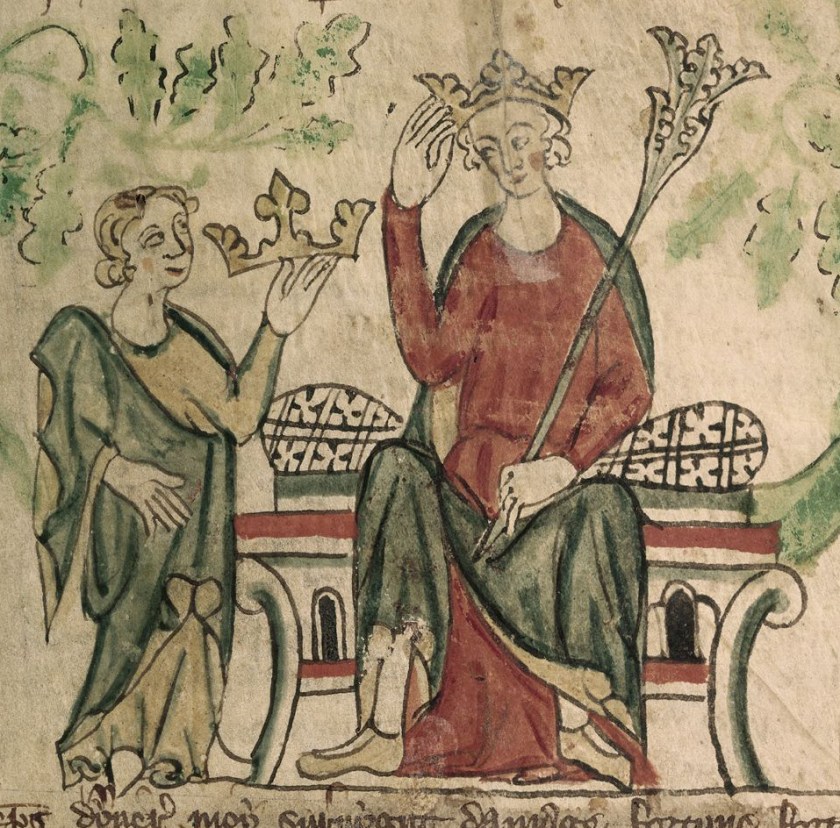
Here is an extract from an illuminated manuscript showing Eddy II getting a crown. Or more precisely a second crown. Not sure what that is all about but given he was by reputation a high maintenance sort of fella maybe two crowns makes sense.

George Benjamin and librettist Martin Crimp had a massive hit, (by contemporary opera standards), with their previous collaboration Written on Skin, which in terms of repeat performances has gone down better than BB’s Peter Grimes. Having finally seen it at the ROH in January last year I can report that it is pretty much as good as it is cracked up to be. GB is a superb dramatic composer for drama and, specifically, for the very particular prose that MC creates. I was not entirely persuaded by the only play of MC’s that I have see, The Treatment (The Treatment at the Almeida Theatre review ***), but I think he is growing on me.

This time round they have taken seven “events” in the life of the infamous Edward II, wisely leaving out his messy end, to tell the story of his relationships with lover Gaveston, wife Isabel and rival Mortimer. The two royal kids are thrown into the somewhat unusual household and we also see associated flunkeys and down trodden hoi polloi who were suffering under Eddy’s spendthrift ways. We begin with the banishment of Mortimer, then Isabel joining the plot to murder Gaveston after seeing the desitution of the people, Gaveston predicting the King’s future and then being seized, the King disowning Isabel after Gaveston’s death, Mortimer and Isabel setting up a rival court and grooming young Eddy (to be the III), the King’s abdication at Mortimer’s behest and finally the young Edward III seizing control from his Mummy.

As you might surmise the focus of MC’s story here is more on the “domestic” struggle between the “couples” and less on the conflict between King and nobles. The relationship between Mortimer and Isabel and Isabel and Edward II is given as much weight as that between Gaveston and the King. This, together with the truncated plot, makes it very different from its most obvious precursor, Marlowe’s Edward II, or, more precisely, The Troublesome Reign and Lamentable Death of Edward the Second, King of England, with the Tragical Fall of Proud Mortimer. Now I happen to believe Marlowe’s play is one of the finest ever written, comparable with Shakespeare’s History Plays. But it does go on a bit. If MC and GB had attempted to set the whole story as an opera I would still be sitting there two weeks later. So Kent, Warwick, the Spensers and all the other nobles. Canterbury and the bishops, Hainault, the Welsh, the sadists and various other hangers-on are absent. As are France, fighting, Kenilworth, scythes and pokers. The key themes in Marlowe’s play, his two fingers to his own contemporary society, namely homo-eroticism, religion and social status are downplayed, Isabella’s role and the passion between the four main protagonists are foregrounded.

Extracting these key episodes and, in some cases, manipulating them to allow GB to weave his marvellous score around them, was a classy move by MC. His libretto, as in pretty much all he writes, swings from the prosaically direct to the cryptically poetic. I mean this as a compliment but his writing is not florid but quite angular with intriguing turns of phrase and clear delineations between characters. I gather that once they have agreed the shape of the work, MC goes off and writes the whole thing, with minimal consultation, before handing it over to GB, who then slowly and patiently builds up the music from the “bottom up”. At least that is what is sounded like from the interview in the programme. But given how distinctive, dark and clever MC’s approach is I can see why it works. GB knows the “voice’ he will write around and, as in their prior collaborations, he knows his musical style, which has itself been through iteration, will fit the libretto.

The music is superb. The orchestration is immensely colourful but GB only uses large scale forces occasionally. Most of the time small clusters of instruments are used to create different moods in each of the seven scenes, notably from bass clarinet, bassoons and brass. The percussion section gets to play with all sorts of new toys. A cimbalom gets an frequent airing. There are probably motifs, patterns and structures within this but you will need to find that out from someone who knows what they are talking about. All I know is that music and drama were perfectly matched across the compact 90 minutes. I think the emotional extremes were more pronounced that in Written on Skin which had a more mythic feel. GB ratcheted up key points in the action by plunging us into dramatic silences. In Scene 3 when Edward and Gaveston private tryst is interrupted by Isabel, the kids and the courtiers and in Scene 2 when the people impinge on the Court a rich musical chaos is invoked. Harmony and counterpoint are wound up into a ball before collapsing.

The production, courtesy of the genius director Katie Mitchell, regular design collaborator Vicki Mortimer, lighting from James Farncombe and movement from Joseph Alford, reflected the enclosed and intimate nature of the drama. Each scene was set in a royal bedroom, which revolved to offer a different perspective. This included the “private” entertainment in Scene 3 with Eddy II and Gaveston and the mirroring “public” entertainment in Scene 7. The “people” were given an audience before Isabel in the bedroom in Scene 2 to air their grievances. Mortimer’s household and the King’s imprisonment at Berkeley are also presented in the confined, intimate setting of the bedroom. A massive fish-tank, which drains of water and therefore life through the scenes, is both visual treat and prominent symbol. There is a Francis Bacon style painting on the wall: that probably tells you all you need to know about the uncomfortable, existential aesthetic the production seeks to traverse. There are one or two predictable Katie Mitchell cliches, slow motion soft-shoe shuffles anyone, but the tableau are undeniably effective, When you are stuck up in the Gods, (you would be hard pressed to be further away from the stage than I was, me being such a tightwad), this matters. At this distance the Court becomes a dolls house, an interesting perspective in itself, so the “choreography” that the director brings to proceedings, matters more than the close up expressiveness of the singers.

The ROH orchestra was on top form. Mind you if you have the composer himself conducting then there is little room for error. This is not a chamber opera, GB’s sound world is too rich, but some of the textures require various players to push their technique which they certainly did. I can’t really tell you much about the skil of the cast, they all amaze me, but Barbara Hannigan, as she always does, was off the scale as Isabel, vocally and as an actor. Stephane Degout bought a petulant, entitled air to Edward II, Peter Hoare’s Mortimer was a mixture of ambition and pragmaticism. Gyula Orendt stood out as Gaveston in his scenes with the King, a mystic of sorts. Samuel Boden’s sweet high-tenor stepped up very effectively towards the end as the Boy King and Ocean Barrington-Cook, (well done Mum and Dad for the name), artfully portrayed the damage done to her and her brother by having to witness the turmoil, despite not having a voiced part (another clever idea from the creators). The children were, I suppose, the ultimate recipients of the “lessons in love and violence” that we the audience were also privy to. Though the production was smartly modern-dress there was no crass attempt to draw any lessons for our own times but the plot, MC’s libretto and GB’s music combined to underscore the tension between the private and the political for those that wield power across history.

My guess is that if I saw and heard this again, perhaps from a more advantaged position, it would merit 5*. A few punters trotted out at various junctures which intrigued me. This surely is as digestible as contemporary. “modernist” opera gets. The historical subject is not obscure, the plot direct, music is beautiful, the libretto intriguing, the staging is excellent and it is hard to imagine the performances being topped. (the vocal parts were largely written for exactly this cast). Not much in the way of tunes and no arias, but surely the most cursory of examination would have revealed this in advance. The dissonance is never uncomfortable and is rooted in chordal progression. And it is short so why not see it through.

I would assume that GB and MC will, in the fullness of time, have another crack at this opera lark given how good they are it but I wonder if they have exhausted for now the “Medieval”. Like Written on Skin there is something of the illuminated manuscript here, (see what I have done there), a jewel like morality tale, (without all the God stuff). Suits me but with this amount of goodwill, (this is a seven way co-production), surely they could get away with something genuinely of the moment next time.


A Midsummer Night’s Dream at the Greenwich Theatre review ****

a_midsummer_night27s_dream

A Midsummer Night’s Dream

Greenwich Theatre, 24th May 2018

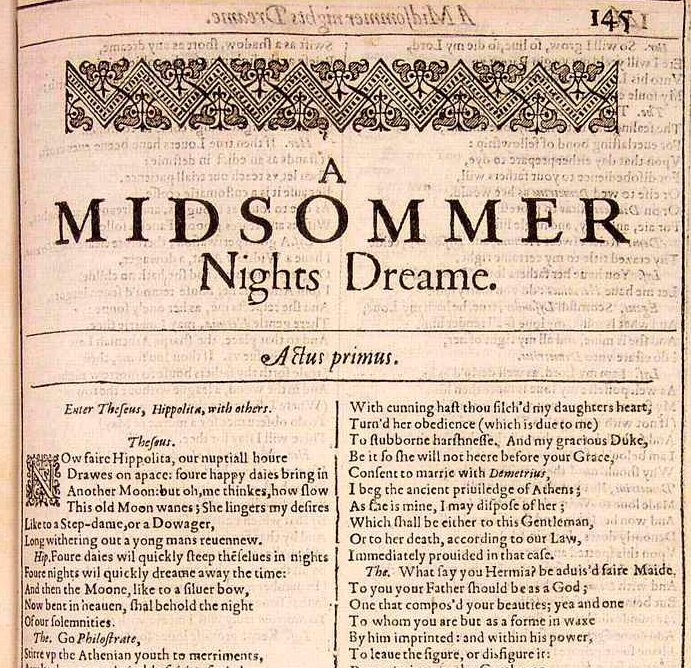
This was the third and final leg of Lazarus Theatre’s hitherto excellent season at the Greenwich Theatre. The previous productions, Edward II (Edward II at Greenwich Theatre review ****) and The Lord of Flies (Lord of the Flies at Greenwich Theatre review ****), both showed off Artistic Director Ricky Dukes’s inventive and combative ideas, and the young, fearless casts, to best effect. This version of A Midsummer Night’s Dream was similarly imbued with image, movement and ambition, but fell down a little on the delivery of verse and on pacing.

Getting Shakespeare’s lines out right isn’t easy. There are plenty of experienced actors who steer clear of the challenge. Practice may not make perfect but plainly it helps. Our cast here was, by and large, just out of drama school. Mr Dukes aim is to present theatre to as young and diverse an audience as he can. This will only work if his cast is similarly diverse. In Lord of the Flies he explored the tension from opening up gender in the casting. The young actors largely became the characters from William Golding’s novel filtered through Nigel Williams’s excellent adaptation. In Edward II the slightly more experienced cast, to a man and woman, nailed Marlowe’s muscular prose helped by Mr Dukes’s dramatic reshaping of the text.

Here though the verse was uneven and the spell was, at times, broken. This is not a criticism, just a reality. Max Kinder’s Lysander and Saskia Vaigncourt-Strallen’s Helena were the most accomplished speakers but the rest of the cast shone in other ways. Tessa Carmody played Puck as an enthusiastic, elfin ingenue not really up to the tasks allotted to her by Oberon. She was very funny. Eli Caldwell stepped into the limelight as a camp Flute in a tutu and Zoe Campbell captured the downtrodden air of a mechanical in her Snout. Jonathon George captured Demetrius’s slightly sour air, John Slade’s Quince was an exasperated but ineffective director and David Clayton was a bumptious Bottom, though might have been better served without the full donkey mask. Elham Mahyoub is an extraordinarily expressive actor in terms of face and movement, and, I mean no offence, was perfectly Hermia-sized. Lanre Danmola was a peeved Oberon with an air of making up his mischief as he went along, Ingvild Lakou’s Titania being suitably unimpressed.

The production really came alive when the director’s eye for movement, design (Jamie Simmons once again using the most mundane of materials), lighting (Stuart Glover) and sound (Sam Glossip) came together. Like all three of the Lazarus productions there is idea after idea which is simple but oh so effective. The highlight was Pyramis and Thisbe, here delivered in an hilarious song and dance routine, which the posh quartet get pulled in to. Like most recent productions Lazarus sort to uncover the darker elements in Shakespeare’s pastoral, though it is humour and joy which dominates. With more money, (which this company richly deserves), and more time, I reckon Lazarus, without too much fiddling with the stripped-back aesthetic, could create a memorable Dream. A Festival setting perhaps?

I don’t know what Lazarus will get up to next but I wholeheartedly recommend you check it out. This is not the most polished theatre you will ever see, and there are occasional missteps, it but it will restore your faith in what theatrical classics can deliver if you are already a luvvie, and should persuade you what you have been missing if you are a reluctant newbie. It’s better than Love Island. Mind you most things are.


Beethoven symphony cycle from Britten Sinfonia and Thomas Ades at the Barbican review *****

beethoven_sym_6_script

Britten Sinfonia, Thomas Ades (conductor), Nicholas Hodges (piano), Joshua Bloom (bass)

Barbican Hall, 22nd and 24th May 2018

  • Beethoven – Symphony No 4 in B flat major Op 60
  • Gerard Barry – Piano Concerto
  • Beethoven – Symphony No 5 in C minor Op 67
  • Gerard Barry – The Conquest of Ireland
  • Beethoven – Symphony No 6 in F major Pastoral Op 68

The latest instalments of the Britten Sinfonia’s Beethoven cycle under the baron of Thomas Ades, (alongside the valuable accompanying survey of Gerard Barry large-scale compositions) ,was as superb os the two concerts last year. (Britten Sinfonia and Thomas Ades at the Barbican Hall *****) (Britten Sinfonia and Thomas Ades at the Barbican Hall *****). That Mr Ades, and his friend Mr Barry, adore the music of Beethoven was never in doubt. That Mr Ades understands it, and can conjure up performances of the symphony that are as good as any that I have ever heard, is what makes this cycle unmissable in my view. I urge you, no I beg you, to come along to the final concerts next year of the last three symphonies. The Hall was no more than half full which is near criminal. If Gustavo Dudamel and his well upholstered LA Phil can fill the house with a big, if not particularly insightful, version of the Choral Symphony, then the Britten Sinfonia and Thomas Ades deserve at least the same. If you hate all the bombast that others bring to Beethoven please look no further: conductor and orchestra have binned all that sickly vibrato, endless repeats, glum grandiosity, and started afresh.

If you can’t go then look out for the recording of the cycle which should appear,God and finance willing. This is how Beethoven should sound. The right orchestral forces, the right tempi, to my ears at least, every detail revealed, and every detail in exactly the right place. Strings never thick and slushy, woodwind given enough room to breathe, brass precise, timpani rock hard. It is the difference between the way you might see an Old Master, badly hung, in the wrong room, of some C19 artistic mausoleum, centuries of filth accumulated on varnish, cracked, colours faded,  and the way you might see the same work, restored rehung, with space and light aplenty, and notes which illuminate not patronise. The joy of rediscovery. The difference between a mediocre and a great performance in a concert hall is easily to tell even if you know nothing about the music. The audience will be still and silent. Sometimes though there is something more, a connection between music, performer and audience that fills the very air.

I felt this here. Or maybe it was just there were fewer people with more invested in the performance. Either way it was a triumph. The Fourth, like the Second last year, couldn’t be dismissed as a happy-go-lucky, lithe cousin of the muscular, growling, Eroica hero that they sandwich. The first movement, marked Adagio-Allegro vivace, is, for my money, one of the finest passages of music Beethoven ever wrote. The painful opening, the booming timpani and giant string chords which conclude it, the uneasy Adagio which follows punctuated by more big chords, the double repeated scherzo theme, a dance but with something lurking in the woodshed, and then the perpetuum mobile finale, which is almost too jolly. Indeed Beethoven scores it that way, a palpable sense of anxiety pervades the whole symphony. It needs a conductor alive to the Goth inside the symphony’s Pop, and its subtleties cannot contemplate too big a sound. Mr Ades is that man. The slow movement Adagio was, and I didn’t expect to use this word about these interpretations, sublime.

I get why 2, 4 and 8 are see as lightweights compared to 3, 5, 7 and 9, the keys, the structures, the moods, the context, but I think it is a shame to get caught up in this convention. The Fourth symphony in particular is as great as its more famous peers. So how would this conductor and the BS render the Fifth anew. Remember the Fifth, (once it got over the infamous disastrous first night, alongside the Sixth, and a whole bunch of other stuff), changed the face of Western art music. Composer, and the performer from now on could be Artists. Everything would be bigger. More emotional. More, well, Romantic. Audience and commentators were now at liberty to hear, think and write all manner of the over the top guff about “serious” music. For that we should probably throttle LvB but the Fifth is just so extraordinary, however many times you hear it, that we’ll permit him the excess.

I expected the BS and Thomas Ades to absolutely nail this and they did. Familiarity can breed contempt. Or it can, as here, promote shared understanding. Everyone on and off stage was able to revel in Beethoven’s astounding invention. If I ever hear a better interpretation I’ll be as a happy a man as I was here. The opening allegro, four notes, infinitely varied, needs no introduction, tee hee, it being the most famous introduction to a piece of music ever. I suppose some might tire of the repetition. Not me. Especially with no unnecessary repeat. The double variation of the Andante, which fits perfectly together ying and yang style, was ever so slightly less impressive but the Scherzo and the magnificent finale were glorious. As in the prior performances you hear everything, no detail is obscured, nothing is too loud or two soft. This means that, along with the “classical-modern” sound of the BS and the “right” calls on repeats that the architecture of Beethoven’s creation is fully revealed, from micro to macro scale.

With Mr Ades and the BS having nailed the detail, shape and rhythm of the symphonies to date, I wondered how they would cope with the Pastoral. Maybe this, with its plain programmatic elements, wrapped its more gentle cloak, expressing all that utopian, Arcadian, rural idyll fluff that art conjured up as a salve to assuage guilt about industrialisation and urbanisation, would be the symphony where Mr Ades’s precise, vigorous approach might come unstuck.

Nope. For choice this might have been marginally less exciting than the rest of the cycle, the precision and heightened differentiation between instruments robbing a little of the warmth from LvB’s narrative. I’ll take the trade though when it results, for example, in the most thrilling storm I have ever heard, double basses thrumming, timpani thwacking. It also means the opening Allegro, which can doodle on a bit, saw variety emerge from the repetition. Nature untroubled by Man. Messaien would have purred at the birdsong emerging from woodwind in the Andante. And, in the finale, we heard the relief of real shepherds, not a bunch of embarrassed house servants dolled up by their lords and masters. Most Romantic plastic art is as schmaltzy as the Neo-Classical flummery that proceeded it, but there is some which sees the world for what it is, not want artist and patron wanted it to be. And some of it, Constable, in his sketches and watercolours, and, in his own darker way, Goya, could eschew history, violent nature and dramatic landscape, and showed more of the working reality of rural life. This Pastoral was in a similar vein. I now this all sounds like a load of poncey bollocks, but hopefully you get the gist.

Moving on. You remember those nights out in the pub, with your mates, talking sh*te and putting the world to rights. Of course you don’t. You were hammered. But you do remember it was a bloody good night out and things might have got a bit raucous and out of hand. Argument and love. Well Gerard Barry’s Piano Concerto, here receiving its London premiere, is the musical equivalent of one of those nights. Nicholas Hodges was basically asked to man-handle, (at one point literally, playing with his forearms), the piano and to get into a scrap with the orchestra. As the punches swung it got funnier though 20 minutes was probably enough. Some of the piano passages were more conciliatory but only in the way a drunk bloke (the woodwind) tries to calm his even more drunk mate (the brass) down a bit. It ends with some childish tinkles. It isn’t in Romantic concerto form, played straight through with no obvious structure, it has two wind machines, (here not amplified as expected, a shame), there is no real interplay between orchestra and soloist, just opposition, it is abrasive, chromatic and gets pretty loud. I reckon Vivaldi might have come up with something like this if he were around today.

In short it is a piece of music by Gerard Barry. I am sure he is nothing like this is reality, and I am being borderline xenophobic, but I see him as the musical equivalent of Samuel Beckett, the very definition of cussed. I am going to have to find a way into recordings of his music, probably after this time next year, as it is just too funny and punk to ignore. Mr Hodges is an expert in this dynamic modernism, having recording and performed the likes of Birtwhistle, Rihm, Carter and, indeed, Thomas Ades himself.

Mind you if I thought the Piano Concerto was a bit in-yer-face bonkers I was in for an even bigger surprise with The Conquest of Ireland. This is set to a text from Expugnatio Hibernica by Giraldus Cambrinus translated by A. Scott and F.X. Martin. Cambrinus was a Welsh writer and cleric in the twelfth century who hooked up with the army which invaded Ireland. The piece is marked quaver = 192 which I gather is pretty enthusiastic but Mr Barry then marks it “frenetic” and “NOT SLOWER” just in case we missed it. The brave soloist, here Joshua Bloom, is nominally a bass but he gets up to all sorts of pyrotechnics as he sings/speaks/growls/squawks the entirely unmusical words. It is basically detailed descriptions, written in a somewhat pompous style, of the bearing and appearance of seven Welsh soldiers. There is just one short throw-away line which dismisses the native Irish as barbarians. Mr Barry has composed intense, passionate, exuberant music to contrast this prosaic prose (!). Bass clarinet, marimba, winds and brass in combination, percussion, all got a work out. It is sardonic, in the way that I now see that so much of Mr Barry’s music is, but it certainly provokes a reaction and makes you think.

Anyway back to the performers. The Britten Sinfonia are my favourite musical ensemble. The others I regularly get to see, the LSO, the LPO, London Sinfonietta, the AAM and the OAE, are all, of course, excellent, and there are international orchestras that can blow my socks off when they visit, but it is the BS which consistently educates and surprises me. And Thomas Ades, IMHO, is now the closest thing to the immortal Benjamin Britten, that I can think of. Composer, performer, conductor. Equally gifted.

Oh and a final plea. This time to the ROH or ENO. A Fidelio. With Thomas Ades conducting. And Simon McBurney directing. I’ll wait.


Van Gogh and Japan exhibition at the Van Gogh Museum review ****

van_gogh_-_blc3bchende_mandelbaumzweige

Van Gogh and Japan

Van Gogh Museum Amsterdam, 18th May 2018

There is an episode of the recent excellent BBC series Civilisations, on the history of art, where the presenter Simon Schama explores Japanese woodblock prints from the C!8 and C19 and shows their impact on the Western art canon. We often assume that the revolution in figurative art that came with Impression, Neo-Impressionism and Post Impressionism was born from the societies in which it flourished especially France, (VvG came to Paris in 1886), with some link back to greats  from the past, Turner, Delacroix and Courbet. Subjects changed, colour and and the depiction of light intensified, artist got out a bit more. You don’t normally hear about how the flood of art from Japan influenced the way these chaps, (mostly chaps as always), saw their world.

This exhibition seeks to show the link between Van Gogh specifically, (it being the Van Gogh museum), and Japanese art but it does rather ram home the connection. Van Gogh collected Japanese prints like they were going out of fashion, which they so weren’t Japonisme being all the rage, so you get to see plenty of his 600 strong own collection, augmented with other jewels from the likes of Hokusai, Hiroshige and Kuniyoshi, contrasted with van Gogh’s own landscapes and other work. There’s even some fascinating direct copies by VvG of Japanese subjects, a bridge and, you guessed it, some blossom on a plum tree. And the exquisite van Gogh shown above is topped by its near neighbour in the exhibition, a bull finch hanging upside down on cherry tree branches by Hokusai. It is breathtakingly beautiful. You can get it as an I-Phone case. Not quite the same.

Oil paint might substitute for woodcut print ink but the same notion of perspective and dynamic, panoramic landscape leaps out. The thoughtful look in portraiture. The attempts to capture the detail of nature. Bold colours, uncluttered composition, clear lines, cropping. Your response might not be quite the same, reflecting the cultural history imposed upon you, but the ideas and impulses that underpin Impressionism, and the reasons why we can’t get enough of it, are uncannily similar. Van Gogh may not be as pretty-pretty as the generation that proceeded him but we punters can still intuitively grasp what he was about even when he had a bad day, which was most days poor fella.

The famous Self Portrait with a Bandaged Ear which we lucky Londoners can normally see in the Courtauld Gallery has a Torakiyo print of Mount Fuji on the wall. Van Gogh wasn’t alone. There is a Manet portrait of Zola with a sumo picture lurking in the background and Whistler brought the craze to London and copied it in his nocturnes.

Yet the differences are also striking. Oil paint adds texture. The woodcuts are flat. Van Gogh’s world is filled with unease, the Japanese masters exude calm (or am I just lazily stereotyping). Style contrasts with substance. Japanese art is steeped in the collective, in reverence for history and nature. Van Gogh peers at the individual and confronts head on the past and the world around him. Van Gogh is utterly devoid of irony or humour. He was, as we know, a serious fellow. The Japanese work was made to sell, (especially to us gullible gaijin), without his brother VvG would have been f*cked economically and artistically. That is why he is tortured genius personified. That, and the mental illness, a source of prurient audience fascination even as his descendants stewarded his work.

So the exhibition succeeds in showing the historical link between the two artistic cultures and the part Japan played in changing the direction of Western art. The questions art poses are universal even if the answers can vary through time and place. That is why VvG was taken with the idea of bringing his fellow artists together in some sort of Zennish brotherhood collective. The Occident and the Orient has been patronising each other for many hundreds of years. It also shows both the socio-economic and historical differences between the two worlds.

What it doesn’t do is show the actual art of either Van Gogh or the Japanese masters to best effect. Van Gogh, perhaps more than any other canonic Western artist, jumps off the canvas and wrestles the viewer to the ground. Old boot, chair, field, self, man, woman, flowers, vase. It doesn’t matter what the subject is, you cannot not stare. Of course you can whizz through like so many punters were doing in the main collection as it filled up. (I got in the queue on the opening – they have slot times now – and bounded up – well took the lift actually – to the top floor which I had moreorless to myself for twenty minutes or so). Even the cultural tickers and phone clickers though get pulled up by something from van Gogh.

In contrast the Japanese prints need a bit of proper looking. That takes time. When some hulking VvG landscape is lurking nearby they get pummelled. No matter. There are just so many astounding things to see in this exhibition that it doesn’t really matter if you accept or reject the message of cultural globalisation. Just enjoy.

Describe the Night at the Hampstead Theatre review ****

nonperson

Describe The Night

Hampstead Theatre, 23rd May 2018

In our country the lie has become not just a moral category but a pillar of the State. Aleksandr Solzhenitsyn.

Describe the Night hasn’t gone down too well with the London critics. The SO and I think they might have missed a trick. It is ambitious, ranging across several periods of Soviet and post Soviet Russian history, with a fairly cavalier approach to naturalism, and mixes fact and fiction, real and imagined events. Its workshop-py creative methodology shows through, but it was for us highly effective and enlightening. We’ve seen a fair few other plays that have fallen far shorter, despite their more limited intent. So hats off to Rajiv Joseph the writer for giving this a go. I see he won an OBIE, off Broadway award, for best new play with this. That’s probably a bit generous, (or New York is lamentably short of new work which I refuse to believe), but it’s proof that this isn’t the disappointment some have claimed it to be.

Polly Sullivan’s design sees a cliff wall of grey metal filing cabinets punctuated with a raised corridor and spiral staircase down to a dark open space with a couple of spindly birches. This, with some nifty work from Johanna Town’s lighting and Richard Hammarton’s sound, serves as backdrop for an underground KGB/NKVD filing room, an interrogation room, a minicab office, a plush Moscow apartment, a sparsely furnished flat and a forest exterior. The action kicks off in Poland in 1920 during the Russo-Polish war, (a conflict itself near forgotten), where we meet Isaac Emmauilovich Babel played by Ben Caplin and Nikolai Ivanovich Yezhov played by David Birrell. Both actors are superb by the way.

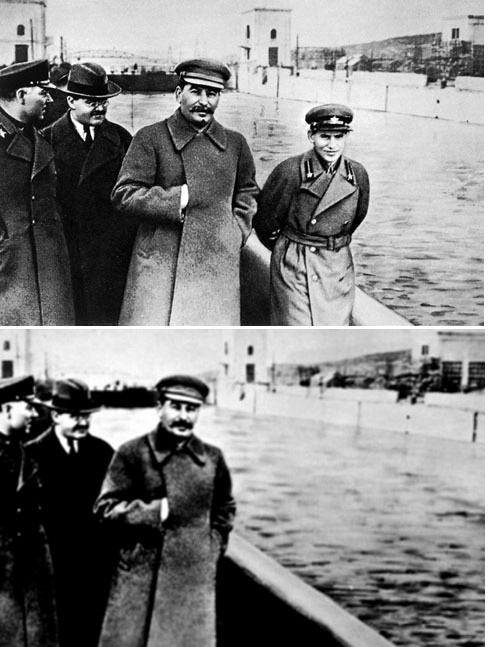
Now Babel was a writer whose stories about his childhood and this war were initially feted by the Soviet authorities but who was eventually arrested, his work confiscated, and he was executed in 1940. Yezhov was a small man, a party functionary, who drank to excess, but rose to become a favourite of Stalin and head of the NKVD through the Great Purge. Eventually though he fell foul of Stalin, his wife Yevgenia Solomonovna Feigenburg (Rebecca O’Mara) was arrested, and he too was executed in 1940, despite trying to save his skin by ratting on his friends including Babel. The photos above show how he was famously “non-person-ned” out of history.

The two meet in a forest near Smolensk as Babel is trying to “describe the night” around him. The literal Yezhov has very little of the poet about him, Babel relishes metaphor,  and the two debate the nature of facts and truth. They strike up a firm, if unlikely, friendship. We move forward to 1930s Moscow where we see Babel, whose estranged wife is in Paris, begin his affair with Yevgenia, (which, in reality, had started earlier before she married Yezhov). In the next scene we have whizzed forward to 2010 and Smolensk, where the plane taking the Polish president, his wife and various political and military elite to the commemoration of the Katyn massacre of 1940, has just crashed. Journalist Mariya (Wendy Kweh) is looking to evade the police and enlists the help of Feliks (Joel MacCormack) to made good her escape so she can tell the story.

For those that don’t know the crash is still the subject of conspiracy theories, despite the Polish and Russian authorities concluding it was down to human error, and the Katyn massacre saw the murder of some 22000 Polish military and intelligentsia by the NKVD, although Soviet authorities only finally admitted this in 2010 having previously blamed the Nazis.

We also seen Wendy Kweh as cantankerous Mrs Petrovna and her “daughter” Urzula, played by newcomer Siena Kelly, living in Dresden in 1989. Urzula wants to escape to the West. They have come to the attention of Vova, extravagantly played by Steve John Shepherd, who you might know as one Vladimir Vladimirovich Putin. We see our putative Putin rewriting his own history in a confrontation with Yezkov, who has “lived on” to control the files of the NKVD/KGB. The real Putin’s early history is somewhat uncertain. Urzula may be the grand-daughter of the illegitimate child of Babel and Yevgenia, who ended up in an asylum thanks to Yezkov, unable to distinguish Babel’s stories from her own memory. Vova also interrogates, unpleasantly, Mariya, mirroring Yezkov’s interrogation of Babel.

And so the stories weave together and what is true and what is fiction becomes ever more uncertain. Babel’s diary, started in 1920, becomes the physical link between the “scenes”. Some have seen parallels in th eplay with other contemporary regimes alongside Russia where the truth is routinely manipulated. Rajiv Joseph is after all an American playwright. There is certainly much to ponder on from Mr Joseph’s particular narratives. and from his mix of fact and fiction, with even some magic realism thrown in, (never be tempted to drink leech soup). History has always been uncertain, from the moment it is “made”. Leaders and states have always sought to confound “truth”. limited only by their shame and intelligence, or lack thereof. The multiplicity of viewpoint that curses our contemporary digital world might seem like it has “never been as bad as this” but it has, as this century of Russian “history”, shows us. People lie. History is rewritten. Truth is fiction and fiction truth where only art might be trusted. The scale of Russia’s current strategy of disinformation may be exaggerated by technology but it certainly isn’t novel.

We thought that Rajiv Joseph’s text and Lisa Spirling’s (AD of Theatre 503) unhurried direction turned into an invigorating display of these “realities”. The cast all seem to have adopted a slightly forced quality in their delivery, which is though entirely consistent with the structure of the play and the world it inhabits. The “workshopped” construction, this version is different from its NYC cousin, does sometimes mean the pace eases ever so slightly, and the play is, perforce, disjointed, but the rewards more than justify this. (I am much happier saying this about Describe the Night than Maly Theatre’s Life and Fate, a similar dramatic exploration of Russian history). There is dark humour throughout. I can imagine a more fleet-footed production, (Stoppard and Kushner, also writers who relish the interplay of ideas and theatre, similarly need momentum), but the play is already asking a fair bit from its audience, (there is definitely a case for reading the excellent HT programme in advance), so a less stagey approach might risk confusion.

For the moment though this is well worth the effort. There are a few performances left at the HT but I have a feeling this will come back in some form or other and will be a “grower” whose reputation will grow with time. Not everything is what it initially seems maybe.

PS. The foyer of the HT contains some of the material from David King’s splendid collection of Soviet graphic art and photographs which formed the backbone of the recent excellent Tate Modern exhibition. There are a few links below to reviews of other cultural events that plough a similar furrow. Treat yourself.

Red Star Over Russia at Tate Modern review ****

Life and Fate at the Theatre Royal Haymarket review ***

Ilya and Emilia Kabakov at Tate Modern review ****

The War Has Not Yet Started at the Southwark Playhouse review ***

The Death of Stalin film review ****

Russian Art at the Royal Academy review ****


Mayfly at the Orange Tree Theatre review *****

mayfly_2

Mayfly

Orange Tree Theatre, 21st May 2018

A play set in a rural location about a family processing grief. Not a million miles away from the not entirely successful Nightfall at the Bridge Theatre I hear you clamour. (Nightfall at the Bridge Theatre review ***). Well yes after a fashion. Joe White’s debut play though benefits, unlike Nightfall, from its location, in the round in the intimate OT space, and because its writing is tighter, funnier and more affecting. This may not be the most innovative play in terms of form and subject that you will ever see but it is a mightily polished effort which marks Joe White out as another talent to add to the list of young British playwrights.

Harry, (a disarmingly genuine performance from Irfan Shamji), works in a rural pub that is closing down. He encounters the plainly damaged pig farmer Ben (Simon Scardifield) trying to take his own life in the river. It is a Sunday in early May in Shropshire. (There are allusions to Housman, Auden and even Breughel through the play. Mr White clearly knows his elegiac English, and Flemish, onions). Loops, played superbly by Evelyn Hoskins, “hard as fuck me”, remembers Harry from some school cadet trip and means to make him her boyfriend. Cat, played by Niky Wardley, completing the quartet of marvellous actors, is lonely and makes an embarrassing pass at Harry in the pub. We soon see that Ben and Cats marriage is stressed to breaking point and immature daughter Loops is trapped. Their pain stems from the death of their young lad, Adam, son and brother. Harry gets sucked in when he comes to eat with them. He too is grieving. Some, limited, catharsis follows. The End.

All in one day. Like the life of the mayfly. The play works because Mr White is neither afraid of, nor forces through, the emotional core at the heart of his story and because it is very funny, more so than many comedies you might see. The naturalistic lilt of the character’s speech is expertly captured but there is still room for telling metaphor. The crumbling of the social and economic fabric in rural areas lurks in the background mirroring the household’s breakdown. When the pub goes all that will remain will be a Spar and a betting shop.

Mayfly is sympathetically directed here by Guy Jones, one of Paul Miller’s proteges at the OT, and the set from Cecile Tremolieres is inventive, (as it was for Suzy Storck at the Gate last year). I’d be surprised if this play doesn’t pop up again elsewhere and I certainly recommend tracking Mr White’s career. The plot here is just occasionally derivative. With a bigger and more complex idea I reckon he might surprise, big time.

Beethoven’s Missa Solemnis at the Barbican Hall review ***

beethoven-missasolemnis-manuscript

London Symphony Orchestra, London Symphony Chorus, Michael Tilson Thomas, Camilla Tilling (soprano), Sasha Cooke (mezzo-soprano), Toby Spence (tenor), Luca Pisaroni (bass-baritone)

Barbican Hall, 20th May 2018

Beethoven – Missa Solemnis

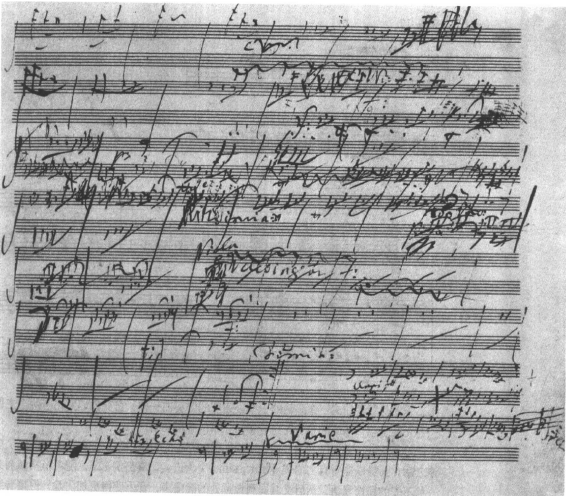
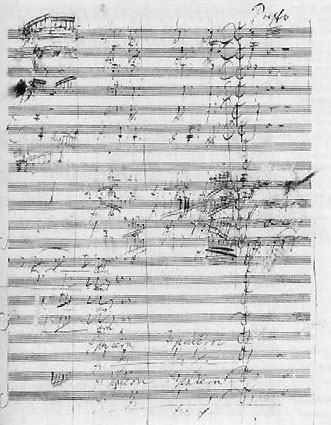
Hard to believe that the scruffy scrawl above is from the hand of the greatest ever composer in one of his greatest ever works. At least he thought so. And so does Michael Tilson Thomas, Conductor Laureate of the LSO, judging by the number of times he has taken it on.

I am not so sure though and find myself siding with Adorno on this. This will probably be the one and only time I can make this absurdly pretentious claim since, however hard I try, I cannot understand a word of what the Frankfurt School of Marxist critical theory was about, though the intellectual posturer in me dearly wishes I did. I would love to know a lot about a lot, or even a lot about a little bit of what there is to know. Instead I am doomed to know a little bit about very little.

The thing is there isn’t much of the theme and variation repetition thing than Beethoven took to unparalleled heights (at least until The Fall and Wire came along) in the Missa Solemnis. The giant fugues at the end of the Gloria and Credo provide me with some structural understanding, and connect with other late works like the piano sonatas and string quartets, but otherwise there is quite a lot of, well, Romantic meanderings.

Now it is Beethoven with massed choral forces offering up a Mass on a scale comparable with the Choral Symphony so it can’t all be bad. And it isn’t. There are stills scraps of cracking tunes which are explored in imitation to conjure up the goose-bump feel that the earlier masters of polyphony managed. Especially in the second half of the Gloria, the middle of the Credo and the beginning of the Sanctus. But there just isn’t the overarching structure to help my little head stay happy. LvB intended to complete the MS for his patron and mate, Archduke Rudolph, who was receiving some honour or other in March 1820. He missed the deadline so didn’t actually complete it until 1823 just ahead of the Ninth. Maybe that changed it.

The LSO chorus is now so bonkersly brilliant that it sort of didn’t matter when they were belting it out. Especially in the soprano section. And, like I say, MTT knows his way around the score. The soloists seemed well matched to me, though I would marginally take Sasha Cooke’s mezzo and Toby Spence’s tenor over Camilla Tilling’s soprano and Luca Pisaroni’s bass-baritone.

I will keep trying but I don’t think I will ever fully succumb to the MS. Whisper it but I am happier listening to the Mass in C which, as Beethovian experts will tell you, leaves me on the nursery slopes and forever banished from the pistes. So be it. Vita summa brevis.