Porgy and Bess at the ENO review ****

5415298151_f79aac8ec5_o

Porgy and Bess

English National Opera, 31st October 2018

It has been a long time coming. This co-production, together with the Met and the Dutch National Opera, is the first time it has appeared on the Coliseum stage. The re-written version, with book by Suzanne Lori-Parks, (which attracted the ire of Stephen Sondheim no less), popped up at the Open Air Theatre a few years ago and I gather that Welsh National Opera staged the Cape Town Opera production transcribed to South Africa in 2009. Prior to that I believe you have to go back to Trevor Nunn’s various tilts, at Glyndebourne in 1986, the Royal Opera House in 1992 and the less than successful musical theatre version, with speech replacing recitative, from 2006 at the Savoy. (Which, I have surmised, was what my special guests for this evening BUD and KCK, must have seen).

You’d think with all those tunes it would be a far more regular feature. On the other hand, one look at the set, and the massed cast at the opening of this production, perhaps reminds you why it is such an infrequent visitor. This must have cost a few bob. And assembling this many fine black singers from around the world, for this amount of time, will have required a patient, and skilled, logistical hand. The ENO has come under the cosh in the last few years, often unfairly in my view, so it is terrific to see that this has been a resounding critical and commercial success with standing room only across the run.

That is not so say it is perfect, at least from where the Tourist was sitting. (Nothing wrong with the view mind, though the old back was playing up a bit). The First Act does go on a bit: a fair few punters took the steamboat whistle as their cue to head to the bar. The chopping and changing of the time signatures in the jazzier parts of the score gets a bit wearing and I wouldn’t have minded if debutante conductor John Wilson has taken some passages at a greater lick. Not to say that he dawdled, just that I am all for brevity and clarity when it comes to orchestral music.

The plot and characterisation is very much of its time, Charleston in South Carolina in the 1920s. Not woke for sure. Even in the 1930s casts and creatives wrestled with the stereotypes that the opera presents. By the 1960s the opera had been pretty much consigned to the dustbin: no-one would perform it. It wasn’t just the characterisation, plot and language that vexed but also the appropriation of musical styles. In the last few decades performers have reclaimed the piece however, notably in South Africa. Ira Gershwin refused permission for the opera to be performed with white casts under apartheid as he and George had from the outset. Their stipulation for black only casts hasn’t always been maintained however, most notably by the Hungarian State Opera in their last season with a predominantly white cast, which looked, on the face of it, like a political provocation.

Having said all that I can absolutely see why the creative team, led by James Robinson AD of the Opera Theatre of St Louis, on his ENO debut, have played this absolutely straight, (and I suspect they always had one eye on the reception from the punters at the Met). Putting the condescension to one side, the characters in Porgy and Bess, even if there are probably too many, are more emotionally rounded than in most opera, and the drama, with its mythic underpinning, more engaging. This in large part reflects the work of Dorothy and DuBose Heyward from whose play and book the story is taken. That doesn’t mean it is without flaw however. Porgy’s seeming accommodation of his poverty and disability, Bess’s total lack of agency and final descent: these require a great deal more exploration than the few lines that opera can offer, especially one where so many other voices are heard. And Gershwin’s music as it slips from folk to jazz to blues to gospel to spiritual to, very obviously in the melodies of some big songs, his own Jewish heritage, doesn’t always match up to the psychology of the character. Say what you like about Mozart and Da Ponte’s plots, when words fall short and music needed to take over, Wolfgang was your man.

George Gershwin’s ability to mix popular, musical theatre with high art classical composition is there from the very beginning of the piece. The jazzy theme for full orchestra that emerges from the frenetic opening, with the entire cast on stage, drops down to a simple piano roll. Then Clara emerges and launches into you know what. If there has ever been a tune that more defines time and place in musical theatre, the bluesy Summertime is it. It’s hot, we are on Catfish Row and, for a lullaby about protecting the child, there is something infinitely sad about it. Which of course there is when it subsequently re-appears later on before the murder of Robbins by Crown and after the fatal storm.

Up to now George and lyricist brother Ira had delivered Broadway musical but George was determined to filter this through European classical modernism to create a unique American opera style, just as Bernstein would in the following decades. They must have got something right in this their operatic debut. The programme mentions an estimate of 25,000 version of Summertime. Billie Holiday, Ella Fitzgerald and The Fun Boy Three in my library. From there on, for all the twist and turns of the music when it stands alone or supports the recitative (and kind of arioso), for all of the musical call-forwards, call-backs and motifs it is the songs and arias that the audience came to hear. Gone, Gone Gone, spirituals My Man’s Gone Now and It Take A Long Pull To Get There, It Ain’t Necessarily So, love duet Bess You Is My Woman Now,, Oh Doctor Jesus, Oh Lawd I’m On My Way., even banjo song I Got Plenty of Nuttin’.  Hard not to be carried away by that lot.

I have said before that I am not up to the task of commenting on the technical skill of the performers and, for me, acting in opera is as important as singing. If I had to pick out individuals then I would plump for Eric Greene’s rich, powerful baritone voice, which builds through the evening, and the poignancy he brings to Porgy. Nadine Benjamin’s sweet, sensitive Clara and Frederick Ballentine’s oily Sportin’ Life also stood out and I was taken with, at our performance, Gweneth-Ann Rand’s noble Serena and Tichina Vaughn’s gritty (acting not voice!) Maria. Soprano Nicole Cabell’s Bess was a little too reticent at times and Nmon Ford’s Crown, complete with rippling torso, a little too brisk, but what do I know. It is though when the chorus and orchestra come together in the big set-pieces, the fights, the murder, the funeral, the prayer-meetings, when the opera really takes off, and this chorus drawn from as far apart as the US, South Africa and New Zealand, was as good as I have heard anywhere. This was when I got the “opera buzz”. I am looking forward to the War Requiem that will follow at the ENO from this chorus.

For all the story-telling, playing, singing and dancing (courtesy of Dianne McIntyre) though, it was the look of the production that was perhaps the best thing about it. The set from legendary American designer Michael Yeargan, gives us the the bare bones of the Catfish Row tenements. The flesh then comes from another legend, lighting designer Donald Holder and the video design of our own Luke Halls, who is about the best in the business. No innovative representation or symbolism here. Sun, rain, water, daybreak, twilight, moonlight, quick time, slow time, public space, private space. All were vividly imagined. Catherine Zuber’s costumes are equally effective. Wheeling out the best of Broadway and pooling the budgets of the three producing houses has paid dividends handsomely. Even the SO to whom plot is everything was bowled over by the look as were keen companions BUD and KCK. We definitely got our money’s worth.

I see that I have a recording of Porgy and Bess, the LPO under Simon Rattle. I don’t listen to it though. I do listen to Miles Davis’ instrumental versions though, which are all over the shop. Not sure what that means. Essence of trumpet maybe.

 

The Wolves at the Theatre Royal Stratford East review ****

soccer-1392175_1920

The Wolves

Theatre Royal Stratford East, 26th October 2018

…. or 3 stars if you would prefer the opinion of LD which may be more relevant since she should have a greater affinity with the subjects of Sarah DeLappe’s novel debut play. The SO similarly enjoyed the production but was less enthusiastic than the Tourist. Thus proving that association with the subject/object in theatre may not always be the best indicator of potential satisfaction.

It was very heartening to see a full, and young, house at TRSE drawn in, I would guess by the subject, and by the reputation of the play. I have remarked before on just how attractively Nadia Fall’s first season as AD at the TRSE is shaping up what with this, The Village just gone, and The Unreturning (by Anna Jordan and produced by Frantic Assembly), Equus (from English Touring Theatre) and August Wilson’s King Hedley II (with Lenny Henry), to come.

So what’s to like about The Wolves. First off the subject. 9 diverse young women who are part of an indoor soccer (that’s football to you and me) team in middle, middle America. Second the dialogue. Their animated conversations centre on what is important in their lives. School, families, relationships, futures, politics, emotions, well-being, fears, frustrations. With 9 characters across 90 minutes, each carrying some specific trait relevant to their age and gender it was probably too much to ask that they become fully rounded individuals, but I certainly wanted to hear them. We laugh with, not at them, adult perspectives are peripheral, and the specifics of identity, obstacle and dilemma are not rammed down our throats. Not wives, not daughters, not girlfriends, not objectified, not victims.

This the play, with one minor exception, sails through the Bechdel test: there are other new plays emerging which featured strong, determined young women, but they are still few and far between. At least it would sail through the test if the women were named. For Sarah DeLappe has deliberately eschewed giving the women names, instead they refer to their kit numbers. This, together with the fact that each scene is played out during their warm-ups ahead of their competitive games, complete with movement guided by Ayse Tashkiran and ball skills courtesy of West Ham, (no comment from this Spurs fan), creates an echo of the military boot camp at the outset of a war movie, as Sarah DeLappe intended. Without of course the violence and toxic masculinity.

Rosie Elnile’s set, artificial turf enveloped by bright green inflatable walls, is striking, though this and the bright lighting and abrupt sound of Joshua Pharo and the Ringham brothers, brings a harshness which detracts from the musicality of the movement and dialogue. There is no connection to a world out there, (their grasp of global geo-politics is deliberately restricted), not a problem for yours truly, but this is I think what left LD a little perplexed. There is a plot of sorts, new player turns up to unsettle the equilibrium of the team, and a twist at the end, but even a director of Ellen McDougall’s imagination, cannot quite prevent it from feeling a little contrived and tacked on.

Now I am a shocker for identifying the authenticity of accents. I fake a bit of Mockney to make myself feel more “working-class” which is truly pathetic, and deep down, you can still hear the Devonian roots in me straining to get out, but I am about as boringly Home Counties as it gets. So, for the first couple of scenes, I was convinced that the cast was the real deal having come over en masse for the run. Nonsense obviously, made more so when it dawned on me that I had seen several of the actors before: Seraphina Beh (Leave Taking and Parliament Square at the Bush), Nina Bowers (Twilight at the Gate), Rosie Sheehy (Escape the Scaffold and The Hairy Ape) and Rosabell Laurenti-Sellers (at the Guildhall where she trained). They, and the rest of the cast, Annabel Baldwin, Lauren Grace, Francesca Henry, Shalisha James-Davis and Hannah Jarrett-Scott, were just so convincingly American, thanks to Michaela Kennen’s voice guidance. Preserving the balance of the ensemble, whilst sketching out the characters and, to paraphrase the mighty Harry Redknapp, “f*cking running around a bit”, is an exacting challenge but each and every one of the cast rose to it.

So for me a success because I got to see into an unfamiliar, yet recognisable, place in a witty and dynamic way. Maybe less interesting to LD precisely because it is familiar, in which case the fact that the story doesn’t really go anywhere, and the various “secrets” that are revealed about each of the young women are never properly developed, was more of a drawback. Team sport as metaphor for life is beyond cliche but Ms DeLappe has smartly subverted the trope by omitting victory or defeat. I will be very interested to see where she goes next.


The Australian Chamber Orchestra at Milton Court review *****

mozart_jupiter_finale_final_section2c_bars_389-396_all_five_themes_together

The Australian Chamber Orchestra, Richard Tognetti (director)

Milton Court Concert Hall, 22nd October 2018

WA Mozart

  • Symphony No 39 in E flat major K543
  • Symphony No 40 in G minor K550
  • Symphony No 41 “Jupiter” in C major K551

If you don’t know the Australian Chamber Orchestra then you should. I don’t mean personally one by one. Though I am sure that the 17 permanent members are all excellent people. No I mean that if you have any interest in classical music, or in music generally, for under their director and lead violinist, Richard Tognetti, they cast their net pretty widely for a classical band, you should find a way to see, and hear, them. In their chosen repertoire, primarily large chamber and small orchestral works, whether original scores or those adapted by the mercurial Mr Tognetti, they are well nigh unbeatable, I reckon. It’s the combination of scholarship, musicianship and enthusiasm you see.

There were magnificent last year in the concert I attended (Australian Chamber Orchestra at the Royal Festival Hall review ****) and there were again this evening. Only this time they had expanded their strings core with more strings, woodwinds, brass and percussion drawn from various other ensembles to perform Mozart’s last 3 symphonies, which I defy anyone not to accept are amongst the finest pieces of music ever composed. And the biggest treat for me. The presence of MS whose intellectual and cultural curiosity knows no bounds, but who has been way too infrequent a companion for me at classical concerts. Let us just say that, by the end of the Jupiter, my boy was hooked.

There is plenty of Mozart that passes me by, too nice and too many notes. But not these symphonies, the da Ponte operas, the later piano concertos, the famous wind chamber pieces and various string quartets and quintets. After all you would have to be made of stone not to connect to this. These last three symphonies however are something else because they seem to operate on a higher musical and emotional level. Written in 1788, over a period of just six weeks, we don’t now who they were written for or where they were intended to be performed. His Dad Leopold, who was a big of a control freak by all accounts, had died the prior year. In the last couple of years of his life, Wolfgang was pretty poorly and reduced to begging from mates, but at the time of the composition of the symphonies, he had a decent income from his work at the Viennese Court, his and Constanza were happy and his operas had been a storming success in Prague. I don’t have too much truck with biographical or genius theories of creativity but I think these symphonies, whilst challenging on places, are pretty jolly overall, and there is enough invention to suggest that Wolfgang didn’t just download from brain to stave, however rapid their formation.

39 kicks off with a slow intro a la Haydn but soon perks up as it shifts to a cantilena with trumpets, timpani and descending strings. The second subject is softer, led by clarinets. The slow movement starts tentatively but then gets into a trademark groove as strings and winds each take the lead across three different themes, again with clarinets and bassoons, getting a workout. You might well know the minuet and trio tunes, (even if you don’t as is so often the case with WAM), and you certainly should know the Allegro finale which is as resolutely upbeat as anything he composed. It is easy to see why some smart punters reckon this was his best ever.

40, along with 25, is the only symphony in minor keys, and it is the use of clarinets once again which sticks in the ear (and mind). The Allegro opening, with the violin tune, two quaver, one crotchet, underpinned by pulsing violas, is another WAM classic, only he could have written it. There is a second theme, but you barely register it, such is the brilliance with which this opening tune is tweaked. Violas kick off the slow movement as well but here there are tics and tremors that point to what would have happened if WAM had managed a couple more decades. The minuet that wraps around the trio in the next movement also has its dissonant moments and the final Allegro really breaks the mould, famously, with its twelve note “serial” theme.

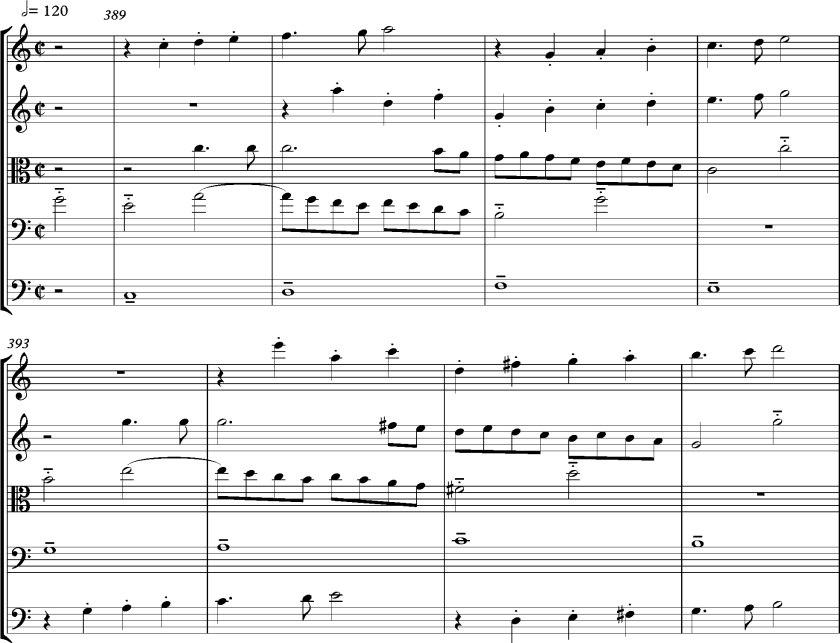
Apparently 41 was unperformed during WAM’s remaining 3 years, and it was a few decades before the world caught up. No clarinets here, oboes and bassoons get to do the wind work, and using the triumphal key of C major. Surely it is no coincidence that Beethoven kicked off his symphonic career in this key. The Tourist yields to no man (or woman) when it comes to the all time greatest, that’s LvB, but with 41 at least I get why some favour Wolfgang. From the jokey military demeanour of the opening movement through sweet mystery of the Andante, to the deceptively simple dance movement and into that “fugal” finale, which is as good as it gets, it is a marvel. Five themes, all magically locked together, by the end. There it is above. Seems so simple doesn’t it. It doesn’t sound it though.

It certainly pumped up MS as I said, and the Australian Chamber Orchestra, wasn’t in the mood to hold back. Richard Tognetti is known for the drama and intensity he brings to performance and the ensemble, including guests, rehearses to within an inch of their lives as far as I can hear. The strings, literally, play as one and their is no room for any mawkish vibrato. HIP on mostly modern strings with period winds and brass suits me. The tempi are quick throughout and the phrasing is muscular. Right up my street. Mr Tognetti and the band have been playing the last three for over 25 years. I reckon they’ve nailed it.

Hogarth’s Progress at the Rose Kingston review ***

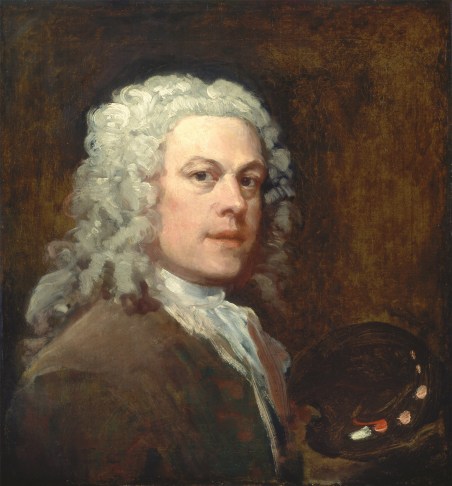
william_hogarth_-_self-portrait_-_google_art_project

Hogarth’s Progress: The Art of Success and The Taste of the Town

Rose Theatre Kingston, 21st October 2018

South West London was a popular place for the cultural, liberal, metropolitan elite in the first half of the C18. It still is. Hogarth, Horace Walpole, David Garrick, Henry Fielding, Alexander Pope, Henrietta Howard (the King’s mistress no less), Lord Burlington, Richard Steele, Paul Whitehead, Lady Mary Montagu, John Beard, Kitty Clive, Peg Woffington, James Thomson, John Moody, GF Handel (for one summer), Stephen Duck, John Stuart, Thomas Twining, Augustin Heckel. Oh, and early on in the period, no less than the Queen herself, Anne, at Hampton Court, following in the footsteps of William and Mary. Royalty and the Thames is what made it desirable,

OK so I can’t pretend I had heard of all of these luminaries but some of the big names, Walpole, Garrick and Fielding, play a big part in Nick Dear’s brace of plays about one of the area’s most famous residents, Hogarth himself. The first play, The Art of Success, premiered at the RSC way back in 1986, with Michael Kitchen and Niamh Cusack starring (seen last year on this very stage in the marvellous adaptation of Elena Ferrante’s Neapolitan Novels (My Brilliant Friend at the Rose Theatre Kingston review ****). This tells the story of Hogarth’s early years carousing his way through Georgian London with Henry Fielding and their mates, Frank and Oliver. The new, companion, piece, The Taste of the Town, revisits Hogarth, now in Chiswick, at the end of his life (1697-1764). His house is now supported by the Hogarth Trust, owned and run by LB Hounslow and can be visited most afternoons. Worth a peak especially if you take in he neo-Palladian beauty that is the recently refurbished Chiswick House just round the corner. And, once in your life, you have to see the flamboyant spectacle that is Strawberry Hill House. This is why interior designers are best avoided.

Now for those who aren’t familiar with William Hogarth, he was a painter, printmaker, social critic and cartoonist in the first half of the C18. This period saw a huge increase in the wealth of Britain, (in full union with Scotland from 1707), built on trade, specifically trade in people, specifically slavery. With this came the rise of the liberal Whigs who took power from the Tories in 1715 and drew their support from the new industrial and merchant classes. It was a period of vigorous political debate. At least it was if you were rich. If you were poor …. well you were still f*cked over as always. Anyway Hogarth and his mates were dead centre in this cultural maelstrom, specifically in criticism of the great and good. Journals, newspapers, pamphlets, clubs, all mushroomed. And these boys were bad to the bone.

Hogarth himself came from a less privileged background, enough to get an apprenticeship as an engraver, but precarious enough to see his teacher Dad have spels in the debtors prison. This is where his satirical edge was sharpened. His morality tale “comic strips”, such as A Harlot’s Progress and A Rake’s Progress, were dead popular at the time and have remained so ever since, and sort of defined the entire genre. Yet he was also a renowned painter, largely society portraiture that being the mode at the time, and the tension between his “popular” and his “high” art is one of the themes that Nick Dear explores in the plays.

Dear also doesn’t hold back on portraying the seedier side of Georgian life. The Art of Success kicks off with Hogarth (Bryan Dick), Fielding (Jack Derges), Frank (Ben Deery) and Oliver (Ian Hallard) lashed up after a meeting of the Beefsteak Club and contemplating their next move, which is going to involve sex for money I am afraid. There is a lot of this sort of thing going on in the first play set in the 1730s. Indeed Hogarth’s relationship with prostitute Louisa (Emma Cunniffe), and its discovery by his wife Jane (Ruby Bentall) forms a major part of the plot of this play, such as it is. Alongside his encounter with murderess Sarah Sprackling (Jasmine Jones) who was the subject of The Harlot’s Progress and who seeks to wrest control of her image back from Hogarth after he draws her in prison. This question of who “owns” a representation in art, the observer or the observed, is another central theme of the play.

In the hands of Antony Banks as director, alongside period costumes and a striking, if s;lightly unwieldy, set from Andrew D Edwards, some fine video work from Douglas O’Connell, lighting from James Whiteside, sound from Max Pappenheim and music from Olly Fox, scene after scene unfolds with distinctive verisimilitude. The Queen, Caroline of Brunswick (Susannah Harker complete with comedy German accent) gets a look in, and reveals herself ken to get inside Hogarth’s britches, as does Prime Minister Robert Walpole (Mark Umbers) who reveals himself keen to see a liaison between Sarah and Jane (it’s a long story). Walpole indeed cuts a deal with Hogarth to push through the copyright deal that WH craves to stop his work being ripped off. Yet, alongside Fielding he rails against the political censorship that Walpole introduced to the theatre, a process that persisted until 1968.

This personality parade though gives an inkling into the plays’ problems. The comedy smut becomes a little wary after a while and the crowbarring into the script of biographical and historical fact after fact leaves little room for any change of pace or tone. There is the vulgar, which is fun, or there is the art history lecture, which is a little less so, once you know what is coming. The repellent power of men over women in the Georgian booms out through both plays but to no great end, as the strands are never pulled together..

The second play with Hogarth now retired to Chiswick, and railing against rivals like Sir Joshua Reynolds feels even slighter in some ways. Hogarth is now played by Keith Allen. One word. Irascible. Perfect casting. Jane Hogarth, now played by Susannah Harker, puts up with his grumpiness and abuse, but is a little tired of the suburban life. Hogarth and his mother-in-law, Lady Thornhill, the majestic Sylvestra Le Touzel initially in full on Lady Bracknell mode, do little to disguise there dislike. Things perk up for Hogarth however when old chum, near neighbour and charming egoist David Garrick (Mark Umbers) comes to call and the two go on a road trip. Of sorts. On foot. Down the Thames. Drink intervenes and Hogarth swans off to visit another local celeb, the ostentatious Horace Walpole (Ian Hallard, who seems to be having a lot of fun) who has dissed Hogarth’s painting skills in his stab at classicism Sigismunda (which is. to be honest, pretty limp). They argue, they make up. More misadventure etc, etc.

It’s not that I didn’t appreciate the history lesson. I really did. It’s not that I wasn’t impressed by the acting, notably Bryan Dick, (who impressed in Great Apes and Two Noble Kinsmen recently on stage and as Joe Orton on the box), and Keith Allen, as the main event. And many of the scenes are, of themselves, striking and entertaining. It’s just that the plot, and the arguments it seeks to explore, seem to have been welded together from the events and the personae that are portrayed, and the bawdy and the pedagogic never quite gel.

There is a book, which we seem to have acquired, which you can find in most National Trust shops. Scenes From Georgian Life by Margaret Wiles. It is a collection of period caricatures and cartoons, including some from Hogarth. From the tamer end of his oeuvre for sure. We wouldn’t want to upset the gentle, middle classes. Nick Dear’s two sketch plays are muckier and cleverer but ultimately not that much more impactful.

The Habit of Art at Richmond Theatre review *****

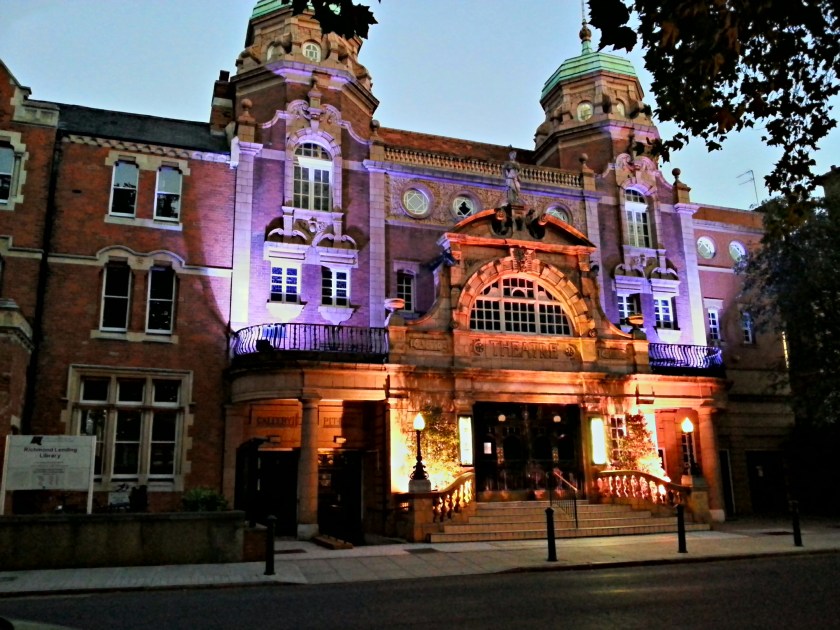
richmond_theatre_2013-09-23_20-19-48

The Habit of Art

Richmond Theatre, 19th October 2018

There are a handful of plays that I regret not seeing when they first appeared. Not those I wish I had seen, That would be a very long list and cover those periods where I was not putting the required viewing effort in, being too consumed by work and/or drink. No I mean those where I toyed with the idea of going but didn’t get round to it one way or another. The Habit of Art is definitely one of those. I can see why some might get irritated by the voice of Alan Bennett. Not his actual voice of course. Surely everyone loves that unmistakable broad Yorkshire drone. No I mean his theatrical voice with its now ever-present risk of self-parody.

The Habit of Art, from 2009, along with The History Boys (2004), The Lady in the Van (1999) and The Madness Of George III (1991) must all surely rank somewhere near the top of the pile of great British plays written in the last three decades for all the pervasiveness of the last three.  The Habit of Art “imagines” a meeting between WH Auden and Benjamin Britten in 1973 as a departure for an investigation not just into their specific art and lives but into art and theatre as a universal. Right up my street. And best of all for me at least, Benjamin Britten, for all his flaws, which are far from concealed here, is one of my favourite composers.

My only concern then, perhaps, was the cast. The NT run saw Alex Jennings, near full time Alan Bennett impersonator, take on the role of BB with the sorely missed Richard Griffiths as WHA having stepped in for the indisposed Michael Gambon, which I gather was more than fortuitous. You can take your pick as to your favourite Richard Griffiths role: in Potter, as Hector in The History Boys or as Henry Crabbe. I have two words for you though: Uncle Monty. As for Alex Jennings. Is there nothing this man cannot play? There are literally no duff roles or performances on his CV. The last thing I saw him in on the telly was Unforgotten Series 3. As chilling sociopath doctor Tim Finch. Sh*tting ‘eck as AB might say.

Anyway Matthew Kelly as WHA and David Yelland as BB, and indeed Philip Franks as director of this production, Nick Hytner (who else) having directed first time round, had big boots to fill then. And fill them they did. And then some. This is the first ever revival and I can report that it is really very. very good. And don’t just take my word for it. TMBOAD can vouch for it as well, my viewing partner on this evening, and he is one of the cleverest people I know. Ditto some elegant and cultured Richmond ladies of my acquaintance. The production, in addition to Richmond, has popped up in York, Brighton, Salisbury, Oxford, Guildford and Ipswich. It is in Liverpool as we speak and goes on to Cambridge, Coventry, Salford, Southend and Malvern. Residents, you would be mugs to miss it.

Richmond Theatre doesn’t always get the best of touring productions but here they struck gold. The Original Theatre Company, led by Alistair Whatley and Tom Hackney similarly didn’t quite hit the nail on the head with their last outing, Torben Bett’s Monogamy (Monogamy at the Park Theatre review ***) but on this outing I should look out for their next production at the Park. Richmond also hosts pre West End fare. I can’t think of anything more suited to the West End than this brainy, but not too brainy triumph.

Anyway what about the play. Well as I should have pointed out Messrs Yelland and Kelly don’t actually play BB and WHA. For the players are actually Fitz (Kelly), Henry (Yelland), Donald (John Wark) and Tim (Benjamin Chandler), who are rehearsing a play called Caliban’s Day. The play is set in WHA’s rooms in Christ Church Oxford on the set (keep up) of said play with Company Stage Manager Kay (Veronica Roberts) and her Assistant SM George (Alexandra Guelff) keeping the luvvies, and precious playwright Neil (Robert Mountford) ticking over.

Neil’s play draws it’s title from WHA’s contention that The Tempest was incomplete and requires an epilogue. In the play Donald, playing Humphrey Carpenter, the real-life biographer of WHA and BB amongst others, has come to interview the somewhat impatient WHA (played by Fitz), who it transpires, confuses him with the time-limited rent-boy Stuart, played by Tim, that he has procured. Donald also though steps out to narrate proceedings. Henry as BB arrives to join the set-up. He has been auditioning boys to play the part of Tadzio in BB’s Death in Venice, but wants to discuss his concerns over its plot with WHA, despite them not having met since their falling out 25 years earlier in America after WHA wrote the libretto for the somewhat derided Paul Bunyan. WHA though assumes that BB wants him to replace Myfanwy Piper as librettist for Death in Venice. After his father-in-law was Thomas Mann, the author of Death in Venice.

Neil’s play however, as I said, is in rehearsal so we have Kay kicking things off before Neil arrives and her and George standing in for various minor roles. notably two cleaners. The actors constantly bounce in and out of character, though never confusingly, and this is what allows us to see into them as individuals, as well as into the process of acting and performing. At the same time the play itself and the discussions between the actors. Neil, Kay and George, about what it is saying and why, offers multiple insights into BB and WHA, their art and the society in which they practiced their art. Alan Bennett doesn’t hold back from showing what it meant to be a gay artist through the middle of the C20 nor the paedophiliac controversy that surrounded BB.

Now normally with this much learning on show, play within a play meta-ness, theatrical self-referencing, in fact all round arty-farty pretentiousness, you would be a) rightly very wary and b) waiting for the whole thing to unravel . Not here though and not with Alan Bennett pulling the strings. It is very, very funny, (this time the smut isn’t laboured), but also very, very sincere. It dazzles with just how much intellectual and emotional ground it covers yet never fails to entertain. Even if some of the references pass you by, they did me, the perspicacity of the insight into the “cast” will not. And being a play about an “event” it moves from A to B.

I have seen Matthew Kelly, “tonight Matthew”, on stage in recent years in Richard Bean’s Toast, and for about 20 minutes before rain stopped play (ha, ha), at the Open Air in Pride and Prejudice. He makes for an excellent Fitz, fruity and cantankerous, but still vulnerable, qualities that segue into WHA but with the intellectual spotlight switched on to full intimidating beam. An actor playing an actor playing a man who relished playing the role of artist. David Yelland’s Henry,  like BB, is more tentative, more restrained, who then takes on the needy, sickly and child-like BB and his “obsession” with innocence corrupted. Their debate about Britten’s obsessions in his art, as well as Auden’s creative regrets, are what drew me in the most but I am sure you will find your own point(s) of contact.

Robert Mountford shows us Neil’s exasperation with actors who wish to distort his precious script. Veronica Roberts expertly shows us how much, in this case, maternal nourishment is required to bring a play into being but also shows us how Kay rues her own missed opportunities. John Wark gets to reveal, at one point with surreal humour, just what happens when an actor tries too hard to look for meaning in character.

It is hard to imagine a more appropriate set that Adrian Linford’s rehearsal space, with rough cut scenery and busy props, fitting into a classic proscenium stage, which Frank Matcham’s Richmond Theatre jewel (there she is) perfectly frames in a nod to the play itself. Philip Franks’s direction makes everything perfectly clear, no mean challenge as you might surmise from the above.

By some margin my favourite Bennet play. Mind you next up Mark Gatiss and Adrian Scarborough in The Madness of George III. This is showing live at cinemas but I see there are more than a few tickets left at the Playhouse. So students of Nottingham University. amongst others, save your beer money and go see this instead.


Pinter at the Pinter One review ****

chair-2963765_1920

Pinter at the Pinter One

Harold Pinter Theatre, 18th October

  • Press Conference
  • Precisely
  • The New World Order
  • Mountain Language
  • American Football
  • The Pres and an Officer
  • Death
  • One for the Road
  • Ashes to Ashes

Just so you are clear. These are plays by Harold Pinter. Did I mention that?

A combination of diary clashes and me hoping for ticket prices to come my way, (always fun playing Economics 101 with West End theatres), meant that I missed out on Part Two of Jamie Lloyd’s season of all of the one act plays of Harold Pinter, (and many other morsels besides). So no The Lover or The Collection and therefore no Hayley Squires, John MacMillan, Russell Tovey or David Suchet. A shame but rest assured dear reader I am signed up to the rest.

Now Pinter is an acquired taste but once acquired is rarely relinquished. The Lover is a two hander about an apparently adulterous couple which sounds like it went down well although, as with much of Pinter the surface misogyny can discomfort, though being Pinter there is always sufficient ambivalence to undermine the apparent premise. For me HP’s unrelenting picking away at human weakness is not gender bound but I can see why others might disagree. The Collection from 1961 covers similar territory in a similar way but with two couples, one gay, sharing a stage, linked by a possible affair.

Anyway probably better if the Tourist focusses on the programme he did see. Here, in the first half, we are in the world of late Pinter, with politics as the subject, and specifically the excesses which can be visited on the individual by a totalitarian state. Some of the pieces imagine more brutal and sadistic scenarios than others but all can be seen as warnings of what can happen when power corrupts. Their very lack of specificity is meant to show that this sort of oppression is only a few short steps away even in a liberal democracy. Not all of the pieces are up with Pinter’s best, and they have never really been, to be frank, universally appreciated even by criterati, but when they work, notably for me here in Mountain Language, they are very effective.

Press Conference is exactly that. A sketch where a Minister of Culture, who was the head of the secret police, responds about the state’s attitude to children. His brusque matter of fact responses – “We distrusted children if they were the children of subversives. We abducted them and brought them up properly. Or we killed them” – is very funny but also very chilling precisely because Jonjo O’Neill’s politician is speaking as if he were right here, right now in Britain. Precisely is another short sketch where Maggie Steed and Kate O’Flynn play a pair of toff establishment types debating a number, 20 million or maybe more, which turns out is a body count.

Next up was The New World Order from 1991 which saw a cocksure Des (Jonjo O’Neill) and a pumped up Lionel (Paapa Essiedu) discussing how they will torture the gagged, blindfolded and naked man (Jonathan Glew) in the cell with them. No physical violence, the menace is all in the language, which is almost stereotypically Pinteresque in its banal tone. These are almost caricatures of modern day torturers, in sharp suits and, in Paapa’s case, aviator shades. They are trying to impress each other as much as scare the victim. They could be Goldberg and McCann. Taking pleasure in their work. Once again Brits not Americans as in the original premiere. Pinter nails that uninhibited, exuberant arousal that seems to inhabit the cruel.

Mountain Language is an better piece of drama though. Written in 1988 apparently in response to the treatment of the Kurdish people, Pinter actually saw this as a more universal attack on regimes where minorities are victimised through the suppression of language. It is an altogether more expressive piece as Jonjo O”Neill’s callous Sergeant, assisted by the officious voice of Michael Gambon (who took the role at the premiere), and Paapa Essiedu’s Officer, work out want to do with, variously, Kate O’Flynn’s young woman, her elderly woman relative Maggie Steed who can only speak the “mountain language”, Jonathan Glew, this time hooded, and Pappa Essiedu doubling as a prisoner. The prison/detention centre is revealed as a series of rooms in Soutra Gilmour’s suitably depressing cuboid set, all dark walls and utilitarian chairs. No beginning or end but we do get the movement through the set and the contrasts between the characters. And our first proper sight of the mesmerising presence of Kate O’Flynn.

She then bounds on as a US military type for Pinter’s poem American Football written in response to the Gulf War and which satirises the aggressive triumphalism of the victor. This was followed by The Pres and an Officer, a sketch which sees John Sessions impersonating our current POTUS alongside Jonjo O’Niell as the top brass tasked with issuing his orders, here to nuke London, albeit accidentally, reflecting the president’s geographical confusions. I’ll be honest it is a bit soft and one-dimensional but, written in 2008, it is remarkable for its prescience. The presence of a narcissistic, ill-educated, populist bully in the White House clearly wouldn’t have surprise HP who died on Christmas Eve a few weeks before Obama was sworn in.

This was followed by Maggie Steed performing’s HP’s moving short poem Death about the registration of an unknown corpse. Then One for the Road from 1984 the most substantial and well-known of HP’s political plays. It was prompted by HP reading Jacobo Timerman’s book on torture during the Argentinian military dictatorship, but, as you might expect, reveals no specific setting. There is no on-stage violence but the references to the off-stage mutilation of Victor (Paapa Essiedu), the multiple rape of his wife Gila (Kate O’Flynn) and the implied murder of their son Nicky (Quentine Deborne) is upsetting enough. Anthony Sher plays Nicholas the precise officer (“one has to be so scrupulous about language”) who represents the totalitarian regime. He shifts from matey pen-pusher to psychotic tormentor in the blink of an eye though Sher wisely tones down the apoplexy. Think O’Brien in Room 101. And Hannah Arendt’s rule of nobody. Nicholas has all the tools of the state at his disposal, and, it seems, years of experience, but still seems troubled by what he is doing. I can’t quite put my finger on why, though it may be because I am not Mr Sher’s greatest admirer, but this felt a little over-egged to me. It is still a mighty fine play though.

After this varied and variable dissection of the roots and risks of totalitarianism, Act Two ostensibly sees a return to the domestic with two-hander Ashes to Ashes. Yet by contrasting this, here directed by Lia Williams, with the Act One pieces directed by Jamie Lloyd, what we really see is HP’s insights into one theme, the use and abuse of power. Kate O’Flynn is Rebecca who is being “interrogated” by her “estranged” husband Devlin, Paapa Essiedu, but who has done what to whom, and what they each say about how they feel, is even more slippery than usual for HP. Maybe they aren’t married, but lovers. Maybe he is threatening her, or she is mocking him. Is Rebecca describing her dreams? What does the story about the police sirens mean, or the pen? Rebecca’s responses to Devlin’s prompts are oblique to say the least. There are pauses and silences galore and some harrowing imagery. not the least at the end with the apparent description of women, or a woman, or Rebecca herself, being separated from her baby en route to a concentration camp. The whole thing swirls around, and, with acting of this quality, draws you in. In any other hands it would be utter b*llocks but with Pinter the language makes it compelling if ultimately impenetrable.

HP’s reputation and casts should be enough to persuade the uninitiated and/or the curious. Jamie Lloyd can push the envelope a bit far on occasion but he is a master in Pinter. So sign up. If I had to choose I would say 3 and 6. More to follow …..

BBC Symphony Orchestra at the Barbican review ****

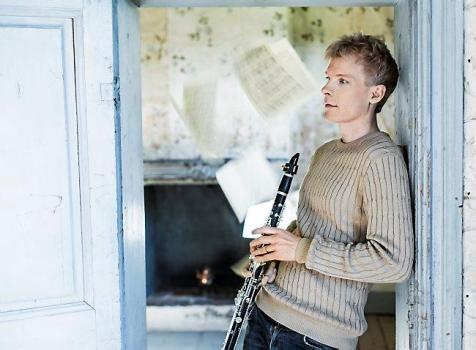
20150227_150301ae-spco_frost

BBC Symphony Orchestra, Sakari Oramo (conductor), Martin Frost (clarinet)

Barbican Hall, 17th October 2017

  • Dmitry Shostakovich – Symphony No 9 in E flat major Op 70
  • Aaron Copland – Clarinet Concerto
  • Sergei Prokofiev – Symphony No 6 in E flat major Op 111

Vikings, stave churches, Celsius, Bohr, Angstrom, Ibsen, Strindberg, Laxness, Kierkegard, Nielsen, Sibelius, Greig, Munch, Balke, Olafur Eliasson, ABBA, Bjork, Bergman (x2), Lars von Trier, Ullman, Sofia Helin, Mads Mikklesen, Kim Bodnia, the laconic Kimi, Schmeichel (P), Salonen (EP), Lego, IKEA, SAAB, zips, mobile phones, seat belts, loudspeakers, Alvar Aalto, Arne Jacobsen, art glass, Georg Jensen, BIG, arket, meatballs, herring, saunas, Gamla Stam, Djurgarden, Tivoli, that Bridge, Roskilde Cathedral, Uppsala Cathedral, Copenhagen Opera House, Temppeliaukio Church. There’s a few of my favourite Scandi  people and things. And that’s before anything from the natural world. And doesn’t include those Scandinavians I would count as friends. There are good reasons why Scandis are generally pretty pleased with themselves, though not in a wanky kind of way. They have much to be pleased about.

Anyway it turns out that there is an organisation for promoting the Scandinavian countries and their culture. CoScan. The Confederation of Scandinavian Societies. And every year since 1994 it has given an award to recognise the contribution of an individual. body or group on the international stage. Previous winners have included Sandi Toksvig, Magnus Carlsen (the best chess player in the world), Hans Blix, The Nordic Optical Telescope, that Bridge and Mika Hakkinen. This year was the turn of Finn Sakari Oramo, the Finnish Conductor of (amongst others) the BBC Symphony Orchestra. Presented on this very evening. Good on you Sakari. He seems like a thoroughly decent bloke and we here should be eternally grateful for the musical contribution he has made, especially to the Proms (five this year alone). He is a whizz across much of the Scandi composer repertoire, but especially Carl Nielsen, whose symphonies and, especially string quartets, don’t get enough of an airing IMHO.

in this programme he also wheeled out three works that should be performed more often. DSCH’s 9th may not be down there with the weird and whacky modernism of Nos 2 and 3 and the overly patriotic, fim-scorish 12th, but it does get neglected. Copland’s jazzy Clarinet Concerto is one of his favourites and was written for Benny Goodman but is pretty tricky so needs a top-notch soloist to do it justice. And Prokofiev’s 6th Symphony is rated by enthusiasts of his work but it is 1 and 5 that get trotted out most often.

So this seemed to me to be well-worth the effort. Which it certainly was. All three works come from the immediate post WWII era, and a scary time personally for DS and SP, but they are far from completely gloomy, at least in places.

Copland’s concerto is genuinely untroubled, and was premiered by Goodman in 1950. The slower opening drops straight out of Copland’s Americana, specifically Appalachian Spring, kicking off with low strings and harps, against which the clarinet meanders, with the violins then following. Just like the sad scene when the love interest dies in a Western. It then jumps into what seems to me to be a fiendishly tricky cadenza, fully written out, which Martin Frost, doing that curious Pied Piper jig that woodwind soloists seem to adore, made look simples. Of course maybe it is. What would I know. I got booted out of recorder practice at school on the grounds of persistent ineptitude. It ends with a fortissimo scale from one end of the clarinet range to the other. Amazing. Straight into the faster, final section, with all sorts of string effects like a sort of mega Bartok quartet. More showing off from Mr Frost with a jazz jam to finish. He encored with a klezmer arrangement from his brother Goran which near brought the house down. There he is above looking suitably impish. Frost is a good name for him.

DSCH initially promised a big splash for his Ninth, with soloists and chorus, just like you no who. Shostakovich being Shostakovich though what he actually served up was a five movement, small scale (by his terms) joke, which barely gets over the finish line. Obviously he has form with odd, almost embarrassingly jejune structures, and musical satire, as much as he could get away with, witness the Sixth, but here we have what I read as an entire flippant f*ck you across a whole symphony. Maybe not just to his political masters but also to the music world in general. Everything he is routinely accused of is there but recast in a sort of Haydn-esque jollity. Scurrying strings, whistling woodwind, boy soldier drums, farting brass fanfares, an abrupt “I’ve done enough” concluding chord. And that’s just the first movement. The second movement is one of those desolate stalking Moderatos but never plumbs the depths and the screaming strings never come. The scherzo lollops along but with no repeat slows into the regulation Largo with doomy fanfare and bassoon lament which as always for me at least conjures up the battlefield dead. But again it is on a tiny scale. This is the sort of movement DSCH can crank up to 20 minutes plus. This is all over in four. The symphony ends with a quick movement which kicks of with a folksy little lick which builds up and eventually dashes over the line to the close. The whole thing is like some child’s Toy-town version of a DSCH symphony. Oramo and the BBCSO, correctly, didn’t attempt to make a case for profundity, taking it straight. I loved it.

Once again I found myself being really taken with a major Prokofiev piece that I had dismissed previously. It is the most symphonic of his symphonies, the most expansive and the most, dare I say Shostakovich-ian. It does occasionally start to go a little too C19 Romantic on your ass but there are enough of the trademark SP lurches and new twists to forestall tedium. So, like DCSH, got himself into a lot of bother with Stalin’s “realist” henchman by being a sarky, modernist clever clogs. The difference is SP actually came back to Russia to face this, er, critical music. He liked to satisfy his customer but the iconoclast in him could never be entirely suppressed. The Sixth, as a commemoration for the war dead was initially OK’d by the authorities but then, in 1948, censured.

The first movement kicks off with a couple of lazy themes led by strings then oboes before snapping into gear with a third, more forthright chanting theme, set against a tick-tock rhythm, which revives the first theme and sets up a massive tutti climax. A mixture of Mahler, Shostakovich and Saint Saens, it collapses into horn squeals, then all three themes are reprised. As usual with SP it lurches around a bit but has some great colours and sounds. It can probably turn into a bit of a grandiloquent mess in the wrong hands but I reckon Mr Oramo, by cracking on, get it about right.

The second movement Largo starts off with a series of big, chromatic gestures, but with some swinging brass, a bit like Wagner loosened up and had a nice long toke. Then we move into a kind of dreamy, lyrical reminiscence, all Hollywood love story, which breaks back into the tick-tock march of the second theme, before the first is reprised, in size. Overall this movement is genuinely unsettling.

As, in some ways, is the final movement marked Vivace, but only because it kicks off in perky neo-Classical vein. Though the bass line is anything but gallant, thumping away angrily, and backed up with percussive piano. The second idea is another jolly scamp led by woodwind, then rising strings, but this time with the tuba doing its best to create havoc. Gradually the dance starts going off-kilter, the fun peters out, and nasty stuff jumps out. The chant from the first movement returns now over the percussive thuds and deep brass fanfares. A major triad to conclude. Happy and triumphant it ain’t.

Very convincing. I have subsequently revisited the work listening to a couple of Russian orchestra performances. It wasn’t just Sakari Oramo and the BBCSO who nailed this. It really is a terrific piece of music. I think I am properly converted to SP’s world. That’s the thing with “high” art. You just need to put the hours in.


Southbank Sinfonia and Vladimir Ashkenazy at Milton Court review ****

sergei_prokofiev_04

Southbank Sinfonia, Vladimir Ashkenazy

Milton Court Concert Hall, 16th October 2018

  • Edvard Greig – Holberg Suite
  • Sergei Prokofiev – Symphony No 1 “Classical”
  • Ludwig van Beethoven – Symphony No 7

I am very partial to Vladimir Ashkenazy’s musicianship. Especially his way with Beethoven and Chopin on the piano. I gather the cognescenti think he is a bit bland and a tad direct. I disagree. I can’t be doing with all that showy rubato. I want to hear Chopin’s, and especially Beethoven’s, notes. He is best known for his Rachmaninov but I can’t be doing with all that syrup and I probably need to find out if he is my way into Scriabin.

Anyway he doesn’t play piano live any more but he is still an inspirational, and energetic in his 81st year, presence on the podium. And here he was with the Southbank Sinfonia where he is Patron. The Southbank Sinfonia is an orchestral academy which each year brings together 33 young musicians, supported by a bursary, to provide an opportunity and plenty of hands on experience from which to launch into their professional career. There have been many successful alumni since the initiative was launched by Music Director Simon Over in 2002. They are based in St John’s Waterloo, (London, not Liverpool or Canada, that might be an expensive trip), and offer excellent rush hour concerts each month for any of you classical curious.

They are an impressive and enthusiastic bunch and I rarely miss an opportunity if convenient to hear a Beethoven Seventh, it being, along with Vivaldi’s Four Seasons (scoff if you like but it won’t change my mind), Bach’s Partita No 2 for violin, Britten’s Serenade, Holst’s Planets, Mozart’s Jupiter, Ligeti’s Etudes, Monteverdi’s Vespers, Part’s Speigel am Speigel, Steve Reich’s Drumming, Shostakovich’s Eighth String Quartet, Stravinsky’s Rite of Spring and Tallis’s Mass for 5 Voices, the greatest works of classical music. The Seventh is the best of all though. I am now remembering the interpretation from Kirill Petrenko and the Berlin Philharmonic at this year’s Proms (No 68). Pardon my French, but f*ck me that was about the most exciting musical experience I have ever had, up there with Led Zeppelin at Knebworth and the Bunnymen in their pomp.

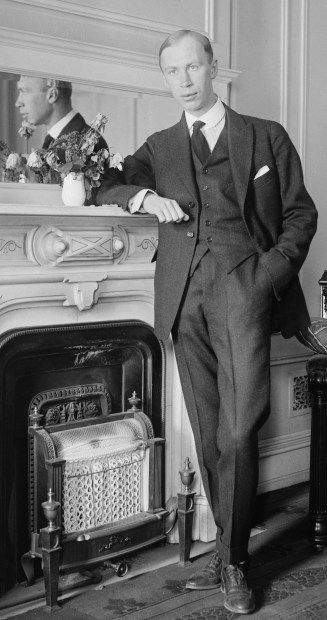
Anyway VA and the band delivered a very palatable rendition here, though the first movement was a little plodding and the last a bit unkempt, which the audience lapped up. As they did in the Greig. I had only heard the Holberg Suite once before, (with a quick revisit ahead of this). It’s neo-classical feel, an introduction then four dances, is attractive and Greig can conjure up a tune but it’s not really my bag. My regular reader will know that I have an ambivalent attitude to the boy Sergei, (there he is above looking well dapper), but that I am being increasingly persuaded. The First Symphony though is always a joy though, and being so, and because its all over in less than 15 minutes, it does pop up quite a lot in concert programmes.

Now we know that Prokofiev, even before that magpie Stravinsky, was on to the Classical, what with this First Symphony and his love of Haydn. Anyone with half an ear should love Haydn after all. It kicks off with a Mannheim Rocket, the same eight-note ascending arpeggio figure that Mozart uses in the finale of his G minor Symphony No 40 and Beethoven employs in the Scherzo of the Fifth. Way to go Sergei. The opening allegro keeps off in D major but soon bobs its way along into C. Come in anywhere and you could be listening to Haydn or Mozart, only just slightly off-kilter. There’s a rousing tutti about half way through then back to the scurrying. The second movement marked larghetto has a delicate string melody set against one of SP’s typical tick-tock rhythms. A brisk bunny hop. It could be early Beethoven. The third movement is a short plodding French gavotte, backed by characteristic drone, not the elegant minuet and trio of the genuinely Classical. If you think you’ve heard it before that’s because you have as it crops up again in Romeo and Juliet the ballet. Full on foot-tapper. The rousing finale races around the orchestra, the love child of a Shostakovich scherzo and a Beethoven rondo, wth sweet woodwinds, much like the finale of the Seventh.

So nice programme, enthusiastically, if not always entirely accurately, played, drenched with Mr Ashkenazy’s customary enthusiasm.


The Sweet Science of Bruising at the Southwark Playhouse review ****

fight-306372_1280

The Sweet Science of Bruising

Southwark Playhouse, 16th October 2018

Now that MS, BD and LD have turned into exemplars of their youthful generation, (I am their Dad so may be biased), we no longer watch Doctor Who. However with Malorie Blackman, Ed Hime, Pete McTighe and Vinay Patel (An Adventure at the Bush Theatre review ****) on the writing roster, and Jodie Whittaker as the good Doctor, perhaps I need to rethink.

Even more so since the writing team also comprises Joy Wilkinson, who is the pen behind The Sweet Science of Bruising, which is, if you get your skates on, still playing at the Little at Southwark Playhouse. Joy Wilkinson first wrote the play in 2007 but it has taken until now for it to be stage thanks to the enlightened team at Troupe theatre under Ashley Cook, (who takes on three of the minor males roles here), responsible for Rasheeda Speaking, Dear Brutus and The Cardinal (The Cardinal at the Southwark Playhouse review ***), and the theatrical factory that is the Southwark Playhouse.

The reason it has taken so long to come to life is that it demands (here) 10 actors for 15 named parts. Thus making it an expensive proposition to stage. Still here it is, and what a fine, and novel, play it is. Its subject is the world of women’s boxing in pre-suffrage, Victorian times, 1869 to be exact. Its message is powerfully feminist. Four women, earnest nurse and would-be doctor Violet Hunter (Sophie Bleasdale), clever Irish street-walker Matty Blackwell (Jessica Regan), suppressed and abused upper class wife Anna Lamb (Kemi-Bo Jacobs) and gutsy Northern pugilist Polly Stokes (Fiona Skinner), a real life boxer, come to the boxing club of “Professor” Charlie Sharp (Bruce Alexander) to seek fame, fortune, validation, redemption and political awakening.

Joy Wilkinson cleverly intertwines their personal stories with the oppression and prejudice that women faced from men and society in Victorian times, with boxing, it transpires, the perfect metaphor to realise this. It proceeds energetically across 26 scenes. Director Kirsty Patrick Ward, designer Anna Reid and, especially, fight and movement director Alison de Burgh bring the spirit of time, place and spectacle alive. There are a few scenes where the message is a little shoe-horned in, as often happens when playwrights wish to expose their scholarship, but this is more than compensated by the genuine connection Ms Wilkinson creates to the stories of these four (yes four, how good is that) women.

There is an awful lot of drivel shown on stages much bigger than this, with much less to say and much less entertaining. This really should find a bigger home, or, if there is any justice, some shrewd TV type should commission Joy Wilkinson to adapt it for the telly.


A Very, Very, Very Dark Matter at the Bridge Theatre review ****

andersen-hc

A Very, Very, Very Dark Matter

Bridge Theatre, 13th October 2018

OK then. All of you fans of densely-plotted, cerebral, potty-mouthed, fairy-tale, political, splatter, revenge, comedy fantasies. Your ship has come in.

I have a strong feeling that Martin McDonagh’s new play at the Bridge will, in years to come, form the basis for many a Theatre and Drama Studies students’ dissertation. Let’s just say he doesn’t hold back here. All of his tics, tropes and obsessions are on show: moral instability, savage humour, verbal aggression, twisted irony, brutal violence, calculated abuse, punishment, justice and revenge, inversions, post-modernist borrowings, self-reverence, complex allusion, high and low art juxtapositions, exaggerations, call-backs, call-forwards and protean plot twists.

In a word: meta.

Once again he is pushing the audience, deliberately transgressive, a kind of theatrical meta-regression to keep us on our toes, but this time, unlike the best of his work, it doesn’t quite hang together on first viewing. The rhythm of the language is less immediately persuasive, less precise, (even allowing for a few timing issues at this early performance). It cannot be missed mind you, and it may be that the production will tighten up through the run, but overall I found it a little less convincing than Hangmen or The Lieutenant of Inishmore, or Three Billboards … or In Bruges. In these the intricate plotting and more naturalistic settings make for a more satisfying whole. On the other hand AVVVDM might turn out to have more intellectual depth: I am simply not clever enough to take it all in on one viewing. Probably closest to Seven Psychopaths for you students of MM, a film even he described as maybe a bit too meta, but one which I think gets better on repeated viewing.

AVVVDM is drawn from Mr McDonagh’s 1995 play The Pillowman, which was first performed in 2003 at the NT and also starred Jim Broadbent, (who plays Hans Christian Anderson in AVVVDM), as cop Tupolski, alongside David Tennant, Nigel Lindsay and Adam Godley. In this play a writer, living in an unspecified totalitarian theocracy, is accused of murders which mimic the plots of his own fairy tales. It is a bit Gothic, it captures the power of literature, there’s some Kafka going on, the ethical dilemma is fascinating if a little forced, of course there is violent imagery and of course there is humour.Like all of McDonagh’s plays The Pillowman’s morality is slippery, though not really ambiguous; it is normally pretty clear what he is saying, just that its compass is oscillating so rapidly between perspectives of right and wrong that we in turn start to lose our bearings.

Once again it he world of “fairy tales” that forms the starting point for AVVVDM. In fact the “plot” looks to be drawn from The Shakespeare Room, which Michal, Katurian’s damaged brother, references in The Pillowman. In this story it turns out that Shakespeare’s plays were written by a pygmy woman he kept in a box. MM has described in the past, reiterated in the programme here, how he made up fairy tales in his teens for his older brother John. One of these formed the basis for another of Katurian’s stories in The Pillowman, The Tale of the Town on the River, which tells how the Pied Piper “saved” one of the children by chopping off his toes. And so fairy tales get darker and darker with the telling.

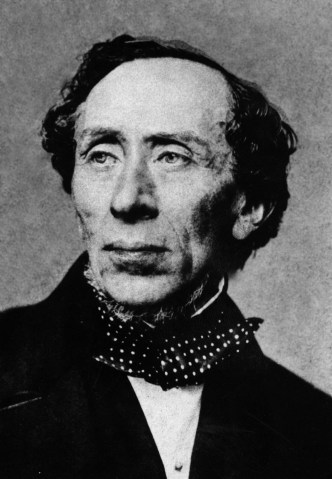
AVVVDM kicks off with Hans Christian Andersen giving a contrived recital of The Little Mermaid. Now it turns out that the real HCA was an awkward character, abused at school, with unrequited longings for men and women but likely celibate. One of the objects of his affections, Edvard Collin (Lee Knight), is in the crowd in this opening scene. And, incongruously, also there, well there in HCA’s mind, cue the scary music, are a couple of blood encrusted, walking and talking, corpses, Barry (Graeme Hawley) and Dirk (Ryan Pope), sporting fine moustaches. Well this is a fairy tale after all. Cut to the attic of HCA’s townhouse where, surprise, surprise, we discover that he has a secret, namely a Congolese pygmy, Marjory, in a box, who is writing his stories.

All this is accompanied by a gravelly narration from none other than Tom Waits. From here MM weaves together the genocide in the Congo Free State in the late C19 with the real life friendship of Charles Dickens (Phil Daniels) and HCA, which unravelled when HCA overstayed his welcome on a visit in 1857. I’ll stop there. Let’s just say the plot plays fast and loose with fact, fiction and time.

I guess MM’s main thrust is to contrast the near unbelievable horror of King Leopold II’s direct, private rule of the Congo from 1885 to 1908, where maybe ten million died, and which scarred the country through Belgian colonial rule, and post independence, with the pygmy population suffering most, (as it still does today), with the maudlin tales of innocence and virtue standing fast against corrupting forces of both HCA and Dickens. It is hard to avoid the stories told by the latter, they permeate Western culture: the barbarous reality of the former though, a couple of decades later, and far worse than anything imagined in fiction, is still barely known by many, including me until now.

The fact that MM tells this story in the form of a comedy, in an expletive-ridden contemporary vernacular, is only to be expected from MM. Casting Jim Broadbent and Phil Daniels, who are, by virtue of career and demeanour, are distinctively Dickensian, is surely no accident. After all a new MM script will pretty much guarantee any actor from his roster of favourites will sign up, sight unseen. Both went all out for laughs, many of which were at the broad end of the subtlety scale. Emily Berrington, as she so often does, near steals the scenes she is in as the earthy Mrs Catherine Dickens. I loved the sweary kids as well. Paul Bradley, as the inexplicit Press Man, also turned in his customarily fine performance.

However the play would not be possible without the formidable Johnetta Eula’Mae Ackles as Marjory, (and later Ogechi, you’ll see). From the moment she emerged from the box, suspended from the ceiling in Anna Fleischle’s amazing set, I couldn’t take my eyes off her. This was BUD, and KCK’s, first exposure to the wonderful and frightening world of Martin McDonagh. The SO was converted at Hangmen. When we emerged, not a little bewildered, after the 90 minutes, we debated the play long into the night. OK then maybe not long into the night, but certainly as long as it took to have a drink, some rarebit (highly recommended) and some madeleines, in the excellent Bridge foyer. Anyway BUD, being the analytical sort of chap he is, couldn’t get over the fact that the play could only exist with Johnetta Eula’Mae Ackles in the role. Surely it must have been written for her?

I agree. But not for the obvious reasons of appearance. Simply because she is an outstanding actor. Sardonic, bitter, vengeful, powerful yet also vulnerable, compassionate and forlorn. Don’t get me wrong she delivers plenty of killer (literally) comic lines but she also carries the entire weight of the emotional and political substance of the play on her shoulders. This is her professional debut. Extraordinary.

Now director Matthew Dunster, and Anna Fleischle, have previous with Martin McDonagh, having brought the Royal Court production of Hangmen into being. (Mr Dunster also has form with HCA, directing the Pet Shop Boys’ ballet adaptation of his story The Most Incredible Thing. Messrs Tennant and Lowe know a thing or two about stagecraft challenges but they are not a patch on MM).

Even so I suspect director and designer, and the rest of the creative team, James Maloney (music), Philip Gladwell (lighting), George Dennis (sound), Chris Fisher (illusions), Finn Ross (video) and Susanna Peretz (wigs and prosthetics), must have rolled their collective eyes at their first meeting. How were they going to make this leap of mischievous imagination from page to stage? Impressively, as it turns out.

So you see the thing with MM is there is just so much there. So many echoes yet uniquely his own voice. Scorsese, Malick, Pinter, Tarantino, Synge, Le Fanu, Mamet, Beckett, Borges, punk. Insert your own thoughts here. I for one really what to believe he likes The Fall.

A master story-teller. With maybe, in this case, not quite a master story. It might annoy you. It might frustrate you. It might provoke you. It might overwhelm you with “WTF” moments. It should make you laugh, (assuming you know a little of what you are letting yourself in for). It will certainly make you think. And you definitely won’t forget it in a hurry.