The Papatango New Writing Prize is apparently the biggest of its kind in the UK, offering its winner the guarantee of a production and a commission to support a follow up play. The Funeral Director, Hanna, Trestle, Foxfinder, and especially Matt Grinter’s Orca, have all impressed me. Many of the writers have gone on to successful careers. This year’s winner, Shook, is as good, if not better than its predecessors, and, on the basis of this, I pray that its writer Samuel Bailey, has more ideas up his sleeve.
Shook is set in a young offenders institute where three young men, with expectant partners, are taking a class in parenthood facilitated by Grace (Andre Hall). Jonjo (Josef Davies) is initially skittish, agonised by the violent crime he has committed, whose nature and context takes time to emerge. Scouser Cain (Josh Finan) is incapable of self-censorship and sports an empty swagger. In contrast Riyad (Ivan Oyik) is more self-assured, deadpan in attitude, but keen to use education to help him thrive post his impending release. Samuel Bailey’s pin sharp dialogue initially accentuates the masculine banter, and is very funny, but gradually the deeper truths about the three young men emerge. Cain’s hyper-activity masks his helplessness, life inside preferable to the chaos of his upbringing, to Jonjo’s harrowing realisation that his reaction to provocation has ruined his chance of the normal family life he craves and Riyad’s temper and bravado sabotage his fierce intelligence. They may be young offenders, the exchange of sweets reminds us of their youth, but upbringing, society and system seem destined to conspire to break any chance they have of rehabilitation.
The characters are brilliantly crafted, back-stories and expectations, emerging naturally which is remarkable given the deliberately confined setting, and is helped by having the matter-of-fact Andrea as an emotional foil to contrast with the disclosures that emerge from the three men’s burgeoning friendship. The play doesn’t set out to be didactic or hammer home a message but still secures the audience’s sympathy for the wasted lives that seem set to emerge. The classes may ultimately be futile but at least offer some opportunity of catharsis for the three.
Jasmine Swan’s naturalistic set, is perfectly realised, and director George Turvey, focusses as much on the movement and non-verbal, as verbal, communication between characters, which, given the quality of the dialogue, is no mean achievement. Above all though it is the three young actors who utterly persuade. We are asked to imagine their lives before, beyond and outside, that we do so reflects their total commitment.
Fascinated to see what Mr Bailey comes up with next.
Fannyed about and failed to book this when it came to Chichester. Wasn’t about to make the same mistake again so quick off the mark when the transfer to the MCF was announced and a three line whip to include the SO and, a new fellow traveller, TSLOM, whose literary knowledge might even exceed that of the SO herself.
Anyway, and at the risk of coming all over key board warrior alone in his bedroom, IT IS ABSOLUTELY VITAL THAT YOU DO NOT MISS THIS ON ITS THIRD OUTING. It will show at the Harold Pinter Theatre from 8th May to 26th September, and there are plenty of tickets left, which gives you no excuse even if you wait.
For this is one of the funniest and smartest plays you are likely to see in this or any other year. No great surprise given Laura Wade’s track record (Home, I’m Darling, Tipping the Velvet, Posh, Alice, Breathing Corpses, Colder Than Here) and a sympathetic, I assume, director in the form of partner Samuel West (Prue and Timmy’s boy for you canal lovers).
Easy enough to find out the central premise. The Watsons was a novel from 1803/4 that Jane Austen abandoned, (as she did in 1817 with Sanditon, which, as I am sure you are aware, Andrew Davies and ITV recently “completed”). JA produced about 80 pages, laying out all the characters, and some clues as to where it would end up, though whether as novella or full blown novel isn’t clear. Apparently loads of punters have had a stab at completing it, the Austen industry being a continuing British success story, though I doubt have been as successful in their efforts as Ms Wade.
On to the bijou stage at the MCF, mediated through Ben Stones’s, ingenious white box with props and plinth stage, and Mike Ashcroft’s precise movement direction, we meet all the characters from the original novel at a ball, obviously. Emma Watson (Grace Molony – perfect) is the youngest daughter of a widowed, and poorly, clergyman (John Wilson Goddard). She was brought up by a wealthy aunt, and is thus educated and refined, but after her benefactor remarries, she returns home to Daddy and her daft sister Margaret (Rhianna McGreevy). The sisters are, by dint of economic circumstance, looking to make a “good match”, with more than one eye on the dashing, though plainly caddish, Tom Musgrave (Laurence Ubong Williams). His shortcomings are identified by Emma’s level headed eldest sister Elizabeth (Paksie Vernon). Their neighbours include super toff, Lady Osborne (Jane Booker) and her super awkward son (Joe Bannister), and his sprightly sister (Cat White). At the ball, accompanied by kindly chaperone Mrs Edwards (Elaine Claxton), she is introduced to local vicar Mr Howard (Tim Delap), a potential Mr Right, even if he veers towards the priggish, and his eager young nephew, Charles. Soon after Margaret returns home with grasping brother Robert (Sam Alexander) and his snobbish wife Mary (Sophie Duval). Nanny (Sally Bankes), looks on bemused.
So far, so, er, Jame Austen. And then the maid arrives, who is, to say the least a bit lippy and forward. Yes it is, and I am giving nothing away here, our very own playwright Laura (played by Louise Ford -also perfect), hot from “reality” to rescue Emma from making a crappy marriage choice from the three candidates, and boost female agency. When Emma, who isn’t, it must be said, altogether happy with the intervention, and the rest of the cast, have adjusted to this surprising turn of events the fun really begins. Meta doesn’t begin to describe as the cast take umbrage with being “characters” in a “play” and rebel against Laura’s authorship of their “lives”. This permits the dissection of class and gender, as in previous plays by Ms Wade, but against the backdrop of who owns a story, genius in the context that this was both unfinished and that so many of us have an obsessive interest in its author and her books, and the social mores it represents, well beyond what is there on the page, (JA I mean not LW, though, of course, as the conceit unfolds, we are very much invested in LW, the character of LW the playwright).
There are precedents for the play, notably Pirandello’s Six Characters in Search of an Author, which LW self-deprecatingly admits, but this is much more immediate in its impact. LW doesn’t abandon the comedy that flows from parody, though there are no cheap laughs here, nor does she abandon the search for logic in the face of what she is articulating. Even if that logic is as daft as the very idea of the willing suspension of disbelief in the first place. This is not clever-clever, up its own arse theory theatre, though. It will make you think about its themes but never at the expense of making you chuckle.
Sam West’s direction, and Ben Stokes’s costumes, are geared to this purpose, the conventions of period drama never entirely subverted even when the cast threatens anarchy to plot, and there is a knowing warmth throughout. This may be satire, but everyone involved plainly loves, and fetishises Austen, as much, if not more than the audience. When the production, including Richard Howell’s lighting, Gregory Clarke’s sound and Isobel Waller-Bridge’s music, opens up on the Harold Pinter stage expect the brilliance of Laura Wade’s creation to be even more apparent.
From one side of London to the other. All on track until the very last gasp, so snuck in a few minutes late to this. A big thanks to the very helpful ushers at this friendly house. TBQOL isn’t starved of revivals but this was my first live viewing of Martin McDonagh’s first play, though somewhat nominally since the next two in the Leenane Trilogy, A Skull in Connemara and The Lonesome West, as well as the first two of the Aran Islands trilogy, followed hot on its heels in the mid 90s. Hence my completist determination to see it.
And the fact that it had attracted some decent reviews at the run at Hull Truck, the co-producer. Whose veracity I can testify to. Designer Sara Perks has delivered a Connemara farmhouse, shared by Mag Folan (Maureen McCarthy) and daughter Maureen (Siobhan O’Kelly), required for all these plays, but with a twist. The walls are half-built, foretasting Maureen’s escape, though beyond the walls all is dark, in Jess Addinall’s moody lighting design. (There is an interview with young Ms Addinall, who started as a temporary technician at Hull Truck, which shines a light !! on her work and ambitions).
At its heart this is a simple story. 70 year old Mag is suffocating the 40 year old Maureen, who, after her two sisters married off, grudgingly tends to her every whim, tea, porridge, lumpy Complan. When she meets old schoolfriend Pato Dooley (Nicholas Boulton) at the farewell party of a visiting American uncle the chance to escape beckons, despite Mag’s interventions. The only other character is messenger Ray (Laurence Pybus), Pato’s younger brother, default setting bewildered, distracted by casual violence. This being MM the course of true love doesn’t run smoothly and things don’t end well.
It is brilliantly written, with exquisite dialogue, by turns comic and tragic, (my favourite, the crucial fire poker is casually described by Mag as “of sentimental value”), and a sturdy plot. That’s why it won a ton of awards when it first appeared in 1996, in Galway itself, before the Royal Court run and then transferring to Broadway in 1998. It is also, intertwined with the bitterness and regret, of all three characters, brimful of pathos, perhaps more so than the other Irish plays. Maggie McCarthy, slumped in her chair, allows us to see Mag’s vulnerability even as she passively-aggressively plots to keep Maureen in her place. Nicholas Boulton shows us the deep sadness at the core of Pato, happy neither in London, where he goes to work, and home in Leenane, and the excitement with which he imagines a new life with Maureen in Boston. And Siobhan O’Kelly is mesmerising as Maureen, whose past, and isolation, explains her awkward, exaggerated behaviours. Daughters turn into their mothers. Who’d have known.
Just a shame some berk in the audience seemed incapable of turning their phone off, twice, much to the chagrin of Ms O’Kelly. If you don’t know how your phone works (which I surmise was the issue here), ask someone younger (yep it was an early boomer), or, better sill, don’t bring it to the theatre. Whatever it is can wait. You are not that important.
My guess is that Hull Truck AD Mark Babych is a big fan of McDonagh’s. Mind you who isn’t. The SO and I still rate Hangmen as the best play we have seen in recent years, LD’s favourite was the Michael Grandage revival of The Lieutenant of Inishmore with Aidan Turner, and everyone I know who saw A Very, Very, Very Dark Matter, despite its flaws, hasn’t forgotten it in a hurry. Mr Babych has plainly lavished a great deal of care on this production and I am a little surprised that it hasn’t toured. Still, London audiences will have another chance to see the play at the Lyric Hammersmith later next year, in a production directed by LH AD Rachel O’Riordan (she kicked off her inaugural season with the superb version of A Doll’s House written by Tanika Gupta).
The Tourist recently saw another play centred on a dysfunctional mother-child relationship, Eugene O’Hare’s misfiring Sydney and the Old Girl at the Park. Chalk and cheese, This is how it should be done.
Hard to credit but the Tourist had never seen a production of AWTEW until now. Which made the pleasure in seeing Tom Littler’s pint sized production, in tandem with the Guildford Shakespeare Company, even sweeter. Wiki tells me that AWTEW is, by Will’s standards, a compact play with 13 named characters as well as the usual stand-in “Soldiers, Servants, Gentlemen, and Courtiers”. Mr Littler has whittled it down to a cast of 6 with some clever excisions, revisions, re-inventions, gender changes, doubling and tripling. And some precise choreography, thanks to Cydney Uffindel-Phillips, to make it all fit the tiny JST stage.
Now as far as I can see all the elements of the plot, pinched from The Decameron, are present and correct though I can’t be sure about the detail of the text. Doctor’s daughter Helena, the graceful Hannah Morrish who has already impressed in the RSC’s 2017 series, Julius Caesar, Titus Andronicus and especially Coriolanus, as well as Simon Godwin’s Tony and Cleo at the NT, is in love with the up himself Bertram, a well judged performance from Gavin Fowler. His Mum the Countess (Miranda Foster take 1) is on board but Helena heads off to Paris to cure the sickly Queen (not King) of France (Miranda Foster take 2) who commands Bertram to marry her as the payment for her healing hands. The cad scoots off to war, with his chum, prize arse Parolles, Robert Mountford having about as much fun as it is possible to have on stage whilst still nominally acting, telling Helena he will truly be hers if she bears his child and wears the family ring. The Countess disowns him, Bertram turns his charm on one Diana (Ceri-Lyn Cissone take 1), she and Helena hatch classic bed swap routine. Ring secured, sexy time wrapped up. Helena fakes death, naturally, Bertram returns home to marry aristo but Helena interrupts. Bertram bowled over. AWTEW.
Overseeing the capers is one Lord Lafew (Stefan Bednarczyk) and Miranda Foster’s final incarnation as a Florentine widow and Mum of Diana. Oh, and of course, there is a whole comic routine mocking the bravery of wind-bag Parolles, facilitated by a handy, invented, soldier Dumaine, also Ceri-Lyn Cissone.
Mr Bednarczyk and Ms Cissone are not on stage just for their, fine, acting skills though but also for their facility on a piano. For, if music be the food of love …. I know wrong play but music is central to this production, though not maybe always quite the tunes you might expect. Helena loves her vinyl collection with Rumours, Horses and Blue, (look ’em up Gen Z), forming the soundtrack which are expanded and extended in some nifty arrangements courtesy of Stefan B himself. I can see why the one-size fits all lyrics of The Chain might fit the AWTEW bill though I was a little less sure elsewhere. But the music acts as a very pleasing counterpoint to the text and creates continuity in the shifts between the scenes.
As I say this is a logistical triumph with lighting (Mark Dymock) and sound (Matt Eaton) tailored to fit Neil Irish and Annett Black’s glam, cardboard box set, which like the play itself, works way better on stage than on page. But that was just the admirable starting point in Tom Littler’s direction. How to make the audience believe that the lovely, perfect in every way, Helena would fall for the shallow, man-chump Bertram? And especially believe his turn on a sixpence, she’s the girl for me, at the end. Is it because he was always secretly in love with her, just paralysed by the class divide? Or is it because he cannot, or will not, lose face at the end?
Not in this reading I think it is because we, like her, believe he can get better and that his initial dismissal is in part youthful inexperience. And she is the maturer, having had to grow up fast after the loss of her parents, (she regularly caresses her keepsake box), and not driven by money or status. Which is what makes it a thoroughly modern rom-com, for both good, it is hard not to like the set up, journey and the happy ending, and bad, it really is still the most sexist tripe when you think about it. But because both hero and heroine learn something about themselves along the way, once again the Bard, gets away with it, in our age as well as his. Of course there is clowning and plotting which are knowing in their familiarity, and, in Parolles, we have one of WS’s finer comic creations, whose comeuppance, as he rats on Bertram, is salutary.
This then is a dreamy, charming productions which has charmers at its heart, including, Queen, Countess and, in her way, Widow, and uses Helena’s unspoken memories as a way to solve some of the “problems” that this lesser-performed play presents. The intimacy of the staging, every single expression is conveyed to very single audience member, and the strength of the performances, also helps to frame and unify the production which just about magics away the abrupt shifts in tone.
And anyway, let’s face it, all this guff about Shakespeare’s problem plays is exactly that. They all contain “problems”. Life is full of problems. Veering from comedy to tragedy, with dead ends, changes of heart and head, and never really making any sense. Will knows that, and knows that we know that. Marriage may have been couched in rather ore prosaic terms in Elizabethan England but Tom Littler has, by rolling with Shakespeare’s invention, found a way to create a minor key classic.
An adaptation of Ibsen’s Ghosts, relocated to modern day India. Seems like a good idea no? It was. In fact better than I had expected even with its visible flaws.. Anupama Chandrasekhar has written a play that takes the Norwegian master more as inspiration than instruction and created her own, hard-hitting, response to male violence, female exoneration and the visitation of the sins of the father on the son. And with a crack cast and Indhu Rubasingham directing it is powerfully realised.
Bally Gill, who shone as Romeo in the RSC production last year, plays Akshay, the spoilt entitled son of Hema, (the marvellous Ayesha Dharker who you will recognise from big and small screen), who, along with grandma Jaya (Bollywood veteran Soni Razdan in full-on say what you think mode), fawns over him. We first meet him at the games company he works for in Mumbai, getting a dressing down for the failure of his latest idea from David (Paul G Raymond), the school friend and now successful entrepreneur, who was cajoled into giving Akshay a job because of family connections. Uma, (Miriam Haque who also plays Hema’s progressive sister), gets the nod from David to work on a new game, denting Akshay’s pride. He is still sulking when the three go to a bar for after work drinks. Later he vents his fury in an horrific act of violence with a clear real life antecedent.
He runs back to Mummy and we watch as the truth comes out. But Akshay’s guilt is not punished. Instead the corrupt police inspector, (a somewhat mannered Asif Khan, who plays neighbour Gopi in a similar way), and Hema concoct a plan to shift the blame and Akshay’s toxic aggression turns against Ragini (Aryana Ramkhalawon), the carer for the irascible Jaya. Whilst the development of the story is sickeningly predictable, Ms Chandrasekhar, has her writing hand firmly on the disclosure tiller, ratcheting up the tension, through to the explosive ending. Family history, as you might surmise from the source, plays a big part in this disclosure. There is no hope here; just brutal truth.
The dialogue is leavened with Hindu religious monologues from Jaya and the pesky crows, (realised by the puppetry of Matt Hutchison), which she feeds provide a symbolic edge well matched to Richard Kent’s claustrophobic, shadowy Chennai mansion house set, accented by Oliver Fenwick’s lighting and the Ringham brothers sound.
It isn’t subtle, teetering close to melodrama at times, and the original victim of Akshay’s horrific crime has no voice. There are, early on, humorous lines built on stereotype. Many reviewers recoiled from both play and production seeing sensationalism. But I was not clear if they were saying this subject shouldn’t be dramatised, or shouldn’t be dramatised this way. Personally I trust writer and director here and if the narrative and characters didn’t fit received wisdom then, for me, so much the better in terms of getting the message across. This is not a subject or setting that regularly finds its way on to mainstream London stages. There is nothing nuanced about the grotesque, misogynist violence which disfigures all societies, not just India, and reminding audiences outside the normal echo chambers of understanding seems to me a laudable aim. The casual and callous way with which female victims of male violence are portrayed every day of the week on the telly, or elsewhere in popular and high culture seems to me to be a far more pertinent target than this uncomfortable play.
One book, a Soviet TV adaptation, two films. And now a play. And, between us, the SO and I have all the bases covered. SO, a big fan of Stanislaw Lem’s ground-breaking 1961 dense sci-fi/horror novel, me, unusually tolerant of Tarkovsky’s high culture, languid 1972 film, and both fans of Soderbergh’s more straightforward 2002 remake with Clooney playing Dr Kelvin and Natasha McElhone his dead wife. .
With David Greig as adaptor, having thoroughly succeeded with Touching the Void and The Suppliant Women in his last two outings, and some very favourable reviews from the initial run at the Royal Lyceum Edinburgh where DG is Artistic Director, we were both quite excited, particularly after our epic bus journey to get there. (As time expanded it felt like the A310 itself was auditioning for the role of the eponymous blue planet).
A good sized and young audience for the Saturday matinee, and some mesmeric rolling wave cinematography from Tov Belling and Katie Milwright, and the reveal of Hyemi Shin’s bright monochrome set only increased our expectations. Not for the last time I was reminded of the look, feel and intention of Alistair McDowall’s excellent X at the Royal Court a few years ago. What followed was a stripped-down, simplified, but still essentially faithful rendition of the story, (though sticking mostly to the Tarkovsky film) which didn’t quite live up to its theatrical potential.
A gender switched Polly Frame plays Kris Kelvin, the scientist sent to investigate the strange goings-on at the space station studying the water planet Solaris. There she meets the wary Sartorius, (Jade Ogugua in another smart gender switch), and the geeky Snow (Fode Simbo). The planet itself is apparently conscious, sending “gifts” first in the form of objects and then as visitors from the crew’s past. Dr Gibarian, recently dead, possibly by his own hand, possibly a cancer, has left videos, (cue a giant sized projection of Hugo Weaving), offering Kris his insights. Much of the plot however, like the Soderbergh film, centres on Kris and her relationship with her visitor, Aussie surf boy, Ray (Keegan Joyce), her last, uninhibited, love who may offer her some sort of emotional redemption. Unfortunately this version of Ray, who is real and not just a figment, literally has no back story and cannot cope with the absence this creates.
This being a play we clearly need words, however good the technical prowess of the creatives, (including, in addition to the above, lighting from Paul Jackson, picking up on the planet’s red and blue suns, outstanding sound and composition from Jethro Woodward and further visual effects from Toby Angwin). David Greig’s adaptation cleverly obviates the need for prologue, flashback, exposition or resolution. The three surviving humans, Snow and Sartorius being significantly less fucked up by the experience than their literary equivalents, collectively work through the implications of what they have stumbled upon together. But this is where the text slightly lets down the production. Having set up the, shall we say, echo chamber, the opportunity for the three to share their own stories and to debate what this means for wider humanity is only partly explored. No one likes a talky play but surely here, there is after all a vast, infinite intelligence playing with our protagonists on the doorstep, a bit of philosophical theory might not have gone amiss. Existential isolation, infinite space, the problem of consciousness, all are central to Solaris. And these are scientists so no reason why they can’t come over a bit clever clogs.
And this could easily have been done without losing the human dimension. Whilst we do not see Snow’s visitor who he has “destroyed” we do Sartorious’, a small girl child, and learn why she is there, and Ray and Kris’s past, and present, attraction is explored at length. Matthew Lutton, who is AD at the Malthouse Theatre in Melbourne, who co-produced, oversees the impressive staging and the Aussie end of the casting, Hugo Weaving (who was sooooo good in Patrick Melrose as the abusive Dad) and Keegan Joyce, are more than a match for the Brits. The short scenes and cinematic cuts, with shuttering screen, prompt dislocation, but with nimble stage management from Kiri Baildon Smith and team, do not impede momentum.
This was, in spite of the missed opportunities, a satisfying piece of theatre that perhaps deserved an audience beyond just Melbourne, Edinburgh and London, though these are three of the finest cities on our planet. I see that Mr Greig’s next project is a musical version of Local Hero. Meanwhile I see us Poms are exporting Laura Wade’s Home, I’m Darling and Dennis Kelly’s Girls and Boys to the good people of Melbourne, both of which I can heartily recommend, to add to delights such as Photograph 51, Kiss of the Spider Woman and True West coming up. And in Sydney I see the Theatre Company is showing The Beauty Queen of Leenane as we speak, with The Deep Blue Sea, The Writer, Rules for Living and A View From The Bridge to come.
After the resounding success of Madame Rubinstein at the Park Theatre a couple of years ago it was a pretty easy sell to get BUD, KCK and the SO along to the same venue to see our favourite potty-mouthed, near-octogenarian National Treasure, Miriam Margoyles’s latest theatrical outing. SATOG however, whilst, when it got going, offering the twinkly eyed MM opportunities to deliver trademark laugh out loud waspish epithets, was a very different kettle of fish to the straight comedy of Madame R, as either of its lead characters might have said.
MM played the cantakerous Old Girl, Nell Stock, holed up in her shabby east End house, with 50 year old, live at home son Sydney, played by the much admired Mark Hadfield, who, I am ashamed to say, I didn’t initially recognise. Maybe that was because to say Sydney is peculiar would be a massive understatement. He is the archetypal oddball loner and he and Mum are locked into a textbook love-hate relationship. The setting smacks of Steptoe and Son and the dialogue that writer Eugene O’Hare employs to express the toxic dynamic hints at Pinter, or, in contemporary terms, maybe a palatable Enda Walsh . Sydney holds some fairly rum, if unconvincing, opinions, about women and foreigners, and when he does go out, nurses a pint in the local whilst pretending to be with friends. Nell simultaneously detests and relishes the hold she has over him.
Nell’s mobility is limited, spends most of her time in a wheelchair, and needs constant care. Cue Irish home help Marion Fee (Vivien Parry), all round good egg and saviour to the little Catholic orphans of London. After some variable, in terms of length and quality, set up scenes, we discover that Nell is looking to cut Sydney out of her will and deny him the inheritance of the house on which he is fixated.
Which is why I had anticipated an Ortonesque payback in the second half involving some artful double crossing between the three and the acerbic humour ramped up. I was wrong, Instead the guilt which binds Nell and Sydney together, hinted at earlier with Sydney’s fear of sirens, is given a full blown reveal complete with lighting (Tina MacHugh) and sound (Dyfan Jones) effects.
I assume that it was Mr O’Hare’s deliberate intention to shift tone through his play but it left the Tourist unable to settle on plot and character. Which is a shame because when MM and MH got going in the second half, before the overwrought ending, this was a fine black comedy. Vivien Parry had less success trying to persuade us of Marion’s ambivalence. Philip Breen’s direction gives the actors time and space to deliver the lines, as does the elaborate set of co-designers, Ruth Hall and Max Jones. But despite the championing of the director and cast the play never quite hits its stride. Nothing wrong with mixing comedy and tragedy, the lodestar of best dramatists in history. It’s just that without a thorough stir the ingredients can sometimes be half-baked and a bit too lumpy to satisfactorily digest.
P.S. Would be great if the next time MM takes to this, or another London stage, it would be in a reprise of her one woman show. Ideally as unexpurgated as possible. Or better still if the production of Lady In The Van that the good people of Melbourne, MM’s adopted home, enjoyed last year could find its way here.
Old Billers, now set to enjoy retirement as he steps down from his job as chief critic at the Guardian, knows a thing or two about theatre. So, when he identified, with his colleagues, OLOK as one of the best original plays of the C21, it reinforced the need to see it. There are plenty of other crackers on the list. I would concur with the likes of The York Realist, Escaped Alone, King Charles III, The Ferryman, Enron, The Watsons, Sing Yer Heart Out For The Lads, Caroline, or Change, One Man Two Guvnors and the Lieutenant of Inishmore, some of Billers’ other choices, but would be tempted to add Oil, Hangmen, John, Sweat, Love and Information and A Number to the list.
Anyway I missed OLOK at the Royal and Derngate so was very pleased to see it pop up in Stratford and, correctly as it turned out, ventured that this would be something which would pique the SO’s interest. For OLOK is an extraordinary story based on “real” events. Kibeho is a small village in SW Rwanda, home to a Catholic convent secondary school where, in the early 1980s, apparitions of the Virgin Mary appeared to three of the students, Alphonsine Mumureke, Anathalie Mukamazimpaka and Marie Claire Mukangango. The Virgin specifically warned in August 1982 of a Rwanda descending into hated and violence, seen as a premonition of the war and 1994 Genocide, though tensions between Hutu and Tutsi were already escalating. The school itself was destroyed in 1995 with the girls involved, (there were other claimed visionaries), themselves fleeing or dying at the hands of the Hutu militia.
In 1988 the local bishop, Augustin Misago, who was subsequently accused and acquitted of involvement in the Genocide, approved devotion at the site and the Catholic Church eventually sanctified the visionaries. Kihebo is now a place of pilgrimage. Katori Hall’s play, which was first produced in New York in 2014, pretty much cleaves to the story, with this much dramatic material to work with why wouldn’t you, and works not just because it examines the horror of what happened in Rwanda in those dark years, but also the nature of faith and the workings of the Catholic Church. And it does this not with clunky exposition, exaggerated dialogue or blundering censure, but with compassion and through concentrating on these very human characters.
Against the backdrop of Jonathan Fensom’s straightforward but effective set, a room in the hermetic convent, paint faded on the mud and plaster walls, we meet the three girls at the centre of the visitation, played by Taz Munya, Liyah Summers and Pepter Lunkuse, as well as their classmates, actors Aretha Ayeh, Michaela Blackburn, Perola Congo and Rima Nsubuga. The girls display the usual cliquey rivalries exacerbated by Hutu/Tutsi division. All of these young actors convinced, helped by voice and dialect coach Hazel Holder, though Taz Munya as Alphonsine, the naive newcomer and “first” of the visionaries, and Pepter Lunkase, as Marie-Claire, the bullying leader of the Hutu girls who initially mocks Alphonsine, before herself succumbing to the full on Marian experience. Movement director Diane Alison-Mitchell, as well as magic and aerial consultants, John Bulleid and Vicki Amedume when it comes to the end of act I coup de theatre, deserves immense credit for making the ecstatic visitations very real, even a little bit disturbing, though of course I wouldn’t actually know what it is to be called upon by VM.
The tolerant Father Tuyisheme, (a fine performance from Ery Nzaramba), a Tutsi whose wife has already been murdered, initially is the only one who believes the girls who fawn over him, but gradually the evidence of their own eyes persuades the domineering and envious Hutu Sister Evangelique (Michelle Asante), the lofty bishop Gahamanyi (Leo Wringer) and, when he is sent from the Vatican to asses the evidence, the sceptical Father Flavia (Michael Mears). Though their reasons for back-pedalling are not always pure and holy as the hierarchy sees the potential financial benefits of having a pilgrimage site in the middle of Africa, and even the increasingly uncomfortable good Father Tuyisheme plays along with the Church’s testing conditions. The credibility of what the visionaries claimed to see only became clear in retrospect of course, recognised “officially” in 2001, and the rebuilt church in Kibeho now is a magnet for tens of thousands visitors from across the Catholic world. (Anathalie Mukamazimpaka now lives on the site: Marie Claire Mukangang was murdered there).
Now, if, like the Tourist, you think all this visitation and Virgin Mary cult stuff is all nonsense, don’t worry, it won’t stop you enjoying the play. I haven’t seen Katori Hall’s previous feted play, The Mountaintop, set the day before Martin Luther King’s assassination, but she entrusted its direction at the Theatre 503 where it first appeared in the UK, to James Dacre, now the AD at the Royal and Derngate, and she has done the same here. I can see why. There are, of course, obvious parallels with classic plays such as The Crucible and Saint John (and, if you will forgive the re-location, Lynn Nottage’s Ruined), but this is very much an original. The value of faith against such a harrowing backdrop is questioned, as are the motives for the acceptance of the miraculous, but always in a modest and equivocal way, which Mr Dacre is attuned to, as is Charles Balfour’s lighting, Claire Windsor’s sound and Orlando’s Gough’s composition.
A thought-provoking subject and production, full of fine detail, that never loses sight of plot or character. And by occupying a time, before, and a place, apart, from the war to come Ms Hall succeeds in amplifying her message. It is no surprise then that MB rated it so highly and that we concurred. Whilst I can’t pretend that Tina the Musical, for which Katori Hall wrote the book, is on my list of must sees, I confessed to being intrigued by the premise of the TV show she has created, P-Valley, (though, as usual, I will rely on LD and BD to explain how and where to access it), and will keep a weather eye out for any new or revived theatre work from her.
No flies on this. Arinze Kene’s coming of age play which first appeared at the OvalHouse in 2011 is high octane stuff. Which here, under the direction of this year’s winner of the JMK Award, Tristan Fynn-Aiduenu, and a committed cast of Anyebe Godwin as Kehinde, Rachel Nwokoro as Joanne and Khai Shaw as Rugrat, got the production it deserved. (I see there are all deservedly up for Offie Awards). Missing AK’s one man show Misty in 2018 has become even more of an oversight on the basis of this but his take on Biff Loman in the Young Vic Death of a Salesman ranks as one of the best in London theatre in 2019.
Joanne carries a lot of swagger and attitude but worries about her mum’s mental health. Kehinde is a sensitive soul with his eye on a mixed race girl. Rugrat is the class clown who lacks direction. All are negotiating their way through inner city life. School, relationships, gangs, parents, emotions, money, ambition. But this is no fulmination of worthy dialogue. Instead AK mixes monologue, poetry, audience address and participation, recollection, history, comedy, physical theatre, dance, song, to tell their, interconnected, stories, notably Kehinde’s search for his now absent twin sister. It is generous, exciting, uplifting, and sometimes a little confusing as these stories overlap and are often left hanging. It starts off with laughs, a lot of them, but ends up somewhere far more contemplative.
If stage acting is about losing the fear then, trust me, these three show no fear. It really pains me to say this, so good are all three, but Rachel Nwokoro, has got IT. I can see that she has no interest in being tied down to a traditional acting career but I dearly hope I see her on stage again.
Tara Usher’s design is admirably straightforward , Bethany Gupwell’s lighting, dominated by an overhead halo, just about keeps up, Nicola Chang’s sound is superb and I hope DK Fashola, as movement consultant, got properly rewarded for his contribution.
Tristan Fynn-Aiduenu has directed a number of his own plays, including Sweet Like Chocolate, Boy, but I think I am right in saying this is his biggest directing gig to date. There are a number of established BME British directors, Indhu Rubasingham obviously, Nadia Fall, Lynette Linton at the Bush, (and who directed Sweat at the Donmar, my choice for best play of 2019), Roy Alexander Weise, about to take up the, shared, reins at the Royal Exchange Manchester, Nancy Medina, Matthew Xia, Beijan Sheibani, as well as up and coming talents such as Nicole Charles, Ola Ince, Gbolahan Obisesan and Emily Lim, all of whose work I have seen in the last few months. There’s a way to go but this, along with the wealth of BME acting, and lately writing, talent getting an opportunity to tell their stories, is encouraging. It permits me to see and hear stories that I would otherwise not. Which, when you come to think of it, is the whole point of theatre.
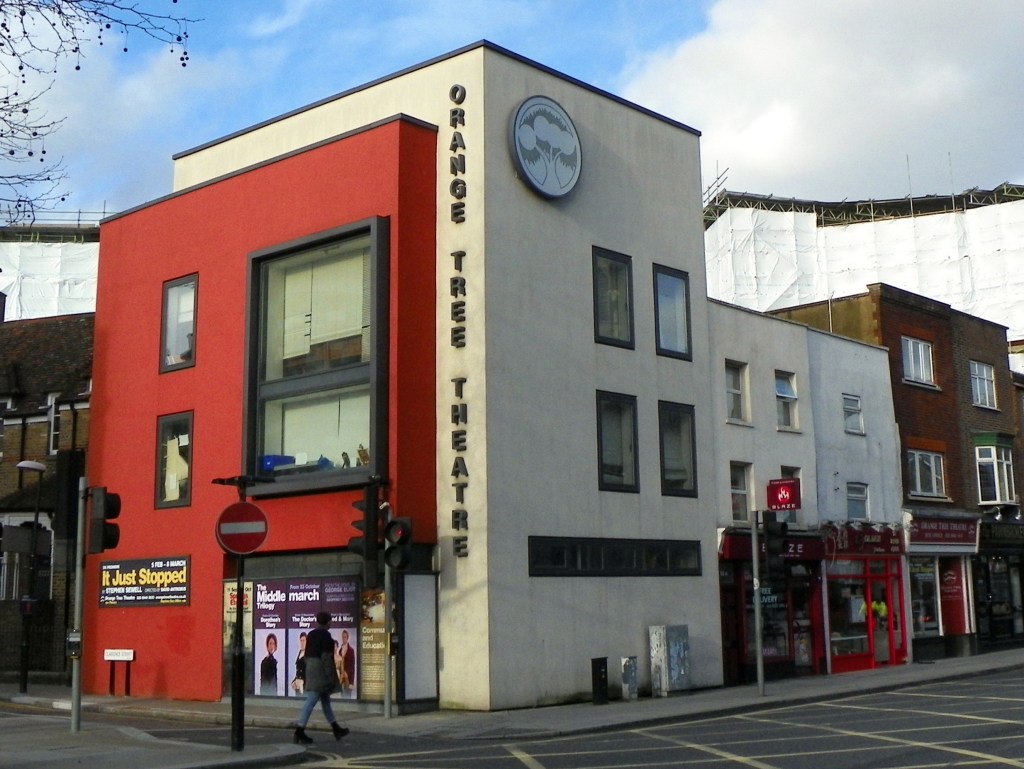
P.S. The photo of the Orange Tree was taken a few years ago. The sharp eyed amongst you will see the poster promoting the OT’s trilogy based on Middlemarch from 2013. Not, if I am honest, an unqualified success but an opportunity to remind me to implore you, in this, the week of the bicentenary of her birth, to read Middlemarch. Either for the first time. Or again. It is the greatest story ever told in the English language. Even if it is about the middle class in middle England.
The Lovely Bones, co-produced by Birmingham Rep, Royal and Derngate, Northern Stage and Liverpool Everyman, is just to wrap up its tour in Chichester. If you saw it good on you. If you didn’t then make sure you sign up for what ever director Melly Still does next. After triumphs such as My Brilliant Friend, which you can catch at the NT as we speak, Captain Corelli’s Mandarin, her RSC Cymbeline, and further back her NT Coram’s Boy, it is plain she is the Queen of physical theatre adaptation. What with her role as Associate at the Rose, and with Christopher Haydon about to arrive as the new Artistic Director, and better seating, things are really looking up for the Tourist’s local theatre.
Now some might recoil from Ms Still’s insistence on the primacy of visual spectacle alongside the text. Not me. And not, based on a spot of vox-popping of neighbours post performance, the audiences. Or it must be said most critics. To which we must give many thanks to adapter Bryony Lavery. Ms Lavery is set for a busy 2020. Her 1997 original play Last Easter will have its London premiere at the Orange Tree, she is adapting Philip Pullman’s La Belle Sauvage for the Bridge Theatre, her adaptation of Oliver Twist with Ramps on the Moon will tour, her adaptation of Oscar and the Pink Lady will take the stage in Sheffield and Theatre Royal Stratford East have chosen her musical version of Red Riding Hood for its Xmas 2020 panto. Not bad for a pensioner.
It is pretty easy to see why collaborators keep returning to her as an adapter of broad appeal theatre. Of course the subject and structure of The Lovely Bones, which is narrated by the now dead Susie Salmon, raped and murdered by a neighbour aged 14, may not quite fall into the category broad appeal. But Alice Sebbold’s 2002 debut book was a best seller and the 2009 film directed by Peter Jackson, whilst generating a mixed critical response, grossed around US$100mn. So safe to say it has “brand recognition”. And, whilst the subject matter is initially, and self evidently, unsettling, the way the story develops, with Susie torn between willing her family and friends to nail her killer and watching them get on with their lives and get over her death, is more compelling. In someone ways it is an unsentimental story told, deliberately, in a sentimental way. There is a Heaven but not that of Christian dogma, her family is broken by her death, but it still celebrates American family and community, it does operate like a slickly paced, artfully plotted thriller, but that was not the real point of its writing, there is some supernatural mumbo-jumbo but, obviously given the initial formal liberty the reader will take it in her stride, and the baddie does get his comeuppance in a melodramatic twist.
So there is enough in the way of event and character to justify a theatrical interpretation. And the mechanism by which Ms Laverty and Ms Still realise this is disarmingly straightforward, In the book Susie narrates whilst looking down on family, friends and the killer from her Heaven. Here Susie walks among them, although of course they cannot see or sense her. Until, of course, they can. Heaven, with its host of other victims, led by Franny (Avita Jay) who becomes Susie’s mentor, appears and disappears at the drop of a jump light, but mostly we are in the world of the living with the brilliant Charlotte Beaumont’s teen Susie as stroppy cheerleader in her own investigation armed only with conviction and banana yellow loons.
Ava Innes Jabares-Pita’s set is overhung with a huge sloping two way mirror, not a new conceit but one that works to great effect here, as we are drawn to see events from two different perspectives. Otherwise we have a bare stage with floor lighting to symbolise house, and with the busy cast carting stuff on and off stage (cornfield, clapboard houses, clothing) to advance the many scenes. As with Ms Still’s previous work, it is lighting (Matt Haskins), sound (Helen Skiera), music (Dave Price, whose playlist guides us efficiently through 70s and 80s) and movement (Mike Ashcroft) which generate the thrills through the brilliantly choreographed ensemble. Scenes begin as quickly as others end so that the whole story is crammed into less than a couple of hours and there are countless moments of theatrical ingenuity.
Of course with all this visual activity theatre-makers run the risk of scrambling the plot and cartooning the characters. Not here though. Ms Laverty gives us as much dialogue as we need, leaning on Susie’s punchy narration, without, as far as I could make out, condensing any of the key plot elements . And the characterisations, Dad Jack’s (Jack Sandle) guilt and grief, Mum Abigail’s (Catrin Aaron) withdrawal, sister Lindsey’s (Fanta Barrie) indefatigability, detective Len Fennerman’s (Huw Parmenter) entanglement, are all sufficiently well sketched to hit home. OK so maybe the various friends, mysterio-goth Ruth Connors (Leigh Lothian), sensitive boyfriend material Ray Singh (Samuel Gosrani), (and his No Nonsense Mum Ruana), and the additional composites created in the form of Sophie (Radhika Aggarwal) and Leah (Leah Haile), only just about stand up to scrutiny, but this is true of the book too. And the less said about hard drinking, homily wielding Grandma Lyn (Lynda Rookie) who comes to look after the family when Abigail leaves, the better.
Nicholas Khan as the killer Harvey screams creepy psycho from the off, but as with the rest of the production, and in keeping with the book, effect and momentum are prioritised over psychological insight. He is convincing mind you. Then again so is Samuel Gosrani doubling up as family dog Holiday who is, in that doggy way, immediately on to Harvey. Those familiar with Melly Still’s Captain Corelli’s Mandolin will know just what the actor as animal routine can bring to this sort of production.
Of course there are times when theatre is best served by two people getting deep and wordy. But its real power lies in its dynamism and in the shared experience, and, in this regard, Melly Still is, in my book, a brilliant practitioner. I am willing to bet that the version of The Lovely Bones on the night that I enjoyed it, (for just a tenner, grab those secret seats people), will have looked different to that presented on the first night in Birmingham. Which is exactly as I would want it to be.







 At Home He Feels Like A Tourist