The Suppliant Women at the Young Vic review ****

suppliant-women

The Suppliant Women

Young Vic, 21st November 2017

Before I get started let us just remind ourselves what a marvellous place the Young Vic is. I don’t just mean the quality and quantity of its productions, though heaven knows under the artistic stewardship of David Lan, this has risen to great heights. Not everything works but it is never for lack of trying. Kwame Kwei-Armah has big shoes to fill, though by all accounts he is well capable of doing so, even if the SO and I weren’t entirely persuaded by his latest directorial outing, The Lady From The Sea at the Donmar.

No it is the “feel” of the place that is the thing and the joy of the experience. It is always busy, it seems to thrive on inclusivity and diversity, though what would I know as a middle-aged, white, straight, rich, liberal, hand-wringing bloke, and everyone involved with the theatre is always so polite, welcoming and jolly. I am a right pain in the arse with my seating demands, but the front of house never fails to calmly sort things out, as they did for this performance. So thank you very much Young Vic.

Now I had been looking forward to this production of the from the Actors Touring Company based on the reviews from the run at the Lyceum in Edinburgh. (I see the Lyceum has a new version of Ionesco’s Rhinoceros and David Greig’s adaptation of Strindberg’s Creditors coming up next year – lucky folk). Your man Aeschylus wrote this 2500 years ago, (it was first performed in 463 BCE), but the issues it examines are just as relevant today. How should we treat refugees, the suppliants of the title? What rights do people have to return to their ancestral homelands? Where do we belong? How should refugees be treated in their new home and how should they in turn behave? Why do we have such a deep fear of the other? How can women be forced into marriage? How do women escape sexual violence? How powerful can women’s voices be when they come together?

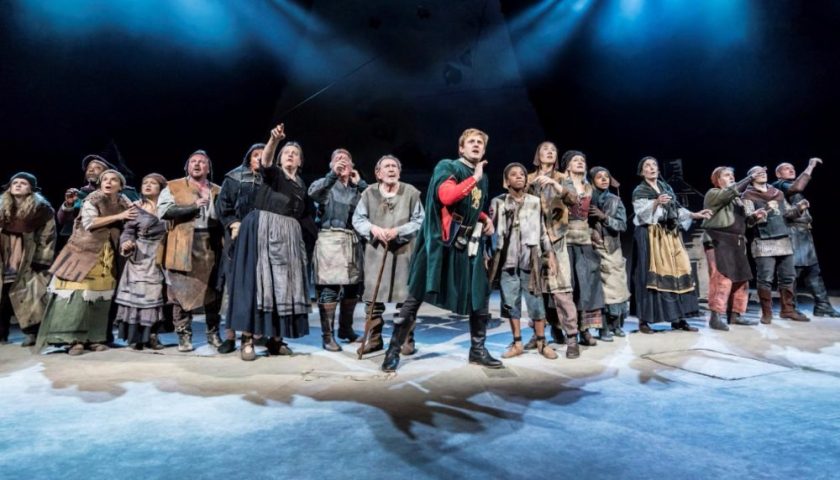
It is all in there. David Greig, as in all modern adaptions, has to take a direct line translation, here by Ian Ruffell, and make it clear to today’s audience. The wonder is that it apparently remains pretty true to the original. I got the text. It is a beautiful read. The rhythms jump off the page. The chorus here is, unusually for a Greek play, the protagonist and has a lot to say, literally and metaphorically. Director Ramin Gray, together with composer John Browne and choreographer Sasha Milavic Davies, takes this structure and conjure up an astonishing feat, and feast, of movement and verse. Percussionist Ben Burton and Callum Armstrong, who has conjured up a real, live double Aulos (the contemporary Greek pipe), are outstanding.

Really. If you want to see the best “musical” in London then come here. Except that it is now over (oops sorry) and it isn’t the best musical in London, not whilst Follies is still on. Oh and I haven’t seen any other current musicals which I guess makes me a somewhat unreliable witness. BTW I note that if you are a) available and b) a party of one, or two at most, and c) enterprising there are normally returns on most days if you still haven’t seen Follies

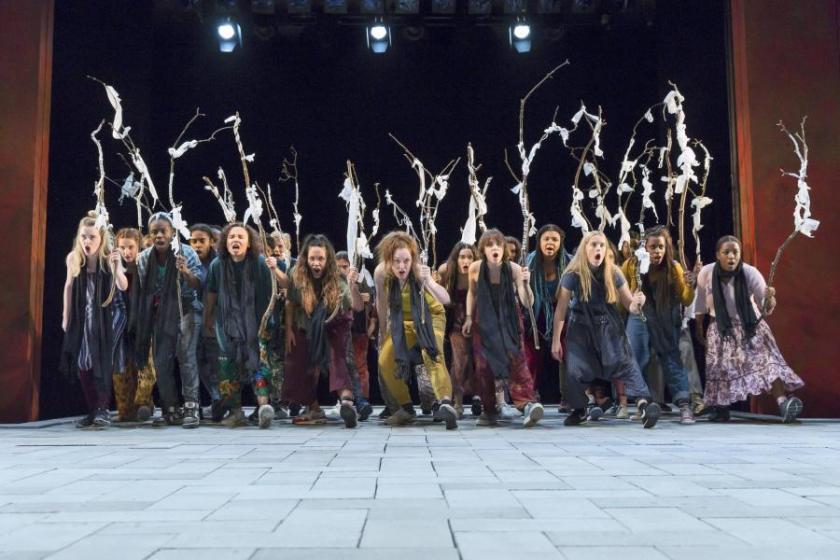
The whole spectacle of this Supplicant Women is made even more remarkable by the fierce performances of the non-professional chorus of young women playing the supplicants drawn from the boroughs of Southwark and Lambeth. It is not just their verse, their singing and their dance and movement which impresses, but their complete commitment to the story which impresses. All after just a couple of months of rehearsal. Staggering. At the end you could see the pride in the performance of these women felt by the local lads ,who had a smaller involvement as the chorus of Egyptians come back to claim their would be brides, and the more mature amateurs who made up the Athenian citizens who tentatively welcome the supplicants.

Oscar Batterham as King Pelasgos, who agonises before persuading his people to accept the Women and Omar Ebrahim, who switches from Danaos, the “father” of the Women to the brutal Egyptian Herald, in the blink of an eye, as well as acting as our MC, are both excellent. However Gemma May, as the Chorus leader, stood out for me, not just for the clarity with which she delivered the lines specifically carved out for her, but the way she, well er, led the Chorus.

Fidelity to the Greek original includes a libation from an academic, whose name to my shame I have forgotten, which explained, as was the custom, who funded the performances, and a dedication to Bacchus, which involved a mediocre (I hope) bottle of red being poured on to the suitably practical breeze block flooring of Lizzie’s Clachan’s elegant set.

We have Aeschylus to thank for the concept of tragedy, and for the introduction of more than one character alongside the chorus. Only seven of his plays remain including the three that make up the extraordinary Oresteia, which should be seen by everyone at least once. The other two plays which make up the Danaids trilogy alongside The Suppliants are lost. In the Persians he actually had the temerity to warn his fellow citizens about gloating too much over their victories. In fact he fought against the Persians and his military exploits brought him more fame than his playwriting, despite the fact he ruled supreme in the Dionysia through the 470s and 460s BCE. One final lesson we can learn from Aeschylus: don’t stand directly under an eagle in case it drops a tortoise on your head. Unlikely I grant you but this apparently is how he met his end.

So there you have it. All the big questions, one way and another, were covered off by Aeschylus and his mates, Sophocles and Euripides, whilst the best we Brits could manage at the time were a lot of beakers, pointlessly shifting huge lumps of stone to catch the sun one day a year and pining for a decent hairdresser. To be fair, in all these Greek dramas, you do have to get your head around the intervention of the gods. Specifically in the Suppliant Women the somewhat erratic Zeus. For he it was who caused the women to end up being born in Egypt after he got the hots for a cow lady, Io, from whom the Suppliants were descended. And it is to Zeus they turn to help them when they cross the Med. If it was me I might be a little wary of appealing to the very bloke who indirectly got me into this predicament. Mind you that’s the problem with these top gods, especially the monotheistic ones. Simultaneously good cop, bad cop, vengeful then loving, all to keep us on our toes.

I am guessing that this version of the Suppliant Women will engage further communities after having visited Bern in Switzerland. Edinburgh, Dublin, Belfast, Newcastle, Manchester< Hong Kong, as well as London.  If so please seek it out. It is about as perfect a testament to the power of theatre, then (Ancient Greece) as now., and a paean to the collective power of women. It is also the first time the word “democracy” ever appeared in writing, albeit in the form of an arch pun from the Chorus. Precious stuff.

The Firm at the Hampstead Theatre review *****

the2bfirm2breview2bhampstead2btheatre2bflyer

The Firm

Hampstead Theatre Downstairs, 22nd November 2017

N.B. The Firm is returning to the Hampstead Theatre Downstairs for another run between the 3rd May and 8th June 2019. The Tourist goes to a lot of theatre in London and, trust him, there is no better value than a preview ticket at HTD. Just £5. And here you are taking no risk as it is an excellent play. Even during the main run, at just £14, it is a steal. You’d be a mug to miss this. 

How does the Tourist choose whether to see a play?

Writer first, since he/she is the wellspring from which all else flows. In the end all there is is text, actors and audience. And observers and observed have nothing to share without the text. Poor text, poor play. Nothing anyone else can do about that.

Venue second. A function of convenience and familiarity, but also, not unreasonably, if you have enjoyed one production at a theatre, you may well enjoy another. This will probably reflect the vision of the artistic team and the rather grubbier fact of the demographic the executive team wants to prise cash from. On the downside, there are venues where comfort is so compromised that price does not represent value and must be avoided.

Then there is the subject. Not always easy to divine for new plays from the blurbs, teasers and trailers but something needs to pique my interest. As it happens most new drama has its finger firmly on the pulse or contrives relevance from places or times far removed from my cosy little world.

Director next. Same principle as the writer, if you have enjoyed their way of doing things once you may well do again, though this is not guaranteed.

Reviews of course, but the Tourist’s addiction and simple economics, (why paid 70 quid in the West End when I can get a top seat for half the price or less at the original production at the Royal Court or Almeida), means that reviews only help for transferred in productions.

Cast, relevant but not a deal breaker, though expectations rise when favourite names are announced.

Ideally a number of these factors come together. Sometimes though the Tourist takes a punt. As he did with The Firm. Downstairs at the Hampstead normally serves me well, but this is by no means guaranteed. I was interested in the subject, a gang reunited, but concerned it might lurch into cliche. I knew nothing about the work of playwright Roy Williams, director Denis Lawson or designer Alex Marker. I had not seen any of the cast on stage as far as I could remember (based on their bios), with the exception of Clarence Smith. I would like to pretend I had a feeling but I didn’t. And to cap it all I pushed my just-in-time arrival strategy to the limit. So a quick Jimmy, an inward groan at the 1hr 40mins run time and the only seat left tucked in a far corner (mind you the HT Downstairs benches are comfy).

As it turns out this is an excellent play and probably the biggest surprise of the year for me. Alex Marker’s set transformed the reconfigured Downstairs space into a “sophisticated” urban bar, complete with pristine Wurlitzer juke box and array of aspirational spirits brands. We first encounter the nattily dressed Gus (Clinton Blake) who owns the bar, (and, as we discover, quite a tidy portfolio of assets elsewhere), bantering with Leslie (Jay Simpson), the archetypal (and white) Sarf Londoner who has recently left prison. Gus and Leslie are waiting for Shaun to arrive. A party in his honour is planned followed by a night out on the town and then a trip to the Palace, (Selhurst Park not down the Mall, for regrettably they are Eagles), the next day. Shaun never comes. The rest of the “The Firm” do pitch up though, first stout Trent (Delroy Atkinson) followed by a nervous and limping Selwyn (Clarence Smith). But Selwyn brings a young stranger with him, Fraser (Simon Coombs) who, for various reasons, unsettles the gang. He comes with a proposal.

I’ll stop there. This all sounds way more mysterious than it actually is. This is an absolutely riveting insight into the nature of manhood, the camaraderie of criminality, the value of loyalties, the meaning of success and the trials of friendship. These forty/fifty somethings were happiest in the past, right the way back to when they first embarked on their “life of crime”, by The Wall near their school. The pace at which Roy Williams releases the many revelations that show who the characters are, and what they have become, is perfect. We learn enough, but not too much, to keep the dramatic intensity on the boil. We see the damage the past has done and we witness the final break-up of the gang. We see the love and the jealousy the mates have. There is a Pinteresque threat of violence and malice as you might expect throughout, most notably from Gus, who was the leader of the gang, and who is the only one to have avoided a stretch inside. He probes and manipulates the others, until they begin, in their various ways to fight back.

It is also very funny. The dialogue is utterly believable, the banter is spot on. The interplay between the cast is superb. Clinton Blake’s Gus is preening bully, but it is clear from the off that he is troubled. Jay Simpson excels as Leslie, the mediator and the joker, who is trying to start again. (If anyone is ever looking for a Joe Strummer in a play about the Clash here’s you man). Delroy Atkinson as Trent, at first submissive, gradually asserts himself and, in a very powerful scene, shows himself as the only one of the gang capable of pacifying the psychologically damaged, and desperate, Selwyn of Clarence Smith. Simon Coombs as “younger” Fraser is insolent and cocky, but, in a neat inversion, shows some maturity that escapes the others. His final scene with a defeated Gus is gripping.

The play offers no moral perspective on gang membership. It does make abundantly clear though that for men of current, this and proceeding generations, in the absence of other opportunities, this way of life, and the crime that comes with it, is the clearest path to securing the validation and respect of others. It also shows how fragile this respect can turn out to me and how poor men are in admitting, articulating and coping with their frailties and failings.

I may be guilty of reading too much into the play but that is what I saw. I highly recommend it. Roy Williams actually references Goodfellas and West Side Story in the dialogue to remind us of other masterful portrayals of this subject. Don’t get me wrong: this isn’t Goodfellas, but in its own way it is similarly involving. I understand that Mr Williams has mined issues of race, sport, poverty, random violence and teen parenthood in previous works, as well as the father/son relationship in Soul, his last play about the death of Marvyn Gaye. I really hope I get an opportunity to see some of them. He really, really has the measure of his stories and characters.

Coriolanus at the Barbican Theatre review *****

coriolanus-production-photos_-2017_2017_photo-by-helen-maybanks-700x455

Coriolanus

Barbican Theatre, 16th and 17th November 2017

This angry looking chap is Sope Dirisu and he is playing Caius Martius ,who you might know better as Coriolanus, in the RSC’s latest production of Shakespeare’s last proper “tragedy”. This will be followed from Stratford to London by the other plays in the Rome season, Julius Caesar, Antony and Cleopatra, and the gorefest Titus Andronicus, as part of the “Rome” season. You can read all the proper reviews from the Stratford run, but, if this is anything to go by, I reckon I am in for a treat with the rest, as this was better, in my view, than those reviews let on.

Now it helps that I happen to like this play. A lot. Maybe not as much as Othello, Macbeth and Hamlet, but, whisper it, more than Lear. It is sparse, he (Coriolanus) is a flawed character, and the writing is, by Shakespeare’s sublime standards, a little lacking in poetry and lyricism. This is exacerbated by a “prose driven” production – suits me but maybe not the  purists. Like Macbeth and, indeed Titus A, it tells of a hero, (or maybe anti-hero, that is why it is so clever), whose destiny is bound up with that of his country, in this case 5th century BCE Rome, the early days of the republic. Coriolanus is, like these other “warriors”, a complex and unique personality, whose vanity and inability to compromise leads to his downfall. He harbours powerful homo-erotic desires for his mortal enemy, Tullus Aufidius, and he has the mother of all mother complexes, as it were.

There is some humour, and some satire, though I get that it is a bit buried. The body count, by the standards of Shakespeare tragedy, is minimal, just one at the end. There is War though, unusually very early on, which allows fight scenes that this cast revelled in. Fight  director Terry King deserves a great deal of credit. The plot is straightforwardish, (WS once again pinched his story from Plutarch), and revolves entirely around the Big C himself. It is his connections with his family, his own people and the Volscian people of the enemy state Corioles, that defines the play and what makes it interesting for our, (and probably plenty of other), times. For the play brutally examines the exercise of political power, the relationship between classes, the limits of democracy and representation, the dangers of populism, the nature of patriotism, the business of compromise, the call of duty in both military and civil society, in addition to all the deep, Freudian, psychological stuff. Ancient Rome is fundamentally different to our world today but the issues it grapples with are uncannily similar.

Which is why, in its way, its the best “Brexit” play I have seen this year. People’s visceral reactions to what is “right” and what is “fair” and the way in which they are, or think they are, being treated by their leaders, is what lies at the heart of this play. The continuing tensions between the haves and the have-nots, the “leaders” and the “led”. As ever though, there is no black and white with big Will, as you oscillate between hating and maybe admiring Coriolanus’s actions and intentions, and you see the ways in which those around him react, Mum, wife, nemesis, tribunes, friends, soldier colleagues and substitute Father, all try to influence and manipulate him.

Now a twist of fate “permitted” me to watch the first half twice, up to Big C’s banishment. A technical issue on the first performance I saw meant a return the next day to see the rest. I confess I was so pumped up by the first half and by the cliff-hanger when Coriolanus tells Rome to go f*ck itself that I was bound to return. And the tightwad in me wasn’t going to miss a free hour and a half of this. Turns out the repeat viewing was an insight into how the interplay of text, action, acting and audience can create a very different experience. Same play, same production but different lines and words leapt out; I focussed on different characters at different times and thought about different aspects of plot and message as it evolved.

Sope Dirisu turned out to be a suitably virile military man and the camaraderie and mutual admiration between him, Charles Aitken’s ardent consul Cominius, and Ben Hall’s pragmatic general Titus Lartius, rang true. As did his hesitation with Hannah Morrish’s wispy wife Virgilia. The turning point scenes with mother Volumnia also stood out. Whether extolling the virtues of her son’s military achievements in full on patrician mode, or achingly pleading with him to curb his revenge even though she knows what this will lead to, Haydn Gwynne was magnificent in the role. Duty trumping family. The best performance of the evening. Mr Dirisu also shines in the scenes with Tullus Aufidius, but once again this as much reflects the skill of James Corrigan’s performance as the bested Volsci. It is tricky to convey the admiration, nay passion, that he feels for Coriolanus whilst still letting us know that he intends to play him to his country’s advantage when Big C turns treacherous.

It does take a bit of time for our Coriolanus to ramp up from haughty disdain to bilious disgust of the people, and the two tribunes, Sicinius Veletus and Junius Brutus, who orchestrate them. This though created a welcome ambivalence in our political sympathies. Should we side with the put-upon plebeians, hungry and overlooked by the out of touch Senate and the aristocratic Consuls, or with fearless Coriolanus, who may saved Rome from the enemy, but who sneers at the people and refuses even a pretence of the humility expected to secure their approval for his election as Consul?

Having two women play the tribunes, given Coriolanus’s conflicted relationship with the opposite sex, added an interesting dimension, and the contrast between Martina Laird’s more measured Junius and Jackie Morrison’s more provocative Sicinius was also well observed. Paul Jesson’s patient, though frustrated, Menenius, father, mentor and apologist for Coriolanus, was another fine performance.

Now as it happens Paul Jesson has a bit of form with Coriolanus having played Junius Brutus in Ralph Fiennes’ 2011 film version. This is an outstanding production, with a magnetic performance by Mr Fiennes, who also directed, a stunning cast and the uneasy backdrop of Serbia. Angus Jackson, with this modern dress production, has, perforce, created a somewhat different tone, but, I think, similarly makes the case for what I think, is a riveting play. It seems to me that there is a case for moderating Coriolanus’s “pride” and subsequent “fall” and for questioning the political “rights and wrongs” and, if that is true, Mr Jackson’s definitely direction succeeded here. A bully oozing utter contempt may lead to more powerful lead performances but can be overbearing. I liked the contrast of Mira Calix’s string and voice led score and Robert Innes Hopkins design (excepting the troublesome plinth) was coherent (it carries through the whole season).

Coriolanus a tricky, difficult, awkward play. Nonsense, as many recent productions have shown. Mind you I’ve never understood the difference between Shakespearean tragedies and comedies, so you can safely ignore me.


Rules For Living review at the Rose Theatre Kingston ***

120244

Rules For Living

Rose Theatre Kingston, 13th November 2017

The Tourist loves the Rose Theatre. Admittedly it helps that it is just a hop, skip and a jump, (well brisk walk), away from him. It does serve up some interesting theatre though, in amongst the music and comedy, and it does a grand job for the local community, notably for the young people. Understandably most of the theatre it produces is shared with other venerable regional houses but this makes eminent economic sense. And by and large, when it has nabbed something for itself, the decision has paid off. All this is achieved without an Artistic Director or commissions. Given the size of the place, 900 seats, comparable with the Lyttleton say, or the newly opened Bridge, this seems to me a laudable strategy.

Over the last couple of years we have had the excellent productions of My Brilliant Friend (My Brilliant Friend at the Rose Theatre Kingston review ****) and The Good Canary, the outstanding Junkyard, (Junkyard at the Rose Theatre review *****), which was a massive positive surprise for me and BD, a pretty good recent revival of The Real Thing (The Real Thing at the Rose Theatre Kingston review ****), the ambitious and largely successful Wars of the Roses, a fine All My Sons and decent productions of Toast, The Herbal Bed, The Absence of War and Maxine Peake’s Beryl, (looks like the marvellous Maxine will end as good a writer as she is actor). Oh and we got the Play That Goes Wrong before the West End.

Coming up we have a new production of Much Ado About Nothing with Mel Giedroyc, (which means BD and LD are already signed up), as Beatrice, (dying to know who will be Benny), and a Don Carlos, (shared with the Nuffield Southampton and the Northcott Exeter so LS will be instructed to attend), in which Tom Burke, (you know him off War and Peace), will partner again with the fancy-dan Israeli director Gadi Roll. A bit of Schiller should wake up the good burghers of Kingston.

Right that’s the puff piece over. What about Rules for Living? This play by Sam Holcroft premiered at the National Theatre in 2015 where it was, by and large, well received. Brothers Matthew (Jolyon Coy, last seen by me in the somewhat different Little Eyolf at the Almeida) and Adam (Ed Hughes) have returned to the family home with, respectively, partner Carrie (Carlyss Peer) and wife Nicole (Laura Rodgers), for Christmas Day. Matriarch Edith (Jane Booker) is marshalling the troops ahead of her husband Francis (Paul Shelley) coming home from hospital, after, it transpires, having had a stroke. Last, and probably least since she is off stage in bed until the end, is Emma, the fragile daughter of Adam and Nicole.

So far, so middle class sitcom. Carrie is a flighty actress, who wants successful lawyer Matthew to pop the question. Adam was a cricketer whose career was ignominiously cut short when he froze on his Test debut. He is now a provincial solicitor. Adam and Nicole’s marriage is on the rocks. Dad Francis was a judge and doesn’t suffer fools gladly. Under Edith’s direction the festive activities are run with military precision. 

Now the twist, because, as it stands, this cracker would be more Poundland than Waitrose.  Each of the characters has to follow a rule to govern their behaviour. This flashes up above Lily Arnold’s lovely doll’s house set. The detail of this rule is expanded through the play. So, for example, Matthew has to first sit down, and then eat, when he tells a porkie. I will refrain from trotting out the other rules in case you chance to see this. You get the picture I am sure. Ms Holcroft took learnings from cognitive behavioural therapy as the inspiration for the play and cleverly ensures each of the rules matches the characters faults, frustrations and personalities.

This then is the catalyst for the hilarious goings-on and, initially, at least, there is much humour in this conceit. Having weaved this into the plot though, Ms Holcroft then doesn’t see to entirely know what to do with it, so we veer off into a quasi-farce which ends with a food fight. Amusing yes, and it bears comparison with the master it emulates in Alan Ayckbourn, but it felt to me that the idea was too clever for the execution. The conceit boxed the characters in and didn’t leave enough room for the pathos which was needed to balance the farce.

The cast entered into the spirit of the venture with energetic enthusiasm, even Ed Hughes and Carlyss Peer whose “rule’ was the trickiest to pull off without being annoying. Jane Booker had the pick of some very funny lines and Paul Shelley, with no lines as such and precious little stage time, was a hoot. Laura Rodgers probably dug deepest though her “rule” gave the most opportunity for nuanced development. Director Simon Godwin, who has had some notable successes at the NT, especially his Twelfth Night, chose to anchor proceedings in the family home and play down the “game-show” context of the original production.

All in all then like a game of family charades. A really good idea when it kicks off but wearing after an hour or so. We are going to try doing massive jigsaw maps in silence for Xmas this year. Yo ho ho.

PS. I see that Sam Holcroft is writing a play for the Bridge based on the novel The Black Cloud by astrophysicist Fred Hoyle. Blimey. There will be some big ideas in that for sure.


Labour of Love at the Noel Coward Theatre review *****

header

Labour of Love

Noel Coward Theatre, 15th November 2017

The Tourist is wracked with guilt. A couple of lovely women who were sat next to him asked his opinion at the interval as to whether James Graham’s Ink or Labour of Love was the better play. He said Ink. By the time this was finished he had changed his mind. Ink is a fabulous play (Ink at the Almeida Theatre review *****), don’t get me wrong, with superb performances and a delightful set, but Labour of Love is funnier, and, in its own way, quite moving. There are one or two occasions where Mr Graham’s script goes for the easy laugh, or is slightly too blunt in terms of characterisation, but as in his other plays, all is forgiven because of the sheer level of entertainment which is delivered.

Two plays in the West End, Quiz playing in Chichester (and surely West End bound), This House embarking on a national tour next year, a commission, The Culture: A Farce in Two Acts, for Hull Truck in the pipeline and, I bet, some revivals of his earlier Finborough Theatre plays will pop up. It seems the boy wonder can do no wrong.

That’s because he has the gift. Writing consistently very funny plays, with real dramatic momentum, gentle formal innovation, about relatively recent events, which manage to examine big and important issues, (the way power is wielded in our modern democracy), and which pack in the punters, is not easy. Otherwise everyone would be at it. Yet James Graham makes it look effortless. And he is in the groove. No doubt about that.

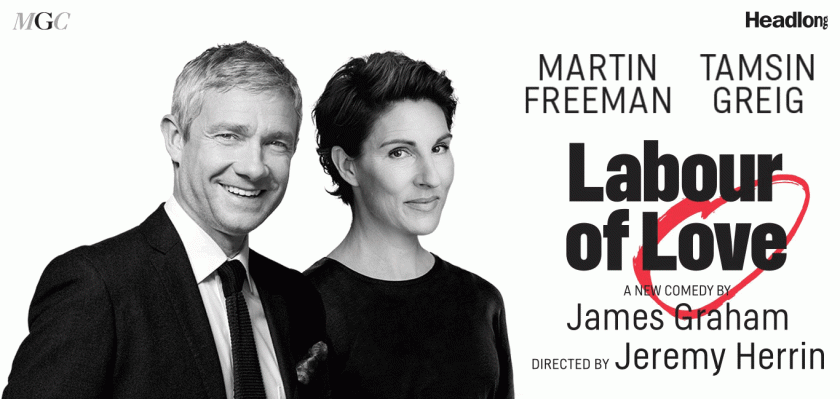
Labour of Love charts the course of the Labour Party through the seven General Elections from 1992 through to 2017. The wheeze is that the first half shows events in reverse, the second then rolls forward again. Martin Freeman plays David Lyons, an initially ambitious Blairite, who is tasked in 1990 by Party HQ with fighting a “safe” Labour seat in Nottinghamshire, near where he was brought up. His ambitious lawyer wife Elizabeth, (well played by Rachael Stirling, given the somewhat one-dimensional hand she was dealt), initially intends being his constituency agent but is reluctant. In steps Jean Whittaker (Tamsin Greig) who was married to Terry, the previous MP before he became ill. She knows the ropes and is Nottinghamshire through and through. The MP and his inherited agent then play out, over the years, the struggles between the left and the right of the Labour party, the democratic socialists and the social democrats, against the backdrop of a Northern town that falls further and further behind through the 1990s and 2000s.

The relationship between David and Jean is alternately wittingly combative and awkwardly tender and is, eventually, consummated (don’t worry, not literally). Kwong Loke plays Mr Shen a Chinese industrialist who might prove the town’s employment salvation, Susan Wokoma is Margot Midler ,who is roped in as a local activist, and Dickon Tyrell is Len Prior, council member, old school Labour and, for a time, Jean’s second husband.

You have to feel sorry for Sarah Lancashire who was initially cast as Jean but had to withdraw on doctor’s advice. Her loss however was Tamsin Greig’s gain. And ours. Jean is an absolute peach of a role. And Ms Greig, who might be our greatest current comic stage actress, literally wolfs it up. She is marvellous. As with her Malvolia at the National before this (Twelfth Night at the National Theatre review ****) it is not just that she is a master of timing but that she can connect with the whole audience wherever she is on stage and in whatever she is saying. And, as in Twelfth Night, when the tone shifts so does she. Immediately. And we the audience follow her. Immediately. Martin Freeman is equally at home as David, in particular when he gets to deliver a rousing soliloquy, on the virtue of pragmatic Government rather than the sanctimony of permanent Opposition, which saw the audience break into spontaneous applause.

This is a joint production between Michael Grandage and Jeremy Herrin’s Headlong with the latter in the director’s chair. He may have misfired a little with Common at the National, but he is back on form here having previously brought This House to life. Lee Newby’s set is as workaday as you like and a big call out to wig and hair director Richard Mawbey, who convincingly took the leads backwards and forwards through the three decades. Also vital in plotting the history is the video and projection design of Duncan Maclean and the master sound designer Paul Arditti has some fun with the soundtrack.

Labour of Love. Labour of course, that is the subject. Labour of Love because it is pretty clear where James Graham’s sympathies lie, though he scrupulously avoids the soapbox. Labour of Love as a pun on his writing skill maybe, as this feels like it was anything but a struggle to create. And Labour of Love because David and Jean’s witty sparring has more than an air of Benedick and Beatrice about it. A popular playwright, banging out the texts, selling out the theatres, engaged with the politics of the day, making us laugh, (sometimes with the most obvious of material), and making us think. It worked five hundred years ago. It is working for James Graham now. Maybe this is the lost Love’s Labours Won.


Heisenberg: The Uncertainty Principle at Wyndham’s Theatre review ****

cw-20768-medium

Heisenberg: The Uncertainty Principle

Wyndham’s Theatre, 9th November 2017

Everyone’s at it. The “science” play. Science, whether directly through using theory to inform plot, or indirectly, often through the impact of ecological or other catastrophe, has underpinned many of the best new plays I have seen in the last couple of years. Steff Smiths’s Human Animals, Nick Payne’s Constellations and Elegy, The Forbidden Zone from Schaubuhne Berlin, Caryl Churchill’s Escaped Alone, Lucy Kirkwood’s The Children and Mosquitoes and Christopher Shinn’s Against all have a healthy dose of science in the mix.

Mind you this is nothing new. The brainy playwrights have been at it for decades. Think of Stoppard’s The Hard Problem, even Brecht’s Life of Galileo, the mighty Caryl Churchill’s A Number and Love and Information. Lucy Prebble’s The Effect, Timberlake Wertenbaker’s After Darwin. Indeed Michael Frayn in Copenhagen even took Werner Heisenberg himself as the subject for his play. Nor is it really surprising given the importance of mathematics and physics to our lives. After all it is the role of theatre to comment on, engage with and maybe even influence the big ideas that underpin our world. But it does take a fierce intellect to make this sciencey stuff work.

It was probably only a matter of time before the prolific, eclectic and clever Simon Stephens came up with his own variation. Like Lucy Kirkwood in Mosquitoes he takes a big idea from theoretical physics to create a metaphor for the actions of his characters, though I am not sure he is as successful. Heisenberg’s Uncertainty Principle states that if we measure the position of a particle with ever greater precision, then at some point we have to accept a correspondingly increasing imprecision in our measurement of the particle’s momentum. (Thank you Wiki and the programme – I would be lost without you). When we look at the little stuff, like electrons, its behaviour sometimes emulates a particle bouncing around but sometimes it is like a wave. Apparently “vagueness” is built into nature at the quantum scale. Yet we humans are always deluding ourselves that we have control and that there is order around us. We live at a larger scale than the quantum so see the physical world obey laws and we can trust the effect of statistical averaging.

Allied to the Uncertainty Principle is the idea of the observer effect. The act of observing will influence the phenomenon being observed. At the quantum scale for us to “see” and electron, a photon apparently must interact with it, thus changing the path of the electron. You can see why this concept might appeal to the inventive playwright. 

(I will refrain from opening up to the idea that some neuroscience even suggests our concept of “free will” is an illusion. “Free won’t” maybe, but the electrical activity in or brains that prompts an action seems to come before our “conscious” realisation of the intended action. Get your head round that). 

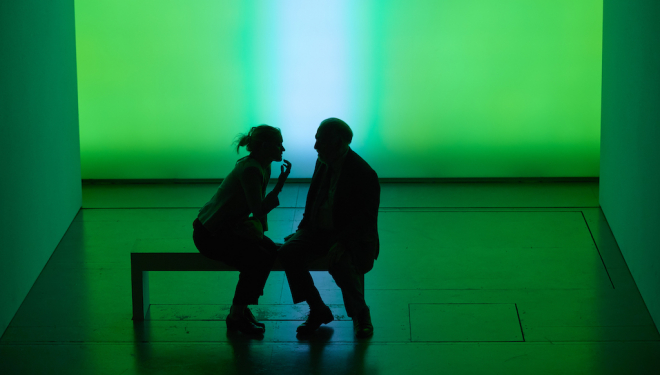
Anyway this randomness is the idea Mr Stephens builds into his play. Unpredictability is built into our lives. When forty something garrulous, and dissatisfied, American expat Georgie Burns (Anne-Marie Duff) randomly kisses, on the back of the neck, mid seventies lonely butcher Alex Priest (Kenneth Cranham) on a bench in St Pancras station, no-one, least of all them, could have predicted where this would lead. As it happens it leads to a beautifully observed affair which brings happiness and lashings of extra life to both

Now I guess that, at the end of the day, you might be able to take any other boy meets girl (or boy meets boy, or girl meets girl, or other feasible combinations) stage double hander and overlay the same idea. Nick Payne’s Constellations covered similar territory albeit with a very different formal structure. Indeed if you jettisoned old Heisenberg and just took the play on its own merits you wouldn’t lose much. You would ask yourself why would Georgie ever approach Alex in the first place, but might soon be persuaded as to why, and indeed would be offered some alternative explanations. The question of the age gap would loom large but fairly soon be dismissed, as it should be. Some of the twists in the romance might seem a little contrived but then you could say the same about all romances, real or imagined.

That the play works independent of its big ideas is down to the performances, and to a lesser extent, the sure direction of Marianne Elliot, the much praised set of Bunny Christie and the lighting of Paule Constable. In Anne-Marie Duff and Kenneth Cranham we have here two actors at the top of their game. In fact they are so at the top of their game that they are both banging in hat-tricks on a weekly basis like the love-child of Harry Kane and Cristiano Ronaldo. Ms Duff is always better than the play she leads, even when the play itself is perfect. Saint Joan, Cause Celebre, Strange Interlude, Husbands and Sons, Oil, the unfairly maligned Common. In her every major London stage role in the last few years she has, to overwork the sporting metaphors, banged it out the park. Of course, there may be some cause and effect here, as I will see everything she stars in. Even so, for my money, she is on a par with the theatrical dames of the prior generation. I am literally wetting myself with excitement at next year’s NT Macbeth with her and Rory Kinnear.

Now I was not as impressed as the smart money with Florian Zeller’s The Father thinking it a bit too tricksy, (mind you I had an uncomfy perch on the night of performance so my view might, literally, have been guided by arse), but there was no doubting Mr Cranham’s sterling performance. Here his Alex starts off, unsurprisingly, a little discombobulated by Georgie’s approaches. As the relationship unfolds, and he opens up, we see the joy fill first his face and, eventually, his whole body. Ms Duff similarly is as skilled in bringing Georgie to life through her movement as much as her words. Together their timing is perfect with the interplay of lines, and pauses, perfectly modulated. As Alex explains, when talking about his love of music, it is all about “the space between the notes”. They get it.

My guess is that, in lesser hands, this might all be far less effective. Simon Stephens is a wise man I think because he seems to know how important is the rest of the collaborative eco-system. Whether this be the writers whose works he has adapted (Chekhov on multiple occasions, Mark Haddon for The Curious Incident of the Dog in the Night-Time. Bizet for Carmen Disruption) or directors (Marianne Elliot, here and many times before, Carrie Cracknell, Katie Mitchell and, successfully, the erratic Ivo van Hove).

More importantly he is a very wise man because, as he says in the programme, “I think I only write plays because I’ve never been in The Fall”. There are those of us who recognise that the most important artist in the world is alive, well (hopefully) and using his free over 60s bus pass in Prestwich, and those of you who don’t.

Slaves of Solitude at the Hampstead Theatre review ***

slaves-of-solitude-3

Slaves of Solitude

Hampstead Theatre, 8th November 2017

As this blog testifies I spend a lot of time in theatres, (too much I think), but the SO is far more circumspect in her choices. Occasionally, very occasionally, the SO’s desire to see a play, and her enjoyment thereof, outstrips mine. Slaves of Solitude was one such occasion, though we both agreed that this fell a little short of our expectations.

Patrick Hamilton (1904-1962) was a writer and playwright whose star is now very firmly in the ascendant after many years of neglect. His studies of working class London life between the wars, such as Hangover Square and the trilogy Twenty Thousand Streets Under the Sky, (adapted for TV a few years ago), bear comparison with Dickens. They are populated by recognisable characters and shot through with a sardonic wit. Early on he was an actor and his most famous plays, Gaslight and Rope, were both made into successful films (Gaslight twice in the UK and then the US – obviously the UK version is superior). If you know either of these films, especially Hitchcock’s version of Rope, then you will appreciate how skilled Mr Hamilton was at creating gripping thrillers, though these plays are somewhat removed from his novels.

He was not it seems, a happy chappie. Left scarred by a car accident in his twenties, disdainful of the culture around him and a committed Marxist, he sank into alcoholism and died at 58. Despite his heavy drinking he kept writing throughout although the tone of his work darkened through time. Slaves of Solitude is the only one of his novels set during WWII and is apparently a “lighter” work than some of his other novels.

The novel has been adapted for the stage by Nicholas Wright who is a dab hand at this sort of thing and is an admirer of Hamilton, along with master director Jonathan Kent, whose last major outing was the Chichester Young Chekhov Trilogy. The play is set in a genteel boarding house in Henley-on-Thames run by the brisk, but warm-hearted, Mrs Payne (Susan Porrett) and Irish assistant Sheila (a fine professional debut from Eimear O’Neill). It is December 1943. Residents include the redoubtable Mrs Barrett (Gwen Taylor) and the kindly spinster Miss Steele (Amanda Walker) and the bombastic, blazered Mr Thwaites (an authentic Clive Francis relishing the character’s preposterous turns of phrase). There is also the enigmatic Mr Prest (Richard Tate) who spends a lot of time up in London.

Our “heroine” is Miss Roach , a pitch perfect Fenella Woolgar with her prim exterior reserve concealing a more passionate, though buried interior. She works in publishing and has been forced to leave London to escape the Blitz. This is the stiff upper lip England of fading Empire, adapting to the war time privation of ration books, blackouts and the arrival of American troops. We see early on that the women are far more willing than the nasty, misogynistic, bullying Mr Thwaites to sympathise with the plight of individual “enemies” caught up in the war. This is put to the test after Miss Roach meets vivacious German emigre Vicky Kugelmann, (a magnetic performance by Lucy Cohu), who proceeds to move in to the boarding house.

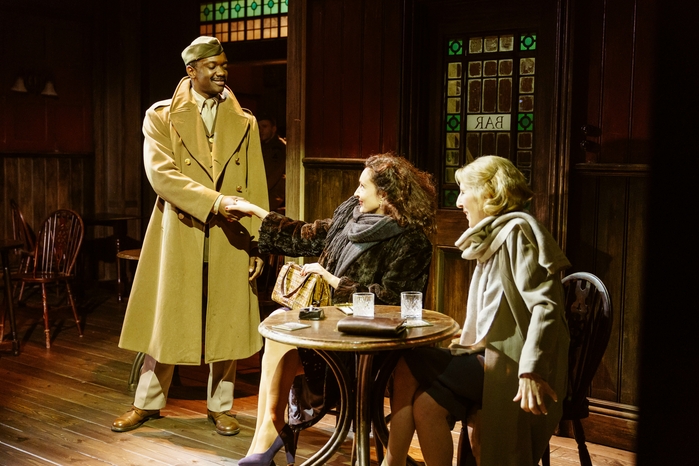
Miss Roach’s afternoons in the pub also contrive for her to meet Lieutenant Dayton Pike (Daon Broni), a friendly American GI, who begins to chat her up. Casting Pike as a black soldier, in contrast to the book, creates a heightened level of interest which Mr Wright’s adaption capably, if not forensically, explores. Roach and Pike’s subsequent affair is complicated by the presence of Vicky and by Pike’s own excessive drinking. An impromptu party at the boarding house gets out of hand with, inevitably, unfortunate consequences. Miss Roach escapes but Pike catches up with her for one final goodbye.

Now Patrick’s Hamilton gift for characterisation and creating atmosphere is splendid. The set and costume design (the Hampstead excels in this) from Tim Hatley is ingenious and puts us right inside the dining room of the boarding house and the saloon bar of the pub. These are emotionally stiff, but still sympathetic, people. The established social order has been thrown into turmoil by the war. Outsiders have arrived. Risks can be taken, particularly by women, leading to behaviour which would have been shunned before the war. Yet there are still consequences.

Unfortunately we see that this precarious world will be shattered via a flash forward at the opening which, for me, was unnecessary. The plot drifts along fairly predictably until a lurch into something more melodramatic in the second half, and the ending, which is intended to offer a modicum of solace is a little abrupt. These shortcomings were broadly compensated by the overall “feel” of the production however. Yet I was left with the nagging doubt that this was one of those subtle stories that might have been better left on the page and not taken to the stage. Whilst I do sometimes find his work annoying and frustrating I can’t help feeling that Terence Rattigan has cornered the market in theatrical British forlornness.

St George and the Dragon at the National Theatre review ***

saint_george_and_the_dragon_c_johan_persson-1000x572

Saint George and the Dragon

National Theatre, 31st October 2017

This must have looked a great idea on paper. A state of the nation play, with much to say about ill at ease contemporary Britain, told as allegory, in a format and staging that nods to a fairy tale. Writer Rory Mullarkey took as his inspiration The Dragon, the most well known play from Soviet writer Evgeny Schwartz which was an allegorical satire on Stalinism, with the knight Lancelot in the lead. Clearly Mr Schwartz was a brave man. There is also a whiff of Chaucer and Medieval morality play in Mr Mullarkey’s construction.

Designer Rae Smith has created an imaginative set, like a child’s pop-up book, which roams across the three periods that Mr Mullarkey’s story encompasses, the Medieval, the Early Industrial and our own Post Modern present. Lyndsey Turner, who is expert at these big ideas plays, gives the production plenty of room to breathe, with a light and often amusing tone that matches the “modern fairy tale” mood, and the rest of the creative team conjure up some magical aural and visual effects.

John Heffernan’s George is very affecting, alternately brave, stupid, confused and naive, Julian Bleach’s Dragon is as pantomime camp as you like, Richard Goulding’s henchman who is redeemed has real presence and Amaka Okafor strikes the right balance as feisty champion Elsa. The rest of the 22 strong cast also fit like a glove and we have a groovy 6 strong band.

But there is a but. It just all seemed a bit vague. The idea that we have needed and relied on a hero in the past to rescue us English when things go t*ts up was efficiently conveyed as were some elements of what might constitute our national identity, the things that bind and divide us. A nation remember is just some lines on a map (admittedly some sea is involved here) and a largely fictional shared history and SGATD was neatly rooted in this premise. The dichotomy between the enemy without and the enemy within was also engagingly scrutinised.

It is just that, when all was said and done on stage, we didn’t seem to have moved any further from this point of departure. Enjoyable yes, creative yes but not really very satisfying for me, which, at a time when anyone and everyone theatrical is trying to jemmy in a state of the nation perspective, was a little disappointing. There is more than enough on show to warrant a visit and there are plenty of tickets for the rest of the run, but the play, like the current England it depicts, comes up a bit short.


Mother Courage and Her Children at the Southwark Playhouse review ***

first-look-mother-courage-at-southwark-playhouse

Mother Courage and Her Children

Southwark Playhouse, 7th November 2017

Hmmm. I am torn. This was a mixed bag and no mistake.

The good stuff first. Well it is Brecht so there will always be big issues to chew on, although here the anti-war appeal that lies at the heart of the play felt curiously understated. The production does have a ramshackle design from Barney George which I was quite taken by and which seemed to capture the ravages of a long drawn out war on a society. The transverse staging and the constraining of the larger Southwark Playhouse space had some advantages, particularly when it came to observing the best of the cast. Mind you this did put paid to the Brechtian distancing effect. Hannah Chissick’s direction had some nice touches though this seemed to lack an overall coherent vision. I like the folksy song arrangements by Duke Special which are drawn from the 2009 NT production. Tony Kushner’s translation from 2006 is strong on characterisation but seems somehow to play down the “epic” nature of the action, though the production was partly responsible.

Best of all was the swaggering performance of Josie Lawrence as Mother Courage. Whilst there was a part of me that would have liked a more hard-bitten Courage to ram home the war as commercial opportunity message, her more sympathetic spirit paid dividends in the scenes with her “children”, the Chaplain and the Cook. David Shelley and Ben Fox in these latter two roles also turned in strong performances, as did Laura Checkley’s brassy Yvette and, especially Phoebe Vigor’s Kattrin. I was less convinced though by the rest of the cast whose tone seemed uncertain, notably the sons, Swiss Cheese played by Julian Moore-Cook and Eilif played by Jake Philips Head. Don’t get me wrong, the boxes were largely ticked, it just seemed to me that motivation and understanding was sometimes lacking.

This lack of conviction was ultimately why the production was only a qualified success for me. There were some powerful scenes notably when Courage disowns the corpse of Swiss Cheese, when Courage turns down the Cook’s offer to escape to Utrecht and especially at the end when Kattrin is beating the drum to warn the townspeople, but many of the other scenes have less definition, and those that do work rely too much on the sympathy generated by the performers, which risks melodrama, and which Brecht specifically wanted to eschew. This should be far more threatening and dislocating to convey the true horror and to reveal the economic and religious imperatives that underpin war, whether in the Early Modern Age or now, in the throes of Late Capitalism.

An avowedly non-specific staging also risks, as it does here, the distancing effect offered through Brecht’s setting in the Thirty Years War of the early C17 between Catholic and Protestant. We are supposed to be immersed in Brecht’s epic story but also to think long and hard about what he is telling us, and I am not sure we were fully afforded that opportunity. We are allowed to understand why Courage does what she does, because she has to to survive, but we are not supposed to like her.

The transverse staging was complicated by some early scenes which took place partially in a mezzanine which was, literally, a pain in the neck for half the audience. Music, sound and lighting worked with the staging but the lack of space constrained the pattern of movement, (to avoid problematic sightlines),  which had the perverse effect of slowing the momentum at times.

My conclusion. A brave attempt which is worth seeing for Josie Lawrence’s fine, if ultimately flawed, performance and for some of the ingenuity of the creatives in trying to make this work in this space. And because it is Mother Courage and Brecht. But there have been, and there will be, more coherent and biting productions which do more to reveal the layers of Brecht’s art, passion and instruction.


Suzy Storck at the Gate Theatre review ****

npo2yrr80p17jyxhc4xc

Suzy Storck

Gate Theatre, 4th November 2017

The Gate under Ellen McDougall has found another blinding play, this time courtesy of French writer Magali Mougel (translated by Chris Campbell). Visceral only begins to describe it. Ms Mougel has created a modern-day Medea and invested it with an arresting, and bleak, poetry. This is about as sharp a dissection of the prison of gender roles and maternal “instincts” as you could hope to see in just over an hour.

Suzy Storck has three kids and hates her life. A patronising mother, a selfish husband who offers no support and whinges about how hard he works, an untidy flat, a career that stopped with bagging chickens, a baby that won’t sleep and two older siblings who never stop needing. She’s knackered, it’s boiling hot in her tiny flat, so she opts to knock back the vino and escape with an unfortunate consequence. We flashback to her life before the kids, her childhood memories, meeting and dreaming with husband Hans Vassily, enjoying her job at the poultry factory before it closed, an agonising interview arranged by Mum, the conception of the children.

So far, so predictable you might be thinking. You’d be wrong though. Not because the plot turns up anything extraordinary, quite the reverse. But the disorientating language, rhythm and structure of the play brings the story to exhausting life creating a very recognisable universal out of the painful specific. We have a Chorus in the form of Kate Duchene (also the Mother) and Theo Solomon (also the Children) who comment, probe and articulate. We have some creative intervention from props, video, lighting and sound. The audience even helps out. We have pained monologue and recollection. We have some powerful argument.

Jonah Russell as Hans Vassilly Kreuz, who has popped up to admirable effect in a few things I have seen, is spot on as the ineffectual male sh*t full of self-pity. The whole thing though hinges on the performance of Caoilfhionn Dunne who is shatteringly magnificent. She caught my eye in Mike Barlett’s Wild at the Hampstead Theatre last year as well as in The Nest at the Young Vic and Our Country’s Good and The Veil at the NT. Up close, in the scene where she won’t play the game in an interview for a job in a shop, and in the drunk scene at the end, she is utterly, physically real. Her eyes dull, her limbs hang heavy, the stuff of life drains out of her. Terrific stuff.

Director and designer, Jean-Pierre Baro and Cecile Tremolieres seem to have effortlessly opened up what I suspect is a very existential French text into an equally powerful English equivalent. There is no let up until you get out and down the stairs. But at least you can get out. Unlike Suzy. Well worth seeing.