Greek at the Arcola Theatre review *****

4720781800_20e6175e64_b

Greek

Grimeborn, Arcola Theatre, 13th August 2018

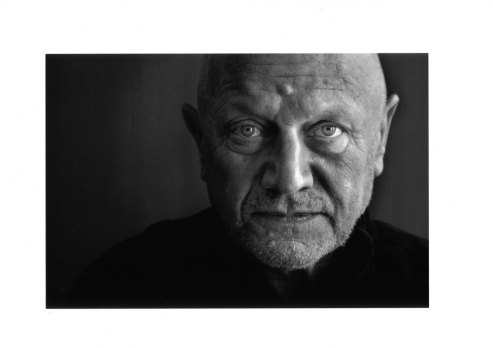
It is a shame Steven Berkoff’s plays don’t get performed more often. They do, like the stage, film and TV villains he has memorably played, (there he is above doing the menacing thing), sometimes lapse into “in yer face” cliche, but at their best they are thrilling theatre. The verse plays, notably East, West and Decadence, are the most exciting, and Greek, which transports Sophocles’s Oedipus Rex to East End London in the 1980s, was inspired. A few nips and tucks to make it fit but moreorless the same brilliant story. I love it, see here for the latest incarnation (Oedipus at Amsterdam Stadsschouwburg review ****). Aristotle thought it was the greatest story ever told and he, being the cleverest bloke that ever lived, knew a thing or two.

More inspired still though was when young Essex lad. Mark-Anthony Turnage, just 28, announced himself to the world with an opera version of Berkoff’s already “musical” play. His mentor Hans Werner Henze suggested the Munich Biennale commission him, and Jonathan Moore helped him with the libretto and directed the premiere. And Mr Moore, no less, was back to direct this production. I was lucky enough to see the first revival in 1990 at the ENO and, I tell you, it blew my socks off. I knew it was possible for opera to be the best of art forms when I was a young’un but I had also been disappointed by some allegedly top notch productions of classics by the likes of Verdi, Puccini and, even, God forgive me, Wagner. I was bored witless by much of this nonsense. But Greek, as one of the first contemporary operas I saw, made me realise that it is the theatre that matters and not the singing. Not saying that when the singing, music and drama all come together I can’t be moved by “classic” opera, especially Mozart and Monteverdi, just that it is a lot easier when the stories stack up and mean something to me and the music isn’t just a bunch of whistling tunes all loosely stitched together.

Of course some buffs might not accept that Greek is an opera at all, more musical theatre in the manner of Brecht and Weill at their best. I see their point. Indeed M-AT, probably more to wind us all up, termed it an anti-opera. Anyway who cares. Greek was a punch in the gut and food for the brain first time round for sure. Mr Turnage, with his rock and jazz inflections, and his adoration of Stravinsky especially, and the likes of Britten and Berg, as well as teacher Oliver Knussen, knows how to compose for the theatre. I knew nothing about the source of his latest outing Coraline (Coraline at the Barbican Theatre review ****) so had no baggage and, whilst if might not be up to Greek and to his version of The Silver Tassie, I thoroughly enjoyed it.

No need to trot you through the story here in detail I assume. By having the lead, here named Eddie, living a life of frustration in Thatcher’s Britain, Berkoff and Turnage have a contemporary alternative for the plague afflicting Thebes. Mr Moore wisely sticks with the 1980s, no need to invoke “Austerity/Brexit” Britain, that would be crass, which designer Baska Wesolowska, through set and multiple costume changes, neatly evokes. Class relations, cultural impoverishment, addiction, the patriarchy, hopelessness are all revealed but never bog down the story.

The differences between “foundling” Eddy and his heavy drinking Mum and Dad, and Sister, are highlighted by their over the top, “gor-blimey, Eastender, chav, working class” dialogue (no arias here folks) and movements. Eddy is angry and frustrated with them so, after having his fortune told, understandably f*cks off to meet, then marry Wife/real Mum, after an ill-fated altercation with her first hubby in a caff. There’s a fair bit of cursing and violence and the still marvellous riot, Sphinx and “mad” scenes, where M-AT’s brilliantly percussive score is at its best. It is funny and aggressive by turns, is deliberately cartoonish, has some great tunes and musical, (and music-hall), echoes and it belts through the story. And there’s a twist as you might have guessed.

Edmund Danon was a perfect Eddy if you ask me. M-AT asks for a high baritone and that is what Mr Danon provides. Every word was clear as a bell and boy did he get round the Arcola space. As did baritone Richard Morrison as Dad (as well as the, in so many ways, unfortunate Cafe owner and the Police Chief). For choice I preferred the mezzo voice of Laura Woods as Wife, as well as sister Doreen, Sphinx I and Waitress I, over the purer soprano of Philippa Boyle as Mum, Sphinx II and Waitress II.

Greek is now a staple of the operatic circuit as it can reliably pull in younger punters to even the grandest of opera houses, (the ROH got on the bandwagon in 2011). Its physicality, irreverence, punky aesthetic and social commentary can appear a little quaint now, especially if it is “over-produced” in a big space. Which, once again shows why Grimeborn, and the Arcola, is the perfect setting for works like this. With the Kantanti Ensemble, founded by conductor Lee Reynolds to showcase the best young musicians in the South East, under the baton of Tim Anderson, by turns belting out, and reining in, the score, the toes of the audience at risk of crushing from the four performers bounding around the Arcola main stage, and with the original director in charge, this production stripped Greek back to where is should be. Another Grimeborn triumph.

I genuinely urge you to try and see this once in your life. Especially if you think opera is for w*ankers. You will be blown away without any need to reassess that, largely reasonable, preconception.
The Rape of Lucretia at the Arcola Theatre review ****

rape_of_lucretia

The Rape of Lucretia

Grimeborn, Arcola Theatre, 1st August 2018

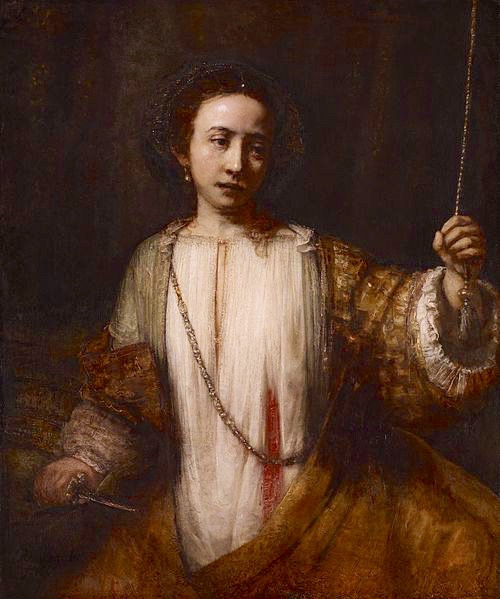
The Rape of Lucretia is a story with a long historical and artistic pedigree. It lies at the heart of the creation legend of the founding of the Roman Republic in the late 500s BCE, was documented by Livy and Ovid, then St Augustine, appears in Dante, Chaucer and Lydgate, was the subject of a poem by Shakespeare, (and Lucretia was referenced in some of his plays), and was a staple of much Renaissance and later art, notably works by Titian, Veronese, Rembrandt, Dürer, Raphael, Botticelli, old Cranach and Artemisia Gentileschi. The worst of these, depicting the rape, are violently voyeuristic, the best examine Lucretia’s subsequent suicide whilst avoiding gory titillation. Check out Rembrandt’s two takes on the latter, (see one above), Veronese’s and, best of all, Artemisia Gentileschi’s.

The story has undergone a few variations through the ages but, in the events of the Britten opera here, essentially runs like this. Tarquinius, the son of the last king of Rome Tarquinius Superbus, is sent on a military errand where he meets up with Collatinus and Junius. They have a few beers, (or the Roman equivalent),  and get to discussing the chastity of the women of Rome. Junius goads Tarquinius into testing the virtue of Collatinus’s faithful wife Lucretia. Tarquinius rides to Collatinus’s house that night and the servants are obliged to let him in. He rapes Lucretia and leaves. Collatinus returns. He comforts her but she cannot bear the shame and commits suicide. Junius tries to atone for his involvement by sparking a rebellion against the King.

As you can see there are multiple perspectives for the creatives who take on this ugly story, and specifically this opera, to alight on. Ronald Duncan’s libretto, which in turn is based on the French play Le Viol de Lucrece by Andre Obey, uses the device of a Male and Female Chorus to frame the action and, incongruously to me, to tack on a Christian message, notably in the Epilogue, to the “pagan” tale. He also uses some pretty high-falutin’ and fancy language for both chorus and in the dialogue. It is easy to grasp what is going on but the florid text does sometimes get in the way a bit.

Fortunately though the genius of Mr Benjamin Britten is at hand. The Rape of Lucretia, like Albert Herring and The Turn of the Screw which we recently saw in the superb production at the Open Air Theatre (The Turn of the Screw at the Open Air Theatre review *****), is a chamber opera scored for just thirteen instruments. As usual it took me 15 minutes or so to adjust to BB’s astounding mix of tonality, effect and experimentation but, once the ears were fully up and running, this music was as dazzling as I remembered. It has been a fair few years since the last performance I saw, (can’t actually remember where),  and I can’t say it is a turntable regular Chez Tourist, but, no matter, I was mesmerised. The Orpheus Sinfonia under Music Director Peter Selwyn, (who provided piano recitative accompaniment), were well up to the task and it was thrilling to hear the score in such an intimate space. The Sinfonia was founded to give an opportunity for talented young musicians to pursue a career that, trust me, they are doing for love not money. On this showing there are some fine talents here.

How then to deal today with what is plainly a deeply unsettling story? Britten was drawn to it as yet another “corruption of innocence” parable, the theme of so many of his operas. Yet I am not convinced that, as with those other operas, he fully thought through the perils of the material he was dealing with. Director Julia Burbach though made the most of the “universal” message that Duncan and Britten devised. The modern dress Male and Female Chorus, (here tenor Nick Pritchard and soprano Natasha Jouhl), open the opera by explaining how Rome under the Etruscan King Tarquinius Superbus is fighting off the Greeks and how the city has fallen into depravity. A Christian message for sure but as, subsequently, the two singers voice the thoughts of the male and female protagonists and move the story on, “out of time” as in classical Greek tragedy, a device to “explain” the motives and psychology of the characters and to involve us, the audience, in the action.

Fealty to Duncan’s libretto maybe means the production cannot resonant quite as volubly as it might have wanted to current MeToo awareness. Even so the drunken toxic masculinity, the fear that grips Lucretia and her two servants on Tarquinius’s arrival, the rape itself and Lucretia, broken, arranging flowers the next morning, are immensely powerful scenes reflecting the music, the acting and the movement of the characters and chorus under Julia Burbach’s direction. Having the Male and Female Chorus move through, and even at some points shape, the action was a smart move which offered insight.

I am not sure that any of this made the content of the story more palatable though and I can certainly understand why some may think this is an opera better left unstaged. I would suggest you see a production and decide for yourself though. This is not the only misogynistic opera: far from it. But when Lucretia, as here, is literally staring directly at you after the violence she suffers, it is impossible to ignore. And, when she dismisses Collatinus’s plea that Tarquinius’s action can be “forgotten”, the reason for her suicide is shifted from shame to anger.

The performances were uniformly excellent, particularly the two Chorus and contralto Bethan Langford as Lucretia. Bass Andrew Tipple was a deliberately vapid Collatinus, James Corrigan was a suitably odious Junius and a menacing Benjamin Lewis skilfully conveyed Tarquinius’s sickening importuning ahead of the rape. Claire Swale and Katherine Taylor-Jones both sang beautifully as Lucia and Bianca, Lucretia’s maid and nurse respectively. I am guessing that the performers had to take it down a notch or two in the Arcola space but what was lost in singing power was more than made up in clarity and immediacy.

The opera was staged as part of the Arcola’s Grimeborn festival which is not into its 11th year with 55 performances across 17 productions. For those of us who cannot face, or afford, the trip to Glyndebourne, where this opera was premiered in 1946, Grimeborn offers a bloody marvellous alternative. The small space means poncey C19 boring opera is off the agenda or the creative teams have to aggressively rethink it. New interpretations and new work abound. Chamber opera is in its element. Everything comes alive and acting, not vocal histrionics or regie-directorial setting, takes centre stage. All for around 20 quid a pop or less if you arm yourself with an Arcola Passport which is simply the second best gift to culture on the planet, after the Arcola AD Mehmet Ergen who should be knighted this minute.


The Prime of Miss Jean Brodie at the Donmar Warehouse review ****

24795636677_646fd86a04_o

The Prime of Miss Jean Brodie

Donmar Warehouse, 19th July 2018

The SO obviously is a big fan of Muriel Spark’s novel. We are both big fans of Ronald Neame’s film version, (only the other day I revisited this director’s magnificently cheesy The Poseidon Adventure), though let’s face it that is largely because Maggie Smith delivers a technicolour Maggie Smith performance. No less than David Harrower, (Knives in Hens, Dark Earth, Blackbird and some classic adaptions), was turning book into text here and Polly Findlay was directing. We have actors of the talent of Angus Wright, Sylvestra Le Touzel and Edward MacLiam and I was particularly keen to see Rona Morison again, who was so good in Orca at the Southwark Playhouse in 2016).

But, more than all of this, the big draw was Lia Williams in the title role. I believe Ms Williams is one of our finest stage actors, most recently seen in the Almeida’s Mary Stuart and Oresteia, (alongside Angus Wright as it happens), and, earlier in her career, Oleanna and Skylight. She is also a mean Pinterite, (if that is the word), and I am looking forward to her directing the opening salvo of plays in the upcoming Pinter season alongside Jamie Lloyd.

Now I had not remembered, from the film, just how ambiguously complex a character Ms Brodie is. An inspiration to the girls, (with Grace Saif, Emma Hindle, Nicola Coughlan, she who brilliantly told a twat of a critic where to get off in his insulting review, and Helena Wilson, all superb alongside Rona Morison’s Sandy), who genuinely wants to help then break free of stifling convention, but also manipulative, desperate, unfulfilled with a nasty undercurrent of fascist sympathy. David Harrower’s adaptation makes all this plain, without any need for histrionics, artfully augmented by Polly Findlay’s methodical direction and Lizzie Clachlan’s pared back design. His subtle inclusion of sub-plots involving Nicola Coughlan’s Joyce Emily, who is spurned by Sandy (and belittled by Miss JB) and goes to fight in the Spanish Civil War, and the framing device of Sandy’s book, worked for me.

Angus Wright as the long suffering, and increasingly frustrated music teacher Mr Lowther, and Edward MacLiam as the more volcanic, and damaged art teacher Teddy Lloyd, were admirable foils to Lia William’s Brodie as they vied for her complex affections. Miss Brodie affects to the aesthetic but real human connection seems to scare her. She provokes rebellion but is actually intellectually conservative. Maybe the guilt of Sandy, as the pupil who betrays Miss Brodie and enters a convent as penitence, (which we see in flash forwards through interviews with Kit Young’s journalist), was a little too forward in Mr Harrower’s adaptation, you know she is Miss Brodie’s nemesis from the off, but it does draw out the darkness in Miss JB’s psyche.

Lia Williams is up against some pretty stiff competition when it comes to theatrical Brodies even if we put Dame Maggie to one side. Vanessa Redgrave, Fiona Shaw and Patricia Hodge, as well as Geraldine McEwan on the telly, have all had a stab. I can’t comment on any of these performances but I can’t imagine they were any better at capturing Miss JB’s dichotomies than this.

With a bit of luck this will end up a run out in the West End. If so I heartily recommend you see it.


For King and Country at the Southwark Playhouse review ***

poppy_stock_1_by_sassy_stock-d4r019g

For King and Country

Southwark Playhouse, 17th July 2018

You get all sorts of theatre at the Southwark Playhouse. Bold, experimental stuff, new works, revivals, youth theatre, musicals. classics. You name it, someone will put it on. It doesn’t always fly, but very rarely does it disappoint. That would be my overall take on For King and Country. The play was written by John Wilson and premiered in 1964 with a cast including Richard Briers, Leonard Rossiter and John Hurt. All greatly missed. It is based on part of the novel Return to the Wood by one JL Hodson, (nope me neither), and was quickly made into a very successful film with Leo McKern, Dirk Bogarde and Tom Courtney, (who at least thankfully is still showing his immense acting talent on screen). I haven’t seen the film, at least I don’t think I have.

There is nothing tricksy about this story. A proper, straight up and drama which is nonetheless very moving. 306 men in the British army were executed for cowardice in WWI. It is thought that many of them suffered from shell-shock, or, more correctly, post-traumatic stress disorder. The play tells the (fictional) story of one of them. Private Hamp, (a fine performance here from Adam Lawrence), has, almost absent-mindedly, wandered back from the front line at Passchendaele in an attempt to return home to London. He is captured by the military police and put on trial for cowardice and desertion. The increasingly sympathetic Lieutenant Hargreaves, played by Lloyd Everitt, does his level best to defend him. The President of the Court (Peter Ellis, all stiff upper lip) isn’t going to be swayed by the appeals of the youthful Padre (Eugene Simon), wrestling with his faith, placing more weight on the testimony of the weak-willed Medical Officer O’Sullivan (Andrew Cullum) who told Hemp to pull himself together and prescribed useless laxatives. Both the medical officer and Hemp’s CO Lieutenant Webb (Henry Proffit, suitably obnoxious), fear the consequences on the “morale” of the troops if they accept that Hemp’s behaviour requires sympathy and treatment, not condemnation, and are keen to sacrifice him as an example to others. However the Court can see that mercy is required.

A courtroom drama, a set-up guaranteed, from our contemporary perspective, to make the blood boil with anger at the cruelty of the military machine, and a plot which holds sufficient suspense such that, whilst fearing the worse in terms of outcome, you hope for the best. Yet what really makes the play interesting is the character of Hemp himself. Hargreaves, and another officer, Lieutenant Midgeley (Fergal Coghlan) do everything they can to explain Hemp’s behaviour, but he is passive, preferring to place his faith in Hargreaves oratorical skills. We see something of the class divide between the officers and the rank and file and we also learn that Hemp, a volunteer, is the last of his company alive, a friend was blown up by a shell in a foxhole and that his wife has left him back home.

Director Paul Tomlinson doesn’t do any funny stuff, the play neither requires nor deserves it, and designer Jacqueline Gunn has come up with a convincing set. The production comes courtesy of the Dilated Theatre Company, under AD Alexander Neal, which focusses on the political, plays by the likes of Barrie Keefe for example. All up then a fine play, diligently performed, even if it didn’t push any theatrical boundaries. It takes a bit longer than it should to get going but the second half definitely draws you in.

Finally remember that it took until 2006 before these 306 “deserters” were finally granted posthumous pardons, and only then thanks to the efforts of the family of Private Henry Farr and after a long legal battle. FFS. You have to wonder at idiocy of the Establishment sometimes.


Directors’ Festival at the Orange Tree Theatre 2018 review

jvudn7az

Directors’ Festival 2018

Katie Johnstone ****

Precious Little Talent ****

In the Night-Time (Before the Sun Rises) ****

Right it was a brilliant idea last year. It was a brilliant idea this year. And it will be a brilliant idea next year (Directors’ Festival at the Orange Tree Theatre review). As part of their MA’s at the nearby St Mary’s University, (in close conjunction with the OT itself), let three talented young directors loose on some superb short contemporary plays written by three equally talented young playwrights. Let us la-di-dah local culture vultures and a bunch of the directors’ fellow students and mates enjoy the results. And charge just a few quid for the proceeds. The Orange Tree now is getting close to Almeida-like levels of consistency, it is a superb space to see intimate two and three handers like these and the works, whether new, recent or revival, are so well chosen that you wonder why others can’t seem to beat them to the punch.

Anyway here was a new play (Katie Johnstone) from the prolific pen of Luke Barnes who writes for and about you young-uns, a revival of the second published play from the brilliant Ella Hickson (Precious Little Talent), she of Oil and The Writer fame, written in 2012, and a production of Nina Segal’s first play (In the Night-Time) which premiered at the Gate in 2016. Unsurprisingly these are all very fine works. Perhaps also unsurprisingly given the quality of last years’ productions they are all amazingly well directed by, respectively, Samson Hawkins, Dominique Chapman and Evangeline Cullingworth. I can’t be sure, in the absence of scripts, just how much they had to work with in terms of the look, feel and pace of each of the plays but I have to say, in every case, these were as inventive and as dramatic solutions to the limitations that the OT space imposes that I could wish to see, or indeed have seen.

Samson Hawkins is AD of his own company, tomfool, and assisted on the recent OT production of Romeo and Juliet and appears to be joining the team at the Oxford Playhouse. Dominique Chapman assisted on Joe Whtie’s excellent debut play at the OT, Mayfly (Mayfly at the Orange Tree Theatre review *****) and is freelance and works at the Globe. Evangeline Cullingworth assisted on Humble Boy and is associated with the Royal Court and the Gate. On the strength of these three shows I expect them all to go far. They all worked with set designer Eleanor Bull and OT lighting and sound regulars Stuart Burgess and Anna Clock to deliver equally dynamic productions and to allow their talented casts to shine.

I am not sure if this was intended but it seemed to me that all three plays were linked in that they all dealt with the crushing of youthful dreams in one way or another.

The eponymous Katie Johnstone is determined not to end up stacking shelves in Tesco alongside Mum and her bessie, and taking up with any old local lad. She wants to get to college and start her own business. Exams, and not knowing what sort of business, are no barrier to her dreams. In the end she can’t escape but Georgia May Hughes, on her main stage debut, shows us a feisty and powerful young woman whose humanity shows through even when her hopes and dreams are dashed. Kristin Atherton who caught my eye in the RSC Rome season is very good as Mum and friend Janet and Reuben Johnson also shines as all the male characters and, especially, as the fox, a recurring and intelligently used symbolic presence. There is a real energy to the production and it packs a lot into just over an hour.

Precious Little Talent tells the story of fervent young American student Sam and somewhat mordant British expat Joey meeting in New York in 2008 just after the election of Obama. This is a night to remember for both of them though their memories don’t quite coincide it transpires. We see that Sam also helps look after his neighbour George who has dementia. It turns out that George is Joey’s Dad. Sam’s crush on Joey never fades and he comes to London to try to persuade her to come back to New York and give up on her going-nowhere jobs and life. There’s a lot more to it than that, as you might expect from the pen of Ella Hickson, as it explores the relationships between each of the three principals, contrasting Sam’s optimism with Joey’s disillusionment, the fracturing of the father/daughter bond and the frustrations of George’s illness. Not a line is wasted and Matt Jessup and Rebecca Collingwood are outstanding as the two young’ers with Simon Shepherd, (you will know him off the telly), lending George an air of deliberate pathos.

Nina Segal’s In the Night-Time is a more experimental play which follows one young couple’s sleepless night with their newborn baby. This is the jumping off point for a fantasia of words and movement telling the story of their relationship to this point, their hopes, fears, dreams, frustrations, all amplified by their extreme tiredness and centred on the child they have together brought into the world.. It is far from naturalistic but still manage to convey just how scary those first few days are with baby number one, (though the SO and MSMM would both fairly point out that I was f*ck all use all those years ago). Ms Cullingworth asks a lot of her actors and Man (Ziggy Heath) and, especially, Woman (Anna Leong Brophy) don’t hold back, pulling us, the audience, into their story. There is also some nifty work from the stage management team pushing prop after prop through the centre staged cot. It didn’t all come off but when it worked it packed a powerful emotional and dramatic punch.

I reckon all three of these productions would merit a further outing and I intend to watch the future careers of these directors, and the less experienced cast members here, with close interest. Put this in your diary for next year. You won’t regret it.

Love and Information at Sheffield Theatres review *****

sheffield_wide_from_meersbrook_park

Love and Information

Sheffield Crucible Theatre Studio, 7th July 2018

So here was my cunning plan. LD wanted/needed to have a sniff around the University. I spied this revival on the very evening. A chance to have a good look at this fine city. And, though not the original intention, time to watch the England game, (thanks Novotel), whilst LD and the SO had the shops to themselves before they set off back to London.

Love and Information is by Caryl Churchill, the greatest living writer in the English language. She would be the greatest ever if it wasn’t for some long dead geezer from Stratford (upon-Avon not Ontario).

Love and Information was first performed at the Royal Court, (where CC’s plays are normally first presented), in 2012, but despite its relative youth, it has already seen numerous revivals around the world. No surprise there. Like everything she writes it is a work of staggering genius, in terms of dramatic impact, formal invention and intellectual insight. OK so sometimes I have no idea why she chose to show specific scenes and exchanges or what they might “mean”, but that’s all part of the “fun”. It just makes your brain fizz – “my head’s too full of stuff” as one of the characters says early on – indeed. It is exhilarating, if very occasionally frustrating, stuff.

There are seven sections in total whose order is specified by CC. Within these sections however the 57 individual scenes/episodes can be performed in any order. Moreover a random selection of some of these episodes at the end of the text can be inserted wherever the director chooses. There are over 100 characters in all but CC offers no detail as to age/gender/race. And as is typical for CC there are no stage directions or instructions leaving it to director, cast and creatives to decide how they are going to stage the scenes/episodes. So the way in which the relationship between text, performer and audience is constructed and mediated is about as loose as it is possible to get whilst still avoiding the trap of pretentious twaddle.

There are two clear themes: er, Love and Information. Each episode has some moreorless explicit connection with, and/or insight into, these themes, though there is plenty more to chew on besides that, (memory, ageing and ecological crisis pop up for example which also inform most of CC’s recent work) . The effect is of a kaleidoscope of interactions and relationships alongside an essay on the proliferation of “knowledge, both pointless and valuable. We are bombarded with information? How does that affect the way we interact? The structure of the play reflects the very questions it seeks to confront. A philosophical variety show if you will.

Despite the absence of context, identities, names, narrative or indeed any “normal” dramatic anchors CC still manages, often in the space of just a few lines or a couple of minutes to sketch character, to serve up humour, longing, sadness, regret, anger, jealousy, joy, in fact the whole gamut of human emotions. Like so much of CC’s work it is an exercise in distilling drama down to its very essence in order to create lasting impressions and arresting ideas. And all because CC knows how to use words.

The original production used 16 actors. Here Sheffield Theatres associate director Caroline Steinbeis cut this down to just 6. Which means she and her colleagues did a lot of thinking about how to put the scenes together. It also means that some of the scenes were very effectively stitched together, most notably the “children’s TV show” near the end, to create a longer arc of meaning. Max Jones’s set, a bare stage backed by six coloured light boxes, also permitted rapid cutting between the episodes. Costumes, movement (Jenny Ogilvie), lighting (Johanna Town) and sound (the Ringmam brothers yet again) were also carefully considered to create far more concrete settings where abstraction might have been more tempting (and easier). I see that some critics found this more precise and considered technical achievement, (compared to the premiere apparently), somewhat distracting. I loved it, though having not seen a previous production, I knew no better.

I would imagine the cast had a ball putting this together. It is hard to imagine a more challenging, though ultimately satisfying, acting job. So thank you very much Debbie Chazen, Marian McLoughlin, Mercy Ojelade, Ciaran Owens, Ian Redford and Sule Rimi.

And thank you Sheffield Theatres. And Sheffield. But most of all thank you Caryl Churchill.


One for Sorrow at the Royal Court Theatre ****

magpie-846146_1920

One For Sorrow

Royal Court Theatre, 5th July 2018

Sometimes I wonder why I bother with this blog. It takes me so long to get round to seeing and commenting on anything that any post here is worse than useless to the unlucky reader who inadvertently stumbles across it. And all it ever does is recycle far more learned opinions from more talented commentators and bloggers. I can’t be doing with social media so no-one gets to hear about it anyway. I could pretend I like it that way but that would be untrue: my ego needs as much stroking as the next man or woman. I’m just a bit intimidated by this new world of immediate communication.

Sometimes, as here with One for Sorrow, I even momentarily forget what is is that I have seen. Which, in essence, is why I keep going. For there is no better way to learn than writing stuff down and learning through consuming culture is where I am at. So here we go again.

The premise for One for Sorrow was intriguing if not entirely novel – young, privileged, “middle-class”, idealist type invites “victim” of attack in London into the family home despite the misgivings of her liberal family – and playwright Cordelia Lynn was, by all accounts, someone worth listening too. The Royal Court certainly believes in her talent. And I can confirm that, broadly, they are right (no surprise there), and that the play delivers on its promise, even if it does get a little stuck in a cul-de-sac plot-wise towards the end.

Irfan Shamji, who stole the show in Joe White’s excellent debut play Mayfly at the Orange Tree (Mayfly at the Orange Tree Theatre review *****), plays the stranger John. The scene is set with his breathless voiceover as we sit in total darkness. He has a gentle, yet intense, presence that convinces you that he might just be the perpetrator, rather than the victim, of the atrocities that have descended on the capital. Pearl Chanda captures elder daughter Imogen’s air of stubborn righteousness, but also her desire to test her own, and her family’s, commitment to the politics of tolerance. When John turns up after responding to Imogen’s social media invitation to help he is understandably agitated and disheveled but his defensiveness, rucksack and refusal to remove his coat, sow the first seeds of doubt in the family. The sublime Sarah Woodward and the unshowy Neil Dudgeon are perfectly cast as Guardianista parents Emma and Bill, and Kitty Archer, as the breezily self-absorbed, excitable younger daughter Chloe, on her stage debut, also turns in a fine performance to complete the quintet. Ms Lynn has a way of pinpointing not just what this family would say if such an existential threat were posed to them but exactly how they would say it. Shades of Pinter, whose estate commissioned this play.

As the scale of the terror outside becomes apparent, up to and including gunshots on the surrounding streets, and a direct personal connection is unveiled, the tensions within the family, catalysed by John, ratchet up, and the gulf between what they say and how they act, widens. John’s sympathies, and his engineering knowledge, create greater uncertainty and, to Imogen’s disgust, the rest of the family turns on him. The problem is that, in order to maintain the suspense, “is he or isn’t he”, the plot does go round in circles somewhat and the arguments become a little over-extended. However with writing, acting and directing, from the ever reliable James MacDonald, of this quality it is pretty easy to forgive the meandering momentum in the second half.

The culture of fear (and fascination) of terrorist violence, the hypocrisy of the “liberal elite” (that’s me), the impetuosity of youth, the hollowness of hashtag activism, all are eloquently exposed. The title comes from a story Imogen tells about a trapped magpie in the house, bird symbolism being de riguer in London theatre recently. I was reminded of Winter Solstice, the superb play by Roland Schimmelpfenning, which, taking different subject matter also skewered the crisis of liberalism in Western society.

It was a warm day outside, (state the bleedin’ obvious why don’t you Tourist), so I can’t be sure if a dial turn on the air-con, or deliberation, accounted for the streaks of moisture that emerged on the walls of Laura Hopkin’s efficient set but it certainly helped add to the unsettling tenor of the play, alongside Max Pappenheim’s dynamic sound design.

Ms Lynn has the dramatic knack, no doubt about that. I suspect there is much more to come from her pen. She also writes opera librettos apparently and is a mean pianist. She’s only 29.

Monogamy at the Park Theatre review ***

torben_betts-2

Monogamy

Park Theatre 200, 28th June 2018

This was a curious confection. Playwright Torben Betts (there his is above) has, by all accounts, made a very creditable stab exploring the comic social realism so expertly, and prolifically, mined by his one time mentor Alan Ayckbourn. Here is another to follow the likes of Invincible and Muswell Hill (also set in a kitchen). I hadn’t seen any of his work before, other than his adaption of Chekhov’s Seagull at the Open Air Theatre, which displayed his sympathy for the Russian master.

With Janie Dee in the title role, so superb in the NT’s Follies, as Caroline, a celebrity TV chef whose “perfect” life starts to unravel, this sounded interesting. Which, in some ways, it was. The problem is that it couldn’t quite make up its mind what it wanted to be or say. Nothing wrong with flipping between comedy and tragedy, this is after all, what the mighty Chekhov and all his subsequent acolytes have strived to perfect. The British middle class family, and specifically the British middle class marriage, is a perfect dramatic target and is guaranteed to put knowing bums on theatrical seats. (Remember the phrase “middle class” in this, and most other, contexts doesn’t actually mean those in the middle. It means those at the top who assuage their guilt, and give themselves room to complain about their entitled lot, by pretending they are in the middle. I should know. I am one of them).

In Monogamy though the comedy, whilst often very witty was just too broad, veering into farce. The satire was just too obvious, the targets too cliched. The tragedy too contrived. I am pretty sure this technicolour effect was what Mr Betts set out to achieve, assisted by Alistair Whatley’s direction,  but it left me a little muddled despite some satisfying individual elements.

The play opens with the effortlessly capable Caroline rehearsing in the kitchen of her house which, temporarily is doubling up as her TV show kitchen. After the show her new PA, the coked-up Amanda, very amusingly played by Genevieve Gaunt with sub-Russell Brand verbal strangles, breezes in and announces the tabloids have got pics of Caroline pouring herself out of a bar after a big night out. It is wine o’clock though and Caroline, glass in hand, starts preparing for a party to celebrate son Leo’s Cambridge graduation. Leo (Jack Archer) is brooding, indulgently left-wing, gay and looking for his parents approval/spoiling for a fight as he comes out. We discover that builder Graeme (Jack Sandle), polishing up the house for sale, is having an affair with Caroline. As if this wasn’t enough the second act sees the return of the utterly over the top husband Mike return from his round of golf, (played with blustering, red-faced, apoplectic aplomb by Patrick Ryecart), and the arrival of Sally, (an under-utilised Charlie Brooks), bent on revenge for her husband’s infidelity. And the action ratchets up from there to a blackly comic conclusion, a knife standing in for the Chekhovian gun.

So you can see. Sit-comish staples, farcical energy, a hotch-potch of targets. Mike is a banker. And a philanderer. Obviously. Caroline is a Christian. Improbably., and her faith offers no protection from the demolition of family and fame. Sally is depressed, conveyed with real pathos by Charlie Brooks, but drowned by the rest of the shenanigans. Salt of the earth type Graeme turns out to have not so hidden depths of compassion. Amanda thinks they are all w*nkers, a fair enough assessment in the circumstances though she is the very embodiment of annoying. Though it may not be her fault as, McGuffin alert, her Mum has just died. Leo and Daddy make up, sort of.

It is genuinely hard not to like much of the detail and the performances, and I for one would be happy to acquire the kitchen conjured up in James Perkins’s set, but all together it overwhelms to the point of underwhelming if you see what I mean. I am pretty sure Torben Betts will hit the theatrical jackpot (and he can write other, more serious fare). This just doesn’t quite cohere. Having said that I gather it is set to tour in 2019, after a mini-tour prior to the run at the Park, and I would certainly look out for it if it comes near you.


Machinal at the Almeida Theatre review ****

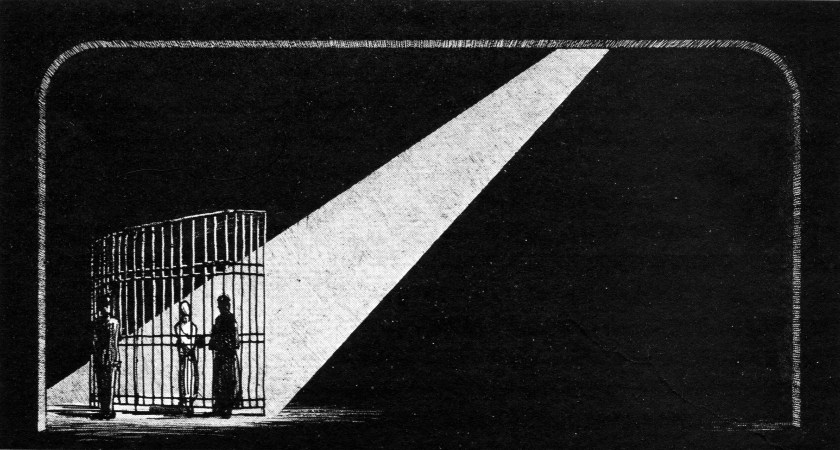
machinal-1928-setting-cell

Machinal

Almeida Theatre, 27th June 2018

I always like to do as much reading as I can before seeing a play. Reviews, synopses, articles, cross referencing creatives to previous work. You get the idea. The SO however will have none of that, preferring to go in cold and then see what she makes of it. And so it was with Machinal at the Almeida. Which made it a great deal more fun for me when I asked her after we came out to guess when it was written. She guessed the 1980s and was taken aback when I told her that Sophie Treadwell wrote this, her most famous and provocative play, in 1928.

For the most striking thing about the play is its modernity. It has an Expressionist structure, with nine scenes (“episodes”) and 29 characters telling the story of A Young Woman, (named Helen Jones we learn at the end), from her dull office job as a stenographer who lives with her Mother, through to her trial and execution after she murders her Husband, George H. Jones. It is inspired by the notorious real-life case of Ruth Snyder, but Sophie Treadwell significantly changes the facts of that case to portray the Young Woman as, in part, a victim of the mores of the patriarchal society she lived in. This is what has made the play relevant to later generations as this woman’s story could have been told yesterday. The rhythm of the dialogue, the choice of scenes, the motivations of the character,s all display a formal invention that was apparently not so apparent in most of Ms Treadwell’s other, more prosaic, plays (there are 39 in total). Her prime concern though in these plays, and in her short stories and journalism (which also took in sport, theatre and WWI), is the place of women in contemporary society, specifically in the domestic and economic spheres, the role of journalism and questions of race, all of which are addressed here.

Interest in her work waned after her death but has increased over the last three decades or so with major revivals of Machinal. It is easy to see why for this is a startling play. Not just in the story, which is gripping enough, and in the message, a powerful indictment, but in the way in which Ms Treadwell structured the play. I have to think there must be valuable creative opportunity in the rest of her dramatic oeuvre based on this.

No surprise to see this play paired in this Almeida spring/summer season with Ella Hickson’s brilliant The Writer (The Writer at the Almeida Theatre review *****). They both subvert dramatic form in order to express controlled fury at the way women’s desires and creativity are crushed by the expectations of men. And both remember to deliver their ideas in a thrillingly entertaining way.

Director Natalie Abrahami locates this production at the opening in a recognisably late 1920’s America but thereafter adds timeless twists to reinforce how little has changed. Miriam Buether’s set is framed, (in a way similar to The Twilight Zone on this stage), so that each scene is viewed through a window as it were, which, in turn, is reflected by a mirror angled above the stage. This creates a suitably claustrophobic atmosphere and allows for some dramatic contrasts between each scene, (and some extraordinarily quick work by the stage management team at the Almeida led here by Kate McDowell who could give a Formula 1 pit stop crew a run for their money). The opening scene, rows of typewriters and desks, is a tour de force as the Young Woman’s colleagues gossip and bicker as she is hauled up before the boss who eventually becomes her Husband.

The rapid fire dialogue is matched by the superb sound design of the Ringham brothers and lighting of young Jack Knowles, (together these might just be my favourite sound and lighting team especially when it comes to more uninhibited shows). All this sound and rhythm is written into Sophie Treadwell’s text which is astoundingly modernist. Subsequent scenes, at home with Mother, as the Young Woman talks herself into the doomed marriage, in the hotel room on the honeymoon night, especially queasy, in the bar where the Young Woman, helping out a colleague on a double “date’ begins her ill-fated affair with a Man, through to the courtroom scenes and the execution, are also brilliantly realised. There is so much that the Almeida gets right which makes it the best theatre in London right now, but the quality and imagination of the design is always just amazing.

Emily Berrington is spot on as the Young Woman. She is simultaneously the author of her own fate, (the real life Ruth Snyder was the instigator of her husband’s murder egging on her lover), with agency, but also sometimes apparently meek, helpless, naive, accepting, submissive even. She is disgusted by her work and husband but, when offered a way out of the trap, she seizes it, albeit with tragic consequences. The murder is not shown. It is simply the consequence of her escape from the inexorable social and economic forces that weigh down on her. She falls in love, real passion, but, here too, she is eventually disappointed and disillusioned.

Denise Black as her caustic Mother, husband long gone, is from a generation with absolutely no opportunity and sees an “economic” marriage as her daughter’s only path. Jonathan Livingstone as the smothering Husband sees her as a trophy and baby-maker with no interest in her thoughts, ideas or well-being. The Doctor, (Andrew Lewis), in the hospital where she gives birth to the daughter she doesn’t want is a patronising tosser. Her lover (Dwane Walcott) offers excitement, a path to an imagined new life, but you know his interest in her is transient, and he soon takes her for granted too.

Machinal means mechanical or automatic in French and this is what Sophie Treadwell seeks to reveal, the trapped automaton. The art of the 1910s and 1920s was preoccupied with the rapid social and economic change brought on by the rise of the machine. Yet this crushing imperative is contrasted by a series of emotional monologues delivered by the Young Woman which describe her resistance and which only theatre can proffer. I was struck by the resemblance to Alice Birch’s outstanding Anatomy of a Suicide shown at the Royal Court Downstairs directed by Katie Mitchell. Another breathtakingly original, formally experimental, superbly staged dissection of female entrapment with a tragic, repeated, outcome. That too didn’t need swathes of expositional dialogue to get the story across, just rapid, vivid exchanges. Yet that was written in 2015 not 1928.

So another hit for the Almeida. Next up is Dance Nation which is probably not for me but I can’t wait to see what Rupert Goold and the team have up their sleeve for the autumn/winter season.


Genesis Inc at the Hampstead Theatre review **

sperm-956480_1920

Genesis Inc.

Hampstead Theatre Upstairs, 25th June 2018

Sometimes less is more. A lesson that writer Jemma Kennedy and director Laurie Sansom here chose to, if not ignore, certainly bypass. Made even more frustrating because, at the kernel of this play, and in its execution, are some very good ideas. I applaud the ambition of the creative team at the Hampstead Theatre under Edward Hall, and the variety of the offerings, but it does mean that, just occasionally, there is a misfire amongst the hits and the deserved West End transfers. Some of my favourite productions over the last couple of years, (Gloria, Prism, The Firm, Dry Powder, The Phlebotomist and Describe the Night), have shown at the HT, both Upstairs and Downstairs, and often I have enjoyed them more than the critics. Sadly Genesis Inc. was not one of them.

Jemma Kennedy, who is also a screenwriter, has based her first major commission for the stage, (I believe), on her own experience of IVF treatment. She has also chosen to write a comedy. So far, so good. There is a vital personal and political story to be told about the commercialisation of reproduction and fertility in an ageing capitalist society and the dilemmas this creates. She has well-structured arguments to present, and, with distressed couple Jeff (Oliver Alvin-Wilson) and Serena (Rita Arya), and prospective single parent banker Bridget (Laura Howard), sympathetic, and sufficiently complex, characters to present those arguments. Harry Enfield plays Dr Marshall, the medical entrepreneur behind the fertility clinic that the three of them turn to. There are some pointed exchanges, sharp observation and some very funny lines,

But Ms Kennedy cannot then resist the temptation to add complication through additional characters and formal invention. And this is where the play goes awry. Bridget has a gay, impecunious, teacher friend/housemate/ex, Miles, played by Arthur Darvill who does a musical turn and falls for the priest, Father Scales (Arthur Wilson), at the school he rocks up in. He needs money to get on the property ladder so decides to sell his sperm for a few quid. Serena’s Mum, and dead Great-GrandMum, (played by Shobu Kapoor), poke their noses in. There is a sub-plot involving a social worker and salt of the earth victim of domestic violence played by the wonderful Claire Perkins, who also plays the childless alpha-female boss at the investment bank she works in. They, of course, get to IPO Dr Marshall’s clinic. Karl Marx and Susan Sontag are wheeled in. There is even a biblical scene involving Old Testament Abraham, wife Sarah, (90 years old when she conceived if you believe the big book), concubine Hagar and son Ishmael, and even, as you can probably guess by now, God himself. And maybe more startling, Serena’s ovary and vagina get to say a few words

All this is thrown in to allow Jemma Kennedy to make important points about the way in which women and their fertility has been treated through history and how the patriarchy and capitalism have degraded reproduction. This scattergun approach, taking aim at so many different targets, leads to some odd tonal shifts though, especially in the fantasy scenes, and especially at the end, and results in a distractingly complex set from Jess Curtis and some awkward on stage prop-shifting and costume-changing, (there are 42 named roles!).

It was a more than a little frustrating because there was so much in the basic premise, the satire of the moral framework which supports this unsavoury industry, which seems to trade on hope through unsubstantiated claims. Ms Kennedy is a smart enough writer I think to have made some of her points, and still got the laughs, within the context of the narrower personal stories. Harry Enfield is still an awkward stage presence, as he was in Once In A Lifetime at the Young Vic, but here his charm, alongside comic SA accent, masking a more ruthless commercial streak, seemed to work. Kirsty Besterman, as his officious assistant and sales jockey, had some choice lines. The stress that the IVF treatment put on the relationship between Jeff and Serena was well observed as was Bridget’s struggle to balance her desire for a child, by freezing her eggs, with career and demand for a relationship. Arthur Darvill has an unsteady naivety which matched his character and gamely rose to the challenges he was posed.

I can certainly see why the idea of stripping out the sub-plots and fantasy sequences would not have been an option for Ms Kennedy or director Laurie Sansom. The ambition to emulate the dense intellectual and theatrical experience of say an Angels in America, (cited by Edward Hall in the programme), is laudable but it didn’t really come off. And, by over-egging the pudding, I was left dissatisfied with the whole. Intrigued yes, entertained at times, made to think for sure, but just that bit uncomfortable that everyone involved was straining too hard to pull this off.