All My Sons at the Old Vic Theatre review *****

All My Sons

Old Vic Theatre, 10th May 2019

Take Arthur Miller’s most “Greek” and, probably, most moralising play. Wheel in a couple of Hollywood heavyweights (Bill Pullman and Sally Field, Neve before seen on a UK stage). Add a couple of high recognition and talented Brit actors (Jenna Coleman and Colin Morgan). And a supporting cast at the top of its game (Sule Rimi, Gunnar Cauthery, Kayla Meike, Bessie Carter and Oliver Johnstone). Design an entirely naturalistic, picket fenced, clapboard house set (Max Jones) draft an A team for lighting (Richard Howell), sound (Carolyn Downing) and video (Duncan McLean). Put Headlong chief Jeremy Herrin in charge, a man with a proven record of delivering serious, yet still entertaining, popular theatre (This House, Labour of Love, People, Places and Things, The Never, Junkyard and Wolf Hall/Brin up the Bodies). Kick off proceedings at a gentle canter but slowly and surely racket up the tension as the disclosures tumble out and the velocity of the dialogue accelerates. Don’t hold anything back at the end. Mr Miller certainly didn’t.

No surprise then that the Old Vic has a hit on its hands playing to packed houses with no need for the occasional discounting that has dogged a few, very good in my opinion, productions in the last couple of years (notably Fanny and Alexander). If you are to believe the Blonde Bombshells, BUD, KCK and the SO, and you should, this is well deserved. After a near miss with Three Sisters I have the team back in the palm of my booking blind hand.

So what is about the play and production that works so well? The last time I saw it, at the Rose Theatre in 2016, director Michael Rudman took a similar unfussy approach to proceedings, with a near identical set and some strong performances from Penny Downie as Kate Keller, Alex Waldmann as son Chris Keller and David Horovitch as Joe Keller, the “common man” and flawed “hero” of Miller’s tragedy. But it never really caught fire as here.

This is largely down to the quartet of excellent performances at the heart of the play. Though we have had a couple of contrarian opinions elsewhere in the viewing circle that mostly centre on the casting of Bill Pullman as Joe, which I can acknowledge but not agree with.

Bill Pullman started out as a stage actor but, as far as I can see, got sidetracked, as one might, by the big bucks of Hollywood. It is fair to say not everything he has laid down on celluloid has been of the highest quality though, also fair to say, I don’t know most of his films. He does have a very particular style of delivery though which, for me, works to great effect here. The pitch of his performance is pretty much unchanged throughout, but its amplitude is constantly changing. Alternately sympathetic, matey, defensive, aggressive, wheedling underneath the homespun, bumbling exterior, this is a man who who knows one day his secret will break him but continues to deny it even to himself, until right at the end. Sally Field as Kate, is similarly covering up, and therefore refuses to accept that her pilot son Larry died in the war, casting a protective cordon around her family. When she finally “finds out” the truth her impassiveness speaks volumes. In my pretty limited experience the stars of the American big screen generally hold back on stage, (a notable exception being Christian Slater in the recent Glengarry Glen Ross). That’s close-ups for you. It can seen underpowered, (and I wouldn’t want to see this production from up in the gods). Jeremy Herrin tough, with his master of pace, finds a way to turn this to advantage, “naturalising” the exposition of the first act and making the sh*t-hit-fan third act even more devastating

It was a joy to see Jenna Coleman as Ann Deever take to the stage after her phenomenally successful TV career. Her exchanges with Sally Field, as she and Chris seek her approval, are extremely affecting. For me though, Colin Morgan as Chris was the star of the show. Racked with survivor guilt from his brother’s death, and buried anger from his own war experiences, and then seeing his chance of happiness through a life with Ann turn to ashes as his father’s sins, (which deep down I think he knows), are revealed. Mr Morgan, as in Translations at the NT, (though this is a very different role even if he again stands at the centre of the plot), is dynamic and enthralling.

All My Sons first appeared in 1947. AM’s first efforts attracted critical acclaim but his previous Broadway opening in 1944, The Man Who Had All The Luck, was a flop closing after just 4 performances. Thank goodness he didn’t give up. All My Sons doesn’t quite scale the heights of its successors, Death of a Salesman, The Crucible and A View from the Bridge, but, as the standing ovation here demonstrated, (mind you that is par for the course now and no bad thing – these creatives deserve our gratitude), it delivers a whacking great emotional punch to the gut. Maybe not quite as much food for thought or structural elegance as those successors, and there are a few near McGuffins, (that letter), in the plot, but this is what drama is all about. You might occasionally rankle at the way AM controls the flow of information, and elevates dialogue over action, but you’ll still be hanging on every word as you catch up with what the various characters know, don’t know and learn about the central hubris. There’s also the old Miller criticism chestnut of veiled misogyny given that Ann acts primarily as the catalyst of the emerging truth and Kate is seen as somehow manipulating those around here. You might also, as a couple of our crew did, question the end, but, hey, that’s catharsis folks.

Well I didn’t know this. AMS is actually based on a true story which AM’s mother-in-law pointed out about an Ohio based aeronautical company that conspired with army inspection officers to approve defective aircraft engines for military use, eventually leading to a congressional investigation. I can see why this would have piqued AM’s interest. It could accommodate his overarching concern, the corruption of the American Dream, but here his critique of capitalist individualism riding roughshod over socialist collectivism, found an unambiguous moral centre in one family’s story. Whatever one’s political persuasion, putting profit above the safety of young men fighting for their country and for freedom is surely a no-no, but then again sending them to war in the first place shows a remarkable lack of collective intelligence on the part of the human race. Joe made the execrable decision, (or absence of decision), but did he feel the pressure from the military and the ideal of family? Where AM is really smart though is in taking inspiration not just from the Greeks, (All My Sons even strictly obeys the unities of time, place and action), but also from Ibsen, specifically The Wild Duck, where Hakon Werle’s wealth and influence is built on a crime that his former business partner, Old Ekdal, took the rap for.

There is also a pop at the veracity of the legal justice, (both Ann and brother George (Oliver Johnstone) believe their father is guilty and Joe innocent because the investigation said so), the frustrations, resentments and contradictions of “normal” small town America families, the Bayliss’ and the Lubeys,( though at least they don’t have the back story of the Kellers and the Deevers), are exposed, as are class and education. In the end though the story of a man, (or woman), losing, (or finding), their honour has brought us together for thousands of years (as all you GoT fans know). Hard to imagine anything better.

Of course all that was before we went down the road a week later to see The Death of a Salesman. Crikey.

Out of Water at the Orange Tree Theatre review *****

Out of Water

Orange Tree Theatre, 9th May 2019

The Tourist was much taken with Zoe Cooper’s last play, Jess and Joe Forever, also at the Orange Tree, in 2016. A coming of age story which charted the relationship of Joe, Norfolk born and bred, and Jess, posh and up from London for her holidays, but with, quite literally, a difference. In Out of Water she has, on a somewhat broader scale, created another uplifting story of difference and acceptance, this time set in the North East. She has a light and witty touch, but there is something more, an emotional depth that gradually emerges out her beautiful writing which marks here out as a dramatist of genuine talent.

Forthright Kit (Zoe West) is a police officer who returns to her native South Shields with her diffident partner Claire (Lucy Briggs-Owen) who is a teacher and is expecting their first child. Kit’s family, give or take, is accepting of the lesbian couple but Claire, a posh-ish Home Counties type, who has landed a job in a local school to facilitate inclusion and work with certain of the pupils, finds it more difficult to adjust. Her attempts to reach out to non-binary Fish (Tilda Wickham), who dreams of the sea, and is regarded with suspicion by her prosaic peers, are received warily and provoke misgivings from others.

These three excellent actors also play a bevy of other characters, Kit’s down to earth Mum, the head teacher that recruits Claire, Brendan, the disciplinarian PE teacher who gets results, a lippy school-kid, amongst others. All turn out to be not quite what they seem as Ms Cooper mines the arguments about how we define who we are. Scenes slide into each other, Georgie folk songs evoke a sense of place, this being the Orange Tree, the parquet floor of Camilla Clarke’s set open up to reveal the “sea” beneath, there is a fish tank in one corner, a ladder in another. In one effective scene Fish lip-syncs to a David Attenborough nature programme. The symbolism is maybe a touch heavy handed and the narration to supplement the dialogue is maybe a little overdone but it does mean Ms Cooper, and director Guy Jones, are able to cover a lot of ground and allows the subtlety of the themes she is exploring to fully emerge.

Avalanche at the Barbican Theatre review ****

Avalanche: A Love Story

Barbican Theatre, 8th May 2019

Dear Wonderful People Who Make Theatre,

Please can you persuade Maxine Peake and Andrew Scott to come together on stage in a naturalistic two hander about a normal couple who have something extraordinary happen to them. Manchester, London or Timbuktu. I don’t care where. Subject TBD. As long as there is bucketloads of emotional pain which has to be worked through whilst stoically carrying on with their daily lives.

Yours respectfully,

The Tourist

There is nothing actually that innovative about this monologue based on Australian writer Julia Leigh’s memoir about her experience of IVF. There is no need for it. A bit of symbolism from an avalanche and a pair of imagined kids. Otherwise it charts the fractured relationship of a film-maker, her overwhelming need to conceive and the grief that follows from the failed treatments. Anna-Louise Sark’s staging, a three sided, clinical, white space which rises slowly through the 90 minute production, a table and chairs that collapse, from designer Marg Horwell, some, occasionally, overly forthright lighting and sound from Lizzie Powell and Stefan Gregory, may give a hint of art-theatre. It doesn’t really add anything though to the performance.

Which is, in the least surprising surprise since we were apprised of the fact that His Holiness is of the Roman persuasion, just brilliant. It isn’t just the fact that Maxine Peake makes the movement of face, hands and body look entirely natural, (even when awkwardly directed to shift stage positions to break up the monologue), or the easy conversational style that projects, on on one, even up to us cheapskates in the gods. It is the fact that whilst remaining entirely Maxine Peake throughout – vowels, grins, wry knowing asides, pauses, reflections, repetitions, pointing, pawing – she becomes the woman whose harrowing story she is telling. This is not, forgive me, and thankfully, a story that I can relate and yet, pretty much throughout, I was there with her.

In anyone else’s hands the slight drawbacks in the adaptation would probably have been laid bare. It is too long, you can, an hour in, practically hear the pages turning, with too much emphasis on the how and what of the journey and not enough on the why, and this is too big a space for any monologue, (and robs the end of much of its theatricality). It does though get into the joyless mechanics and desperate economics of IVF treatment, six rounds in total, and captures the loneliness of the Woman’s quest. As it happens IVF treatment played a small part in Out of Water, the new play by Zoe Cooper, on my next night’s viewing. And this was, by comparison with the other stage work I have seen prompted by this experience, the weak Genesis Inc, a resounding success. And the Fertility Fest at the Barbican, of which this was a centrepiece, deserves everyone’s praise.

To my mind the only actor who can match Maxine Peake when it comes to force of personality and stage charisma is the aforesaid Andrew Scott. As was apparent to anyone lucky enough to see Simon Stephens’s monologue Sea Wall at the Old Vic last year (or in its previous outings);

And that is the reasoning behind my plea above.

Jude at the Hampstead Theatre review ***

Jude

Hampstead Theatre, 8th May 2019

I am guessing if you are the playwright responsible for The Churchill Play, Epsom Downs, The Romans in Britain, Pravda, Paul, 55 Days and Lawrence After Arabia you can get to write pretty much what you like. Especially if you plainly have a history of not giving a f*ck what people think of your work.

And if you are the outgoing director of the Hampstead Theatre, which you resurrected, (with your team), from near collapse a decade ago you also have the right to choose your swan song. And the writer who offered up five of his plays for you to stage over those ten years certainly deserves your loyalty.

But this is, no doubt, a tricky, uneven and, ultimately, not entirely convincing work. Howard Brenton has taken the bones of the story of Thomas Hardy’s Jude the Obscure, repurposed it for our time, and then, in what might have seemed like a good idea at the time, added a kind of chorus in the form of Euripides himself.

His Jude is a female Syrian refugee, self-taught in Ancient Greek and the Classics, who, working as a cleaner, improbably secures a place at Oxford on the whim of a lesbian don, Deirdre. After having married a pig farmer. And with a cousin, (yes there a bit of unconvincing cuz-luv per Hardy,) who gets a bit carried way with his religious fervours and end up being surveilled as a terrorist by one of the Prof’s ex students. And Euripides, also self taught, comes to our Jude in dreams. Because he was, as Mr Brenton says, bloody good at this drama lark and interested in the story of refugees, minorities and strangers.

The play’s main message I think is that society must find a place for its geniuses but on to this already rickety framework, HB has a pop, in a moreorless non-PC way, at all manner of targets. Racism, nativism, fear of the other, Brexit, dumbing down and cultural ignorance, tokenism, institutional hypocrisy, the power of the state and surveillance, masks, the bicameral mind (nope, me neither). All liberally sprinkled with quotes from the Iliad.

HB’s heart is definitely in the right place, and there is plenty to chew over, but the execution is often idiosyncratic, the dramatic momentum uneven and the arguments scatter-gun. No amount of directorial patience from Edward Hall, or creative ingenuity from designer Ashley Martin-Davies, can mask (ha, ha) the structural flaws. Isabella Nefar does have a bloody, (literally at one point in a rather forced nod to Hardy), good crack at pulling the contradictions of her character together and Caroline Loncq gets well deserved laughs out of Deirdre. Paul Brennen wears his Euripides mask well and doubles up as one of the spooks, (remember HB wrote for the TV show of the same name), alongside Shanaya Rafaat. But Anna Savya as Jude’s aunt, (her father was killed back home but he is the one who fuelled her ambition, natch), March Husey as the naive cousin, Luke McGregor as the doltish husband Jack and Emily Taafe as Jude’s A level teacher are all stymied by some awkward dialogue and thin characterisation.

Yet, despite all of this, I quite took to Howard Breton’s misguided intellectualism and stylistic kitchen sink-ism. What most of the audience made of it though is anyone’s guess. What with this, David Hare’s not shooting the lights out with I’m Not Running, ditto (actually worse) with Alan Ayckbourn in The Divide, Michael Frayn retired and not a peep for years from Tom Stoppard, maybe the best days of the grand old men of British theatre are behind them.

Thanks heavens for the mighty Caryl Churchill then. The new season at the Royal Court is advertising there new short plays Glass. Kill. Bluebeard. “A girl made of glass. Gods and murders. A serial killer’s friends“. That’s all there is by way of intro. That’s all I need. I can’t wait.

My London theatre recommendations May 2019

Time to update my London theatre recommendations. The last list from February 2019 turned out pretty well and a fair few from that are still available for selection. Now I know I go on a bit, and offer too many options, so I have taken the wider selection below, considered quality, certainty, availability (if they are sold out or won’t be extended they don’t appear) and chronology, and picked out the eight very best which should not be missed IHMO. The first four are tried, tested and, Lehman Trilogy excepted, aren’t too pricey. The final four are classy classics with top-drawer creatives in the saddle.

DO NOT MISS

Sweat – Gielgud Theatre.

Touching the Void – Duke of York’s Theatre.

The Lehman Trilogy– Piccadilly Theatre.

Small Island – National Theatre Olivier.

Blood Wedding– Young Vic.

Noises Off – Lyric Hammersmith.

The Doctor – Almeida Theatre.

Hansard – National Theatre Lyttleton.

**********************************************************

Here then are the selections from the various categories. Enjoy.

ON NOW AND STAMPED WITH THE TOURIST’S APPROVAL

Death of a Salesman – Young Vic. Along with Sweat the play of the year so far. Brilliant text, brilliant direction, brilliant cast. The best version I have ever seen. Of course this was always going to be the case so you should have listened to me months ago. Sold out now so the only way to see it will be if/when it transfers. My guess is, if it happens at all, it will end up on Broadway before coming back to London but don’t hold your breath.

Small Island – National Theatre Olivier. If you know the Andrea Levy epic novel about two couples in post war Jamaica and Britain, (or have watched the TV adaptation), you are in for a treat. If you don’t, well you still are. There are tickets left later in the run and, in terms of scale, stagecraft and story, you are definitely getting your money’s worth.

Rosmersholm – Duke of York’s Theatre. OK so it probably helps if you are Ibsen trained, and be prepared for the performance from the Stephen Toast school of acting from Tom Burke, but this is a superb production of an under-appreciated play with its finger on lots of pulses – moral, social, gender and political hypocrisies and contradictions . It isn’t jolly though. Plenty of tickets left but try to find a discount.

All My Sons – Old Vic. As with Death of a Salesman I told you so and it has now sold out. Probably Miller’s most moralising play and Bill Pullman’s performance is idiosyncratic for some, but the play is bullet-proof anyway. Will it transfer? Depends on the two Americans. My advice? Make sure next time a classic Miller is reunited with top-drawer cast and creative teams you just buy ahead.

Out of Water – Orange Tree Theatre. A beautifully written and uplifting three hander set in the North East about difference and acceptance. Playwright Zoe Cooper has a light and witty touch and the cast are excellent.

ANNA – National Theatre Dorfman. OK so this has already started but I haven’t seen a review yet. Ella Hickson, who is probably our most talented young playwright, and the Ringham brothers, sound maestros, combine in a tale set in East Berlin in 1968 which the audience will hear through headphones. Think Stasiland and Lives of Others. It is sold out so you will have to sniff out returns on the day.

BOOKING AHEAD AND STAMPED WITH THE TOURIST’S APPROVAL

Sweat – Gielgud Theatre. Transferring after the sell-out run at the Donmar. Lynn Nottage’s conscientiously researched drama about blue collar America is the best play I have seen this year, bar Death of a Salesman, and one of the best in in the last 5 years. Nothing tricksy here just really powerful theatre. The impact of de-industrialisation in the rust belt on three women friends and their families.

Equus – Trafalgar Studios. Just announced. Theatre Royal Stratford East’s superb production of Peter Shaffer’s classic play is transferring. You have to get your head around the concept, the relationship between a damaged young man with an erotic fixation on horses and his psychologist, but you won’t see more committed and exciting staging, direction and performances.

The Lehman Trilogy– Piccadilly Theatre. I told you to see it at the NT last year. If you ignored me, do not make the same mistake twice. An acting masterclass as the three leads take us through the history of the leaders of the eponymous investment bank and thereby the history of America since the mid C19.

Touching the Void – Duke of York’s Theatre. So the tale of Joe Simpson, the mountaineer left for dead by his partner who then survived against all the odds, is a obviously powerfully dramatic, hence his book and the subsequent, superb, film. But the way cast and creatives have then turned this into something that works in a theatre, with just a few props, some flashbacks and some inspired physicality, is marvellous. I saw this in Bristol before it went on tour and can thoroughly recommend it.

YET TO OPEN BUT YOU WOULD BE A MUG NOT TO TAKE THE PLUNGE

Blood Wedding– Young Vic. Lorca’s “not quite the happiest day of their lives” for a couple in rural Spain will be directed by Yael Farber (this should suit her style). The last time the Young Vic did Lorca it was an overwhelming Yerma. It will probably be atmospheric, stylised. angry and emotional.

Bitter Wheat– Garrick Theatre. World premiere of new play by David Mamet about Weinstein with John Malkovich in the lead. Woo hoo.

Noises Off – Lyric Hammersmith. The funniest play ever written returning to the theatre where it premiered in 1982. It may be theoretically possible to make a mess of Michael’s Frayn’s farce in two halves, seen from front of stage and then backstage, but I reckon it is unlikely with director Jeremy Herrin in charge. If you have never seen it you will be stunned by its technical construction and laughs per minute. And just £20 a ticket.

Appropriate – Donmar Warehouse. Branden Jacob-Jenkins take on the dysfunctional American family drama and confront their racist past finally comes to London. No messing with form as in his previous plays (An Octoroon, Gloria) but this young playwright has the knack.

A Very Expensive Poison – Old Vic. Lucy Prebble wrote Enron, one of the best plays of the last decade, about the financial crisis. She is finally back with this, based on the real life thriller book by heroic British journalist Luke Harding about the Russian spy poisoned in London. Espionage and power politics. Could be a stunner.

The Hunt – Almeida Theatre. Will probably help if you know the film with Mads Mikkelsen about a teacher who is wrongly accused of child sexual abuse in Denmark. It’s in because the Almeida and Rupert Goold the director rarely mess up.

The Doctor – Almeida Theatre. It is Robert Icke directing. It is Juliet Stevenson in the lead. It is at the Almeida. That’s all you need to know. Based on the classic play by Schnitzler about a doctor in early C20 Vienna destroyed by anti-semitism. Has a trial in it that will be meat and drink to Mr Icke. I am very excited by this.

RISKIER PUNTS TO BOOK AHEAD ON

Glass. Kill. Bluebeard – Royal Court Theatre. Three new short plays by Caryl Churchill. I’ve realised that, like Shakespeare, recommending productions by CC to non theatre obsessives doesn’t always pay off, (the Top Girls at the NT wasn’t perfect I admit), but she is still a genius.

Hansard – National Theatre. Not much to go on. A comedy about a Tory MP and his wife. But Simon Godwin is directing and best of all it has Alex Jennings and Lindsay Duncan in the lead. Obviously I am not the only one to realise that is a classy combination so it has sold out but they will likely conjure up more dates so look out and just buy blind.

Magic Goes Wrong – Vaudeville Theatre. If you are familiar with Mischief Theatre then this, created with magicians Penn and Teller, has to be seen. It will probably run for years but why not treat yourself for Christmas.

When the Crows Visit – Kiln Theatre. Ibsen’s Ghosts revamped and relocated to modern day India. The Kiln in Kilburn, along with the Arcola in Dalston and the Theatre Royal Stratford East, are all on a roll at the moment in terms of repertoire that isn’t too fringe-y but still diverse. This is the most intriguing offer.

Rosmersholm at the Duke of York’s Theatre review *****

Rosmersholm

Duke of York’s Theatre, 6th May 2019

Right finally a review that might conceivably be of some value to my solitary, loyal reader. Not that you should need me to tell you to go and see this. The proper critics and committed theatre bloggers will already have told you that. But I can heartily concur. Though I freely admit this is, in part, because I am awestruck by Hayley Attwell, who turns in an even better performance than she did in Measure for Measure at the Donmar, Labyrinth at Hampstead or The Pride at Trafalgar Studios.

Rosmersholm is apparently considered by many Ibsen aficionados to be his best play though it is rarely performed when compared to say, Hedda Gabler, Ghosts, The Wild Duck or The Master Builder. Now that normally just means it has some fatal flaw which the clever luvvies are prepared to forgive but which leaves us normal folk a bit nonplussed. Well, on the basis of this production, it is hard to see what has held it back from being as “popular” as Ibsen’s other works. The ethical, religious and political message is more pointed, the heroine, Rebecca West, more “contemporary”, the hero, Rosmer, more conflicted, the plot more transparent and the message more “relevant”, (though you should always be wary of people who vest past dramatists with “uncanny foresight” – it is human behaviour that doesn’t change). If you like your Ibsen social critique raw and bloody, and characterisation that doesn’t fanny around with dainty nuance, then this will be right up your street.

I have seen some reviews that imply that director Ian Rickson takes his time here. Nonsense. As in his other, superb, productions recently, Translations, The Birthday Party and The Goat, and his work with Jez Butterworth, he doesn’t feel the need to display any directorial excess, simply concentrating on forensically letting his actors breathe life into the text. Now of course I cannot be sure if the adaptor here, Duncan MacMillan, has taken liberties with Ibsen’s intent, never having seen the play before, (and having fallen behind, actually having never left the starting gate, with my Danish). If he has then good on him. It works. There is a bit of maladroit symbolism on show, a vision of a white horse which first appeared after Rosmer’s wife, Beata, committed suicide a year earlier by throwing herself into the waterwheel, but this no less grating than what’s served up in Lady From The Sea, Little Eyolf or, in the closest parallel, Ghosts. Oh, and there is of course, this being Ibsen, apparently some unintentional incest.

It is true that there is no escaping the melodrama of the conclusion, as the burden of guilt for the central couple becomes to much to bear, but frankly I want to be emotionally manipulated by great drama. There is a reason why the Greeks, Shakespeare, Ibsen and Miller still punch in the gut and it isn’t located in cosy domesticity. Of course it is hard to believe that in the space of 10 minutes Rebecca and Rosmer make their pact but it is not as if the two of them have been hiding their emotional dissonance up until then. Oh, and there is, of course apparently some unintentional incest. So even if deep-rooted shame is something few of us in 2019 might recognise, (look to our political class for confirmation), it doesn’t require too much of a leap of imagination to believe it of Norway in 1886.

I can also see why some might not take to Tom Burke’s “actorly” portrayal of John Rosmer. Mr Burke has a particular intonation and delivery, (last see by us in Schiller’s Don Carlos), which doesn’t always ring true but it does make his character’s intellectual life explicit. You make not entirely accept what Rosmer is feeling here, especially when it comes to his guilt about Beata, but you certainly now what he is thinking. Set against Ms Attwell’s restless, impulsive Rebecca, whose “freedom” almost overwhelms her, and Giles Terera’s inflexible, but oh so reasonable, brother-in-law Andreas Kroll, his anguished, grieving Rosmer soon makes sense.

The tension between the Rosmer’s heritage as a rich aristo at the heart of local society who has lost his clerical mojo and the progressive leanings fuelled by Rebecca, and by Jake Fairbrother’s cynical reformist journo Peter Mortensgaard, all set around local elections, is pummelled to a pulp by Ibsen, MacMillan and cast, but that is what gives the arguments universality. The way in which values inform political positions, the way in which the press turns ugly and fans the flames, the struggle between engagement or withdrawal, (here taken to its ultimate, Romantic, conclusion). Lay on top the clarion feminist call that Rebecca represents, the doomed passion that follows Rebecca and Rosmer’s meeting of the minds and the dissolution of Peter’s Wright’s knackered Ulrik Brendel, Rosmer’s ex-teacher, the hypocritical foil to the buttoned up Kroll, and you have the full Ibsen package of contradiction.

Rae Smith has conjured up another elegant set. Much like Mike Britton’s construction for the Royal and Derngate’s Ghosts which the Tourist relished a few days earlier, authenticity was key, but here the faded grandeur of a long unused reception room in Rosmer’s ancestral pile was imagined. Lined with ancestral portraits which Rebecca instructs the staff to reveal from under dust covers at the opening, the new broom, (apparently the original text calls for Rebecca to sit in a chair knitting before the first line). Later on, just to make sure we haven’t missed them, Rosmer chucks flowers at his forebears. Neil Austin’s lighting design takes full advantage of the possibilities of the setting, as does Gregory Clarke’s sound. The servants are omni-present reminding Rosmer of his position and creating swish scene changes but only the pithy housekeeper Mrs Helseth (Lucy Briers) gets to chip in with dialogue. And big respect to whoever signed off the health and safety papers for the aqueous resolution.

As with Ghosts as I was leaving I overheard some punters saying that they liked the actors but that it was a bit “word-y”. I am going to say this fully aware of just what a patronising c*nt it makes me sound like but …. it is not just about whether you recognise the cast from the telly and …. it is a play …. it is supposed to be “word-y”.

Ghosts at the Royal and Derngate review

Ghosts

Royal and Derngate Theatre Northampton, 2nd May 2019

A little bit of back to back Ibsen action. First this Ghosts and then, a few days later, Rosmersholm at the Duke of York’s. And the Tourist’s first visit to the Royal and Derngate which, he has Benn rather slow to observe, has been producing some very tempting offers as of late. I gather most of the drama here, (plays not fist-fights), takes place in the Royal with the larger Derngate offering a broader range of entertainment (Wet, Wet, Wet on the evening of the afternoon the Tourist attended, for those few of you who might be tempted by such). Both are wrapped inside a fine, open foyer area and I gather there are other spaces as well, the Underground Studio and a Filmhouse. All round very impressive.

As was this production of Ghosts, masterminded by director Lucy Bailey in a new version from Mike Poulton. Mr Poulton has a long history of adapting the European classics, Chekhov, Schiller, and a definitive version of Turgenev’s Fortune’s Fool. His last outing was the excellent RSC two part Imperium, the story of Cicero, which I caught on its London transfer. I last saw Ghosts in 2013/14, two versions pretty much back to back. In Richard Eyre’s West End take Lesley Manville pretty much wiped the floor with any other Helen Alving’s past and future. In the other, Stephen Unwin’s ETT version at the Rose Kingston (his final play there as AD), well let us just charitably say it didn’t quite match it. But Ghosts is such a fine play in my book that it is hard to go too far wrong.

Having said that it is possible to get bogged down in old Henrik’s miserabilism. Religion, syphilis, potential incest and assisted suicide are never likely to make their way into the repertoire of, say, Mischief Theatre, (though Ghosts: The Musical might prove tempting), but there is more in terms of plot and character beyond a metaphor for late C19 moral hypocrisy. Helen Alving, holed up in her gloomy mansion, is a woman of rare depth, her doomed son Osvald does have moments of joy, at least potentially, Pastor Manders is not entirely devoid of sympathy, Jakob Engstrand wants to atone and Regina will, I think, one day come to terms with her parentage.

Indeed if it wasn’t for the prize c*nt, the dead Captain Alving, things might have been very different. He was the faithless husband who ruins his wife’s, his son’s and Regina’s lives. The sins of the father and all that. (The Danish/Norwegian title is Gengangere, “the thing that walks again”, which is more like a revenant than a ghost, someone and something that comes back to haunt others). By confronting the past Helen knows she is going to make things worse, of course, but this is also, as with all of Ibsen’s important women, a catharsis to break free from that past and to engage with the truth however ugly. To reject the social mores and religious convention that trapped her in the painful marriage, even if it is too late for her son and her dead husband’s illegitimate daughter.

Lucy Bailey, Mike Poulton and designer Mike Britton have worked together before and it shows. Adaptation flows into direction which is perfectly framed by the set. Mr Britton was apparently inspired by Edvard Munch’s art. Munch produced numerous illustrations of Ibsen’s plays and designed a production of the play in 1906 shortly after HI’s death. The darkest of dark blue-greens, think Farrow and Ball Green Smoke but darker, creates a fitting “psychological” backdrop. Gauze screens divide reception rooms and conjure up spectres. Props, costumes and architecture details are spot on period, straight out of a Vilhelm Hammershoi interior (as above). This is what Ibsen should look like. After the effective orphanage fire the set does angle back to create a “pit” which the actors have to clumsily navigate but otherwise this was perfection.

Made more so by Oliver’s Fenwick’s moody lighting and by Richard Hammarton’s sound design and composition. No barely audible ambient background noise here. A proper soundscape. With lots and lots of rain and a proper fire. And some top drawer cello, violin and piano chord dissonance.

It is possible to judge the success of a production of Ghosts as pure drama by the reaction of the uninitiated members of the audience to the various disclosures. Ibsen, being a genius, doesn’t just bounce them out in a line or two of clumsy exposition, they emerge, organically, from the plot. Mr Poulton’s adaptation perfectly registers these twists, not quite turning it into a thriller, that would be asking too much, but definitely more than enough to persuade the Ibsen-curious. Well maybe not all, as I overhead some student-y types complaining it was too “text-y” afterwards. Trust me kids this is as racy as Ibsen gets.

Penny Downie, particularly in the scenes where she rounds on Manders, was a fine, dignified, Helen Alving. Pierro Niel-Mee’s Osvald was a little too camp for my taste. I know he is an artistic type but too much surface petulance risks losing the despair of what might have been. Declan Conlon’s Jakob by contrast was well rounded and Eleanor McLoughlin wisely held back to make her escape at the end more pointed. James Wilby did verge on the shouty at times but his Pastor was sufficiently human, confused, and, finally, ashamed, to make the initial friendship with Helen believable (sometimes a problem if he is overly puritanical).

Apparently Ibsen only took a few weeks to write Ghosts in 1881, whilst summering in Sorrento, though it didn’t get staged until the following year by a Danish company in Chicago. The subject matter was in part a two-fingered riposte to all the churchmen and stiff-necks back home in Norway who got wound up by the his previous play, the far milder A Doll’s House. There his heroine Nora walks out on her sh*t-head husband. Here we see what can happen when a wife is convinced to stay. If HI thought he had wound up his conservative enemies with A Doll’s House, they went batsh*t when Ghosts arrived back home. Even when the King of Sweden loaded up HI with medals and honours galore years later, as he was recognised as Scandi’s greatest cultural export (at least until ABBA, just joking), his maj told him off for writing Ghosts.

HI famously said “we go through life with a corpse on our back”. This masterly version shows just why Ghosts is probably, IMHO, the Ibsen play which best represents this maxim. If our Henrik never stopped picking away at the scabs of his own life and the society around him then Ghosts is when the blood started to properly flow.

I will be back at the R&D. I have seen three of the Made in Northampton shows that are currently touring, Touching the Void, The Remains of the Day and the Headlong Richard III. The first two are outstanding and I see that Touching the Void is coming to London later this year. Mandatory viewing. I missed Our Lady of Kibeho which, judging by the reviews, was a massive oversight. So I am not going to make the same mistake with The Pope, Two Trains Running and A View From The Bridge in the rest of this season.

I can see why the R&D has garnered awards though, and, I say this with the greatest respec,t it is hard to reconcile the fact that its AD, James Dacre, has the ex-editor of the Daily Mail for his dad. It would seem that, in this case, the sins of the father have not been visited on the son.

Edmond de Bergerac at Richmond Theatre review ****

Edmond de Bergerac

Richmond Theatre, 1st May 2019

Alexis Michalik is a loving looking chap. Oozes Gallic charm. The wunderkind of French theatre. So its good to know he is half-British. He kicked off as an actor but it is his plays, which have run to packed houses in Paris and beyond, and garnered multiple awards (5 Molieres for Edmond), which he directs himself, that have turned him into a star. First Le Porteur d’Histoire, then Le Cercle des Illusionnistes, most recently Intra Muros, which was adapted in English at the Park Theatre recently (though didn’t get great reviews). His most famous play though is Edmond which appeared in 2016, a theatrical paean to the creator of Cyrano de Bergerac, Edmond Rostand, and already made into a film.

Cyrano is the most performed play in the French language. A massive hit when it hit Paris in 1897, a broad fictionalisation of a real life nobleman, novelist, playwright, epistolarian and duelist in C17 France (1619-1655), written entirely in classical alexandrine verse (12 syllables per line) and about the most uplifting love story you are ever likely to see. Apparently the curtain call on the first night went on for over an hour and the French Foreign Minister emerged from the audience to go backstage and pin the Legion D’Honneur on Rostand there and then.

Cyrano regularly gets an airing in British theatres, luvvies love it, usually in Anthony Burgess’s wonderful translation, and you may well know know it from the film adaptations, either the faithful French classic version from 1990 starring Gerard Depardieu and directed by Jean-Paul Rappeneau (there were others before this) or the rather freer 1987 interpretation Roxanne starring Steve Martin and directed by the underrated Aussie director Fred Schepisi.

If it you have never seen a version you are probably aware of Cyrano’s defining feature, to wit, his huge nose. This is what prevents him wooing his beautiful cousin Roxane who he adores. When he befriends the handsome but inarticulate Christian, who also falls for Roxane’s charms, he sees a way to woo her vicariously with his exquisite love poetry. It works, Roxane and Christian are secretly engaged, but there love in turn attracts the wrath of yet another suitor, the Comte de Guiche who sends the lads off to the brutal war with the Spanish. Cyrano, on Christian’s behalf, but unbeknownst to him, writes to Roxane every day though and eventually Roxane comes to the front. She loves the poet and Christian realising the pretence asks Cyrano to confront Roxane and explain. He doesn’t drop his mate in it though, Christian is killed in battle, Cyrano sees off the Spanish.

Over the next 14 years, Cyrano, now a satirist, visits Roxane every day in the convent she has holed up in mourning Christian. Finally, after sustaining a head wound, he arrives late and faints. Roxane asks him to read one of “Christian’s letters” but in the dark he recites in from memory. He dies. Roxane realises her true love. Cue tears. At least for the Tourist (and not in the Steve Martin version). You would have to be made of stone not to get caught up in this.

Now that is actually the film plot, there’s a bit more to the play, but that’s the gist of it. Except, of course, the plot is turned into something transcendent by the verse. Can’t speak French but Anthony Burgess, albeit with what apparently is know as a “sprung” rhythm, is faithful to Rostand’s intention.

It is on the French language curriculum and is regularly revived in France so Alexis Michalik was taking a bit of a risk with his text. a bit like Tom Stoppard and Marc Norman with their script for Shakespeare in Love the 1998 Oscar winning film starring Joseph Fiennes, Gwyneth Paltrow and Judi Dench, directed by John Madden. Like SIL, Edmond, (de Bergerac here to avoid confusion with a David Mamet film), mixes the “real life” business of putting on a play with the plot of the play itself, in this case just the one play though.

Edmond Rostand (here Freddie Fox) is a failing twenty something poet, playwright and dreamer drawing his sorrows in drink with beau monde, womanising mate Leo (Robin Morrissey). Steadfast wife Rosemonde (Sarah Ridgeway) is on his case to provide for her and his two kids. In desperation he pitches an idea to the famous actor Constant Coquelin (Henry Goodman); an heroic comedy, based on the life of Cyrano de Bergerac, for the Christmas slot. Only problem. He hasn’t written anything. Still, the legendary Sarah Bernhardt (Josie Lawrence) believes in Edmond, and the services of diva Maria Legault (Chizzy Akudolu) to star in the play are secured. A couple of wide-boy Corsican producer/gangsters, the Floury brothers, step in with the cash (Nick Cavaliere and Simon Gregor) and, always at the last minute, Edmond delivers his three, then four, then five, act masterpiece.

We meet the prim Georges Feydeau (David Langham), Rostand’s rival and the master of farce, the philosophising Monsieur Honore (Delroy Atkinson) owner of the bar, where, along with the Palais Royal theatre, and the Rostand house, the bulk of the scenes are set, Jean (Harry Kershaw), M. Coquelin’s beloved son, would be pastry chef and terrible actor, and Jeanne (Gina Bramhill), the wardrobe mistress and saviour of the premiere who captures Leo’s heart, aided, of course, by Edmond’s words. Which are, you guessed it, what gets Rostand’s creative juices flowing when to comes to writing the play.

Many of the cast take on multiple other roles, we even meet Maurice Ravel and Anton Chekhov at one point, in the quick-fire and frenetic scenes. Movement director Liam Steel, in this production from the Birmingham Rep does an outstanding job, alongside director Roxana Gilbert in marshalling all this activity. Edmond de Rostand is not pure farce or musical but at times it looks like it. The plot is cleverly constructed, if a bit baggy, drifting in and out of the plot of Cyrano itself, the cast give their all and the set that Robert Innes Hopkins has created is brilliantly versatile allowing the sevens to shift rapidly with no loss of momentum.

I think it may have left some of the Richmond Theatre midweek matinee audience a bit nonplussed but that wouldn’t be the first time. For me, and I hope the audiences at the Birmingham Rep, York Grand Opera House, Royal and Derngate Northampton and Cambridge Arts Theatre where it toured prior to this, it was a delight. It deserves a bigger audience, why not the West End. Fair enough it would help to know a little big about its foundations, less of a problem in France where, as I have said, Cyrano de Bergerac is part of the cultural fabric, and there are occasions where M. Michalik is perhaps overly in love with his creation but for me it was one of the, positive, theatrical surprises of the year so far.

I haven’t seen nearly enough of Roxana Silbert’s work for the Birmingham Rep or, prior to that, Paines Plough. I was taken with Chris Hannan’s What Shadows which came to the Park Theatre, though that had a lot to do with Ian McDiarmid’s complex portrayal of Enoch Powell, and I can thoroughly recommend the Birmingham Rep’s latest co-production with the Rose Kingston, an adaptation of Captain Correlli’s Mandarin. I guess, when Ms Silbert joins the Hampstead Tate as AD I will be able to make a more informed judgement.

I wouldn’t want to single out any one member of the cast of Edmond but, if forced, I would highlight Freddie Fox whose performance is up there with his Tristan Tzara in Tom Stoppard’s Travesties. His default mood is despondency but, as the frazzled nerves give way to a determination to succeed, and the tender affection for Jeanne builds, (don’t worry he doesn’t cheat on Rosemonde in a clever inversion of Cyrano), so we get to see a rounded hero emerge. I am also partial to Delroy Atkinson who was so good in Roy Williams’ The Firm, (still on at Hampstead), though he, like the rest of the players, stays in one dimension. If you know Henry Goodman and Josie Lawrence from other performances you certainly won’t be disappointed.

Now apparently the original Cyrano play was responsible for the word panache finding its way into the English language. M. Michalik aims, and succeeds, in capturing that spirit. I suspect even the master of comic opera translation into English, Jeremy Sams, may have been stretched to the limit in bringing clarity to the chaos here, but, if you just roll with the comic punches, and are in love with theatre, then you really should try to see this should it pop up elsewhere. The show is funny, clever and, in the end, like its inspiration, heart-warming.

The Crucible at the Yard Theatre review ****

The Crucible

The Yard Theatre, Hackney Wick, 29th April 2019

The latest instalment in the Tourist’s engagement with this year’s unofficial Arthur Miller season was director Jay Miller’s often insightful, occasionally daft take on The Crucible which for me, and I know this is not the aesthete’s choice, probably just about trumps Death of a Salesman as Arthur Miller’s greatest play.

BTW it looks like, as any fool might have guessed, that the Young Vic and Marianne Elliott, and the stunning cast, have played a blinder with the now-opened revival of Death of a Salesman. This was predictably likely to be one of the best plays in London this year. And so it seems it is.

BTW again. I have been talking to some ypung people. Or rather I have been talking at some young people. At MS and MSC’s wedding amongst other ocassions so technically they had no means of escape. They, like MS and BD, hold Arthur Miller in low regard. I have a feeling that English Lit teachers may have been giving the poor chap a hard time. I get that there is some evidence in his life to support this, and revealed most explicitly in After The Fall, to pin him as an arrogant misogynist, who abandoned his disabled son, trashed the reputation of ex-wife Marilyn Monroe, stuck with impossibly idealistic political positions secure in his ivory tower and repeated himself to diminishing effect in terms of issues and form in his later plays. But, for me, his greatest plays are about as good as drama gets, and that is what matters.

And these plays can still thrive even when starved of creative sympathy. Especially The Crucible. As some sage observes in the Time Out review for this very production The Crucible is “built like a brick shithouse”. Correct. This apparently is the first time that The Yard Theatre has produced a classic play. It has played host to some others’ interpretations, notably Rash Dash’s wham-bam take on Three Sisters. But now Jay Miller and his young cast have given his namesake the shoestring, experimental once-over. Now the Yard, for the uninitiated, is exactly how a privileged, well-off, ageing, ex-City, liberal, insulated, South West Londoner imagines a theatre in edgy East London should look like. Scruffy space, ropey bogs, wooden benches now helpfully rendered fit for purpose with plastic seats. On a site by a canal, in an old industrial estate, next to the ginger line, two brew pubs on the site, (nice pizza courtesy of CRATE), creative spaces, studios, artisanal food-makers, cheek by jowl with old school light industry and breakers yards’. And graffiti. Lots of graffiti. Oh and beards. Lots of beards.

Love it. The Tourist is now looking for ways to get some of his chums to make the trek there. For even with the new material it presents this theatre is making a mark. I like the look of the upcoming Armadillo and its cast and hope that something beyond that might tempt his picky punters. The Yard is now getting Arts Council funding so expect it, like the Arcola, to go from strength to strength.

Probably should have pushed those punters a bit harder on this Crucible. they would have been intrigued. There are a few quirks – the TV screen announcing characters and other visual distractions sat on a chair, the spooky, masked witches that pop up in the later scenes, some extravagant Massachusetts c. 1692 accents, European regie-theater use of microphones, a spot of karaoke – that might bemuse rather than illuminate. But there are other innovations that manifestly do work. The cast kicking off on name-tagged chairs describing characters and context, and even stage directions and Miller’s own footnotes (A not J though that might have worked too); then slowly donning “period” dress (designed by Oliver Cronk) and taking on those accents; the doubling and truly gender blind casting; some dramatic lighting (Jess Bernberg) and ensemble effects; Jonah Brody’s ambient score and Josh Anio Grigg’s killer sound design. Brechtian and disorientating for sure but ramping up the strangeness of the events here and counterpointing the McCarthyite parable.

Since The Crucible is actually a belter of a story independent of its meaning then all this collectively serves to make us more engaged in what is happening as the hysteria in this ramshackle Salem boils over and the epic sacrifices by the Proctors are made. For surely The Crucible is as epic as anything Brecht or Euripides ever conjured up despite its superficially “historical” setting. Hence the link back to those opening quotes from Arthur M highlighting the historical inaccuracies. This is where Jay Miller’s mad genius pays dividends across the full 3 hours he commits to the production.

Young Mr Miller is plainly a clever fellow. For not only has smartly subverted the mythic quality of the play, whilst still retaining its dramatic power, (though like I say I have never actually see a bad production of The Crucible), and emotional connection, (I don’t actually well up when JP hangs on to his name but …..), but he has also feminised A Miller’s muscular language, exaggerated in The Crucible by the C17 New England idiom, with his casting of Caoilfhionn Dunne as John Proctor and Sophie Duval as Giles Corey (as well as Abigail Williams’s chief sidekick Mercy Lewis). Now as it happens these two are the best of the very talented bunch on show. I have seen Ms Dunne before, most recently in Mike Bartlett’s Wild, in The Nest at the Young Vic, on my allotted night at the Gate’s Dear Elizabeth and, most memorably at that same theatre in Suzy Storck, (where Cecile Tremolieres was, as she is here, the innovative designer). This was proof of just how much emotion she can wring from a character and so it proved again with her John Proctor, dim at first, but full beam by the time we get to the confession. Sophie Duval showed us intense pathos when Giles Corey loses his book reading wife to the madness but also plenty of laughs with Corey’s pithy comments about the venal motives of those egging on the teenage accusers.

It is usual to have sympathy for the scorned Abigail Williams. Not much though in Nina Cassells’s take where she has no discernible remorse for the carnage she unleashes. The scene when she meets Proctor, who begs her to recant, is especially chilling. The argument between, in this case, the two women, contrasts with the tetchy and tense arguments between JP and his (good)wife, played by Emma D’Arcy, in the Proctor house and then later the desperate exchange as JP wills her to lie on his behalf. I didn’t see Ms D’Arcy in Mrs Dalloway at the Arcola, (couldn’t find a date that worked for the willing SO), but it seems we missed a trick there. I am reminded that she mastered a tricky role in the unfairly maligned, if scattergun, Against at the Almeida as a complex student. The female side of the casting is completed by Sorcha Groundsell as the alternately, bolshie, brave and intimidated Mary Warren, (the weakest of A Miller’s Crucible characters IMHO). (I gather she has signed up for Netflix series The innocents – good on her). And a spirited (literally) Lucy Vandi as Tituba and the irksome Mr and Mrs Nurse.

As for the gents, Syrus Lowe, fresh from The Inheritance, offers a petulant, self aggrandising Reverend Parris, the willing executioner, as well as the officious Willard and Cheever, Jack Holden manages to avoid the trap of letting Reverend Hale descend into melodramatic self-pity as his faith is broken, and Jacob James Beswick stands out as “the Judges” Hathorne and Danforth, who care more about order and power than true justice.

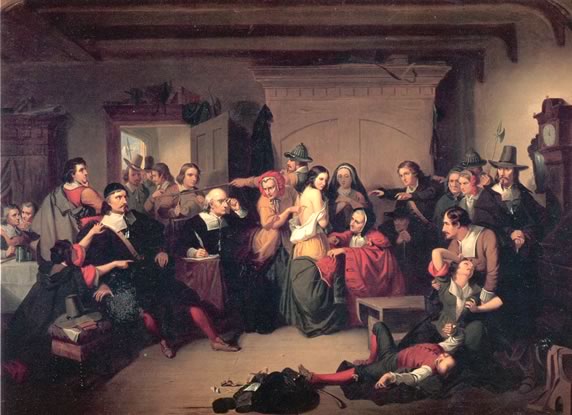
The doubling shows us that there is good and bad in all of us, though you have to hope yours isn’t going to be exposed by witchcraft trials, and that we are all capable of overlooking or conniving in state sanctioned persecution. The Crucible was written as allegory prompted by his mate Elia Kazan’s naming of 8 members of the Group Theatre to the House Un-American Activities Committee. Following the opening of The Crucible Miller also went before the Committee in 1957, had his passport confiscated, was held in contempt and sentenced to a fine and imprisonment. The “conviction” was overturned the following year but hardened Miller’s political views. He made up with Kazan years later. (As it happens Miller managed to get his work banned in the Soviet Union in the late 1960s as well, proving he was doing something right). Whilst, as I have said, the message of The Crucible and its dramatic power can stand all sorts of treatment, there is no doubt that Jay Miller’s radical take, at its best, offers an exciting and dislocating perspective on the play. A Miller took liberties with the “true” story of the Salem witch-hunts. Jay Miller is simply returning the favour.

The Crucible, like most of A Miller’s greatest plays, is ripped straight from the play book of Sophocles. John Proctor is the archetype tragic hero whose peripeteia (reversal of fortune) is brought on by his hamartia (fatal flaw) which leads him to anagnorisis (self discovery). All the very best plays, the ones that jump out, thump us in chest and head and leave us exhilarated, follow the Greek rules moreorless closely. Well maybe I exaggerate a bit. Though the following, including some of the Greek originals, suggests I might just be right. These plainly should be on everyone’s theatrical bucket list.

  • The Oresteia – Aeschylus
  • Oedipus the King – Sophocles
  • Medea – Euripides – (I know – it broke the rules)
  • Tamburlaine the Great – Marlowe – (see if you don’t end up quite liking the fella)
  • Hamlet – Shakespeare
  • Phedre – Racine
  • Woyzeck – Georg Buchner
  • The Master Builder – Ibsen
  • Long Day’s Journey Into Night – Eugene O’Neill – (four for the price of one)
  • All My Sons – Arthur Miller – (or Death of a Salesman or A View From The Bridge)
  • The Goat, or Who is Sylvia – Edward Albee
  • The Ferryman – Jez Butterworth – (work with me on this)

See what I mean.

Creditors at the Jermyn Street Theatre review ****

Creditors

Jermyn Street Theatre, 27th April 2019

I am still tiptoeing my way into Strindberg. A long history of ignoring him after an early dismissal many years ago was corrected with the companion piece to this, a version of Miss Julie, also translated by Howard Brenton, also directed by JST AD Tom Littler and also co-produced with The Theatre By The Lake which seems to serve the good people of Cumbria very well and probably needs a visit. There was also Polly Stenham’s version, simply Julie, in 2018 at the NT, a variation on her usual style. Neither were completely convincing, the former because of the play, the latter because of the production, but I recognise there is food for thought here, though far less than with Ibsen and Chekhov where I am now properly in the swing after some similar false starts many years ago.

It’s the underlying misogyny, even when old August may well be confronting it, and the violent swings in emotion which seem to be more necessitated by plot than character, which put me off. That is not to say that the grumpy Swede had nothing to say about the nastier side of love and passion just that the way he tackles it feels artificial to me. Now I know. It’s theatre. It isn’t real and doesn’t have to look like. Except that this is intended to be naturalistic and, like his contemporaries, offer an insight into the human condition, and specifically that thing that gets bound up in the phrase “love/hate relationship” or, more lazily I think, “the battle of the sexes”.

Mind you I have to say that this Creditors was a more engaging experience than Miss Julie. Maybe I am getting better at this theatre viewing lark, which would be heartening given the time and money invested, or maybe the way in which Creditors approaches the three way romantic tussle, here MFM rather than FMF, was more “relatable” (ugly word) to me, though I hasten to add I have never been caught up in such a scenario. The benefit, (or maybe curse), of being dull and painfully inept when it comes to matters of the heart.

What it can’t be, obviously is the creative approach. Like I say its the same team. Even down to the set where Louie Whitemore employs the same basic structure to create the seaside hotel reception room in which the sensitive, would-be artist, Adolf is convalescing with his fervent wife Tekla, that she employed to create the Scandi period kitchen for Miss Julie. Maybe the cast here was a little more to my taste though it is the same James Sheldon playing Adolf here in Creditors as the sexy servant Jean in the Miss Julie. I have a lot of time for Dorothea Myer-Bennett most of whose recent performances I have seen (Rosenbaum’s Rescue, Holy Sh*t, The Lottery of Love, The Philanderer) and she always stands out even if the play isn’t entirely convincing. Here she captured Tekla’s independent spirit, her devotion to Adolf and her still unresolved passion for the third character in this conflicted trinity, Gustaf.

He was played by David Sturzaker, another very fine theatre actor as it was my pleasure to discover recently in the multiple parts he mastered in the RSC’s excellent Tamburlaine. Here he shows how Gustaf’s insistent charm first cast doubts in Adolf’s mind about Tekla’s history, fidelity and ambition and then, as it is revealed that his presence in the hotel is no coincidence, he attempts to “win back” his ex-wife whilst Adolf eavesdrops from the room next door. These two scenes sandwich that between Tesla and Adolf where Adolf’s suspicions are angrily voiced despite her attempts to reassure.

Pretty straightforward huh and maybe not an especially original subject for drama you might think. But it is the way that Strindberg explores the motives and psychologies of his three protagonists, and the the way their emotional ambiguity is expressed, that turns it into something compelling. Why is Adolf so weak and open to persuasion? Tekla has expanded his artistic horizons and the marriage has been happy so why does he fall so easily for Gustaf’s Iago-like duplicity? She is intelligent, educated, sophisticated and worldly so why just WTF is Adolf’s beef? What is driving Gustaf to wreak this emotional havoc? Revenge, love for Tesla, wounded pride at the way Tekla, thinly disguised, ridiculed him in her autobiographical novel, toxic masculinity? Are Adolf and Tekla hiding something about their own history? Who is dependent on whom? Is Tekla still attracted to Gustaf’s “stronger” character? Is this just a game for Gustaf? Why the melodramatic ending?

Howard Brenton, like so many theatre types, is fascinated by the interiority, (yep it’s a real word), questions that Strindberg poses. As he is with other literary greats – see my forthcoming attempt to pick the bones of his latest play Jude inspired by Hardy (and, somewhat bizarrely, Euripides). As with Miss Julie this seemed, at least to this novice, an admirably forthright adaptation but then I know no better. It certainly, like the Miss Julie, serves up contemporary dialogue and caustic humour to set against the period setting and it comes in at a crisp 80 minutes or so. Same goes for Tom Littler’s direction and the unfussy lighting of Johanna Town and sound of Max Pappenheim. Howard Brenton has written a play, The Blinding Light, about Strindberg’s drift into madness, his “Inferno” period, which was directed by Tom Littler, and they have also combined for AS’s dances of Death, so you have to think they know what they are about here. So I am guessing this is about as good as it gets when it comes to modern interpretations of our August. Especially in the very intimate surroundings of the JST.

There is a lot more to Strindberg than the early, naturalistic plays which deal with that are most often performed. There are the the later more ambitious, symbolist works (A Dream Play, Ghost Sonata and The Dance of Death). Various history plays. Theatre director and producer. Novels. Poems. Essays. Scientific investigations. Painting, (his symbolist landscapes, example above, tick the boxes for the Tourist). Also dabbled in theosophy, though this was very trendy in fin de siecle artistic circles, occultism and alchemy. Not surprising he went a bit bonkers. A social/anarchist with a strong antipathy for all forms of authority but also an anti-semite. A campaigner for women’s rights who helped transform the role of women in drama who was also an ugly misogynist in print and whose wives where decades younger than him.

When you read about his him, his plays and his place in Swedish culture it is easy to see whay he holds such an important place in world drama. Am I persuaded? I’ll let you know in a few more years, and after a few more productions.