
The Wild Duck at the Almeida Theatre review *****

The Wild Duck

Almeida Theatre, 28th November 2018

He’s only gone and done it again. Director Robert Icke has taken Ibsen’s perhaps most circumspect, but probably greatest, masterpiece, from 1884, and adapted it to make it shine anew and say something profound about our world today. There may be a small price to pay in terms of subtlety, (and the sense of eyebrows-raised irony that permeates old Henrik’s world), but the gain, in terms of the clarity of text and story, and the lecture on the nature of truth, more than compensates. Mr Icke, to paraphrase Ian Drury, ain’t half a clever bastard, and he has no qualms about showing us that he is, but when he creates theatre as powerful as this then we should all be grateful. Mary Stuart, Uncle Vanya, Oresteia, Hamlet, 1984, Oedipus, Romeo and Juliet and now this. One or two hiccups outside these triumphs for sure but when he takes a classic and lets fly with his intellectual vajazzling you know you are in for a treat.

Gregory Woods (yep, as in his Vanya, Icke has anglicised the names), has just returned from a self-imposed exile. His father Charles is having a party to celebrate his betrothal to his housekeeper Anna Sowerby, also attended by Greg’s old school chum, jobbing photographer James Ekdal. James has married Gina, previously a servant in the Woods household, who may have had an “affair” with patriarch Charles, at least according to Greg’s now dead (unhappy) mum. Greg believes James and Gina’s life is built on a lie. In subsequent acts, set in the Ekdal’s apartment and photography studio, we also meet James’s own broken, alcoholic father Francis, once Charles’s business partner, daughter Hedwig, who is slowly losing her sight, and cynical neighbour, John Relling.

Oh and there is a wild duck upstairs, (or not as it turns out). And, when Bunny Christie’s set extravagantly pays off near the end, (in tandem with the production itself), much more besides. It is artifice, of course, that’s Icke’s point, but it is so dammed affecting.

You might have guessed that Mr Icke treats us to more than the naturalism normally accorded to Mr Ibsen’s play however. The play opens with an empty stage. It’s the old rehearsal room schtick. Kevin Harvey as Gregory, (last seen by me in preposterously high heels and sparkly drag in the marvellous community theatre Pericles at the National), sets the scene armed with microphone and explanation. “All stories are lies”. That’s the gist of it. Edward Hogg’s James enters from the stalls and borrows a jacket from an unfortunate front-rower. He takes the mic and starts to explain his character. And so we continue with the actors coming in, seizing the mic, (Nicholas Day’s Charles started off in a seat next door to the Tourist), and then breaking into the narrative of the play itself to offer reflections on their characters motivations, the way Ibsen’s own life, (notably the illegitimate daughter he fathered with a servant girl and abandoned), interact with the play and to explain sub-text. Gradually though Ibsen’s own words, (filtered through modern Norwegian and then Icke’s idiomatic English from archaic Danish-Norwegian as Greg reminds in an initial aside), take centre stage and the brilliance of his plot is revealed. Simultaneously the stage is, almost imperceptibly, transformed into a period version of the Ekdal household, as the props accumulate and Elliot Grigg’s lighting gradually dims.

Pretty much everyone in the Wild Duck lies to themselves and to each other. For that is what they do just to keep going, just like we all do. Their “life-lies” in Ibsen’s words. Political idealist Greg though is having none of this and, as he picks away at the scabs of the past, starting with his Dad, everything unravels. For him truth is what matters, regardless of the damage caused by its revelation. So he wades in with his size twelves leaving James as the main casualty, as the multiple skeletons cascade out of multiple metaphorical cupboards.

Now you might contest that Mr Icke too has aggressively waded in feet first in his determination to expose the message and the context of the play. Mind you I don’t know how big his boots are nor, indeed, whether he is, indeed, too big for them. It is just a clumsy metaphor. Just like the many that Ibsen employs. And now Icke. The real time “deconstruction” hammers home these metaphors but the attention to detail and intelligence of the “interventions” only serves to increase our understanding and enjoyment. The audible gasp from the audience at the big reveal shows me that Icke’s restoration job has made the Ibsen “original” arguably more powerful and more vivid. It certainly doesn’t want for emotional power. I’ll even forgive him the torch version of Love Will Tear Us Apart. Some might prefer their Old Masters in a mausoleum, dark, dingy and covered with layers of accumulated interpretative varnish. Not me. Get back to the original colours, slap them in a white, light filled room and provide copious notes please.

I’ll warrant that the cast also profited from the reworking. Kevin Harvey strikes just the right note of fractured righteousness in his soft Scouse. Edward Hogg is mesmerising as his pride is undone and his moods shift alarmingly. Nicholas Farrell and Nicholas Day excel as the two estranged fathers and Rick Warden as Relling and Andrea Hall as Anna Sowerby both offer convincing support. However for me the standout was Lyndsey Marshall as Gina, whose pain is most acute but who still has to pull the threads of her family together. “I don’t know if I love you but it is my best guess that I do”. Just marvellous. And finally I was frankly bloody stunned by the performance off Clara Read, as Hedwig in our performance. Little Hedwig is largely the reason why so many lies are told. Most young actors, when surrounded by adult characters, are always still acting however good their performance. Ms Read didn’t appear to be acting, ironic since, as I recall she was the only one on stage who didn’t break the fourth wall. I would love to see her perform again.

The Wild Duck sadly has flown away from the Almeida and, like The Writer, I suspect it may prove a little bit too cerebrally audacious for a West End sojourn. But it does prove the current No 1 rule of London Theatre. Always take a punt when booking opens on anything at the Almeida. Especially when directed by Mr Icke, Mr Goold or Ms Frecknall. Sounds like the Tragedy of King Richard the Second with Simon Russell-Beale is dividing the criterati – I have yet to see it, though reading between the lines and based on Joe Hill-Gibbons’ recent Shakespeare outings I suspect I’ll love it. But the new play by Annie Washburn, Shipwreck, looks tempting, (even if I had some reservations about her last two outings premiered here, Mr Burns and The Twilight Zone), and the Three Sisters, in an adaption by Cordelia Lynn, directed by Rebecca Frecknall, (whose Summer and Smoke is now bowling ’em over at the Duke of Yorks), and with Patsy Ferran and Pearl Chanda in the cast, is near guaranteed to be a belter.

Regular readers of this blog, (ok some kindly chums), have oft remarked that I am prone to generosity in my reviews, if not in life. True. But in this case if you don’t believe me then take the word of the SO who rated this Wild Duck up there with Network and The Lehman Trilogy as her plays of the year. And trust me she isn’t always easy to please. Theatrically that is, not domestically.

One final aside. I spend a lot of time in the theatre. It is therefore quantifiably a large part of my own reality. And sometimes it feels more real than reality. This was one of those times. I could still happily be sat in the Almeida watching the unhappiness of the Ekdals and the Woods three weeks later so immersed was I by the end. Pick the bones out of that.
Time Stands Still: Aurora Orchestra at Kings Place review ****

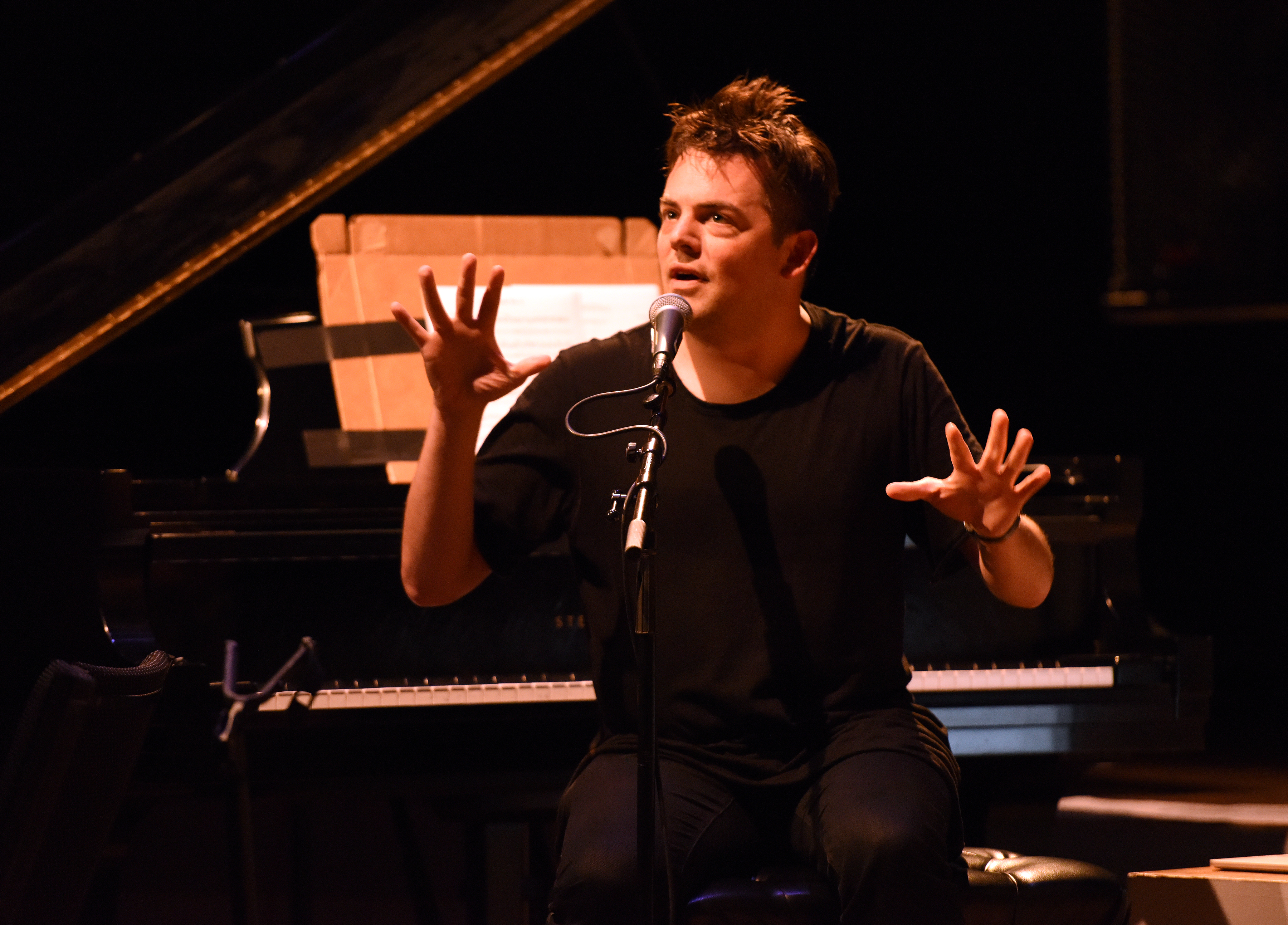
Aurora Principal Players, Iestyn Davies (countertenor), Sally Pryce (harp), John Reid (piano), Nico Muhly

Kings Place, 23rd November 2018

  • Satie – Gymnopédie No. 3
  • Thomas Adès – The Lover in Winter
  • Nico Muhly – Clear Music
  • Debussy – Danse Sacrée et Danse profane
  • Brahms – Gestillte Sehnsucht
  • Nico Muhly – Old Bones (world premiere of ensemble version),
  • Nico Muhly – Motion
  • Thomas Adès – The Four Quarters
  • Dowland (arr. Nico Muhly) – Time Stands Still (world premiere)

A full house, moreorless, for a diverse programme of chamber music and songs anchored by (relatively) well known works from Thomas Ades and Nico Muhly, whose effervescent presence also graced the evening as performer, conductor and even compere. Oh and did I mention he “curated” the event. The evening was part of the year long Kings Place Time Unwrapped season now coming to an end with the pieces ostensibly linked through their meditation on, er, time and music from an earlier age. 

The musical backbone was provided by the graceful pianism of John Reid, with strings and clarinet from Aurora principal players, Alex Wood, Jamie Campbell, Helene Clement, Sebastian van Kuijk and Peter Sparks. Against this a number of the pieces showcased the unusual harmonies of the harp (Sally Price whose playing was certainly not backward in coming forward), celesta (John Reid again) and the ethereal countertenor of Iestyn Davies

There was a world premiere of a new chamber version of Old Bones, a song cycle about the rediscovery of the body of Richard III in a Leicester car park in 2012, (an event which also formed the opening sequence for the Almeida Theatre production of Shakespeare’s play with Ralph Fiennes in the lead). The arioso of Iestyn Davies was originally accompanied only by a lute, which can be discerned in the fragments of poems about Sir Rhys ap Tomas, the alleged killer of the king, which follows the news commentary intro. The momentum builds into a processional as the text, from Philippa Langley of the Richard III society, eloquently connects the infamous monarch to today.  

Muhly’s Motion for string quartet, clarinet and piano takes as its starting point a verse anthem from Orlando Gibbons, See, see the Word, and applies his trademark post-minimalism energy to Gibbons’s complex vocal counterpoint .

In contrast Clear Music is based on just a fragment of a John Taverner motet. Mater Christi Sanctissima, and is scored for cello. harp and celesta with the latter gifted an inventive solo part for an instrument normally reserved for adding orchestral colour. The texture doesn’t change and the piece is locked in a pretty high register, even in the cello line, but, as usual with Mr Muhly, he creates an engaging piece that doesn’t come anywhere outstaying its welcome. 

Thomas Ades’s Four Quarters from 2010 is a string quartet which takes as it subject the ebb and flow of time, in common with the TS Eliot Four Quartets, poems from which it surely drew inspiration. As usual Ades serves up all sorts of striking  sounds, a wide dynamic range rhythmic complexity, beginning with the eerie babble of Nightfall, followed by Morning Dew evoked through pizzicato, the steady pulses of Days and the astounding harmonic complexity of the last movement, the Twenty Fifth Hour, which is measured in an unusual 25/16 time.

The evening’s outstanding piece of me though was The Lover in Winter, written when Ades was only 18. It is made up of 4 very short songs, in Latin drawn from an anonymous text. It has a bleak, brittle, chilly feel, just chiming piano chords and Iestyn Davies’s exquisite countertenor, though the last song fails up the passion. Melismatic with candid word-painting. 

Mr Davies was also superb in Time Stands Still, a Dowland song which Nico Muhly has re-arranged. The melody is defined by the singer, based on an anonymous love song, with the whole band coming together to provide complementary but recognisably contemporary harmonies. 

The programme kicked off with John Reid in Satie’s ubiquitous piano waltz  Gymnopedie 3, blink and you’d miss it, as well as a helping of (to me) an unremarkable Brahms song and Debussy’s showcase for the harp with its “medieval” first part and  bouncy Spanish inflected second “profane” part. At the end we were treated to Messrs Muhly and Davies presenting an aria from Marnie, which has just finished at the Met, and which I bloody loved at the ENO.

For someone who I gather lives in NYC, Nico Muhly seems to spend a lot of time in London. No surprise that to the Tourist. Indeed he will be back at Kings Place on New Years Eve with the Aurora Orchestra. I can think of worst places to be. Mind you I do have a better offer for once. 


Modern Couples at the Barbican Art Gallery review ****

Modern Couples: Art, Intimacy and the Avant-Garde

Barbican Art Gallery, 15th November 2018

Here’s another smart bit of curating from the team at the Barbican, in collaboration with the Centre Pompidou-Metz here led by Jane Alison. Track the history of modernism in art – not just painting, but sculpture, photography, design, print, literature and architecture, with a nod to the commercial where appropriate – through the couples which created it. 

The net has been cast wide, both in terms of the number of artists involved, 46 partnerships in total, the themes that are explored, including love, sex, passion, politics, collaboration, abstraction, communication, and the nature of the relationships, straight, gay, bi, polyamorous, homoerotic, controlling, liberating, disturbing, equal, unequal, conventional, unconventional. 

With a few exceptions there isn’t a great deal of material here to map each couple but the quantity, and the clear and direct tone, display and messaging, makes up for that. The private connections are fascinating in themselves but also shed a lot of light on how art and artists have changed society since the turn of the C20.

There are a fair few relationships that you might expect to appear, the Bloomsbury Group permutations, Frieda Kahlo and Diego Rivera, Georgia O’Keefe and Alfred Stieglitz, Ben Nicholson and Winifred Nicholson and then Barbara Hepworth, Alma Mahler and Gustav and Oskar Kokoschka (who really couldn’t let go), Jean Arp and Sophie Tauber, Lucia Moholy and Laszlo Moholy-Nagy, the Delauneys. And then there are a few which I didn’t anticipate. The Aaltos, Gustav Klimt and designer and businesswoman Emilie Floge, Nancy Cunard and Henry Crowder. 

It is hard not to be drawn into the stories of those women artists whose contributions, the exhibition argues, may not have been justly recognised in the shadow of their more “famous” partners, Camille Claudel and Rodin, Maria Martins and Duchamp and, arguably, Dorothea Tanning and Leonora Carrington with Max Ernst. The fate of Dora Maar, Picasso’s early muse, and Unica Zurn, the “inspiration” for Hans Bellmer, will likely disturb. A lot of these fellas don’t come across well here. 

Most interesting for me. The intense friendship between Lorca and Dali. The portraits of Romaine Brooks, (her lifelong partner, and oft-subject was the writer Natalie Barney), entirely new too me, Lee Miller, during her years with Man Ray and Roland Penrose, she is a cast-iron genius though here, as elsewhere, the submission is unsettling, and, best of all the extraordinary creative partnership of constructivists Varvara Stepanova and Alexander Rodchenko. Now they were the future, and looking at their work, they still are. And as far as I can see they were genuinely equal with no hint of the f*cked up sadism of the surrealist fringe. There they are above in the 1920’s looking pretty cool. 

Well worth a look. It may end up being more biography than art and it is probably fair to say, like most of the Barbican’s exhibitions, it is designed for the slighter, and maybe outre, attention span, but, let’s be honest that is sometimes what the head, and feet, requires. Don’t expect to be bowled over by amazing art, but do expect to learn something. Tie it in with something else – it’s not like there isn’t plenty going on at the Barbican. 

Romeo and Juliet at the Barbican review ***

Romeo and Juliet

Barbican Theatre, 8th November 2018

You can stay right next to Juliet’s balcony in Verona. Le Suite de Giulietta. The Tourist, SO, BD and LD can vouch for the lovely decor, the sizeable rooms and the delicious breakfast. The courtyard is closed at night so it is very tranquil and, in the day, it is quite fun watching the crowds do a double take when you exit from the hotel. And Verona itself is a very fine city. 

Now I am not a berk. I know it was a window not a balcony. And that this is a story which Will S nicked from William Painter via Arthur Brooke via numerous Italian medieval raconteurs, including Dante, and then all the way back to Ovid and Xenophon. But even this cranky curmudgeon can get swept along by the definitive tale of young love dashed. Though Shakespeare being Shakespeare there is a lot more too it than that, what with the examination of gang violence, pointless vendettas, family loyalty, sexual freedom the curious nature of Mercutio, the expanding eloquence of Romeo, the precocity of Juliet (she’s supposed to be coming up to 14 remember), the constancy of Benvolio, the comic good-naturedness of the Nurse and the misguided and hare-brained intervention of Friar Laurence.

It’s easy to see why R&J is so popular and has been presented in so many ways. The denouement with our two dead teens is always, or should be, a tearjerker, even as we know the outcome, the idiocy of Friar John – all you had to do was deliver a letter, how hard is that numbnut – is always a reason to shake your fist, the reconciliation of the families, (even as you know it won’t last), always stirs, there are some good, often dirty, jokes and some fine, sweet verse. 

It can endure a lot of textual and/or directorial abuse, (though it is hard to fathom the happy endings of previous centuries), and, even with the sub-plots is a breeze to follow, even without the Friar’s helpful “brief” summary at the end. What it doesn’t like though, in my book, is less than clear delivery of the verse. You need to hear the clever way WS matches language and form to character, you should clock the sonnets, you ought to grasp the filter of metaphor and religion through the language of love, and hate, you should be left to decide for yourself whether the narrative is driven by “fate”, by “chance” or by character “flaws” or “humours” and you need time to ponder on Shakespeare’s preoccupation with, well, time.

In this respect I wasn’t entirely convinced by director Erica Whyman’s gung-ho interpretation. The youthful cast, in the relevant roles, certainly brings to the fore the recklessness of their behaviours, their strutting self-absorption, their need for peer validation, and the brings out the parallels to contemporary knife crime. Bally Gill’s impetuous, swaggering yet still sensitive, Romeo and Karen Fishwick’s animated, “mature beyond her years”, Juliet could live in any city near you right now. They certainly have the chemistry. Charlotte Josephine brings a whole new dimension to Mercutio’s complexity, his/her relationship with Romeo and exaggerated masculinity. To me there was almost a rap like quality to Mercutio’s wilder flights of linguistic fancy. Josh Finan’s Benvolio offered counsel to Romeo which maybe also sprung from a deeper admiration. The gender fluidity in the Houses of Montague and Capulet also extended to Donna Banya’s timid Gregory. 

In the adult roles casting Beth Cordingley as Escalus pays off especially when she spits out “you men, you beasts” and Michael Hodgson is a severe Daddy Capulet who pushes his daughter into disobedience. Ishia Bennison’s Nurse also delivers, offering up her deceptively “simple” verse complete with funny accent. Andrew French’s Friar L relished every syllable. Tom Piper’s set, with oxidised cube, doesn’t really add much, then nor does it detract, (well maybe a bit at the end), and Ayse Tashkiran’s movement seems more in tune with Erica Whyman’s vision than some of the other creatives. As well as time, Will S bangs on about light and dark, night and day, sun and moon/stars, incessantly through the play, and the whole tone lurches to the minor post Mercutio’s slaying by Tybalt, but this contrast didn’t fully emerge. Sophie Cotton’s score similarly veered towards the murky. 

Overall then, in trying to explore the “tragedy of youth” and the intricacy of passion in a fresh and recognisably modern setting, to get to the root of “feelings”, the words sometimes ended up grating. The chopping of text wasn’t always helpful. And the delivery was uneven. I want to believe that this unlikely chain of events really could happen, to see the “if-onlys” as exactly that, and not to watch some swooning melodrama, but I also want to hear and digest exactly what everyone is saying. So big picture, this works, in some of the details, it is a little less cogent. 


Honour at the Park Theatre review ***

bookcase-books-bookshelves-159711.jpg

Honour

Park Theatre 200, 1st October 2018

Never, ever, marry a writer. That’s the main lesson I learnt from Honour. Jessica Murray-Smith’s 2003 play, much revived, which premiered at the NT with Ellen Atkins and Corin Redgrave, tracks the break up of a 32 year marriage when literary heavyweight George falls for calculating younger woman journalist Claudia. He leaves behind bewildered wife Honor, whose successful writing career was cut short when daughter Sophie, who is pretty livid about all of this, came along.

Across its two hours or so there is no doubt that Ms Murray-Smith covers all the bases. George’s priggish self-satisfaction. The hypocritical, “mid-life crisis”, vanity that allows him to fall for Claudia despite mocking a friend who does similar. His blustering erudition. Honor’s sacrifice of career and legacy to “support” George and bring up Sophie. Her shock, bemusement, anger and acceptance of what has happened to her. The generational gap between her and Claudia who has put career ahead of relationship and sees others in the light of what they can do for her. “Some women use loyalty as a way of justifying their sacrifice of themselves”. Claudia’s manifest certainty, at least until it starts to go wrong, as it was inevitably going to do, with George. Sophie’s anger with her Dad and exasperation with her Mum, and the gap in academic success, if not emotional intelligence, between her and Claudia, her near predecessor at Cambridge. The fading of passion in marriage, the value of monogamy, the betrayal of adultery, the idea of honour in love.

Yet the whole thing is curiously bloodless, as if the characters are acting out their reactions to each other and the situation. Which of course they are. But what I mean is the dialogue itself just doesn’t always persuade. This is not because these people lack eloquence and the ability to express themselves. Quite the reverse. They are INTELLECTUALS and that is how they talk. All the time. About everything that happens. Perhaps this is exactly how people of this class and position would behave in this situation. It is hard to connect though especially when a scene is contrived to explain to us the difference between naturalism and realism in drama.

This is nothing to do with the cast however. Producers Tiny Fires have assembled a super quartet, and under director Paul Robinson, I have to think they delivered the lines exactly as intended. If anything Katie Brayben as Claudia, who shows here that she is so much more than a musical star, and Natalie Simpson as Sophie outshone even the venerables Henry Goodman and Imogen Stubbs. I have been fortunate enough to see pretty much every professional stage performance of Ms Simpson (The Cardinal at Southwark Playhouse, as Ophelia in the Simon Godwin Hamlet opposite Paapa Essiedu, as Cordelia in the last RSC Lear, in Melly Still’s very fine RSC Cymbeline and as Juliet in Joe Hill-Gibbons’s Young Vic Measure for Measure). She is going to go a very, very long way.

Liz Cooke simple, blue set, marked with lighting strips and with a natty curl in one corner (the Park 200 has go in-the-round for this production) is intended to evoke a competitive space, a boxing ring. This is a similar conceit to that seen in Mike Bartlett’s Cock at the recent Chichester revival, also a four hander about a love triangle but, I think, far more successful, largely because the dialogue of the protagonists is riddled with uncertainty and rationality of behaviour is in short supply (Cock at the Minerva Theatre review ****).

With actors of this quality on this form, and with its squarely “middle-class” concerns (why is that the elite always insists on calling itself “middle-class”?) and flavours, I think this probably deserves, and may well get, a wider audience. Just make sure you put on your best speaking voice if you go.