It is not difficult to see why theatre-makers, and audiences, continue to be drawn to drawn to Ibsen’s masterpiece, now over 140 years old. First and foremost, there is the still extraordinarily powerful message. Just think what old Henrik would have written if he had actually set out to write a feminist manifesto and not used the real-life experience of a family friend. Then there are the complex fully rounded characters, not just Nora herself, but Helmer, Rank, Kristine, Krogstad and Anne Marie, a mixture of good, bad and indifferent, shaped by, and shaping, the society they are immersed in. Of course, our sympathies are drawn towards the women’s predicaments, with indignation reserved for the patriarchal men and the way they treat those women, but, as ever with Ibsen, there is plenty of grey to ponder in between the black and white. Then there is the plot. Enough twists, believable disclosure, that ending, getting close enough to melodrama to please even the casual theatrical punter but offering enough pleasure to those who seek repeated viewings.
And then there is its seemingly infinite elasticity. We may have moved on from the stifling morality of late C19 Norwegian society and the “exclusively male society, with laws made by men and with prosecutors and judges who assess feminine conduct from a masculine standpoint” that HI observed, but his skill and intention in framing a more universal message of personal freedom and self-expression is, if anything, even more relevant in our world today. As last year’s queer reworking of the play, in Samuel Adamson’s Wife at the Kiln Theatre, demonstrated. (He has previous with reinterpretation of the play, though with psychology rather than gender, in his 2003 adaptation at the Southwark Playhouse).
I am still most drawn to those interpretations which stick closely to Ibsen’s structure, plot and characters though am always up for an interpretation that shifts time, place and/or look. The best of the recent crop was Tanika Gupta’s resetting to colonial India at the Lyric Hammersmith, recently streamed for one day only. Going further back I gather the 2009 Donmar production from Zinnie Harris was a bit of a damp squib despite a stellar cast, (Anderson G, just seen on the NT/YV stream as a peerless Blanche Dubois, Stephens T, Lesser A, Fitzgerald T and Eccleston C). I would certainly have liked to have seen Thomas Ostermeier’s hand grenade reworking based on what he did with Hedda Gabler just shown on the Schaubuhne Berlin streamfest.
Mind you, from the sound of it, the Royal Exchange outing from 2013 sounds like it would have been my glass of akevitt, with Greg Hersov in the director’s chair using Bryony Lavery’s reliable adaptation and with Cush Jumbo as Nora. (I do so hope we will get to see her Hamlet at the YV though I am not holding my breath – oops quite literally as I write this they have had to can it pro tem). Completing the history lesson Nora’s last visit to the Young Vic itself was in 2012 I believe with Hattie Monahan courtesy of Carrie Cracknell which I will watch one day soon on a streaming service near me.
And so to Nora: A Doll’s Hose. This re-think, from Stef Smith (Human Animals, Royal Court), by way of Glasgow Citizen’s Theatre, offered more than enough to chew on. As you probably already know , this comment coming a full 2 months and change after the production closed, (just a week or so early as the curtains came down everywhere), her big idea is to offer us three different Noras: from 1918, the year women finally git the vote, 1968, the “Sexual revolution” and the introduction of the pill, and 2018, the dawn of MeToo., against a backdrop of austerity Britain Though with one actor, Luke Norris, as husband, in a quick-change, of character as well as costume, masterclass.
We gain in Nora dimensionality, as social and, notably, economic context and mundane duty, especially childcare, are fitted to period. 1918 Nora (Amaka Okafor), is patronised, yet remains dignified, in her care of war-damaged Thomas 1, 1968 Nora (Natalie Klamar) is a bundle of nerves, popping pills, bullied by Thomas 2 and 2018 Nora (Anna Russell-Martin), weighed down by debt and childcare seeks solace in drink, Thomas 3 being abusive and bugger all use. Stef Smith cleverly finds ways to keep the broad brush strokes of HI’s plot visible and the choreography of Elizabeth Freestone’s direction, (and especially EJ Boyle’s movement), through Tom Piper’s skeletal set, signifying door and not much more, beefed up with Lee Curran’s lighting and Michael John McCarthy’s sound/composition, as we zip back and forth in time, is remarkable.
However with Mark Arends tripling up as xx Nathan, Zephryn Tattie as xxx Daniel and the three Nora leads also interchanging as her mate, and, in the swinging sixties lover, Christine, it can, even with excellent performances all round (wrong to have favourites, but most impressively, Anna Russell-Martin) it does get a bit breathless with, er, breadth supplanting depth of character. No question it works as innovative theatre making and it conveys its feminist message smartly with rhythm in words and actions, bar a rather maladroit coda. We, the SO, BUD and KCK, could have done with a pie and a pint to discuss further in what, it transpired was our last pre-lockdown outing. But it could have done with drilling down further, and more finely, into the detail of the thoughts it provoked. Maybe in a more focussed, original, contemporary, play with just a faint echo to the Ibsen that Stef Smith so plainly, and rightly, is inspired by.
That’ll be it for Nora this year I think. The Tourist’s annual outing to Amsterdam and the ITA to see Robert Icke’s Children of Nora was a casualty of our times, though the Jamie Lloyd production based on Frank McGuinness’s adaptation and starring Hollywood royalty Jessica Chastain is still planned for July. We’ll see.
London Symphony Orchestra, Gianandrea Noseda (conductor), Roman Simovic (violin)
Barbican Hall, 9th February 2020
Prokofiev – Symphony No 1 in D major Op 25 “Classical”
Prokofiev – Violin Concerto No 1 Op 19
Mussorgsky arr Rimsky-Korsakov – Prelude to “Khovanshchina”
Shostakovich – Symphony No 9 in E flat major Op 70
The latest all Russian instalment in the Shostakovich symphony cycle from Principal Guest Conductor Gianandrea Noseda and the LSO. Late to the party the Tourist has tuned in to Nos 4, 8 and 6 and mightily persuasive they were too. I confess I am not sure where we are up to or what is left to go, or, obviously, when this might happen. Main concern at the moment is that everyone in both venue and orchestra is safe and that all is intact for when performance returns.
Let’s face it, old Dmitry and his music is not the jolliest. Most obviously the predecessor to this. The Eighth, from 1943 with the Battle of Stalingrad still raw, was written in the face of, and is a testament to, the horror of war. It sounds like it. In 1945, war over, the smart money then was on DSCH coming up with some sort of triumphal victory ode, albeit laced with his characteristic torments, which recognised the immense sacrifice of the Soviet nation and people. And not just to keep the Party bosses onside. He even started work on a grand choral symphony, (this is number 9 after all), but abandoned this and instead came up with the Ninth, a far from heroic, five movement, parodic, tragi-comedy. He claimed it was light touch but, unsurprisingly, the censors baulked and it was added to the Sixth and Eighth, (and the by now forgotten Fourth), as proscribed. “formalist” works.
The opening Allegro kicks off with a light, Haydnesque theme, before a comic polka second theme exposition which is, uniquely for DSCH, repeated, then an angry development, before the polka theme, now darker, returns. There is nothing delightful about the shuffling waltz which follows nor the final three movements, a short-lived shrieking scherzo, a bassoon led Largo which ends in a grotesque march and a sarcastic race-to-the-finish victory parade. Their unbroken structure reflects that of the Eighth, but the impression is more like the stunted circus of the Sixth. It is even shorter clocking in at under half an hour. So much for Stalin and the boys expectation of a rival to Beethoven’s Choral.
Still, even with all of the DSCH expected, and unexpected tics, there is something of the Classical about the Ninth, which makes its pairing with Prokofiev’s own “Classical” symphony satisfying. Both are pretending to toe the line by imitating the acceptable, lightly-scored, face of the musical past. But both are also using this to convey some other meaning. Or are they? After all, DSCH’s and SP’s musical satire, and the bombastic paeans to Soviet greatness by their compliant, less talented, and now forgotten, peers in the Composers’ Union, are surely just notes on a page. Any interpretation, beyond that of the performers, is imposed upon the notes by composer, commentator and audience. What if DSCH was serious when he said about the Ninth “a transparent, pellucid, and bright mood predominates”.
The young Prokofiev said he set out to ape Mozart in his First Symphony. But foreshadowing the neo-classicism of Stravinsky and others, especially with plenty of trademark, spikey dissonances was still a provocative thing to do in some ways in the year of the Revolution. Even so, and accepting that its pure sonata form is more Haydn than Mozart, the Classical is a gem which I, and plenty of others, will never tire of hearing.
I hope to be able to say the same thing about his First Violin Concerto in time. I don’t have a recording of this, also composed in 1917, or its sister from 1935. I probably should. It has some damned fine tunes, inspired by his trip to the great outdoors at that time, before he skipped to the US, as well as epiphany of seeing the Ballet Russes in 1914. It didn’t get performed until 1923 by which time his Puck-ish, musical bad-boy reputation had cemented, so it’s lyricism and easy melodies, especially in the opening movement marked Andantino, are a bit of a surprise. On the other hand with the vibrant scherzo, packed full of extended technique for the soloist, and the tick-tock repetition of the orchestra behind the solo cantabile line in the finale, we are back on a surer SP footing. It is still though an easy listen.
Especially when the soloist, Roman Simovic, and the orchestra are so friendly. For Mr Simovic is their leader and, judging by their appreciation, as well as ours, after the performance, he is very well-liked. Which I think extends to Mr Noseda as well. He doesn’t push either music or orchestra, so that what we get is interpretations of energy and expression without too much softening of the sharp edges which characterise both of these C20 Russian giants. I was a little less persuaded by the Prelude to Khovanshchina but whether this is because even Rimsky-Korsakov couldn’t conjure coherent colour from the, admittedly, bold ideas of the, by then, permanently sh*t-faced Mussorgsky, I know not. I see Shostakovich also offered an arrangement (and Stravinsky and Ravel) but I doubt even this would persuade. I have dipped into that Boris Godunov during lock-down from my already short short-list of operas which might do it for me. It doesn’t.
Mr Noseda certainly knows which of the LSO many fine buttons, especially the woodwind girls and boys, to press with unmannered and intelligible phrasing in the symphonies and unintrusive back-seat driving in the concerto. He may not have much in the way of “natural rhythm” on the podium, think drunk uncle/wedding/Guns N’Roses, but musically he is proving, in this intense repertoire at least, to be best man (see what I did there).
February 21st 1982 if I am to believe t’Internet. Which, given that the source, Setlist.fm, is not associated with the hate and porn that comprises the vast majority of the web, seems reasonable in this case. The sorely missed Hammersmith Palais. The Teardrop Explodes. (Supported by The Ravishing Beauties of which I have no recollection whatsoever). One of the last indoor gigs on their major tour before they set off to Oz and the US. Not the last time I saw them however as, unbelievably, they supported Queen for a few stadium gigs that summer. That’s right Queen, along with Heart and Joan Jett and the Blackhearts. So there was I, with MGF1, at Milton Keynes Bowl, probably the only diehard Teardrops fan in a sea of rocker types. Who, by that time, despite my own dubious musical history pre punk, I loathed. MGF1 wouldn’t let me leave before the headliners came on though, for which I am eternally grateful. For Queen, and Freddy, were predictably amazing.
Anyway as if that weren’t enough in the way of incongruous line ups I know that it was the 21st at the Palais and not the following second night because I was back there on the 23rd. To see Aztec Camera. Supporting Killing Joke. With UK Decay as warm up. Yes. You read that right. Aztec Camera. Not sure if Roddy Frame and the boys made it past 5 songs before being gobbed off. Glad I knew my way round the Joke’s first, brilliant, couple of albums since, revealing myself to be a devotee of jangly Scottish pop, however perfect, was clearly a BAD IDEA that night. As the punk mate of a mate I went with reminded me. especially when he introduced me to a mate of one of his mates. He was a sight. Think Wez from Mad Max II. Y’know. “You can run but you can’t hide”. Didn’t catch the fella’s name but he cut an impressive dash when the Joke arrived as he fashioned a ten foot diameter personal dance floor through the simple stratagem of unhooking his giant studded belt and wildly swinging it for a few minutes. Glad I was up on the balcony.
Happy days.
Anyway this was the setlist I gather that night. How good is that. And Cope-y was simply a mesmeric presence. Wild barnet, frenetic dancing. Notably when he stripped to the waste and doused himself in beer. Or maybe juice. I can’t remember. But it was thrilling whatever. Mind you he famously went on to more dramatic and disturbing stage interventions. That’s all part of his charm.
Anyway read this and savour the memories. Personal favourites away from the big singles; Seven Views of Jerusalem, Ha Ha I’m Drowning, Bouncing Babies and Sleeping Gas and I am a sucker for the “ballads”, Falling Down Around Me, And the Fighting Takes Over and Tiny Children. Barely remember Log Cabin and and no recollection of Clematis (was never a completist and to pick up the ephemera outside of the two genius albums, Kilimanjaro and Wilder, and the fraught reunion, Everybody Wants to Shag …, is a costly business now).
Like Leila Khaled Said
Seven Views of Jerusalem
Ha Ha I’m Drowning
Falling Down Around Me
Log Cabin
… And the Fighting Takes Over
Passionate Friend
Bouncing Babies
Suffocate
Tiny Children
You Disappear From View
Clematis
Treason (It’s Just a Story)
Colours Fly Away
Reward
The Culture Bunker
Just to See Me
Screaming Secrets
Sleeping Gas
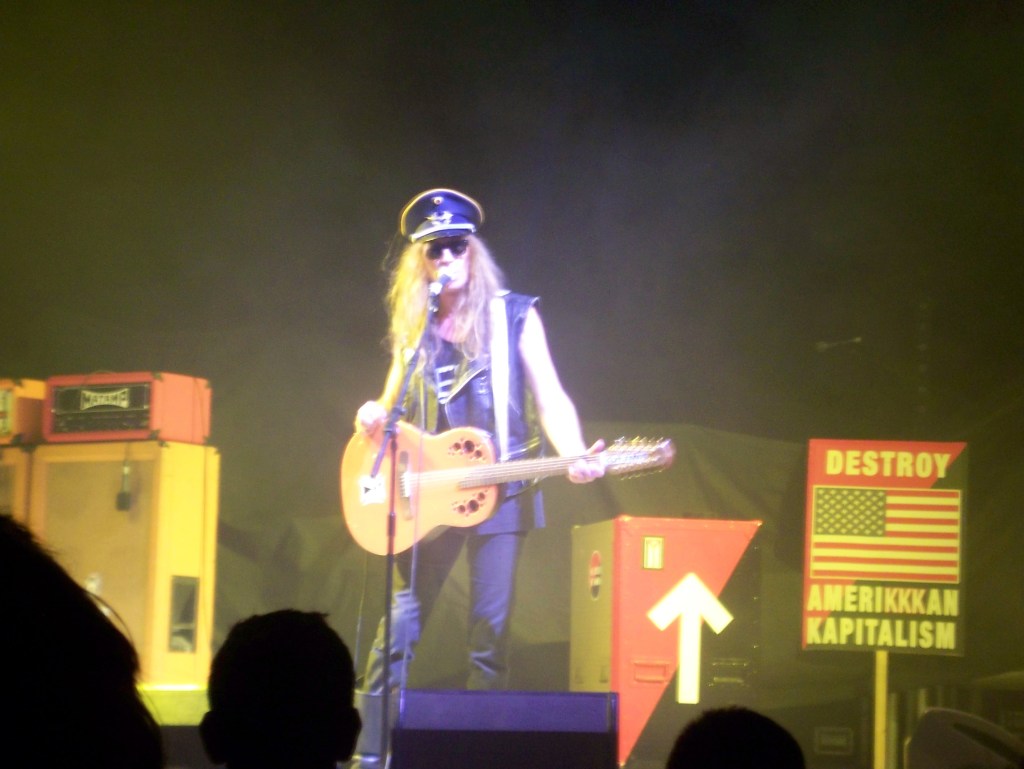
38 years later. St Julian is now 62. Though not like any other 62 year old you may know. He’s been through a lot. What with the music, (punk, post-punk, pop, psychedelia, funk, rock, folk, lo-fi, Krautrock, space-rock, metal, ambient noise, drone and everything in between) , drink, drugs, arguments, production, blogging, social commentary, protesting, activism, counter-culturalism, fantastical fiction, autobiography, musicology and cutting edge antiquarian research. The look is unchanged from the flattering, if dated, picture above. Military cap, shades ,(for medical not sartorial reasons), black sleeveless hoodie, long tresses, the beard matted and flecked with grey, the shorts a bit freer and the boots a bit comfier. Cool in a hippy/eco-warrior/biker/crazy farmer kind of way.
And the set covers most of the career highlights. Teardrops highlights (Passionate Friend, Treason and a brilliant drone version of The Great Dominions which is near the top of all Teardrop, a duet with roadie Chris), the doomed to fail attempt at pop star years, (Greatness and Perfection, showing perhaps why Mercury Records didn’t try too hard) and the brilliant Sunspots, the beginning of real Julian, with encore Out of My Mind on Dope and Speed from Skellington, as well as Pristeen from the pristine Peggy Suicide, Soul Desert from its near equal Jehovahkill, Autogeddon Blues from Autogeddon, I’m Your Daddy from 20 Mothers, Cromwell in Ireland from Psychedelic Revolution, They Were on Hard Drugs from return-to-form Revolutionary Suicide and Your Facebook, My Laptop and Immortal from the latest album Self Civil War. Oh and crowd pleasing piss-take Cunts Can Fuck Off, which takes direct aim at the great man’s detractors, US mostly, complete with ba-ba-ba chorus.
Soul Desert
Your Facebook My Laptop
Autogeddon Blues
The Greatness & Perfection of Love
They Were on Hard Drugs
The Great Dominions
Cunts Can Fuck Off
Passionate Friend
Cromwell in Ireland
I’m Your Daddy
Immortal
Sunspots
Treason
Pristeen
Out of My Mind on Dope and Speed
Now I confess not all of these were familiar. After Autogeddon, with the exception of Revolutionary Suicide, I kind of lost track of his output and there are vast unexplored tracts and tracks, which will likely remain that way. (Odin for example is 70 mins of JC humming). He has made 34 solo albums apparently, most of which since the bust up with Island in the early 1990s, released on his Head Heritage label/website/radio station/review site/manifesto/discussion forum site.
Now I doubt there are many people who can say they have lived a life remotely like JC’s, and a lot of what he bangs on about doesn’t touch my mainstream world, but you have to admire him even if you may not quite understand him. His gigs reflect his concerns. Him, his guitars, wah-wah pedal, roadie Chris and a load of chat, which is at turns funny, scathing and self-deprecating. As are the arrangements of the songs. Of course it would be great to hear them in all their full rhythmic, melodic and harmonic beauty, given JC’s prodigious musical gifts, but they are his and he can do WTF he likes with them.
An impassioned, eccentric, iconoclastic head for our, or any other, times.
Another in the lengthening list of contemporary plays where the reach of ambition exceeds the grasp of execution. Janice Okoh has set her sights on “imperialism, cross-racial adoption, cultural appropriation … and tea” with her “outrageous” play set firstly, in Victorian Brighton in 1862, and then in a present-day village in Cheshire. It has some thought-provoking, and funny, dialogue and some arresting scenes, born of its formal invention (and doubling), but it doesn’t quite hang together and loses focus, and turns preachily didactic, after the first two acts.
In the first act Sarah Bonetta Davies played by newbie Shannon Hayes is a Yoruba princess, orphaned, enslaved, rescued and then “adopted”, as was her “fashion”, by Queen Victoria, and now about to return to her African “home”. She attempts to school her unrefined black maid Aggie (Donna Berlin) in the etiquette of tea drinking before being join by Yoruba husband James (Dave Fishley), peremptory “aunt” Mrs Schoen (Rebecca Charles), benevolent Reverend Venn (Richard Teverson) and social climber Harriet Walker (Joanna Brookes). Interesting because Sarah Bonetta Davies was a real person (with a fascinating legacy) and interesting because of the way Janice Okoh uses this classic drawing play set up to explore her themes.
Then a switch to the tasteful front room in Cheshire where new white neighbours, artisan baker Harriet (Rebecca Charles) and Ben (Richard Teverson), have come to visit black professional couple James (Dave Fishley) and our latter-day Sarah (Donna Berlin), armed with muffins. Tea, of every possible hue, is taken. Through a mix of misplaced good intentions and weakly concealed racism, the white couple’s woke-ish self-image unravels and they start digging and don’t stop, especially when it comes to the subject of James’s and Sarah’s adopted, white, daughter, Victoria. James and Sarah initially pass off the unconscious gaffes but, especially when Ben’s comments turn offensive, then push back, inducing the inevitable “well if that’s how you feel” wounded umbrage from Harriet and Ben. Ms Okoh absolutely nails this scene with laugh out loud satirical writing of the highest quality.
A powerful scene follows where modern Sarah, worn out from the casual bigotry, strips and walks off rear stage through a series of light box squares. Interval. And then the return for the tea party showdown between the oblivious Queen Victoria (Joanna Brookes) and the furious Sarah BD. Great concept but tension has defused and Sarah’s arguments become too sustained. And Aggie reappears as some sort of time-lord oracle. Intentions are exemplary, but the structure becomes all too visible and the drama climaxes with a thud.
Though not for want of creative nous. Dawn Walton, who founded Eclipse Theatre, the co-producer of The Gift alongside the Belgrade Coventry, handles the detail of each act with surety, with Simon Kenny’s set, Johanna Town’s lighting and Adrienne Quartly’s sound, all chipping in, but even she can’t quite bring together each strand of the narrative. And the cast, especially Donna Berlin, (last seen by the Tourist at the Arcola in Great Apes – please give that beacon of East London culture, as well as this one here, some cash), plainly relish Janice Okoh’s dialogue.
I would still be very keen to see more of Ms Okoh’s work, particularly if she were to challenge the audience with “just” ideas and dialogue and not form as well. Nonetheless The Gift counts as another in the growing list of plays that Nadia Fell has programmed at the TRSE that talk up to its diverse audiences as well as entertain. They are coming back soon(ish) I hope. With a panto. We’ll need it.
Encore: various Bagatelles Op 126, Op 33, Variations Op 76 and Ecossaise WoO 86
A quick pat-down of the still unruly barnet, bounce up the steps and stride purposely across the stage to the single Steinway piano. Quick bow. No score obvs. Then straight into the sombre beauty of the Pathetique’s Grave introduction, before the dotty rush of the ensuing Allegro, the gorgeous Adagio chorale and then the closing Rondo repeats. Then the Eroica Variations which take that famous opening questioning, slightly arch, melody from the finale of the Third Symphony, and present a half hour of extraordinary variations (15) around it with closing fugue. The highlight for me. The Tempest, with uncertainty the key to the opening’s barrage of arpeggios and trills, the siren song of the Adagio and then the desperate, incessant waves of the closing Allegretto. Finally the Waldstein with the rolling exploration of the mysterious Allegro, the short, equally weird Adagio which never gets going before jumping into the closing Rondo which builds and builds and builds, a symphony dressed up as a sonata. Then more, and more, and more, encores with the Op 76 Variations in D major the standout.
He shuffled off in between, took the tumultuous applause with a few short bows, might have smiled a bit, but otherwise this was another day in the office for Evgeny Kissin. Except that his office is unlike yours. Or any one else’s for that matter. Including those rarefied few engaged in the same profession as him. We have come a long way from the child prodigy, wunderkind, genius, how the f*ck does he do that years, he’s now 47, but to see and hear the Russian-Brit-Israeli maestro is still a fascinating experience. He can do anything he wants with a piano and a score and he makes it look easy. But, as in previous encounters, I can find this a bit numbing. And, in Beethoven especially, in these perfect, middle-ish, sonatas, I think he still adds too much. I want the all of Beethoven’s invention, surprise, technique, but I want to get inside his patterns and structure. It is almost as if, in the cat and mouse of perfect performance, the Kissin cat is just too smart for the Beethoven mouse. Just too good. Mind you I suspect LvB, even in his head, may not of imagined quite what dynamics the modern piano machine can conjure up.
Weird thing to say I know. He is not mannered. Or indulgent. Textures are full but not weighty. He doesn’t add, or subtract. Tempi are overall right. It’s just there is just a little too much polish to the detail. The architecture and line is intact, but I just get overwhelmed by technique. The notes are perfect, the space between them less so.
Still no question I’ll be here next year assuming the programme is even moderately appealing, (not a given with his Romantic leanings), and that science and cooperation have vanquished politics and blame. To hear piano playing of this technical brilliance even if it doesn’t quite convince at the punch in the gut level is still one of life’s great privileges.
House of Macabre, Vault Festival, 5th February 2020
Off to the Vaults again, this time with the SO, to What the Dolls Saw from the all women House of Macabre company. It is a dark comedy, as one might have guessed, penned by Nic Lamont, who specialises in such things and plays Megan, one of three sisters who return to their childhood home for the funeral of their father.
Prissy Megan is a children’s author, though her stories, surprise, surprise, sport something of the night, spirited Christine (Holly Morgan) is an investigative journalist and Zara (Sasha Wilson) is currently between careers having returned from the US, with, a mute ward in the form of Belle (Rebecca O’Brien) who, as we shall see, is handy with puppets. Improbable I know but such is the nature of the genre. Mother Rose (Rosy Fordham) is fond of the sauce, reminisces about her life on stage when a child and lacks the maternal instinct. Aunt Lily, now no longer with us, brought up the girls, Dad was, drum roll please, a renowned doll-maker. The sisters decide to delve into their parents’ past and air their findings on Christine’s podcast. They find more than they bargained for.
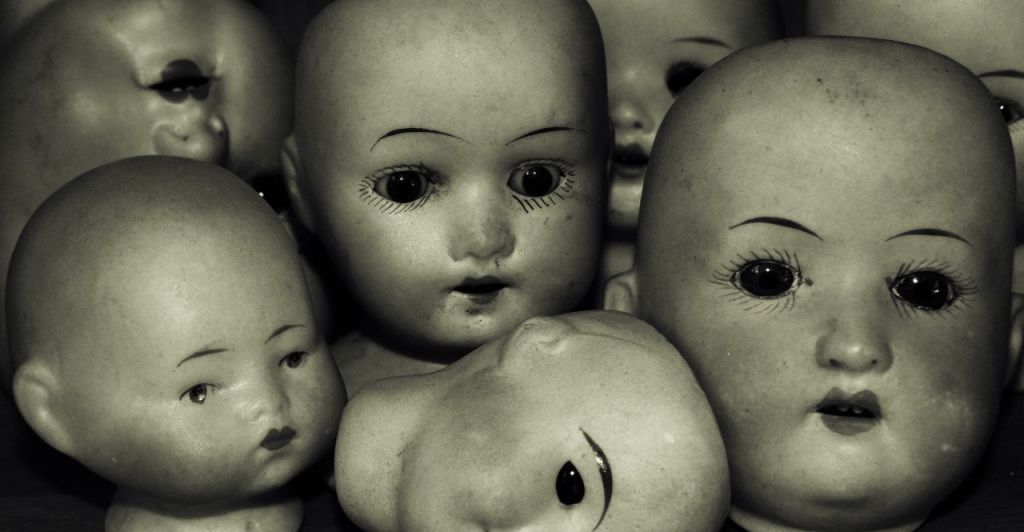
Hopefully all this conjures up a house of horror vibe but all delivered in a sassy contemporary way. The Pit, with its pews, barrel-vaulted roof and musky scent is one of the Vaults more atmospheric venues, enhanced by the lighting design of Holly Ellis, the spooky set of Benjy Adams complete with doll displays and an original sound design from Icelandic composer Odinn Orn Hilmarsson. The shadow puppetry of Rebecca O’Brien lends an air of cinematic Expressionism to the fairy tales based on Megan’s latest, rejected, children’s book.
If this was played straight it would have come off as a bit too much fan-girl amateurism. Fortunately, the ensemble have written the story, and perform it, for laughs. It isn’t overly arch however, genre clichés nurtured not scorned, the cast don’t mug inappropriately, and I think there are strands of real experience in the three quirky sisters’ lives. Which means when the story does turn properly Poe-ish, as the history comes out, it is surprisingly effective. It isn’t Ghost Stories jump-scarey, not is it League of Gentlemen twisty, but it is smart, and it is occasionally thrilling. For which director Lisa Millar deserves immense credit. OK so the tone sometimes wavers, and maybe the company have bitten off a little more than they can chew given obvious limitations, but this was still a very enjoyable way to spend an hour. The SO is a doyenne of the ghost story format, though is, as you know, notoriously hard to please, and The Pit seating did no favours to her, but it still passed muster.
This is a very talented writing and creative team and I, for one, would be very excited if they were given, say, a small screen commission to work with.
I bet Chris Bush was good at English at school and maybe beyond. In the precis question. For she has an unerring eye/ear/pen for taking complicated/contentious/convoluted issues and dramas and rendering them explicable, topical and entertaining. Kicking off with TONY! The Blair Musical from 2007, through a series of productions based and performed in her native Sheffield to her take on Pericles for the NT’s Public Arts project. I haven’t seen The Assassination of Katie Hopkins, the play that is, though would like to. The play that is …. Even a narcissistic cretin, who takes money for voicing offence, and who has choked and failed in her “career” on multiple occasions, deserves our sympathy, though not our attention.
Music and inclusiveness have formed central planks of CB’s work with Standing at the Sky’s Edge, co-written with Richard Hawley, set to grace the NT when normal service is reviewed. With Faustus TDW however she has chosen to contemporarise, (as she did with the mystery plays), and gender switch, the overly ambitious man about town and time, made famous by Marlowe and Goethe. With mixed results. It’s looks brilliant, there are some sound ideas beyond the gender inversion, and, for those of us new(ish) to the story, it is easy to follow, but some of the dialogue doesn’t quite match the ambition and it features a bold central performance from Jodie McNee which doesn’t help us to get beyond the cipher.
Johanna Faustus works hard alongside apothecary Dad (Barnaby Power) in plague-ridden 1660s London after Mum is executed for witchcraft. God isn’t going to dispense justice so our Johanna bites Lucifer’s (also Barnaby Power) hand off when he offers the deal. 144 years, 6x more than the male Faust, no requirement to be taken consecutively. Yet she, unlike her hubristic mythic counterpart, sets out on an altruistic path, first in her ‘hood and then, after a quick-fire Enlightenment education, a melodramatic Victorian London, through time, Cloud Atlas style, to a far future as CEO of a pharma company set on delivering eternal life to the masses. She meets various women (and some men) along the way, Elizabeth Garrett, Marie and Pierre Curie, variously played by Katherine Carlton, Alicia Charles, Tim Samuels and Emmanuella Cole, and is accompanied by her camp Mephistopheles (Danny Lee-Wynter), decked out in a natty white suit, Cuban heels and rouge, and ever quip-ready.
Ana Ines Jabares-Pita’s set design may well be the star of the show, an expansive cavern, expressively lit by Richard Howell, like the inside of a whale, though it does come to dominate. There are a few enjoyable effects, notably in the recreation of the Seven Deadly Sins, assisted by Giles Thomas’s sound and Ian William Galloway’s video. Headlong director Caroline Byrne keeps things moving along, though this comes at the expense of the questions, of faith, of female agency and oppression, of mortality, technology, free-will, redemption, which themselves are rather jumbled up. Ambition and imagination has been a feature of the UK stage over the last few years, but Faustus TDW does, like some of its predecessors, push the envelope a little too far and risks looking a bit daft.
Mind you Marlowe’s anti-hero does drone on a bit, is an annoying clever dick and uses his expensively secured special powers to mostly make practical jokes and perform crowd-pleasing tricks. Which, to be fair, is probably what this bloke would do as well. On that basis we have to applaud the two CB’s for setting out an alternative. It just might have been better to restrict the inversion to the historical starting point. Still I enjoyed it and kind of liked its can-do punky attitude. A fine foil to the rather more technologically adroit achievement of Katie Mitchell and Alice Birch’s adaptation of Orlando which Schaubuhne Berlin kindly streamed the other day. Perhaps I should have a look see at what the mainstream female time traveller in Jodie Whittaker’s Doctor Who is up to these days.
Rural Suffolk. 1759. A court case. There was only ever going to be one companion for the Tourist’s visit to see The Welkin. Step forward MS. A Tractor Boy by upbringing, if not birth, and an expert on all things legal and rural in the Medieval and Early Modern. Dad once again wells with pride as he writes these words.
Now admittedly this was a bit late for his practice and a little early for mine but the subject, a jury of 12 matrons mulling over the case of one Sally Poppy who may or may not be pregnant, the writer, Lucy Kirkwood no less, (NSFW, Chimerica, The Children, Mosquitoes on stage, and with Adult Material coming soon to Channel 4 and certain to rile the blue-rinses), director, James MacDonald, and a bravura all female, (well just about), cast, still had us very excited pre-game.
Natasha Cottriall (Whodunnit Unrehearsed), Jenny Galloway (The Starry Messenger), Haydn Gwynne (Coriolanus, Hedda Tesman), Zainab Hasan (Tamburlaine), Aysha Kala (An Adventure), Wendy Kweh (Top Girls, Describe the Night), Cecilia Noble (Faith, Hope and Charity, Downstate, Nine Night, The Amen Corner), Maxine Peake (Avalanche, Hamlet), Dawn Sievewright, June Watson (Uncle Vanya, John, Road, Escaped Alone, Good People), Hara Yannas (Amsterdam, Dealing With Clair, The Treatment, Oresteia), Brigid Zegeni (I’m Not Running, Twelfth Night) and Ria Zmitrowicz (The Doctor, Three Sisters, Gundog, X). What a line up. And the credits are just those I can testify too. At the risk of unwarranted favouritism, Cecilia Noble and Maxine Peake would be in my top 10 stage actresses if I had such a thing, and reading June Watson’s credits suggest she is literally incapable of backing a theatrical nag.
With this much acting talent on show there were instances when I thought that Lucy Kirkwood and the NT might be guilty of delighting us too much. Even with 2.5 hours running time, and an attempt at equitable distribution, some of the actors didn’t quite get the airtime to flesh out character. And Bunny Christie’s set, a grand Georgian municipal hall, with impressive, working, (in the sense of the Devil’s ingress in the first act’s concluding coup de theatre), fireplace, and Lee Curran’s bright lighting, created a clinical, painterly doll’s house effect which marooned many of the cast. I can see why the creatives wanted to restrict the furniture to a minimum, and, with the help of Imogen Knight’s movement, blocking was exemplary, but with a dozen or man bodies always on stage it did distract from the detail.
Mind you, prior to the main event, there were some stunning tableaux, as the women stepped out of a line to introduce themselves and, courtesy of a compartmentalised light-box, they performed their literal women’s work to the repetitive rhythm of Carolyn Downing’s sound design. (A nod to Kate Bush came later with a acapella Running Up That Hill; This Woman’s Work might also have hit the spot. After all you can never get enough of the greatest single musician of our age).
As did the funny accents. It was Suffolk and many of our matrons were of the middling, or lower, sort, even Haydn Gwynne’s apparent toff, but some were better at projecting beyond the activity than others.
Still minor quibbles. What mattered was the story, and the feminist message, and here I can report Ms Kirkwood and those charged with bringing this scale entertainment to life, played a blinder. Now there is no getting away from it. The Welkin is not a million miles away from Twelve Angry Men. Except that it involves a jury of women judging another woman in a time and place when such female agency was rare. And this, I was reliably informed by MS, was no flight of authorial fancy. “Matrons” were tasked with checking the veracity of claims to pregnancy from medieval times through to the early C19, and you smart people will no doubt recall the “offer” to Elizabeth Proctor to avoid the noose whilst she was pregnant. The Twelve Angry Men parallel continues into the device of having one woman, Maxine Peake’s Elizabeth Luke, as the Henry Fonda sympathetic voice of reason/conscience, entreating her peers, who, initially at least, have very different, and largely disdainful, views on Sally Poppy’s guilt and fidelity.
However the reasons for Elizabeth’s Luke’s persuasions, in a twist that is just about concealed for long enough, turn the play into something more than a commentary on justice and fairness. The perspectives of the matrons, the methods by which they assess Sally, their arguments and conversations, and especially the way in which, eventually, a man, Doctor Willis (Laurence Ubong Williams who also plays Sally’s grudgeful husband and the Justice), and his callous technology, is called upon to decide, all point up women’s experience and biology in a patriarchal world, then, and, by implication, now. And to cap it all there is nothing remotely sympathetic about Sally Poppy herself, guilty of infanticide according to her cuckolded husband, though she is still a victim of male power, (and, in a shocking conclusion, of class, even in death). Which allows Ria Zmitrowicz to go full-on stroppy in her portrayal which she is, based on recent turns at the Almeida, very, very good at.
There is plenty of humour, (much of it at the expense of Philip McGinley’s steward Mr Coombes), and poignancy in the dialogue and in the woman’s stories, and pacing in the disclosure to keep us on our toes, even if the set-up itself is, as I said earlier, somewhat static with words superseding action. Ms Kirkwood’s scholarship is never self-serving, and exposition, whilst not entirely mixed in to plot, doesn’t irk. This was a time when Enlightenment was supposed to banish superstition, specifically here witchcraft, the year of Halley’s comet, all of which LK explores in the women’s exchanges.
The wider message is how the justice system serves women differently. Until 1920, outside of this special case, women could not sit of juries or be judges. Women weren’t considered “capable” of administering justice. Crimes against women were ignored. Even now supposed promiscuity and culpability still colours the judgements of men, and other women, in rape cases. Women commit very little crime, but are often judged more harshly when they do.
An important play then with more to chew on even if it didn’t quite deliver the tense narrative it promised. Lucy Kirkwood and her collaborators were probably more concerned with the context around these women’s stories rather than the story itself and with delivering a production of exemplary quality, and event if you will, rather than pinning us back in our seats. For the cerebral MS and his Dad keen to fake knowledge, this was just the ticket but I can see why some reviewers found it just a little intellectually over-stuffed. It couldn’t match the economy or bite of Caryl Churchill but Lucy Kirkwood is edging closer to the godhead, in ambition if not quite execution.
Beckett Trilogy: Krapp’s Last Tape, Eh Joe, The Old Tune
Jermyn Street Theatre, 4th February 2020
Fragments: Beckett by Brook – Rough for Theatre I, Rockaby, Act Without Words II, Neither , Come and Go – VIMEO, Bouffes du Nord– 26th March 2020
Endgame/Rough for Theatre II – Digital Theatre, Old Vic – 9th April 2020
Having put in countless theatre hours over the last few years the Tourist feels ready to get to grips with another of the “writers who changed theatre” in the form of one Samuel Beckett. Anyone with a passing interest in culture generally, and theatre particularly, is going to have encountered the great Irishman, but, to the uninitiated like me his reputation is fearsome. Still no time like the present.
Especially when the equally fearsome Peter Brooke, similarly ascetic and similarly a Parisian expat, has kindly posted up a recording of his (and Marie-Helene Estienne’s) production of Fragments: Beckett by Brook from the Bouffes du Nord in 2018 (and last in London in 2008). I have had a couple of cracks at Mr Brooke and Ms Estienne’s oeuvre with mixed success, Battlefield at the Young Vic, their take on The Mahabharata, and The Prisoner at the NT, both works of elongated, and exacting, beauty. Fragments comprises five short pieces by Beckett, Rough for Theatre I, Rockaby, Act Without Words II, Neither and Come and Go, performed by, drum roll please, Kathryn Hunter, Jos Houben and Marcello Magni. Jacques Lecoq alumni, and all round stage acting royalty, especially when it comes to the tough, avant garde-y stuff.
Now it doesn’t take a genius to work out that Beckett, in addition to posing questions about language, memory, purpose, mortality, despair, isolation, confinement, observation, connection, indeed, the whole futility, with tenacity, of human existence and nature-of-the-self gig, liked a laugh, especially of the mordant, and/or gallows absurd, kind. Which is what PB and the three actors mine in Fragments. It isn’t too much of a leap from this to Python. Honestly. Of course it helps that Belgian actor Jos Houben is peerless as a physical comedy theatre actor, that Kathryn Hunter is the very definition of “shape-shifter”, (whatever you do do not miss an opportunity to see her on stage, most recently in the RSC Timon of Athens), and that Marcello Magni was a founder member of Complicite, (the other two are regular collaborators), about as innovative a theatre company as it gets. Oh, and he was also the voice of Pingu.
Rough for Theatre I is probably the trickiest customer on the bill. A blind beggar, busking on his fiddle, teams up with another chap who has lost a leg. Both reference past lovers/carers/family. They might be abandoned. They search for food. Mutual support turns to annoyance and, maybe, violence. A lot of the classic Beckett stuff is on show, a couple of cranky fellas bound in uneasy interdependence. But it doesn’t quite persuade and turns into a long, old 20 minutes.
Rockaby, with the archetypal old woman, W, in a rocking chair, the ghostly vibe, the simple, pre-recorded, dimeter verse echoing a lullaby, the hypnotic stresses and repetitions, (each of the four sections begins with “more”), the gradual withdrawal of W from the world, and her eventual death, is a work that most definitely does work. Especially in the hands, and eyes, and mouth, of Kathryn Hunter. There isn’t much here to express, but express she does, packing all manner of emotion into less than 10 minutes. Fuck life as W says. But do it gently.
Act Without Words II, like its companion piece, and the likes of Waiting for Godot, Endgame and Krapp’s Last Tape was written ion the 1950s, but unlike them it is a mime piece. Two fellas, of course, emerge consecutively from sacks on stage after being prodded by a large pole, before engaging in their, presumably daily, routines. One is chaotic, a hypochondriac, the other fastidious, a clock-watcher. A recipe for audience bemusement? You might think so from the sound of it, but, in the hands of Messrs Houten and Magni, it is hilarious, Laurel and Hardy-esque, one of the funniest things I have seen on stage. With Rockaby and now this I think I can see the attraction of Beckett.
And Come and Go only added to the attraction. Three middle-aged women, Flo, Vi and Ru, friends since childhood, Houten and Magni decked out with coats, hats and a bit of rouge, sit on a bench, natter, and then, as each moves away in turn, a whispered secret something is exchanged between the remaining pair. At the end they link hands in the “old way”, a Celtic knot. I can imagine this scenario might come across as foreboding, a reference to incipient illness or death, we don’t actually hear the secrets, but in this production it is comic, the whispers more gossipy or bitching. More Cissie and Ada (google it) than “staring into the void”. After all we all like to chide our friends behind their backs with our other friends in the guise of concern.
Neither is a poem of sorts, just 87 words, in ten lines, with apparently just 3 commas. That’s minimalism for you. It is some kind of dialectical journey, maybe to death, who knows. Kathryn Hunter can’t make its meaning clear but blimey does she make every word count.
All in all then highly recommended (it’s still on Vimeo). How all the little tragi-comic stuff can shed a light on all the big stuff which rattles around in our heads. Not, as Peter Brooke says, wall to wall despair and pessimism as Beckett reputation dictates. And showing how the best actors can reveal, even to the dubious like the Tourist, that there is more to Beckett than initially meets the eye, and ear.
On to Endgame. Or to be more precise Rough for Theatre I and then Endgame. From the Old Vic. Now my scheduled performance was a casualty of you know what but the nice people at the Old Vic offered up a filmed version of the production which I snapped up. Now, before the interruption, the draw of Daniel Radcliffe and Alan Cumming, had ensured brisk business for something relatively challenging judging by the wait it took me to secure my favourite perch. For Endgame, Fin de partie in the original French, (the language Beckett always initially used), does jog on a bit coming in at 80 minutes. It is bracketed up there with the likes of Waiting for Godot in the Beckett canon, and, whilst the critics response to the production was decidedly mixed, there was enough to make me gently expectant.
I have to say didn’t really get on with it though. Whether this was down to play or to performance, it is difficult to say. Having now see what PR and M-HE could do with Beckett in Fragments, (and, as you will see below, what Trevor Nunn was able to serve up in his Beckett trilogy), I think the director, here Richard Jones, might have been culpable. True the director’s freedom to interpret is proscribed by the still vice-like grip exerted by the Beckett estate, demanding compliance with the great man’s stage directions, and by the stripping away of realist anchors, the lack of plot, the minimalist aesthetic and so on. Even so I still think the thematic repetition, this really is about four troubled souls going round in circles, and the skill of certain the actors, left Mr Jones only really scratching the surface.
Alan Cumming played Hamm, confined to a chair, (with a rather distracting pair of fake stick-thin beanie legs on permanent display), with a splenetic camp which at first amused but soon curdled. And Daniel Radcliffe, who to his credit, seeks out acting challenges in an almost penitent way since the screen Potter juggernaut was wound up, is similarly one-dimensional as restless servant/foundling Clov. I am afraid he does’t really seem to get with the profundity, opting for a superficial humour in word and deed. The two don’t feel that they have spent an eternity locked together. Contrast this with Karl Johnson and Jane Horrocks, (with facial prosthetics which really do convince), as Magg and Nell, Hamm’s parents, living in wheelie bins downstage left. Much less to say, but by not trying to grasp for comedy that isn’t there, both convey far more .
In order to get under the surface of “life is absurd”, and “in the midst of death we are in life”, (or maybe it’s the other way round), I think I can see that creatives need to delve a bit deeper. If all we see is the outward character, like a realist play, here Hamm as childish despot “actor” doing a turn primarily for himself, or Clov as mild-mannered extra from the Ministry of Silly Walks, it just become too much hard work to listen to what Beckett was saying. I am guessing the existential bitterness at the core of Endgame really is the deal but having the confidence to see that through feels like a big ask. As Hamm says “nothing is funnier than unhappiness” but only I guess if you don’t try too hard to make it too funny in the first place. I will need to try again with the play to test the theory or to accept that it could just be that I simply don’t have the patience to see it through in which case, mea culpa.
As it happens I preferred Rough for Theatre II. Two bureaucrats, Bertrand and Morvan, are in a room assessing the evidence as to whether would be suicide Croker, (Jackson Milner standing stock still for half an hour with his back to us – bravo fella), should jump or not. There is a contrast between the two, Cumming’s Bertrand is sweary, impulsive, keen to crack on, Radcliffe’s Morvan, more measured, though indecisive. The scenario is milked for gags as it echoes the likes of It’s A Wonderful Life, Here Comes Mr Jordan and A Matter of Life and Death from the 1940s. Croker might have been rejected, he might be ill, he might be a tortured artist. The comments of the various witnesses from Croker’s life are mostly banal, only occasionally poignant or profound. The banter between B and V edges towards Shakespearean wordplay, as well as the more visible vaudeville. The end is ambiguous. It could be Pinter, which is probably why I much preferred it
Right finally to the Jermyn Street trilogy. Sorry that took so long but this is how I learn. Firstly the intimacy of the JST served these plays very well especially Krapp’s Last Tape and Eh Joe. Secondly the cast. David Threlfall, James Hayes, Niall Buggy and, even if in voice only, Lisa Dwan have the measure of Beckett. It is rare to see Lisa Dwan’s name in print without the words “foremost Beckett interpreter/scholar” appended, (Not I, the one with the mouth, is her particular Beckett party piece), though she has plenty of other heavyweight acting credits to her name in Ireland and elsewhere, as does fellow Irish actor Niall Buggy. David Threlfall is just an all round top geezer, last seen on stage as the RSC Don Quixote, who has played Beckett on screen, albeit in the hit and miss comedy series Urban Myths. James Hayes has been treading the boards for as long as the Tourist has been mortal, and collaborated with Trevor Nunn at the JST in radio play All That Fall in 2012 with Eileen Atkins and Michael Gambon.
Understandably the Beckett estate rates Trevor Nunn, now 80. He is, after all, pretty much the Father of the House when it comes to theatre direction. Unlike Richard Jones whose USP is showy, scatter-gun, (though often brilliant), opera. Max Pappenheim is able to conjure up a sound design with real impact in a space he knows well and I assume David Howe, normally to be found lighting up the West End, said yes straight away when he got the Nunn call. The monochrome world, specified for Krapp’s Last Tape, persists throughout. Old age and memory is what links the three works. What four old men remember and what they forget.
Krapp’s Last Tape, from 1958, the year after Endgame, was big draw here, with James Hayes, literally, in the chair. Krapp on his 69th birthday, and sporting a natty pair of snakeskin shoes, sets out to make a tape (reel-to-reel kids, ask Grandad, though make sure it is by phone) documenting the last year and to review a similar tape he made when he was 39, made after he had returned from celebrating that birthday in the pub. This tape mocks the commentary of another tape he made in his mid twenties. He is more interested in the definition of the word “viduity” than the death of his mother. (The table is piled up with tapes, a ledger and the dictionary). Some memories annoy him, others, notably a romantic tryst in a punt, enchant him. The 39 year old is confident in the choices he has made, the 69 year old full of regret, notably in his writing. Is this his “final” tape?
Beckett was 52 when he wrote it. You can read whatever you want into it but it seems easy to just take it as autobiography and revel in the power and construction of memory. Failures in love, in work and in drink. It went through many drafts, much like our memories I suppose. The Wiki page is very helpful in fleshing out the characters, real and fictional, mentioned in the monologue and in describing Beckett’s own position at the time of writing.
I can’t pretend I was hanging on every word of James Hayes’s mesmerising performance. but that is because I ended up revisiting my own past in my mind. What better praise can I offer?
Eh Joe is pretty scary. It was SB’s first play for television, first performed in 1966 by Jack MacGowan, for whom it was written, with Sian Philips as The Voice. Joe, in his fifties, is sitting alone on his bed in dressing gown and slippers, with a camera trained on him. He gets up to check windows, curtains, door, cupboard and bed as if in fear. The camera cuts to a close-up of his face from just a metre away which slowly zooms in, nine times, through the remaining 15 minutes or so. Joe is relaxed, though confined, staring at, though not into the camera. Then the voice, here Lisa Dwan, starts hammering away at him, the recording heavily miked, accusatory, recalling their relationship and his abandoning of another woman who attempts suicide. She is the guilt-ridden voice inside his head I guess, the feminine judge of his masculine sin. He has excised the voices of his mother, father and others who may have loved him. The Voice’s words brim with violence. There is Catholic and sexual guilt aplenty. Niall Buggy, for a man who doesn’t speak, is riveting and now I get why Lisa Dwan is so well regarded. Once again it is all about the getting the rhythm and melody of the language to convey interiority.
Lisa Dwan was 12 when she saw Eh Joe on the telly. It stayed with her. I’m not surprised.
Fortunately we were then given a break before The Old Tune, which compared to the two previous plays, was a breeze. Rarely performed, it is a free translation by Beckett of a 1960 radio play, La Manivelle (The Crank) by his Swiss-French mate Robert Pinget. Niall Buggy and David Threlfall are a couple of Dublin old-timers, Gorman and Cream, shooting the breeze on, of course, a bench. They share memories, all the way back to early childhood, but can’t always agree on exactly what. It’s got some laughs.
So that’s that then. No doubt I will be back to Beckett. But for the moment, at least when the performers are on song, memories are made of this ….
I am very partial to the work of Ella Hickson. Precious Little Talent, Boys, Oil, The Writer, ANNA, all have met their, expansive, ambition. Splendid theatre with something powerful to say. With Swive she has collaborated with director Natalie Abrahami, (who marshalled cast and technology so effectively in ANNA), and has alighted on the life of Elizabeth I, not a novel subject for dramatic treatment, in theatre, film or small screen, but still a vital subject for the dissection of women and power. (The SO, BD and LD scored an early collective lockdown viewing success with Josie Rourke’s cinematic debut Mary, Queen of Scots, for example).
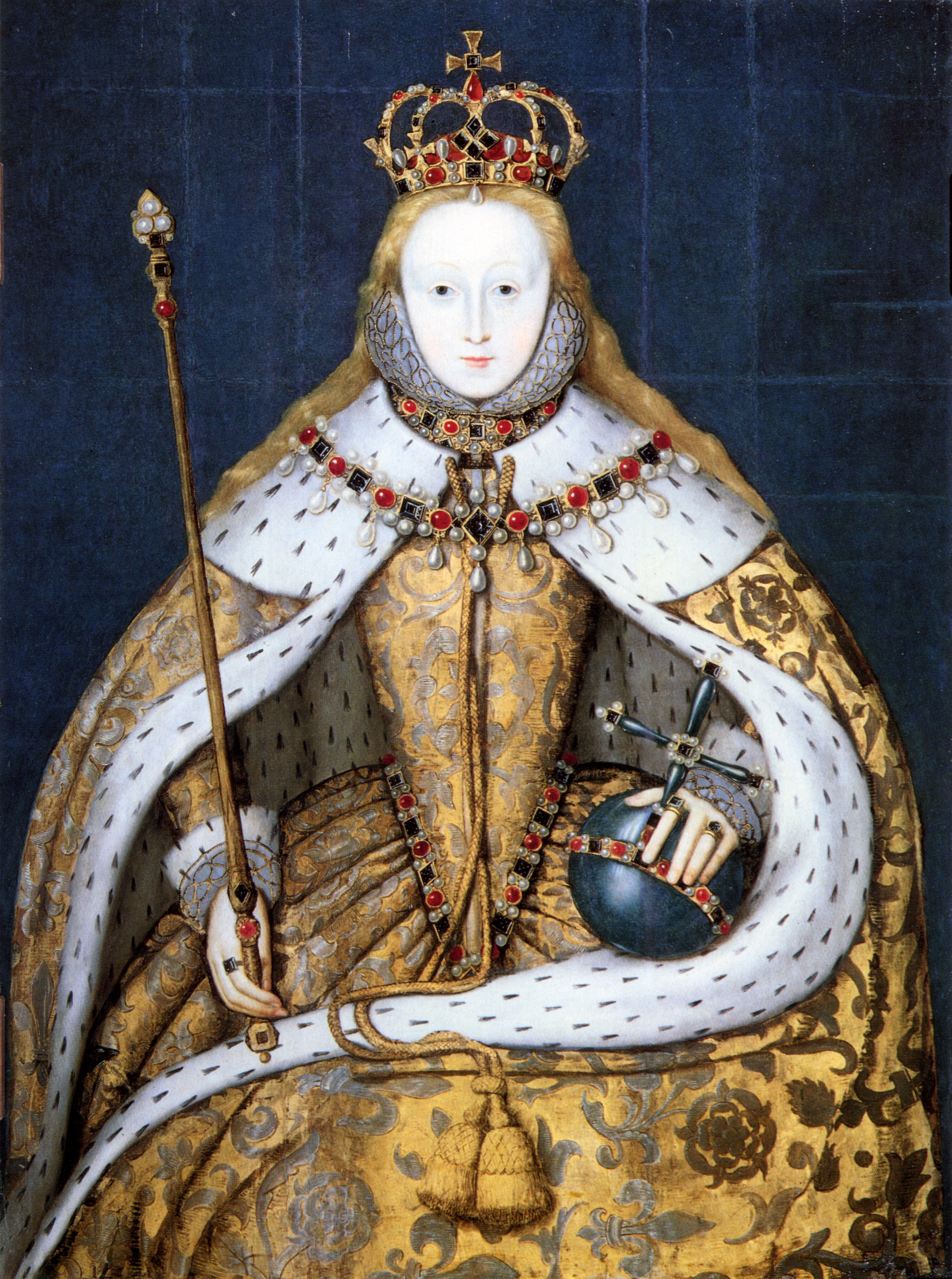
The play is small scale, mixing the political with the domestic, and casts two actors, Nina Cassells as the young Princess Elizabeth, (as well as an unnamed Court washerwoman and Lady Katherine Grey) and Abigail Cruttenden as Queen Elizabeth, (as well as her step-mother Catherine Parr, and her predecessor Mary Tudor). In a series of short scenes, enlivened by Ben Stokes’s sly, chip-boarded, candlelit set and teasing costumes, we see how the young and mature Elizabeth negotiate the patronising and miscalculation of significant male influences, Michael Gould as long time adviser and Protestant defender William Cecil, and Colin Tierney as pervy “step” father Thomas Seymour and hubbie-in-waiting Robert Dudley, and how this extraordinary woman was able, ultimately to rise above patriarchal repression and dominate Court and Country.
This is no dry history though. Key events are obliquely referenced but EH’s and NA’s dialogue is more concerned with the how and why of Elizabeth’s tortuous negotiations, rather than the what, before and during her reign. Overcoming her “illegitimacy”, avoiding the fall-out from the association with the scheming Seymour, countering the threats posed by half- brother Teddy VI, and “bloody” half-sister Catholic, Mary Tudor, stringing Dudley along and pimping him out to Scots Mary, claiming the right to be head of the Church as well as the State, despite Cecil and the other geezer’s misgivings, (yet not, if she had married, head of her family), the obsession with her, and others, uberty (yep new word for me). All are cleverly crammed in but the vernacular words the two Elizabeths use to highlight their dilemmas could come from any woman now, asked to justify herself when justification is unjust and unwarranted.
This equivalence of then and now occasionally fails, the perpetual question of the succession for example as Lady Katherine Grey blows her chances, but the message so vital and the delivery so lucid that it doesn’t matter. Abigail Cruttenden is as deliciously peremptory as you might imagine and Nina Cassells masks the young Elizabeth’s decisiveness with a precocious air of vulnerability. Both are adept at turning the arguments of the men back on themselves.
There are some laugh-out loud zingers, the artifice of the SW Playhouse is acknowledged right at the beginning, and even the candle snuffing and relighting seems rhetorical. All this, the 90 minute run time, a paracetamol and and a wisely chosen perch, meant the Tourist’s back remained in fine-(ish) fettle until the trot back to London Bridge. Not quite enough to persuade him that visits to the SWP, and the Globe, should not remain few and far between given the hair-shirt comfort levels, but more than enough to ensure that Ella Hickson’s remains very near the top of his list of favourite contemporary playwrights.







 At Home He Feels Like A Tourist