Three Sisters at the Almeida Theatre review ****

Three Sisters

Almeida Theatre, 25th April 2019

It creeps up on you this Three Sisters. As with her feted take on Tennessee Williams’s neglected Summer and Smoke last year, Almeida Associate Director Rebecca Frecknall is unafraid of letting the play take its time to unfold and delivers a similar, dreamy quality to events in this Chekhov staple. And, with Cordelia Lynn’s loose-limbed, idiomatic, yet poetic, adaptation, (draw from Helen Rappaport’s literal translation), and Hildegard Bechtler’s barely-there set and timeless costumes, (if there had been some old rope lying around I would have guessed she were the taking the p*ss), she has some very willing accomplices. This is a Three Sisters pretty much stripped of context or artifice, no birch trees or big frocks here, where we are forced to focus entirely on the relationships between the characters. Time, space and place, and even action at some points, are erased to just leave people, their language and their interaction (or lack thereof – there aren’t many great listeners is Chekhov).

Fair enough. This is, after all a play about (father and mother-less) three sisters and their dodgy brother (I’ve always wondered if Anton C had a Bronte thing going on), bored sh*tless and pointlessly dreaming of returning to the buzz of metropolitan Moscow. And marriage. And its frustrations. And parenthood. And its frustrations. And old age. And its frustrations. And work. And its frustrations. And money. And its frustrations. And unrequited love and its frustrations. And idealism. And its frustrations. And denial. And its frustrations. And sacrifice. And emotional manipulation. And politics. And class. And knowledge. And drink. In fact the whole meaning of life gig. There’s a party. A bunch of soldiers come. There’s a duel. Then they go. A clock gets smashed. A piano doesn’t get played. And, in the background, there is the march of history with the first Russian Revolution just 5 years away from when AC completed TS.

Patsy Ferran is back with Ms Frecknall after her award winning performance in S&S but as Olga the oldest, unmarried, sister and the self sacrificing glue that holds the family, just about together. She is mesmeric but actually has less to say and do than Pearl Chanda as Masha or Ria Zmitrowicz as the youngest Irina. Here Irina veers towards needy, self-obsessed, Gen Z-er, reinforcing the abstracted nature of the interpretation. In any one else’s hands this might not have worked but Ria Zmitrowicz is good enough to get away with it, For me though Pearl Chanda as the sardonic Masha is the pick of the three. Masha is the engine room of the play, the catalyst for its sharp humour and for the changes in the direction of the meandering plot. Her infatuation with Peter McDonald’s solemn philosophising widower Lieutenant Vershinin, needs to mix a genuine passion with a sort of bored, going through the motions. And she needs to bait her cuckolded Latin teacher husband Kulygin who knows exactly what is going on. Elliot Levy’s portrayal of Kulygin certainly captured his foolishness and compulsion to deflect tension with humour but not so much his underlying sadness and yearning for Olga.

The other central female character is Natasha, (another precise performance by a favourite of mine Lois Chimimba), who goes from gauche, brittle servant to imperious lady of the house after marrying the weak, vacillating Andrey (Freddie Meredith) who spunks the, limited, family fortune away gambling. Natasha, with her doting on her new born son Bobik, her antipathy to devoted family retainer Anfisa (Annie Firbank) and her pursuit of the unseen Protopopov, the head of the local council which Andrey joins to give him purpose, is here the most conventionally Chekhovian, at least from my memory of previous productions I have seen.

Mind you my memory is far from perfect as, for a few minutes in the second act I think I may have drifted off into The Cherry Orchard as I confused the confused Ferapont (Eric MacLennan) with Firs and the drunk army doctor Chetbutykin (Alan Williams) with Leonid Andreieveitch Gayev. Fortunately the ever attentive BB’s, who, along with my other guests, BUD, KCK and, of course, the SO, put me right and, as usual, saw in the production all that I missed. This is one of the joys of Chekhov. We all agreed on the overall tone of the play, in a word melancholic, and the direction of the plot, but because there is so much of themselves explicitly voiced by these complex characters we all focussed on different facets and dimensions off their existence, to then share our findings, albeit briefly, at the end.

Normally having set out situation and the arrivals, (there are always arrivals and a departure, after moreorless dramatic disclosures, in Chekhov), here the soldiers, including the unfortunate Baron Tuzenbach (Shubham Saraf) who pines for Irina, a troubled poet Solyony (Alexander Eliot), photographer Fedotik (Akshay Sharan) and Rode (Sonny Poon Tip), AC plays start to move through the gears drawing you in with major key attempted resolutions, before drifting off into a minor key conclusion. Not here though. Once the pace is set, at Irina’s name day party, it doesn’t really alter. It is as if the ominous, “keep calm and carry on even if it is all going to sh*t” ending feeds backwards into the rest of the play. But the absence of any distraction here, (dusky lighting and ambient sound by Jack Knowles and George Dennis are as non-specific as set and costumes), the intimacy of the space, the dedication of cast and director to the intention and, especially, Cordelia Lynn’s adaptation reeled us all in and held us there. It feels its length, just shy of three hours, and there are times when words, and only words, test the patience but ultimately it is a rewarding, if nebulous, experience.

For it is perfectly possible to never get out of a wistful second gear in Three Sisters. Nick Hytner did this in his 2003 NT production, despite a cracking cast. I plumped for this in contrast to Michael Blakemore’s West End production a few months later. Which appears to have been a mistake even though MB used a Christopher Hampton rather than a Michael Frayn adaptation. Alternatively, as Benedict Andrews proved at the Young Vic in 2012, it is possible to pimp it up, rev up to fifth gear and set out on the highway. That wasn’t perfect but it was bloody exciting in parts. I think I have seen a couple of other takes before record-keeping began, (yes I am a boy and I like making lists), but don’r remember them too well but there’s always the ennui.

I see the reviews are a bit all over the place. I can see why. In this case I think the only way to be sure is to see for yourself. And, if you like it, then mark down Rebecca Frecknall’s next outing. I suspect she will have her way with Ibsen one day soon. That could be very interesting. Meanwhile we have another Three Sisters in the pipeline. This time at the NT with Inua Ellams shifting the action to 1960s Nigeria and with Nadia Fall in the director’s chair. Neither, in my experience, reach for the soporific so this should be fun.

Tartuffe at the National Theatre review *****

Tartuffe: The Imposter

National Theatre Lyttleton, 24th April 2019

Top Girls. Downstate. Small Island. Follies which I can vouch for from the first run. And now this Tartuffe. All superb. If the NT is still going through a dodgy patch artistically then f*ck knows how good it is going to be when it gets back on track. This punter for one is very happy. And having paid £15 for this, as well as Small Island, and just a few notes more for Downstate, combined this has to represent just about the best bullseye the Tourist has ever spent.

For those of you Londoners, (I accept that for those outside the capital the N in NT may be a source of frustration despite the NT Live and touring initiatives), who whinge about not being able to get to see the NT “sold-out” productions I say the following. Sign up. Watch the updates. Book early. And take a risk. There will always be a few hot playwrights or big name actor productions where the members will beat you to it, but generally you will be OK. Risk a few quid. Worst case if your busy social life means when the date looms you are positively FOMO’d then, for a couple of quid, you can get credit for next time. And, if it does turn out to be sh*te, think of it as a necessary donation to maintain society’s cultural fabric. Any one of these recent productions was still eminently, and cheaply, bookable just a few weeks in advance. If you wait for reviews and chase the big hits you’ll end up paying twice the price in some cramped West End mausoleum. Here endeth the lesson.

Until now I hadn’t seen a convincing adaptation of Tartuffe or, frankly, any of Moliere’s plays. Started too late in my learning and maybe just unlucky. Played with too much fidelity to the “original” conception and it’s just unfunny caricature. Depart too far from the central hypothesis of hypocrisy, especially religious, or cram to much in in a bid for relevance and it can become chaotic or risibly naive. Keith A Comedy?, Patrick Marmion’s take at the Arcola recently smacked of the latter. As for the recent RSC Tartuffe, no comment. Sounded interesting but just a bit too far for the Tourist to go to knacker his back again in the Swan.

For this version, at the time of booking, I didn’t know the cast and, in any event, had never see anything by our Tartuffe here, Dennis O’Hare. Translator/adaptor John Donnelly was also new to me. Forget actors. I can’t stress enough how important the role of the adaptor is to making ye olde theatre work for modern, attention deficit audiences. But, as I say, in this case, no form guide. So that just left director Blanche McIntyre as the only confirmed draw. That was enough however. Ms McIntyre was the canny brains behind the RSC’s 2017 Titus Andronicus with David Troughton in the lead and The Writer, Ella Hickson’s brilliant feminist discourse at the Almeida last year. Next up she will tackle Bartholomew Fair at the Sam Wanamaker.

What can I say? Result. John Donnelly and Blanche McIntyre have created a Tartuffe who genuinely appears to believe his own hype and an Orgon (Kevin Doyle) who desperately wants his sins expiated. He is a speculator who has made a fortune trading around some dodgy war time activity facilitated by the government. (Think big oil, Cheney and Iraq if you find this too hard to believe). He is holed up with family, and Tartuffe himself, in his hyper-designed Highgate palace, Robert Jones’s set offering a nod to French baroque routed through World of Interiors.

Dennis O’Hare’s Tartuffe comes with prayer beads, topknot, bizarre South American accent and compromised personal hygiene. His spiritual philosophising veers from trite to acute. His religion is eclectic but filled with Goop-y self-help, lifestyle, homilies. Kevin Doyle’s agitated Organ believes the rest of his family sees his family’s antipathy to Tartuffe’s wisdom as reflecting their selfish claims on him and his wealth. So far, so recognisable. The difference here is that our shaman Tartuffe might just be right rather than the pious Christian hypocrite of most interpretations. And Orgon might just be justified in ridding himself of his ill-gotten gains and the guilt that comes with it to try to live a simpler life, albeit steeped in nostalgia. And there is a hint of something more like love in their complex relationship. (Maybe the pink and green neon St Sebastian on the back wall had something to say about this?)

From this starting point Mr Donnelly builds a consistent thesis all the way through to the expeditious deus ex machina which concludes the business. Here Orgon is saved from Tartuffe’s disclosure because the government doesn’t want its illegal war-time activities disclosed. Tartuffe is still the vehicle for much comedy but his genuine belief in his mission shifts the focus of the play into more satirical territory, closer to Moliere’s original intention. The original was quickly banned, not because Louis XIV, (and the public by all accounts), didn’t love it but because the Church and Aristocracy couldn’t stomach the p*ss taking.

The rhyming couplets, at least until the end, are abandoned which allows the retributive message, the farce in the plot, the fine jokes (Spymonkey’s Toby Park was involved) and the characters, (with their roots in the stock characters of Roman comedy), to emerge with more than usual clarity. Money makes their worlds go around and Orgon is the ATM. Kitty Archer, (who stood out in her debut One for Sorrow at the Royal Court), as daughter Marianne is a spoilt brat, but painfully aware of it, as she debates the forced marriage to Tartuffe per Daddy’s demands, or pauperdom with posh “street poet” boyfriend Valere, (some cracking lines for Geoffrey Lumb – “rhyme is a bourgeois concept”). Susan Engel does a fine turn as Orgon’s dismissive mother Pernelle who even, at one point, starts to fall for Tartuffe’s logic. Olivia Williams as wife Elmire shines in the “seduction” scene, here showing the wrong done to women by being used as sexual pawns in male games. Hari Dhillon’s Cleante and Kathy Kiera Clarke as Dorinne both offer a knowing, though still selfish, take on the action. Enyi Okoronkwo’s doltish son Damis gets some good laughs out of being a few lines off the pace.

I can see why some might want their Tartuffe to be lighter and less didactic. See the pic above. More comedy less message. Tough. There’ll probably be the same bunch who can’t contemplate Shakespeare without doublets. The reason theatre lives is because it changes as we do. And Tartuffe is a classic because it can speak to all times. This certainly did.

Small Island at the National Theatre review *****

Small Island

National Theatre Olivier

If you know Andrea Levy’s Small Island either from the original 2004 book, (not me I confess), or the 2009 Two part BBC adaptation with script from Sarah Williams and Paula Milne and starring the inimitable Ruth Wilson and Naomie Harris then you will know roughly what to expect from Helen Edmundson’s adaptation directed by NT head honcho Rufus Norris. This is an epic social history, set in post-WWII Jamaica and London, and centred on the lives of two ordinary couples, or more specifically two, extraordinary, women, Hortense and Queenie.

It is a brilliant story, brilliantly told, but, even with the NT’s formidable financial and creative resources to hand, it was still an ambitious ask to bring it to life on the stage. Now I reckon Rufus Norris has been unfairly pilloried in some quarters during his stewardship at the NT. Not all the new commissions have come off but there have been some absolute belters as well. Keeping the progressive and conservative stakeholder congregations onside at the NT would test the patience of a saint, especially in these interesting times, and I reckon RN has had a pretty good stab at it. And a couple of the projects where he has taken the director’s helm himself, Everyman and Mosquitos, were superb. Yet for me he is at his best when pulling together multiple narratives and kaleidoscopic forms; as long as the writing on which any work is created is up to snuff and the stories he helps tell make an immediate emotional connection. London Road, Behind the Beautiful Forevers, The Amen Corner, Feast, (both of which I missed), Festen and, I gather his takes on Cabaret, all fit that bill. So I was pretty sure this would work and fill the Oliver stage with technicolour life again.

And it does. Superbly. We first meet Hortense (Leah Harvey) in the Jamaican school she teaches in alongside glamorous American Mrs Ryder (Amy Forrest). A hurricane is coming. Michael (CJ Beckford), the rebellious son of Mr Philip (Trevor Laird) and Miss Ma (Jacqueline Boatswain), who are also Hortense’s, very strict, stand-in parents, (she is the illegitimate daughter of Mr Philip’s affluent white cousin). arrives. Hortense loves Michael but he has eyes only for Mrs Ryder. Cue a brilliant set piece prologue, bravura lighting (Paul Anderson), sound (Ian Dickinson) and, especially, projection design from Jon Driscoll, taking us through the storm, interspersed with Michael and Hortense’s childhood, (not sure who played little M and H but blimey they are brave), and an explosive argument at the dinner table. In this Tempest-ian prologue it soon becomes clear we are in for an aural and visual treat thanks to these creatives in tandem with the sedulous stage and costume design of Katrina Lindsay, music of Benjamin Kwasi Burrell and movement of Coral Messam. Heaven knows how many hours they all put in but not was worth it.

This is worth the ticket price alone. Especially if, like the Tourist, you only pay £15. The proper reviews have come in and they are excellent. If Billers at the Guardian and DC at the Telegraph both say 5 stars then you would be a t*t to miss it. There are plenty of tickets left towards the end of the run from which to take your pick. With acting of this level and stories with this much passion I would happily have paid £75 for centre front stalls but trust me, with stagecraft of this quality and scale you’ll be fine in the cheap seats as well.

Now the characters do take a little time to fully come to life. The setting does dwarf the actors a little in the prologue and, in the preview I attended, the delivery of the dialogue initially lacked a bit of fizz. But when we move to England, the “mother country”, to meet Queenie (Aisling Loftus) and her awkward, repressed suitor, bank clerk Bernard (Andrew Rothney), and then track the progress of Gilbert (Gershwyn Eustache Jnr), during the war as an airman and then when he returns after the war, with Hortense who has married him to realise here dream of escape, things really begin to crank up.

Andrea Levy’s story, replayed deftly by Helen Edmundson, is built on memorable episodes which together create an irresistible momentum topped, at the end of the first, long, half by the arrival of the Empire Windrush, and then in the shorter, more constrained second half, set in 1948, by the return of Bernard and the momentous decision which finally binds the two couples. Queenie’s date with Bernard in the cinema, her first encounter with Michael’s irresistible charm after he too arrives in GB to fight for Empire, Hortense mistaking Gilbert for Michael on first meeting, the ill-fated fight in Yorkshire, Hortense’s desperate betrayal of best friend Celia (Shiloh Coke). Queenie’s tender care for her traumatised father-in-law Arthur (David Fielder), the overt racism Gilbert and Hortense encounter, as postie and would-be teacher, (audience visibly outraged), and from Bernard after he returns. And many more. Each scene is expertly navigated and beautifully mounted.

Small Island is, of course, primarily about race and prejudice, and the journey that the protagonists take, both geographical and emotional. It reflects Andrea Levy’s own, mixed race heritage, and the legacy of Empire. In this adaptation though, and maybe just because of the brilliance of Leah Harvey as the proud, uptight, determined Hortense and Aisling Loftus as the openhearted, optimistic but tough Queenie, I was particularly drawn to the compromises the women had to make to carve out any sort of meaningful life for themselves. All the main characters have dreams that, in order to be realised need to confront unpalatable realities, but the two women, in their own, intertwined, ways have so much more to overcome. This, ultimately, is what makes them so sympathetic and the story itself so warm, uplifting and, dare I say, inspirational.

Without the somewhat syrupy narration, and with the exuberant, (even in some of the darker passages), innovation which was required to bring each scene to life, this stage version is more moving and satisfying than the TV version. It is around three hours, even without the interval, but it never feels like it and, though I can’t be sure not having read the book, it seems to offer a more than faithful distillation of Ms Levy’s intention. Unfortunately she passed away in February before the play opened so we can’t be sure but she was apparently fully signed up to director and adaptor’s vision . The programme contains an extract from her 2014 essay “Back To My Own Country”. Everyone should read it.

“We are here because you were there.” I was particularly struck by this quote from Ambalavaner Sivanandan, prime mover in the Institute of Race Relations, highlighted in the programme notes from Leah Cowan. Remember everyone who came to Britain from Jamaica and elsewhere was a British citizen. Same rights as my grandad. Who just happened to be, I knew even as a child brought up in an entirely white monoculture, an ugly, visceral racist. He’s long gone. Yet it seems the open abuse he habitually lobbed at his black neighbours still hasn’t.

Small Island with bowl you over as a piece of theatre, make you laugh and maybe even cry, but it should also make you think long and hard about our shared history. Do go.

(As an aside can I beg Naomie Harris, Hortense in the TV adaptation, to return to the London stage. You will know her from her film roles as Eve Moneypenny in the last few Bonds or Moonlight, amongst others. I think the last time she was in the theatre was in Danny Boyle’s amazing sounding Frankenstein which I never got to see. Come to think of it it would be good to see Mr Boyle’s boundless imagination let loose again on the Olivier stage. He would fill it I am sure. As for Ruth Wilson, Queenie in the TV Small Island, anyone who saw her magic in Ivo van Hove/Patrick Marber’s Hedda Gabler will be counting the days to her UK stage return).

Other People’s Money at Southwark Playhouse review ***

Other People’s Money

Southwark Playhouse, 23rd April 2019

The Tourist is a generous man. As a cursory glance at his “recommendations” on this blog will reveal. He accentuates the positive. And so it will prove here. Jerry Sterner’s play Other People’s Money was a big hit, when it first appeared, off Broadway in 1989. So big that it spawned a film, directed by Norman Jewison, and starring Danny DeVito. Mr Sterner never really matched this play, though I see that he had sufficient wit to have his headstone inscribed “finally, a plot”.

Whilst I can certainly imagine Mr DeVito, with his trademark New Jersey wisecrackery, relishing the lines delivered by Lawrence “Larry the Liquidator” Garfinkle (Garfield in the film, recognising the lazy stereotype), I can also concur, based on this production from Blue Touch Paper, that the film, like the play, falls a little short of the coruscating satire on 1980s US capitalist excesses that it purports to be. For that look no further than Oliver Stone’s Wall Street. The evil asset stripper Larry is more concerned with his one-liners than making a case for unfettered, free market Darwinism and his opponent, Andrew “Jorgy” Jorgenson, is just way too homespun to persuade as the benevolent CEO of family business New England Wire and Cable. And Kate Sullivan, daughter of Bea, Jorgy’s second wife and loyal assistant, is pretty unconvincing as the lawyer (not banker) called in to mount a defence against Larry’s hostile predation, (on the company as well as her virtue). The play makes some good points about the uneasy relationship between the shareholders that provide the capital to the industrialist who put it to work and gets a few details of process right. But it also, trust me, gets a fair few wrong and gets bogged down in cliche and homily. The ending, as with much of the comedy “chemistry” between Kate and Larry, is troubling.

Yet it does have a fair few good lines, some dynamism, if predictability, in it sub-plots and, in the hands of director Katherine Farmer, clips along at a fair pace. The traverse stage setting of Emily Leonard, means quick transitions from Jorgy’s office, battered desk and chairs, in the wire factory to Larry’s Manhattan lair, black and steel gleaming furniture and cubist artwork, and she has sourced some full on 80’s power dressing costumes. This though, like the main plot, locks the action down in its period which blunts any attempt at relevance.

For my money, (no pun intended), Beth Steel’s Labyrinth, which went back to the late 1970s and LatAm debt crisis had much more to say about the risks, and rewards, that the last four decades of financial capitalism have brought to the world and Sarah Burgess’s Dry Powder was a far more accurate, and detailed, blackly comic take on the individuality amorality that can ensue. And, as drama, probably because the real life tale is just so outrageous, Lucy Prebble’s Enron is far stronger. Oh, and of course, the genius Caryl Churchill nailed the genre in 1987 with Serious Money.

Mark Rose as Jorgy’s duplicitous COO William Coles, offered the most convincing performance, and kept the plot on track with his expositional narration. The rest, a shouty Michael Brandon as Jorgy, US born Amy Burke as “sassy” Kate, Lin Blakley, an Eastenders regular I gather, as the apple-pie Bea, and an uncomfortable looking Rob Locke as Larry, also over-egged it for me. The relationships between the characters were therefore as thinly drawn as the characters themselves.

So as an occasionally sparky period piece with the odd flash of insight it works. As an examination of the confrontation between these perspectives and the archetypes that populate them, with any contemporary relevance, or as family/individual drama, it falls a fair way short.

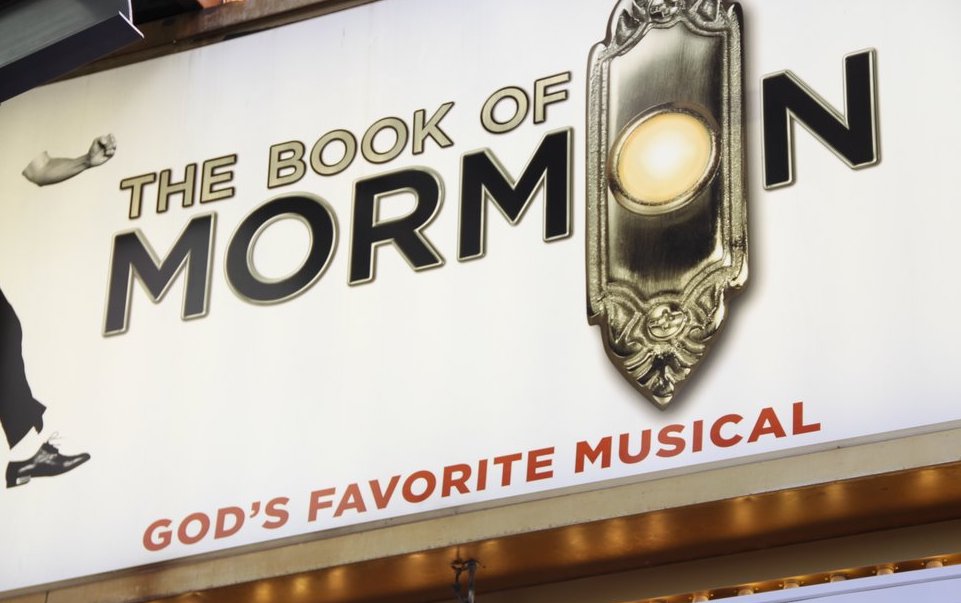
The Book of Mormon at the Prince of Wales Theatre review ****

The Book of Mormon

Prince of Wales Theatre, 20th April 2019

Better late than never. Six years after it opens the Tourist finally gets to see The Book of Mormon. As all Tourists should. Thanks to LS and LGN.

Now the previous musical theatre adventures with the two of them have not been unalloyed successes. The Lion King visit predates this blog. Just as well as there would be no review for the simple reason that I don’t do reviews of stuff which is awful. Seems unfair. But it was. Sorry. Les Miserables was better, though not as good as I remember first time around, reflecting increasing age and pretentiousness on my part. Though I also think my misgivings may actually in part reflect the source material. Victor Hugo’s story is just too melodramatic and too chock full of coincidence for me to swallow. This was clear in Andrew Davies’s recent TV adaptation despite it being crammed with cracking acting talent. Mr Davies has penned many of the best things I have seen on the telly. House of Cards (UK not US), Middlemarch, Vanity Fair, Daniel Deronda, Tipping the Velvet, Bleak House. His War and Peace also put in a strong showing, though maybe didn’t quite encompass the full scope of the novel. For that you probably need the full weight of the Soviet authorities behind you. On that note I see that the mid 196os four part adaptation by Sergei Bondarchuk has been recently restored and is about to be released on DVD. Can’t wait. Anyway the idiosyncracies of Mr Davies’s approach, focusing on key episodes and key character traits, which has worked so well in the past, didn’t quite cut it for me in Les Mis. But I was also painfully aware of just how contrived the story is. Which probably is the major reason for my resistance to the musical.

The other problem I have with popular musicals is that they are, er, popular. If anyone says “ooh you like theatre, they you must see this” and proceeds to recommend a West End musical, then the snob in me is guaranteed to dismiss their opinion. This is not because they are likely wrong. It is because I am a w*nker. But, in my defence, as with The Book of Mormon, where numerous people, whose opinion on all other matters I value very highly, have implored me to see it, I will eventually back down. As with TBOM.

(So on that basis, and having made a rash promise to LS, if you are prepared to wait a few years, eventually I will gush forth on Hamilton, most likely with a grudging admission that it is very good, though still not in the same league as Ben Jonson, Brecht, Edward Albee, Caryl Churchill, David Harrower, Ella Hickson or whichever “serious” playwright I am obsessed with at the time and wish to show off about).

Now the first thing I would say about TBOM is … what a very nice theatre the Prince of Wales is. The Tourist detests most West End theatres. I hate most late Victorian/Edwardian neo-classical architecture, (though I can get my head around Frank Matcham’s buildings), facilities are usually dreadful, seats cramped, sight-lines awful and sound poor. The Prince of Wales’s jaunty Art Deco vibe, dating from 1937, and expertly tarted up in 2004, is a delight. We were up in the Circle, the Tourist being a cheapskate, though to be fair even the best seats in the house here are not outrageously priced given the entertainment. Whilst the Circle may be pitched at an unnervingly steep angle, and the seats are ram-rod upright, this does mean the view is perfect, and, with the cast miked up to the eyeballs, even the hard of hearing Tourist could hear every word. Just a shame I’ll probably never go back as this will probably run for many more years until replaced by whatever the musical magpie Andrew Lloyd Webber can cobble together for his parting swan song musical.

So the Tourist, pleased with the accommodation, was open to persuasion on the entertainment. For the first ten/fifteen minutes or so however he was anything but. For that is how long it took him to adjust to the tone of the satire and depth of musical parody. Oh no, was it just going to be a bunch of crude, scattergun jokes that mocked the US and religion (permissible for us liberal, metropolitan elite smart-arses), but in doing so was needlessly and uncomfortably offensive about Africa (most definitely not permissible)? And was this childish music all there was? It didn’t take long though to realise that is much cleverer, and, despite surface appearances, much subtler than that. TBOM makes some telling points about the idiocy of Mormonism, and by implication, all religious dogma, but not in a snarky way. The irony in the portrayal of Uganda and its people is rapidly revealed; this is taking the p*ss out of the way we, Lion King I am looking at you, see Africa.

Every trope of musical theatre is trotted out but in an utterly disarming way. The songs are not so bad that they are good. They are so accurate in the styles that they are undercutting that they are good. And, on occasion, actually just good in themselves. The whole thing is suffused with a sense of knowing fun such that, by the end, it doesn’t actually feel like satire anymore, in fact the story and characters take over.

I hated South Park, (another reason for trepidation going into The Book of Mormon), but loved Team America and now loved this. So I guess I have to hand it to the Trey Parker and Matt Stone combo. They are far smarter than I thought. Mind you, based on the brilliance of the musical pastiche, (the whole history of comic opera and theatre seems to be be lovingly teasing somebody else), Robert Lopez might be the main man to thank. Maybe I need to see his other hit, Avenue Q. An extraordinary admission for a man whose idea of theatrical heaven would be Brecht in German in a car park.

There are about a billion people involved in creating The Book of Mormon named in the programme, (in fact, for once, I wish I hadn’t bothered to buy one since a list is about all it is), so I will just single out the cheesy choreography, (and original direction with Trey Parker), of Casey Nicholaw and the performances of Tom Xander as the hapless hero Elder Cunningham, Leanne Robinson as (correctly named) Nabulughi and, especially, Steven Webb, who has got stage sparkle and knows it, as Elder McKinley.

So there you have it. A show that mocks its subject, its characters, its genre, its audience and itself. But also loves all of them. And is very, very funny, (unless you are a blue rinse conservative or grim class/identity warrior), very entertaining, musically diverse and even, surprisingly, uplifting. Though maybe not in Spooky Mormon Hell Dream, my particular song highlight. I see from the original 2013 reviews that all the papers bar, predictably, the Daily Heil, loved it. That should have been the only recommendation I needed.

Don’t be a dick like me and make sure, if you haven’t seen it, that you add it to the bucket list.

Downstate at the National Theatre review *****

Downstate

National Theatre Dorfman, 17th April 2019

Sweat, Shipwreck and now Downstate. Some of the best new plays I have seen this year have come from established US playwrights. Whilst Brits can usually be relied upon to come up with more innovative theatre in terms of subject and form, (well maybe Shipwreck fits that bill), if you want talky, gritty, politicised, soundly structured drama then the American heavyweights fit the bill. I guess it reflects their history, we are currently being treated to a Miller-fest in London, one of the greats, and, socially, culturally and political, the US theatre community has much to comment on right now.

We have more to look forward to later in the year with the world premiere of David Mamet’s latest play Bitter Wheat, a “farce” inspired by the Weinstein scandal, Appropriate, Branden Jacobs-Jenkins’s take on the classic American family drama at the Donmar, Fairview at the Young Vic, the Pulitzer Prize winner from Jackie Sibblies Drury and The Starry Messenger from Kenneth Lonergan. Judging from the reviews in the US, (they do go on a bit those Broadway critics – mind you, pot, kettle, black), they are all well worth seeing. And maybe later in the year, or next year, we have Antipodes from the mighty Annie Baker to look forward to at the NT.

Now Bruce Norris is most renowned for his play Clybourne Park from 2010, a kind of sequel to Lorraine Hansberry’s classic A Raisin in the Sun from 1959, and The Low Road from 2013, which is pretty much at the top of my “you f*ckwit, how did you manage to miss that” list since its premiere at the Royal Court with a cast to die for. Property, race, the contradictions of capitalism, the marginalised. These are the beefy concerns of Mr Norris and many of his peers. And Mr Norris has an advantage in that his work is usually brought to life by the world famous, (well in certain circles), Steppenwolf Theatre Company in Chicago.

Downstate premiered at Steppenwolf’s Upstairs Theatre last year but, having been jointly commissioned by the NT, the company, including our own Cecilia Noble and Aimee Lou Wood, has been preserved for the London premiere. And it shows. This is ensemble acting at its best, and, I assume, the weeks of performance have polished up Mr Norris’s already sparkling dialogue to the jewel we see here. Downstate is not an easy subject to dramatise. Four paedophiles, released from prison but restricted in terms of movement (electronic tags and restriction zones), money, jobs and access to technology by state laws, are sharing a house in downstate Illinois overseen by weary police probation officer Ivy (Cecilia Noble). The elderly Fred (Francis Guinan) is wheelchair bound and the play starts with him listening to the testimony of one of his two victims, Andy (Tim Hopper) accompanied by his wife Em, (Matilda Ziegler). Andy, fresh from a survivors group, is plainly damaged and angry and determined to hear Fred acknowledge the abuse. Fred, who in all respects appears a kindly, almost naive old man, admits the crime but more as a matter of fact than remorse.

Fred is cared for by Dee (K Todd Freeman), a witty, intelligent and acerbic gay man, who still loves the young man, pointedly a Lost Boy in a production of Peter Pan, who was his evident victim. Gio (Glen Davies) is a garrulous younger man who refuses to accept he committed an offence, having had sex with young woman who “lied” about her age and, in breach of the conditions which govern his freedom, has befriended his young co-worker, bolshie Effie (Aimee Lou Wood) . The quartet is completed by Hispanic American Felix (Eddie Torres), who is barred from any contact with his family having abused one of his daughters. Like Gio, he has turned to religion, to atone and deflect.

Bruce Norris has thus created a realistic situation, (the programme offers some vital insights into the way sex offenders are treated in the US after they have nominally served their sentences), and four believable characters who cover the spectrum in terms of offences and the way in which they accept and acknowledge their actions. The play highlights the way in which society seeks to punish and secure revenge for these crimes as well as the debilitating impact on these men of the need to secure “protection” for any future potential recidivism. Punishing offenders for crimes that they have yet to commit is what makes sex offenders a special category of criminal. Which apparently doesn’t work anyway.

The brilliance of Mr Norris’s writing is that, without in any way lessening the impact of the suffering of the victims, Andy continues to play a central, if ambiguous, role throughout, we are asked to see them as sympathetic individuals, not monsters, and to listen to their accounts of what they did and who they are. They all see themselves in some way as victims. The uneasy fact is we start to understand, if never accept, why they would believe this and persist with the self-pity. Some of the bait and switches, and the speechifying, is a little mechanical, and I have still to make up my mind about the ending, but this is forgivable given the drama and dimensionality that it creates. It is not a comfortable watch but it grips from start to finish, and, if ultimately the task of a great playwright is to make you grapple with complex moral issues, without providing definitive answers, whilst still telling a story, then Mr Norris has delivered. It pokes and provokes, with no little humour, and even manages to generate audible audience gasps. That makes it a great play.

Todd Rosenthal’s set, Clint Ramos’s costumes, Adam Silverman’s lighting and Carolyn Downing’s sound, are note perfect. We are in the house with the characters. Pam McKinnon, who is the AD of the American Conservatory Theatre in San Francisco, is a long time collaborator with Bruce Norris. It shows. The rhythm here is well nigh perfect. And the cast is, as I said, superb. Normally when I say this it actually means one or two members didn’t quite bring the A game that most of their colleagues did. Not here though. Even so, if I had to pick out one performance, it would be K Todd Freeman’s Dee. It is he who has to say most of the unsayable.

I would be surprised if, like Clybourne Park, this doesn’t quickly become a staple, and, whilst I find it hard to believe a future production could match this, it is a play you must see. If only to reflect on how easy it would be to fail when dramatising these issues, (Lucy Prebble has fortunately gone on to bigger and better things since her debut The Sugar Syndrome which addressed a similar subject). Mr Norris is a brave writer, like many of the peers mentioned above. I look forward to seeing more of his work.

Ghost Stories at the Lyric Hammersmith ****

Ghost Stories

Lyric Hammersmith, 18th April 2019

BD, LD, MS and SO joined the Tourist for this.

Here is what we learnt.

A. Don’t see the film version first.

B. If you follow A. You will be sh*tting yourself.

C. if you don’t follow A this is still very, very effective.

I won’t say much. There are three connected stories. It is cleverly written by Jeremy Dyson, (The League of Gentlemen, Funland, Psychobitches amongst others), and Andy Nyman, (versatile actor and Derren Brown collaborator), and brilliantly realised by the creative team of Sean Holmes/Joe Murphy (direction), Jon Bauser (design), James Farncombe (lighting), Nick Manning (sound) and Scott Penrose (special effects), and many more no doubt. The cast here, Garry Cooper, Simon Lipkin, Preston Nyman (yes Andy’s boy) and Richard Sutton, throw themselves into it.

It has been around for nearly a decade now but the Lyric was the theatre that first commissioned it, in fact it was pretty much the first thing Sean Holmes did when he took over. So, if like us, (doh, like you’d see it twice – maybe yes actually), you have never seen it, this seems like the fitting place to go. And, at 20 quid a pop it’s a bargain. And businesslike in duration at just 80 minutes.

So you think you won’t be scared by theatre? Get along to the LH with some mates in the best few weeks and test the proposition.

And, if like me, your youngest lets out an entirely solitary, and very loud, yelp at probably the least scary of the jump-scare moments, you will, also, p*ss yourself laughing.

A German Life at the Bridge Theatre review ****

A German Life

Bridge Theatre, 15th April 2019

It is pretty easy when you spend as much time consuming theatre as the Tourist to go full on luvvie and get well carried away with the “genius” of playwrights, directors, creatives and, especially, actors. So you would probably be wise to ignore all of what follows and the gushing that generally ensues whenever acting royalty treads the boards. But, just for once, this was the real deal.

I see, for example, in today’s Guardian that there is a ranked list of Dame Judi Dench’s film roles. It’s pretty thin pickings, with the exception of some big screen Shakespeare, Iris, Philomena and, especially, Notes on a Scandal. This is not because Dame JD is a poor actress. Nonsense. It is because most films are rubbish. But when a proper text is given to her she is peerless. Which, for anyone who has ever seen her on stage, should be self-evident. I only know her from the recent collaborations with Kenneth Branagh and Michael Grandage, an RSC Mother Courage, Madame de Sade and the Midsummer Night’s Dream at the Rose. Too young and too stupid to have seen her in any major Shakespeare roles unfortunately.

Mind you I had never seen, until now, Dame Maggie Smith, on stage. Never saw The Lady in the Van at the NT or in the West End. Or earlier West End triumphs like Albee’s Three Tall Women and A Delicate Balance, or David Hare’s The Breath of Life. All in the fallow period for the Tourist’s theatre going. So it’s just the film and telly stuff. More often than not DMS stamps her mark on these screen roles so completely that you cannot imagine anyone else playing them. Sardonic, trenchant, caustic, acerbic, take your pick of adjectives, you know what I mean. Yet always something far more profound, revealing and empathetic beyond the natural comic timing.

So I wasn’t going to miss this. Whatever it was. Even if she had read out the telephone directory. As it happens a play based on the testimony of Brunhilde Pomsel, a personal secretary to Joseph Goebbels, the Reich Minister of Propaganda, was always going to be right up my street. Ms Pomsel died in 2017, aged 106, on Holocaust Remembrance Day, having given a series of interviews, aged 102, that formed the basis for a documentary film A German Life, produced and directed by Christian Krones, Olaf Muller, Roland Schrotthofer and Florian Weigensamer. This script in turn formed the basis for a subsequent biography and for Christopher’s Hampton’s translation and adaptation for the Bridge stage.

Ms Pomsel had a relatively unremarkable upbringing, despite the remarkable times, as a child in WWI and in 1920s Germany, and went to work as a stenographer in the late 1920’s for a Jewish lawyer and, soon after, simultaneously, for a right wing insurance broker. In 1933 she moved to a a job in the news department of the Third Reich’s broadcasting department, (having taken up Nazi Party membership), and eventually was posted in 1942 to the Reich Ministry of Public Enlightenment where she was a shorthand writer. Following the fall of Berlin in 1945, and Goebbels’s suicide, she was imprisoned by the Soviet NKVD for 5 years in various concentration camps, escaping to West Germany after her release and working for state broadcasters until her retirement, living in Munich.

Now it is pretty easy to see why the German documentary makers alighted on Brunhilde Pomsel. Yes, her proximity to Goebbels, but also the clarity and honesty of her recollection. Her apparent apolitical stance, she joined the party to get the job and couldn’t quite remember if she voted for the Nazis or the DNVP (the Nationalist party) in the early 1930s, but liked the colours and the meetings, and refusal, even in retrospect to utterly condemn the system she found herself at the heart of, made her a more authentic commentator on what happened to Germany than many others with more pointed conviction in their stories. Her testimony is not concerned with her own personal guilt or innocence and can therefore more credibly get to the heart of the question: what would you have done differently in the same situation?

I am not sure if Mr Hampton had Maggie Smith in mind when he began the process of translating and editing the material from the documentary, though I gather she had plenty of input to the final outcome. I assume that an unbroken monologue, in line with the film, was the only feasible option but I would guess again that Mr Hampton, and the creative team here, Jonathan Kent as director, Anna Fleischle (designer), Jon Clark (lighting), Paul Groothuis (sound), must have had some trepidation at presenting a talking head for near two hours. The set, a naturalistic representation of Ms Pomsel’s apartment, moves gradually towards the front of the thrust stage, Mr Clark’s lighting subtly rings changes and there are a handful of crucial sound interventions, (not least of which is subtle amplification – the Bridge is a brilliant space but not intimate), but otherwise it is just DMS sat in chair.

They shouldn’t have worried (in fact they probably didn’t). From the opening knowing aside “let’s see how this goes”, through Ms Pomsel’s strict childhood, her delight in Weimar Berlin society, the reckoning of Kristallnacht, the fear in Hitler’s bunker, disgust at the Soviets and the search for her Jewish friend post-war (she died in a camp in 1943), DMS is, and this is no exaggeration, spell-binding. You don’t hear and see a German centenarian on stage, it’s still DMS, but this is the vivid, animated story of a real person, conveyed in an entirely naturalistic way, with just hesitant voice, mobile hands and febrile face. Leaving you ample opportunity, as the details build, to reflect on the core question posed above. For it seems to me that any guilt than Ms Pomsel may have carried was actually more the guilt at not feeling guilt, despite all that had happened, and not the guilt of complicity, ignorance or indifference. The banality that lies behind Hannah Arendt’s banality of evil personified. The contradictions about what she did and didn’t know about the concentration camps, or more actually cared to remember about what she knew, especially when contrasted with her own experience in these same camps after the war, are the most pointed passages of testimony and play. “We didn’t want to know about them, we really didn’t”.

This I suppose is why this “evil” is a constant in human history. It’s not lack of resistance or evasive denial that lets this continue. Just “ordinary” people not understanding or caring enough to stop it. This story will never be irrelevant.

I would assume that this will proved to be Dame Maggie’s stage swan song. If so it is a remarkable demonstration of her skill. But beyond that this is a vital story. Powerfully told. It looks like Blackbox Film and Media, the documentary makers, have told, and are telling, other such vital stories. I need to find out more. Not least of which is to see the A German Life documentary. As should you perhaps given the play is sold out.

Herbert Blomstedt and the Philharmonia Orchestra at the Royal Festival Hall review *****

Philharmonia Orchestra, Herbert Blomstedt (conductor) 

Royal Festival Hall, 14th April 2019

  • Mozart – Symphony No 40 K550
  • Beethoven – Symphony No 3 “Eroica”

Bernard Haitink is 90. Herbert Blomstedt is closing in on his 92nd birthday. Unsurprisingly perhaps neither of them is particularly animated on the conductor’s podium. Mind you neither of them ever has been. Now you might ask yourself, apart from, by reputation, being a thoroughly nice bloke, (probably part and parcel of his fervent faith), at this age what is in it for him, and us, of Herbert Blomstedt continuing his life’s work when he should have retired years ago. To which I respond the world of classical music works to different rules.

Just to be clear. An orchestra of the calibre of the Philharmonia probably doesn’t need a conductor, of whatever vintage, to play this two warhorses effectively and efficiently. But it does need a conductor to lead and shape its musical vision. In its case the soon to be departed Esa-Pekka Salonen, its current Principal Conductor and Artistic Advisor. The reputation of young conductors is made on their skills in interpreting and shaping the music on the page, but their legacy is a function of what they do to the orchestras they are tasked to lead. What they play, why they play it, how they play it, where they play it, who they play it with, what they choose to set down for prosperity. All artistic decisions.

And then there is the commercial imperative. The PO helpfully shows what funds its 11 million quid annual running costs. (Just before any of you philistines get antsy that’s the price of one first team, high end Premiership footballer. I know football clubs are commercial concerns, often listed. But the cost of paying the asserts still makes then a sh*tty investment. Stick to consumer staples I say).

Around 25% comes from its Arts Council grant and tax relief – peanuts to you the taxpayer for the massive contribution to our cultural fabric. The result largely comes from ticket sales (15%), tours (25%), recordings/bookings (10%) and just over 20% from fundraising, all those nice philanthropic types. Now the head honcho conductor isn’t in the front line begging for money, (quite the reverse, E-PS donates a chunk of his earnings to the orchestra), but his, (shamefully still only very occasionally her), standing makes a big difference to the economics.

Of course the Chief Conductor/Artistic Director isn’t the only stick waver employed come show time. There are, depending on the size and status of the orchestra, a host of Guest Conductors, Conductor Laureates, Associate Artists and featured partner conductors who also shape and lead performances. One or two may play a part in the broader life of the orchestra, (the trainees for the big jobs if you will), but most pitch up for, more or less, just the rehearsal and the performance. But they will still have an ongoing relationship with the orchestra. This is important. Music making is a shared endeavour. If the orchestra doesn’t believe in the conductor trust me it shows.

Even so, unless things start to go seriously awry, the beat-keeping on the podium is more for us than them. Mind you in a big piece with a. big orchestra, the conductor is the thing that holds the dynamics together. And, he/she can still be invaluable, with his/her cues, in helping mesh soloist and orchestra together in a concerto. But largely, I would say, it’s all part of the orchestral theatre. So, obviously, it is what goes on beforehand that matters. There aren’t that many scores with nailed-down instructions on tempi, dynamics, articulation, phrasing, shaping ….. and all the other stuff that us non-musicians have no idea about. And even if there are it is not illegal to shake the score up a bit. So someone needs to set the interpretative rules.

And this can make a big difference. Just compare recorded performances of the same piece and you will get the picture. Composer and performer are generally the same in modern music genres. Not so, generally, in classical, art music. Who matters more is a function of musical history. Go delve.

(Now I know that there are plenty of performers and ensembles who work in a different way. No permanent conductor. Playing from memory. Just a leader. But I don’t they would do it for Mahler’s Eighth).

Which, finally, brings me to these performances of Mozart 40 and the Eroica. You and I have heard them billions of times. Old school, HIP, HIP informed, gut, steel, smaller/larger orchestration, fast/slow, Classically cool or fervently romantic. There are loads of ways to cut these delicious cookies. Herbert Blomstedt and the PO just played them. Perfectly. At a fair lick if I am honest which suits me, but never over-revving the PO’s engine, and with some well placed, not too much, vibrato, when it was reasonable to do so. But overall nothing showy. Just the right choices each and every time.

Mozart is not standard Blomstedt territory but he captured the tension in the opening Allegro, the clean textures of the Haydnesque slow movement, the bracing dance of the Menuet and Trio and nailed the forward-looking innovation of the finale. All the repeats present and correct. Maybe the minor key (this and No 25) is HB’s bag.

Beethoven definitely is his territory and this was marvellous. He plainly loves it and made the PO fall in love with this, the most important work of music in the Western canon IMHO, all over again. 50 strings. Count ’em. Violins antiphonally divided. But every texture, every phrase, even when it get a bit blowsy, in the coda to the epic opening movement or the heroic final variation in the Finale, was utterly transparent. He has clearly continued to learn from the new ways of approaching LvB’s music and grafted that on to the decades of dramatic interpretation he has lived through. No need to open the score. Back straight. Legs planted. Just fingers, elbows, shoulders to remind the players what they already knew. Some stand out double bass grooves and well hard thwack timpani. Natural trumpets. And, in the funeral march, plenty of aural elbow room for the woodwind to shine. The change that this piece of music ushered in was plainly heard but never at the expense of its still Classical grounding.

Best of all. He believes in Beethoven’s markings. Even if he, like most, can’t quite get there. I am not advocating blast beat fast a la Gardiner, (though I am salivating at the complete cycle with the ORR next year at the Barbican), but LvB knew what his was up to and if you don’t agree you can go back to your interminable Wagnerian dirges.

Even when taking the well deserved applause HB seemed more concerned with praising the audience than lapping up the audience appreciation. Mark of the man. With Abbado, Boulez, Harnoncourt, Masur and Davies sadly no longer with us this leaves Maestros Haitink and Blomstedt as the granddaddies. (I can’t vouch for Mr Muti). Both prize purity and don’t f*ck about with what is on the page. Haitink still gets my vote but he only seems to do Bruckner or Mahler now. So hearing what a legend does with stuff I love was a real privilege.

There aren’t that many recordings I would own conducted by HB, whether with the various Scandi outfits he has headed up, the Dresden Staatskapelle or the Leipzig Gewandhaus. (Under Barenboim and Chailly these two have climbed to the very top of the orchestral tree but guess who kicked off the journey). But I wouldn’t be without his Nielsen symphonies with the San Francisco Symphony Orchestra. Basically he single handedly showed what the rest of the world what Denmark’s favourite musical maverick (I know, it’s a small field) could do. Priceless.

The Remains of the Day at the Yvonne Arnaud Theatre review *****

The Remains of the Day

Yvonne Arnaud Theatre, Guildford, 13th April 2019

Right all you good citizens of Derby, Salisbury, Cambridge and Bristol. There is still time for you to book tickets to see this excellent adaptation of Kazuo Ishiguro’s celebrated novel The Remains of the Day. A very well crafted script by Barney Norris, (just the fellow to write pensive studies of “Englishness” based on his previous work), in an excellent production from one of our premier touring companies Out of Joint, thoughtfully directed by Christopher Haydon, (latterly of the Gate Theatre), with a pair of sparkling central performances from Stephen Boxer and Niamh Cusack.

Now the Tourist has never been much good at reading. Nothing ever seems to sink in without repeated exposure. Especially with fiction. And especially with fiction he read in his youth. A vague recollection of the big picture, a few specific episodes and a general “I like that author”. Not like the SO who can trot out plot, character, meaning, style, context, like an A* student even for things she read decades ago. Maybe this low level intimidation is what stops the Tourist picking up a book except when on hols. That and spending too much time at the theatre and writing this stupid f*cking blog.

Anyway you probably. like the Tourist. know this work more from the 1993 Merchant-Ivory film with Anthony Hopkins and Emma Thompson as Stevens and Kenton, both quietly upstaged by Peter Vaughan as Stevens Senior. Nominated for 8 Oscars, won none. Mind you that was the year the Academy rewarded Spielberg for Schindler’s List. Fair dos. I see that one Harold Pinter wrote an original screenplay for the film when Mike Nichols was slated to direct. Bits of Harold’s work made it to the end but he removed himself from the credits. Might have been a very different film with him and Mr Nichols in the driving seat.

Instead I remember the central, unrequited, relationship between the stiff Hopkins and the droll Thompson, the look and feel of the thing, (Merchant-Ivory being allowed to film in any toff’s house at the time such was their fame), and the almost elegiac take on the history under examination, the 1950’s and the 1930’s. Yes the politics were there but not as sharply delineated as in this play. Class, deference, knowing one’s place, belief in the wisdom of the elite, are common to both treatments but I was far more struck in this treatment by the desire of many in the aristocratic class in the 1930’s to broker a deal with Hitler, to appease, than I was in the film. And specifically the reasons why, the guilt at having inflicted so much economic misery on Germany post First World War, as well as the memory of the human carnage of that war, and, of course their anti-semitism, which motivated them to pursue this course.

It may just be that, like my reading of the book, I just don’t remember the film very well. Which is salient given that The Remains of the Day is a memory book/film/play. Or maybe more specifically a memory of a history, personal and political, book/film/play. To solve the “problem” of butler Stevens remembering the events at Darlington Hall in the run up to the Second World War, (as he undertakes the road trip in 1958 to pay the visit to the ex-housekeeper, Miss Kenton, prompted by her letter), the film makes generous use of flashbacks. And a cast of thousands.

Well maybe not quite but tons of extras and actors of the calibre of James Fox, Christopher Reeve, Hugh Grant, Michael Lonsdale and Tim Pigott-Smith to fill all the named characters, (trust me, a lot of people found their way to Darlington Hall). Even the minor parts are filled by the likes of Ben Chaplin, Patrick Godfrey, Peter Eyre, Pip Torrens and, the go-to actor for Germans in British films, Wolf Kahler. Blimey even a young Lena Headey, Cersei in you know what, gets a look in. Basically if you could do plummy or gor-blimey, and you weren’t engaged elsewhere, you got a part in the film.

No such technology of budget for Out of Joint and Messrs Haydon and Norris. So a fair bit of character pruning, some adroit exposition to incorporate those written out, and extensive doubling. But this is not just any old “exit Act 1, turn up as someone else in Act 2 with new costume and wig” stagecraft. This is seamlessly executed, on stage choreography, a hat, a coat, a pipe, to turn a cast the cast of 8 into the staff and guests of pre war Darlington Hall and the locals Stevens meets on his pint-sized odyssey of self-discovery. This means that the ghosts of the past are always present. Very clever and very easy to follow.

Stevens devotion to duty even in the face of the shocking demand by Lord Darlington to sack the two Jewish maids, Kenton teasing Stevens about his book, Stevens carrying on his duties even as his father dies and Mme Dupont, (a gender change to accommodate the casting pyrotechnics), whinges about her feet, Reginald’s increasing awareness of what his godfather is up to, Stevens disowning the past in his conversations with Dr Carlisle, the mocking Stevens is forced to undergo from “Sir David” the composite collaborator with Lord D, the radical conservatism, or conservative radicalism, espoused by everyman Morgan in the pub and, of course, the extraordinarily moving scenes between Kenton, or Mrs Benn later on, and Stevens, as the happiness they might might have had slips through their fingers. You flipping noodle Stevens.

All of these scenes are memorable, providing plenty of minor key drama, but the best things about the play are the performances of Mr Boxer and Ms Cusack. I’ll stick my neck out here and say that for me, and remember this is based on my faulty memory, they capture the essence of Stevens and Kenton more that Hopkins and Thompson in the film. The ten year age gap between these actors seems more convincing than the 20 years of the film. Mr Boxer seems to me to bring out more of the interior life of Stevens, the way he buries the emotions that he plainly has in the cause of maintaining the dignified exterior he believes is required of him, the way he is puzzled by, but still craves, Miss Kenton’s attention. Ms Cusack seems more playful as Kenton, holding back the regret until the very end. the structure of the play lends more prominence to the conversations in the pub and the way this changes Stevens’s perspective.

The directness of the political dilemma, and its flawed morality, is far more pointed here than in the film. And the reliability of Steven’s recollection is more nuanced as in the book, (yes I took a quick peep again whilst writing this). In fact generally Mr Norris seems to capture the essence of the book in a, er, more reliable way that the period-drama aesthetic of the film does.

The rest of the cast step up. Miles Richardson captures the naivety, in life as well as politics, of Lord Darlington and the middle class bonhomie of Dr Carlisle. Sadie Shimmin offers us an uncomplicated pub host in Mrs Taylor alongside the hauteur of fascist sympathiser Mme Dupont. Edward Franklin warms to his task as the bespectacled, conscientious godson Reginald, (drawn from the film not the book), Patrick Toomey is the arrogant American politician Lewis (and, I think Farraday, Steven’s current employer) and Pip Donaghy marks out Stevens Senior decline. Top marks to Stephen Critchlow though as he he shifts from Morgan to the real “villain” of the piece the anti-semitic Sir David.

I see a lot of plays but this is one of the more satisfying I have seen so far this year. “Knowing” the content helps of course, and, from a personal geographical perspective a hop to Guildford, and the fine design and accumulated history of the Yvonne Arnaud Theatre, was no inconvenience. I get that Out of Joint rightly values its touring credentials and I am grateful to the Royal and Derngate, (on my list to visit), and the Oxford Playhouse for co-commissioning Barney Norris’s script. But I am stunned that this hasn’t secured, as far as I know, secured a berth in London.

The familiar story, the quality of the acting, the script and the production, (Lily Arnold’s set is another stand-out as is Elena Pena’s sound design), the themes it explores and their contemporary echoes – the dangers of passivity and nostalgia – all would suggest to me that this would pack them in in a mid sized West End venue. There is plenty for the customary theatre demographic to enjoy, (they certainly did on this Saturday afternoon), but, with the right tone, I reckon some younger folk could be persuaded. I know that Out of Joint’s last major production, Rita, Sue and Bob Too, had a false start, understandably, before eventually gathering plaudits as the Royal Court but most of the rest of their historical efforts have popped up in the capital. This, whilst still posing some thorny questions, looks to be a far more commercial proposition than many of those predecessors.

Barney Norris plainly says that “the play must be unlike the book or the film or it shouldn’t exist” in the programme. Fair dos. But, whilst its structure and perspective match his manifesto, there is more than enough of both earlier manifestations to justify your attendance should you know them.

Over to you nice people at ATG.