The best theatre coming up in London

It’s been a little while since the Tourist set out his favourite theatre opportunities either on now (in the case of Nine Night), or coming up over the year in London. Nothing too obscure or fringe-y here. Tried and trusted in terms of writer, director, cast and/or venue.

The first ten plays are written by, are about, or have creative teams led by women. We’re getting there.

Top Girls – National Theatre Lyttleton. The English speaking world’s greatest living playwright Caryl Churchill and one of her best ever plays. Still relevant, with its profound feminist critique, near 40 years after it was written. Audacious beginning with the dinner party scene and then the force of nature Marlene takes over.

Small Island- National Theatre Olivier. An adaptation by Helen Edmundson of Andrea Levy’s brilliant novel about race (the Windrush generation) and class in post war Britain. A cast of 40 count ’em directed by Rufus Norris (this should play to his strengths after a couple of duffers).

ANNA – National Theatre Dorfman. The bugger is already sold out but more seats promised. Ella Hickson, who is probably our most talented young playwright, and the Ringham brothers, sound maestros, combine in a tale set in East Berlin in 1968 which the audience will hear through headphones. Think Stasiland and Lives of Others.

Medea – Barbican Theatre. Euripides’s greatest tale of female revenge with Europe’s finest actress, Marieke Heebink, in a production by Europe’s greatest theatre company International Theater Amsterdam (was Toneelgroep) directed by Simon Stone. Don’t let the Dutch (with English sur-titles) put you off.

Three Sisters – Almeida Theatre. Chekhov. New adaptation. Cast not fully announced but Patsy Ferran and Pearl Chanda is a great start and directed by Rebecca Frecknall who garnered deserved praise for her Summer and Smoke by Tennessee Williams. Usual Chekhov tragic-comic ennui. A few tickets left.

Sweat – Gielgud Theatre. Transferring after the sell-out run at the Donmar. Lynn Nottage’s conscientiously researched drama about blue collar America is the best play I have seen this year and one of the best in in the last 5 years. Nothing tricksy here just really powerful theatre.

Blood Wedding – Young Vic. Lorca’s not quite the happiest day of their lives directed by Yael Farber (this should suit her style). The last time the Young Vic did Lorca it was an overwhelming Yerma.

A German Life – Bridge Theatre. Dame Maggie Smith. That’s all you need to know. (Playing Brunhild Pomsel who was Goebbels’ secretary in a new play by Christopher Hampton who did Les Liasions Dangereuses and translates French plays).

The Phlebotomist – Hampstead Theatre. Blood of a different kind.. I saw this last year in Hampstead Downstairs. Now a run in the bigger space for Ella Road’s debut near term dystopic relationship play with Jade Anouka tremendous in the lead.

Nine Night – Trafalgar Studios. Only a few days left and only a few expensive tickets left but Natasha Gordon’s debut play about Jamaican and British identity is a cracker.

Death of a Salesman – Young Vic. Arthur Miller’s greatest play and therefore one of the greatest ever with an amazing cast directed by Marianne Elliott and Miranda Cromwell. This is near sold out but book now otherwise you will be paying twice the price in the West End for half the view as this is bound to be one of the best productions of the year and is bound to transfer. Willy Loman is maybe the greatest male part ever written for the stage.

The Lehman Trilogy – Piccadilly Theatre. I told you to see it at the NT and you ignored me. Do not make the same mistake twice.

Cyprus Avenue – Royal Court Theatre. Probably pointless putting this in as it is pretty much sold out but I missed David Ireland’s sharp satire of Irish republicanism and am not about to repeat that error.

Bitter Wheat – Garrick Theatre. World premiere of new play by David Mamet about Weinstein with John Malkovich in the lead, Woo hoo.

Rosmersholm – Duke of York’s Theatre. Hayley Attwell and Tom Burke in the “greatest ever Ibsen play” which rarely gets an outing. Expect usual Ibsen misery tropes. Directed by Ian Rickson and adapted by Duncan MacMillan, marks of quality.

The Night of the Iguana – Noel Coward Theatre. Talking of less often performed classics by the greats here is a Tennessee Williams with Clive Owen putting in a rare appearance along with Lia Williams, directed by James MacDonald.

The Unreturning at Theatre Royal Stratford East review *****

The Unreturning

Theatre Royal Stratford East, 24th January 2019

Denizens of Leicester, Swansea and Oxford. Consider yourself lucky. There is still time for you to catch the tour of Frantic Assembly’s The Unreturning which has already travelled to Plymouth, (the Theatre Royal who cannily commissioned it), Southampton, Edinburgh, Liverpool, Birmingham and Chichester, as well as Stratford East. For make no mistake this is a fine piece of theatre that deserves your attention for a number of very good reasons.

First off Anna Jordan is clearly a very talented playwright. I haven’t seen Yen, her much lauded breakthrough play, though on the strength of this I really hope it is revived soon. I am though looking forward to what she brings to Brecht’s Mother Courage which she has adapted and which has just opened at the Royal Exchange Manchester.

In The Unreturning she has interwoven the stories of George, Frankie and Nat, who return to their home town of Scarborough, damaged from their experience of war. In 1918 George is shellshocked after his experiences in the trenches in WWI and his wife Rose cannot cope with his breakdown; in 2013 disgraced Frankie is not welcomed back as a hero from his turn in Iraq and cannot put a lid on his anger; and Nat is stricken by guilt about the brother Finn he left behind after escaping as a refugee to Norway in 2026 from a future British civil war. Scarborough may be home but they are not welcome. Time may move on but the issues the returning combatants face remain the same.

This is no naturalistic drama however as Ms Jordan has created a far more episodic and lyrical structure for drama and text. That is not to say that the narrative does not quickly come into focus. The three opening monologues which together form a prologue, describe what each of the three protagonists are aching to experience when they come home, and that, together with the experiences they bring back with them (which go well beyond the simple “war is hell”), forms the nub of the play. In each case the multiple characters that Ms Jordan also introduces, as well as the prudent use of a chorus, serve to flesh out the personal histories and create real drama. The chorus, as well as further monologues, also n’tbring real poetry to contrast with the dialogue of each short scene.

As if that was enough, Frantic Assembly’s trademark physicality also brings a further, thrilling, dimension.. At first glance, Andrzej Goulding’s set, a revolving (when pushed, no fancy technology at TRSE) shipping container, is hardly revolutionary, but when combined with his strikingg video design (for which he is more renowned), Zoe Spurr’s prominent lighting design and Pete Malkin’s bold electronic soundscapes, the effect is invigorating. Especially when combined with a four strong cast who are constantly in motion. It is difficult to believe that they play all twenty five named parts, in addition to the chorus, as well as shifting sets and props. An immense technical achievement, especially when I see no attributed movement director. Though as it happens the stock-in-trade of director here, Neil Bettles, who is a Frantic Assembly Associate Director, is movement.

Of course with this much activity it occasionally takes a second or two to work out exactly who is who in each scene though the reason for each of the supporting characters being there is plain enough to fathom. The cast. Jared Garfield (Frankie), Joe Layton (George), Jonnie Riordan (Nat) and Kieton Saunders-Brown (Finn), are all past alumni of Frantic Assembly’s Ignition project which each year supports twelve young men from across Britain from backgrounds which normally preclude access to drama education to create a performance over a week in London. Whilst all of them have gone on to successful TV and theatre careers they have come together to work on The Unreturning offering conclusive proof, if such where needed, of just how effective this venture has been. They are all tremendous, not just in the effort they put in, but in the way they tease out character from relatively few lines and from the ensemble effect they create. I would happily watch this team, with this creative team, in a future production. In fact I would watch them all again in an extended version of each of the three intertwining stories.

Regular readers of this blog will know that the Touris,t given that he loves his theatre, and, he contends, chooses wisely, is easily pleased. But you don’t have to take his word of it. The matinee performance he attended was chock-a-block with local schoolkids, the TRSE not having forgotten its local identity even as AD Nadia Fall looks to broaden its audience and create destination theatre (which this most certainly is). Always a discerning audience, there was the usual shuffling and tittering early doors but pretty soon these young’uns where as gripped as I was.

I see that the proper reviewers were generally not as overwhelmed as I was with many emphasising the triumph of technical style over dramatic substance. They are wrong. Yes it is a viscerally exciting piece, with a clear message, but it is also expertly constructed and beautifully written. I know we are only a couple of months in, and this is not quite the best play the Tourist has seen this year, that honour goes to Sweat at the Donmar, (now transferring to the Gielgud I see – do not miss), but I reckon it it will prove one of the most ambitious and memorable theatrical experiences of this or any other year.

I’m Not Running at the National Theatre review ***

I’m Not Running

National Theatre Lyttleton, 22nd January 2019

If you have a moment one day take a look at the writing credits of David Hare, both for stage and screen. There are a lot, including some of the finest dramas written in the English language over the past four decades. And he shows no sign of slowing down in contrast to some of his eminent peers. I enjoyed his interpretation of Chekhov’s The Seagull and his last original play, The Moderate Soprano, (even if it veered towards the hagiographic), as well as his screenplay for the film Denial, and prior to that the Worricker thriller trilogy on telly, which he also directed. I can’t say I was completely persuaded by The Red Barn, his adaptation of a Georges Simeon story, his last outing at the NT, though it looked brilliant nor by Collateral, his four part TV police procedural/thriller on the Beeb last year, which was packed with detail and performance but didn’t quite hang together (especially when compared to the likes of Line of Duty and Informer).

So is the old boy going off the boil. Well, obviously not. Here is someone who can literally churn out line after line of exquisitely apposite dialogue in his sleep, (even if it does verge on catechism), his drama continues to be stuffed with commentary on big moral, political, social and economic issues, the sine qua non of state-of-the-nation drama, he can sketch out a character in just a few lines, (even if deeper psychological details can sometimes move elusive), and his stories normally have a verve and pace that rapidly draws you, in provided you are prepared to engage the brain as well as the heart. All of this is on show in I’m Not Running, which also features a couple of bravura lead performances from Sian Brooke and Alex Hassell (and fine supporting turns from especially Joshua McGuire and Amaka Okafor, Brigid Zengeni and Liza Sadovy).

Yet it is not an entirely convincing play and, IMHO, falls short of vintage political Hare seen in the likes of Gethsemane, or The Power of Yes and Stuff Happens, and falls well short of the likes of The Secret Rapture, Plenty or, on a similar theme, The Absence of War. This, I think reflects, the slightly awkward conjunction of the personal connection and political rivalry of the main characters Pauline Gibson and Jack Gould, and the censure of a Labour party, (always a favourite target for Hare), which smacks more of the Blair years than the current incarnation. There is surely much that Mr Hare could have criticised about the current Opposition in his play, notably its enabling of Brexit, but here we are asked to look instead at how the party machine locks out “outsiders”, specifically a woman, in favour of well-connected, “professional” politicians, with the NHS as the idealogical battleground. Whilst the points it makes, and this being David Hare, the way it makes those points, are elegant and indubitably valid, the absence of Corbyn, Momentum and the B-word, seems curious.

The play opens with a media scrum ahead of an announcement from Pauline Gibson (Sian Brooke) and her adviser Sandy Mynott (Joshua McGuire) about whether she will stand as leader of the Labour Party. We then flashback to Newcastle University in 1997 and the Blair landslide when Pauline, a headstrong medical student, and boyfriend, hesitant would-be lawyer, Jack (Alex Hassell), are splitting up. Pauline, whilst dealing with the fall-out from her alcoholic mother Blaise, (a savvy, though somewhat wasted, performance from Liza Sadovy), enters Parliament as an Independent defending her Corby hospital from closure. She crosses paths again with Jack, scion of an intellectual heavyweight of the Left, who is now a smooth careerist rising up the Parliamentary ranks tasked with NHS reform. Principles vs pragmatism, single issue vs party machine, popularity with party and public, institutional sexism in politics, all are explored against the backdrop of the smouldering passions of the voluble couple.

It is still a testament to Mr Hare’s dramatic gift that the arguments can be interrogated without any hint of cumbersome exposition and that the characters he recruits to the cause still come across as real, if not in both cases here, as completely likeable. Director Neil Armfield could hardly do more to tease out the detail of the text and Ralph Myers rotating blank room set doesn’t get in the way (though there are occasions when the actors look a little lost when standing at the wings of the Lyttleton stage).

Sian Brooke’s Pauline contains enough distanced vulnerability to set alongside her self-righteousness and Alex Hassell’s fly-by-night Jack convinces as he treads the path littered with compromise that he was ordained to follow, but the Tourist couldn’t escape the feeling that this was all a little bit David Hare by numbers and that the couple, even with the supporting characters, seemed to be operating in a bubble devoid of external context. Still well worth seeing though for me James Graham’s Labour of Love was a far more entertaining, and insightful, take on similar territory.

Stan and Ollie film review ****

Stan and Ollie, 22nd January 2019

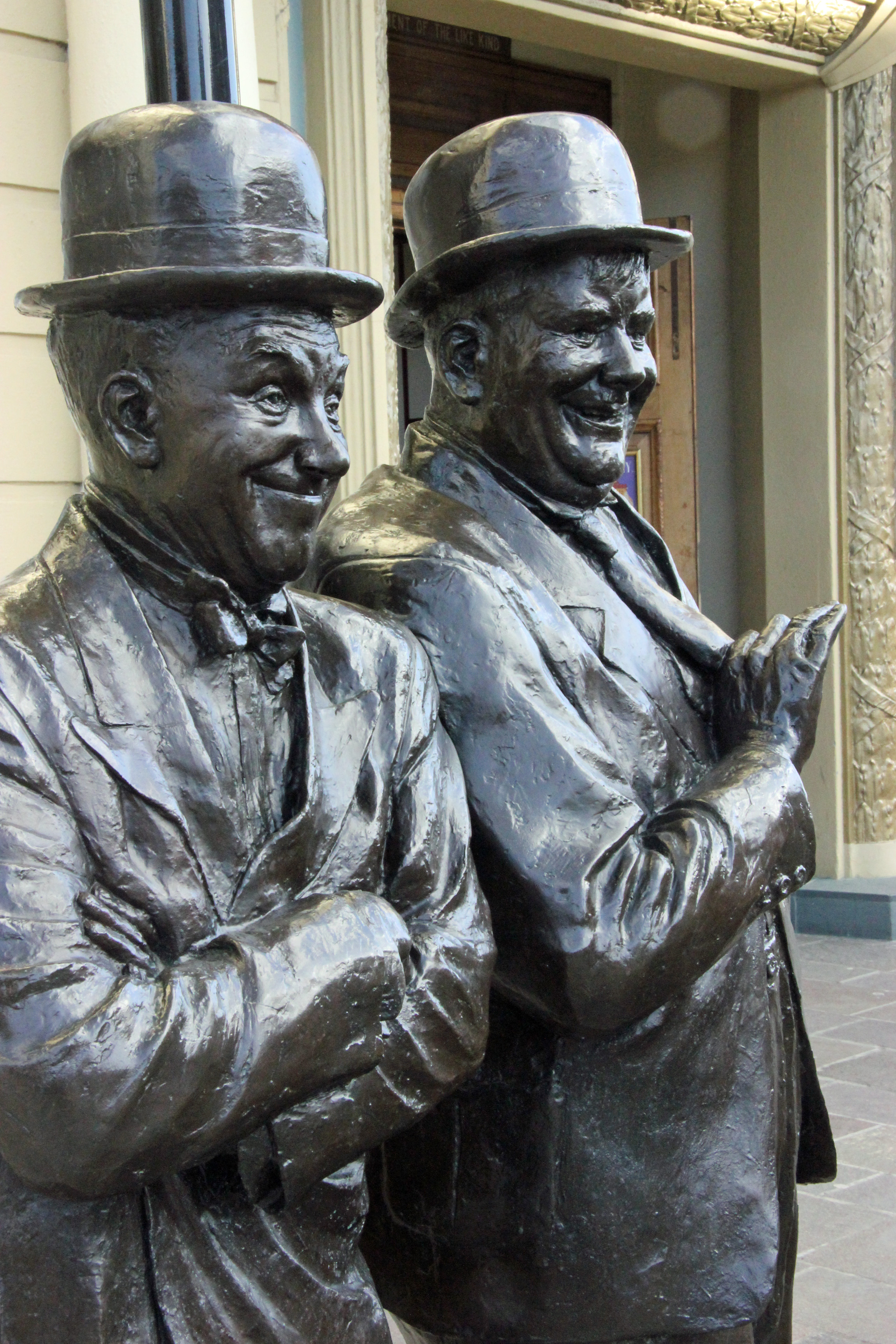
For the avoidance of doubt the two fellas above are not Steve Coogan and John C Reilly, the stars of film Stan and Ollie, nor indeed are they yer actual Stan Laurel and Oliver Hardy. No this, obviously is a statue of the comedy duo, courtesy of artist Graham Ibbesson, propped up against a lamp post outside the Coronation Hall in Ulverston near the seaside in South Lakeland, Cumbria. Where Stan Laurel was born. Pretty good likenesses you’ll warrant. Art initiating life imitating art imitating life …. you get the picture.

For imitation is what the film does best as the two lead actors turn in a couple of memorable, painstakingly detailed, turns as the beloved S&O. The story charts the return of S&O, down on their uppers, to Britain in 1953 to undertake a tour, organised by impresario Bernard Delfont (a well cast Rufus Jones). Only the boys are not offered much in the way of quality venues, (Delfont preferring the questionable comedy talents of one Norman Wisdom), so start off playing to tiny, nostalgic crowds Oop North, with Stan reassuring Ollie that, once in London, he can secure the backing for a new film script, a Robin Hood spoof, that will rehabilitate both reputation and bank balance. Word of mouth, and immortal talent, turns the tour into a massive success, and the lads are joined by wives, the devoted and fiercely protective Lucille H (the ever brilliant Shirley Henderson) and the terse Russian Ida (a pitch perfect Nina Arianda), comically hamming up their own rivalry (“two double acts for the price of one”). Cue a falling out and reconciliation when Ollie’s health takes a turn for the worse.

So cliched you could barely make it up. Except that it is true. And these are about the most lovable pair, as portrayed and in reality, that you could want to watch. There are obviously generations, my age or older, who are familiar with Laurel and Hardy from repeats on the telly. There will be other youngun’s as well, I am sure, who will have discovered them through their own volition or Mum and Dad’s reminiscing. Whatever, there was clearly going to be enough of an audience to make this film a success.

Which may also be why it is played so straight. Not straight as in lacking humour. Like I say Messrs Coogan and Reilly have the routines of S&O down to a tee. As they do when it comes to the more complex off-stage/screen personalities. Vocally and physically the resemblances are uncanny. No, it is just that the way the story is told contains next to no surprises. It isn’t mushily sentimental, but it doesn’t take any risks at all. It is cheesy, sweet and melancholic in all the right places. The two leads, director Jon S Baird and writer Jeff Pope (co-writer on Steve Coogan’s other major big screen success Philomena), all plainly, and rightly adore their subjects but a slightly less decorous tone might have paid dividends.

Still the best bits, the dolly shot opening in the Hollywood back-lot, Stan sticking it to Hal Roach (a cameo from Danny Houston), Newcastle in the rain, the “hospital sketch” repetitions (especially the exchange on Ollie’s actual sickbed), the double door routine, the ladies bitching at the reception, the venue interiors, Stan looking wistfully up at the Abbott and Costello film poster, are undoubtedly effective, laden with pathos, humour and affection. Cinematographer Laurie Rose takes much of the credit and the make-up and prosthetics of Jeremy Woodhead and Mark Coulier, turning John C Reilly into Oliver Hardy, especially in the later scenes, is remarkable.

All in all a very nice, touching and amusing film. Make of that what you will.

The Cane at the Royal Court Theatre review ***

The Cane

Royal Court Theatre, 21st January 2019

Somehow, until now, the Tourist has failed to see any of the work of Mark Ravenhill, either as writer, performer or director, or even his columns in the Guardian, surprising given the Tourist’s status as a paid up Guardianista. There was a recent revival of his breakthrough play, Shopping and Fucking, at the Lyric Hammersmith, but sadly the performance the Tourist signed up for was cancelled. (Made worse by the fact that the Tourist had gone straight to the theatre from an outing elsewhere during a period of deliberate mobile phone estrangement. It should be possible to chuck the bloody thing away, and to this day the Tourist doggedly persists without data, ring-tone or any social media, but realistically the everyday organisation of modern life prohibits a complete embargo. That, and the unhealthy compulsion to surf free wi-fi so as to rubber-neck the latest instalment in the Brexit car-crash).

Anyway the chance to see Mr Ravenhill’s latest play, after a hiatus of many years, at the ever reliable Royal Court, and its apparent subject, the education system, was not to be missed, and the SO agreed. Especially when directed by RC AD Vicky Featherstone and with a cast comprising Alun Armstrong, Maggie Steed and Nicola Walker. You will know all three off the telly, but their stage appearances are all too rare, though Maggie Steed was in the first instalment of Jamie Lloyd’s current Pinter anthology, and it was a privilege to watch Nicola Walker’s brand of nervy, restless emotional plasticity being applied to the role of Beatrice in Ivo van Hove’s A View From The Bridge.

Vicky Featherstone kicks off proceedings at a fair lick as we learn that Edward’s (Alum Armstrong) retirement as a teacher after 45 dedicated years is being disturbed by his historical engagement with capital punishment and by his school’s imminent takeover by an academy. There is a mob of kids outside Edward and Maureen’s (Maggie Steed) house and their estranged daughter Anna (Nicola Walker) has now turned up. It is a somewhat improbable set up but no matter. Mt Ravenhill uses this as a jumping off point to explore the uneasy relationship between the fretful couple and their seething daughter, how we apply the morality of the present to actions in the past, how much responsibility an individual should assume, and how much an institution, for excessive punishment and how violence and disciple become conflated, accepted and even internalised,

Within this tricky web Mark Ravenhill, using precise and considered language, cleverly shifts moral perspectives around and between the questions and the characters, sometimes even on a line by line basis. He asks a lot of questions but is never so crass as to give clear answers. There is a constant undercurrent of tension and hostility fuelled by the subject matter, and the symbolic cane, the weight of the past and the menacing family dynamic, visually realised in Chloe Lamford’s off-kilter, grim, and increasingly claustrophobic, set. The three actors are superb in the way they draw us in to this queasy moral maze. The looks they give each other, the barbs that they spit out, the arguments they advance and retreat from, the flashes of violence and acquiescence, all are expressively portrayed. However, over the unbroken 100 minutes or so, the flaws of all three characters become unremitting, the premise becomes over-stretched and just a teensy bit too slippery and the dialogue just a bit too predictably adversarial.

It made us squirm, it made us think and the acting is top notch. But this is a play that deliberately sets the audience outside its world. Fair enough but it might have worked better for us in more concentrated form, or with some eventual solid pay-off to all the rug-pulls and hypocrisy exposures.

Keep: Daniel Kitson at Battersea Arts Centre review *****

Keep, Daniel Kitson

Battersea Arts Centre, 20th January 2019

Beckett, Pinter, Stoppard, Kitson. I know, I know. He is only a stand-up comedian. So comparing him to these master explorers of the absurdity of the human condition is, to say the least, stretching it a bit. However, as those of us who have become addicted to his “story shows”, (I don’t think DK would like to think he has “fans”), as well as his “stand up”, in recent years. he is a very clever fellow, as are the chaps above, he is very funny and he delivers startling insights. Yes the conceits that underpin the structures of these stories can be as pretentious as they are inventive, and once set-up it is usually pretty easy to see where they will end up, (though the pay-off here is still worth the wait), and yes the man himself, or rather his persona, and his repeated tropes can be annoying, but when he hits it no-one comes close. And that includes many great dramatists who search for tragic-comic perfection.

In Keep he hits it. No question. The preamble, where he gives the audience a chance to excuse itself, as he describes what is coming, the threat, to read out a list of everything he owns, the diversions and repetitions which follow, the self reference, self reverence and self revelation, (now’s who’s being pretentious), the gentle provocations, the playful aphorisms, all are present and correct and all beautifully delivered. Maybe by the end the various layers become a bit too meta, and maybe, as DK himself admits the metaphor of stuff in filing cabinet for mind and self is a bit too creaky, and could be applied by anyone to anyone, but frankly I don’t care as no-one else comes close to being able to create this kind of work.

Don’t worry, there are plenty of laughs. And for those who appear to think it is too long I suggest they need to work on their attention spans. I would have taken another couple of hours no problem. Of course it meanders and digresses, it’s Kitson FFS, but, certainly not in the performances I saw, without considered effect. Love, loneliness, hope, regret, memory, agency, language, he has covered this territory before, but these are the staples of many of the modern dramatic greats including those mentioned above.

And all this for £12. It’s gone now. Don’t miss the next one.

Julia Wolfe’s Anthracite Fields at King’s Place review *****

Bang on a Can All Stars, BBC Singers, Tecwyn Evans (conductor)

Kings Place Hall One, 19th January 2019

I had heard a few snippets of Julia Wolfe’s compositions but freely admit this was a bit of a leap into the unknown. Still what I had heard seemed interesting, I was keen to take in a few of the excellent looking concerts programmed as part of the year long Venus Unwrapped season at Kings Place, focussing on women composers, and Anthracite Fields is an acclaimed work that won a Pulitzer Prize.

It is an oratorio for choir and chamber ensemble which was premiered in Philadelphia in 2014 by the Mendelssohn Club Chorus and the Bang On A Can All Stars, Julia Wolfe being on of the founders of BOAC, alongside Michael Gordon and David Lang. It is scored for bass (acoustic and electric and here played by Robert Black), keyboards (Vicky Chow), percussion (David Cossin), cello (Mariel Roberts), guitar/voice (Mark Stewart) and clarinet/bass clarinet (Ken Thomson) and, as well as the choir, also requires the services of a sound engineer (Andrew Cotton) and accompanying visuals (Jeff Sung and Don Cieslik).

The piece is a tribute to those who “persevered and endured in the Pennsylvania Anthracite coal region”. Julia Wolfe grew up in Montgomeryville, Pennsylvania which lies to the South of the coal producing region, Anthracite is the purest form of coal, was mined from the turn of the C19, and by the turn of the C20 the region was powering much of America’s heavy industry. However through the first half of C20 the region declined in importance as the reserves were exhausted and, by the 1960’s, mining had essentially ended. It plays an important role in American industrial and labour history and Ms Wolfe is not the only artist to have explored its legacy. Less than one week later, the Tourist was privileged to see another top drawer, Pulitzer Prize winning, creative work which took inspiration from near this region, Lynn Nottage’s play Sweat, based in Reading, Pennsylvania, which, over a century, turned from one of the richest to one of the poorest cities in the USA.

Julia Wolfe herself had previously addressed the plight of the American worker in Steel Hammer, her “art ballad” about the folk hero John Henry. Her text for Anthracite Fields is drawn from various sources, oral histories and interviews (including her own), local rhymes, a coal advertisement, geological descriptions, a mining accident index, a list of contemporary daily activities that use coal power and an impassioned political speech by John L Lewis, a past head of the United Mine Workers Union.

It is made up of five movements together lasting just over an hour. In Foundation, a kind of dark chorale, the choir intone the names of miners killed in accidents, but only those named John with one syllable surnames, there being so many who died. It ends with further chant of representative polysyllabic names which give a flavour of the diversity of countries from which the miners emigrated to this small corner of one State. There is also a poetic passage drawn from the geology of coal formation. Breaker Boys takes a series of nervy rhymes and an interview and describes the painful work of the Breaker Boys, children employed to sort debris from the coal as it came down the chutes from the heads of the mine-shafts. Think folk-rock. The third movement Speech takes the aforementioned John L Lewis’s powerful oratory, “if we must grind up human flesh and bones”, sung here by BOACAS veteran Mark Stewart with choral responses. Flowers is inspired by the list of flowers Barbara Powell, literally a coal-miner’s daughter, recited during an interview with Ms Wolfe. It is gentler in tone than the other movements and, over its memorable rhythmic base, the choir explores some haunting harmonies. The last movement is another list, of activities followed by a rhyme about Phoebe Snow, a fictitious NYC socialite created for an advert whose white gown was unsullied during her railway journey, so pure was the coal fuelling the engine.

Now there is nothing difficult about Julia Wolfe’s music in Anthracite Fields. Quite the reverse. It is almost alarming in its immediacy. At its core it is a minimalist work, driven by the dirge-like rhythms laid down by the various members of the ensemble, and it is not afraid of grungy rock’n’roll. There is plenty of instrumental colour and the 20 or so strong choir have plenty of opportunities to show off. Here, in the well-balanced but enclosed acoustic of Kings Place Hall One, initially at least the band had the upper hand but this seem to be corrected through the second half of Foundation, or maybe it my ears adjusting.

It packs a huge emotional punch and there is nothing subtle about its messages. Bearing all this mind, and if you are prepared to be immersed in the concept, music and projections, you are in for a treat, should this return, as it should (this was its UK premiere). I should imagine it would be even more powerful in the version for a larger choir, 150 strong. It certainly deserves a bigger audience than this though I get that this sort of fusion, which is at the core of the Bang on a Can ethos, lies a bit beyond normal musical boundaries.

Pinter at Pinter 6 review *****

Pinter at Pinter Six: Party Time and Celebration

Harold Pinter Theatre, 17th January 2019

This for me was the best off the bunch so far in the Pinter at Pinter one act play season. And proof that Jamie Lloyd is the Man when it comes to directing the menacing Master. Mind you cop this cast. John Simm, Phil Davies, Eleanor Matsuura, Celia Imrie, Katherine Kingsley, Tracy-Ann Oberman, Gary Kemp, Ron Cook and Abraham Popoola. It is something when probably the least well known on this list, Abraham Popoola, just happens to be, as anyone who saw his performances in STF’s Othello, the Bridge’s Julius Caesar and Pity will know, one of our finest young stage actors.

Jamie Lloyd has profitably emphasised the clear connection between the two plays. Both have a cast of 9 and both are centred on functions in swanky locations. Soutra Gilmour’s alternately monochrome and gaudy sets and costume designs, and Richard Howell’s sharp focus lighting, elegantly reflect this. In both cases a wealthy elite, inured to the concerns of, and detached from, wider society, bickers amongst itself. There is the usual menace, threat, misogyny, oneupmanship, bitterness, jealousy, entitlement and exaggeration that is the HP hallmark but here employed in the service of biting satire. The social class that HP is shredding may differ in each play but the message is the same.

Party Time dates from 1991 and originally premiered with the more overt political satire of Mountain Language seen in Pinter One in this season. Phil Davis’s businessman Gavin is hosting a party where the barbed chat revolves around country club membership, luxury island holidays and past affairs. John Simm’s Terry cruelly bullies his wife Dusty (Eleanor Matsuura), particularly when she mentions Jimmy, her estranged brother. The other guests are equally offensive and vapid in their various ways. Occasionally the sniping and boasting stops and a bright white light is revealed through open doors at the rear. The outside world has plunged into violent disorder, suppressed by the state, and eventually Jimmy (Abraham Popoola) stumbles through the light to deliver a poetic monologue describing this collapse.

Celebration, from 2000., sees Ron Cook’s Cockney villain/businessman (“strategy consultant” in his own words) Lambert celebrating his wedding anniversary with wife Julie (Tracey-Ann Oberman) and brother Matt (Phil Davies), and his wife Prue (Celia Imrie), who is also Julie’s sister, in a swanky restaurant. Vulpine banker Russell (John Simm) and partner Suki (Katherine Kingsley) who Lambert “knows” eventually join them. Restauranteur Richard (Gary Kemp) and Maitresse d’ Sonia (Eleanor Matsuura) alternately schmooze and patronise their ignorant, nouveau riche guests. Waiter (Abraham Popoola) “interjects” to tell tall stories about the literary circles that his grandad mixed with. Here class is the target though some rather darker themes, misogyny, misandry, incest, domestic violence, also emerge.

As elsewhere in this excellent season, the connections that run through HP’s work, and their continuing relevance, are highlighted. The divisions between an elite, defined by wealth, and the rest of society are laid bare. The callous indifference and amoral stupidity of this moneyed, brash, narcissistic class, and those who seek to emulate it, is laid bare. Materialism reigns supreme.

Of course this being Pinter there are times when you are going to fell pretty uncomfortable with some of the dialogue, but, this also being Pinter, you are also going to laugh, a lot, notably in Party Time. Whether you are laughing at, or with, the characters, or at, or with, yourself, is for you to decide.

Impossible to pick out favourites with a cast of this calibre, but if pushed, I would go for Ron Cook and Tracy-Ann Oberman. The latter does not have quite as many lines as some of her equally renowned peers but every one strikes home (it would be good to see her back in some Shakespeare) and Ron Cook is about as perfect a Pinter actor as it is possible to get. Mind you the last few times I have seen him he has pretty much stolen the show (The Children, Girl From the North Country, The Faith Healer and The Homecoming).

One more collection to go as well as the production Betrayal. Even the venerable Danny Dyer, Martin Freeman, Tom Hiddleston et al are going to have there work cut out to top this.

SoundState Festival: LPO at the Royal Festival Hall review ***

London Philharmonic Orchestra, Marin Alsop (conductor), Stewart McIlwham (piccolo), Colin Currie (percussion)

Royal Festival Hall, 16th January 2019

  • Arne Gieshoff – Burr
  • Anders Hillborg – Sound Atlas
  • Erkki-Sven Tuur – Piccolo Concerto (Solastalgia)
  • Louis Andriessen – Agamemnon
  • Helen Grime – Percussion Concerto

It is amazing what a little bit of knowledge, a dash of pretension and a fair amount of persistence can do. A few of years ago, like any right-minded, gregarious, gainfully employed individual, the Tourist wouldn’t have gone near a concert comprised solely of contemporary classical music. A minority pursuit for the culturally affected. Now I am wondering how many of the Southbank’s SoundState festival to attend. In the end I bottled it and only pitched up to this but there was plenty across this adventurous festival ,for the musically curious to get their teeth, and ears, into. Try it. What have you got to lose.

The draw here, aside from the always perky Marin Alsop on the podium and, of course, the LPO, was the Percussion Concerto from Helen Grime, written for master whacker Colin Currie, and the Louis Andriessen premiere. I also figured three Nordic composers, who I admit I had never heard of, couldn’t be a bad thing. (Though it turns out only one was actually from the region showing how little attention I was paying and the pitfalls of lazy ethnocentricity). And who would’t be tempted by a piccolo concerto.

Well it turned out that the Andriessen was as bold and brassy as expected, the Percussion Concerto will definitely require a revisit but the big surprise, for me if not the cognoscenti as he is already a big noise in their world, was Anders Hillborg’s Sound Atlas.

As Marin Alsop wryly observed her introductory interview with Arne Gieshoff was in danger of lasting longer than the piece itself. It was inspired by a wooden “burr” 3D puzzle, dates from 2014 and certainly had some spunk about it. There was an echo of Elliot Carter in the concentrated energy circling more stable “pedals”.

Estonian Erki-Sven Turr lives on an island in the Baltic Sea, (images of Nordic noir crime drama immediately pop into my head – a dull day and very windy,) and was prompted to write Solastalgia by the visible impact of climate change on his surroundings. Solastalgia is a time coined by philosopher Glenn Albrecht to describe the distress we feel when we see how the climate is changing the environment of our memory.

(Now my regular reader has probably divined that much agonising has left the Tourist in the Stoical camp, philosophically speaking. We humans will come and go, we are not special, we will have failed to hang around for very long in the scheme of things (despite thinking we are better than every other species) and the earth will get over the damage that our brash, selfish selves do. Still he can’t deny that it is pretty scary to watch how our infantile inability to defer gratification has left us f*cking up so much in my lifetime, with climate the obvious victim).

In Solastalgia the piccolo acts as the squeaky catalyst for much bigger shifts of texture and process across the orchestra.. E-S T describes his “vectorial” compositional style in the programme but I confess it is beyond me. As was frankly this work. Never mind, if you don’t try it you won’t ever know if you like it.

Sound World was commissioned by the LPO alongside the LA Phil, the NDR Elbphilharmonie and Goteborgs Symfoniker, and this was its world premiere. Now this was much more my style. Crystalline is the word used to describe its sound world and the first section, which makes sense giving the extensive use of string micro-tones and the eerie squeals of the glass harmonica, expertly played here by Philipp Marguerre. River of Glass, Vaporised Toy Pianos (!!!), Vortex and Hymn follow this first section and all accurately describe the mood and texture of the music. It is measured in tempo and there is enough relation to diatonic history to make it easy to digest. Ligeti sat on top of Romantic, Sibelian string drones.

Helen Grime, like the three composers mentioned above, had a few words to say ahead of her piece, again receiving its world premiere. For someone so talented she is remarkably modest. To be fair there wasn’t anything ground-breaking about the Concerto in terms of structure, with three movements played straight through, (Bright, Subdued/Lamenting and Fleet-footed/Mercurial), instrumentation or technique, but, if you have one of the best percussionists in the world, then you might as well turn up the virtuosity quotient, which she duly did. The outer movements were predominantly tuned percussion, marimba, glockenspiel and vibe, with the inner section largely tom-toms, bongos, cymbals and woodblocks. The best ideas came with the frenzied, semi-quaver rhythmic repetitions at the beginning and end, counterpointed with strings and with the interplay between soloist and orchestral percussion. The wobbling pitches of the middle section, like all “drum solos”, was remarkable more for CC’s skill than musical inspiration. Even so I was rapt, but then I always am by this musician. Given how excited he was it is remarkable he didn’t crash into anything as he bobbed from one side of the podium to the other.

Louis Andriessen’s Agamemnon was here also receiving its European premiere. The inspiration was The Iliad and LA helpfully lays out the Dramatic Personae to include homo-erotic warrior Achilles, defecting bird-watcher Kalchas, the hapless, wind sacrifice Iphigenia and best-served-cold vengeful wife Klytaimnestra, as well as the brutal Mycenaen king himself. I must admit to being a little suspicious of this conceit especially when I saw that LA had pimped up his orchestra with a couple of pianos, a sax, electric and bass guitar and a drum kit. Well, as is always the case with this veteran composer, I should not have worried. The characters do not appear in programmatic sequence, except at the end, when Kassandra, she of the prophecies, steps ups with text from Aeschylus, via Ted Hughes, and here voiced by woodwind Principal Sue Bohling. Instead the colour and tone of the various episodes in the 20 minute piece indicates the various mortals of the story. War and terror are audible, this is Greek tragedy after all, but there are softer, more lyrical passages, notably for oboe and sax. There isn’t too much of the LA post-minimalism with which I am more familiar, though there are echoes of ancient musical structures a la his classic De Staat, but there are jazz infections and syncopated percussion. A kind of post-modern tone poem/film score if you will.

It was a lot to take in but there was more than enough that warrants further examination and would be surprised if any of these pieces fail to get a further outing in years to come. The hall wasn’t full but it was busier than I have seen for many a more traditional programme. That perhaps speaks to the esteem in which Marin Alsop is held. Many a conductor talks a good game when it comes to new music: she, and the LPO, were prepared to put in the hard yards to make it happen. There were certainly four happy looking and grateful composers on stage.

Approaching Empty at the Kiln Theatre review ***

Approaching Empty

Kiln Theatre, 16th January 2019

An overly optimistic faith, despite a welter of evidence to the contrary, in the combined efforts of South Western Railway and Network Rail’s ability to convey passengers to the stated destination on time meant that the Tourist pitched up late for this showing. So he had to watch the set up in Ishy Din’s new play on one of those little black and white TV screens that theatres provide for latecomers (and production crew obviously) where the sound is reedy thin and where the lighting comes across like a molten sun on stage. Not the first time either. Please make sure you never take the Tourist’s casual attitude to pre-performance timekeeping.

Anyway it is April 2013 and we are in a minicab office in Middlesborough. Mansha is marshalling the cabs through a mic whilst bored twenty-something Shazad is phonearsing (this being my all-encompassing term for texting/browsing/Instagramming/WhatsApping/taking selfies/looking at cats/admiring themselves/trolling/dying a small death at the fake success of others/Candy Crushing and whatever else it is you people do on your phones). The telly in the background pipes up with coverage of Mrs Thatcher’s funeral. Raf enters, coughing.

Now it transpires that sharp Raf is the owner of Kings Cars, Shazad is his vague son, supposedly learning the ropes, and Mansha is Raf’s mate from way back, and manager of the cab office. We hear from feisty Sameena, a new driver, who comes back to the office, as does the gullible Sully, Mansha’s son in law, and we hear talk of Sameena’s younger brother Tony, who plays a pivotal role at the end. From these characters Ishy Din builds a story of a friendship, missed opportunities, family ties and a double-crossing all wrapped up in a critique of neo-liberal economics (with Mansha and Raf’s different takes on Thatcher’s legacy being the catalyst). Mr Din was himself a taxi-driver in this very city, and the dialogue rings true and the sympathetic characters arrive fully formed. The problem is the somewhat lumbering plot and telegraphed reveals. It is not a bad story, quite the reverse, but in his haste to crank it up the playwright smothers the interchanges between his characters, which is where the play is most affecting. Less might well have been more.

As it is we do take away how Mansha and Raf, as first generation Pakistani immigrants, have gone from hard, but dignified, graft in the factory, to a more precarious existence in the service economy, and how many, and not just in this community (the intention was to write a drama which could equally well be set elsewhere in “left-behind”, post-industrial Britain), end up skirting the law in some way. Rosa Maggiore set looks the part and Pooja Ghal’s direction is supportive of people, place and message. Kammy Darweish as Mansha is the epitome of careworn decency and Nicholas Khan as Raf neatly treads the line between arrogant, shifty and desperate. I will look out again for Karan Gill who impressed as Shazad. I have seen Rina Fatania (Sameena) and Nicholas Prasad (Sully) so was not surprised by the way they end humour out of their characters. Maanuv Thiara was left to do what he could with textbook thug Tany.

This is the second of a proposed trilogy about Asian men in Britain, with theatre company Tamasha, following his debut Snookered from 2012. Ishy Din came late to the scriptwriting game but it’s pretty easy to see he has the ear. The last play will focus on men who leave families to work here with the intention of returning “home”. I will look out for that and for his earlier work. Whilst Approaching Empty, in its dissection of a community whose bonds are fracturing under the stress of financialised capitalism, doesn’t quite scale the heights of, say, Sweat at the Donmar, it is definitely worth seeing, and when Mr Din reins in his desire for action, slows it all down and focuses on family and faith, he is going to write a classic.