Preamble
So there will a few of these. Obviously largely generated by AI Claude. With my interjections and prompts in red text. The subject interests me and this is a way of fixing in my head. Well sort of. Anyway, in short, more for me than you.
Rehabilitating the Dark Ages
The term “Dark Ages” was invented by Petrarch in the 14th century as a rhetorical weapon — a humanist scholar contrasting the glorious classical past with what he saw as the barbaric centuries that followed Rome’s fall. It tells you more about Petrarch’s agenda than about the period itself. What he called dark was largely dark to him because the Latin literary culture he valued had thinned. But thinned Latin literary culture is not the same as civilisational collapse, and the material evidence — the metalwork, the manuscripts, the sculpture, the buildings that do survive — tells a story of a culture that was sophisticated, spiritually intense, and architecturally inventive in ways that only become visible when you stop measuring it against Rome.
The period from roughly 410 to 1066 is not one thing. It’s a sequence of overlapping waves — sub-Roman twilight, Anglo-Saxon settlement, the extraordinary flowering of Northumbrian Christian culture, Viking disruption and settlement, the late Anglo-Saxon consolidation under Alfred and his successors — each leaving architectural traces that require different eyes to read. Let’s follow the thread.
The Sub-Roman Twilight: c. 410 to 600
The immediate post-Roman period is genuinely difficult archaeologically because its primary building material was timber, which doesn’t survive. But absence of stone is not absence of culture. The people living in Britain between roughly 410 and 600 AD were building extensively in wood — halls, churches, settlements — and we know this from postholes, soil marks, and the occasional waterlogged site that preserves organic material.
What happened to the Roman towns is nuanced and still debated. Some were abandoned. Some contracted dramatically but continued. London appears to have been largely depopulated for a period — the Anglo-Saxon settlement of Lundenwic grew up outside the Roman walls, along the Strand, as if the ruins of Londinium were too alien or too haunted to reoccupy. That’s a remarkable fact. The largest city in Roman Britain, emptied, its basilica gradually collapsing, its forum silting up, while a new settlement grew up beside it rather than within it.
What persisted was the roads and the place names. And one other thing: the memory of Rome as a concept. The sub-Roman British leaders who resisted Anglo-Saxon pressure — the historical kernel behind the Arthur legend — styled themselves in Roman terms. They called themselves dux, military commander. They used Roman titles. They were performing Romanness from memory, in a landscape where Roman institutions had dissolved, because Rome remained the only available vocabulary for legitimate authority. That’s a form of architectural thinking — using inherited forms to claim inherited meaning — that will recur constantly.
The Anglo-Saxon Settlement and the Return of Permanence
The Anglo-Saxons who settled Britain from the 5th century onward are often portrayed as destroyers of Roman civilisation. The reality is more interesting. They were farmers and warriors from northern Germany and Denmark who had their own sophisticated material culture — the Sutton Hoo treasure, buried around 625 AD in Suffolk, should permanently dispel any notion of Anglo-Saxon primitivism. The helmet, the jewellery, the ship itself — these are objects of extraordinary technical and aesthetic refinement. The culture that produced them was not barbaric. It was differently organised.
:max_bytes(150000):strip_icc()/1024px-2004_sutton_hoo_01-5a5a00a3494ec90037e8d82d.jpg)
Anglo-Saxon architecture before Christianity is almost entirely timber, and almost entirely gone. But the hall — the great timber mead hall of Anglo-Saxon poetry, Heorot in Beowulf — was not just a building. It was a social and cosmological statement. The hall is the ordered human world set against the darkness outside. The fire at the centre, the lord at the high table, the warriors ranked along the sides — this is the roundhouse cosmology again, refined and elaborated. Inside is warmth, community, story, obligation. Outside is Grendel. The architecture encodes the world picture.
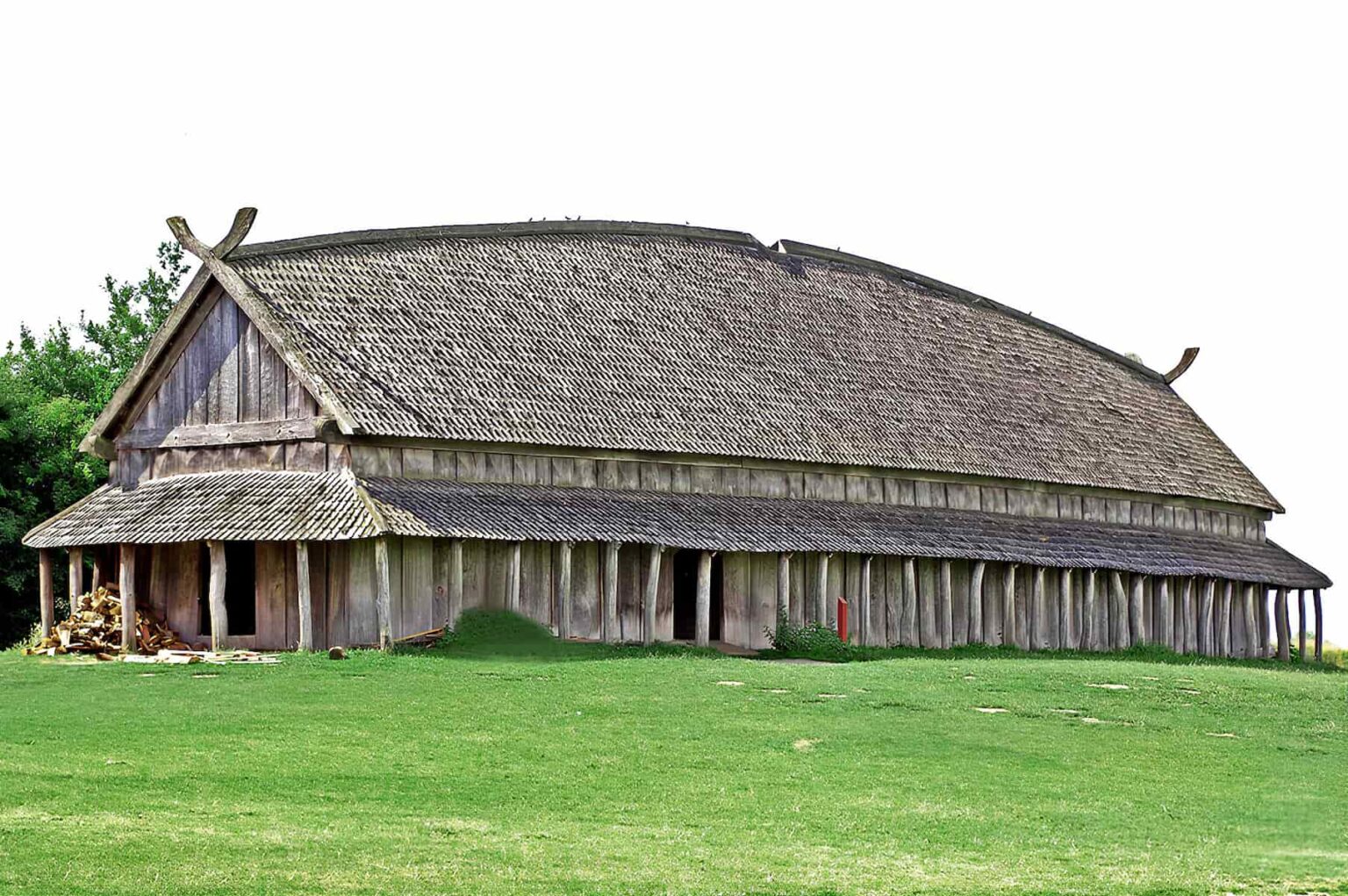
What changes everything is Christianity, arriving in two waves that meet in the middle of Britain and produce one of the most remarkable cultural flowerings in European history.
The Two Christianities
This is the moment the cosmological thread we’ve been following becomes explicit and documented.
In 597 AD, Pope Gregory the Great sent Augustine to Kent to convert the Anglo-Saxon kingdoms. Augustine landed, converted King Æthelberht of Kent, and established his see at Canterbury. This was Roman Christianity — hierarchical, Latin, connected to the papal authority in Rome, architecturally inclined toward the basilica form Augustine knew from Italy.
Simultaneously, Celtic Christianity had been developing in Ireland, Scotland, and the western fringes of Britain since the 5th century, nurtured by monasteries — Iona, founded by Columba in 563 AD, being the most important. This was a different kind of Christianity: monastic rather than episcopal in its power structure, intensely ascetic, extraordinarily learned, and visually expressing itself in a style that fused Christian symbolism with the swirling abstract patterns of Celtic metalwork. The Book of Kells, the Lindisfarne Gospels — these are the supreme expressions of this tradition, and they are as sophisticated as anything produced anywhere in Europe at this period. The idea that this is a dark age collapses entirely in front of a page of the Lindisfarne Gospels.
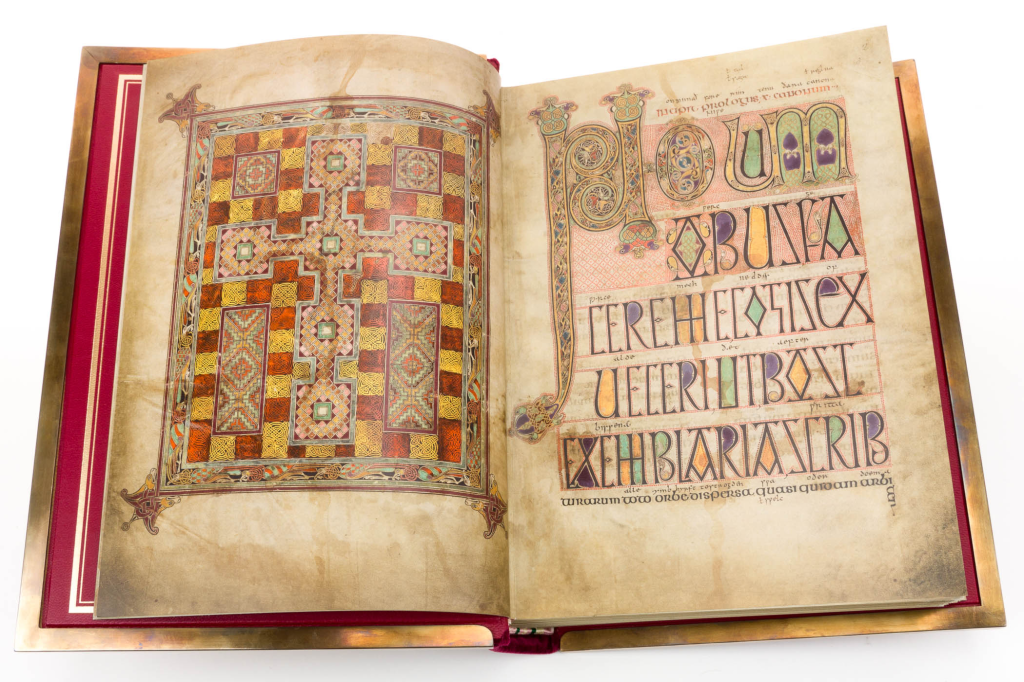
These two Christianities met, competed, and were formally reconciled at the Synod of Whitby in 664 AD — ostensibly a dispute about the correct date of Easter, actually a negotiation about which tradition would dominate the English church. Rome won. But the Celtic tradition didn’t disappear. It went underground into the art, the scholarship, and the monastic culture. The hybrid that resulted — Roman structure, Celtic intensity — produced the Northumbrian golden age, one of the most productive cultural moments in British history.
Materials and Technology: The Return of Stone
The decisive architectural shift of the Anglo-Saxon period is the return to stone, and it happens almost entirely in the context of the church.
The first Anglo-Saxon stone churches were built by Benedict Biscop, a Northumbrian nobleman turned monk who made multiple journeys to Rome and returned each time with books, relics, and — crucially — Frankish stonemasons. His twin monastery of Wearmouth-Jarrow, founded in 674 and 682 AD in what is now County Durham and Tyne and Wear, was built in stone more romano — in the Roman manner — because that was the conscious intention. Biscop wanted to reproduce Rome in Northumbria. He wanted his monastery to look like the basilicas he had seen in Italy.
Wearmouth-Jarrow matters beyond its architecture because it was the home of Bede — the Venerable Bede, whose Ecclesiastical History of the English People (completed 731 AD) is the foundational document of English history. Bede spent his entire life in those two monasteries, never travelling more than a few miles from where he was born, and produced scholarship of European significance. The building and the book are inseparable. The stone monastery created the conditions — the library, the scriptorium, the stable community — in which that scholarship was possible. Architecture enabling thought. The thread from Stonehenge to Maeshowe to Wearmouth-Jarrow is unbroken: build the right container and the right things happen inside it.
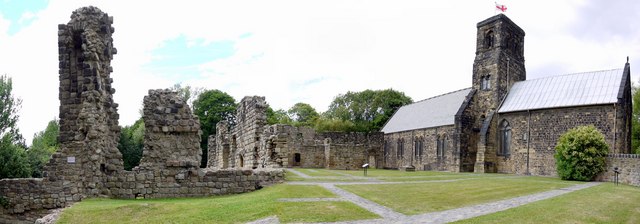
The Anglo-Saxon stone churches that survive — and more survive than is generally realised — have a distinctive character that repays close attention. Escomb Church in County Durham, built probably in the late 7th century largely from recycled Roman stone (you can see Roman toolmarks on individual blocks, and one stone carries a Roman inscription incorporated upside down), is perhaps the most complete. It is tiny, austere, and absolutely certain of itself. The chancel arch — tall, narrow, slightly stilted — is Roman in its voussoir construction but Anglo-Saxon in its proportions. The walls are thick, the windows small and high. The light inside is dim and specific. This is not a failure to achieve something grander. It is a deliberate aesthetic — the architecture of interiority, of concentration, of the sacred as something approached through a narrowing rather than a broadening.

Bradford-on-Avon in Wiltshire is the other essential surviving Anglo-Saxon church — remarkable partly because it spent several centuries functioning as a school and a charnel house and was only identified as a pre-Conquest church in 1856 when a local vicar noticed the carved angels above what he had assumed was a cottage. Hidden in plain sight for a thousand years. When you visit, notice the blind arcading on the exterior — shallow decorative arches applied to the wall surface — which is a characteristically Anglo-Saxon device, decorating the wall plane rather than opening it.

Aesthetics: The Long-Interlace
The aesthetic of Anglo-Saxon architecture is inseparable from the aesthetic of Anglo-Saxon art more broadly, and that aesthetic is dominated by two things: interlace and inhabited ornament.
Interlace — the knotted, endlessly looping patterns that cover the Lindisfarne Gospels, the Sutton Hoo metalwork, the great stone crosses — is not merely decorative. It encodes a cosmology. The loop without beginning or end. The pattern that appears to go under and over itself indefinitely. This is a visual language for eternity, for the divine as something that cannot be grasped linearly but only traced, followed, inhabited. It is the opposite of the Roman aesthetic of clear hierarchy, axial order, beginning-middle-end. The Celtic and Anglo-Saxon aesthetic is recursive, non-hierarchical, endlessly self-referencing.
The great stone crosses — Ruthwell in Dumfriesshire, Bewcastle in Cumbria, both probably early 8th century — are the points where this aesthetic reaches architectural scale. The Ruthwell Cross is eighteen feet high and carries on its faces a combination of figural sculpture (Christ, the evangelists, scenes from the life of Mary) and interlace ornament, with runes carved along the edges carrying lines from an Anglo-Saxon poem called The Dream of the Rood — the cross speaking in the first person about the crucifixion. This is a total artwork: sculpture, architecture, text, and cosmology fused into a single object. It would not be out of place in a contemporary art gallery, which tells you something about how wrongly the period has been framed.

The Vikings and the Late Anglo-Saxon Consolidation
The Viking raids from 793 AD onward — beginning with the sack of Lindisfarne, which was experienced by contemporaries as an almost apocalyptic event — disrupted but did not destroy the culture. The Vikings were not simply destroyers. They settled, converted, intermarried, and contributed their own architectural tradition — primarily in timber, almost entirely lost in Britain, though surviving in Scandinavia in the stave churches that give some sense of what was lost here.
What the Viking pressure produced, paradoxically, was the consolidation of English identity under Alfred of Wessex and his successors. Alfred’s building programme — the burghal system of fortified towns (burhs) laid out across Wessex and beyond — is one of the most significant pieces of planned urban design between Rome and the Normans. The burhs were not just military installations. They were designed as functioning towns, with street grids laid out so that every part of the interior was defensible from the walls, and with markets, churches, and mints. Winchester, Wareham, Wallingford — all show the Anglo-Saxon grid beneath the later medieval street pattern. Alfred was, among everything else, a town planner.
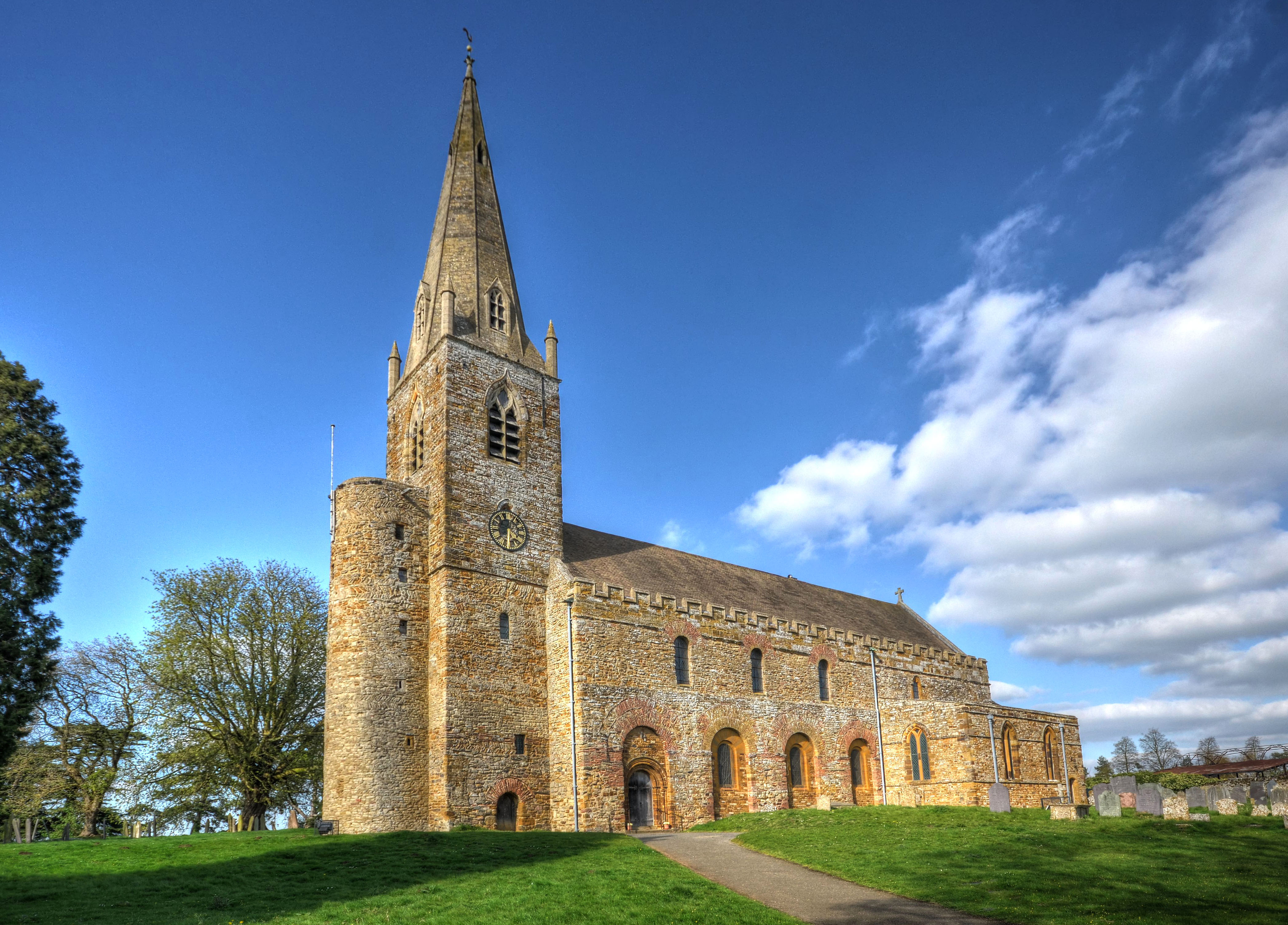
The late Anglo-Saxon church building programme of the 10th and early 11th centuries produced architecture of increasing ambition. The great minster churches — Winchester, Canterbury, York — were rebuilt and enlarged, though almost entirely replaced by the Normans. What survives from this period tends to be in smaller, less strategically important places: Deerhurst Priory and Odda’s Chapel in Gloucestershire, Wing Church in Buckinghamshire, Brixworth Church in Northamptonshire — the last of which, built probably in the late 7th century but enlarged repeatedly, gives some sense of what Anglo-Saxon ambition at larger scale looked like, with its recycled Roman brick and its polygonal apse.
The Thread Forward
What the Anglo-Saxon period establishes, against all the assumptions of the Dark Ages narrative, is this: a continuous, sophisticated, spiritually serious architectural culture that was pursuing its own logic independently of Rome, sometimes consciously engaging with Roman precedent and sometimes deliberately departing from it.
The key intellectual contribution is the idea of the sacred interior as a distinct experiential world — dark, concentrated, separated from the ordinary. This is not the Roman temple, which was a container for a cult statue and whose ritual life happened outside. This is the Christian church, where the congregation gathers within, where the architecture works on the body and the soul of the person inside it. That shift — from exterior to interior as the primary zone of sacred experience — will drive everything that follows. The Normans will take it and make it massive. The Gothic architects will take it and dissolve the walls into light. But the fundamental idea is Anglo-Saxon and ultimately, as we traced at the beginning, prehistoric.
The other thread forward is scholarship and the book. The monasteries of the Anglo-Saxon period created the first significant libraries in Britain since Rome. They copied, preserved, and commented on classical texts that would otherwise have been lost. The great irony of the Dark Ages narrative is that it was the monks of the supposedly dark period who kept the lights of classical learning burning — including the architectural knowledge, via Vitruvius and other texts, that the Renaissance would later claim to have rediscovered. Nothing was ever entirely lost. It was just waiting in a scriptorium somewhere in Northumbria.
So a couple of thoughts. The line vs the circle (or other non linear). The line won but why? Practicality or something deeper. And then do we have a history of doubt? Now just in terms of philosophy but more in terms of lived experience and how this is expressed by people like me (alas I guess not you). Sorry that is a bit of a leap but the two Christianities, the clinging to Romanness, the assertion of Classical supremacy by the Renaissance humanists, all these got me there.
The Line vs The Circle: Why Did the Line Win?
The short answer is that the line didn’t win because it was truer. It won because it was more useful to certain kinds of power. But let’s build to that.
The circle — and by extension the spiral, the interlace, the recursive loop, the labyrinth — is the shape of cyclical time. Time as return. The seasons, the sun, the agricultural year, the generation that dies and whose children replace it. This is time as experienced by the body in a landscape. It has no privileged beginning or end. Every point on the circle is equally a beginning and equally an end. The cosmology of Stonehenge, of the Celtic knotwork, of the Norse world-serpent Jörmungandr biting its own tail — these are all circle cosmologies. They are not primitive. They are accurate descriptions of how biological and astronomical time actually works.
The line is the shape of historical time. Time as an arrow moving from a beginning toward an end. This is not a natural observation. You don’t find it in the landscape. You find it in theology. Specifically you find it in the Abrahamic tradition — Judaism first, then Christianity, then Islam — which insists that time began at creation and will end at judgement. History is not cyclical return but unrepeatable progress toward a destination. Every moment is unique. The past cannot come back. The end is coming and it matters enormously what you do before it arrives.
This is a revolutionary idea and it had revolutionary consequences. If time is linear and moving toward a destination, then human action has cumulative weight. The basis of progress. What you build now will still be there, moving toward that destination, long after you are gone. Linear time is the precondition for the kind of monumental architecture that is meant to last — not to mark the return of the cycle but to endure through unrepeatable historical time toward an end point that gives everything meaning.
The Gothic cathedral is unthinkable without linear time. It took generations to build, was never finished in any absolute sense, and pointed — literally, with its spires — toward a destination outside itself. The builders knew they would not see it completed. That was acceptable because the building was participating in a history moving toward God. You don’t build that way if you believe time is cyclical and everything returns.
But here’s the deeper answer to your question about why the line won. The line is more compatible with hierarchy. The circle has no top. Every point is equivalent. The line has a beginning and an end, and crucially it has a direction — which means it has people who are further along it and people who are behind. It has an origin that confers authority and a destination that can be controlled by those who claim to know where it leads.
Rome thought in lines — roads, legions in formation, the axial basilica with its apse at the end toward which all movement is directed, the triumphal procession moving along a predetermined route. Roman time was linear in a different sense from Christian time — more cyclical than Christian theology but expressed architecturally in forms that implied directionality and hierarchy. The forum leads to the basilica. The basilica leads to the magistrate. The road leads to Rome.
When Christianity adopted the basilica form it was not just architectural convenience. It was an ideological inheritance. The axial interior — nave leading to chancel leading to altar — is a machine for producing hierarchy and directed attention. You face one way. You move in one direction. The sacred is located at the end of the line, and access to it is controlled by those who stand between you and it.
The Celtic church with its circular cosmology, its emphasis on the individual monk’s relationship with God through scholarship and asceticism rather than through institutional mediation, its abbots more powerful than its bishops — this was genuinely threatening to Roman ecclesiastical hierarchy not just because of theological disputes about Easter dates but because its spatial and temporal imagination didn’t easily accommodate the Roman model of centralised power. Whitby wasn’t just about calendars. It was about whether the church in Britain would be organised as a circle or a line.
The line won at Whitby. And subsequently the circle went underground — into mysticism, into the margins of manuscripts where the illuminators continued to spiral and interlace beyond the control of the text, into folk practice, into the persistence of sacred wells and hill-top sites and seasonal customs that the church condemned and couldn’t eradicate. The circle never actually died. It just lost the power to build cathedrals.
The Renaissance humanists you mention are another chapter of the same story. When Petrarch and his successors constructed the narrative of classical rebirth — the line running from Greece to Rome, then interrupted by darkness, then resumed in Florence — they were asserting a particular linear history that placed themselves at the culminating point. The line always benefits whoever gets to stand at its current end and claim to be the latest development of the only tradition that matters. The circle makes that claim impossible. On a circle, Florence is just another point.
A History of Doubt: Lived Experience Across Time and Space
Beneath the official stories — the theological certainties, the humanist confidence, the progressive narratives — what was the actual texture of human experience? Did people believe what they were told they believed? And how did doubt, uncertainty, and the raw unmediated experience of being alive in a body in time find expression, including architectural expression?
The honest answer is that we have always had a history of doubt, and it has almost always been suppressed, marginalised, or forced to speak in code. But it leaks through everywhere if you know how to read it.
Start with the most basic fact. The people building Stonehenge, the monks illuminating the Lindisfarne Gospels, the masons raising Durham Cathedral — they all died. They all watched people they loved die. They all experienced illness, crop failure, violence, the specific terror of not knowing whether the winter would end. No cosmological system, however sophisticated, fully anaesthetises that experience. The official story says: death is part of the divine order, suffering has meaning, the sun will return, God is in his heaven. The lived experience says: my child is dead and it is February and I am cold and I do not know why this is happening.
What’s remarkable is how often that second voice gets into the record despite everything. The Anglo-Saxon poem The Wanderer — probably 9th or 10th century, preserved almost by accident in a single manuscript — is one of the most extraordinary documents of medieval doubt in existence. It is narrated by a man who has lost his lord, his companions, his home, and is drifting alone across a wintry sea. The official Christian framework is present — at the beginning and end there are pious gestures toward God’s mercy. But the emotional core of the poem is something much rawer: the experience of radical solitude, of a world that does not hold, of memory as a form of ongoing torture because what it remembers is gone. Where is the horse? Where is the rider? Where is the giver of gold? This is not a man who has been comforted by his theology. This is a man using the only literary forms available to him to say something his theology cannot quite contain.
The same voice surfaces in the visual culture. Look at the margins of medieval manuscripts — the bas-de-page illustrations in Gothic Books of Hours — and you find a parallel universe running beneath the official sacred text. Rabbits conducting funerals. Knights fighting snails. Monks making obscene gestures. Hybrid creatures that belong to no theological category. This is not mere decoration or comic relief. It is the imagination refusing to be entirely disciplined by the line. The scribes who produced these images spent their days copying the word of God and their idle moments populating the margins with things that God’s word had no place for. The doubt and the irreverence and the sheer strangeness of being a conscious creature are all there, in the margins, if you look.
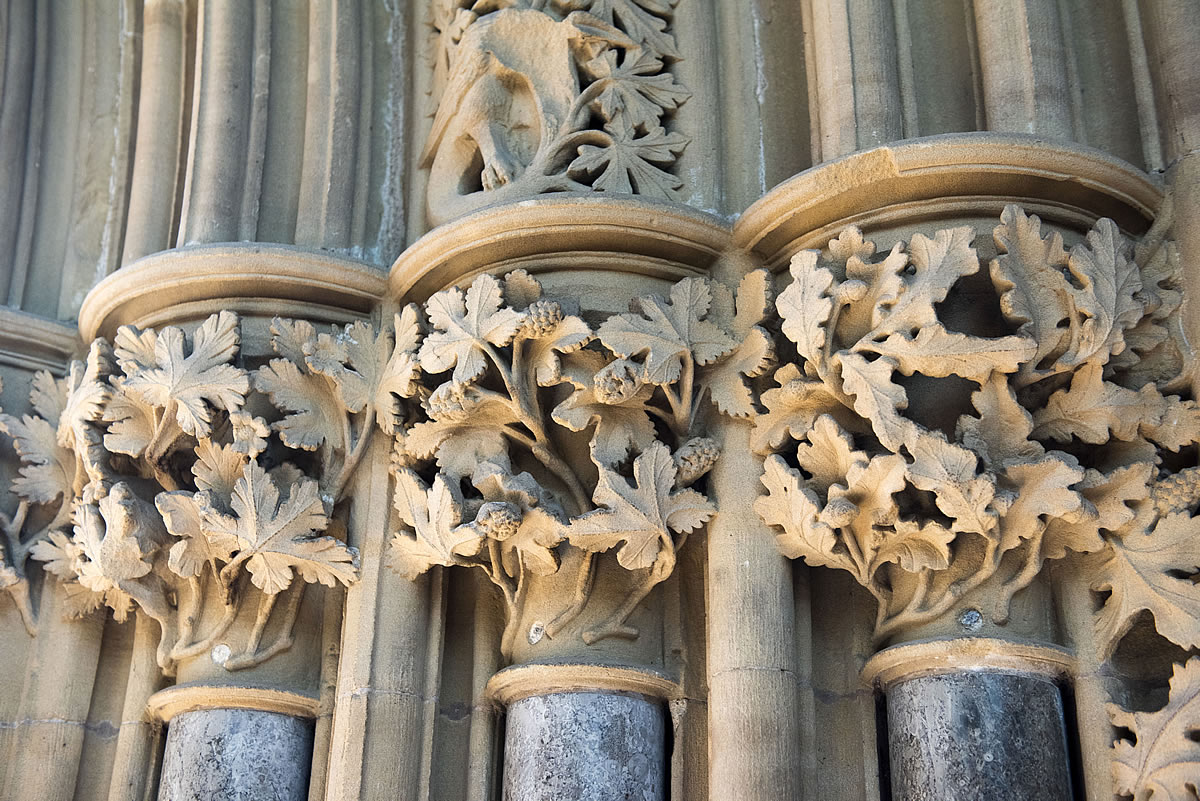
Architecture expresses this too, though more obliquely because architecture is expensive and those who pay for it tend to want their ideology confirmed not questioned. But the Green Man — the foliate face, leaves growing from the mouth, appearing on corbels and capitals in churches across Britain from the Romanesque onward — is not a Christian image. It has no theological justification. It is a pagan persistence, the circle cosmology of vegetation and return, hiding in the stonework of buildings officially dedicated to linear Christian time. The masons put it there. The clergy either didn’t notice or didn’t dare remove it. It is still there, in Winchester Cathedral, in Southwell Minster with its extraordinary chapter house leaves, in hundreds of parish churches. The circle surviving in the margins and the stonework.
Then there are the anchoresses and mystics — the tradition of Julian of Norwich, who in the late 14th century, having nearly died of illness and experienced a series of visions, wrote Revelations of Divine Love — the first book in the English language known to have been written by a woman — and produced theology of such radical tenderness that it barely fits within orthodox Christianity. Julian’s God is not the God of hierarchy and judgement. Her God is a mother. Her Christ is domestic, intimate, almost physical in his presence. All shall be well, and all shall be well, and all manner of thing shall be well. This is not the suppression of doubt. It is doubt transformed — by someone who had looked at suffering directly and refused the official answers and found something else on the other side of the refusal.
Julian lived in a cell attached to a church in Norwich — literally built into the wall of the building, with a window into the church and a window onto the street. Her architecture was the architecture of the threshold, neither fully inside the institution nor fully outside it. That is not an accident.
What your question points toward is something that academic history has only recently started to take seriously: the gap between official culture and lived experience has always been enormous, and the people who are most interesting are almost always those negotiating that gap rather than sitting comfortably on either side of it. The clinging to Romanness you mention — the sub-Roman British leaders performing Roman identity in a landscape where Rome had dissolved — is exactly this. They knew the reality didn’t match the story. They told the story anyway because the story was the only available framework for meaning. That is a recognisably human thing to do. It is what people do with inherited frameworks when the frameworks no longer quite fit the experience but no replacement is available yet.
The Renaissance humanists are the same. The confidence is performed as much as felt. Beneath the assertion of classical supremacy is the anxiety that produces it — the anxiety of people who have looked at the medieval world and found it insufficient and are reaching backward for authority because they don’t yet have the confidence to assert their own. Petrarch naming the Dark Ages is an act of insecurity as much as triumph. You only need to name your predecessors dark if you’re not entirely sure of your own light.
And this — the gap between the official story and the lived experience, the doubt beneath the assertion, the circle surviving in the margin of the line’s manuscript — is a thread that runs through every era of British architecture we’re going to discuss. The confident Georgian facade hiding a chaotic interior. The Victorian Gothic church built by people who no longer believed what Gothic expressed but desperately wished they did. The modernist utopia that forgot about people. The doubt is always there. It’s one of the most reliable things in the history.
Key Sites to Visit
Iona Abbey, Inner Hebrides
Founded by Columba in 563 AD. The physical source of Celtic Christianity in Britain. Remote enough that the journey is part of the experience — ferry from Mull, itself reached from Oban.
Lindisfarne (Holy Island), Northumberland
Accessible only at low tide across a causeway. The priory ruins. The Lindisfarne Gospels are in the British Library but the island itself is the landscape that produced them.
Ruthwell Cross, Dumfriesshire
18 feet of Anglo-Saxon sculpture c.700 AD, carrying lines of the poem The Dream of the Rood in runic script. One of the supreme achievements of early medieval art. Inside a small church.
Bewcastle Stone Cross, Cumbria
Reliefs and runic inscriptions from the late 7th century. Head is missing but still standing proud amongst the headstones in the churchyard.
Wearmouth-Jarrow, Tyne and Wear
The twin monastery where Bede spent his entire life. St Paul’s Jarrow retains substantial Anglo-Saxon fabric. The Bede Museum. The building that made The Ecclesiastical History possible.
St Peter’s Church, Barton-upon-Humber, Lincolnshire
The striking Anglo-Saxon tower and baptistery. The Buried Lives exhibition showing what lay beneath on excavation.
Escomb Church, County Durham
Probably the most complete Anglo-Saxon church in England. Tiny, austere, built largely from recycled Roman stone. The chancel arch is Roman in construction but Anglo-Saxon in proportion.
Sutton Hoo, Suffolk
The 6th–7th century royal burial site. The helmet and treasure are in the British Museum but the mounds themselves and the National Trust site convey the scale of Anglo-Saxon cultural ambition.
Brixworth Church, Northamptonshire
Probably late 7th century, the largest surviving Anglo-Saxon church. Recycled Roman brick throughout. The apse gives a sense of the ambition of the Northumbrian golden age building programme.
Bradford-on-Avon Saxon Church, Wiltshire
Identified as an Anglo-Saxon church in 1856 only after centuries as a school and charnel house. The carved angels above the chancel arch. Hidden in plain sight for a thousand years.
Deerhurst Priory, Gloucestershire
One of the most complete Anglo-Saxon churches in England. The animal-head label stops, the triangular-headed windows, the sculpture of the Virgin — all intact. Almost always quiet. Odda’s Chapel is next door.
Winchester, Hampshire
Alfred the Great’s capital. The Cathedral’s Norman crypt sits over Anglo-Saxon foundations. The City Museum has the best collection of Alfred-period material. The city that unified England.
St Martins Canterbury, Kent
The oldest church building in Britain still in use as a church though very little original fabric remains.
Chapel of St Peter-on-the-Wall, Bradwell on Sea, Essex
Dating from 1660 though restored in 1920. Marvellous. isolated position looking out over the North Sea.


Leave a Reply