Preamble
So there will a few of these. Obviously largely generated by AI Claude. With my interjections and prompts in red text. The subject interests me and this is a way of fixing in my head. Well sort of. Anyway, in short, more for me than you.
Building as Power
The Normans arrive — 1066 and the most concentrated and dramatic building programme Britain has ever seen. In the space of roughly fifty years, the Normans constructed cathedrals, castles, and parish churches across the entire country on a scale that still shapes the landscape. They were building an argument in stone, and the argument was about power. But it’s also the moment when British architecture rejoins the mainstream of European architectural development and the great adventure of the Romanesque and then the Gothic begins.
The Norman Paradox
The Normans were Norsemen — Viking settlers who had taken a chunk of northern France in 911 AD, converted to Christianity, learned French, absorbed Frankish culture with the same promiscuous speed that the Romans had absorbed everything they conquered, and within four or five generations had produced one of the most militarily aggressive and culturally voracious aristocracies in European history. This is important. They were not a ancient settled people expressing a deep cultural tradition. They were newcomers, recently arrived, still in the process of becoming something, and that incompleteness was their engine. They had everything to prove and the energy of people who know it.
By the 11th century they were operating simultaneously on multiple frontiers. William conquering England in 1066. Robert de Hauteville and his brothers carving out a kingdom in southern Italy and Sicily — taking it from the Byzantines and the Arabs between roughly 1060 and 1090. The same generation, the same families, the same restless acquisitive intelligence, producing radically different architectural results depending on what they found when they got there.
That difference is everything.
Why Sicily Got the Beautiful One
When the Normans arrived in Sicily they encountered a functioning, sophisticated, three-way civilisation. The island had been Arab for two centuries — the Arabs had brought irrigation, agriculture, silk production, mathematics, astronomy, and an architectural tradition of extraordinary refinement. Beneath the Arab layer was a Byzantine Christian culture, still present in the monasteries and the Greek-speaking communities of the interior. And beneath that, Roman and Greek foundations going back to antiquity. Sicily in 1060 was arguably the most culturally complex place in the western Mediterranean.
The Norman response — and this is where they reveal their essential character — was not to destroy this complexity but to rule it. Roger I and his successors made a calculated decision to govern through existing structures, to employ Arab administrators, to retain Byzantine craftsmen, to worship in churches where the liturgy might be Latin but the mosaics were Byzantine Greek and the ceiling was carved by Arab craftsmen in the muqarnas style of Islamic woodwork.
The Palatine Chapel in Palermo is the supreme expression of this. Built by Roger II, consecrated in 1143, it has a Latin basilica plan, Byzantine mosaics of overwhelming richness covering every surface, and an Arab muqarnas ceiling of stalactite-like carved wood that is one of the most beautiful things made in the medieval world. The inscription dedicating it is in Latin, Greek, and Arabic. This is not syncretism as compromise. It is syncretism as assertion — the Norman king demonstrating that he rules a world large enough to contain all of these traditions simultaneously and is diminished by none of them.
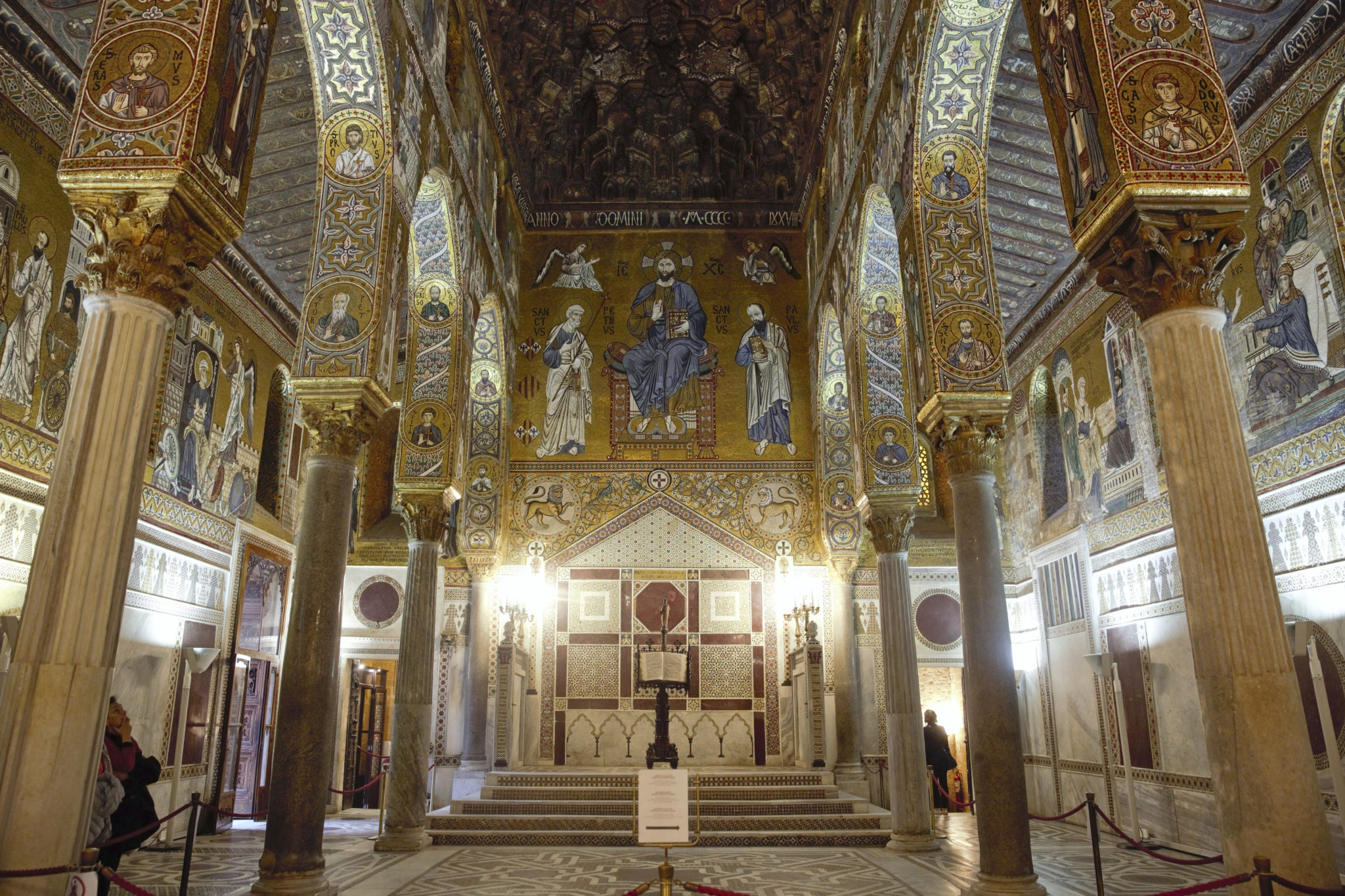
The Cathedral at Monreale, the Church of the Martorana, Cefalù Cathedral — each is a different calibration of the same synthesis. At Cefalù the apse mosaic of Christ Pantocrator — the all-ruler, Byzantine in iconography, overwhelming in scale — looks down the long Norman nave with an authority that synthesises both traditions without belonging entirely to either. When you stand at the west end of that nave and look toward it you understand immediately why Byzantine art chose that image and that location. It is the end of the line. It is what the line was always pointing toward.
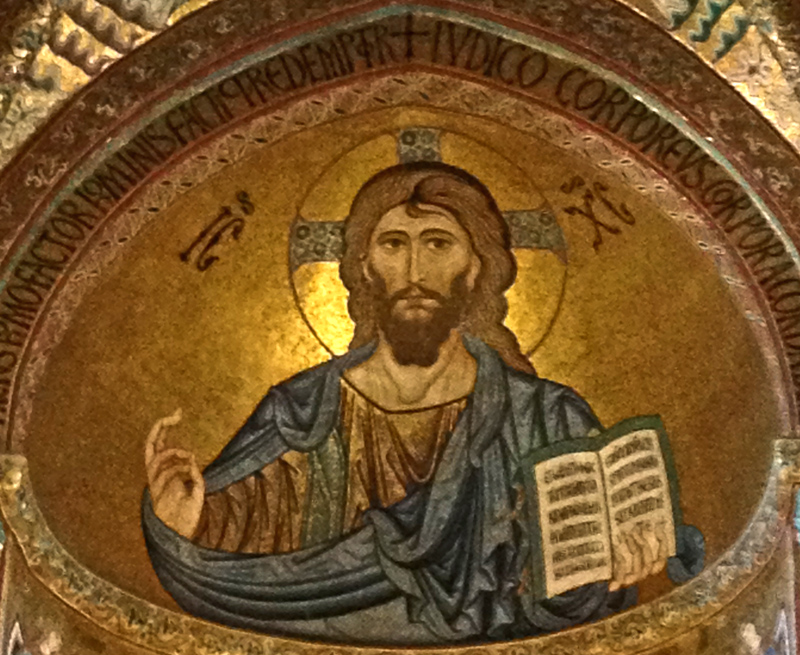
Sicily got the beautiful one because the Normans found beauty already there, concentrated and sophisticated, and were intelligent enough — and secure enough in their power — to absorb it rather than replace it. The paradox is that the most militarily aggressive aristocracy in Europe produced, in the right conditions, some of the most inclusive and culturally generous architecture in the medieval world.
Why Britain Got the Angry One
Britain is the other experiment running simultaneously, and the conditions were completely different.
When William landed at Hastings in October 1066, he was not arriving in a culturally sophisticated multi-ethnic society ripe for synthesis. He was arriving in a functioning Anglo-Saxon kingdom with its own deeply rooted architecture, its own church hierarchy, its own legal culture, its own language — everything that constitutes a coherent civilisation. And he was arriving as a conqueror whose claim to legitimacy was disputed. Harold had been crowned king. The Anglo-Saxon nobility was intact and had to be broken.
The Norman building programme in England was not therefore primarily an aesthetic project. It was a political weapon, and understanding that changes how you look at every Norman building in Britain.
Consider the speed and scale. Within twenty years of Hastings, the Normans had begun construction of — depending on how you count — somewhere between thirty and forty major castle and cathedral projects simultaneously across the entire country. Durham Cathedral begun 1093. The White Tower in London begun 1078. Winchester Cathedral begun 1079. Ely, Lincoln, Norwich, Gloucester, Rochester — all begun within a generation of the conquest. This is not a building programme driven by aesthetic aspiration. This is a building programme driven by the need to physically occupy a conquered landscape and demonstrate, in the most unmistakable possible terms, who is now in charge.
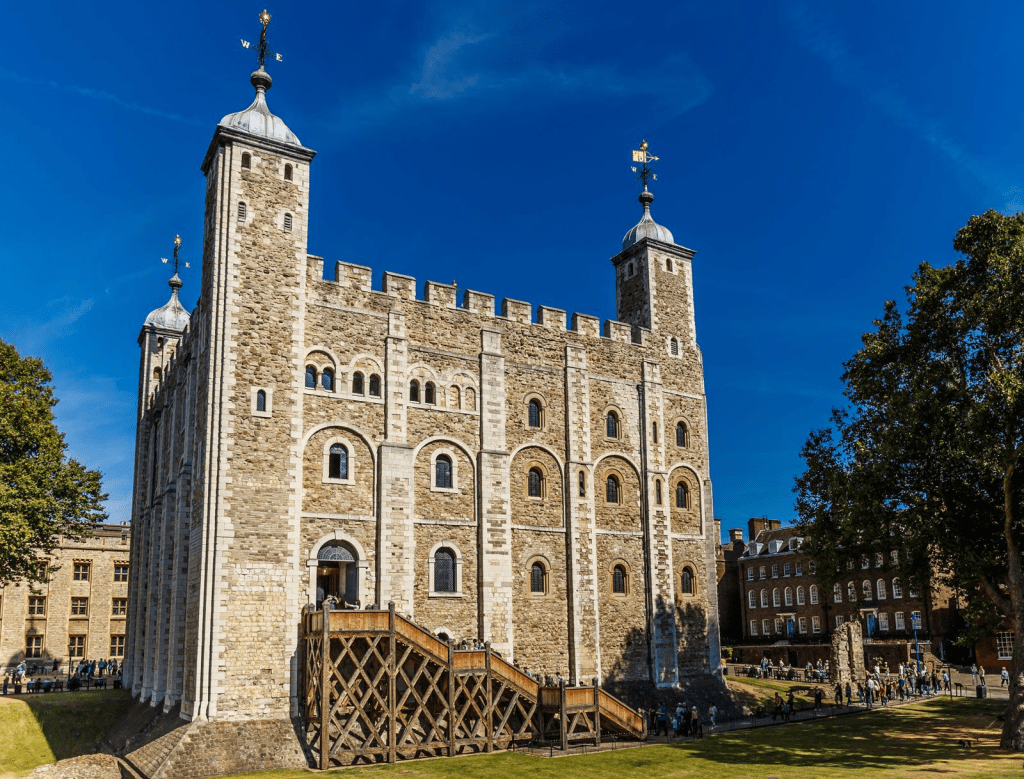
The castle comes first because the castle is the purest expression of the argument. The motte-and-bailey — a timber tower on a raised earthen mound, surrounded by an enclosure — could be thrown up in days and was immediately replaced in stone wherever the Normans intended to stay. The White Tower at the Tower of London is the archetypal Norman keep: massive, almost windowless at ground level, the walls fifteen feet thick at the base, designed to be impregnable from outside and inescapable from within. It is architecture as intimidation. It says: we are here, we are permanent, and there is nothing you can do about it.
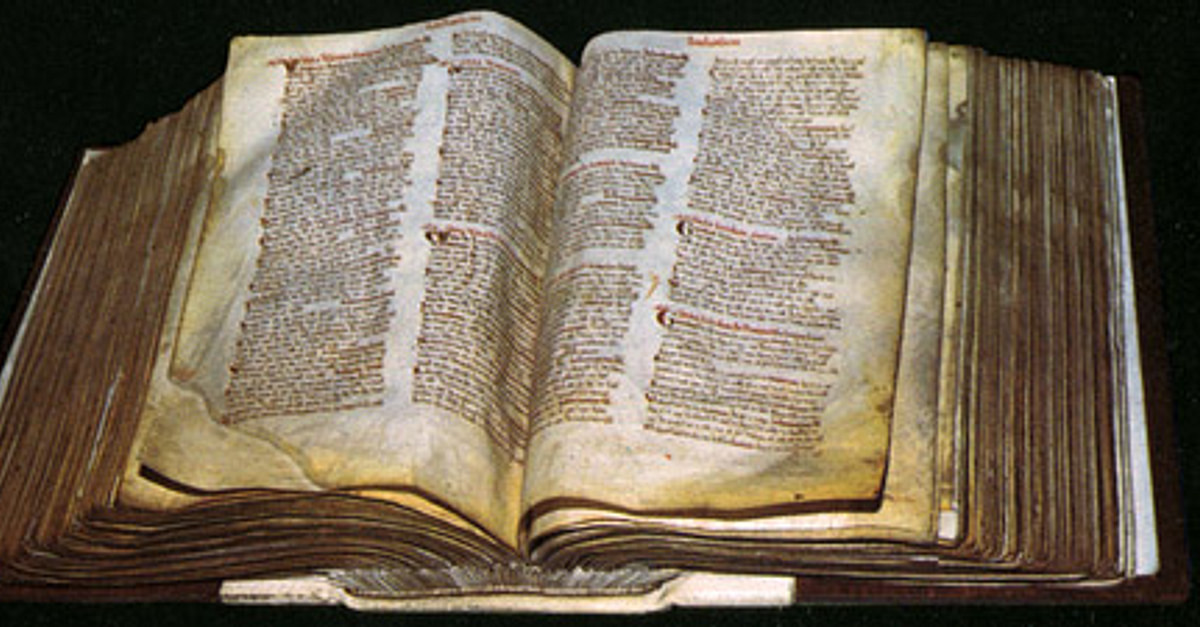
The Domesday Book of 1086 — William’s comprehensive survey of every landholding in England — is the written equivalent of the castle programme. Between them, the castles and the survey constitute a complete act of territorial possession. We know what you own. We have built on what we want. Everything is now ours by right of conquest, and the buildings prove it.
The Norman Cathedral: Power Made Sacred
But here is where it gets more complex and more interesting, because the Normans were not simply brutal. They were also genuinely, if instrumentally, pious — and their cathedral programme produced buildings of a grandeur and ambition that had no precedent in northern Europe.
The Norman Romanesque is a style of overwhelming physical confidence. Massive cylindrical piers, round arches of enormous solidity, thick walls, small windows, interior spaces that feel hewn rather than built — as if the stone were continuous and the space carved from it rather than constructed within it. Durham Cathedral is the exemplar, and it deserves particular attention because it is also the site of a genuine structural revolution.

Durham was begun in 1093, on a dramatic rocky peninsula in a loop of the River Wear — a site so naturally defensive and visually commanding that it feels chosen by geological fate rather than human decision. The exterior, seen from the railway as you approach from the south, is one of the great architectural views in Britain — the cathedral and castle together on the rock above the river, the city clustered below. Turner painted it repeatedly. Ruskin called it one of the wonders of the world. For once the hyperbole is justified.
But Durham’s real significance is structural. The nave, completed around 1130, uses pointed transverse arches and ribbed vaulting over the high nave — the first use of this combination anywhere in Europe. This is not a decorative choice. It is a structural discovery of enormous consequence. The ribbed vault concentrates the weight of the stone ceiling onto specific points rather than distributing it along the entire wall. This means the wall between the weight-bearing points can be thinner — eventually, in the Gothic that follows, it can be opened into windows. Durham didn’t know it was inventing Gothic. But it was. The most important architectural innovation of the medieval period happened in a Norman cathedral in the north of England because the masons were trying to solve a practical engineering problem and accidentally found a new structural principle.

The interior of Durham does something else that is worth understanding. The great cylindrical piers of the nave are incised with bold geometric patterns — chevrons, fluting, spiralling lines — that have no classical precedent and no obvious theological meaning. They are there because Norman masons in England were working with Anglo-Saxon craftsmen who brought with them the decorative instincts of the culture that had just been conquered. The spiral patterns on the Durham piers are cousins of the spirals on the Lindisfarne Gospels. The circle surviving in the stonework of the line’s most triumphant expression. Again.
The Parish Church: The Normans Everywhere
The cathedrals and the castles get the attention but the most pervasive Norman architectural legacy in Britain is the parish church, and it is everywhere. Almost every village in England with a medieval church has Norman fabric somewhere in it — a doorway, a chancel arch, a font, a section of wall. Because the Normans didn’t just build at the top of the hierarchy. They built the entire ecclesiastical infrastructure of a Christian kingdom, from the great cathedral priories down to the smallest rural church.
The Norman doorway is the detail to look for. Round-headed, often elaborately carved with chevron, beak-head, and other geometric ornament, frequently recessed in multiple orders that create a deep tunnel of carved stone around the opening. The doorway is the threshold — the point of passage between the ordinary world and the sacred interior — and the Normans spent disproportionate decorative energy on it. This is not arbitrary. It is the same threshold thinking we identified at the chambered cairns in our essay on Prehistoric British architecture, expressed now in the vocabulary of Romanesque ornament. The zigzag and the beak-head replace the cup-marked stone, but the intention — to mark and charge the moment of crossing — is identical.
Kilpeck Church in Herefordshire is the place to see this at its most extraordinary. A tiny 12th century church in a quiet Herefordshire valley, its south doorway is covered in carved figures — serpents, warriors, sheela-na-gig fertility figures, Green Men, dragons — of a wildness and inventiveness that has no parallel in Norman England. The sculptors were the Herefordshire School, a workshop active in the mid 12th century whose work draws on Scandinavian, Celtic, Byzantine, and classical sources simultaneously. It is hybrid work, provincial work, work that the official hierarchy of Norman ecclesiastical culture would probably have considered too strange. And it is among the most alive sculpture in Britain. Go there. It is almost always empty and you can stand in front of that doorway for as long as you need.

The Synthesis That Wasn’t — And Then Was
The fundamental difference between Norman Sicily and Norman Britain comes down to this: in Sicily the Normans were a minority ruling a sophisticated majority and pragmatism demanded synthesis. In Britain they were a conquering minority replacing a ruling class and pragmatism demanded assertion. Same people, different power relationships, radically different architecture.
But — and this is the long thread — the synthesis does eventually happen in Britain too. Just more slowly, and more violently, and with more suppression along the way. By the 12th century, a century after the conquest, the distinction between Norman and English is already blurring at every level of society. Intermarriage, shared language, shared institutions. The English language that emerges from this collision — absorbing Norman French vocabulary into its Anglo-Saxon grammatical structure — is the most promiscuous and capacious language in Europe, capable of expressing almost any nuance because it has two or three words for everything, drawn from different traditions. Norman French gives us beef, pork, venison — the animals as food, the language of those who eat. Anglo-Saxon gives us cow, pig, deer— the animals as animals, the language of those who tend them. The power relationship is encoded in the vocabulary.
Architecture follows the same pattern. By the late 12th century, in the transition toward Gothic, you can no longer easily separate what is Norman and what is English. The style has been absorbed, digested, and is beginning to produce something new.
The Normans establish the infrastructure — the castles, the cathedrals, the parish churches, the feudal landscape — within which everything that follows happens. Next is the moment the infrastructure starts to dream: the Gothic, which begins as a structural experiment in France and becomes in Britain something stranger, more elongated, more mystical, and more various than anywhere else in Europe. It is also the moment the light comes back — literally, through the dissolution of the wall into glass.
Let’s go further and consider what the political imposition of the new order and its subsequent assimilation meant for the subsequent creation of our nationhood myths? The thousand years of “unbroken” history. For the British colonialism and exceptionalism that flows from and through it. Especially given the signifiers (cathedrals, Domesday Book, White Tower, etc). Ironic really that what makes us British comes from the French.
The Angry Norman and British Exceptionalism
You’ve identified something that most English constitutional history is very reluctant to look at directly, so let’s look at it directly.
The Norman Conquest is the founding trauma of English — and subsequently British — political culture, and the remarkable thing is how completely it was sublimated into the opposite of what it actually was.
What actually happened: a French duke with a contested claim invaded, killed the legitimate king, replaced the entire ruling class within a generation, imposed a new language on the institutions of power, surveyed and redistributed every landholding in the country, built an apparatus of castles and cathedrals that physically demonstrated permanent occupation, and created a colonial hierarchy so total that for two centuries the language you spoke identified your position in it. This is not meaningfully different from what the British later did in India or Ireland or Kenya. It is conquest. It is colonial imposition. It is the restructuring of an entire society by external force for the benefit of the conquerors.
What the English subsequently made of this: the foundation of liberty.
The mechanism of that transformation is one of the most audacious pieces of ideological alchemy in political history. By the 13th century, the Anglo-Norman barons who extracted Magna Carta from King John in 1215 were presenting their demands not as the interests of a French-speaking military aristocracy protecting its privileges against royal encroachment — which is what they actually were — but as the ancient liberties of free Englishmen, recovered from tyranny. The Norman feudal hierarchy reinvented itself as the guardian of Anglo-Saxon freedom. The conquerors became the continuity.
This required the invention of a usable past — specifically the invention of Anglo-Saxon constitutional liberty as something the Normans had interrupted and Magna Carta restored. By the 17th century, Parliamentary opponents of Charles I were citing Anglo-Saxon precedents, the ancient constitution, the freeborn Englishman’s immemorial rights — a mythology built substantially on fabrication, but fabrication with enormous political utility. The English Civil War was fought in part over competing versions of an invented Anglo-Saxon golden age.
What this created — and here is your British exceptionalism — is a political culture that is structurally incapable of acknowledging its own violence as violence because the violence is the foundation. The Norman Conquest cannot be acknowledged as colonial imposition because if it is, Magna Carta becomes a factional deal between rival Norman interests rather than the birth of liberty, and the entire constitutional mythology unravels. So instead it gets absorbed, naturalised, made into the continuous story of a people who were always already free, always already exceptional, always already the ones who invented the rights that other nations merely aspire to.
The irony you identify — that Britishness in its institutional forms is substantially French — runs even deeper than the Norman input. The common law is Norman French in its foundational concepts and terminology. Parliament derives from the French parler, to speak. The royal family was German for two centuries before it renamed itself Windsor in 1917 because the First World War made Saxe-Coburg-Gotha politically untenable. The very idea of Englishness as a stable continuous identity is a construction built from layers of continental importation that then forgot its own origins.
Which is not unique to England. Every nationalism does this — constructs a continuous identity from discontinuous materials and then defends the construction as natural fact. But the English version is particularly elaborate and particularly resistant to examination because it was so successful for so long. Empire confirmed the mythology. If you rule a quarter of the world it is very easy to believe you were always destined to, that there is something in you — your institutions, your character, your racial stock — that explains and justifies it. The Domesday Book and the White Tower are still doing their ideological work, just in different forms.
Canonical Texts for the Argument
On the fiction of nationhood and invented tradition:
Benedict Anderson’s Imagined Communities is the foundational text — the argument that nations are not ancient organic facts but modern constructs, held together by shared fictions, print capitalism, and the peculiar experience of reading the same newspaper simultaneously with strangers. Written in 1983 and still the sharpest tool for this particular job.
Eric Hobsbawm and Terence Ranger’s The Invention of Tradition is the essential companion — a collection of essays demonstrating how many apparently ancient British traditions were invented in the 19th century. The Highland Scottish tradition of tartans and clan identities, largely fabricated in the early 19th century and then turbocharged by Walter Scott. The elaborate Victorian ceremonies surrounding the monarchy, presented as timeless but mostly dating from the 1870s onwards. The Welsh Eisteddfod. The Oxford and Cambridge rituals. Hobsbawm’s introduction alone is worth the price.
Linda Colley’s Britons: Forging the Nation 1707-1837 does for British identity specifically what Anderson does for nationalism generally — shows how Britishness was constructed, largely through anti-French Protestant sentiment and imperial project, in the 18th and early 19th centuries. Particularly good on how a genuinely multinational and multicultural entity — England, Scotland, Wales, parts of Ireland — was made to feel like a natural unity through shared mythology and shared enemies.
On the specific English pathology:
Tom Nairn’s The Break-Up of Britain — written in 1977 and almost embarrassingly prescient about devolution, Scottish independence, and English nationalism. Nairn’s argument is that Britain never had a proper bourgeois nationalist revolution of the French or German type, and consequently its nationalism remained archaic, monarchical, and backward-looking — always reaching for the past rather than projecting a future. The English nationalism that eventually emerged from the British imperial shell would therefore be particularly toxic precisely because it had been so long suppressed and had so little modern democratic content.
Perry Anderson’s essays — particularly those collected in English Questions — on the peculiarities of English ideology. Anderson argues that England’s dominant intellectual traditions — empiricism, common law, parliamentary sovereignty — are all ways of refusing systematic thought, of privileging practice over theory, muddle over principle. This is presented as a virtue — the pragmatic English versus the ideological continentals — but Anderson shows it is itself an ideology, one that systematically prevents the English from examining their own foundations.
David Edgerton’s The Rise and Fall of the British Nation — a revisionist corrective to the declinist narrative, arguing that Britain was never quite the thing it thought it was, and its current condition is not fall from grace but normalisation. Useful for puncturing the exceptionalism from a different angle.
On the architectural-political argument specifically:
Adrian Forty’s Words and Buildings — a rigorous examination of the language used to talk about architecture and how that language carries ideological freight invisibly. What we mean when we say a building is honest, or appropriate, or monumental, or democratic.
Patrick Wright’s On Living in an Old Country — on heritage, Englishness, and the political uses of the past. Particularly good on how the conservation and heritage industry in Britain produces a version of the past that is comfortable, depoliticised, and available for nationalist consumption. The country house as England. The village green as England. The cathedral close as England. All real, all selective, all serving a function.
And Robert Hewison’s The Heritage Industry — a polemical 1987 text arguing that Britain was turning its past into a theme park as a substitute for having a future. Written during Thatcherism and aimed at it, but the diagnosis has only become more accurate since.
The wildcard:
Walter Benjamin’s Theses on the Philosophy of History — nine pages that will permanently alter how you think about time, progress, and the use of the past. Benjamin’s image of the angel of history, face turned toward the past, watching the wreckage pile up while the storm of progress blows it helplessly into the future — this is the counter-image to every linear progressive narrative we’ve discussed. Written in 1940 as Benjamin was fleeing the Nazis. He didn’t survive. The text did. That fact is itself part of its argument.
Key Sites to Visit
Durham Cathedral, County Durham
Begun 1093. The ribbed vault over the nave is the first in Europe — the structural invention that made Gothic possible. The spiral-patterned piers carry the Celtic interlace into the Norman building. One of the supreme buildings of any period.
Tower of London (White Tower), London
Begun 1078. The purest expression of Norman military architecture as political statement — massive, almost windowless at ground level, designed to be seen from everywhere in the city. St John’s Chapel inside is the finest surviving Norman interior in England.
Winchester Cathedral, Hampshire
Begun 1079. The Norman transepts survive almost intact — massive, dark, and authoritative. The crypt is one of the finest Norman spaces in Britain. The building that established the Norman architectural programme in England.
Norwich Cathedral & Castle, Norfolk
Cathedral begun 1096, castle c.1067. The two instruments of Norman control together — the ecclesiastical and the military. The cathedral’s nave is one of the most complete Norman interiors in England.
Kilpeck Church, Herefordshire
The south doorway carved by the Herefordshire School c.1140 is the most extraordinary Norman sculpture in Britain — serpents, warriors, sheela-na-gig figures, Green Men. Almost always empty. The circle surviving exuberantly in the line’s most triumphant period.
Canterbury Cathedral, Kent
The Norman choir rebuilt by William of Sens after the fire of 1174 — the first Gothic building in England. The Trinity Chapel stained glass is among the earliest narrative glass in Britain. The crypt is the finest Norman crypt in England.
Ely Cathedral, Cambridgeshire
The Norman nave is one of the longest in Europe. The Galilee Porch is a masterpiece of Romanesque decoration. The later Gothic Octagonal Lantern — built after the Norman tower collapsed in 1322 — is the greatest act of medieval structural improvisation in Britain.
Lincoln Cathedral, Lincolnshire
The “crazy vault” of St Hugh’s choir c.1200 is the moment English Gothic definitively parts company with French rationalism — extra ribs added for visual rhythm rather than structural function. The invention of the tierceron vault, the beginning of the tradition that ends in the fan vault.
St Albans Cathedral,Hertfordshire
Begun 1077. Built substantially from recycled Roman brick taken from adjacent Verulamium — you are looking at Roman material while thinking you are looking at Norman work. The longest medieval nave in England.
Rochester Cathedral & Castle, Kent
Cathedral begun 1080, castle keep c.1127 — one of the tallest Norman keeps in England. The two buildings together, facing each other across the city, are the clearest expression of how the Norman programme worked: cathedral and castle as paired instruments of control.


Leave a Reply