Britain’s built environment as political confession
17th April 2026
Start with this: the people who built Stonehenge were not solving a shelter problem. They lived in timber houses that have long since vanished. What they built in stone — and they built almost exclusively in stone for the dead and the sacred — was a container for their terror and their hope. The solstice alignment is not a lucky accident. It is a complete theological statement: the community gathered at the threshold between the dark and the light, the midwinter sun moving through the precisely oriented passage to illuminate the back wall of the chamber where the dead lay, proof that the darkness would not last forever.
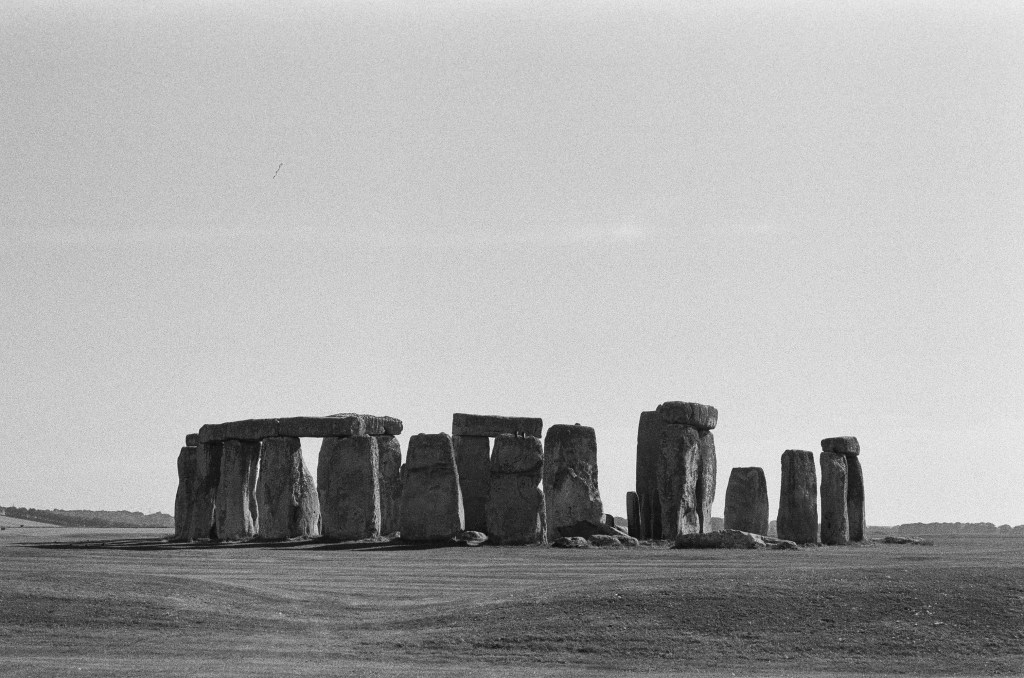
Every era of British architecture since has been, in some sense, still answering the questions first posed by the people who dragged bluestones from Wales. What are we afraid of? What do we hope for? And are we willing to build honestly about either?
The answer, across five thousand years, is: sometimes. The buildings that last — that matter, that accrue meaning rather than shedding it — are the ones that were honest about their materials, their structure, their purpose, and the people they served. The buildings that fail, structurally or socially or morally, are the ones that were not. This is not a moral argument. It is an architectural one. And it runs without a break from Stonehenge to Grenfell.
What we build is what we believe. What we preserve is what we cannot admit we no longer believe. And what we allow to fall or burn is who we have decided does not count.
Two formal languages run through the whole of British architectural history, and the tension between them is the engine of everything worth discussing.
The circle is the cosmology of cyclical time — the season, the generation, the return. It is the Celtic interlace that has no beginning and no end, the Green Man growing from the Gothic capital, the vernacular building that uses local materials in patterns evolved over centuries, the craft knowledge that lives in the hand rather than the blueprint. The circle belongs to a place and a time rather than progressing through them.
The line is the cosmology of historical progress — the Roman road, the Christian salvation narrative, the Enlightenment march from superstition to reason, the Victorian civilising mission, the property ladder. The line always has a destination. Whoever controls the destination controls the meaning.
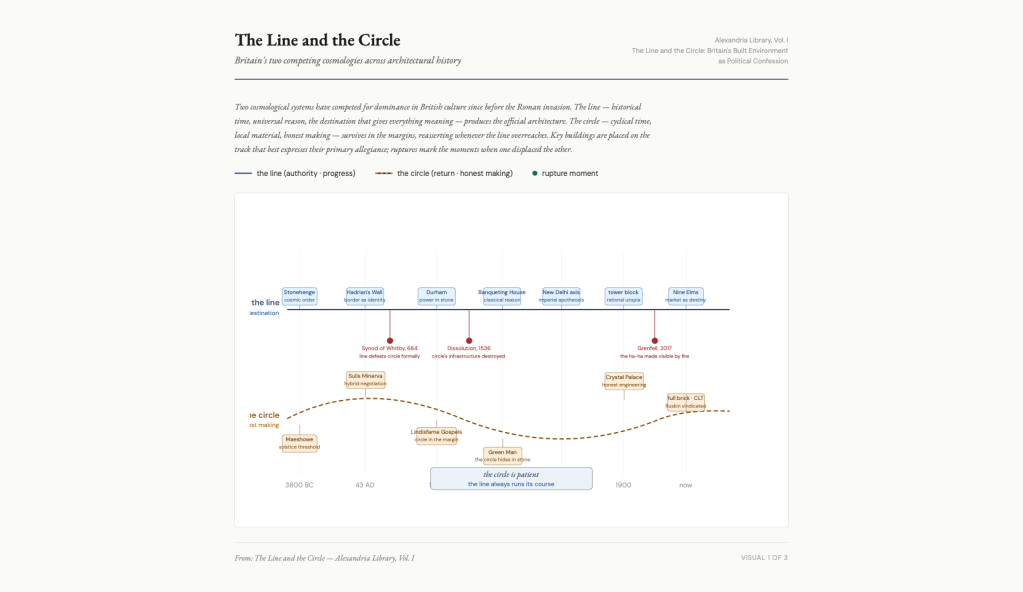
The line wins every formal battle. The circle wins every long war. The line produces the official culture, the canonical buildings, the histories written by the victors. The circle survives in the margins — the folk tradition, the craft knowledge, the persistent human preference for the warm and the particular over the rational and the universal. And periodically, when the line has overreached and the cost of its overreach becomes undeniable, the circle reasserts. Not as nostalgia. As necessity.
We are at one of those moments now. But we will get to that.
— II —
In 43 AD, four Roman legions landed in Kent and within a generation had transformed a landscape of timber roundhouses and sacred groves into grid-planned towns, underfloor heating, and the first urban architecture Britain had seen. The line, in its most literal form: the road, straight across the landscape regardless of what was in the way, because the road was not navigating the landscape but asserting dominion over it.
The Romans built brilliantly. Their engineering — concrete, the hypocaust, the aqueduct — was genuinely superior to what preceded it, and they knew it. What they could not do was erase what preceded it. The Celtic circle survived: in the rural areas, in the religious practice that continued beneath the Roman veneer, and most visibly in the manuscript borders and church carvings of the centuries after Rome left. The conquered culture left its mark not in the buildings — those were demolished — but in the ornament that crept back into every surface the line tried to discipline.
This is the first ha-ha. The term comes later — the Georgian country house, the sunken wall that keeps the sheep at the correct picturesque distance, invisible from the piano nobile so the view from the drawing room reads as pure nature. The management concealed in the landscape. But the concept is Roman: the official culture performing rationality while the suppressed tradition continues beneath the surface, visible only at certain angles, in certain light.
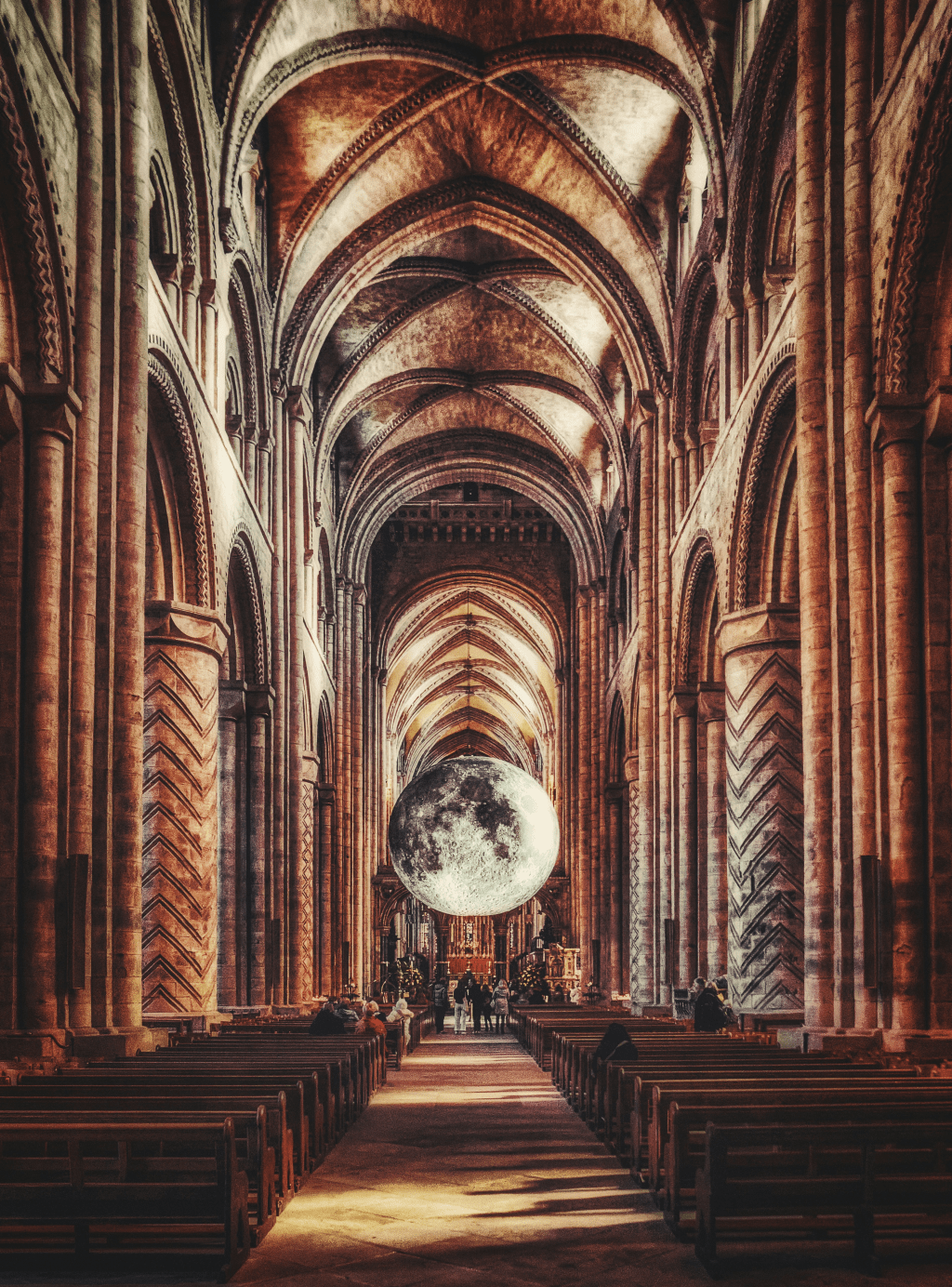
Every era has its ha-ha. The Norman cathedral is the line’s most ambitious assertion; the spiral-patterned nave piers at Durham are the circle’s most beautiful infiltration of it. The Georgian terrace expresses classical reason; the slave trade capitalised it. The Victorian railway station engineers the future honestly; the Gothic Revival hotel on the front conceals the iron shed behind historical costume. The Grenfell cladding performs improvement while failing, catastrophically, at the basic duty of not burning.
— III —
Durham Cathedral is worth a detour because it is where the argument becomes most visible.
The Normans arrived in 1066 with a complete architectural programme: the Romanesque, massive, round-arched, asserting permanence and power in stone. Durham, begun in 1093, is the supreme expression of that programme in Britain. The nave is enormous, the walls are thick, the message is unmistakable: we have conquered this island and God has ordained it.
Look at the nave piers. They are carved with spiral and chevron patterns — the circle, in its most direct form, cut into the surface of the line’s most confident assertion. The craftsmen who cut those patterns were working in a tradition that predated the Norman conquest. The conquered culture marked the conqueror’s most ambitious building, and the conqueror either did not notice or did not mind, because the marking was in the decoration and the structure was still the line’s.
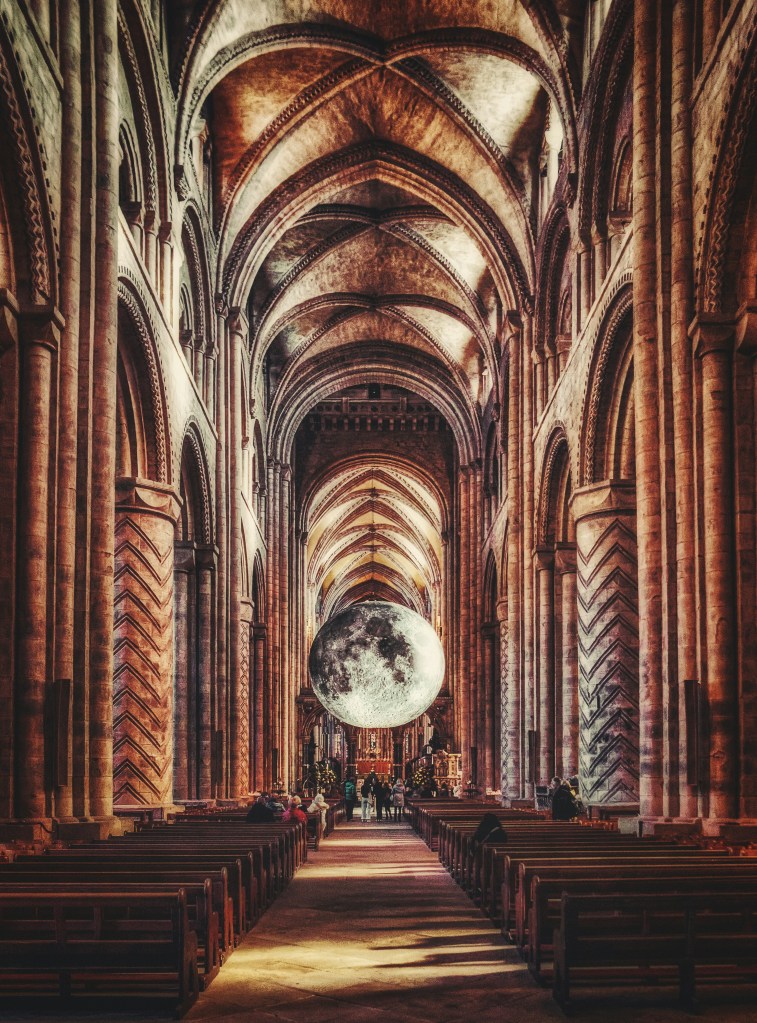
This is not a small thing. It is the entire history of British architecture in miniature. The official culture, the line, proceeds with its programme. The suppressed tradition, the circle, finds the margin — the capital, the corbel, the misericord, the border of the manuscript — and leaves its mark. Over centuries, those marks accumulate into something that changes the character of what the line built. The Gothic cathedral is secretly full of circles. The English landscape garden performs naturalness through total management. The Arts and Crafts movement recovers the vernacular tradition by aestheticising it for the bourgeoisie.
The line is always the plan. The circle is always the reality.
— IV —
The pointed arch was not invented for aesthetic reasons. It was invented because the round arch has a fundamental structural problem: it exerts enormous lateral thrust, which means the walls have to be enormously thick to resist it, which means the windows have to be small, which means the interior is dark. The Gothic builders wanted height and light. The engineering solution — pointed arch, flying buttress, ribbed vault — achieved both. The aesthetic followed from the structure, not the other way round.
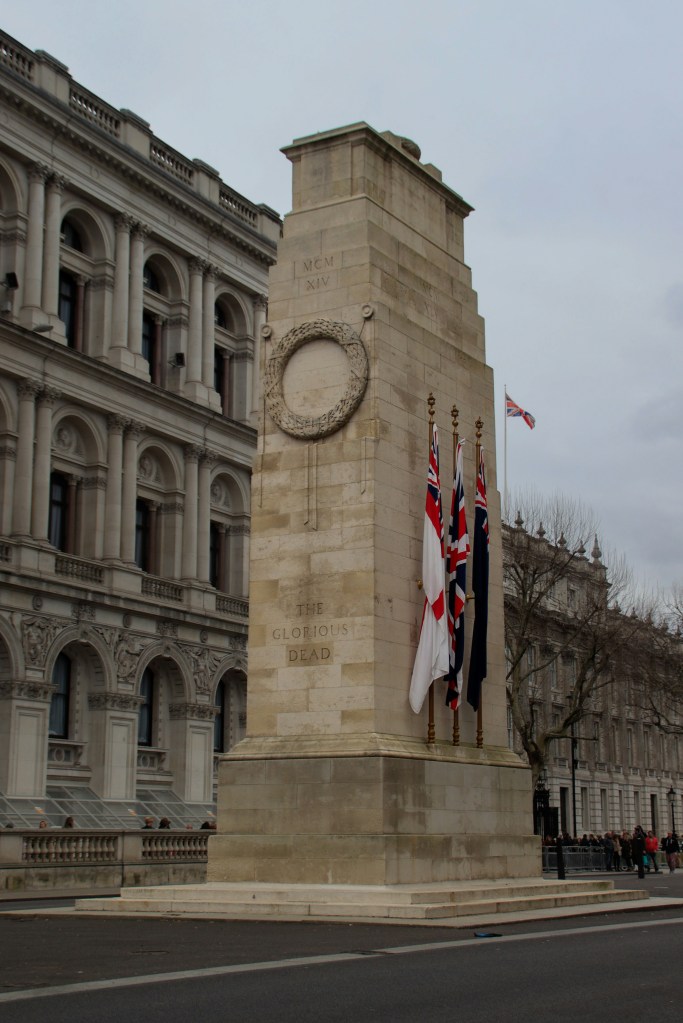
This matters because it is the template for every genuinely good building in British history. The Crystal Palace (1851) was made of iron and glass because Paxton had six months to design it, iron and glass could be prefabricated offsite, and the budget was tight. The aesthetic — the breathtaking lightness, the dissolution of the wall into transparency — followed from the constraints. The Cenotaph (1920) is ten feet of Portland stone with two words because Lutyens stripped the imperial architectural vocabulary down to its irreducible minimum, and what remained — after all the allegory and the rhetoric and the historical costume was removed — was exactly as much as the occasion could bear.
The dishonest building always works in the opposite direction: the aesthetic chosen first, the structure made to conform to it, the cost externalised onto materials or maintenance or, in the final case, onto the people who live in the result. St Pancras dressed its shed in Gothic costume because the Midland Railway wanted dignity and the Gothic Revival was what dignity looked like in 1868. The shed was fine. The costume was a lie. The lie cost money and weight and complexity and produced a building that generations of architects cited as a reason not to take Victorian architecture seriously — until the shed was about to be demolished and everyone suddenly noticed it was magnificent.
The honest building does not perform importance. It does not dress in historical costume. It does not conceal its management. It is what it is, made of what it is made of, serving the people it serves with the directness of something that has nothing to hide.
— V —
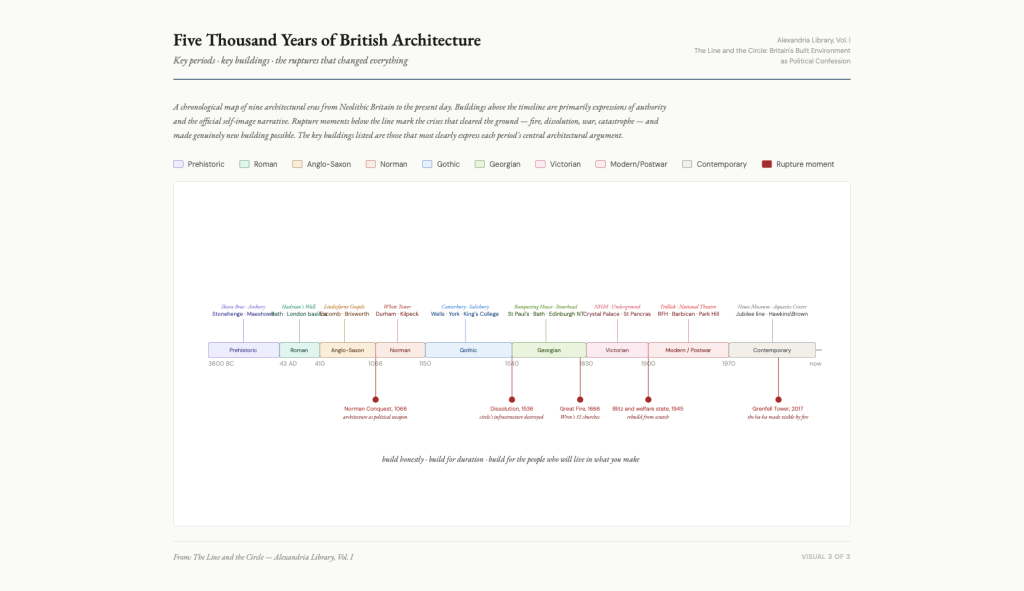
Every era of British architecture is the physical expression of a story the culture tells about itself. The Norman cathedral: we have conquered this island and God ordained it. The Palladian country house: we are the inheritors of classical reason, governing our estates as Rome governed its provinces. The Georgian terrace: we are a commercial civilisation, orderly and prosperous, our streets expressing the mathematical harmony of our institutions. The Victorian railway station — in its engineering shed — we are the workshop of the world and our technology is our glory. The Edwardian Baroque government building: we govern a quarter of the world and our architecture must confirm it.
Each narrative contains a truth and a lie simultaneously. The truth is the genuine aspiration. The lie is the concealment. The Georgian terrace’s classical harmony was funded by enclosure and slavery. The Palladian country house sat in a landscape from which the agricultural reality had been managed out of sight. The Edwardian Baroque arrived — Portland stone, imperial columns, the full rhetorical apparatus — at the precise historical moment when the empire it was designed to celebrate had begun its terminal decline. The costume outlasted the body it dressed by a century.
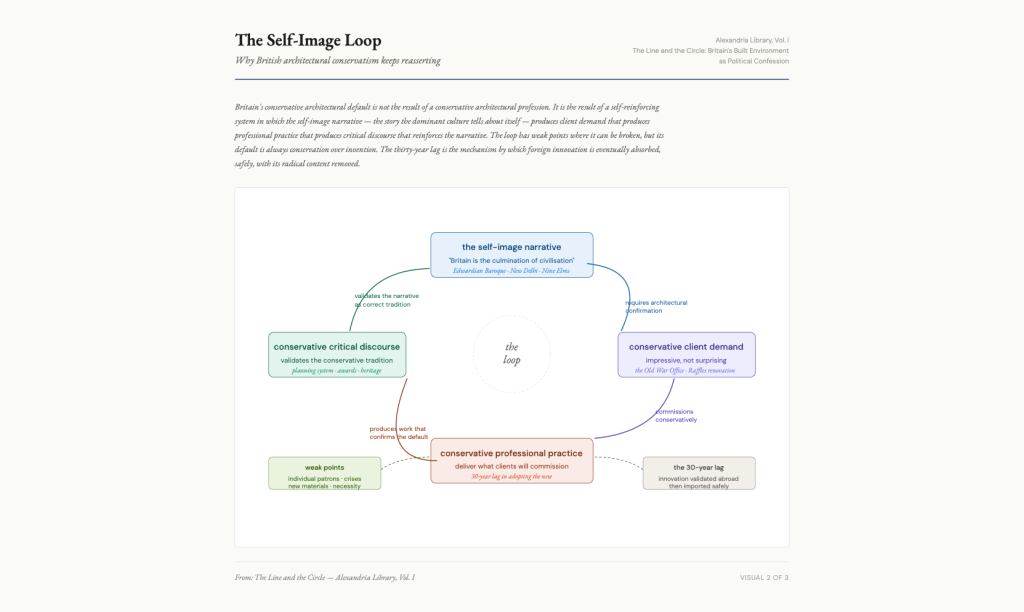
This is the thirty-year lag, and it is the most consistent feature of British architectural culture. The validated alternative is always already available. The domestic adoption is always delayed by the conservative client, the self-image narrative that cannot accommodate the admission that the old thing is over, and the institutional inertia of a culture that mistakes familiarity for quality. Offshore wind was proven in Denmark in the 1990s. The Gothic pointed arch was available from the Islamic world before the Crusades. The cast-iron frame was available before the Gothic Revival insisted on stone. The lag is not a failure of knowledge. It is a failure of nerve.
— VI —
The British Empire was the most complete expression of the line in British history. The road that went — not literally, but figuratively — through the Roman road, the Norman castle, the Palladian country house, the Georgian slave trade, the Victorian civilising mission, through Lutyens’s New Delhi axis — arrived at the proposition that Britain was not just a particular culture with a particular history but the universal standard against which all other cultures were measured.
This proposition required an architecture of universality: the Classical style deployed not as one tradition among many but as the tradition. The Viceroy’s House in New Delhi. The Government House in Calcutta. The colonial courthouse in Nairobi. The line drawn around a quarter of the world and called civilisation.
The unravelling began at the moment of maximum extension. The First World War — the European civilisation that had exported itself as the universal standard destroying itself with an efficiency its own industrial technology had made possible — was the first crack. The Cenotaph is the architectural expression of that crack. Lutyens stripped the imperial vocabulary down to ten feet of stone and two words — The Glorious Dead — and produced something more powerful than all the Edwardian Baroque that surrounded it, precisely because it refused the performance. The glorious dead, not the glorious empire. Not the glorious cause. The dead, and the emptiness where the certainty had been.
The postwar attempt to build a new narrative — the Festival of Britain in 1951, the welfare state and its architecture, the tower block as the new Jerusalem — was the road not taken. Not because the ambition was wrong but because the politics was lost. Churchill won the 1951 election and dismantled the Festival. The tower block continued, but without the social investment that might have made it work. The circle — the street, the neighbourhood, the community organised around human scale — was demolished to build the line’s next confident assertion, and the line’s next confident assertion failed, systematically, across three decades.
Grenfell Tower was built in 1974 and was mediocre. It was made murderous in 2015–16 by a refurbishment in which the cladding system was specified, procured, and installed by a chain of actors each of whom prioritised the budget constraint over the life safety requirement, each of whom relied on someone else to have checked the thing that none of them checked, in a regulatory environment that had been systematically weakened since 1980 because the regulatory burden on the development industry was understood as an obstacle to the market rather than a protection for the people the market was supposed to serve.
Seventy-two people died because the self-image narrative — the Britain that governs itself through the common law tradition, the parliamentary democracy, the free market — failed them at every level simultaneously. The ha-ha, made visible by fire.
— VII —
Here is the thread, drawn directly.
The Neolithic builders at Stonehenge were building for the community that would gather in the cold at the threshold between the dark and the light. They chose materials with intention, oriented their building to the thing that mattered most — the return of the sun — and built it to last. They were not building for the market. They were not building for the self-image narrative. They were building for the people.
Durham’s spiral piers are honest about two things simultaneously: the Norman line of power and ambition, and the circle of the craftsman’s tradition that refused to be entirely suppressed. The Crystal Palace was honest about being iron and glass. The Cenotaph was honest about what had been lost and refused to dress that loss in anything that might make it more bearable than it was. The best Underground stations — designed under Frank Pick’s tenure, when the proposition was that the commuter deserved beauty as a matter of course — were honest about being public infrastructure in service of citizens.
These buildings share a quality that is not primarily aesthetic, though they are all beautiful in their own registers. They refused the ha-ha. They showed what they were. They served the people they served with the directness of something that had nothing to hide.
Against them: the Edwardian Baroque government building performing imperial confidence after the empire had begun its dissolution. The system-built tower block imposing the line of rational progress on communities that needed the circle of neighbourhood and street. The Grenfell cladding, chosen for its appearance and its cost, by people who would not live in the result.
The line always runs its course. And then the circle — the return, the material, the particular, the honest, the local, the durable — reasserts. Not because it wins an argument. Because it outlasts one.
— VIII —
We are at the end of the line’s most recent extension and the beginning of the circle’s next reassertion. The evidence is structural, not ideological.
The climate emergency is making the honest material the rational material. Embodied carbon accounting is doing what Ruskin’s moral argument never quite managed: making the case for brick over cladding, for timber over concrete, for the building designed to be maintained over the building designed to be sold. The honest material is becoming cheaper than the dishonest one, which means the market — that most conservative of clients — is beginning to align with the architectural tradition that was always right.
The generational shift is making the permanent renter a political identity rather than a transitional condition. When you will never own, the quality of what you rent matters differently. The circle of the rental model — continuous, relational, without the destination of outright ownership — is beginning to generate its own architectural demands. What does a building look like when it is designed for people who will live in it for thirty years rather than buyers who will sell in five?
The institutional capital is beginning to ask the same question. Long-term investors — pension funds, patient equity — are discovering that the thirty-year maintenance bill makes the cheap building expensive and the expensive building cheap. The financial argument for quality is assembling itself without requiring anyone to read Ruskin.
The Hawkins\Brown housing block exists, is getting built, and is getting better. Full brick, genuine public realm, refuses the marketing image. The ha-ha-free building, in the current market, from a practice that has worked out how to make it financially viable. It is not utopia. It is evidence.
None of this is fast. The loop is deep. The conservative default is strong. The thirty-year lag is real. The planning system will continue to frustrate the best briefs and permit the worst ones. But the conditions this time are not dependent on a single political decision in the way the Festival of Britain was. They are structural. The climate emergency does not care which party is in government. The maintenance bill does not care about the planning system. The generational shift does not care about the thirty-year lag.
— — —
The thing the Neolithic builders knew — and that every generation of honest makers has known since — is that the circle is patient. You build for the return of the light, and the light returns. You build for the people who will gather in the cold at the threshold, and the gathering happens. You build honestly, and the building lasts long enough to be understood.
The line runs its course. It always does. The self-image narrative cracks when the reality it was concealing becomes too expensive to manage. The ha-ha fails when the fire reaches the wall that was supposed to be invisible.
What remains, after the costume is stripped away, is always the same question the bluestones were asking from their precise orientation in the Preseli Hills: what are we actually afraid of, and what do we actually hope for, and are we willing to build honestly about either?
Britain has occasionally answered that question well. Durham. The Crystal Palace. The Cenotaph. The best Underground stations. The Hawkins\Brown block on the edge of a city that still can’t quite decide what it’s for.
The rest is detail. And some of the detail, as it turns out, is extraordinary.


Leave a Reply