The Favourite film review *****

The Favourite, 3rd January 2019

The more theatre I see, the more I am turning into an insufferably superior luvvie. “A play will always trump a film because it is organic, dynamic, viewed from multiple perspectives, energised by audience complicity, palpable, alive, more daring in terms of form and structure” and much other such guff.

However sometimes I have to accept that the cinematic trumps the theatrical and that is definitely the case for The Favourite. For only a couple of years earlier, writer Helen Edmundson, director Natalie Abrahami, the massed ranks of RSC creatives and a cast led by Romola Garai and Emma Cunniffe served up Queen Anne, a play that, like The Favourite, dramatises the relationship between Anne, Sarah Churchill and interloper Abigail Hill. Except that the play offered a much broader sweep of history, Anne’s accession, the War of the Spanish Succession in Europe between the Grand Alliance and the Spanish and French Catholic monarchies, the rise of the Duke of Marlborough, Sarah’s husband, as well as Lord Godolphin and Anne’s political interventions. It also focusses on the birth of the free press in England at the turn of the C18 and, specifically, the spread of satirical publications. All this in addition to the personal troika.

In contrast The Favourite, whilst referencing the political manoeuvrings between protectionist Whig and free-trade Tory, and the impact of the growing tax burden to finance the war on landowners, is firmly focussed on the relationship between the three principal women. Mark Gatiss gets a look in as Marlborough (Winston Churchill’s ancestor) but not much opportunity to show off. Same goes for James Smith as Godolphin. Both were Tories but they became ever more reliant on Junto Whigs to finance the war.

(As an side I personally continue to sh*t myself about the long term, and increasingly short term, effect of debt on this country. As it happens public debt to GDP ballooned in the years after William III first went cap in hand to the City spivs with the idea of issuing Government bonds. At the peak of the War of Spanish Succession it approached 200%. War tends to do that. Anyway now good old Blighty runs at around 90%, not too far away from our major developed economy neighbours. But when you add in private debt it gets closer to 300% of GDP. There are a bunch of countries with “higher” levels but this reflects their tax friendly approach to issuers of corporate debt. Our debt is built on the backs of consumers.

So for those Brits who now purport to prize “sovereignty at any price” I would venture we are already in more of a pickle than all the Euro economies you take a pop at. But that is not all. Our current account deficit currently runs at 5% or so. Comparable with the likes of Turkey and Argentina. This has to be financed by foreign investors, “the kindness of strangers” as the Governor of the BoE would have it. Who knows what might happen in the next few weeks and months but if we balls this up, sterling depreciation, imported inflation, capital flight and sale of assets is guaranteed. And there may be f*ck all the BoE and Government can do to protect us. Forget about your ten quid for a visa, roaming charges, lorry queues or medicine stockpiling. That’ll be the least of your worries).

Oops I’ve done it again. Back to the script. So Anne, a natural Tory, became increasingly less enamoured of the Junto dominated government, especially when she fell out with Sarah, and the non-Junto Whigs started to break bread with the Tories led by Robert Harley. Cue the terrific Nicholas Hoult for it is he that plays Harley, sumptuously powdered and bewigged, but still brutally Machiavellian. He intrigues with the ambitious Abigail, eventually marrying her to his ally Masham (a virile Joe Alwyn), with the Queen’s approval. Harley wins the political battle, last straw for Sarah, but the Whigs win the battle after Anne’s death when the Hanoverian line is established, the Jacobites are defeated and the Whig supremacy is ushered in. The new money trounces the old.

Anyway I suspect that once the mercurial director Yorgos Lanthimos, in 2009, got his mitts on Deborah Davies’s original script, first written twenty odd years ago, it was always likely that the political context was going to be downplayed. Mr Lanthimos went on to garner deserved critical acclaim for Dogtooth (my favourite of his until, er, this Favourite), The Lobster and The Killing of a Sacred Deer. For those that don’t know, these are not your run of the mill Hollywood blockbusters. So, in many ways, The Favourite it surprisingly in its near naturalism. It is beautifully shot courtesy of cinematographer Robbie Ryan, the costumes (Sandy Powell) and set decoration (Alice Felton) are, as you might expect, exceptional and the locations, mostly Hatfield House, also Hampton Court Palace and the Bodleian’s Divinity School, are all stunners. The soundtrack, without exception, is divine, though amongst all the Purcell, Handel, Vivaldi and Back (WF as well as JS) make sure to listen out for Anna Meredith’s rasping contribution from her string quartet Songs for the M8.

So it looks and sounds wonderful. A period drama with a twist of Peter Greenaway’s Draughtsman Contract. But it is the relationship between the three women that is Mr Lanthimos’s concern and, with a little embellishment and ornamentation, he constructs a drama that the Tourist thinks sheds more light on the workings of power than any dry “historically accurate” portrayal could do. It is a drama, so “historical accuracy” for all the pedants out there is meaningless in this context, and, in any event, history is simply what is left and what is found, and it always changing. I suspect what really winds these punters up is the functional lesbian love triangle but, without that there would be no drama. The power games between the three women seem to echo, and directly, influence the power games between politicians and Crown and State.

Queen Anne, (we never see husband George who was an arse by all accounts), famously lost all 17 of her children and left no heir, hence the invitation to the Germans, 26 years after the invitation to the Dutch. Protestant royal kids eh, never there when you need them. This, unsurprisingly, leaves her sad, needy, physically incapacitated and isolated. Hence her bunnies. And her cake. She has a friend from childhood, Sarah Churchill, but these two chums are beyond dysfunctional. Having opened the door to her, she, Sarah, is in turn is manipulated by impecunious upstart cousin Abigail Hill, who then steps in to manipulate the Queen, literally and emotionally. Except that she, the Queen, whilst vulnerable is also capable of manipulating both, and ultimately pulls rank.

There are external scenes, in the palace gardens, on horseback, to Parliament, but most of the action takes place indoors and specifically in the Queen’s bedchamber and the corridor outside. Genius. Adds to the damaging intensity and claustrophobia of the relationships. As does the roving camera. And the predominantly wide-lens shots. The dialogue is dynamic and contemporary, the humour broad and often incongruous, the tone ambivalent. Your sympathies will constantly oscillate between the characters.

It is probably a comedy, but not one of those “dark” or “black” comedies where you don’t laugh. There are hints of Restoration romp and barbed bitch-fest a la Les Liaisons Dangereuses but then the idiom is right here, right now. It might be a tragedy but who is the heroine? Historical drama? But no-one normally speaks or moves like this in the bog-standard drama. The Madness of King George filtered through an absurdist lens. Maybe, but then it isn’t that absurd. Parallels with the arch Whit Stillman’s Love and Friendship, or the recent ITV Vanity Fair. Yes, but with more filth and camp. Could another director have taken the scrip and budget and churned out a more than passable film. For sure but it wouldn’t be half as much fun or half as original.

All of this reflects Yorgos Lanthimos’s off-kilter, deadpan style but it was never going to work without the three leads stepping up and, crikey, they do. In any other filmic context Emma Stone’s opportunist Abigail would take your breath away. Then along comes Rachel Weisz’s cruel to be kind, then to be cruel, and then back again, Sarah. And then, in probably the least surprising acting triumph of all time, Olivia Colman comes along and chews them up with her Queen Anne. The way all three bring out the conflicts implicit, and explicit, in their relationships is, frankly delicious, but OC takes it to another level.

I have already intimated that IHMO the present shower of Parliamentary sh*te might as well be dissolved to be replaced by a matriarchy comprised of acting Dames. Judi Dench as PM, Maggie Smith as Chancellor, Helen Mirren as Foreign Secretary, Eileen Atkins as Home Secretary, Joan Plowright as Education Secretary, Patricia Routledge at Health, Harriet Walter Justice, Kristin Scott Thomas International Development, Julie Walters Work and Pensions. You get the idea.

Culture Secretary I hear you cry. Easy. Sarah Caroline Olivia Colman. Only a matter of time before she is be-Damed. And surely she could cheer us all up. Telly, film or, too rare, on stage (she was close enough to touch in Mosquitoes), how she manages to get so deep into the emotional core of the characters she has played, even in relatively “lightweight” roles, is astounding. Anyway she now seems to have cornered the market in screen Queens, as it were, and here she is simply magnificent. Whether vomiting up blue cheese, petulantly cutting short a recital, stroking her rabbits (no euphemism), freezing in Parliament, linguistically weaponising cunnilingus (yep that’s what I meant), weeping for her lost child, ecstatically responding to Abigail’s poultice (again no euphemism) or bullying some poor footman, she always convinces, even as we snigger.

I see The Favourite, and Olivia Colman, Emma Stone and Rachel Weisz, are all over t’internet as Oscar candidates. I haven’t seen many of the other films habitually mentioned bar Blackkklansman and Black Panther (note to self: get on to that Roma caper asap). I doubt they will get far. But just maybe Olivia Colman can do the business and the whole world can see how perfect she is. That would be nice.
My top ten concerts and opera of 2018

Just a list so I don’t forget.

1. A Midsummer Night’s Dream – English National Opera – 4th March

Not quite a war-horse of a production but Robert Carsen’s version of Britten’s Shakespearean opera looks, sounds and, well, is just wonderful.

2. Ligeti in Wonderland – South Bank – 11th, 12th and 13th May

Gyorgy Ligeti. Now bitten and no longer shy. If there is one second half of the C20 “modernist” composer every classical music buff should embrace Ligeti is that man.

3. Beethoven Cycle and Gerard Barry – Britten Sinfonia, Thomas Ades – Barbican – 22nd and 24th May

This is how Beethoven should sound. Do not miss the last instalments in the cycle this May.

4. Isabelle Faust, Kristian Bezuidenhout (harpsichord) – JS Bach
Sonatas and Partitas – Wigmore Hall and LSO St Luke’s – 9th April and 16th June

And this is how JSB should sound.

5. Opera – The Turn of the Screw – ENO – Open Air Theatre Regents Park – 29th June

Even the parakeets came in on cue in this magical, and disturbing, evening.

6. Greek – Grimeborn – The Kantanti Ensemble – Arcola Theatre – 13th August

Mark-Anthony Turnage’s breakthrough opera is still a thrill.

7. The Silver Tassie – BBCSO – Barbican Hall – 10th November

And this was a graphic reminder of why his mature masterpiece must be revived on an opera house stage.

8. BBC Prom 68 – Berlin Philharmoniker, Kirill Petrenko – Beethoven Symphony No 7 – Royal Albert Hall – 2nd September

Crikey. I only went for this. If Mr Petrenko keeps going on like this he might just become the greatest ever.

9. Brodsky Quartet – In Time of War – Kings Place – 18th November

A stunning Shostakovich 8th Quartet and then George Crumb’s jaw-dropping Black Angels.

10. Venice Baroque Orchestra, Avi Avital (mandolin) – Vivaldi (mostly) – Wigmore Hall – 22nd December

As rock’n’roll as the Wigmore is ever going to get.

Don Quixote at the Garrick Theatre review ****

Don Quixote

Garrick Theatre, 2nd January 2019

Finally the Tourist gets to see this. Took a chance that it would, after the mostly strong reviews, eventually find a home in London, and waited for the run to settle in to secure a fairly priced ticket. If you are of a similar mind, and haven’t seen it yet, I would advise you to do the same in the remaining few weeks. I am not sure it is quite the triumph some of the criterati would have you believe but the spry adaptation of James Fenton, the creative staging under Angus Jackson’s animated direction and the straight man – funny man double act of David Threlfall and Rufus Hound make it impossible not to enjoy.

Indeed once you strip out the comedy, Rufus Hound’s audience patter, the gags, the pratfalls, the puppetry, the knowing asides, the gurning, the mugging, the bun fight, all superbly orchestrated by comedy director Cal McCrystal, this is actually a moving, and occasionally, insightful play. In that regard it captures the spirit of the Cervantes novel(s). DQ may be an aged eccentric, living in a fantasy world, harking back to a world of chivalry unknown by early C17 Spain, let alone today, but he is also a man of conviction and belief, and this, surprisingly, just about squeaks through in this RSC production.

As the bond between DQ and sidekick Sancho Panza develops, and as we see the melancholic DQ doggedly stick to his quest despite the incredulity of those around him, we get ever closer to the “real” character. Result: a hushed audience taking in a closing deathbed scene, (sorry folks DQ does snuff it), where DQ regains his sanity, that is both moving and poignant. That this should be so is in part due to the sincere warmth that a padded-out Rufus Hound brings to SP, but mostly thanks to the wonderful performance of David Threlfall. Whilst the rest of the cast shifts, swirls, sings and dances around him, playing characters who, predominantly see him as a figure of fun to be endlessly mocked, DT plays it absolutely straight, even when flying Peter Pan like above the stage.

Mr Threlfall is no longer, unfortunately, the most prolific performer on stage or screen. The Tourist has only seen him once before, in the Young Vic Skellig many years ago. The last TV outing I can remember is his performance in the valuable, if flawed, recent BBC/Netflix retelling of the Greek myths, where he played Priam. Now it looks to me like DT is only interested in parts that allow him to proudly display his magnificent silver hair and beard. For his Don Quixote there is a whiff of aged Frank Gallagher, in looks, if not moral complexion, with whiskers, straggly hair and crumpled stockings. After the humorous introduction to SP, his wife and the villagers, all it takes is a few quick deft touches, by both adapter and actor, before we are convinced that reading too many chivalric romances from previous centuries could inspire our geriatric hidalgo to become a knight-errant and set off on his fantastic adventures. He may be deluded but we believe that the world he sees is all too real.

A short three hour play (it breezes by) is never going to be able to capture the complexity of Cervantes’s picaresque novel. There is a reason, actually there are many reasons, why DQ is considered the greatest literary work from the Spanish Golden Age, indeed one of the greatest of all time, comparable with contemporary Shakespeare. The first “modern” novel indeed. It is both stirring adventure (the Tourist’s take on first reading when a tween) and fountain of intertextuality (the lesson from the second reading a couple of decades latter). It is tragicomedy, genuinely both funny and sad, a plea for the primacy of the individual non-conformist and a nuanced social commentary, a satire on misplaced nationalism, a discourse on the nature of truth and reality and a tragedy centred on the corruption of idealism. It is road movie, buddy movie, heroic fantasy, action movie, tall tale, parody, burlesque, fairy tale, slipstream fiction and psychological thriller.

Cervantes’s own precarious upbringing and life of adventure (duels, midnight flits, military service, serious illness, paralysis, years of slavery in Africa, prison sentences, stabbings, affairs) are reflected in its pages. It is pretty much the only work for which Cervantes is remembered but, despite the great success of Part 1 (1605) and then sequel Part 2 (1615) he barely made a penny out of it. He died in poverty a few days after Shakespeare.

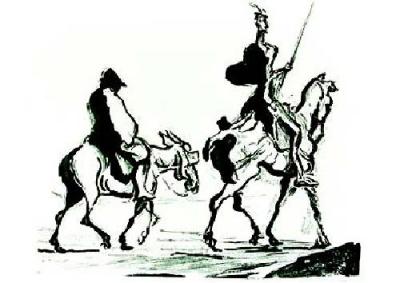
All this sort of stuff was meat and drink to writers, and readers, in C17 Spain, and clearly given the speed with which its fame spread, the rest of the Western world, but its cultural ubiquity ever since speaks to its resonance. Films, TV shows, books, songs, paintings, illustrations, tapestries, sculptures, operas, ballets, tone poems. And of course a Broadway musical in the form of The Man From La Mancha. A quick perusal of London entertainment guides will show you that in the next few weeks you can see this very musical at the ENO or, should you prefer, Marius Pepita’s ballet version at the Royal Opera House.

Whilst not quite matching the stirring cheesiness of Joe Darion and Mitch Leigh’s To Dream The Impossible Dream, this production has plenty of catchy Hispanic-inflected songs courtesy of Grant Olding and James Fenton. This does add to the somewhat episodic nature of the production, as does the need to wheel out the various sceneries, props, puppets and the like. Then again that is entirely in keeping with the tone and structure of the novel, as is so much here, and there is enough pantomime distraction to maintain momentum. The attempt to mimic the meta-theatricality of the novels by having DQ’s fame preceding him in the second half is a little stilted but, again, offers something to chew on besides the generous humour.

The set design of Robert Innes Hopkins, in common with his other recent RSC outings, has an elegant simplicity (and he does like to emphasis the vertical), and another meta touch with the giant cut-out of our hero as a backdrop, and the lighting of Mark Henderson and sound of Fergus O’Hare expertly delineates the mundane from the fanciful. Most notable however is the puppetry of Toby Olie, notably a peckish falcon, an angry lion and some convincing sheep (though maybe not quite the army that DQ sees!). Now frankly the Tourist is a bit fuzzy on the art of puppetry so he can’t be sure that the constructions signifying horse and donkey, with their human appendices, fall into the category, but they are the basis for some mighty fine entertainment.

My top ten theatre shows of 2018 … and top ten to look forward to

Right even by the standards of the drivel that the Tourist usually posts on this site this is an utter waste of your and my time. Weeks too late, built on flaky foundations of understanding and appreciation and precious little use to anyone. Except maybe me that is, as an aide memoire. You can find my thoughts on these shows elsewhere on this site, if you can be arsed.

I have also appended a list of the top ten plays, so far announced, that I am looking forward to seeing this year in a desperate attempt to beef up the content. Some marginal utility in that maybe. Or maybe not.

BTW you can, and should, see The Lehman Trilogy at the Piccadilly Theatre from May through August. You can, and really should, see Caroline, or Change at the Playhouse Theatre right now. The good people of Edinburgh can see Touching the Void and it will go to Hong Kong, Perth and Inverness before coming back to Bristol. I bet it pops up in London. And, if you are in NYC, and haven’t yet seen Network, jump to it.

  1. Network – National Theatre
  2. John – National Theatre
  3. The Wild Duck – Almeida Theatre
  4. The Lieutenant of Inishmore – Noel Coward Theatre
  5. The Writer – Almeida Theatre
  6. The Lehman Trilogy – National Theatre
  7. Touching the Void – Bristol Old Vic
  8. Julius Caesar – Bridge Theatre
  9. Death of a Salesman – Manchester Royal Exchange
  10. Caroline, or Change – Playhouse Theatre

Near misses? Girls and Boys at the Royal Court, Cheek By Jowl’s Pericles, The Phlebotomist (now coming back to the main stage at Hampstead – do not miss), Nine Night (at Trafalgar Studios from February), Quiz, Love and Information at Sheffield’s Crucible Studio, Copenhagen at Chichester, Henry V from Shakespeare at the Tobacco Factory, The Jungle (support the two Joes in their plan to put this in front of the Home Secretary !!) and The Madness Of George III at Nottingham Playhouse.

What about this year? Take your pick from these if you trust my judgement. Which would be a surprise. No particular order BTW. There’s a few big tickets missing from this (When We Have Sufficiently Tortured Each Other, All About Eve, Betrayal, All My Sons). Like I said it’s what I am most looking forward to.

  1. Sweat – Donmar Warehouse. Too late to get in now except for returns but this may well pop up elsewhere.
  2. Mother Courage and Her Children – Manchester Royal Exchange. Julie Hesmondhalgh as Brecht’s survivor.
  3. A Skull in Connemara – Oldham Coliseum. For my fix of McDonagh.
  4. Cyprus Avenue – Royal Court. Finally I will get to see this.
  5. Medea – Barbican Theatre. Internationaal Theater Amsterdam bring Simon Stone’s Euripides to London with best female actor in the world Marieke Heebink.
  6. Berberian Sound Studio – Donmar Warehouse. How the hell are they going to make this work?
  7. Top Girls – National Theatre. Caryl Churchill. Enough said.
  8. Three Sisters – Almeida Theatre. Best of the Chekhov offerings.
  9. Death of a Salesman – Young Vic. Miller, Elliott, Pierce, Clarke, Kene. Best play of 2019?
  10. Blood Wedding – Young Vic. Lorca given the Farber treatment.

Oh and Antipodes, Annie Baker’s latest. Obviously.

Anglo-Saxon Kingdoms at the British Library review *****

Anglo-Saxon Kingsdoms: Art, Word, War

British Library, 30th December 2018

I mean it isn’t all books. There are charters and letters as well. And pottery, coins, art and jewels. But there are a lot of books. Oh my word though, what beautiful books. If you are at all interested in this period of history and the formation of our country, and you like, as Tubbs would say, precious things, (which haven’t been burnt, or otherwise destroyed, notably by the dispersal of monastic libraries in the 1530s), then this is unmissable. The British Library has wheeled out some of its finest treasures from the period, Beowulf, the Lindisfarne Gospels, the St Cuthbert Gospel and Bede’s works, but it doesn’t stop there, with some extraordinary loans from the British Museum, Cathedrals (Canterbury, Durham, Exeter, Lichfield and Rochester), Oxbridge colleges (notably the Parker Library at Corpus Christi Cambridge) and generous institutions around the world (notably France, the Netherlands, Sweden and, maybe best of all, Italy).

The exhibition begins with the first Anglo-Saxons coming to Britain in the 5th century, takes us through the kingdoms that emerged, Kent, East Anglia, Northumberland, Mercia and Wessex, before England was created, as well as the continuing influence of the Danes, and, finally the Normans. We see how the history, art and literature of these Anglo-Saxon Kingdoms developed, and we see the emergence of the English language, (though don’t expect, unless you are an expert in these things, to be able to read the manuscripts. but do listen to the spoken originals and modern translations provided).

The earliest evidence of the language is contained in some cynic inscriptions and a Kentish law code in the first room, Origins. My first highlight though was the unique Spong Man urn lid from the 5th century, he looks so crestfallen, but then again so might you if you were sat atop someone’s ashes. The St Augustine Gospels from the late 6th century are something special, but the Moore Bede from the mid 8th century, copied out soon after the Venerable’s death at his own monastery Wearmouth-Jarrow, is a jaw-dropper. This is the Ecclesiastical History of the English People, the page on show tracing the journey of St Augustine, in letters. The script is pretty dense but this is basically the beginning of our written history.

The second room, Kingdoms and Conversions, has some exquisite jewellery from, amongst others, Sutton Hoo and the Staffordshire Hoard, but once again I was drawn to the scripts. The fragment of a letter from St Cyprian, bishop of Carthage, possibly from the late 4th century, brought here by Abbot Hadrian, various charters, letters and rules from the 7th and 8th centuries, the beginnings of our systems of law, and the Book of Durrow from c. 700 with its various decorative influences. These are trumped though by the beautifully preserved Echternach Gospels, maybe from Ireland, maybe Northumbria, maybe Echternach itself in Luxembourg, the even more spectacular Lindisfarne Gospels also c. 700, and, drum roll please, the Codex Amiatinus.

OMG. Now even if your are some bored teen being dragged around by your pillock of a Dad I defy you not to be impressed by this. First off, it is bloody enormous, 1030 leaves in total. Secondly the page it is open to, a full page illumination of a scribe at work, is just so vibrant and, finally, the history of the Bible itself is just so fascinating. One of three made at Wearmouth-Jarrow in the early years of the 8th century it was taken in 716 by Abbot Ceolfrith and chums to Rome. AC, poor chap, died on the way but in the 1300 years until now it has been cared for in Italy, latterly at the Biblioteca Medicea Laurenziana in Florence. Welcome home then Codex Amiatinus, if only for a short visit. It is the oldest complete Latin Vulgate version of the Bible; only the fragmentary Leon palimpsest is older. It was assumed to be Italian, from the 6th century, until some top-drawer research revealed that it was actually created during Northumbria’s Golden Age.

Take your time surrounded by these gems. There are more treasures to come but this room, for me, was the pinnacle. The next room, Mercia and Its Neighbours, details the rise of that kingdom, through military power and political skill, and the creation of a third archdiocese at Lichfield alongside York and Canterbury. Once again the Gospels (Barberini, St Chad, Harley Golden) will draw your eye, as will the Lichfield Angel if you have not see it before, but I was particularly interested in the various charters, from King Aethebald dated 736 and from King Offa dated 783, and the evidence of links with Charlemagne in mainland Europe. It made me reflect again on how the powerful choose leaders primarily to validate their own appropriation of land and capital, and spend an awful lot of time arguing with each other to secure leaders more amenable to their ambitions.

The Favourite, Richard II, C18 British history, Brexit newsflow, this exhibition. All entertainments and/or learnings on the Tourist’s plate in the last couple of weeks, all variations in part on this theme. Similarly the next room, The Rise of the West Saxons, which charts the ascendancy of King Alfred and his successors and the idea of an England. Now the Tourist cheerfully confesses that he is addicted to The Last Kingdom, the TV series now in its third season, based on Bernard Cornwall’s The Saxon Stories novels. Now it is a bit daft at times, and cheesy, and the main protagonist, Uhtred of Bebbanburg, and his mates, do, implausibly, get about a bit. He may be fictional but many of the other players on show were for real and, in David Dawson playing Alfred, it has a top-notch actor showing his class. Like I always say, take your education wherever you can.

By 880 Alfred had made peace with the Danes, who were increasingly “naturalising”, and promoted a cultural leap forward, with the development especially of the English language. This legacy continued through grandson Aelthelstan, the first King of England from 927 to 939, who claimed control of Northumbria and submission from the Scots, Welsh and remaining Britons. Aethelstan centralised government, expanded the reach of the law, founded places of religion, (his personal psalter, a pocket gospels, is on display), and got stuck into European politics. So there you are little Englanders. Even when little England first became a reality we were tied to that pesky Europe. It will never go away whatever you may think. BTW, in my final, I promise, “look at me” moment in this post, I walked past the very spot where Aethelstan was crowned not a few hours ago. Outside the police station in Kingston-upon-Thames. I kid you not.

So no surprise that I took a long look at the Council of Kingston document in the exhibition which dates from 838 and confirms the alliance between Ecgberht, Alfred’s grandad, and the Archbishop of Canterbury. The beautiful Stockholm Codex Aureus, on loan from, er, Stockholm, will also detain you but it is the famous historical documents, the Anglo-Saxon Chronicle, Asser’s Life of King Alfred, the treaty between Alfred and Guthrum the Dane, a translation from Alfred himself and the Foothill Letter from the early 10th century, the oldest letter in the English language, that require careful examination. History. Boring. Think again.

Highlights of the next room, the self-explanatory Language, Learning and Literature, include the only surviving manuscript of Beowulf, the greatest Anglo-Saxon literary relic, the Junius Manuscript, 1000 lines of Old English verse, the Old English Hexateuch, the first six books of the Bible and the Old English translation of Boethius’s Consolation of Philosophy. If your interest extends to natural sciences, medicine and mathematics then you will be fascinated by this section.

The next room, Kingdom and Church, is focussed on the elevation of the Church under King Edgar, Alfred’s great-grandson. The highlight here comes at the end with the display of the Utrecht (825), Harley (first half 11th century) and Eadwin (c. 1150), Psalters displayed side by side. Seeing how one was copied into another into another is just amazing. Prior to this though the room is stuffed full of dainties, notably the Benedictional of Aethelwold from the 970s, the Vespasian Psalter from the second quarter of the eighth century, (the earliest Biblical text in the English language), the Boulogne and, especially, Trinity Gospels and the Winchester Troper.

The final room, Conquests and Landscapes, looks at the return of the Danes under Cnut and then the Norman Conquest, culminating with the BL’s Domesday Book and a short video.

I could go on and on but no purpose would be served in this. I have my catalogue accompanying the exhibition and can safely say, as one who regularly purchases such items, (and doesn’t always look at them immediately), that this is one of the most informative, involving and attractive I have ever seen. Even the short exhibition guide is a mine of information and the notes to the exhibits themselves could not be clearer.

All in all, and given the potential bone-dry bear-trap of a subject, early English history, and exhibits, in a word books, (though there is, as I said, plenty of other material on show here), this is a triumph. Maybe not enough to persuade those for whom history and manuscripts are anathema but if you have any interest at all, from any angle, don’t hesitate. No need, as ever with these things, to dutifully read every note or take in every exhibit. But if you can’t find at least a few items that command your attention I would be amazed.

It is on until 19th February. Usual rules apply. First thing in the morning. Sunday afternoon or the later slots on Tuesday when this opens until 8pm. And avoid the last week.

Venice Baroque Orchestra and Avi Avital at Wigmore Hall review *****

Venice Baroque Orchestra, Avi Avital (mandolin)

Wigmore Hall, 22nd December 2018

  • Francesco Geminiani Concerto Grosso in D minor after Corelli’s ‘La Follia’ Op. 5 No. 12
  • Vivaldi – Concerto in D for lute and strings RV93
  • Vivaldi – Sinfonia in G RV146
  • Vivaldi – Concerto in A minor Op. 3 No. 6 RV356
  • Vivaldi – Concerto in D minor for strings RV127
  • Vivaldi – Mandolin Concerto in C RV425
  • Giovanni Paisiello – Mandolin Concerto in E flat
  • Vivaldi – Concerto in G minor for mandolin, strings and basso continuo ‘Summer’ from The Four Seasons RV315

Saturday before Christmas. Family loafing about in front of screens or head in a book. Not the Tourist though. Two plays down and on to hear one of the finest Baroque ensembles anywhere rock out with some kick-ass Vivaldi and a couple of his lesser known contemporaries. With one of the world’s finest mandolin player (mandolinist?), Israeli Avi Avital, as soloist.

However before I got there, an errand to run. Tracking down specified cosmetics for BD and LD courtesy of Father Christmas. From Selfridges. On the Saturday before Christmas. I thought everyone did their shopping on-line now. And that retailers where watching sales plummet as the Great British public collectively sh*ts itself ahead of the March madness. Or that we had reached peak stuff.

Apparently not. I was scared. I am not much of a bricks and mortars man even on a quiet Tuesday morning. This though was positively Dantean, Especially when I got to the specified concession to discover that every woman in London under the age of 25 had come to the purchasing party. In trying to track down the appropriate shade of eye shadow I was man-handled, or should that be woman-jostled, on multiple occasions. Sensing my fear a patient sales assistant took pity on me and, in an instance, she briskly completed my elementary task. For the briefest of moments I was overtaken by an excess of Christmas spirit smiling at all those around me. Seeing fear on the faces of the throng, as they sized up the scruffy, fat, ageing weirdo grinning inanely at them, I then realised it was time to scarper. Out I waddled, weaving between the happy shoppers, scuttling along Oxford Street, round the corner, through the phalanx of black Range Rovers, (if you cannot, will not or you are proscribed from using public transport why on earth do you need to be carted around in these malevolent gas guzzlers), until finally reaching the comparative calm of Wigmore Street. Tempted to let out a cry of Freedom!!! Braveheart style but the Tourist realises that might unsettle the real tourists.

Two lessons dear reader. Financialised, neo-liberal capitalism edges ever closer to eating itself in an orgy of debt-filled consumerism and the Scrooge-like greying Tourist is now happier in the company of the genteel Wigmore Hall audience that the massed ranks of the crazed hit-polloi on a retail mission.

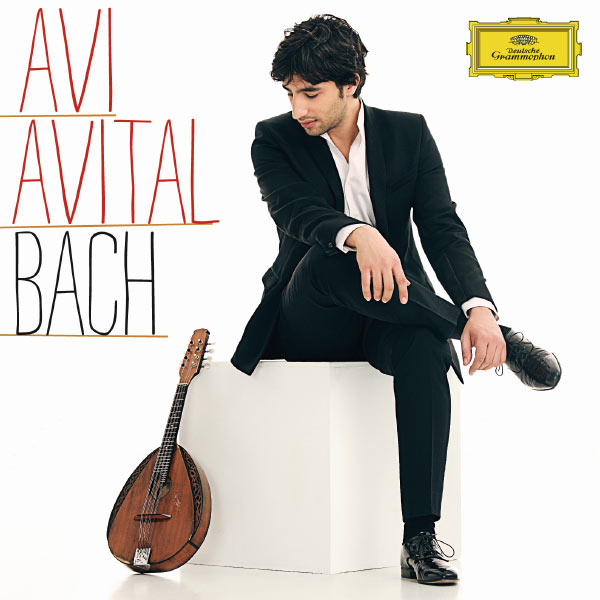
Though it turns out that the Wigmore Hall denizens are less genteel that you might imagine. For when Avi Avital came on the crowd when apeshit. OK maybe I exaggerate but ladies, and gentlemen, of a certain age definitely came out in a hot flush. For he is a good looking boy as you can see from the above, tousled-haired, tall, dark, handsome and when he gets going on his mandolin, channeling his inner rock god, it was as if Jimmy Page was back on stage at Madison Square Gardens circa 1973. OK minus the lighting rigs, dry ice, Catherine wheels, hummingbird jacket and Boeing jet round the back. Oh and he was sat on a chair somewhat curtailing the head-bang. Still there is no doubt he is a captivating performer who justified the delirious (by classical music audience standards) reaction.

Now the remaining (discovered) mandolin repertoire in the Western classical tradition, or at least that which the modern punters will pay to hear, is a little thin on the ground. (Though it is not a problem found in folk, especially, bluegrass, music). Which, perforce, limits the number of professional players. The lute, the precursor of the mandolin family, has a long and proud history in Renaissance and Baroque music, but the mandolin didn’t really take off as a solo instrument until the middle of the C18 when, most likely, the Neapolitan Vinaccia family came up with the eight stringed (in two courses) baby we know today. With strings of steel so the little fella could be heard, and then some, above the orchestra. The world has countless things of beauty to be grateful for from Italy. Not least most Western musical instruments.

Cue a burst of activity from Vivaldi and other Italian Baroque giants for the mandolin. But not much else. Beethoven had a fondness for the instrument, Mozart slipped it into Don Giovanni and a few other notables since have smuggled it into their opus list. There was a notable revival in Italy led by Rafaelle Calace in the mid C20 and the instrument has a fair following in Japanese classical music, I guess because of the sound similarity with the koto. I also see that Ligeti found a place for it in Le grande macabre: mind you he found a place for just about everything in that extraordinary masterpiece

All this means that adapting works originally scored for other instruments is par for the mandolin course. As here with Mr Avital’s own arrangement of Summer from The Four Seasons. (AA preceded this with a little patter about how he confused “Summer” with “Winter” when he was a nipper. OK so it wasn’t full on scathing Bill Hicks but it was worth a chuckle especially when you have shared that confusion).

Now I am guessing, that is if you care at all, that you either fall into the camp that believes, like the Tourist, that Vivaldi was a genius able to weave magic from short, simple repetitive musical ideas, or that he was a flashy journeyman who wrote the same arpeggio-laden riffs over and over again. Well Bach was with me even if Stravinsky wasn’t. To get the best out of AV though you need a specialist band that knows its stuff. The Venice Baroque Orchestra, along with the Concerto Italiano, Europa Galanta and Il Giardino Armonico is that band. Founder harpsichordist Andrea Marcon may have taken a back seat now but this ensemble still contains some of the very best Baroque specialists in Italy and a couple of jokers in lutenist Ivano Zanenghi and leader here, violinist Gianpiero Zanocco.

The difference is their ability to created complex harmonies, expansive dynamics and varied tempi from the apparently simple notes on the pages. Whilst, especially in the basso continuo, but also in the ripeno, tirelessly banging out thumping motoric rhythms. Vivaldi, and his Italian Baroque chums, may have worked to the principle that less is more when it comes to the length of their works but even so there is no let up, for player or listener, when the burn kicks in. Try it if you don’t believe me. Find a bog standard Four Seasons from 30 years ago churned out at a chugging medium pace by a modern orchestra that was probably rehearsing some interminable Bruckner that very afternoon, and compare it with the VBO’s “period everything” Sony recording with Giuliano Carmignola on the fiddle. See what I mean? The latter will blow your socks off, the former will likely see you popping the kettle on.

VIVALDI IS NOT BACKGROUND MUSIC AND SHOULD ON NO ACCOUNT BE PLAYED IN THE CAR. SLAP ON THE AFOREMENTIONED DISC. TURN IT UP VERRY LOUD. AND DANCE.

Giovanni Paisiello is primarily known for his operas including a setting of The Barber of Seville twenty odd years before Rossini seized his moment. He also banged out reams of scared music and a few keyboard concertos. His Mandolin Concerto was not signed but is generally accredited to him. AA really let fly here bouncing off his chair own a final flourish. Francesco Geminiani was one of the many Italian musicians who came to London in the first half of the C18 armed with an education from the master Corelli who served as the basis, with added string parts, for the Concerto grossi played here.

Vivaldi’s RV 425, the C major concerto written specifically for the mandolin, was probably the evening’s highlight. The strings, bar a few bars from the cello, play pizzicato throughout the final movement. Amazing. RV 93, pinched from the original lute, was another joy. RV 356, from L’estro armonico, was originally scored for violin so AA has substituted tremolos to replicate the long violin sustains. What a clever fellow. Of course this, as with the Winter, is always going to sound better on the violin but AA seems to me to make as good a case as is possible for his purloining.

Wonderful concert. Last entrant in my top 10 of the year. And as it turned out the highpoint before a somewhat fraught Christmas. Ho hum.

Borders (*****) and Games (****) at the Arcola Theatre review

Borders and Games

Arcola Theatre, 22nd December 2018

I had only seen one of Henry Naylor’s acclaimed plays prior to this double header and that was Angel at this very venue. That was enough to know that I like the cut of his jib. Mr Naylor, prior to writing plays, was, amongst other things, the lead writer for Spitting Image and he has, as far as I can tell, always had an acute political conscience which he is prepared to put to good use in his writing. His first play, Finding Bin Laden, was a satire on the media treatment of the 2003 invasion of Iraq, (and it is now being made into a film,) whilst his second, Hunting Diana, dealt with conspiracy theories surrounding the Princess’s untimely death.

These were showcased at the Edinburgh Fringe as were his next offerings, The Collector, set in an Iraqi jail in 2003, and then Echoes and the aforementioned Angel, to complete the trilogy, Arabian Nightmares. Echoes is a two hander which contrasts two teenage women, one a Victorian colonialist adventurer, the other a Muslim jihadist. Angel is a dramatic monologue about the Angel of Kobane, a Kurdish sniper who became a symbol of resistance against Islamic State. All three plays were multiple prize winners at Edinburgh and have gone on to tour globally as well as to the Arcola.

You kind of know what you are going to get with a play from Mr Naylor. A scrupulously researched examination of a major issue of our time, (with a particular focus on the “Middle East” to date), told from the (often juxtaposed) perspective of individuals involved which sets out to even-handedly explore cause, effect and impact. Part history, part drama, part monologue and part exposition the plays cover a lot of ground in a relatively short span but don’t lack emotional heft. There is enough surprise in terms of dialogue, which is unafraid of deploying poetic symbolism where necessary, to set alongside the unfolding stories to keep the audience on its toes, and there is plenty of opportunity in terms of movement and impersonation to test the mettle of the actors. And, of course, text-based one and two handers are cheap to stage meaning Mr Naylor’s discourse can be quickly spread, as it deserves to be.

Obviously these subjects and structures are not much use to you if your idea of theatre is feel-good musicals but if serious, but never dour, political theatre floats your boat then don’t hesitate to seek out his work.

Borders adds another dimension to HN’s oeuvre to date. Premiered in 2017 at the Gilded Balloon it is another double monologue telling the stories of Nameless, a young graffiti artist in Homs protesting the Assad regime, and Sebastian Nightingale, a photographer who makes his name with an iconic early portrait of Osama Bin Laden, but who goes on to “sell out”, clicking lame-brain celebs for big money. Graffiti specifically, and art more generally, has, I now learn, played an important role in opposition to the regime in Syria since 2011, and Assad and his supporters have brutally punished its practitioners. The story of Nameless’s courage in using her art to incite resistance, and the passion which eventually leads to her exile, is very stirring, especially because, like many of NH’s previous protagonists, she is a young woman in a patriarchal society. Sebastian’s fall from grace, as he debases his own art and principles to chase fame and money, is equally riveting.

You can guess early on that the two of them, outsider and insider, are destined to meet but HN still conjures up a thrilling end. Of course this sort of story-telling, about a conflict few of us here understand at even the most basic level, is occasionally going to have to thwack the audience over the head to get its points across but HN once again finds a way to do this without getting in the way of the personal dramas. There are laughs, quite a few in fact, which often skewer the hypocrisies of Sebastian and of the men who seek to control Nameless. The other characters, played by our two actors, have sufficient presence to go beyond ciphers, Nameless’s Mum, her “boyfriend”, his dad and the elder statesman war correspondent, Messenger, who gnaws away at Sebastian’s conscience. The stories are inevitably contrived but that is probably a necessary pre-condition for theatre with this strong a message.

It wouldn’t work without two remarkable actors and that is precisely what we have here. Now in the original Edinburgh performances, and in the subsequent worldwide tour, Nameless has been played by Avital Lvova, who took over from the sadly missed Filipa Branganca in the tour of Angel, and who is also a fearsomely talented actor. In this Arcola run however the role of Nameless was taken on by Deniz Arixenas. The crib-sheet tells me that Ms Arixenas, who is of Kurdish and Syrian descent, is currently doing her Masters degree in Law with the intention of becoming a human rights lawyer. Acting’s loss is the legal profession’s gain. However if this woman can bring an ounce of her talent on stage to the task of making the world a better place then I can be assured, alongside so many of the young people I know, that the next generation will be able to unravel the mess that my, and previous, generations’ have made of our world. I confess couldn’t take my eyes off her.

Which made Graham O’Mara’s performances as Sebastian all the more exceptional. He nailed that thing where you know that, as a rich privileged beneficiary of the institutional and economic order imposed by the West on the world since WWII, you should help those who haven’t been so lucky, but you just can’t bring yourself to do it. In a connected world where those post-war institutional structures are under pressure, where selfish ideology trumps co-operation and where I suspect, (largely suspect), arguments around the concept of “Western guilt” are likely to intensify, NH has come up with am intelligent shorthand for debate.

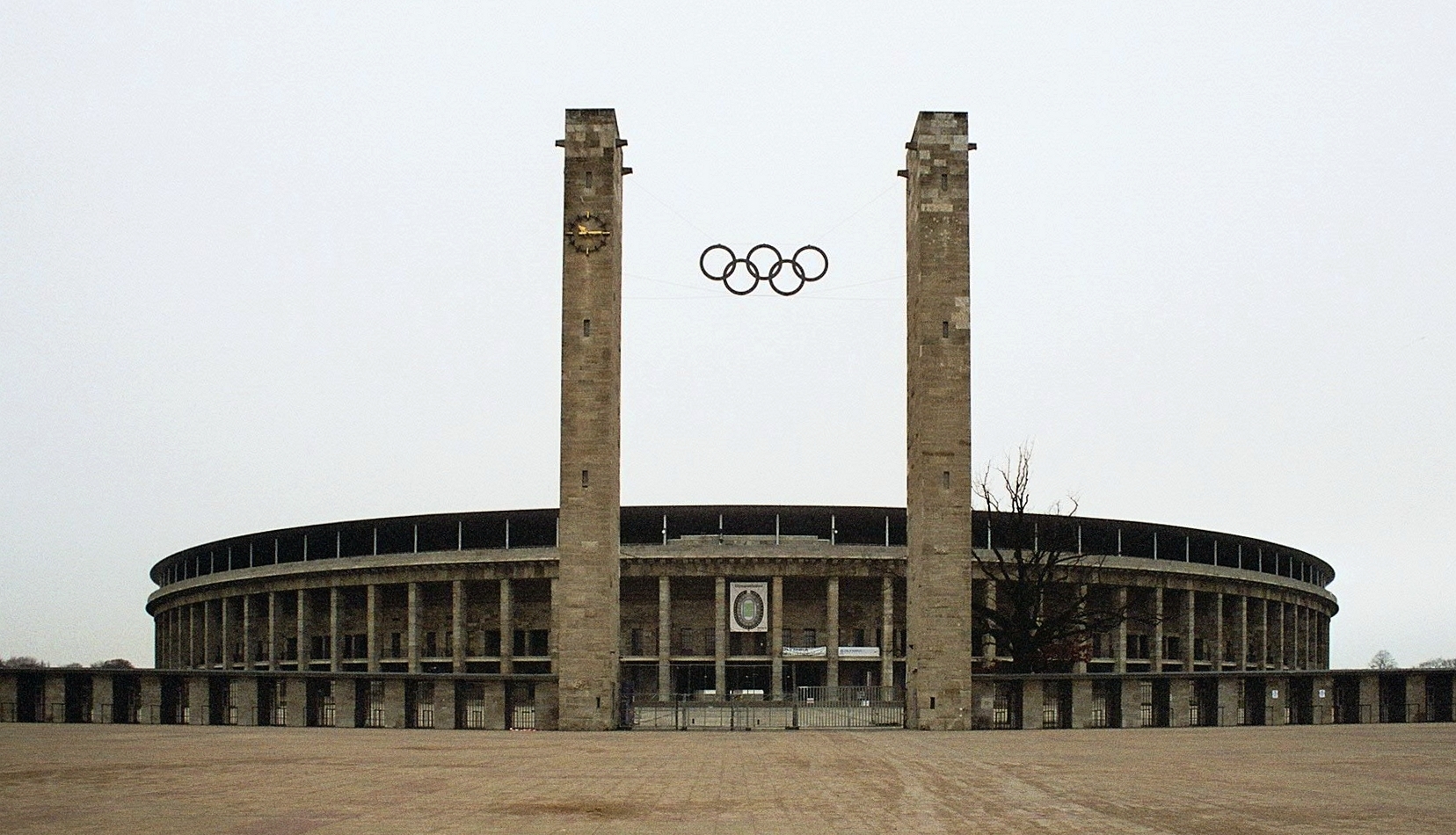
Games heads back a few decades to tell the story of German-Jewish athletes before and during the infamous 1936 Berlin Olympics (Tourist and family had a good look around the imposing stadium, now home to Hertha Berlin, last year). The two protagonists, high jumper Gretel Bergmann and fencer Helene Mayer, actually existed and the main events portrayed in the two-hander actually happened, but from this HN has woven a more nuanced debate on the nature of identity, and the iniquity of fascism, than we had any right to expect Helene Mayer won a gold medal in 1928 in Amsterdam, missed out in Los Angeles in 1932 and won silver in 1936, but despite her fame and success was still forced to leave for the US in 1935 because she was Jewish. The discrimination against Gretel Bergmann was more over,t both before the Nazis assumed power in 1933 and thereafter, as she and other Jewish athletes were denied access to training facilities, competed separately and were stripped of titles. Many left but Helene Mayer returned in 1936 to compete for Germany as the regime succumbed to pressure from the US who threatened a boycott.

Ms Mayer was an enigmatic character, whose German identity might have eclipsed her Jewish heritage and who, at least publicly, was not critical of the Nazis. She returned to Germany again in 1941and lived there until her early death in 1953. Tragic geo-political pawn or naive opportunist who put her own sporting glory above the suffering meted out to her own people? Easy to see then why HN alighted on her story, and that of Ms Bergmann, who died just a year ago aged 103, whose own resistance was implacable and who was determined to point up Hitler’s racial theories for the bollocks it was.

Maybe not quite as powerful as Borders (and Angel for that matter), and a little heavy on the biographical exposition, Games will still make you think and is surprisingly resonant on wider issues of nationalism, self-identity, and the role of politics in sport (or do I mean sport in politics), all subjects you probably thought you had a settled view on. Directed, as was Borders (in conjunction with Michael Cabot), with a confident hand by Louise Skaaping, Games has another pair of actors on top form. Sophie Shad has already written, produced and acted in Kitty’s Fortune which tells the story of a Holocaust survivor and her eagerness to tell Helene’s story shines through. She realistically captures her apparent ambiguities, internal conflicts and the impact of personal grief. Tessie Orange-Turner as Gretel has the physicality and grace of the athlete (maybe she is) and relays her character’s burning sense of injustice. In contrast to Borders the two meet on multiple occasions, Helene is Gretel’s original inspiration, but the use of the space and sparse props, (here two boxes and a flag, just two chairs in Borders), is similarly effective.

Henry Naylor has found a formula to educate us about complex political (and moral) questions without hectoring us and whilst still entertaining and moving us. And he usually brings it in at around an hour. In pretty much any space, (the credits here stop at the lighting design of Vasilis Apostolatos and stage management of Holly Curtis though I don’t doubt many others, from the research end through to the finished production at the ever welcoming Arcola, deserve credit).

I strongly advise you to hunt out more of HN’s his work. I will.

https://athomehefeelslikeatourist.blog/2017/10/07/angel-at-the-arcola-theatre-review/

The Tell-Tale Heart at the National Theatre review ***

The Tell-Tale Heart

National Theatre Dorfman, 21st December 2018

No panto for the Tourist and family. This year’s entertainment was to be Anthony Neilson’s adaptation of the (in)famous Edgar Allan Poe short story about a writer who, let us say, loses a little bit of perspective. Some concern from our party, particularly those of a nervous disposition, as it gradually dawned on them what Dad had signed them up for, but I can cheerfully report that even LD took all the on-stage frights in her stride. For Mr Neilson, who is also directing, and the rest of the creative team, of which more later, have served up plenty of suspense and, occasionally gory, illusion but it is all undercut with humour and an air of wry parody. More Inside No 9 (though not quite as clever) than Texas Chain Saw Massacre.

Now Poe’s original story runs to no more than a few pages and tells of a madman haunted by the “vulture eye” of an old man. His obsession turns to murder which he confesses in fairly short order. So a classic morality tale of crime and punishment with the twist that it is narrated by the unhinged first person. Poe built on the Gothic horror tradition created by Horace Walpole, becoming the father of the psychological horror which film-makers today can’t get enough of, and the scary eye has been a staple of creepy stuff from the dawn of human existence. Check out Odilon Redon’s famous 1883 illustration for a copy of the story shown above. But Mr Neilson was going to need a bit more than that to fill a couple of hours of stage time and to appeal to us jaded sophisticates so Poe’s story has been subjected to some substantial, and largely, successful expansion.

Tamara Lawrance (soooo good in the adaptation of Andrea Levy’s The Long Song on the Beeb recently) plays Camille (or maybe Celeste) a young writer, feted for her first play, but having a bit of difficulty following it up (an NT commission ha, ha). So she holes up in a top floor garret in Brighton, Shining style, to tackle her writer’s block. Her isolated landlady, Nora, an all-in performance from Imogen Doel, is the chatty type, at first a welcome distraction, then increasingly annoying. She comes with a bit of a macabre back-story and an ostentatious patch over one eye. It doesn’t end well.

The story is told through flash-backs and flash-forwards which also involve the copper(s) sent to investigate Nora’s disappearance. It takes a bit of time to get going, though the first half, as Camille and Nora get to, very closely, friend each other, and detective David Carlyle begins his menacing/camp interrogations, doesn’t lack for atmosphere, but the real pay-offs come in the second half, both visually, and plot-wise. Anthony Neilson is probably guilty of a few too many meta twists and references by the end(s), though it does ramp up the breathless WTF quotient, and it doesn’t entirely all hang together, but who cares when there is this much invention on stage.

For designer Frances O’Connor, together with the lighting of Nigel Edwards, the sound and composition of Nick Powell and, especially, the video work of Andrzej Goulding, and everyone in their teams, have conjured up a visual and aural feast. Of course it is artifice, and deliberately so in many cases to keep pace with the knowing tone, but it is still very effective, there are some genuine audience jumps, and, for the slightly sad members of the audience (hello Tourist), a source of endless fun in ticking off the various techniques employed. As the hair-raising manifestations of her own mental state, (or did this really happen or maybe this just a script?), mount up, Tamara Lawrance steps up, never for a moment giving less than 100% commitment. Imogen Doel, and especially David Carlyle, have more in the way of comedy to deliver, which they plainly relish, and there are even a few unsubtle, though still funny, poo-based jokes.

Anthony Nielson I gather is a bit of a one for the collaborative, workshopping approach and his, and I assume, the rest of the creative team’s itch to pack in as much as they can in terms of plot, gags, schlock and stagecraft often shows, but this is still, for the most part, a thoroughly entertaining show that doesn’t take itself too seriously.

Space Shifters exhibition at the Hayward Gallery ***

Space Shifters

Hayward Gallery, 21st December 2018

Here is another one of the cleverly constructed exhibitions from the Hayward team which brings together a variety of visual works (20 in total), in different media, from different artists which delight, intrigue and entertain. The works span some five decades, (with some new commissions), are informed by a minimalist aesthetic and look to explore our perception of space. Materials are pure and often translucent, indeed many of these works relied on advances in material technologies to become possible, forms and lines are sharp and clearly defined. There is a bit of reflection going on, as in mirroring not contemplation. If art is the manipulation of light then this is, definitively, art.

Before the refurb the gallery offered us Psycho Buildings in 2007, Invisible in 2012, Light Show in 2013 and The Human Factor in 2014. There may have been others the Tourist failed to remember. They pack in the punters, make you think and maybe smile, at least whilst you are there and make good use of the now smartened up Hayward space. Perfect for the Instagram generation.

And that, at the risk of coming across like the old buffer I am, is part of the problem. Whilst individually there are some fine works on show here, the overall effect is a little numbing and, once the novelty has passed, not entirely fulfilling. Still if you take the exhibition as you find it you will enjoy it, no doubt about that, and there maybe one or two artists whose work is sufficiently interesting, work that really does change and engage with the space around it, to make you want to seek out more.

For me those artists would have to include Richard Wilson and his installation 20-50 originally created in 1987. Now there was a bit of a queue to see 20-50 and I confess that we, for on this visit we were a large tribe, the SO, BD, LD, MSBD, TTEW and MSGS alongside the Tourist as expedition leader, frankly didn’t have time. But you must make time, for if you have not seen it then you are in for a treat. The work is doing something of a tour before it sets up in its permanent home in Tasmania where I gather a gambling millionaire has bought it. Now it used to live for many years in the various Saatchi Gallery incarnations (see above) so if you are a contemporary art buff chances are you have seen it. Whilst the outcome will vary according to its location, its function, material and meaning is essentially fixed. Wilson basically floods a room with used engine oil then builds a pier over it so that the viewer is surrounded by the oil on three sides. The mirrored reflection from the utterly smooth, viscous, velvety, unctuous surface makes it feel like you are in a doubled space, stretching down into infinity and revealing every architectural detail of the space above the surface. That surface is dark, unyielding and perfectly flat. The temptation to chuck something in is overwhelming but then so is the desire to preserve this unbroken surface. Oh and the smell is overpowering. This you won’t forget in a hurry.

Mr Wilson is all about intervening into architectural spaces. Inversions, distortions, changing scale and material. He is a big noise in contemporary British sculpture. If you like this check out Slipstream in Terminal 2 at Heathrow, Shack Stack at Grosvenor Waterside, Square the Block on the LSE at the corner of Kingsway and Sardinia Street and A Slice of Reality at Greenwich Peninsula. Readers elsewhere might find one of his public works closer to home. I would loved to have seen Turning the Place Over, Hang on Lads I’ve Got a Great Idea and Queen and Gantry. His work succeeds thanks to the audacity of the ideas, its scale, the way it questions our notions of space and function, the way it disorientates our senses, its humour and the skill and process required in its execution.

Nothing else in the exhibition really comes close. Anish Kapoor’s trademark Non-Object (Door) reflects and distorts the space and things around it including us, like an old style Hall of Mirrors at the funfair. It’s amusing though not as thoughtful as Sky Mirror, Blue on the roof of the gallery which concave, selected surface inverts and saturates in blue the reflected sky above. (The Sky Mirror outside Nottingham Playhouse is another example of the beautifully simple idea. Apparently it is Nottingham’s favourite landmark thus proving the point that contemporary civic art can induce pleasing reactions beyond the purely aesthetic).

Jeppe Hein’s 360º Illusion V is comprised of two rotating mirrors placed at right angles which creates curious double reflections of us and others. Perfect for Homo sapiens who love gawping at each other. Polish artist

Alicja Kwade’s WeltenLinie is an even more satisfying illusion, a steel frame partially filled with double sided mirrors and carefully placed objects which really does mess with our heads. Punters can and do walk into the mirrors, the artificial objects on the floor can and do change shape and colour. You know how it is happening but that doesn’t making it any less fascinating or amusing. Her Medium Median was shown at the Whitechapel Gallery a couple of years ago and was, in a different way, as equally arresting as an installation.

Monika Sosnowka is another Polish artist whose work here, Handrail, subverts interior architecture, here the humble handrail, and is wryly amusing. Larry Bell is an artist I have come across before and his Standing Walls is at the mainmast end of large scale minimalist sculpture. Literally for the purist. As is Robert Irwin’s classic, and slightly menacing, Untitled (Acrylic Column).

Roni Horn is one of a more recent generation of minimalist sculptors who uses glass, here to make a cylinder Untitled (“Everything was slipping as if the universe were a mistake”), which is both simultaneously heavy and light and, for all the world, looks like a pool of water. One of my favourites. As was Ann Veronica Janssens Magic Mirrors (Pink and #2 and Blue). Each is comprised of a shattered pane of safety glass encased by two normal glass sheets lined with filters that allow light to pass through selectively and thus throw shadows on the wall with different, changing and blurring colours. Really captivating as the number of selfies being taken attested to. I will need to check out more of her work.

A century of modernism, and now several decades of minimalism, in art, architecture, design, fashion, graphics and so on, means that we are now all pretty much programmed to embrace this aesthetic. There may be a generation that prefers velour and Toby jugs but they are on the way out. Glass, steel, perspex, resin, artificial light, saturated colours, our world is surrounded by these materials. It is work we work, where we study and where we live. We see, touch and feel spaces and objects informed by mathematics and not messy or maximalist organics. Is this what makes these art works so seductive and will this ever change? Search me.

Handel’s Messiah at the Barbican review ****

Britten Sinfonia, Britten Sinfonia Voices

Handel’s Messiah, Barbican Hall, 19th December 2018

Jacqueline Shave (violin/director), Sophie Bevan (soprano), Iestyn Davies (countertenor), Allen Clayton (tenor), Roderick Williams (baritone)

Christmas on the way. Full house at the Barbican. MSBD as wingman. Messiah. A quartet of outstanding soloists. The Britten Sinfonia Voices. The Britten Sinfonia. And the very wonderful Jacqueline Shave leading the band.

It is of course impossible not to delight in the Messiah. At least that is the received wisdom. Yet, like so much Handel, I was worried it might, well, go on a bit. For this my friends was amazingly the first ever time I had seen and heard a live performance, Which given its Baroque lineage, its status as a Christmas fixture and its frequency of performance, especially by amateur choirs, is something of a surprise even to me. I suspect its appeal to a certain sort of Englishman (and woman), of which there were plenty on show at this performance, explains part of my reticence. The type that stands for the Hallelujah chorus, showing up our shared sheepish enthusiasm for imagined tradition. (And look what a mess that has got us into). It might also be my fear (not too strong a word) of really large scale choral performance. You know, where it all just becomes and aural blur.

So I figured the best way to get over this likely unfounded prejudice was to see an appropriately scaled performance, from an orchestra, choir and soloists at the top of their game, and in the company of MSBD, whose enthusiasm and all round gracious affability knows no bounds.

Well I can report that divvying up the Christ story (with the lead actor written out as it happens) into three sections and loads of parts (I think 54 in total), arias, recitative and chorus, plus the overture and pastoral symphony instrumental, makes for a much lighter affair, with more contrast and texture, than I had expected. Of course you will already know that no doubt, but for the uninitiated, this HIP style of performance, on modern instruments, is definitely the way in. You are probably familiar with the big numbers, the aforementioned Hallelujah chorus (we are suckers for anything fugal), “I know that my redeemer liveth” for soprano, “The trumpet shall sound for bass” as well as the choruses “Surely he hath borne our grief”, “Worthy is the Lamb” and the final Amen with its OTT dramatic pause before the end. Yet to be fair to old GFH is is rammed with good tunes. Pretty much throughout.

GFH never had a problem finding good tunes. he just had a bit of a problem in stopping them. At least that is my limited experience of the operas. other oratorios and assorted vocal extracts I have heard. And it wasn’t just in the vocal music. Those organ concerti can grind on a bit. I prefer those works when the format keeps it short, sweet and long on variation. The Concerti Grossi, bits of the Latin music and some of the trio sonatas. But frankly the old boy churned out, and recycled, so much stuff that I reckon, like your man Vivaldi, it is impossible to really know where you are in any of it, so best to just let it flow.

Messiah benefits from the fact that GFH only had 24 days to turn it around. I don’t hold with all that “genius in direct group chat with God” theory of inspiration, though I can see why the original 700 strong audience at the Musick Hall in Dublin (there it is above), might have felt that way. Sometimes, whatever your skill, you are just on it. And he certainly was here. Though infamously his librettist, who sort of commissioned him, Charles Jennens, didn’t think that much of his score. Bit rich coming from a man whose text, cobbled together from bits of the St James’s Bible and Coverdale Salter, is the very definition of fruity and defiantly non-linear (though to be fair this gave GFH a chance to properly ham up his own music). Anyway the fact that GFH had to take the rich outpouring of ideas and get them down without overworking or extending them was to his, and ultimately our, advantage. And for once he didn’t, or couldn’t, nick tunes from other composers, as he was wont to do. No shame in doing that then as there isn’t now.

Of course Messiah is just an opera without sets or costumes. With a plot we likely know inside out. By 1742 GFH’s actual operas were out of fashion. The public who now turned up and paid to hear music couldn’t be doing with this expensive and drawn out entertainment. (My theory is that the royals and aristos who generally funded opera and similar such entertainments in the C17 were, like the rich have done since time immemorial, mostly just showing off and couldn’t be arsed to watch what they paid for). So the resourceful Handel yet again, a few decades late, simply nicked an idea from Italy, fitted his music to English and served it up to us Protestant Brits (and the Irish) under our then German ruler. Interesting that Jennens became GFH’s bessie and advocate, publishing all his later scores, as he originally opposed the Act of Settlement that brought the Hanoverian line to England.

And he didn’t just nick the idea of the oratorio from Italy. Some of the tunes here are lifted from Italian madrigals that he had previously written, which, together with Jenner’s eclectic libretto, explains why it doesn’t really feel that sacred. And that ultimately is its genius and what probably explains its enduring appeal.

I have said before that the Britten Sinfonia is on the way to being my favourite band, probably because of the repertoire they tackle but also because their ethos, no principal conductor or director, means they can’t. and won’t, get away with just dialling in a performance or grumpily going through the motions with a parachuted in conductor. I get the impression they choose who they work with, and what they work on. And if, as here under Jacqueline Shave, the leadership comes from one of their own, then so much the better. This means the energy they bring to performance, the direct connection with the audience and the texture they create through interpretation is second to none. Now having a professional choir of the calibre of the BS Voices under Eamonn Dougan has opened up even more opportunities.

Now GFH’s original manuscript score is for 2 trumpets, timpani, 2 oboes, 2 violins, viola, and basso continuo (cello, double bass, and harpsichord). The might have proved just a little too hair-shirt for the Barbican Hall so on this evening the BS sported the bassoon of Sarah Burnett, another cello alongside Catherine Dearnley, and another viola alongside Clare Finnimore, and a full 13 violins. Which is still, given the standard Baroque practice leaving later copyists to specify the appropriate instrumentation, as perfectly minimal a band as the work requires. With the 21 strong choir we were treated to absolute clarity with none of the blaring out using huge orchestras and choirs that started at the end of the C18 and continued through the C19. Apparently in 1857 at the Crystal Palace there was a performance with an orchestra 500 strong and a chorus of 2000. And that was not the record. Nuts.

For the bizarre thing is that the beauty of GFH’s invention lies in its restraint. His tunes are always pretty simple to understand, that is what makes them wonderful, and Messiah has a conveyor belt of terrific ideas. But GFH doesn’t feel the need to overdo with the orchestra, often surprisingly spare, and holding back, for example the trumpets and timpani until near the end. The music thus fits the text like a glove and the absence of a defining tonal scheme means that GFH can go where he will with the key to match the “emotion” in the words.

Having the soloists at either side of the stage, walking to the centre for their turns, was at first a little distracting but the payoff, each singer able to “tell”their part of the story and allowing us to focus solely on them and their voices, quickly became apparent. Now I am not smart enough to work out why, in choral works, any particular soloist is more convincing than another, it is a gut feeling, but normally there are one o0f two that stand out. Not here though. All four genuinely wowed. I remember Sophie Bevan from her performance in The Exterminating Angel. Here she had lifted time in the spotlight (not literally, this isn’t Broadway) but the was sublime. I could listen to Iestyn Davies’s countertenor all day, which trust me a few decades ago is not a phrase I thought I would ever write. He probably gets the best of the Messiah arias but even so he didn’t rest easy, ramping up the emotion. Like Mr Davies, I had heard Roderick Williams rich and dramatic baritone pretty recently, in the ENO War Requiem. Wonderful. And hearing the phrasing and virtuosity of Allen Clayton in this, rather than the recent LSO Spring Symphony, which I didn’t really get on with, was a joy.

So, I admit, I get it. Britten Sinfonia under Stephen Layton with Polyphony and two of these soloists now on order.