
Mantegna and Bellini at the National Gallery review *****

Mantegna and Bellini

National Gallery, 11th November 2018

11th November was turning into a very busy day for the Tourist. Fresh from the heady Edward Burne-Jones phantasmagoria at Tate Britain and a proper Sunday lunch, it was off to the National, now solo, for these Old Masters, before rounding off at the Barbican for a bit of choral pleasure (I realise that sounds a little dubious).

Anyway this double header was everything the Burne-Jones wasn’t. Indisputably, vibrantly, thrillingly, alive. Now I know that endless bible extracts, with Jesus suffering and the Virgin Mary looking beatific might not strike you as the stuff of reality, any more than the silly romantic legends that make up the pre-Raphaelite world, but trust me they are. The religious settings, like the music of the time, were just the templates to tell more human stories as well as create work of astonishing beauty. If the Church is the only patron, or rather religious images are what wealthy patrons require, then that is what artists will provide. Can’t buck the market. For me this very restriction on subject is what creates the conditions for supreme innovation.

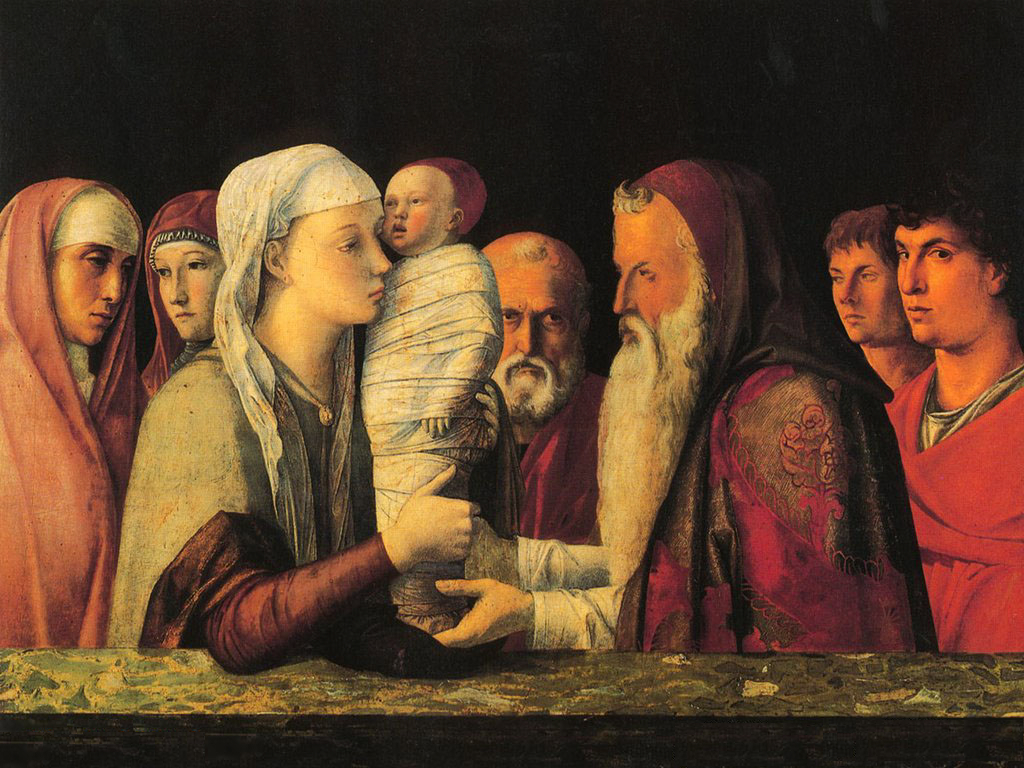
And in this exhibition we get the ultimate BOGOF. In 1453 Andrea Mantegna, already an established painter, trots in to Padua to marry Nicolosia Bellini, daughter of the venerable Jacopo, to become the brother in law of Gentile, and, our subject here, Giovanni. Giovanni, a relative novice, picks up on Andrea’s compositional experimentation and fascination with antiquity, and, in time, for me at least, overtakes him. Mantegna in turn harnesses Bellini’s facility with landscape to produce his greatest works when he moves in 1460 to the Gonzaga court in Mantua. Bellini stays in Venice, but even apart they tread similar paths, though with different results. Mantegna’s precise, flinty, sculptural, sharper, masculine, intellectual work contrasts with Giovanni Bellini’s lighter, softer, airier, more lyrical, enigmatic and emotional output. Same subjects and stories. Radically different ways of seeing and showing them

Guess which is which in the The Presentation of Christ in the Temple above? 20 years separate top from bottom. I’ll leave it to you.

This is not the only direct comparison in this superb exhibition. It would be fascinating just to play that game over a few paintings but here they just keep on coming across the six rooms. Some may be familiar to you (from the National Gallery, British Museum or Berlin museums from which they are drawn)  but it doesn’t diminish the wow factor.  Saint Sebastian, The Agony in the Garden, Crucifixions. The curators walk you through how and why the brothers-in-law created their own interpretations, which, for the interested layman is insightful, though you have to make sure, post comparison, you take the time to examine each painting individually. However there are enough individual unique subjects to offset the comparisons and avoid being overwhelmed by the scholarship.

The exhibition opens with a book of drawings. Pretty much all that remains of Daddy Jacopo’s art. We have to assume, given the importance of family and patronage in making and selling art in the C15, that Jacopo will have had a big hand in the direction of the business. He certainly kick-started the expanded artistic ideas that would emerge from the extended family. Alas this is the last we hear of him. Still the eye is probably already alighting on the two Presentations and your first starter for ten. 

What did Mantegna bequeath the next generation of the Italian Renaissance? The rise of the classical theme. The big picture. Literally in his Triumphs (of Caesar) of which just three are shown here (check them out in Hampton Court Palace when they return). Maybe the birth of the individual in art. That he was a master of perspective following in the footsteps of Masaccio and Uccello, and, in a different way, Donatello, is made pretty clear here. 

And Bellini? Colour, back-stories, people you can identify with, even if they were in deserts or on crosses or generally undergoing some sort of taxing trial or trauma. Maybe Mantegna was the more obvious influencer in his day, but Bellini, “the best Venetian painter of the C15”, may have endured for longer. I reckon I can see in him a thread through to Courbet and, eventually, the modernists. 

Mantegna imposes his narrative from without. Bellini’s flows from within. Pretentious w*ank. Maybe but fast forward to the end and compare Bellini’s OMG portrait of the Doge Leonardo Loredan, the cerulean background, the gold and silver impasto cloak, the confident, steely gaze. Perfectly lit. A very formal, contemporary portrait, that also looks timeless. In oil. Which Mantegna never used. Look then at his Minerva Expelling the Vices from the Garden of Virtue, painted in his 70’s. A complex, symbolic, Classical allegory. Intellectual to a tee. Painted for private contemplation not public edification.

Warm flesh. Cold marble. Head or heart. Fortunately in this exhibition you don’t have to choose. 

Edward Burne-Jones at Tate Britain review ****

Edward Burne Jones

Tate Britain, 11th November 2018

Turns out Burne-Jones isn’t quite as awful as I had previously thought. Don’t get me wrong. All that hippy-dippy, fey, dreamy. dusky-toned, doe-eyed, ginger-permed, long-bodied, nymph-y, mannequin-esque, briar-strewn, Arthurian, industrialisation-denying, fake-Medieval, cod-Renaissance daubing is still guaranteed to do my head in. But I will concede that he could draw. Really draw and there are details, even in the worst of the fairy-tale illustrations, that deserve a properly good look.

I can’t change my immediate reaction to art but I can try to explain it to myself. And, if I am honest, with Burne-Jones, and the rest of the original pre-Raphaelites, and their Arts and Crafts and Neo-Gothic mates, it is in part the context in which they produced their art (and design) that winds me up as much as the work itself. As with this exhibition there are elements that I can concede give me pleasure, the colour (when vamped up as in the stained glass for example), the line and form (notably in drawings, textile, church interiors, tapestries) and the belief in the power of the aesthetic. They started off with the right inspiration, the jewels, (and working practices), of the early Flemish and Italian Renaissance, (the clue is in the pre- moniker) and their vaguely humanist intention to eschew purely religious imagery is commendable. But that doesn’t excuse the lifelessness of their subjects and the utter irrelevance of their mythologies. At the end of the day Burne-Jones ended up churning out knights in armour and pretty ladies for the great and good in Victorian society; the fate of many an artist through history for sure, but these chaps ended up as the reactionaries they purported to abjure. 

The kindness of strangers, well friends in this case, may also have had an effect on my viewing. We were a big party, with the SO, who inclines to the hyper-real in art, (though understanding that paint on canvas in two dimensions could hardly be more artificial), KCK who is an admirer, BUD the ever-curious and the Blonde Bombshells, who know their artistic onions. Me banging on about the preposterous narratives in the paintings, creepy friends and family who are persistently featured (after raiding the dressing-up box), the cut and pastes from Renaissance masters, the pointlessness, introversion and body fascism of this obsession with “beauty”, the upper-class, biscuit tin sentimentality, the failure to move on or develop his art, the dodgy androgynous eroticism, the all-round sameyness, would clearly have been border-line patronising. 

Particularly since I could be found avidly staring at many of the works looking for all the world like some-one who might be enjoying them. And as I discovered that Burne-Jones was not the la-di-dah toff I had assumed but working-class and self-taught. And Jimmy Page has pitched in with his Holy Grail tapestries. Which seems apposite. Led Zep were often musically at their very best (Immigrant Song, Stairway, Achilles Last Stand, No Quarter) just as lyrically they were off with the fairies. 

What was most interesting then? The early drawings, Going to the Battle, Buondelmonte’s Wedding, the stained glass from the V&A (if you ignore the pretty faces), the various pencil studies, the bodycolour nymphs enhanced with metallic paints, King Cophetua and the Beggar Maid, The Morning of the Resurrection, Love and the Pilgrim, the Lucien Freud-like portraits, details of the Briar Rose/Sleeping Beauty and Perseus/Medusa series, The Fall of Lucifer and certain of the tapestries, like the Adoration above. Though I can’t say I “liked” these works, admired might better cover it. And much of the rest still annoyed me. 

So Burne-Jones. Sublime or ridiculous? You decide. For me he was both. Simultaneously. Conservative Victorian or symbolist visionary? Again a bit of both. Style over substance? Certainly but that is exactly what he and his peers set out to deliver I’ll warrant. I can see why people like Burne-Jones’s art. I just can’t quite see exactly what it is they like. It is, at least in the big, showy, famous works, very, very detached from any reality, yet seems to be prized by many for its verisimilitude. I have a feeling you could use Burne-Jones as the ultimate artist in one of those sociology attitude tests. All that useless beauty as Elvis (C not P) once said. 

Me? I would still rather spend a couple of hours with one van Eyck. More beauty. More skill. More reality. More meaning. More life. 

I can’t fault the curation though, Surprisingly this is the first full-scale survey in London of EBJ since 1975, amazing given his popularity, and the Tate has built handsomely on its own catalogue to give us the whole shebang. Downstairs in the tomb-like Manton St galleries. Which doesn’t suit every artist but sets EBJ’s sleepy melancholy and false colour palette off to a tee. There is a kind of cumulative surrender in seeing so many, large-scale, paintings hung together. 

And can anyone tell me who the bloke with the chiseled features and scary eyes is who keeps cropping up?