The Phlebotomist at Hampstead Theatre review *****

6757402169_67e95515f4_b

The Phlebotomist

Hampstead Theatre Downstairs, 2nd May 2018

The Phlebotomist is sold out for the rest of its runs. So you had better hope that it pitches up elsewhere, ideally with the current cast and creatives, for it really is an excellent play. There are three almighty talents on show here. Writer Ella Road in this her debut play, actor Jude Anouka who just keeps on getting better and better and director Sam Yates who proved his mettle with Glengarry Glen Ross recently, but here extracts the maximum amount of tension and drama out of what is already a smartly plotted story.

It is another one of these near future dystopian dramas, which playwrights are currently obsessed with. No real surprise there. Us liberal, luvvie types are never happier than when warning ourselves, (for we are the audience), about the impending disasters that beset us, ideally disasters precipitated by the very technologies which we benefit from most. Ella Road’s story starts with a slightly different, and I think more chilling and realistic premise, that blood samples will be used to provide a detailed genetic profile, an early prognosis of what medical conditions will impact you through your life and even your behavioural characteristics. You can avoid the test but this will impact your educational, employment, credit and relationship prospects and looks shifty. Of course taking the test, and finding out the details all wrapped up in a rating out of 10, will also impact those prospects.

Bea (Jade Anouka) is the phlebotomist, (no I didn’t know either), who administers the test. She, quite literally, bumps into Aaron, (a fine performance from Rory Fleck Byrne, a new name to me), who turns out to be a descendant of the poet Lord Tennyson. They fall in love (and look like they do such is the chemistry between them). Turns out they both have high scores. Char, Bea’s friend, (a spirited Cherrelle Skeete, also new to me), does not and she abandons her career to campaign against the system, after an attempt at deception. The only other character is David (Vincent Ebrahim) a softly spoken, sagacious porter at the hospital Bea works in.

I won’t elaborate. Suffice to say that Ella Road provides enough disclosures to keep the plot moving along but not too many to raise eyebrows. The world she conjures up cleverly eschews compulsion, there is no evil state organ here, implying benign, market driven compliance, (as with so many informational threats to our privacy). Avoidance and manipulation of the test results are, rightly, key elements of the plot. It all feels very real. It asks some big questions, even tackling the stain of eugenics, but never, ever, appears didactic. How much should we know about our genetic make-up? Should this ever be made public? How “perfect” do we want to be? Ms Road has an unmistakeable view but ensures all three main characters elicit our sympathy.

The dialogue between those characters is believable, the monologues perfectly placed, there is humour and there is even a memorable tomato based metaphor (you’ll see). It is something that Charlie Brooker and the Black Mirror team would have been proud to come up with, but this is achieved without their giant budget, and, I think, has far more emotional clout. Rosanna Vize offers a simple, grey transverse set at the HT Downstairs, a few chairs and other props. Zoe Spurr’s lighting and Alex Twiselton’s sound are similarly economic but very effective. Costume changes are effected on-stage. The production is helped enormously by Duncan McLean’s snappy video work which offers social and political context so that the play, which at its heart, is a story about the relationships between Bea and Aaron, and Bea and Char, is never overwhelmed by its central conceit.

Jade Anouka was mesmerising in the Phyllida Lloyd Donmar Warehouse Shakespeare trilogy, as Ariel, as Mark Antony and as Hotspur. She was the only saving grace in the otherwise execrable Jamie Lloyd Faustus. You may have seen her in the recent ITV production of the Trauma, by Mike Bartlett. She was the daughter of Adrian Lester’s high-flying surgeon. When John Simm, who plays the embittered father of one of Mr Lester’s patients, invades the family home, her fear jumps through the screen into your living room. (How Mike Bartlett keeps getting away with these electrically charged finales verging on the melodramatic beats me, but he does).

Up close as here, she is bloody marvellous to watch. A completely natural performer. Not to decry her three colleagues but it is difficult to take your eyes off her. Sam Yates does seem to have a knack of ensuring that great stage actors, (and I am putting Ms Anouka in that category), are great on stage. Not as easy as it sounds. I offer the evidence of, especially, Christian Slater, but also Robert Glenister, Stanley Townsend and Don Warrington in Glengarry Glen Ross at the Playhouse (Glengarry Glen Ross at the Playhouse Theatre review ****), Emily Barber in The Globe Cymbeline, Jane Horrocks in East is East, his collaboration with Ruth Wilson. Why he hasn’t been offered a big gig at the National is a mystery to me.


Pressure at the Park Theatre review ***

2048px-aerographer27s_mate_3_and_2_28197629_281791888562629

Pressure

Park Theatre, 26th April 2018

I had high hopes for Pressure. I have said before that the Park Theatre has a knack of mounting a wide array of productions, which, on paper at least, sound interesting, though execution can be variable. If I am honest Pressure, initially, wasn’t one of them. But the reviews from previous performances in Edinburgh and Chichester and the presence as writer, and performer, of David Haig, and the Park’s always jolly atmosphere, reeled me in. When it transpired that the production was transferring to the West End, (the Ambassador’s Theatre from, in a nod to its content, the 6th June), I confess to feeling inwardly smug that I had got in early, along with the full houses which the Park has secured.

Talking of smug, and I mean this in the nicest possible way, there is a faint air of the self-satisfied about Mr Haig’s performances. Most recently I have seen him play the arrogant, borderline racist Dr Robert Smith in the Young Vic’s revival of Joe Penhall’s marvellous play Blue/Orange alongside some blokes called Daniel Kaluuya and Luke Norris who you might know. Let us hope Mr Penhall’s latest offering, Mood Music, at the Old Vic matches this. He also played the enigmatic Player in the said Old Vic’s recent Rosencrantz and Guildenstern Are Dead. In both cases, and in some of his telly roles, he nails down the patronising pomposity of a certain type of middle-aged Brit expert, whilst revealing any vulnerability or desperation that might lie behind the surface.

I am sure that, outside work, he could not be more different, though his writing, the text of Pressure is intimidatingly exact in terms of directions, suggests otherwise. Regardless, what I can say is that when he gets his teeth into a character there are few more stirring sights than Mr Haig in full flow. So if I tell you that he has written a dramatic account of the real life contribution of meteorologist, Group Captain James Stagg, to the D Day invasion on June 6th 1944, it will likely not come as too much of a surprise. GC Stagg, on this account, was a dour, uncompromising Scot, who staked his reputation on convincing the Supreme Allied Commander General Eisenhower, here played by Malcolm Sinclair, to first hold off, and then go ahead with the invasion plans, despite apparently overwhelming evidence to the contrary and the opinion of his breezy American counterpart Colonel Irving P Krick (Philip Cairns).

It would have made a gripping black and white film in the 1950s or even a one off TV drama today. And that, in part, is something of its problem. It is a powerful story, but, once the die is cast, it is theatrically predictable and Mr Haig presents it that way. The pressure on GC Stagg is, compounded by his wife’s troubled pregnancy. The isobars on the charts measure pressure. We see the pressure mount on Eisenhower as he makes his fateful decisions. There are no real surprises in what the characters do or say and there are times when they verge on cliche.

On the other hand Mr Haig has wisely introduced a major female role in the form of Kay Summersby, the aide-de-camp to Eisenhower. She is played with clip-vowelled exactitude by Laura Rodgers, who I admired in Rules for Living at the Rose Kingston and Winter Solstice at the Orange Tree, (a play that continues to linger long in the mind). Malcolm Sinclair as Eisenhower is also impressive though I have no idea what the man himself was like, and the rest of the cast lend solid support. Director John Dove has collaborated with Mr Haig before on his most famous play (and film) My Boy Jack, based on the relationship between Rudyard Kipling and his son, so doesn’t mess about with Mr Haig’s story.

I appreciate that I am sounding a bit sniffy about Pressure. I don’t mean to be. It is, in its own conventional way, very effective and David Haig turns in an exemplary performance. If this sounds like your sort of thing then don’t hesitate to get down to the Ambassador’s.


Instructions For Correct Assembly at the Royal Court Theatre review ****

technology-2025795_1920

Instructions For Correct Assembly

Royal Court Theatre, 23rd April 2018

I was much taken with Thomas Eccleshare’s previous outing, Heather, on a recent outing at the Bush Theatre (Heather at the Bush Theatre review *****). Instructions for Correct Assembly looked similarly intriguing and, much to my surprise, I manage to rope in both the SO and the Blonde Bombshells to hold my hand. Well I can report that satire IFCA is well worth a viewing even if Mr Eccleshare doesn’t seem to fully explore the ramifications of the imaginative scenario he conjures. Mind you what do I know. I am so dull I couldn’t even come up with an idea one tenth as good and then wouldn’t know what to do with it anyway.

Hari, played by Mark Bonnar, who I guarantee you will know from the telly, and Max, Jane Horrocks, who needs no introduction, are keen to have a second shot at parenthood. Only this time they are taking no chances and opt for a technological solution. An off the shelf AI robot in kit form, think IKEA, which they are trying to put together in the opening scene, whose behaviour, emotions and attitudes can be altered by remote control. The result, Jan, as we soon find out, is the spitting image of their human son, Nick, who, let’s say, didn’t quite meet their expectations. I’ll say no more but the set up provides plenty of opportunity for wicked humour, particularly when Nick’s failings are set against the achievements of Amy (Shaniqua Okwok), daughter of next door neighbours bragging Laurie (Michele Austin) and condescending Paul (Jason Barnett). It also examines the relationship between parents and their children as they turn into adults and specifically what happens when someone “throws their life away” as Nick does on drugs. Would we really want, need or trust technology to help us make perfect kids and what should we do when the real thing fails to live up to our hopes and dreams?

What really makes the play come to life, as it were, is Brian Vernel’s performance as Jan/Nick. I was much impressed by young Mr Vernel’s performance as Konstantin in Sean Holmes’s erratic Seagull at the Lyric (The Seagull at the Lyric Hammersmith review ***), a production which I think in retrospect was better than I gave it credit for. He also stood out in the otherwise disappointing Future Conditional at the Old Vic as well as on the telly (David Hare’s Collateral and in the Last Kingdom, which I was addicted to). He has a slightly other-worldly quality, which, unsurprisingly, fits the bill here, but can turn convincingly nasty when required. Here, as he shifted between a desperate Nick and the machine Jan he was tremendous.

The set design of Cai Dyfan is the other star of the show, as a narrow window into Hari’s and Max’s suburban home, complete with conveyor belt of parts as they put Jan together, opens up in subsequent scenes before metaphorically collapsing again into the finale. This is an enterprising solution to Mr Eccleshare’s text which calls for a lot of different rooms and fairly rapid switches between them. The visual trickery courtesy of illusionist Paul Kieve is similarly eye-catching. Hamish Pirie’s direction is geared to making the most of the clever set pieces even if he can’t quite work out a way to fully realise the emotional torments that the plot should realise. We can only assume that Nick turned into the person he was in part because of Max and Hari’s influence and that their doomed attempt at redemption reflects their guilt. There is not enough in the play though to make this connection. The whole may be somewhat less than the sum of the parts, as it were.

Even so it gets its points across, is often wryly amusing, the dinner party scene in particular, and doesn’t outstay its welcome as some “dystopian satire'” plays are prone to do. The SO and the Blonde Bombshells were more than satisfied with their outing and I await Thomas Eccleshare’s next writing move (he is also a founder of visual theatre company Dancing Brick with his partner Valentina Ceschi) with interest. Meanwhile I humbly recommend you pop along to this

Much Ado About Nothing at the Rose Kingston review ****

1024px-howard281828-3329_shakspeare2c_much_ado_about_nothing_vol12c_p219

Much Ado About Nothing

Rose Theatre Kingston, 20th April 2018

Come on fellow residents of the Royal Borough of Kingston and London Borough of Richmond – both upon Thames. Get your collective arses over to the Rose Theatre to see this new version of Much Ado About Nothing, celebrating the 10th anniversary of your local theatre. There are plenty of tickets left for the last handful of performances. It is not perfect but when it is funny, it is very funny, the setting is intriguing, there are a handful of strong performances, including the star turn Mel Giedroyc, and, in John Hopkins’s Benedick, there is Shakespearean comic acting to rival the very best.

Now I will admit that the main draw for BD, LD, myself, and latterly MS, was Ms Giedroyc herself. Obviously she is a national treasure and we have collectively seen her memorably translate her inimitable style, arch covers it, to the reading of Agatha Christie. Play, proximity and support for the local theatre was enough justification for me, but LD especially needed the hook of her off the telly. LD is probably a bellwether teen, suspicious of Shakespeare, unless forced to consume at school, and then normally pleasantly surprised when Dad mugs her into coming along, usually through vague subterfuge. And she thoroughly enjoyed this. It doesn’t mean a trip to an uncut Lear is just round the corner. Just saying that if it is good enough to entertain her it is good enough to entertain anyone who might be dubious about the Bard.

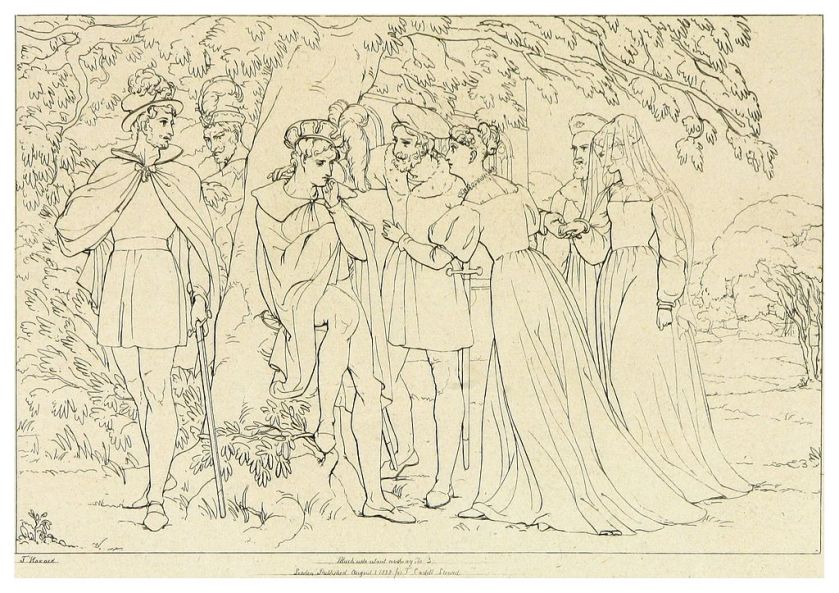
Moreover, this production, jointly staged with Granville and Parnham and Antic Face, rattles through the action so that we are all done and dusted in under 150 minutes inc. interval. That’s including a several minute intro as we are, just so we know, introduced to the resort hotel in a set shrewdly realised by Naomi Dawson. This is modern day Sicily and Leonato’s estate is now a luxury spa to which Peter Guinness’s suitably intimidating mafioso Don Pedro and crew have retired for a bit of rest, relaxation and intimidation. Suffice to say it looked nothing like the bucolic MAAN in the drawing above.

Director Simon Dormandy’s ideas do, fitfully, generate some insight, notably in the way that Kate Lamb’s Hero and Calam Lynch’s Claudio are so precipitously thrust together, in the fancy dress party which permits the romantic plotting, in the wedding scenes and, especially, in Hero’s fake funeral. Here the juxtaposition of modern sophistication with older, deeper, paternalistic traditions is most striking. We love Sicily, (well I do especially), but Sicilians are a wary bunch, unsurprising given colonisations by Phoenicians, Greeks, Romans, Vandals, Ostrogoths, Byzantines, Muslims, Vikings, Normans, Germans, French, Spanish, Italians, Mafia and Tourists. Mind you that is what is makes it endlessly fascinating to the outsider.

On the other hand there are times when the hotel set is a limitation, most notably for the Watch, though frankly that never works, even with Stewart Wright doing his very best as Dogberry. And, let’s face it, most people see MAAN for the comedy, specifically Beatrice and Benedick sparring. Mel, as customer services manager for the hotel and Mr Hopkins, as an unlikely consigliere to Don Pedro, deliver. Ms Giedroyc, is funny, we know that, and exactly the right sort of funny, and doesn’t hold back from mugging to the audience. When she needs to show Beatrice’s independence, and specifically her revulsion at the patriarchal conceits around her, she also shows she can seriously act. John Hopkins however is a cut above, the physical humour matches his brilliant delivery of the text. Their early disdain for each other is done snappily enough, with some evidence of their back story, but it is when they get serious about each other that they hit the heights. Mel’s immediate retort of “kill him” when asked by Mr Hopkins what Benedick could do for Beatrice to right the wrong Claudio has inflicted on Hero, got the laugh, but the audience was palpably nervous. It is their respective eavesdropping scenes which still the show: pure farce, but why not if it makes us happy.

We were taken with young Calum Lynch as Claudio on his professional debut, especially LD, and especially when his top came off. There was a harsh streak in him, where required, to balance the skittish wooing. Kate Lamb presented an initially diffident Hero but bristled wth anger as her reputation was impugned. Peter Bray, rather disconcertingly played Don John as a somewhat dim East London thug; in contrast his Clerk was more Home Counties solicitor. David Rintoul as Leonato, now hotel manager, was alternately brutal and oleaginous. Fine support elsewhere includes Nicholas Prassad as Borachio and Victoria Hamnett as Margaret conjuring up a saucy scene involving Hero’s wedding dress that provides a not unreasonable explanation for the mistaken identity window scene which leads to Hero’s “disgrace”.

There have been, and will be, sharper, richer versions of MAAN, Christopher Luscombe’s recent RSC production for example, but if you want some straightforward easy on the ear and eye Shakespeare comedy, Kingston, for the rest of this week, is the place to be.


Pericles, Prince de Tyr at Silk Street Theatre review *****

Pericles_Pio-Clementino_Inv269_n2

Pericles, Prince de Tyr

Barbican Silk Street Theatre, 19th April 2018

Trust me. You can trust experts. Parading your own ignorance against all the evidence of those who know more than you, just to satisfy your own prejudice, is an ugly human foible. In the very small commercial world of which I was once a part I like to think I knew what I was talking about. When it comes to theatre though I am no expert and you should always seek out the opinions of professional reviewers who do know their onions, as I do. If they think it is very good, it is normally very good, if best avoided, ditto.

In the case of this Cheek by Jowl production though, at their usual London home on Silk Street, it seems that the experts didn’t quite know what to make of it and certainly couldn’t agree. You can safely ignore me, and I recognise I am a pretty easy date theatrically, but I though it was tremendous.

This is the French company affiliate of Declan Donnellan and Nick Ormerod’s Cheek by Jowl empire. There is also a Russian branch. If you want theatre classics, reinterpreted with intelligence, wit and invention, there is no better port of call, (an early Pericles reference for you dear reader), than Cheek by Jowl. But “Shakespeare, in French, in London, what’s that all about Dad, isn’t that too much of a pose even by your standards” to paraphrase LD? Well, it is certainly a different experience, and Shakespeare is about so much more than the words, though I’m not an idiot, I know how important those words are. So a crack ensemble of Gallic thespians, whose previous productions of Ubu Roi and Andromaque did the business, according to them experts, wasn’t to be missed.

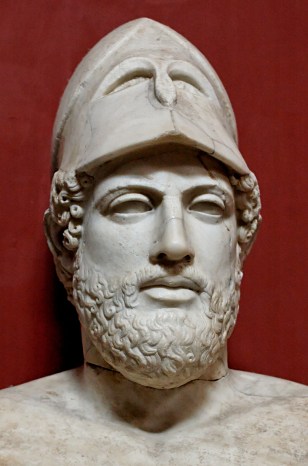
Now Pericles the play, if not the man himself shown above sporting a beard any denizen of Haggerston would be proud of, is a tricky customer. The first couple of acts were written by another bloke, George Wilkins, you can see the join before Will Shakespeare’s acuity becomes apparent, and it really is a rum old plot, written to excite the punters, rather than to make sense. It is a kind of road trip, by sea, of a bloke and his family who keep finding themselves in the wrong place at the wrong time, before it all turns out, improbably, alright in the end. And, as if it wasn’t confusing enough, Messrs Donellan and Ormerod have come up with the cunning idea of locating it all in a hospital ward and, therefore, largely in the mind of patient Pericles.

Apparently they are not the first to come up with this wheeze, but, for me, it was a triumph. They have taken a scalpel to the play’s wilder linguistic excesses, which, with the French translation, sur-titled for bumpkins like me, means it gallops through the story in an unbroken 100 minutes. It can take over three hours normally. It will be interesting to see what the NT comes up with in its forthcoming musical production of the play mixing up an amateur and professional cast.

Now with a story this silly you need your wits about you, especially since the seven strong cast each play at least 3 parts, and the helpful narrator, Gower, in the standard text has been cast adrift. This production, more than ever, supports the Tourist’s contention that it is always worth boning up on the synopsis ahead of any Shakespeare viewing, however many times you have seen the play. No need to treat it like GCSE revision, just a quick reminder of the story will suffice. Then you can focus on performance, spectacle, language, emotion, big Will’s uncanny insight into the human condition, or whatever else takes your fancy. Here, because of the lingo, I could savour the non-verbal communication of all the cast, and the way, they shifted character, and the ingenuity of the production as we shifted between the hospital room and the delusions inside our Prince’s head.

The floor and walls of Nick Ormerod’s set are a vivid, turquoise blue, enhanced by Pascal Noel’s understated lighting design. It was similar to the effect conjured up at the Gate in last year’s intriguing The Unknown Island, that too signalling all things oceanic and marine. The room is filled with hospital details, right the way down to the anti-bacterial hand-wash that the actors take advantage of on entry and exit. Always nice to see a production that cares about hygiene. This hospital room is unlike anything you might see in the creaking NHS though, or even a private hospital, being big enough to accommodate all of Pericles’s family as well as the action from all the exotic Mediterranean locations, Antioch, Tyre, Tarsus, Pentapolis, Ephesus and Mytilene.

(Having said that my one experience of the French healthcare system suggests such luxury might be possible. LD broke her arm pony-riding when she was little, the denouement in a holiday from hell. Very disappointing gite, terrible weather, mother in law crocked her back, dead rat in the swimming pool. The SO stayed with our brave little soldier in hospital, but, carless, a taxi was provisioned for me, by said hospital, so that I could visit prior to her being discharged. Unfortunately my idiocy, and criminal lack of French conversation, saw me dropped down in the wrong wing of the well-appointed hospital. Correct room number though. You can imagine the surprise, nay horror, of the poor French woman, in the early stages of labour, when I popped my head round the door. Mortified I make a rapid exit, mumbling my “pardons”. before I eventually found the right wife and patient. In all the confusion though I do remember the generous size of the room my petrified mon nouveau amie occupied).

Back to Pericles. Our hero, played magnificently by Christophe Gregoire, is asleep in his bed with talk radio humming in the background. He has the gaunt and fevered look of a man prone to psychotic episodes, probably enhanced by powerful medication. The doctor, played by Cecile Leterme, similarly impressive, is doing her rounds. Wife, daughter and friend are watching over him. Cue the first dream/delusion as we kick off with Antiochus (Xavier Boffier) and his rubbish riddle confessing to incest. Like I say you can check out the rest of your story but given that M. Gregoire doubles up as the duplicitous Cleon, Governor of Tarsus, who with wife Dionysa, plot to kill Pericles’s daughter Marina, after he has entrusted her to their care, you need to be on your mettle. He also ends up as the Master of the brothel that Marina escapes to. Meanwhile Mme Leterme, goes one role further, playing the physician, obviously, Cerimon, who revives the half-dead Thaisa, Pericles’s wife, who, he has agreed, should be chucked overboard during shipwreck number two (you read that right). She also plays Simonide, King of Pentapolis and Dad to Thaisa, whose hand Pericles wins through martial derring-do. Oh and goddess Diana, whose temple Thaisa retreats to when she thinks hubby is dead and daughter was never born.

All up to speed. Well Xavier Boffett, also plays Lysimaque, the Governor of Mytilene, brothel town remember, (of which he is a regular patron until swerved by Marina’s saintly virtue), and who brings father and daughter back together at the end. As well as the servant to the Master of the brothel and to bad Dionysa. Who in turn is played by Camille Cayol, in addition to wife, Thaisa, and the Mistress of the brothel. Valentine Catzeflis, thankfully just plays daughter Marina, and, briefly, Antiiochus’s abused daughter. To round things off Guillaume Pottier and Martin Nikonoff step up as various gentlemen, fishermen and knights, without whom the plot wouldn’t make sense (!!!).

In between the Pericleian adventure scenes, even in their truncated form, we have periods of silence when we are back in the (hospital) room, magic suspended, as well as scenes, where Pericles’s delusions are happening in “reality” as opposed to just in his head. Making all of this hang together is an act of imagination on the part of Declan Donellan which rivals that of George Wilkins and William Shakespeare in the first place.

And, for me, it really works. Obviously you lose the Tempest style fantasy from such an interpretation and location. But remember when this was written (1607/08 is the generally accepted date) the audience’s demand for special effects could be accomplished with a few bits of wood, a bit of glue, some pulleys, candles and distraction. If you are going to take a modern, hard-bitten audience, used to films, games and even funny helmets, where technology can conjure up any universe you like, on a believable stage version of Pericles’s journey, you’ll have your work cut out. Look at the technological lengths the RSC went to last year with its holographic Ariel in the Tempest to drag in the kids.

Even if this production eschewed such a journey there was still buckets of theatre-craft, and magic, on show, but it came from the ingenuity of matching the “action” in the play to the setting. The first storm kicks off with Pericles pouring a bed-pan over his head for example, not the only laugh here. The tournament where Pericles wins the hand of Thaisa is conveyed in the corridor behind the room as the orderlies try to pin down Pericles who has gone properly bat-shit. Thaisa’s revival sees her emerging from a body bag on a hospital trolley having been rushed off stage previously in childbirth.

This doesn’t make a lot of sense which ever way you look at it, so why not, literally, make it a dream play, or more exactly a succession of dream plays. And then wait for this supremely talented cast rise to the challenge of condensing character and plot into the transitions the concept afforded. The most powerful scene, and the one all this misadventure builds up to, is the reunion of father, daughter and wife, and I thought it was terrifically moving. If our patient Pericles thinks he is going to die, as it seems here, and therefore lose his family, then the parallels with our Prince Pericles, similarly imperilled, do, sort of, make sense.

Like I say, this may not be for everyone, and is a long way from what you might call, classic Pericles. Then again it is seldom performed probably because, a bit like Cymbeline, it is pretty daft and tricky to swallow. Hidden within, actually not really hidden, the byzantine, travelogue, plot, the stock scenes, the potential coups des theatre, and despite the mangling of Mr Wilkins at the outset, who is more concerned with soapy plot turns that character development, there is some balls out Shakespeare which properly entertains and moves. With a play this highly stylised why not overlay with one more layer of stylisation in an attempt to create a consistent narrative thread.

There is at least one person who cannot wait for next visit from Cheek by Jowl, in whatever language.