

The Wolves at the Theatre Royal Stratford East review ****

soccer-1392175_1920

The Wolves

Theatre Royal Stratford East, 26th October 2018

…. or 3 stars if you would prefer the opinion of LD which may be more relevant since she should have a greater affinity with the subjects of Sarah DeLappe’s novel debut play. The SO similarly enjoyed the production but was less enthusiastic than the Tourist. Thus proving that association with the subject/object in theatre may not always be the best indicator of potential satisfaction.

It was very heartening to see a full, and young, house at TRSE drawn in, I would guess by the subject, and by the reputation of the play. I have remarked before on just how attractively Nadia Fall’s first season as AD at the TRSE is shaping up what with this, The Village just gone, and The Unreturning (by Anna Jordan and produced by Frantic Assembly), Equus (from English Touring Theatre) and August Wilson’s King Hedley II (with Lenny Henry), to come.

So what’s to like about The Wolves. First off the subject. 9 diverse young women who are part of an indoor soccer (that’s football to you and me) team in middle, middle America. Second the dialogue. Their animated conversations centre on what is important in their lives. School, families, relationships, futures, politics, emotions, well-being, fears, frustrations. With 9 characters across 90 minutes, each carrying some specific trait relevant to their age and gender it was probably too much to ask that they become fully rounded individuals, but I certainly wanted to hear them. We laugh with, not at them, adult perspectives are peripheral, and the specifics of identity, obstacle and dilemma are not rammed down our throats. Not wives, not daughters, not girlfriends, not objectified, not victims.

This the play, with one minor exception, sails through the Bechdel test: there are other new plays emerging which featured strong, determined young women, but they are still few and far between. At least it would sail through the test if the women were named. For Sarah DeLappe has deliberately eschewed giving the women names, instead they refer to their kit numbers. This, together with the fact that each scene is played out during their warm-ups ahead of their competitive games, complete with movement guided by Ayse Tashkiran and ball skills courtesy of West Ham, (no comment from this Spurs fan), creates an echo of the military boot camp at the outset of a war movie, as Sarah DeLappe intended. Without of course the violence and toxic masculinity.

Rosie Elnile’s set, artificial turf enveloped by bright green inflatable walls, is striking, though this and the bright lighting and abrupt sound of Joshua Pharo and the Ringham brothers, brings a harshness which detracts from the musicality of the movement and dialogue. There is no connection to a world out there, (their grasp of global geo-politics is deliberately restricted), not a problem for yours truly, but this is I think what left LD a little perplexed. There is a plot of sorts, new player turns up to unsettle the equilibrium of the team, and a twist at the end, but even a director of Ellen McDougall’s imagination, cannot quite prevent it from feeling a little contrived and tacked on.

Now I am a shocker for identifying the authenticity of accents. I fake a bit of Mockney to make myself feel more “working-class” which is truly pathetic, and deep down, you can still hear the Devonian roots in me straining to get out, but I am about as boringly Home Counties as it gets. So, for the first couple of scenes, I was convinced that the cast was the real deal having come over en masse for the run. Nonsense obviously, made more so when it dawned on me that I had seen several of the actors before: Seraphina Beh (Leave Taking and Parliament Square at the Bush), Nina Bowers (Twilight at the Gate), Rosie Sheehy (Escape the Scaffold and The Hairy Ape) and Rosabell Laurenti-Sellers (at the Guildhall where she trained). They, and the rest of the cast, Annabel Baldwin, Lauren Grace, Francesca Henry, Shalisha James-Davis and Hannah Jarrett-Scott, were just so convincingly American, thanks to Michaela Kennen’s voice guidance. Preserving the balance of the ensemble, whilst sketching out the characters and, to paraphrase the mighty Harry Redknapp, “f*cking running around a bit”, is an exacting challenge but each and every one of the cast rose to it.

So for me a success because I got to see into an unfamiliar, yet recognisable, place in a witty and dynamic way. Maybe less interesting to LD precisely because it is familiar, in which case the fact that the story doesn’t really go anywhere, and the various “secrets” that are revealed about each of the young women are never properly developed, was more of a drawback. Team sport as metaphor for life is beyond cliche but Ms DeLappe has smartly subverted the trope by omitting victory or defeat. I will be very interested to see where she goes next.

 

Leave Taking at the Bush Theatre review *****

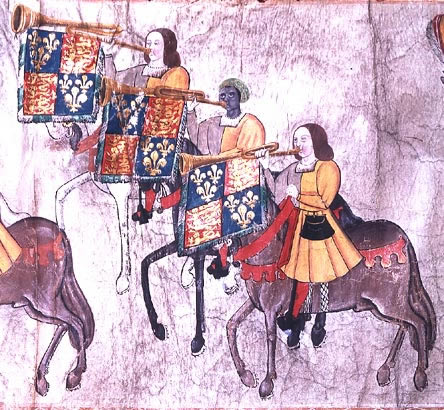
black_trumpeter_at_henry_viii27s_tournament

Leave Taking

Bush Theatre, 13th June 2018

I confess I had never heard of Winsome Pinnock’s 1987 play Leave Taking until this season’s announcement for the Bush. Shocking for someone who considers themselves to be a theatre obsessive. I still have so much to learn.

Still theatre is always the best way to confront ignorance and so it proved here. Leave Taking deals, amongst many other things, with the Black British experience, and specifically the experience of those whose heritage is rooted in Jamaica. In that regard it foreshadowed, and inspired, Natasha Gordon’s excellent Nine Night at the National Theatre recently (Nine Night at the National Theatre review *****) and, like Nine Night, it used comedy to telling effect to entertain and to make its points about the dissonant experiences of first, and subsequent, generation British-Jamaicans. Unlike Nine Night however, it was not overstuffed with plot-lines and the story was confined to, effectively, one family. It might just be, therefore, a stronger play. Definitely a must see – if not this time at the next revival, for there will surely be one.

(BTW Nine Night is transferring to Trafalgar Studios for December and January and must be seen if you haven’t already).

Also before I start warbling on about the Leave Taking I would also highlight the excellent BBC documentary Black and British: A Forgotten History. I guess it will pop up on I Player one day. If so take a look. You will learn a lot. Black Britons have been part of our shared history since Roman times. The picture above, featuring a black trumpeter is from an illuminated manuscript from 1511.

Enid (Sarah Niles), having emigrated from Jamaica, is a single parent living in North London with her daughters, the studious Viv (Nicholle Cherrie) and the restless Del (Seraphina Beh). Brod (Wil Johnson), Enid’s brother-in-law, (her husband abandoned his family long ago), is a frequent visitor. The play opens with Enid taking the girls to see Mai (Adjoa Andoh), the local Obeah Woman, in her somewhat untidy flat. Enid is looking for help with Del who she fears may get into trouble. Mai isn’t much interested in helping but does make a connection with Del. Brod pays a visit to the family flat and talks of the old days in Jamaica. Del returns from a night out. Brod and Enid have a history. Enid talks a call from her sister whose pleas for financial help annoy Enid. Viv tells her mum she doesn’t want to go to university. Del leaves home and moves in with Mai. Enid comes to see Mai. Brod gets drunk and goes to Mai’s place. Del and Mai have a heart-to-heart. Enid comes round.

Now I admit that it all sounds fairly uneventful when described in such stark terms. Nothing could be further from the truth. There are few plays that I have ever seen that get right inside all of its characters, and not just the main protagonists, with such accuracy, using such volitional dialogue. That is not to say that the dialogue isn’t very rich, and very funny, just that Winsome Pinnock had no need to “force” anything out of the mouths of the five characters to tell her story and make her arguments. The eight scenes are so entirely realistic, and naturalistic, that when director Madani Younis felt the urge to play around a bit, with a bit of dripping water and stage puddles, the audience was, rightly, nonplussed. No need for metaphor when the writing speaks for itself.

However fine the play is, it still needed a cast to match and everyone here was on sparkling form. I adore seeing Adjoa Andoh on stage. In Nick Hytner’s recent Julius Caesar at the Bridge she near stole the show, against formidable competition, as a painfully, sardonic Casca. In her hands, Mai was prickly, found of her stout, and her powers uncertain, but her implacable inner strength offered Enid, and Viv, in very different ways, succour. Wil Johnson, with his nostalgic reminiscences of his early years in Jamaica, showed how Brod had never reconciled himself to his new home and offered a clear, and moving, reason why he stayed.

Seraphina Beh was excellent before on this very stage in James Fritz’s Parliament Square (Parliament Square at the Bush Theatre review *****) and she repeated the trick here revealing the self-doubt that lay beneath Dels rebellious exterior. Nicholle Cherrie had less overt opportunity to flesh out Viv, (since Leave Taking is drawn in part from Winsome Pinnock’s own North London upbringing I assume this is the character closest to her young self), but still showed us the frustration that can stunt the older, sensible, more bookish sibling.

However Enid is the plum part here and Sarah Niles grabbed it with both hands. I don’t think Enid has buried her heritage, just been forced to sidestep it whilst she gets on with the tough business of bringing up two children, by herself, in a country that was, and is, ambivalent about her presence. In the first couple of productions of Leave Taking at Liverpool Everyman and the Lyric Hammersmith Enid was played by Ellen Thomas. You might know her from her numerous TV, especially soap opera, roles. She is a first-rate stage actor as well, as her performance in Bonnie Greer’s uneven take on The Cherry Orchard at Theatre Royal Stratford a couple of years ago. I would like to have seen her play Edith. It is not as if the theatrical canon is overrun with roles for strong, black, mature women. Indeed the NT revival of Leave Taking in 1995 (the last before this apparently) was the first play by a back woman on our national stage and the first time a black women writer and director worked together there. It is getting better I guess but given the power of this play, and Nine Night, I for one would like to see a lot more.

You would think that honesty was an easy quality for a playwright and a play to conjure up. You’d be wrong. It’s all an illusion, a story, so showing real people grappling with real life in such an eloquent, witty and emotionally powerful way, and with no formal shenanigans, is only rarely delivered in my experience. This play is as fresh and relevant as the day it was written and definitely ranks as a “modern classic” in my book.


Parliament Square at the Bush Theatre review *****

parliament-square

Parliament Square

Bush Theatre, 6th December 2017

As a few slightly unkind people have pointed out most of the “reviews” I somewhat sadly post on this “blog” are worse than useless as, more often than not, they appear after the event. Fair criticism but I can’t be toddling off to everything in the first week and I judge that most plays at least are best seen about two thirds of the way through. If they have flaws by then, they can be corrected where possible, or parts excised if really necessary. Cast can get the full measure of character and interaction, timings, pauses and rhythm honed. So I reckon I will get more for my money. So yah boo to you.

In this case though I am doing you a favour. Parliament Square runs until 6th January having first appeared at the Royal Exchange, Manchester, there are plenty of tickets left and full price is just twenty quid. The main space at the Bush is airy, comfy and sightlines are terrific. Oh and it is a mightily good play, with an excellent cast, skilfully directed by emerging talent Jude Christian. It has an absorbing central concept, just how far will an individual go to protest against injustice, is formally inventive, each of the three sections has some sort of clever conceit, and it is very well written by James Fritz. It is probably fair to say that the ending is a little too calculated. On the other hand the first section, in large part thanks to exceptional performances from Esther Smith and Lois Chimimba, is as exhilarating a piece of theatre as I have seen this year.

The play won the Judges Award for Playwriting in the Bruntwood Prize in 2015 and, like other plays I have seen which have been recognised here, it has that spark of invigorating originality from the outset which characterises the best new writing. Kat (Esther Smith) gets up one morning, skips work, leaves her husband and young daughter behind, gets the train to London, and commits a premeditated, dramatic, act of self sacrifice. Through the first act, Fifteen Seconds, she is, literally, coached by her conscience in the form of Lois Chimimba, (last seen by me in the unfairly maligned Common, in Peter Pan and in the excellent Diary of A Madman at the Gate). Lois Chimimba also doubles up as Jo, Kat’s sullen teenage daughter in the final act, Fifteen Years. I expect she, and Esther Smith, will go on to bigger, (and maybe even better), things as they are both superb actors.

Kat “fails” in her protest thanks to an intervention by Catherine, another excellent performance from Seraphina Beh. In the second act, Fifteen Steps, we see Kat, vividly and painfully, reconstructing her life and explaining why she did what she did to husband (a perplexed Damola Adelaja), mother (a bluntly perceptive Joanne Howarth) and health professionals (a sympathetic doctor in Jamie Zubairi and demanding physiotherapist in Kelly Hotten) as well as, eventually, to Catherine herself. The rest you can see for yourself.

James Fritz’s writing is very spare but very accurate. We never get to know exactly what Kat is protesting against but it doesn’t matter. We do get to contemplate why someone might choose this idealistic course to try to make a difference, why some might be inspired and some revulsed and why some might see this as futile and selfish. Jude Christian’s direction, (along with Fly Davis’s design, lighting from Jack Knowles, sound from Ben and Max Ringham and movement from Jennifer Jackson), is perfectly matched to the text. There is nothing extraneous here but the required ambiguity about the wisdom of such action is brilliantly conveyed.

James Fritz’s previous plays (The Fall, Comment is Free, Ross and Rachel and Four Minutes and Twelve Seconds) have garnered significant acclaim. I can see why. This is great theatre, well executed. You will come out likely annoyed by some of the behaviour of the characters, but, that is kind of the point given the subject. I think you will admire both writing and acting though. So get along to the Bush. Now.