

Solaris at the Lyric Hammersmith review ****

Solaris

Lyric Hammersmith, 2nd November 2019

One book, a Soviet TV adaptation, two films. And now a play. And, between us, the SO and I have all the bases covered. SO, a big fan of Stanislaw Lem’s ground-breaking 1961 dense sci-fi/horror novel, me, unusually tolerant of Tarkovsky’s high culture, languid 1972 film, and both fans of Soderbergh’s more straightforward 2002 remake with Clooney playing Dr Kelvin and Natasha McElhone his dead wife. .

With David Greig as adaptor, having thoroughly succeeded with Touching the Void and The Suppliant Women in his last two outings, and some very favourable reviews from the initial run at the Royal Lyceum Edinburgh where DG is Artistic Director, we were both quite excited, particularly after our epic bus journey to get there. (As time expanded it felt like the A310 itself was auditioning for the role of the eponymous blue planet).

A good sized and young audience for the Saturday matinee, and some mesmeric rolling wave cinematography from Tov Belling and Katie Milwright, and the reveal of Hyemi Shin’s bright monochrome set only increased our expectations. Not for the last time I was reminded of the look, feel and intention of Alistair McDowall’s excellent X at the Royal Court a few years ago. What followed was a stripped-down, simplified, but still essentially faithful rendition of the story, (though sticking mostly to the Tarkovsky film) which didn’t quite live up to its theatrical potential.

A gender switched Polly Frame plays Kris Kelvin, the scientist sent to investigate the strange goings-on at the space station studying the water planet Solaris. There she meets the wary Sartorius, (Jade Ogugua in another smart gender switch), and the geeky Snow (Fode Simbo). The planet itself is apparently conscious, sending “gifts” first in the form of objects and then as visitors from the crew’s past. Dr Gibarian, recently dead, possibly by his own hand, possibly a cancer, has left videos, (cue a giant sized projection of Hugo Weaving), offering Kris his insights. Much of the plot however, like the Soderbergh film, centres on Kris and her relationship with her visitor, Aussie surf boy, Ray (Keegan Joyce), her last, uninhibited, love who may offer her some sort of emotional redemption. Unfortunately this version of Ray, who is real and not just a figment, literally has no back story and cannot cope with the absence this creates.

This being a play we clearly need words, however good the technical prowess of the creatives, (including, in addition to the above, lighting from Paul Jackson, picking up on the planet’s red and blue suns, outstanding sound and composition from Jethro Woodward and further visual effects from Toby Angwin). David Greig’s adaptation cleverly obviates the need for prologue, flashback, exposition or resolution. The three surviving humans, Snow and Sartorius being significantly less fucked up by the experience than their literary equivalents, collectively work through the implications of what they have stumbled upon together. But this is where the text slightly lets down the production. Having set up the, shall we say, echo chamber, the opportunity for the three to share their own stories and to debate what this means for wider humanity is only partly explored. No one likes a talky play but surely here, there is after all a vast, infinite intelligence playing with our protagonists on the doorstep, a bit of philosophical theory might not have gone amiss. Existential isolation, infinite space, the problem of consciousness, all are central to Solaris. And these are scientists so no reason why they can’t come over a bit clever clogs.

And this could easily have been done without losing the human dimension. Whilst we do not see Snow’s visitor who he has “destroyed” we do Sartorious’, a small girl child, and learn why she is there, and Ray and Kris’s past, and present, attraction is explored at length. Matthew Lutton, who is AD at the Malthouse Theatre in Melbourne, who co-produced, oversees the impressive staging and the Aussie end of the casting, Hugo Weaving (who was sooooo good in Patrick Melrose as the abusive Dad) and Keegan Joyce, are more than a match for the Brits. The short scenes and cinematic cuts, with shuttering screen, prompt dislocation, but with nimble stage management from Kiri Baildon Smith and team, do not impede momentum.

This was, in spite of the missed opportunities, a satisfying piece of theatre that perhaps deserved an audience beyond just Melbourne, Edinburgh and London, though these are three of the finest cities on our planet. I see that Mr Greig’s next project is a musical version of Local Hero. Meanwhile I see us Poms are exporting Laura Wade’s Home, I’m Darling and Dennis Kelly’s Girls and Boys to the good people of Melbourne, both of which I can heartily recommend, to add to delights such as Photograph 51, Kiss of the Spider Woman and True West coming up. And in Sydney I see the Theatre Company is showing The Beauty Queen of Leenane as we speak, with The Deep Blue Sea, The Writer, Rules for Living and A View From The Bridge to come.

The Weir at Richmond Theatre review ****

Marsden_Weir,_Goulburn

The Weir

Richmond Theatre, 2nd March 2018

I am jealous of anyone who has never seen Conor McPherson’s 1997 play The Weir. They have something special to look forward to. I last saw it at the Royal Lyceum in Edinburgh at the beginning of 2016 in a fine production directed by Amanda Gaughan with a wonderful cast of Brian Gleeson, Frank McCusker, Lucianne McEvoy, Gary Lydon and Darragh Kelly. You might think that, given its structure, a series of memorable disclosures over one evening in a pub in Ireland, this was a play which might not warrant repeated viewing. You’d be wrong. I haven’t yet seen any of Conor McPherson’s other plays, bar one, which I hope to correct, but I can guess why this remains the favourite and most oft-performed.

Now Mr McPherson is currently packing them in, and getting award nominations, with Girl From the North Country at the Noel Coward Theatre having transferred from the Old Vic. (Girl From the North Country review ****). He is fortunate in his choice of musical collaborator, a certain Mr B Dylan, and his cast, notably Sheila Atim, Shirley Henderson, Ciaran Hinds and Arinze Kene, but these are his stories, his words and his direction.

For telling stories is what he is good at. Mind you he is in pretty good company. What is it that makes Ireland, per capita, the most talented country in the world when in comes to the dramatic word. This is a wild, unproven assertion, but you take my point. Farquhar, Goldsmith, Sheridan, Synge, Shaw, Wilde, Boucicault, Yeats (he founded the Abbey), Beckett, Behan, Friel, O’Casey, Walsh, Carr, McDonagh (alright he’s not really Irish). And that’s just the ones whose work I have seen. There are tons more.

Maybe it’s the education system, (which champions the word over other art forms), the civil structure, the pub culture, the craic. (I really do not mean to offend with gratuitous paddywhackery here). Maybe its the Catholic Church which tells a lot of lurid stories. Maybe its the long, and deeply held, oral tradition. Maybe it simply reflects past success. Irish writing outside the dramatic form also excels in the short story and the episodic. Maybe its the breadth of the diaspora. If you go round the world you have a lot of stories to tell. But none of this is particular or peculiar to Ireland and, anyway, such generalisations are surely slightly patronising.

Whatever the reason we should all be grateful and The Weir reminds us why. It’s a cold, windy night. Garage owner Jack, (veteran Sean Murray who I think has the juiciest part), comes in to the village pub, (perfectly realised in Madeleine Girling’s set), and pours himself a drink. From a bottle after tetchily discovering the Guinness tap is off. Eventually Brendan, (here charmingly played by Sam O’Mahony), comes from the house behind and officially opens his bar. They chat about their day. They are joined by mild odd-job man Jim (John O’Dowd) and they discuss the arrival of Valerie in the village. Finally local boy made good businessman Finbar (Louis Dempsey) arrives with Valerie herself (Natalie Radmall-Quirke, who is the only member of the cast I had seen before, in Cheek By Jowl Winter’s Tale). Valerie is renting a house and Finbar is showing her around, as she moves from Dublin. Jack and Finbar start verbally sparring with each other, Jack plainly jealous of Finbar’s success and Finbar overly cocky. This is in part a display to impress Valerie. We know these people even before the four mysterious supernatural stories emerge in succession. After the stories, we know them even better.

I’ll stop there in case you haven’t seen the play. Suffice to say all human, and beyond, life is there in the words of the five characters over 100 minutes or so. It is rooted in rural, Irish life, and there is no action to speak of, but at this performance, like I suspect all other performances, the audience is transfixed, so clearly Mr McPherson has tapped into universal truths. Myth is a powerful force in Ireland, and Mr McPherson is not the first of his countrymen to incorporate it into his plays, with Brian Friel an arch exponent for example. Others have also borrowed from the tradition: most recently Jez Butterworth in The Ferryman. Yet The Weir has a kind of special power because the stories are simultaneously extraordinary and day-to-day.

Moreover it isn’t just the monologues that suck you in. The dialogue is also compelling. These are lives lived, funny, sad, tender, sometimes desperate, filled with memory. Drink is an equivocal lubricant, opening the characters up and exaggerating emotions. I haven’t had a drink in years (don’t ask) but The Weir reminds me what I am missing. For despite the intimation of lives that have been blighted by sorrow or frustration these people seem to have had an enjoyable, fruitful evening in each other’s company. Think about it. One way or another your best memories will probably involve having a laugh or a heart to heart with friends. That’s life.

A superb play very well realised by the cast and director Adele Thomas. There were one or two moments where the transitions where a little ticklish, and the fading of the lights into the stories was a bit obvious, but it doesn’t really matter. When a play is this good, and the cast this attuned, then it can only be a success. This English Touring Theatre and Mercury Theatre Colchester co-production is nearly done I am afraid, just a couple more nights in Cambridge, but I see ETT’s next production is A Streetcar Named Desire. If it is coming anywhere near you I would seek it out based on the handful of ETT productions I have seen to date.


The Suppliant Women at the Young Vic review ****

suppliant-women

The Suppliant Women

Young Vic, 21st November 2017

Before I get started let us just remind ourselves what a marvellous place the Young Vic is. I don’t just mean the quality and quantity of its productions, though heaven knows under the artistic stewardship of David Lan, this has risen to great heights. Not everything works but it is never for lack of trying. Kwame Kwei-Armah has big shoes to fill, though by all accounts he is well capable of doing so, even if the SO and I weren’t entirely persuaded by his latest directorial outing, The Lady From The Sea at the Donmar.

No it is the “feel” of the place that is the thing and the joy of the experience. It is always busy, it seems to thrive on inclusivity and diversity, though what would I know as a middle-aged, white, straight, rich, liberal, hand-wringing bloke, and everyone involved with the theatre is always so polite, welcoming and jolly. I am a right pain in the arse with my seating demands, but the front of house never fails to calmly sort things out, as they did for this performance. So thank you very much Young Vic.

Now I had been looking forward to this production of the from the Actors Touring Company based on the reviews from the run at the Lyceum in Edinburgh. (I see the Lyceum has a new version of Ionesco’s Rhinoceros and David Greig’s adaptation of Strindberg’s Creditors coming up next year – lucky folk). Your man Aeschylus wrote this 2500 years ago, (it was first performed in 463 BCE), but the issues it examines are just as relevant today. How should we treat refugees, the suppliants of the title? What rights do people have to return to their ancestral homelands? Where do we belong? How should refugees be treated in their new home and how should they in turn behave? Why do we have such a deep fear of the other? How can women be forced into marriage? How do women escape sexual violence? How powerful can women’s voices be when they come together?

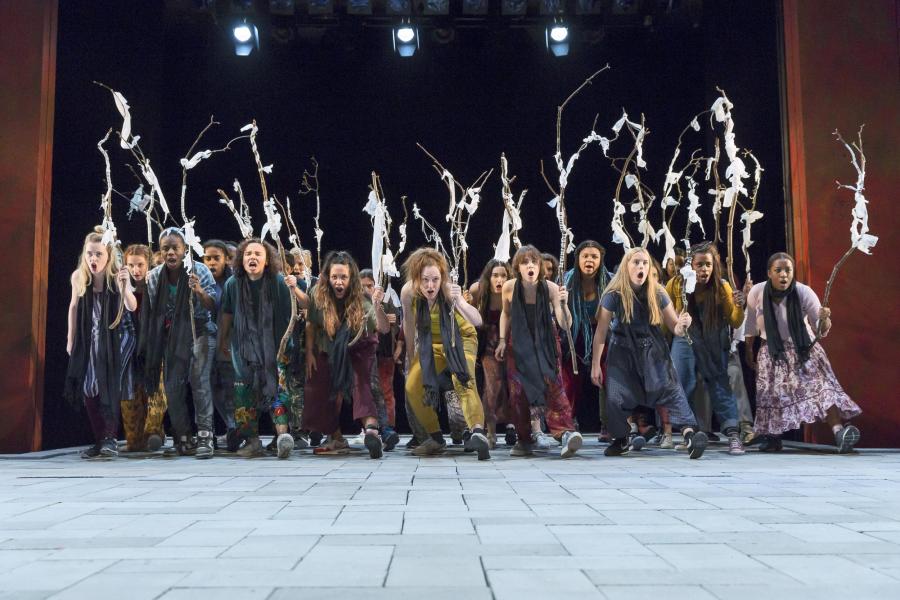
It is all in there. David Greig, as in all modern adaptions, has to take a direct line translation, here by Ian Ruffell, and make it clear to today’s audience. The wonder is that it apparently remains pretty true to the original. I got the text. It is a beautiful read. The rhythms jump off the page. The chorus here is, unusually for a Greek play, the protagonist and has a lot to say, literally and metaphorically. Director Ramin Gray, together with composer John Browne and choreographer Sasha Milavic Davies, takes this structure and conjure up an astonishing feat, and feast, of movement and verse. Percussionist Ben Burton and Callum Armstrong, who has conjured up a real, live double Aulos (the contemporary Greek pipe), are outstanding.

Really. If you want to see the best “musical” in London then come here. Except that it is now over (oops sorry) and it isn’t the best musical in London, not whilst Follies is still on. Oh and I haven’t seen any other current musicals which I guess makes me a somewhat unreliable witness. BTW I note that if you are a) available and b) a party of one, or two at most, and c) enterprising there are normally returns on most days if you still haven’t seen Follies

The whole spectacle of this Supplicant Women is made even more remarkable by the fierce performances of the non-professional chorus of young women playing the supplicants drawn from the boroughs of Southwark and Lambeth. It is not just their verse, their singing and their dance and movement which impresses, but their complete commitment to the story which impresses. All after just a couple of months of rehearsal. Staggering. At the end you could see the pride in the performance of these women felt by the local lads ,who had a smaller involvement as the chorus of Egyptians come back to claim their would be brides, and the more mature amateurs who made up the Athenian citizens who tentatively welcome the supplicants.

Oscar Batterham as King Pelasgos, who agonises before persuading his people to accept the Women and Omar Ebrahim, who switches from Danaos, the “father” of the Women to the brutal Egyptian Herald, in the blink of an eye, as well as acting as our MC, are both excellent. However Gemma May, as the Chorus leader, stood out for me, not just for the clarity with which she delivered the lines specifically carved out for her, but the way she, well er, led the Chorus.

Fidelity to the Greek original includes a libation from an academic, whose name to my shame I have forgotten, which explained, as was the custom, who funded the performances, and a dedication to Bacchus, which involved a mediocre (I hope) bottle of red being poured on to the suitably practical breeze block flooring of Lizzie’s Clachan’s elegant set.

We have Aeschylus to thank for the concept of tragedy, and for the introduction of more than one character alongside the chorus. Only seven of his plays remain including the three that make up the extraordinary Oresteia, which should be seen by everyone at least once. The other two plays which make up the Danaids trilogy alongside The Suppliants are lost. In the Persians he actually had the temerity to warn his fellow citizens about gloating too much over their victories. In fact he fought against the Persians and his military exploits brought him more fame than his playwriting, despite the fact he ruled supreme in the Dionysia through the 470s and 460s BCE. One final lesson we can learn from Aeschylus: don’t stand directly under an eagle in case it drops a tortoise on your head. Unlikely I grant you but this apparently is how he met his end.

So there you have it. All the big questions, one way and another, were covered off by Aeschylus and his mates, Sophocles and Euripides, whilst the best we Brits could manage at the time were a lot of beakers, pointlessly shifting huge lumps of stone to catch the sun one day a year and pining for a decent hairdresser. To be fair, in all these Greek dramas, you do have to get your head around the intervention of the gods. Specifically in the Suppliant Women the somewhat erratic Zeus. For he it was who caused the women to end up being born in Egypt after he got the hots for a cow lady, Io, from whom the Suppliants were descended. And it is to Zeus they turn to help them when they cross the Med. If it was me I might be a little wary of appealing to the very bloke who indirectly got me into this predicament. Mind you that’s the problem with these top gods, especially the monotheistic ones. Simultaneously good cop, bad cop, vengeful then loving, all to keep us on our toes.

I am guessing that this version of the Suppliant Women will engage further communities after having visited Bern in Switzerland. Edinburgh, Dublin, Belfast, Newcastle, Manchester< Hong Kong, as well as London.  If so please seek it out. It is about as perfect a testament to the power of theatre, then (Ancient Greece) as now., and a paean to the collective power of women. It is also the first time the word “democracy” ever appeared in writing, albeit in the form of an arch pun from the Chorus. Precious stuff.