
Rachel Podger and Brecon Baroque: Vivaldi at the Wigmore Hall review *****

Rachel Podger (violin), Brecon Baroque, Marcin Świątkiewicz (harpsichord), Daniele Caminiti (lute)

Wigmore Hall, 1st July 2019

Antonio Vivaldi

  • Sonata a4 al Santo Sepolcro RV130
  • Concerto in G minor for strings RV157
  • Sinfonia al Santo Sepolcro RV169
  • Concerto in D for lute and strings RV93
  • Concerto in D Op 3, No 9 RV230 (arr. for harpsichord after JS Bach’s solo transcription BWV972)
  • The Four Seasons Op 8, Nos 1 to 4

The Tourist adores the sound that Rachel Podger makes in the Baroque violin repertoire and especially in Bach, Vivaldi and Biber. Moreover, and feel free to snigger at the back, but he still gets a thrill when a specialist like RP, or one of the Italian maestros like Giuliano Carmignola or Fabio Bondi, lets rip on the Four Seasons. You can stick all that turgid Romantic nonsense where the sun don’t shine. This is real music. And if you are too snooty in your choice of classical repertoire to agree then more fool you. The Tourist yields to no man when it comes to the outer reaches of early 80’s post punk funk (and, as we speak, has a bit of Stockhausen ringing in his ears), but that doesn’t stop him from wigging out to the perfect pop of Benny and Bjorn’s SOS come party time.

Ms P has a rich, dark tone which gets you right in the gut. Her interpretation with her regular chums Brecon Baroque is a little less Flash Harry than the Italian peers, (though they certainly don’t hold back in the fast movements in Summer and Winter), which pays huge dividends in the super slow Largos in Spring and Winter. This was still exhilarating when it needed to be though. As confirmed by the Tourist’s regular Baroque crony MSBD. Big grins all round. For if there is one thing that singles RP and this ensemble out, apart from their sparkling musicianship, then it is that they look like they are having a ball on the stage. Which infects the audience. Even at the somewhat staid Wigmore.

Before the Four Seasons we were treated to the Easter religious piece, the Sonata and Sinfonia “al Santo Sepolcro” which may have been written in Venice or Vienna when AV visited in the late 1720s to drum up business. The Sonata has a slow movement introduction which builds from a bass line through too an exchange between the solo violin line and full ensemble. The subsequent Allegro alternates between two complementary themes in classic AV fashion. The Sinfonia is similarly just two movements but here the home key is B minor and AV explores a couple of chromatic twists in the contrapuntal Adagio and then in the Allegro which zeroes in on one, sinuous theme. The two pieces were separated by RV157, one of the Concertos written of strings and continuo without soloist. There are 60 or so of these (RV109 to 169), some of which are named as Sinfonia, which seem to have straddled performance in both saved and secular spaces. This one has repetition, imitation, dazzling figuration and syncopation, the full monty of AV’s virtuosity. The step-wise slow movement is captivating and the finale, made up of repeated semiquaver rushes in the bass line and upper lines is terrific.

Sicilian, (so its in the blood), Daniele Caminiti stepped up from theorbo continuo to lute soloist for the RV93 concerto which was probably written by AV for one Count Wrtby during a sojourn in Vienna and for the smaller soprano lute rather that the standard Baroque instrument. It was conceived as a chamber piece, with accompaniment from two violins and continuo, with each of the three movements divided into two repeated halves. It has a more stately feel against which the treble lines of the lute are set, largely down to the exquisite central Largo. This was also part of the programme from funky mandolinist Avi Avital concept with the Venice Baroque Orchestra at the back end of last yea in this very Hall.

Op 3 no 9 is one of seven AV concertos that JS Bach transcribed for harpsichord in 1713/14 when he worked in the Weimar Court. He made small changes to the right hand part and more generous detailing in the left hand part to thicken up AV’s loose textures. From this and the original BB, and especially the Polish harpsichordist Marcin Swiatkiewicz, (who plays on RP’s sublime Rosary Sonatas recording), have devised a harpsichord concerto, a form that AV himself eschewed. Like everything else on this lovely evening this was a perfectly balanced ensemble performance, the soloist a lucid, but never shouty, voice alongside the rest of BB.

RP’s next outing in her residency at the Wigmore are a bunch of Bach concertos which I will miss followed by a Sunday morning slot of the Bach Sonata and Partita No 1 which I most assuredly won’t.
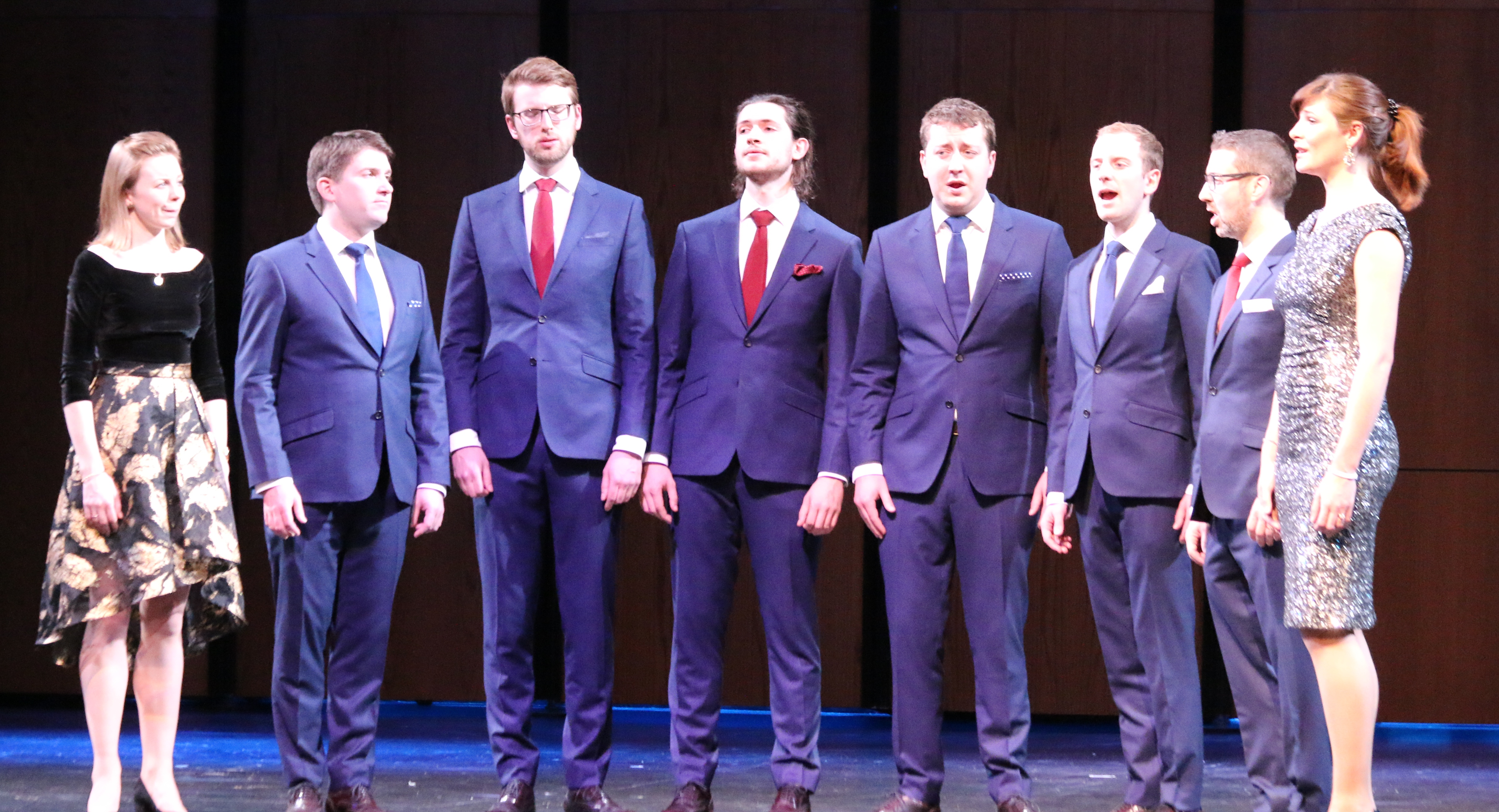
Rachel Podger and VOCES8 at Kings Place review ****

voces8_17feb2017

Rachel Podger, VOCES8 – A Guardian Angel

Kings Place, 28th March 2018

  • Orlando Gibbons – Drop, drop slow tears
  • Plainchant – Pater Noster
  • Heinrich Ignaz Franz Biber – Rosary Sonata No 16 Passacaglia “A Guardian Angel”
  • Jonathan Dove – into thy hands
  • Nicola Matteis – Passaggio rotto, Fantasia, Movimento incognito (from Other Ayrs, Preludes, Allemandes, Sarabandes
  • Mendelssohn – Denn er hat seinen engeln befohlen uber dir
  • Rachmaninov – Bogoroditse Dyevo
  • Tallis – O nata lux
  • James Macmillan – Domine non secundum peccata nostra
  • Thomas Tomkins – When David heard
  • Bach – Partita for flute in A minor BWV 1013
  • Monteverdi – Adoramus te. Christe
  • Orlando Gibbons – Hosanna to the Son of David
  • Giovanni Gabrielli – Angelus Domini descendit
  • Owain Park – Antiphon for the Angels

Blimey. It took almost as long to write out the programme as to listen to some of these pieces.

What do we have here then? Well the undisputed queen of the Baroque violin, (OK maybe not given Isabelle Faust, Monica Huggett, Elizabeth Wallfisch and no doubt a few more I don’t know), has teamed up with the English vocal group VOCES8 to create a programme of violin and vocal works from across the ages all themed around “A Guardian Angel”. Some of these pieces appear on Ms Podger’s 2013 CD of the same name. Rachel Podger creates a big, clear sound with vigorous rhythm which makes it a joy to follow the line of the music. Yet when virtuosity is required, (not so much on this evening), she doesn’t hold back.

Angels being angels in Christian religion they turn up a fair bit in music notably Renaissance, Baroque and the modern composers who seek inspiration from their forbears. Here we have pieces for solo violin, (or flute transposed for violin in the case of the Bach sonata which formed the backbone to the second half), for choir alone and for a combination of the two. Angels watching over you is obviously anathema to my carefully constructed rationalist self-image though maybe all this music and my penchant for early Renaissance art and architecture might cumulatively start to rub off. I was reminded of the world (other-world?) that Annie Baker explored in her latest play John (John at the National Theatre review *****).

The plainchant with the choir perched in the balcony was as meditative as you like and was followed by the Baroque violinists party piece de jour from Biber which seems to be following me around everywhere. It’s title provided the stepping off point for Ms Podger. If you don’t know it, and the genuinely ground-breaking Sonatas that precede it you should. It still sounds cutting edge today. It doesn’t skimp on the bass notes which is probably when it floats my boat. Ms Podger’s recording is the best place to start.

I can take or leave the Mendelssohn, Rachmaninov and Dove pieces though VOCES8 were more convincing than I expected, the Matteis violin extracts were immediately invigorating in that typical Italian baroque way and the MacMillan piece was as spare (echoes of Part) as you might expect from this committed composer. The Tallis was my favourite with Ms Podger’s violin taking the highest line as the Jesus to the choir’s Elijah and Moses and alongside Andrea Halsey’s spellbinding soprano. Her voice is about as good as you will ever hear (says some-one who knows absolutely nothing about singing!!).

The biggest surprise of all was the Thomas Tomkins. New to me, I will need to seek this out. The Bach was obviously wonderful, Ms Podger has made this her own and proved that it could as easily been scored for violin as flute. The Monteverdi, Gibbons and Gabrielli pieces were relatively short but very welcome. Owain Park’s new work was commissioned especially for this collaboration and amalgamates texts by St Ambrose and Hildegard von Bingen sticking to the angel theme. Like so many commissions for choirs it is immediately attractive, it is a real thrill hearing accessible music for the fisr time.

Throughout the concert we had well constructed antiphonal exchanges between violinist and pure toned choir which brought out the best of the exceptional acoustic at Hall One of Kings Place. No clapping between the pieces, a rapt audience, (no phone glows as far as I could see), and discreet but appropriate lighting all combined to maintain the magic.

I can’t pretend I understand the music that was put in front of me. I can’t read music and I am steadfastly failing to learn its language. If you are like me, and I reckon there are a lot of you who are, (obviously I say this in full knowledge of the fact that no-one reads this), then I cannot recommend the combination of Early and/or Baroque music and voices highly enough. Food for brain, heart and soul (not that there is one, but like I say earlier, faith may yet surprise me).