Los Angeles Master Chorale at the Barbican review *****

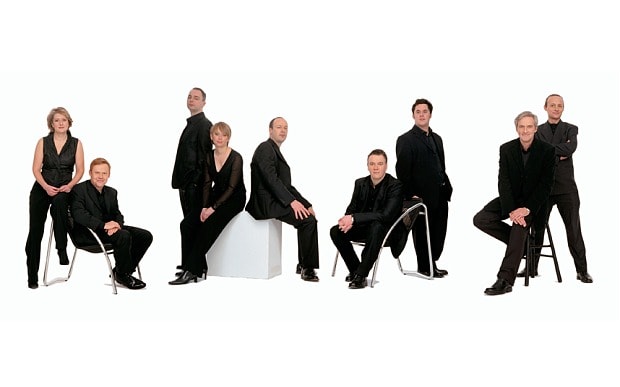
Los Angeles Master Chorale, Grant Gershon (conductor), Peter Sellars (director) 

Barbican Hall, 23rd May 2019

Much taken with our last exposure to Peter Sellars distinctive way with dramatising the choral after the OAE St John Passion at the Festival Hall last month, BUD and I set off, fuelled as usual by an excellent carb repast from Bad Egg, to hear and see this version of Lasso’s masterpiece on the Barbican stage.

Now this was an altogether different experience from the Bach. (unfortunately I missed Mr Sellars take on Stravinsky with the Philharmonia and Salonen). Orlande de Lassus (or Roland de Lassus, Orlando di Lasso, Orlandus Lassus, Orlande de Lattre or Roland de Lattre, take your pick), was a big noise in late Renaissance polyphony, alongside Palestrina and Victoria, who left his native Flanders at the tender age of twelve to ply his singing and composition trade in Mantua, Sicily, Milan, Naples, Rome, then to France and England, back to Antwerp, on to Munich and the Bavarian Court, where he remained until his death in 1594, albeit with plenty more business trips to Italy. Freedom of movement see, at a time when one bit of Europe was economically and culturally much like another. It works to everyone’s advantage despite what the swivel-eyed Brexit nutters tell you.

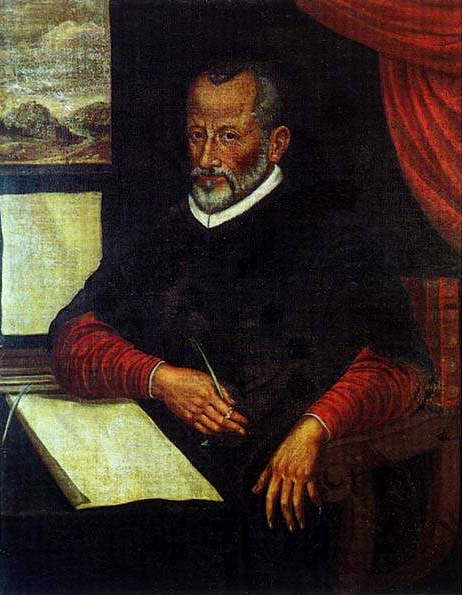
In total Lasso wrote over 2,000 vocal works including 60 (mostly parody) masses, passions, psalm settings, 530 motets, 175 Italian madrigals, 150 French chansons and 90 German lieder. No instrumental music remains; though it seems unlikely that a composer this busy and this much in demand would not have turned his hand to non-vocal works. He was just as much at home in bawdy, secular comedy as he was in strictly orthodox liturgy and certainly pushed the limits of polyphony with exotic chromaticism and highly wrought word painting. There he is above. Makes me wonder if it is time for a revival of the gentleman’s ruff to better show off our beards.

His most famous work is this, the work on show at this performance, a penitential cycle of 20 “spiritual madrigals” and a concluding Latin motet, the Lagrime di San Pietro, (The Tears of St Peter), his final work before he died in 1594. It is scored for 7 voices and is divided equally into three sections, (reflecting St Peter’s claim to fame, the thrice-fold denial of Christ, the holy trinity, the seven sorrows of the Virgin Mary, and no doubt much other Christian numerological hokum). In this performance the LA Master Chorale was comprised of 21 voices, 6 “canto” for which read soprano, 6 alto, 6 tenor and 3 bass. The settings use 7 of the 8 “church modes”, the system of pitch organisation on which chant was built, as well as for the final motet the tonus perigrinus, outside of the system to symbolise imperfection, and come from the poems of Luigi Tansillo (1510-1568). It is through composed with no repetition and Lasso uses all of the skills he had developed in his previous works to create the maximum of emotional, (as well as all this symbolic), impact.

You don’t need to know anything about the arcane history of the secular madrigal, nor Renaissance polyphony more generally, nor all this structural mumbo-jumbo, to be moved by the piece. And it is pretty easy to see why Lasso alighted on these texts. And why the LA Master Chorale, (widely recognised, not least in their own blurb, though I have no reason to doubt it after this performance, as the US’s premier vocal ensemble), under conductor Grant Gershon, should have worked so hard to perfect the performance. Nor why Peter Sellars should have alighted on this for his first stage at directing a non-instrumental piece.

It is, thanks to Tansillo’s faintly (actually not so faintly) melodramatic Italian poetry and Lasso’s extraordinary invention, an inherently dramatic piece, even if it isn’t strictly chronological. Bows, arrows, swords, spears, stabs, wounds, tears, pain, sorrow, shame. You get the picture and that’s just the first couple of madrigals. There’s a couple of lighter moments but it’s mostly the usual Christian S&M guilt trip. So much suffering. Mind you I suppose Lasso was staring death in the face so I can see why he didn’t go with “The Sun Has Got His Hat On”.

Mr Sellars wheels out his usual ritual tropes, arm waving and hand gestures which tend towards the literal, lying on the floor, the whole ensemble assembling tableau style into an alarmed or alarming crowd, various combinations of writhing twos and threes. Remove the music and you could be watching a physical theatre acting class or maybe attending an anger management retreat. Costumes from Daniella Domingue Sumi are gym casual monochrome. The lighting design of Jim F Ingalls is similarly unsubtle. There is a faint whiff of 1970s California.

But you know what, it all works. I can see why some of the pukka reviewers were a bit sniffy about the whole affair but for BUD and I, who like a bit of visual stimulus, it hit the spot. Maybe not “visualising the polyphony” as Mr Sellars claims, but certainly telling a non-linear story. What was most extraordinary however was the sound of the LA Master Chorale. Remember they had to commit both score and choreography to memory. Despite all the on stage shuffling their tone throughout was so precise and so smooth, even in the most complex counterpoint, the shifting dissonances and the meanders through to resolutions. Far less austere than when performed by a European ensemble in penguin suits and evening dresses that’s for sure and better for it.

I was idly through some lists of the greatest choral works ever written which, variously, cover the whole gamut from the very earliest organum from Notre Dame to bang up to date contemporary. But surprisingly few of these lists mention this, Lasso’s finest hour, (well 80 minutes ). Which can’t be right.

Here’s my tuppence worth. Usual rules. No particular order. Well sort of chronological. Only one work per composer. Which is tough on old Bach in particular. All blokes. Sorry.

  • Perotin – Viderunt omnes 
  • Josquin des Prez – Missa Pange Lingua
  • John Taverner – Mass “The Western Wynde”
  • Giovanni Pierluigi de Palestrina – Missa Papae Marcelli
  • Thomas Tallis – Lamentations of Jeremiah
  • Tomas de Luis Victoria – O magnum mysterium
  • Orland de Lassus – Lagrime di San Pietro
  • William Byrd – Mass for 5 Voices
  • Claudio Monteverdi – Vespers of 1610
  • Carlo Gesualdo – Tenebrae Responsories
  • Giacomo Carissimi – Jepthe
  • Antonio Vivaldi – Gloria
  • Giovanni Battista Pergolesi – Stabat Mater
  • JS Bach – Mass in B minor
  • Joseph Haydn – The Creation
  • Igor Stravinsky – Symphony of Psalms
  • Benjamin Britten – War Requiem
  • Krzysztof Penderecki – St. Luke Passion
  • Gyorgy Ligeti – Requiem
  • Luciano Berio – Sinfonia
  • Karlheinz Stockhausen – Stimmung
  • Steve Reich – The Desert Music
  • Iannis Xenakis – Nekuia
  • Arvo Part – Passio

The Cardinal’s Musick at Wigmore Hall review ****

giovanni_pierluigi_da_palestrina

The Cardinal’s Musick, Andrew Carwood (director)

Wigmore Hall, 27th September 2018

  • Giovanni Pierluigi da Palestrina – Motet Tu es Petrus, Missa Tu es Petrus, Gregorian Chant, Magnus Sanctus Paulus a 8
  • Giovanni Bassano – O Rex gloriae
  • Jacob Handl – Sanctus Bartholomeus
  • Thomas Crecquillon – Andreas Christi famulus
  • Tomás Luis De Victoria – Vidi speciosam
  • Francisco Guerrero – Virgo prudentissima
  • Sebastián de Vivanco – Magnificat octavi toni

More people should hand themselves over to the musicianship and scholarship of the best of British Renaissance vocal ensembles such as The Cardinal’s Musick or The Tallis Scholars or The Sixteen. Or, on those rarer occasions, when the best of their European cousins pop over. (Let us hope that isn’t made prohibitively difficult by the clusterf*ck that is Brexit though I suspect nothing would give greater pleasure to the never-happy social conservatives than watching us metropolitan liberals lose the opportunity to listen to such poncey, suspect singing).

Surely, it is impossible not to like complex polyphony sung by experts. Of course you could invest some time into learning about the composers of this ravishing music and the context in which it was created. As the canon of Renaissance music has expanded so too has our knowledge about those who created it, though biographical details are normally scant. Some vague-ish birth and death dates, a list of where they trained and what positions they held and what patrons they, (and by implication we), need to be grateful to. More often than not there is some detail in the careers of the most renowned of these men, (women got more of a look in in Medieval music and in the early Baroque, as we are now, thankfully, discovering), which marks them out as tricky in some way. Often over what they got paid. You would think the aristos and the Church would have been happy to pay up for art of this quality. Clearly not.

There are now a wealth of recordings of the (largely) French, Flemish, English, Italian and Spanish masters and the repertoire is still expanding. However, given the relatively limited number of performances and performers it is still likely that the casual listener/attendee, like yours truly, will encounter something new at every concert. The scholars and musicologists that lead the way still have plenty to play with I gather, so the sense of exploration and novelty that pervades Renaissance music performance, even though we are now well into the sixth decade of “rediscovery” since the first ensembles set out, isn’t about to end. I assume devoting your life to this sort of caper isn’t a way to make a lot of money but I hope that the economic ecosystem is robust enough to underpin such vocation.

You could also seek to understand when, why and how these pieces were performed. I guess having some sort of faith would be a good starting point for grasping the meaning of the religious works, but I also think it is perfectly possible for the irreligious to take something from the words and purposes of the texts. Even if all the rules of Christian liturgy and its founding myths remain a bit fuzzy you will certainly learn a lot about the political, religious and social contexts in which this works were created.

You might arm yourself too with as much knowledge as you can about the musical forms and structures which define this music. Sacred and secular, masses and motets, madrigals, modal and tonal, the way in which the vocal parts are put together, parody, imitation, suspensions, homophony, antiphony, plainsong, cantus firmus, dissonance, dyadic counterpoint. I can’t say I am there yet but some of the terminology is staring to fall into place. And remember folks the Tourist is, by virtue of a grotesquely painful singing voice, unable to perform, a source of eternal shame, and, by dint of what his music teacher at school was wont to call “tone deafness”, in a time before such educational derogation was outlawed, an utter inability to “read” notes on a page, only a consumer, and not a producer, of music. At the time I gloried in Mr Vaughan-Williams’, (I kid you not, but I am pretty sure he was no relation), disapproval. Now I really wish I had listened to him. Mind you I still take pride in being booted out of RE on a couple of occasions, for, and I swear this is no malleably manufactured memory, arguing with the teacher whose name I forget about the existence of God. Calling me a “long-haired jessy”, however apt, only served to fuel my nascent atheism I am afraid.

Anyway, you could learn all you can about this glorious music. Or you could, as frankly I normally do, let it wash over, and through, you. You know the thing where you forget about everything but the now, mind empties, body relaxes, free of the grinding anxiety of what has happened or what might be about to happen? To get it you can, I suppose, teach yourself, or get some-one to teach you, some sort of mindfulness mumbo-jumbo. Or you could just listen to Palestrina or Victoria. I promise it will work. After all it was written for exactly that purpose. To lose yourself in devotion. So piggy-back off that and get yourself along to one of these concerts. Close your eyes and let the voices take over.

Here endeth the lesson.


The Cardinal’s Musick at Wigmore Hall review ****

cardinalls_3132548b

The Cardinal’s Musick, Andrew Carwood (director)

Wigmore Hall, 4th December 2017

  • Giovanni Pierluigi da Palestrina (c.1525-1594) – Missa Hodie Christus natus est
  • Anon – Gaudete, Hail Mary full of grace, Quem Pastores, Salutation Carol
  • Jacob Handl (1550-1591) – Mirabile mysterium
  • Richard Pygott (c.1485-1549) – Quid petis O fili
  • Tomás Luis De Victoria (1548-1611) – Ecce Dominus veniet
  • John Dunstable (c.1390-1453) – Speciosa facta est
  • William Byrd (c.1540-1623) – Lullaby, my sweet little baby
  • Hieronymus Praetorius (1560-1629) – Magnificat quinti toni

In the immortal words of the now septuagenarian, Noddy Holder, “It’s Christmassssssssssss”. And what better way to kick it all off than an evening in the company of Andrew Carwood and The Cardinal’s Musick. Here was a programme that spanned a couple of centuries, various important centres of Renaissance music, Spain, Germany and England, Latin and local, liturgical and secular, motet, mass, carol and lullaby. I confess that despite repeated exposure, reading and learning I am still a bit stumped on how all the religious stuff fits together, but, no matter, this was just a lovely evening of choral music.

Andrew Carwood is a terrific host. Pretty funny too. No suggestion that he should give up his day jobs as scholar, director here, chief music honcho at St Paul’s and general provider of music at all important State occasions, for a life on the comedy circuit, but his introductions to the pieces are droll as well as informative. The CM, as in their recent concert at St John’s Smith Square informed by Armistice Day (The Cardinall’s Musick at St John’s Square review ****), which I also attended, make a simply lovely sound.

There was literally nothing here I had heard before (actually not quite true, see below) but no matter, I enjoyed it all. However, I always expect to uncover something new and interesting, and here it was the Jacob Handl motet, with its extraordinary chromaticism, and the Advent motet of Victoria, tip top polyphony. The Palestrina mass and motet, with its mixed split choirs (SSAB and ATTB) is a jolly affair, made jollier by interspersing with the four carols, including Gaudete, which I own in a recording by, of all people, Steeleye Span. Yep, a musical eclectic, that’s me. You will know it. I was a bit less enamoured of the Pygott lullaby with its baby babbles (I kid you not) but the Byrd equivalent was typically dark and unlikely to send you to sleep pacified. The Dunstable, a piece of Virgin Mary fandom, was the earliest in the programme, very short but very, very sweet. The Magnificat from the extravagantly named German composer Hieronymous Praetorius, went on a little bit but was still full of gesture as it flipped from Latin to German.

Like Bouncing Back this was “lovely stuff”. Anyway the tree is up, shopping’s done, SO has kicked off with the cards so time to get wrapping.